

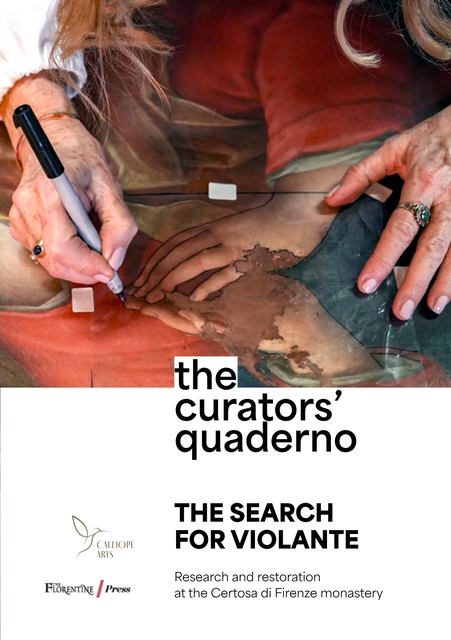
The Curators’ Quaderno - The Search for Violante
The Search for Violante in Florence. Issue 5 of The Curators’ Quaderno follows the restoration of three devotional paintings attributed to eighteenth-century painter Violante Siries, at Certosa di Firenze, a vast monastery in Tuscany. Violante’s Reading Madonna, a rare, highly damaged altarpiece is a mysterious commission for a Grand Tour female artist, even of her calibre. Conservators and scholars embark on a multi-faceted search for these paintings’ attributions. They scour the archives and safeguard the paintings’ future in a restoration laboratory in the Santa Croce district, to determine whether these attributions match the painter’s hand. The Curators’ Quaderno is a collection of notebook-style publications, conceived by Calliope Arts, in collaboration with The Florentine and Restoration Conversations, to raise awareness of women’s contributions to the fields of art, science and culture.
The Search for Violante in Florence. Issue 5 of The Curators’ Quaderno follows the restoration of three devotional paintings attributed to eighteenth-century painter Violante Siries, at Certosa di Firenze, a vast monastery in Tuscany. Violante’s Reading Madonna, a rare, highly damaged altarpiece is a mysterious commission for a Grand Tour female artist, even of her calibre. Conservators and scholars embark on a multi-faceted search for these paintings’ attributions. They scour the archives and safeguard the paintings’ future in a restoration laboratory in the Santa Croce district, to determine whether these attributions match the painter’s hand.
The Curators’ Quaderno is a collection of notebook-style publications, conceived by Calliope Arts, in collaboration with The Florentine and Restoration Conversations, to raise awareness of women’s contributions to the fields of art, science and culture.

Transform your PDFs into Flipbooks and boost your revenue!
Leverage SEO-optimized Flipbooks, powerful backlinks, and multimedia content to professionally showcase your products and significantly increase your reach.
the
curators’
quaderno
THE SEARCH
FOR VIOLANTE
Research and restoration
at the Certosa di Firenze monastery
the
curators’
quaderno
colophon
THE SEARCH FOR VIOLANTE
Research and restoration
at the Certosa di Firenze monastery
Publication sponsor AWA Legacy Fund and Calliope Arts Foundation
Publisher The Florentine Press
tcq series editor Linda Falcone
Book design Marco Badiani
Book layout Leo Cardini
Photographers Marco Badiani, Ottaviano Caruso, Olga Makarova
Printer Cartografica Toscana
ISBN 978-88-97696-38-4
2025 B’Gruppo Srl, Prato
First Edition: June 2025
Series: The Curators’ Quaderno
© Calliope Arts Foundation
All rights reserved
2
Printed in Florence, Italy
4
“Undisturbed silence has characterised the vast Certosa
di Firenze charterhouse, since its construction in 1341, as
home of the Carthusian monks. The artwork displayed in
this fortress-like structure, made strong by contemplation
not weaponry, could represent lifetimes of labour for a
team of endlessly patient restorers. As part of the project
‘Accademia Women: Violante’, conservators Marina Vincenti
and Elizabeth Wicks spent one year with the only woman
in the place – eighteenth-century painter Violante Siriès
– whose Reading Madonna is displayed above the altar,
in what may well be the smallest chapel off the cloister,
adjacent to the prior’s tiny bedroom. Despite its dire need
for restoration, the Cappella del priore is a pastel-hued
Rococo gem and the Siriès altar piece is an ode to daily
work and devotion, but as modern women, we cannot help
but revel in the message between the lines: its protagonist
is a literate woman seeking knowledge, independently.”
Linda Falcone
‘Accademia Women’ coordinator
“Inspired by the leadership of AWA founder Jane Fortune,
Advancing Women Artists foregrounded and restored 70
artworks by women artists in Florence’s museums, in its
13 years of existence. These women’s art spanned four
centuries. Their salvaged paintings or sculptures and
the original research that emerged with each project’s
completion continues to be an important legacy for art
lovers and scholars alike. The AWA Legacy Fund was
created upon the organisation’s closure in 2020, thanks to
support from its Board of Directors. Our partnership with
Syracuse University in Florence and the Accademia delle
Arti del Disegno has focused on three paintings attributed
to Violante Siriès (1709–1783). For all those involved, these
small paintings are like standards of an enduring dream: to
safeguard art by women for posterity.”
Nancy Galliher
Advancing Women Artists
Former president
the
curators’
quaderno
“In the magnificent setting of Florence’s
Carthusian Monastery, heartfelt and
due recognition is being given to
painter Violante Siriès, thanks to an
initiative coordinated by Linda Falcone,
and supported by an extraordinary,
predominantly female team. On behalf of
the Accademia delle Arti del Disegno, a
partner in the project, I’d like to express
my gratitude towards its donors, who
support research and restoration aimed
at deepening the knowledge of artworks
authored by women and ensuring their
preservation, since, all too often, female
artists are misunderstood by official
historiography governed by men.
Like many women artists in past centuries,
Violante was figlia d’arte – art ran in her
family, as her father headed the prestigious
semi-precious stones’ workshop started
by the Medici in 1588, and continued by
the Lorraine. Nonetheless, she was able to
forge her own artistic personality and gain
an autonomous professional status, which
earned her acceptance into the Accademia
delle Arti del Disegno.
A perceptive and graceful portraitist of
the noble class, she proves herself to be
a highly sensitive interpreter of sacred
art, bringing us refined and compact
depictions of women.”
6
Cristina Acidini
President of the Accademia delle Arti
del Disegno, Florence
Certosa di Firenze,
large cloister
Ph. Marco Badiani
8
“For these commissions, Violante Siriès gained access to
an extremely private all-male environment, a monastery,
and that feat should not be taken for granted. Violante
would have been no more than 30 years old when she
painted her Reading Madonna. She was a married woman
– with children – and a working professional. Let’s not take
that for granted either! The artist’s success is indicative
of the city’s dynamic social climate in a period usually
considered the twilight of Florentine culture (mid-1730s
to mid-1760s) with the death of Gian Gastone de’ Medici
and the advent of the Regency period, when Florence’s
new foreign ruler, Francis Stephen of Lorraine, opted to
stay in Vienna rather than establish a court in Florence.
Violante didn’t work under the auspices of a Grand
Duchess, like Giovanna Fratellini before her. Yet, the lower
echelons of Florentine nobility threw parties, hosted
salons, organised art exhibitions and held festivals – all
potential occasions in which to garner commissions.
This period also saw the burgeoning of the English
Community in Florence – comprised of English speakers
of all nationalities – and Violante achieved considerable
acclaim in the Grand Tour circuit. Her time is one of
the lesser-studied eras in Florentine history – yet her
contemporaries laid the foundations of the modern era,
and within that context, she played a significant role.”
Giulia Coco
Curator and art historian
Galleria dell’Accademia di Firenze
Violante Siriès’ Reading Madonna
pre-restoration in raking light
Right: The painting
post-restoration
Phs. Ottaviano Caruso
10
“At the start of our project, the paintings were covered
by a thick layer of dirt and candle-smoke deposits. The
wooden frames of all three paintings had been nailed
directly to the front of their canvases. The Reading
Madonna had over 30 nail holes of varying sizes in the
paint layer. The corners of the canvas were badly frayed
and the paint was actively flaking, and the same is true
in many other areas of the painting. We found four larger
tears in the canvas, three of which had been patched
from the reverse. The patches were made of fine pink
cloth formerly used in book repair, carefully applied
with vegetable glue. These may have been the work
of the monastery, which once specialised in book and
manuscript conservation. Paint losses were evident
around the tears, concealed from the front by fills and
clumsy repainting.
The most severe paint loss was the Madonna’s hands,
most likely damaged when a large bronze crucifix fell off
the chapel altar and into the painting. The damage and
the subsequent repaint – which was itself flaking away –
are visible in the only extant photo we found, which dates
before 1994.
After diagnostic photography and paint analysis of micro
samples, the cleaning of the thick layers of dirt and
smoke deposits was carried out using a mild anionic
surfactant. The layers of yellowed natural resin varnish
dating from the previous restoration were removed with
diluted solvent solutions, monitoring the process under
magnification and in UV light. The repaints and fills were
removed with solvent gels and the use of small scalpels.
During this process, we discovered original paint
underneath the repaints, which aided in reconstructing
the Madonna’s hands.”
12
Elizabeth Wicks
Conservator
During the cleaning process,
conservators removed the
overpaint from the damaged area
of the Madonna’s hands to reveal
the surviving original paint
Ph. Olga Makarova
the
curators’
quaderno
Next page:
Conservators’ tracing of paint
losses helped to reconstruct
the damaged area
“After filling the paint losses,
retouching was carried out using
gouache colours and pure pigments
ground in non-yellowing varnish. The
retouching on the Madonna’s hands
remains identifiable as restoration,
when viewed close-up. We used
relief mapping of the paint loss and
compared the figure’s hands with other
paintings by Siriès.”
Ph. Marco Badiani
14
Elizabeth Wicks
Conservator
“In the Hebrew tradition, the first
fundamental element of prayer is the
act of listening. Listening is prayer. The
Reading Madonna is engaged in prayer,
using Scripture. She ‘compares’ what
she is experiencing in her own life to
what she finds in Scripture, as if these
sacred texts were a mirror.”
Don Bernardo Artusi
San Leolino Community
Certosa di Firenze
“The Madonna’s pin cushion is more
readable post-restoration, and we
can clearly see her sewing needle,
which is symbolic, but not only.
Technically, it was proof of the artist’s
skills – because to paint a needle, you
have to have a deft hand. In the mind
of today’s viewers, this lovely detail
brings the Madonna into the realm of
the everyday, as a woman who has set
her sewing aside, although that was
certainly not Siriès’ intention, because
she was painting her commission for
the monastery. That needle, which
represents daily work, invites the
viewer to contemplate the Madonna
in all of her humanity, without
undermining her divine status.”
16
Graziella Cirri
Art historian and SABAP curator
The first lines of the
Madonna’s open prayer book
are in Hebrew lettering. These
letters are random and do not
refer to actual biblical verses
“The ‘Search for Violante’ has all the hallmarks of an AWA
project. It unites talented and dedicated women from
a range of fields who deploy their expertise to shine a
spotlight on the female side of Florence’s artistic history:
the artist who brought a uniquely female perspective
to her subject and whose mastery of painting earned
her a place in the world’s oldest drawing academy; the
restorers whose painstaking application of the myriad
techniques of conservation restored the luminosity of
centuries-old paintings; the scholars whose archival
research uncovered the details of the artist’s life and
the social and political context in which she worked; the
cultural administrators who appreciated the importance
of filling the lacunae left when women’s stories are
omitted from the official record; the photographers who
documented the process of restoration from the initial
examination of the canvas to the return of the work to the
monastery wall; the educators and interns who became
part of the cycle of passing on knowledge of onceforgotten
works; the patrons whose generosity made
it all possible; and, behind the scenes, a ‘conduttrice
d’orchestra’ who kept the players working in concert to
realise this beautiful project. Brava to one and all.”
Margie MacKinnon
Co-founder of Calliope Arts Foundation
18
20
The Saint Catherine
restoration during the
cleaning phase
Saint Catherine restored to
her original dignity
Ph. Ottaviano Caruso
“This small-scale depiction of Saint Catherine of Alexandria
is especially significant, considering the painstaking
attention given to the rendering of fabrics and jewellery, a
hallmark feature of Violante Siriès. The artist’s meticulous
attention is evident in Saint Catherine’s delicate veil,
whose border is embellished with gold embroidery. It
covers Catherine’s head, fastened in place by the weight of
her crown, encrusted with tiny pearls and precious stones.
The Virgin’s headdress is made of heavier fabric, which
becomes lighter and more transparent as it falls over her
shoulders. A skilled portraitist, especially for women of
noble and aristocratic extraction, Siriès is remembered
by her contemporaries as a ‘good imitator of the real’,
through her use of colour, her correct rendering of natural
expressions and different attitudes, and through the
ornamentation of rich robes, embroidery, fine lace, velvet,
brocade, cloth, and all manner of clothing (Moücke, 1762).”
Giulia Coco
Curator and art historian
Galleria dell’Accademia di Firenze
the
curators’
quaderno
“Without restoration, these three devotional works would never have
reached the public eye. If art is unseen and unknown, it does not
‘exist’ in the collective consciousness, which is true of all artwork not
universally recognised. This project creates a virtuous circle and its
purpose is twofold: to restore three works to their original dignity and
to spark public interest so that people will start asking themselves, ‘Are
there other works by Violante Siriès waiting to be found? How many
treasures are hiding at the Certosa di Firenze monastery?’ Questions
such as these are equally relevant in thousands of private and public
cultural venues throughout Italy. These restored paintings are the first
step in a long journey at the monastery, as the public sees artwork
attributed to Violante and gains greater knowledge of her life and
oeuvre. In this way, her contributions to the art world will enter our
hearts, as we explore the plethora of little-known devotional works that
form part of Tuscany’s artistic fabric and the cultural context in which
masterpieces of worldwide acclaim were created.”
22
Graziella Cirri
Art historian and curator
Superintendency for Archaeology, Fine Art and Landscape for the
Metropolitan City of Florence and the Provinces of Pistoia and Prato
(SABAP)
Saint Agnes
Smoothing down fillings
of paint loss
Ph. Olga Makarova
24
“Observation under magnification and diagnostic
photography of Reading Madonna confirm a painting
technique very similar to that of The Madonna
Presents the Christ Child to Santa Maria Maddalena
dei Pazzi, a large altarpiece painted by Siriès in 1767
and restored in 2015-16. During that AWA-sponsored
project, we examined numerous paintings by the
artist. The brushstrokes, use of colour, canvas
preparation and even the adhesion problems in the
paint layers of Reading Madonna are consistent with
her oeuvre and with the previous work restored.
The style and brushwork of Saint Catherine shows
many stylistic and technical similarities with Siriès’
other work. However, Saint Agnes appears to be by a
different artist altogether. Both the stretcher and the
canvas type are different in the two ovals, which is
unusual, if they were prepared or ordered by the same
artist. The brushwork is quick and loosely executed,
compared to the careful, meticulous rendering of
details in the other two paintings. The strokes that
create shadows and light on Agnes’ face are much
more defined than those used in modelling the faces
of Catherine and the Madonna. The extreme cracking
of the paint on Saint Agnes also points to probable
differences in the painting’s execution.
While not providing definitive answers to the
authorship of the ovals, our project has taken us
one step further in the exploration of Violante Siriès’
oeuvre. We’re happy to be able to add another piece
of the puzzle to our understanding of this intriguing
artist, and to preserve her paintings for generations
to come.”
Elizabeth Wicks
Conservator
“Saint Agnes was severely damaged by
the gradual but continuous movement
of the canvas support, which resulted in
the embrittlement of its glue and gesso
ground layers, causing conspicuous
craquelure on the painted surface.
Darkened by atmospheric deposits, these
cracks interfered with the painting’s visual
integrity and the viewer’s perception of
its colour scheme, preventing a precise
reading of the work’s technical and
stylistic features.”
Marina Vincenti
26Conservator
Saint Agnes,
before and after
Ph. Ottaviano Caruso
the
curators’
quaderno
Conservator Elizabeth Wicks
restores oval frames, which
were varnished silver leaf.
Gold leaf was used for The
Reading Madonna’s frame.
Next page: Funori gel
strengthens the canvases’
cellulose fibres, allowing
them to relax so that
paintings can be pulled into
greater tension, in order to
minimise distortions
28
Phs. Olga Makarova
“The canvas support of Saint Agnes was restored following removal
of the layers of atmospheric deposits, soot, and discoloured varnish
from the paint film. During this process, the original canvas fibres
were toned and relaxed by applying purified Funori algae gel – a
natural consolidant – to the work’s reverse. To fully achieve cohesion
between the layers, a synthetic consolidant was subsequently applied
and the painting was placed in a semi-rigid vacuum envelope using a
thermal mat to provide controlled heat and pressure. Only after filling
in the work’s small lacunae and completing varnishing and pictorial
reintegration, did the painting’s technical and stylistic characteristics
emerge and become clearly recognisable. Saint Agnes is a very
quickly executed painting that was crafted with confidence, using
liquid colour, applied in glazes. The artist’s style is very different from
the minute and highly refined works of Violante Siriès, who has the
controlled hand of a classic, largely academic painter.”
Marina Vincenti
Conservator
the
curators’
quaderno
30
The ‘Accademia Women’
team remounts the restored
artworks inside the Prior’s
Chapel at Certosa di Firenze
Phs. Marco Badiani
“Violante Siriès was trained by pastelist
Giovanna Fratellini and, in turn, she
taught other women like Violante Ferroni
and Maria Hadfield Cosway. Violante
would be pleased with the project’s
university-level internships, in which
today’s professionals passed their knowhow
on to a new generation of women,
continuing the artist’s efforts to convey
knowledge to her younger female peers.”
Sasha Perugini
Director of Syracuse University Florence
32
Photo credits
P. 2-3: Self-portrait, Violante Siriès, Uffizi Gallery,
Florence
Pp. 4-5: Certosa di Firenze monastery,
ph. Olga Makarova
Pp. 9-10: The Reading Madonna protected by facing
paper to secure raised and flaking paint,
ph. Olga Makarova
P. 14: Filling paint losses toned to the colour of the
preparation layer, ph. Olga Makarova
Pp. 16-17: Details of the Madonna’s book,
phs. Ottaviano Caruso, Marco Badiani
Pp. 18-19: Marina Vincenti applies re-touching
varnish, ph. Olga Makarova
P. 20: Cleaning Saint Catherine,
ph. Olga Makarova;
P. 22: Attaching synthetic canvas to the painting’s
edges prior to re-stretching, ph. Olga Makarova
P. 32: Elizabeth Wicks with intern Luna Gordon in
the Prior’s Chapel, ph. Marco Badiani
the
curators’
quaderno
The restoration and awareness-raising project
featured in this edition of tcq, known as ‘Accademia
Women: Violante’, was organised by the Accademia
delle Arti del Disegno (AADFI) and Syracuse
University in Florence, and sponsored by the
Advancing Women Artists Legacy Fund. The
project involved the restoration of three paintings
attributed to eighteenth-century artist Violante
Siriès Cerroti at the monastery of San Lorenzo al
Monte in Galluzzo (Certosa di Firenze) and included
a grant for research and video documentation.
This publication comprises reflections on project
goals and findings, presented at the seminar for
sector experts and the general public at the AADFI
on 3 June 2025.
34
The support of seven women made this legacy
project possible: Connie Clark, Pam Fortune,
Nancy Galliher, Nancy Hunt, Donna Malin, Margie
MacKinnon and Alice Vogler. With special thanks to
the Superintendency for Archaeology, Fine Art and
Landscape for the Metropolitan City of Florence
and the Provinces of Pistoia and Prato (SABAP),
the San Leolino Community at Certosa di Firenze
and media partners The Florentine, Calliope Arts
Foundation and Restoration Conversations.
What is tcq?
The Curators’ Quaderno
is a collection of
notebook-style
publications, conceived
by the Calliope
Arts Foundation, in
collaboration with The
Florentine Press, to
raise awareness of
women’s contributions
to the fields of art,
science and culture.
Special thanks to project ‘curators’,
including scholars, public officials,
conservators, consultants and art
administrators, many of whom are
featured herein: Cristina Acidini, Don
Bernardo Artusi, Graziella Cirri, Giulia
Coco, Nancy Galliher, Luna Gordon,
Sasha Perugini, Margie MacKinnon,
Wayne McArdle, Poiret Masse,
Enrico Sartoni, Laura Turchi, Marina
Vincenti and Elizabeth Wicks.
Heartfelt gratitude also goes to
those responsible for producing and
promoting this quaderno, including
Marco Badiani, Deborah Bettazzi,
Leo Cardini, Ottaviano Caruso,
Giacomo Badiani, Helen Farrell, Olga
Makarova and Giovanni Giusti.
euro 2.00

 Change language