

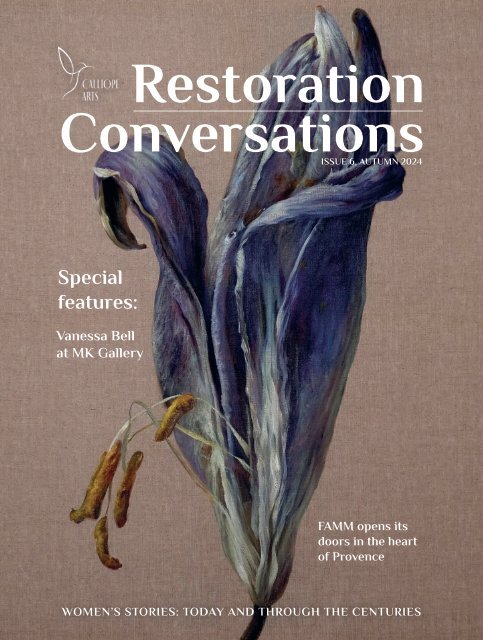
Restoration Conversations magazine - Autumn 2024
Restoration Conversations is a digital magazine, produced by Calliope Arts, spotlighting the achievements of women in history and today. It has two issues a year: Spring/Summer and Fall/Winter. This issue of Restoration Conversations brings a splash of garden colour, with stunning works by contemporary botanical painter Marieluise Bantel, in conversation with the British Museum’s impressive oeuvre of floral works by Mary Delaney, whose fascinating story flows from Molly Peacock’s pen in The Paper Garden. Federica Parretti’s recounting of twentieth-century painter Lola Costa and her garden estate, Il Palmerino, re-conjures a reality we’ve always known: women of all ages and eras find their power among flowers. The varied exhibitions featured in this issue, with their wealth of insights and impressions – from Christian Levett’s newly opened FAMM museum in Mougins, to the silent ‘Revelations’ of Sant’Orsola’s ‘unconstructed’ exhibition venue, also provide ‘fertile mind-space’ for growing. Louise Bourgeois’ late works at the Museo degli Innocenti and Museo Novecento or Vanessa Bell’s ‘A World of Form and Colour’ at MK Gallery – with her art chock-full of Charleston brightness – constitute another kind of garden, where paintings and gouaches grow as plentiful as plants. Our ‘Personal Reflections’ series continues with Glynis Owen’s heartfelt story of her tribute in bronze to cellist Jacqueline du Pré.
Restoration Conversations is a digital magazine, produced by Calliope Arts, spotlighting the achievements of women in history and today. It has two issues a year: Spring/Summer and Fall/Winter. This issue of Restoration Conversations brings a splash of garden colour, with stunning works by contemporary botanical painter Marieluise Bantel, in conversation with the British Museum’s impressive oeuvre of floral works by Mary Delaney, whose fascinating story flows from Molly Peacock’s pen in The Paper Garden. Federica Parretti’s recounting of twentieth-century painter Lola Costa and her garden estate, Il Palmerino, re-conjures a reality we’ve always known: women of all ages and eras find their power among flowers.
The varied exhibitions featured in this issue, with their wealth of insights and impressions – from Christian Levett’s newly opened FAMM museum in Mougins, to the silent ‘Revelations’ of Sant’Orsola’s ‘unconstructed’ exhibition venue, also provide ‘fertile mind-space’ for growing. Louise Bourgeois’ late works at the Museo degli Innocenti and Museo Novecento or Vanessa Bell’s ‘A World of Form and Colour’ at MK Gallery – with her art chock-full of Charleston brightness – constitute another kind of garden, where paintings and gouaches grow as plentiful as plants. Our ‘Personal Reflections’ series continues with Glynis Owen’s heartfelt story of her tribute in bronze to cellist Jacqueline du Pré.

Transform your PDFs into Flipbooks and boost your revenue!
Leverage SEO-optimized Flipbooks, powerful backlinks, and multimedia content to professionally showcase your products and significantly increase your reach.
<strong>Restoration</strong><br />
<strong>Conversations</strong><br />
ISSUE 6, AUTUMN <strong>2024</strong><br />
Special<br />
features:<br />
Vanessa Bell<br />
at MK Gallery<br />
FAMM opens its<br />
doors in the heart<br />
of Provence<br />
WOMEN’S STORIES: TODAY AND THROUGH THE CENTURIES
From the Editor<br />
As we move towards winter, this issue of <strong>Restoration</strong> <strong>Conversations</strong><br />
brings a splash of garden colour, with stunning works by contemporary<br />
botanical painter Marieluise Bantel, in conversation with the British<br />
Museum’s impressive oeuvre of floral works by Mary Delaney, whose<br />
fascinating story flows from Molly Peacock’s pen in The Paper Garden.<br />
Federica Parretti’s recounting of twentieth-century painter Lola Costa and<br />
her garden estate, Il Palmerino, re-conjures a reality we’ve always known:<br />
women of all ages and eras find their power among flowers.<br />
The varied exhibitions featured in this issue, with their wealth of insights<br />
and impressions – from Christian Levett’s newly opened FAMM museum<br />
in Mougins, to the silent ‘Revelations’ of Sant’Orsola’s ‘unconstructed’<br />
exhibition venue, also provide ‘fertile mind-space’ for growing. Louise<br />
Bourgeois’ late works at the Museo degli Innocenti and Museo Novecento<br />
or Vanessa Bell’s ‘A World of Form and Colour’ at MK Gallery – with her art<br />
chock-full of ‘Charleston brightness’ – constitute another kind of garden,<br />
where paintings and gouaches grow as plentiful as plants. Our ‘Personal<br />
Reflections’ series continues with Glynis Owen’s heartfelt story of her<br />
tribute in bronze to cellist Jacqueline du Pré. Enjoy the issue!<br />
Fondly,<br />
Linda Falcone<br />
Managing Editor, <strong>Restoration</strong> <strong>Conversations</strong><br />
Managing Editor<br />
Linda Falcone<br />
Contributing Editor<br />
Margie MacKinnon<br />
Design<br />
Fiona Richards<br />
FPE Media Ltd<br />
Publisher<br />
Calliope Arts Foundation, London<br />
Video maker for RC broadcasts<br />
Francesco Cacchiani, Bunker Film<br />
www.calliopearts.org<br />
Instagram: @calliopearts_restoration<br />
YouTube: Calliope Arts<br />
<strong>Autumn</strong> <strong>2024</strong> • <strong>Restoration</strong> <strong>Conversations</strong> 3
Charleston Festival <strong>2024</strong>, ph. Lee Robbins<br />
4 <strong>Restoration</strong> <strong>Conversations</strong> • <strong>Autumn</strong> <strong>2024</strong>
CONTENTS AUTUMN <strong>2024</strong><br />
MANY TALENTS, MULTIPLE VENUES<br />
6 Vive la Différence!<br />
12 New Babies at Ninety-Nine<br />
18 A Cage and a Choir<br />
24 Upcomiing Insights<br />
38 A Radical Female Perspective<br />
WHEN GARDENS GREW<br />
36 What Shall We Plant this Year, Signora?<br />
42 Flora Delicana<br />
48 Preserving a Paper Garden<br />
50 Late Bloomer<br />
56 Begin Again, with Blooms<br />
SAFEGUARDING LEGACIES<br />
62 Personal Reflections... Jacqueline du Pré<br />
68 Florence’s Daughters at the Innocenti<br />
74 Vasari... and Milestone Women<br />
80 Art Detectives for Violante<br />
86 With Every Clue You Pursue<br />
92 Revelations at Sant’Orsola<br />
<strong>Autumn</strong> <strong>2024</strong> • <strong>Restoration</strong> <strong>Conversations</strong> 5
FAMM in Mougins on the evening of the opening,<br />
ph. Jérôme Kelagopian<br />
6 <strong>Restoration</strong> <strong>Conversations</strong> • <strong>Autumn</strong> <strong>2024</strong>
Vive la différence!<br />
FAMM opens its doors in the<br />
artistic heart of Provence<br />
No one needs an excuse to attend a party in the south of France<br />
on a balmy night in June when the sun, just past the solstice,<br />
lingers in the sky ‘til late in the evening and the scent of lavender<br />
perfumes the air. But, if one were looking for an excuse, what<br />
could be better than the opening of a new museum in the<br />
beautifully preserved hilltop town of Mougins, once home to<br />
some of the most famous artists of the twentieth century? We<br />
will leave those artists unnamed, however, because the museum<br />
in question – FAMM – celebrates a different group of artists. As<br />
the phonetic pronunciation of its name cleverly suggests, FAMM<br />
(a homophone of the French ‘femme’) is a museum dedicated<br />
solely to the work of female artists – the first such private<br />
museum in Europe.<br />
Works by some 80 artists, created from the mid-1800s to the<br />
present, fill the four floors of the museum. Well-known names<br />
such as Mary Cassatt, Leonora Carrington, Frida Kahlo and<br />
Helen Frankenthaler share wall space with the less familiar<br />
Jane Graverol, Giosetta Fioroni and Sahara Longe. FAMM’s<br />
itinerary takes visitors through the history of modern art from<br />
Impressionism, Post-Impressionism and Surrealism to Abstract<br />
Expressionism and figurative and contemporary art.<br />
<strong>Autumn</strong> <strong>2024</strong> • <strong>Restoration</strong> <strong>Conversations</strong> 7
Above: Christian Levett (centre) with guests at FAMM’s inauguration, ph. Jérôme Kelagopia<br />
Our host for the VIP opening is Christian Levett,<br />
the museum’s owner, whose eponymous collection<br />
is the source of the artworks on display. In fact,<br />
the Christian Levett Collection contains over 500<br />
paintings, sculptures and photographs by women<br />
from which FAMM will choose a rotating selection<br />
of 100 works to exhibit. The museum is housed<br />
in a modest, stone building that in an earlier life,<br />
during the Middle Ages, was the village prison. In<br />
the ten years before its reincarnation as FAMM, it<br />
was the Mougins Museum of Classical Art where<br />
Levett showcased his collection of classical<br />
antiquities.<br />
In its most recent transformation, the relatively<br />
restricted dimensions of the building presented<br />
design challenges, which have been admirably<br />
met by Levett’s team. Bold colours on the walls<br />
open up the spaces, and well-placed lighting<br />
illuminates the works and creates the volume<br />
necessary for the larger pieces. Discrete ‘bumpers’<br />
along the floor prevent viewers from getting too<br />
close to the works without the need for more<br />
obtrusive barriers. Glass balustrades add to the<br />
openness and a lift, which transports visitors from<br />
the second floor to the basement level, helps<br />
traffic flow smoothly throughout. The small but<br />
welcoming entrance hall contains only a few<br />
artworks providing a capsule of what the museum<br />
is all about. On the left is Juana Romani’s Baroqueinspired<br />
Herodiade, from 1890, while straightahead<br />
is Tracey Emin’s Always More, a neon<br />
installation created in 2015. Turning to enter the<br />
8 <strong>Restoration</strong> <strong>Conversations</strong> • <strong>Autumn</strong> <strong>2024</strong>
gallery proper, the visitor comes face-to-face with<br />
a “wall of women”, photographic portraits of many<br />
of the artists whose works are exhibited within.<br />
These portraits neatly disguise the lockers behind<br />
them – one is tempted to see them as an allusion<br />
to the hidden depths of the lives of the artists.<br />
But, back to the party. The evening begins with<br />
a welcome glass of champagne, served up at<br />
the nearby ‘L’Amandier’, the restaurant formerly<br />
owned by renowned chef Roger Vergé and now<br />
by Levett himself. Guests mingle at the all-night<br />
cocktail party while groups take it in turns to tour<br />
the museum. Later, there will be live music with<br />
a swing band and a DJ set for those who want to<br />
dance as the stars come out. Stars of a different<br />
kind are also on hand. Among the guests are<br />
several of the contemporary artists whose works<br />
are displayed in the museum: sculptors Beth<br />
Carter and Nicole Farhi, painter Elizabeth Columba<br />
and photographer Delphine Diallo, among others.<br />
Their pride at being included in the collection and<br />
seeing their work exhibited in the company of<br />
some of their artistic heroines is palpable.<br />
A visitors’ booklet identifies the artworks and<br />
provides background information about each<br />
of them in the artists’ own words. Multi-lingual,<br />
well-versed guides are stationed on every floor to<br />
answer questions. They are both knowledgeable<br />
and eager to share what they have only recently<br />
learned about the artists and their works. (Shout<br />
out to the helpful young woman on the basement<br />
level who provided valuable insights into Stacey<br />
Gillian Abe’s ‘Whispers of Sorghum II’, pointing out<br />
the historical and cultural significance of Abe’s<br />
use of indigo in her striking portrait, as well as the<br />
subtle embroidered elements which add texture<br />
and a delicate contrast to the strong figures.)<br />
Above: FAMM, installation shot, with Lee Krasner’s Prophecy (centre), ph. Jérôme Kelagopia<br />
<strong>Autumn</strong> <strong>2024</strong> • <strong>Restoration</strong> <strong>Conversations</strong> 9
CaptionsFAMM installation shot, with Jenny Saville’s Generation (centre) and Cecily Brown’s Couple (left), ph. Jérôme Kelagopia<br />
10 <strong>Restoration</strong> <strong>Conversations</strong> • <strong>Autumn</strong> <strong>2024</strong>
Above: FAMM installation shot, with sculpture by Barbara Hepworth and paintings by Amaranth Ehrenhalt and Perle Fine, ph. Jérôme Kelagopia<br />
Moving from one room to the next, it is no surprise<br />
to bump into Christian Levett leading one of the<br />
tours. He has an encyclopaedic knowledge of the<br />
art and artists in his collection and a passion for<br />
sharing it with all those who show an interest. A<br />
champion of women artists and an astute collector<br />
of their works, he has supported exhibitions of art<br />
by women in London, Florence and elsewhere.<br />
“The most important thing [in creating a collection],”<br />
says Levett, “is that each piece is a great work of<br />
art. If that is the criterion, you end up with a rich<br />
and diverse collection.”<br />
Is it necessary or desirable to have a gallery<br />
solely devoted to women artists? The benefits<br />
of an all-woman exhibition were questioned as<br />
far back as 1976, with the ‘Women Artists, 1550-<br />
1950’ exhibition at the Los Angeles County<br />
Museum of Art, curated by Linda Nochlin and<br />
Ann Sutherland Harris. Harris herself expressed<br />
the view that this female-only exhibition should<br />
not be seen as a model to be repeated over<br />
and over, but rather hoped it would be a pivotal<br />
event which would make any future exhibitions<br />
with this theme unnecessary.<br />
Perhaps visitors to FAMM will be drawn to the<br />
museum in part by its women-only theme – and<br />
why not, when women’s art still makes up such a<br />
small percentage of the works exhibited elsewhere<br />
on gallery walls? But the art here speaks very<br />
loudly and clearly for itself. These are works that<br />
are worthy of any art institution. So, while visitors<br />
may come for the novelty of a ‘women’s museum’,<br />
they will stay – and return – simply to appreciate<br />
the beautiful, challenging, innovative, witty and<br />
thought-provoking artworks that make up this<br />
groundbreaking collection. And that is something<br />
to celebrate.<br />
MARGIE MACKINNON<br />
Femmes Artistes du Musée de Mougins (FAMM) is<br />
located in Mougins, France. Visit www.famm.com/<br />
en for information on tickets and opening hours.<br />
A FAMM guide is also available on the Bloomberg<br />
Connects App.<br />
<strong>Autumn</strong> <strong>2024</strong> • <strong>Restoration</strong> <strong>Conversations</strong> 11
New babies at<br />
ninety-nine<br />
Louise Bourgeois and ‘Do Not Abandon Me’<br />
Louise Bourgeois’ gouaches are wilfully intense but also<br />
imprecise – their colour left to spread or fade without apology.<br />
For those unfamiliar with the technique, gouache is opaque<br />
watercolour, and its end result is matte and highly pigmented.<br />
The artist, who is one of the twentieth century’s most famous<br />
sculptors, lacks control in these pieces – which appears to be<br />
very much the point.<br />
Her Florence show at the Museo Novecento is entitled ‘Do Not<br />
Abandon Me’, just like her ‘motherhood series’ on display. Its title<br />
reminds me of something a teacher once told me after serving<br />
several summers at a camp for foster children: “No matter the<br />
abuse, they always want their mother.” That statement had left<br />
me feeling unsettled, and for me, the show has a similar effect.<br />
Co-curator Stefania Rispoli put the art’s energy into words: “For<br />
Bourgeois, maternity was the fil rouge or common thread of her<br />
whole artistic practice, and its conception was not necessarily<br />
positive. She depicts a dramatic, often complex brand of<br />
maternity, which encompasses both mother and daughter.”<br />
12 <strong>Restoration</strong> <strong>Conversations</strong> • <strong>Autumn</strong> <strong>2024</strong>
The exhibition ‘Do Not Abandon Me’ was created in<br />
close dialogue with the history of the building that<br />
houses our museum, the Ex-Leopoldine Convent, a<br />
complex established in the 13th century and run for<br />
centuries by all-female communities.”<br />
Sergio Risaliti<br />
Exhibition co-curator and the<br />
Museo Novecento’s artistic director<br />
Above: Louise Bourgeois’ Spider Couple at the Museo Novecento for ‘Do Not Abandon Me’, ph. Federica Narducci<br />
<strong>Autumn</strong> <strong>2024</strong> • <strong>Restoration</strong> <strong>Conversations</strong> 13
Above: Louise<br />
Bourgeois, 2007,<br />
The Feeding.<br />
Collection: The<br />
Easton Foundation,<br />
New York,<br />
ph. Christopher<br />
Burke<br />
Right: Gouache on<br />
paper by Louise<br />
Bourgeois, on show<br />
at ‘Do Not Abandon<br />
Me’, ph. Federica<br />
Narducci<br />
Louise Bourgeois’<br />
art is © The Easton<br />
Foundation /<br />
Licensed by S.I.A.E.,<br />
Italy and VAGA<br />
at Artists Rights<br />
Society (ARS) NY<br />
14 <strong>Restoration</strong> <strong>Conversations</strong> • <strong>Autumn</strong> <strong>2024</strong>
Bourgeois’ mother – whom she called her best<br />
friend – died just after the artist turned 21, and her<br />
struggle with the trauma of that loss was life-long.<br />
In the Bourgeois show, we see multiple mothers,<br />
not their faces, usually their bodies. Whatever the<br />
sentiment they convey, they are all vessel-like and<br />
there is a rare form of beauty in their protruding<br />
bellies, from expectation or pain. There is a<br />
variety of mothers here. Some face the threat of<br />
miscarriage. Some seem more peaceable than the<br />
babies they’ll be bearing.<br />
The Bourgeois babies are as bright as blood lost<br />
during delivery, and even in the quiet of Museo<br />
Novecento – a monastery-made-museum – it is<br />
clear these beings are born into a world of struggle.<br />
That is what I get from a good number of the weton-wet<br />
gouaches, which form the backbone of this<br />
well-hung exhibition. The gouaches represent five<br />
years of art production, which the artist began at<br />
the age of 94. I am in awe of Bourgeois undaunted<br />
at 99, still searching her subconscious – still driven<br />
to bring brush to page.<br />
But I am not a mother, and I do not have a clue<br />
what to do with these babies. The artist’s late-inlife<br />
newborns are feverish in their hunger, despite<br />
the works’ ubiquitous breasts, and in picture after<br />
picture, their needs look unnourished. Obviously,<br />
these kids are going to require some sort of a<br />
game plan to survive the messy aftermath of birth,<br />
and I want to know what Bourgeois proposes to<br />
do about it.<br />
In a mostly red show, muted by the solid white<br />
of thirteenth-century walls originally built to<br />
enclose and educate all-female communities,<br />
Right: Louise Bourgeois, 2008, Pregnant<br />
Woman. Collection: The Easton Foundation,<br />
New York, ph. Christopher Burke<br />
<strong>Autumn</strong> <strong>2024</strong> • <strong>Restoration</strong> <strong>Conversations</strong> 15
You cannot arrest the present. You have to abandon,<br />
every day, your past. And accept it. And if you can’t<br />
accept it, then you have to do sculpture! You see,<br />
you have to do something about it. If your need<br />
is to refuse to abandon the past, then you have to<br />
recreate it. Which is what I have been doing<br />
Above: Installation view with visitor, at Louis Bourgeois’ exhibition ‘Do Not Abandon Me’, ph. Federica Narducci<br />
I seek out the show’s in-print bits, to search for<br />
my answer – or hers. On one panel, a quote by<br />
the artist stands out like a lamppost: “You cannot<br />
arrest the present. You have to abandon, every<br />
day, your past. And accept it. And if you can’t<br />
accept it, then you have to do sculpture! You see,<br />
you have to do something about it. If your need<br />
is to refuse to abandon the past, then you have<br />
to recreate it. Which is what I have been doing.”<br />
Yes. She’s got a point.<br />
As soon as I began ‘listening’ more closely to<br />
the show, another ‘answer’ seemed to surface,<br />
thanks to the artist’s several small-scale works<br />
in fabric. Bourgeois’ textile sculpture Umbilical<br />
Cord, from 2003, usually in a private collection<br />
in New York, is especially poignant. I had seen it<br />
often in photograph form, and imagined it to be<br />
a life-sized piece. Instead, it could fit in the arms<br />
of a child, and the tiny baby found in the figure’s<br />
gauze belly would fill a real baby with delight.<br />
“These textile works are linked to the artist’s<br />
biography, because her parents were famous<br />
tapestry restorers living in the South of France.<br />
So fabric is an element associated with her life<br />
as a daughter, which she takes up again, and<br />
rediscovers as a mother and a mature woman,”<br />
says Stefania, who co-curated the ‘Louise<br />
Bourgeois in Florence’ project, with the Museo<br />
Novecento’s artistic director Sergio Risaliti, Philip<br />
Larratt-Smith from New York’s Easton Foundation<br />
and Arabella Natalini at the Museo degli Innocenti<br />
(see pp. 12-18).<br />
It is heartening to imagine Bourgeois, needle<br />
and thread in hand, engrossed in the possibly<br />
therapeutic craft that engaged women for<br />
centuries: doll-making. To call her sculptures<br />
‘dolls’ will strike some readers as derogatory, but I<br />
believe it a reference to that inborn human need<br />
to cradle and be cradled, and frankly, a woman<br />
best known for monumental bronze spider<br />
sculptures with spindly legs and magnet-like<br />
strength has earned the right to make something<br />
soft, if she wants.<br />
16 <strong>Restoration</strong> <strong>Conversations</strong> • <strong>Autumn</strong> <strong>2024</strong>
But speaking of softness, my imaginary dialogue<br />
with Bourgeois actually reached its resolution in<br />
a story Margie MacKinnon told at a celebratory<br />
September event at the Museo Novecento. She<br />
and fellow-exhibition sponsors Wayne McArdle<br />
and Christian Levett had missed the June opening<br />
because it coincided with the inauguration of<br />
FAMM, Christian’s museum for art by women in<br />
Mougins, France (see p. 6).<br />
She described her and Wayne’s first walk<br />
through the exhibition a few days later, as follows:<br />
“We arrived early in the morning and had the<br />
place almost all to ourselves. There was one other<br />
visitor – a young woman, a tour guide as it turned<br />
out, who was quite visibly pregnant. She asked<br />
us if we would take her photograph in front of<br />
one of Bourgeois’ vibrant gouache paintings of a<br />
pregnant woman – two women with their bellies<br />
bulging with the life inside them. It was a touching<br />
moment. And I have thought since about how,<br />
one day, this mother will sit down with her child<br />
and show her (or him) the photograph, and it will<br />
be one of that child’s earliest interactions with art<br />
– a personal connection with Louise Bourgeois, an<br />
artist for whom the mother and child relationship<br />
was a recurring and powerful theme.”<br />
My take away is this: The Bourgeois conversation<br />
is going to continue with many a baby currently<br />
in their mother’s belly. Those who struggle the<br />
hardest will likely “do sculpture”. But some will<br />
sew, or make gouaches of their own. Yet one thing<br />
is certain: whatever they do, these babies – even<br />
if they grow to be a hundred – will never stop<br />
wanting their mothers.<br />
LINDA FALCONE<br />
Above: Louise Bourgeois, 2003 Umbilical Cord, Private Collection, New<br />
York, on show at ‘Do Not Abandon Me’, ph. Federica Narducci<br />
<strong>Autumn</strong> <strong>2024</strong> • <strong>Restoration</strong> <strong>Conversations</strong> 17
18 <strong>Restoration</strong> <strong>Conversations</strong> • <strong>Autumn</strong> <strong>2024</strong>
A cage and a choir<br />
Louise Bourgeois at the Innocenti Museum<br />
Not long before Filippo Brunelleschi began hoisting his peppery<br />
stew up to the top of Florence’s Cathedral to feed workers<br />
building his massive dome, he won another historic commission,<br />
at ground-level, from the then-powerful Art of Silk Guild, of<br />
which he was a member. Brunelleschi was a goldsmith, not<br />
formally an architect, so his commissions were regulated by<br />
the ‘silk people’. He was to build a foundling hospital in Piazza<br />
Santissima Annunziata (1421–1428), on merchant Francesco<br />
Datini’s dime, and the children it took in were to live in a lofty<br />
and graceful place that recalled protection, not abandonment.<br />
That was how Brunelleschi came to design the first-ever example<br />
of Renaissance architecture.<br />
Today, Brunelleschi’s hospital is home to the Innocenti Institute,<br />
Museum and Archive (see p. 68), which preserve its multi-century<br />
history, whilst expanding its social vocation in support of children<br />
in today’s world. Yet to fully understand the museum’s impressive<br />
collection and its recent one-work show featuring twentiethcentury<br />
French-American sculptor Louise Bourgeois, we’d best<br />
go back to 1419, when the Duomo ceiling stood gaping, just a<br />
few blocks away. The cathedral, whose building started in 1296,<br />
was partially open-air during the 140 years of its construction,<br />
because no one knew how to build a dome large enough to<br />
cover it. Without the dome, not just the cathedral, but Florence<br />
itself, was incomplete.<br />
Left: Installation view of Louise Bourgeois’ exhibition Cell XVIII (Portrait) at the Museo degli Innocenti.<br />
ph. Ela Bialkowska, OKNO Studio, courtesy of the Istituto degli Innocenti<br />
<strong>Autumn</strong> <strong>2024</strong> • <strong>Restoration</strong> <strong>Conversations</strong> 19
The still unbuilt cupola, which would ultimately<br />
become the largest masonry vault ever built,<br />
was on everyone’s mind. Florentines knew the<br />
shape well from their icons of the Virgin Mary;<br />
the cupola was her cape. The ‘Madonna of Mercy’,<br />
they called her, for she sheltered humanity<br />
under the maternal arc of her silky robe. Once<br />
Brunelleschi’s hospital was ready to be filled with<br />
children – and artwork – the Madonna of Mercy<br />
icon was revisited and became the Madonna of<br />
the Innocents, as babies in swaddling clothes or<br />
toddlers wearing the Innocenti’s uniform were<br />
depicted under the Madonna’s generous mantel.<br />
“Mary was understood as the force connecting<br />
the Earthly plane and the Divine Sphere, but<br />
she was also the figure that best represented<br />
the welcoming of children, and paintings of her<br />
are well-represented throughout the museum,”<br />
explains Arabella Natalini, the museum’s scientific<br />
curator and co-curator of the Louise Bourgeois Cell<br />
XVIII (Portrait) exhibition, hosted at the Innocenti<br />
Museum, from June to October <strong>2024</strong>, as part of the<br />
‘Louise Bourgeois in Florence’ project, sponsored<br />
by Calliope Arts and Christian Levett Collection /<br />
FAMM, which included the show ‘Do Not Abandon<br />
Me’ at the Museo Novecento (see p. 12).<br />
We are inside the Museum’s rafted gallery,<br />
making our way to the sculpture on show, as Dr<br />
Natalini recounts the work’s connections with<br />
the place. “As plans for the ‘Louise Bourgeois in<br />
Florence’ project developed, I initially thought we<br />
would display Cell XVIII (Portrait) in the gallery,<br />
in direct conversation with Jacopino Del Conte’s<br />
Madonna degli Innocenti (of the Innocents)<br />
painting, because of the Bourgeois sculpture’s very<br />
clear connection with our Madonna iconography.<br />
Then it occurred to me the figure would also fit<br />
well in the choir – a room that once hosted the<br />
Innocenti’s female community. It was a place of<br />
segregation, but also of female fellowship.”<br />
On the way to the Choir Room, we pass the<br />
orphans’ art collection, commissioned to the likes<br />
of Domenico Ghirlandaio, Sandro Botticelli and<br />
Piero di Cosimo. To create art for the foundlings,<br />
they called in the crème de la crème. “Silk Guild<br />
patrons understood the importance of art and<br />
beauty in the development of the individual, from<br />
childhood onwards,” says Natalini. “A foundling<br />
hospital had to be functional and welcoming,<br />
but also beautiful. In the Renaissance mind, the<br />
building’s structural grace needed to be matched<br />
with outstanding inside art – as food for the<br />
children’s souls.”<br />
We can pause here, to imagine that this ‘food’<br />
would have been especially important for the<br />
female children. The Innocenti’s male orphans<br />
were taught mathematics, music, grammar,<br />
painting and sculpture. The clergy took the boys<br />
who were best at their books, and others became<br />
members of the merchant class. Girls were often<br />
sent into service in patrician homes from 8 to 15,<br />
but all of them were taught to sew and weave.<br />
They were not educated with the boys, and<br />
were seldom taught to read or write, and never<br />
to use the abacus. Female cultural literacy was<br />
almost exclusively image-based, and through<br />
devotional art, they learned the power of story,<br />
and imagined the sacred figures worthy of their<br />
daily devotion, when they gathered in the Choir<br />
Room – to work and pray.<br />
In my mind, the orphans’ paintings were<br />
important for another reason too – they gave<br />
the girls a chance to enjoy the excesses of<br />
colour. From childhood and through their teens<br />
they wore all white. Blue frocks were allowed<br />
once they reached womanhood, but at 30, black<br />
became the only colour option available. After 36,<br />
they were transferred to the ‘hospice of Orbatello’,<br />
as old maids, where we can assume the black garb<br />
continued. Amidst the colour codes of their wellordered<br />
quasi convent-style life, I can’t help but<br />
think they got a thrill from works like Ghirlandaio’s<br />
Adoration of the Magi, whose supernatural<br />
brightness is intoxicating even today.<br />
“Do you see?” asks Dr Natalini, once we<br />
reach the Choir Room. “The Bourgeois figure’s<br />
downward slanted gaze looks towards the headlike<br />
figures her mantal enshrines and protects.<br />
Despite being caged, she is welcoming.” To me, the<br />
‘babies’ Bourgeois’ figure protects look like bombs<br />
Right: Museo degli Innocenti’s gallery, art itinerary, photos Pietro Savorelli, courtesy of the Istituto degli Innocenti<br />
20 <strong>Restoration</strong> <strong>Conversations</strong> • <strong>Autumn</strong> <strong>2024</strong>
<strong>Autumn</strong> <strong>2024</strong> • <strong>Restoration</strong> <strong>Conversations</strong> 21
Above: Arabella Natalini, exhibition co-curator, scientific director at the Museo degli Innocenti. ph. Olga Makarova<br />
waiting to go off – and I have yet to read whether<br />
that was the artist’s intent. The Choir Room is<br />
darkened, small and cavern-like, lit only by its<br />
ten display windows and tabernacles, which host<br />
small-scale devotional figures in papier-mâché<br />
and votive statues the girls created and ‘dressed’<br />
in the miniature robes they sewed during spare<br />
time, mostly in the 1700s and 1800s. Bourgeois,<br />
the daughter of tapestry-restoring weavers would<br />
undoubtedly have appreciated their handiwork.<br />
Fabric was one of her preferred media, as Cell<br />
XVIII (Portrait) itself suggests.<br />
“When mass was held in the church on via<br />
Colonna, the Innocenti’s female community<br />
‘attended’ by peeking through the Choir Room’s<br />
long grated windows, to catch glimpses of the<br />
ritual performed by the male community down<br />
below,” Natalini explains. “They could not go in<br />
person, only in spirit.” To me, that is the sentence<br />
that settles it. This quiet caped figure who also<br />
watches the world from behind her own silent<br />
grate, is at home there.<br />
In my mind, this one-work show is purely site<br />
specific, and its placement in the Choir Room<br />
brings me to a simple but definitive conclusion:<br />
Louise Bourgeois is one of the most talked about<br />
artists of the twentieth century. She was a person<br />
of intense, sometimes controversial artwork and<br />
worldwide success. Her public image is as far as<br />
you can get from the Innocenti’s women, who lived<br />
in monastery-like silence. Still, her soul seems in<br />
conversation with theirs somehow, and we have<br />
the artwork to prove it.<br />
LINDA FALCONE<br />
The Louise Bourgeois Cell XVIII (Portrait) exhibition<br />
at the Museo degli Innocenti was created in<br />
conjunction with the Museo Novecento, the City of<br />
Florence and the Easton Foundation of New York,<br />
with co-curators Sergio Risaliti, Philip Larrat-<br />
Smith, Stefania Rispoli and Arabella Natalini.<br />
22 <strong>Restoration</strong> <strong>Conversations</strong> • <strong>Autumn</strong> <strong>2024</strong>
Right: Installation view of Louise Bourgeois’ exhibition Cell XVIII (Portrait), ph. Ela Bialkowska, OKNO Studio, courtesy of the Istituto degli Innocenti<br />
<strong>Autumn</strong> <strong>2024</strong> • <strong>Restoration</strong> <strong>Conversations</strong> 23
Upcoming insights<br />
The Curators’ Quaderno… our new series<br />
With the advent of Florence’s Festival dei Popoli<br />
cinema festival in November and the opening of<br />
Trieste’s photography exhibition on Fondazione<br />
Alinari per la Fotografia’s collection from the Wulz<br />
atelier (December 14), Calliope Arts and the Florentine Press<br />
are gearing up to produce the third and fourth issues of their<br />
newest publication The Curators’ Quaderno, which is distributed<br />
in printed and digital versions to subscribers of The Florentine.<br />
Calliope Arts co-founder Margie MacKinnon explains the new<br />
publication’s premise: “Exhibitions, cultural festivals and grant<br />
projects aimed at the rediscovery of women’s contributions to<br />
history and their relevance today do not begin on inauguration<br />
day,” she explains. “They are the product of a far longer process<br />
of collaboration and ‘care’, in which creative personalities or<br />
‘curators’ band together to research, rediscover, document, or<br />
display these women’s achievements. The Curator’s Quaderno is<br />
about insight into curators’ intentions. It is the starting point of a<br />
journey the reader shares.”<br />
24 <strong>Restoration</strong> <strong>Conversations</strong> • <strong>Autumn</strong> <strong>2024</strong>
Left: Festival dei Popoli <strong>2024</strong>, poster.<br />
Above: Judit Elek, ph. Lucinda Douglas-Menzies<br />
The first edition of this notebook-style ‘exhibition<br />
aid’, featuring Lola Costa and Il Palmerino<br />
captured the spirit of the expat English artist,<br />
who made Il Palmerino her raison d’être, both<br />
on and off canvas (see p. 36). Edition Two, Louise<br />
Bourgeois in Florence, brought together the<br />
project’s four curators at the Museo Novecento<br />
and the Museo degli Innocenti, whose evocative<br />
reflections offer readers an inside look at what<br />
it takes to build two exhibitions for one of the<br />
twentieth century’s top sculptors (see pp. 12-23).<br />
The Festival dei Popoli<br />
2 to 10 November <strong>2024</strong><br />
“The Festival dei Popoli, the oldest event<br />
specialising in documentaries in Europe,<br />
celebrates its 65th edition in Florence with a<br />
wide-ranging and articulated programme, with<br />
special focus on women’s cinema,” says Alessandro<br />
Stellino, the festival’s artistic director. “It is not a<br />
question of observing numerical equity merely by<br />
respecting quotas. Indeed, within the palimpsest of<br />
this edition, more than 50 percent of participating<br />
films are shot by women. Therefore, the real issue<br />
lies in providing an account of the extraordinary<br />
vitality expressed by a brand of cinema that, today<br />
more than ever, finds privileged representation in<br />
the female gaze.”<br />
The filmmakers featured in The Curators’<br />
Quaderno form part of the festival’s cultural<br />
section ‘Women Trailblazers in Documentary<br />
Cinema’, which stems from a three-year grant<br />
programme sponsored by Calliope Arts, whose<br />
aim is to give women filmmakers and women’s<br />
stories greater coverage on the silver screen.<br />
<strong>Autumn</strong> <strong>2024</strong> • <strong>Restoration</strong> <strong>Conversations</strong> 25
What is it like to be a French-Senagalese filmmaker<br />
documenting the return of stolen artwork and<br />
their journey from France back to the Republic of<br />
Benin? What moved women partisans to collective<br />
action in the Balkans at the onset of the Second<br />
World War? International filmmakers Mati Diop,<br />
and Renata Poljak tell these stories in film in their<br />
<strong>2024</strong> releases Dahomey and Woods that Sing,<br />
respectively.<br />
Another film worthy of note is Remanence<br />
(Sabine Groenewegen, <strong>2024</strong>), which combines two<br />
recently discovered archival sources to evoke the<br />
lost history of a Dutch women’s peace movement<br />
from the 1930’s that brought women together in<br />
collective action. One of the Festival’s highlights<br />
is the in-person presence of Hungarian filmmaker<br />
Judit Elek, who will host master classes inspired<br />
by her work spanning more than half a century.<br />
Meet the trailblazing director who, in the words<br />
of György Ráduly, Director of the Hungary Film<br />
Archive, has made “taboo-crushing films that are<br />
ground-breaking in terms of theme and choice<br />
of form, whether present-day psychological<br />
vignettes, sociological reports or works serving to<br />
probe historical traumas.” To join us at the Festival,<br />
held at Florence’s Teatro della Compagnia, please<br />
check venue dates and screening times at www.<br />
festivaldeipopoli.org<br />
A Wulz Studio exhibition<br />
13 December to 27 April <strong>2024</strong><br />
Are you curious to see samples representative<br />
of the wonderful outcomes of our project ’5,000<br />
Negatives’, designed to restore, research and<br />
digitize negatives, photos and other objects from<br />
the Wulz Studio Archive, with a special focus on<br />
Wanda and Marion Wulz? Calliope’s fans and<br />
friends will remember the sisters from our very<br />
first Florence project as donors of the exhibition<br />
‘Fotografe!’ organised by FAF (Fondazione Alinari<br />
per la Fotografia) and supported by CR Firenze.<br />
The partners are back together, this time for the<br />
Wulz Studio’s Trieste exhibition at the Magazzino<br />
delle Idee, created in collaboration with principal<br />
organiser ERPAC (Ente Regionale Patrimonio<br />
Culturale Regione Friuli Venezia Giulia).<br />
We are building a new Quaderno in anticipation<br />
of the show curated by Federica Muzzarelli and<br />
Antonio Giusa, which is scheduled to run from<br />
December 14 until the end of April. Readers can<br />
already begin to browse the newly ‘uploaded’ Wulz<br />
online archive (a project outcome!) at www.alinari.<br />
it. In the meantime, we have also started collecting<br />
insight from the project’s team of experts on<br />
everything from restoration to the search for<br />
accurate attributions.<br />
Wanda and Marion’s oeuvres have proved to be<br />
an ‘attribution headache’, even for the sharpest<br />
photography specialists, since the sisters worked<br />
together for decades, on both sides of the camera.<br />
The project’s photography consultant Emanuela<br />
Sesti shares the quirks of the quest. “It has been a<br />
challenge to check and confirm attribution of the<br />
sisters’ photographs. They took pictures of each<br />
other with great frequency, or they would swap<br />
places behind the camera, and often try to capture<br />
the same subject. Wanda would snap a photo, then<br />
step aside for Marion’s turn, and to determine ‘who<br />
took what’, we’ve tried to locate each vintage print<br />
in search of a possible signature. Then, we match<br />
the image with its negative, to see if the negative’s<br />
placement in the archive provides further<br />
information. Archival study by Marta Magrinelli has<br />
also uncovered whether the sisters documented a<br />
particular photograph in their invoices, ledgers or<br />
personal diaries.” To learn more about the venue<br />
Maggazzino delle idee and the Wulz Studio show,<br />
visit: www.magazzinodelleidee.it<br />
Would you like to receive your complimentary<br />
copy of The Curators’ Quaderno each time<br />
an issue is hot off the press? Become a The<br />
Florentine subscriber, by signing up on line:<br />
theflr.net/subscribe<br />
26 <strong>Restoration</strong> <strong>Conversations</strong> • <strong>Autumn</strong> <strong>2024</strong>
Above: Wanda Wulz, 1932 c. Three women perform gymnastic exercises, conversion of a glass plate negative.<br />
Alinari Archives – Wanda Wulz Archive, Florence. Alinari Foundation for Photography<br />
<strong>Autumn</strong> <strong>2024</strong> • <strong>Restoration</strong> <strong>Conversations</strong> 27
A radical female<br />
perspective<br />
Vanessa Bell at MK Gallery<br />
Vanessa Bell (1879–1961) is best known as a painter and<br />
founding member of the Bloomsbury Group, a circle of English<br />
artists, writers and intellectuals which was influential in the first<br />
half of the twentieth century. She was born into a well-to-do<br />
literary and artistic family. Unusually, her parents encouraged<br />
her and her sister, the writer Virginia Woolf, to follow their<br />
own intellectual pursuits (while her two brothers studied at<br />
Cambridge). On the death of both parents, the four siblings<br />
moved to the then unfashionable Bloomsbury area of London,<br />
where they were intent on creating a new, freer way of living,<br />
after leaving behind the “gloom and depression” of their<br />
Victorian family home in Kensington.<br />
Bell was also a founder member, along with artist and critic<br />
Roger Fry and painter Duncan Grant, of the Omega Workshops,<br />
a project that combined artists’ studios and public showrooms<br />
with a view to incorporating the principles of modern art into<br />
the design of furniture, fabrics and household accessories.<br />
During the two world wars, Vanessa and other members of the<br />
group sought refuge in Charleston, a farmhouse in the Sussex<br />
countryside. It was not just her home but the embodiment<br />
of her artistic practice. Her life and her art were inseparable.<br />
Every visitor to Charleston was a potential model, every surface<br />
a potential canvas.<br />
28 <strong>Restoration</strong> <strong>Conversations</strong> • <strong>Autumn</strong> <strong>2024</strong>
Above: Vanessa Bell, 1912, Conversation Piece, University of Hull © Estate of Vanessa Bell, DACS <strong>2024</strong><br />
<strong>Autumn</strong> <strong>2024</strong> • <strong>Restoration</strong> <strong>Conversations</strong> 29
Ahead of the opening on October 19 of the<br />
exhibition Vanessa Bell – A World of Form and<br />
Colour, <strong>Restoration</strong> <strong>Conversations</strong> sat down with<br />
Fay Blanchard, Head of Exhibitions at MK Gallery,<br />
to discuss the artist and the renewed interest in<br />
her work and legacy. The exhibition, her largestever<br />
solo show, includes drawings, paintings,<br />
ceramics and furniture.<br />
<strong>Restoration</strong> <strong>Conversations</strong>: What was the<br />
impetus for the Vanessa Bell exhibition?<br />
Fay Blanchard: I think it is part of a general,<br />
sector-wide attempt to redress the balance in<br />
terms of the gender split of artists that have been<br />
exhibited [in the past]. Everyone is looking at<br />
‘who are the female artists that have not had the<br />
recognition they deserve?’ Around the time of the<br />
Second World War there was quite a big backlash<br />
against Bell’s work. At that time, the more angsty<br />
style of [Francis] Bacon and [Lucian] Freud became<br />
popular. And then it moved on to the abstraction<br />
of Victor Pasmore and [Patrick] Heron, and then<br />
you’ve got pop coming in. Bloomsbury didn’t<br />
align with any of those things and, in comparison,<br />
looked as if it wasn’t particularly avant garde. And<br />
I think also there was a lot of snobbery around it,<br />
that feeling that the art wasn’t socially engaged<br />
enough, and that it didn’t follow the accepted<br />
trajectory of modernism.<br />
Then, more recently, there’s been a huge reevaluation<br />
of Bell’s work and of Bloomsbury<br />
more widely. An academic called Christopher<br />
Reed published an important study looking at<br />
Bloomsbury as a subculture that created their<br />
own space where they could live in a different<br />
way within the dominant culture, rather than as<br />
a group with a manifesto to change the world.<br />
There have also been younger academics such<br />
as Rebecca Birrell and Claudia Tobin who have<br />
been looking at female artists not through the<br />
male-dominated accepted story of modernism<br />
but looking at the work on its own terms and [in<br />
Bell’s case] thinking that what she was doing was<br />
quite radical. She was taking traditionally female<br />
subjects but then presenting them in a radical<br />
new way.<br />
RC: More specifically, why is MK Gallery<br />
doing this show? Many of the paintings and<br />
objects can be seen at Charleston, Bell’s<br />
home in Sussex which has been preserved<br />
almost exactly as it was at her death in 1961.<br />
FB: With a lot of our historic shows, we like to<br />
take things out of one environment and put them<br />
in another to see how they get on; with George<br />
Stubbs, for example, we were taking paintings out<br />
of stately homes, putting them in a white cube<br />
gallery and actually looking at them as paintings.<br />
After visiting Charleston, I had the same thought<br />
about taking Bell’s works out of the house where<br />
it is impossible to disconnect them from the<br />
artist’s life. I wanted to see these paintings as<br />
paintings in a contemporary gallery space with<br />
great lighting to see them afresh.<br />
RC: The show, which comprises over 120<br />
pieces, includes almost an equal balance of<br />
paintings and decorative and other objects.<br />
Part of the Omega Workshops project was to<br />
blur the distinction between fine and applied<br />
art. Does the exhibition reflect this?<br />
FB: Yes, that’s how we are approaching it. For<br />
example, her designs for rugs very directly lead<br />
up to her working in painted abstraction, so that’s<br />
how we’re telling the story. With the other design<br />
items, we are not seeking to recreate Charleston<br />
as that would be impossible … and naff. So, what<br />
we’re doing instead is taking a lot of the items<br />
from Charleston and presenting them alongside<br />
the paintings [in which they appear] to show that<br />
the house was a never-ending project but also<br />
a kind of muse. I don’t know if that’s been done<br />
before, to present the paintings with the items<br />
from the house.<br />
RC: You are curating the show and creating a<br />
plan for the exhibition while waiting for the<br />
works on loan to be delivered to the gallery.<br />
How much is likely to change when you<br />
actually have the works in front of you?<br />
FB: When you have decided on the kind of<br />
narrative that you want to tell, that generally<br />
30 <strong>Restoration</strong> <strong>Conversations</strong> • <strong>Autumn</strong> <strong>2024</strong>
Above: Festival of the Garden, Charleston, ph. Holly Fernando<br />
<strong>Autumn</strong> <strong>2024</strong> • <strong>Restoration</strong> <strong>Conversations</strong> 31
Above:<br />
32 <strong>Restoration</strong> <strong>Conversations</strong> • <strong>Autumn</strong> <strong>2024</strong>
Left: Vanessa Bell, 1950 c. The Garden Room<br />
at Charleston © estate of Vanessa Bell.<br />
All rights reserved, DACS <strong>2024</strong>. CHA/P/1567<br />
Recto, Charleston © The Charleston Trust<br />
doesn’t change enormously in the middle of<br />
installing the show. But there are always surprises.<br />
There are always things that are bigger, or smaller,<br />
than you think. There may be paintings you<br />
intended to put together, but the frames look<br />
awful together. Sometimes what worked on paper<br />
doesn’t work in the space …<br />
RC: Do you have a particular favourite object<br />
or painting in the exhibition?<br />
FB: There are a few that I am really fond of. One<br />
is Iceland Poppies (1908 –09) (pictured on the back<br />
cover). Bell is renowned as a colourist but I don’t<br />
think her work as a colourist very early in her<br />
career is that well known. The range of grays is so<br />
well handled, and then that pop of the red poppy<br />
is absolutely gorgeous. I can’t wait to see that in<br />
the context of the later works and how she comes<br />
back to that in other pieces. Another painting<br />
which I’ve never seen in real life that I’m excited<br />
we are including is Nursery Tea (c. 1912). She very<br />
deliberately pushed herself to work in a bigger<br />
scale. It was a real statement piece for her, because<br />
it’s a painting of children and nursemaids. It is a<br />
subject associated with a domestic space and a<br />
domestic scale, but she just blows it up to gallery<br />
scale, with these flat areas of colour and blank<br />
faces. It is a completely unsentimental depiction<br />
of childhood.<br />
RC: Vanessa Bell’s relationship to her garden<br />
has recently been examined in the ‘Gardening<br />
Bohemia’ exhibition at the Garden Museum<br />
in London. Does the garden at Charleston<br />
feature prominently in her work?<br />
FB: Yes, there are lots of paintings of the garden.<br />
Very often she’s inside the house looking out into<br />
the garden, or she’s bringing the garden into the<br />
house. The plants in her still lifes are still growing<br />
at Charleston, and she has her favourites – red<br />
hot pokers and artichoke flowers appear over and<br />
over again, sometimes in a way that you think<br />
there might be some symbolism there.<br />
RC: Do the gardeners at Charleston refer to<br />
the paintings to continue the sort of planting<br />
that Vanessa had there?<br />
FB: Yes. During the First World War they had to<br />
make the garden a vegetable garden. Afterwards,<br />
Roger Fry redesigned it, and it became primarily<br />
a flower garden. The Charleston gardeners<br />
still have some of the original plans to be able<br />
to maintain it as it was. And a huge amount of<br />
Vanessa’s photography was taken in the garden.<br />
RC: Are there photographs in the show too?<br />
FB: Yes, they are wonderful, but she didn’t<br />
use them as the basis of paintings. She was<br />
a prolific photographer, but it was a very<br />
individual practice. Alongside all the usual<br />
family shots, there are some which are more<br />
artistic or experimental. A lot of the time she<br />
was recording the plays they put on and the<br />
fancy dress. The impression you often get in the<br />
official photographs of Vanessa Bell is that she is<br />
quite stern. And in these photographs, they’re all<br />
messing around with the children and the dogs,<br />
they’re laughing … I really wanted to bring that<br />
side of Charleston into the show.<br />
RC: Bell has been described as having been<br />
overshadowed by other, better-known<br />
members of the Bloomsbury Group, in<br />
particular her sister, the writer Virginia Woolf.<br />
Has she finally emerged from that shadow?<br />
FB: Virginia actually brought more light onto<br />
Vanessa and the rest of the group during their<br />
lifetimes. Having a catalogue essay written by<br />
Woolf would bring greater audiences to Bell’s<br />
work. And it didn’t hurt that Bell’s closest friend,<br />
Roger Fry, and husband, Clive Bell, were the<br />
leading critics at the time, both of whom were<br />
putting emphasis on the work of the group. The<br />
two sisters were definitely competitive, although<br />
they apparently deliberately set out from a young<br />
age not to do the same thing. Virginia was words,<br />
Vanessa was images. After her death, Virginia’s<br />
<strong>Autumn</strong> <strong>2024</strong> • <strong>Restoration</strong> <strong>Conversations</strong> 33
The house in spring/summer, ph. Lee Robbins © The Charleston Trust<br />
reputation continued to grow whereas Vanessa<br />
was sidelined in her own lifetime. But before that,<br />
Virginia would have been a huge asset to have<br />
on your team.<br />
RC: In her canvases, Bell creates spaces so<br />
skilfully – walls, colours, upholstery, carpets<br />
and ceramics – we feel as if we are stepping<br />
into her world. Conversely, stepping into<br />
Charleston (the house) feels like entering<br />
into one of her canvases. Can you think of<br />
another artist whose art so intimately reflects<br />
her life?<br />
FB: There are quite a few examples of artists<br />
who made their home into a total work of art.<br />
And there are people like Niki de Saint Phalle,<br />
with her Tarot Garden where she lived in one of<br />
the sculptures. In Frida Kahlo’s house in Mexico<br />
City, she surrounded herself with things from<br />
her artwork, but didn’t make the house into one<br />
of her artworks. The closest thing I can think of<br />
is Monet’s garden. But I can’t think of any other<br />
example of an artist creating their house as an<br />
artwork and then going back to it as a sort of<br />
inspiration and a muse to then paint. Rebecca<br />
Birrell argues that Bell made Charleston a subject<br />
of her work because it was a consciously radical<br />
move to present this female-led space from a<br />
female perspective and in a modernist avant garde<br />
technique. And maybe that’s why Vanessa Bell not<br />
only created Charleston, but then recorded it over<br />
and over again in her paintings, because it just<br />
34 <strong>Restoration</strong> <strong>Conversations</strong> • <strong>Autumn</strong> <strong>2024</strong>
feels like a celebration. She seems to be saying,<br />
“this is where we’ve come from – the ‘gloom and<br />
depression’ - and this is where we are now – this<br />
light-filled, pattern-filled, free environment that<br />
we’ve made.”<br />
MARGIE MACKINNON<br />
The exhibition ‘Vanessa Bell: A World of Form and<br />
Colour’, curated by Fay Blanchard and Anthony<br />
Spira, is on at MK Gallery in Milton Keynes from 19<br />
October <strong>2024</strong> to 23 February 2025.<br />
Calliope Arts is providing support to the exhibition<br />
through the Vanessa Bell Circle of Friends.<br />
Right: Music Room vase,<br />
potted by Phyllis Keyes,<br />
decorated by Vanessa Bell,<br />
c. 1932, Charleston Trust<br />
© Estate of Vanessa Bell. All<br />
rights reserved, DACS <strong>2024</strong><br />
<strong>Autumn</strong> <strong>2024</strong> • <strong>Restoration</strong> <strong>Conversations</strong> 35
“An English city girl with a French education,<br />
Lola learned to keep the estate alive. She was<br />
the ‘signora’ behind the easel painting her farm<br />
labourers, but she would stop mixing colours to<br />
help with the harvest.”<br />
Federica Parretti<br />
36 <strong>Restoration</strong> <strong>Conversations</strong> • <strong>Autumn</strong> <strong>2024</strong>
“What shall we<br />
plant this year,<br />
signora?”<br />
An interview with Federica Parretti<br />
on artist Lola Costa<br />
Federica Parretti, president of the<br />
Cultural Association Il Palmerino and<br />
manager of its garden-estate, recounts<br />
the life and art of twentieth-century<br />
English painter Lola Costa, her grandmother<br />
and the former owner of Il Palmerino, who<br />
immortalised the estate and the people who<br />
frequented it, in highly evocative canvases.<br />
Following the first-ever monographic show of<br />
Lola’s works at the artist’s home, fittingly called<br />
‘Return Home’, we sat down with Federica to<br />
record Lola’s story through four of the works<br />
displayed.<br />
The following are excerpts from that<br />
interview, whose intent, in Federica’s words, is<br />
to “describe the seasons of Lola’s life and art<br />
– her youth, maturity, and her late period – in<br />
order to truly see her life”.<br />
The farmers’ cycle, which Lola began as<br />
soon as she moved to Il Palmerino in 1935,<br />
captures what most struck her: the rhythm of<br />
the seasons. Before coming to Tuscany, Lola<br />
lived in London and Paris, highly industrialised<br />
cities. As a 33-year-old ‘city girl’, she first met Il<br />
Palmerino’s labourers, while standing in front<br />
of her easel. It was her way of introducing<br />
herself to these people, her way of relating to<br />
them. Lola did not want to be the aloof signora<br />
locked up in the house. For each phase of the<br />
harvest, from seeding to threshing, she was<br />
expected to give instructions. “What shall we<br />
plant this year, signora?” Lola adored nature,<br />
and she would work alongside the staff and<br />
farmers, to prune the vines (at first with a<br />
novice hand) or treat the well water. Beyond<br />
the vineyards and olive groves, there were<br />
chickens and rabbits to tend to, and in wartime,<br />
the building of a pigeon coop, for wild meat<br />
was a prized commodity during World War II,<br />
when resources were scarce for everyone.<br />
Lola’s diaries – which are now being<br />
studied – are filled with her observations,<br />
as to who the workers were and what they<br />
said and did. One peasant woman gave her a<br />
Left: Lola Costa, 1936 c. Fertilising cabbages<br />
<strong>Autumn</strong> <strong>2024</strong> • <strong>Restoration</strong> <strong>Conversations</strong> 37
Above, left: Lola Costa and life’s stages at Il Palmerino, Angeli Archive.<br />
Right: Lola Costa, 1937, Tulips and playing cards<br />
worthy piece of advice, “Don’t ever learn to milk<br />
your cow, because you’ll end up having to do it<br />
every day, whereas now, you can say you don’t<br />
know how.” That was the wisdom of the farming<br />
people, their Tuscan attitude.<br />
While compiling her archive, we have<br />
discovered two notebooks with sketches and<br />
drawings linked to studies of local farmers, the<br />
peasants, their postures and movements – how<br />
they used their bodies. She was not the only<br />
painter of her time to focus on ‘labour’ as a<br />
central theme. It started with the Macchiaoli, and<br />
painters like Lega in the 1800s, and of course, in<br />
Italy’s fascist years, ‘work’ was a central part of<br />
ubiquitous political discourse – it was in the air.<br />
Lola’s 1937 work, Tulips and Playing Cards,<br />
recounts the art fellowship Lola and her husband<br />
Federigo Angeli shared. She was already a painter<br />
when they met. Here, she rolls three of Federigo’s<br />
paintings into one. They worked in the same<br />
studio for twenty years, and painted the same<br />
subjects, she from her side of the room, and he<br />
from his. Her fruit plate looks thrown together,<br />
and it speaks of autumn, with several varieties<br />
of apples and inedible chestnuts. The tulips are<br />
wild – a rarity at Il Palmerino, even then. She<br />
includes Empoli glassware, along with the glass<br />
fruit plate, through which we see a table cloth,<br />
whose decorative motif recalls the patterns used<br />
in frescoes from fifteenth-century Florentine<br />
palaces – where Federigo worked as a restorer<br />
or to reproduce highly academic replicas of<br />
Renaissance art or decorative motifs. She looked<br />
at his work with admiration, and measures herself<br />
against him. Lola’s painting was freer, more daring,<br />
and despite the ‘tame’ nature of her subjects, her<br />
mindset as a painter was far more contemporary<br />
than that of her husband.<br />
The Garden (1950 c.) is Il Palmerino seen from<br />
Lola’s bedroom window, and the variety of greens<br />
she uses is striking. Federigo had trained her in<br />
brushwork, but there, she goes back to painting<br />
38 <strong>Restoration</strong> <strong>Conversations</strong> • <strong>Autumn</strong> <strong>2024</strong>
<strong>Autumn</strong> <strong>2024</strong> • <strong>Restoration</strong> <strong>Conversations</strong> 39
with a knife, the way she did before their fellowship.<br />
When Lola was widowed in 1952, at the age of 49,<br />
she took a stance against Federigo’s family, who<br />
urged her to leave the place: Il Palmerino was<br />
hers and she would manage it alone. By then,<br />
her affection for the estate was visceral. Lei è il<br />
Palmerino. Her adolescent children were sent to<br />
work, so they could contribute, because for Lola,<br />
the property was the thing.<br />
The yellow light in her garden picture is that<br />
of Florence. Our lives lie in the shade of that hill,<br />
with Florence hiding behind it. We see all of Il<br />
Palmerino here, the field, and the forest brush.<br />
The Italianate garden leading straight through to<br />
the productive fields. She used to call the land<br />
her own, ‘my trees’, she would say, and even today,<br />
every decision we make about the estate begs the<br />
question, “Would Lola like it?”<br />
With Artichokes and Eggs, we see Lola’s<br />
definitive style. Questo è lei. The year is 1974,<br />
and by this stage, her works are almost incisions.<br />
She scrapes the colour away and leaves forms<br />
and her brushstroke has become incisive. She is<br />
no longer ‘the learner’. Look at the intensity and<br />
vibrancy of her purple! That purple lasts a single<br />
day before turning yellow, and she captured the<br />
moment and froze it in time. We believe it to be<br />
a tribute to Vernon Lee. Violet for Violet Paget –<br />
Lola never called Lee by her penname, she was<br />
signorina Paget at home. In Lola’s mind, despite<br />
the author’s death, they shared a house. When Lee<br />
lived here, the vegetable garden – and artichokes,<br />
specifically – were right outside the front door.<br />
Lola’s lemon trees were started by Lee, and they<br />
are still alive and well today.<br />
Above: View of the exhibition ‘Return Home’ at Il Palmerino, ph. Viola Parretti; Right: The Curators’ Quaderno, cover, Issue 1<br />
40 <strong>Restoration</strong> <strong>Conversations</strong> • <strong>Autumn</strong> <strong>2024</strong>
Lola Costa, 1974, Artichoke flowers and eggs<br />
Lola is painting in morning light, and the canvas<br />
brings to mind her ‘still-life philosophy’. Fruit could<br />
be eaten only once, but its soul could be captured<br />
forever within the fibres of the canvas weave.<br />
For Lola, 1974 is post-cancer. During her recovery,<br />
she took up oil painting again, a media she had<br />
abandoned, at Federigo’s death. She worked with<br />
watercolour during that more than two-decade<br />
hiatus. With her diagnosis, Lola returned to oils.<br />
The doctors gave her three months to live, and, as<br />
if to spite them, she lived another 33 years. She<br />
regarded her tumour with the same gumption<br />
she’d conjured while deciding to stay on at Il<br />
Palmerino: “I’m going to prove you all wrong.<br />
I’m going to show you what I can do.” That’s the<br />
power of positive thinking, Tuscan style.<br />
LINDA FALCONE<br />
The ‘Return Home’ exhibition was part of the<br />
‘Estate Fiorentina,’ an initiative proposed within<br />
the City of Florence’s Operational Plan. It marked<br />
the start of a three-year programme entitled ‘The<br />
Florentine Garden: Early Women Ex-pats and<br />
Artists of Today’ organised by Il Palmerino<br />
Cultural Association and Calliope Arts<br />
Foundation, in collaboration with the British<br />
Institute of Florence (BIF). Its calendar will<br />
include lectures, exhibitions and a residency<br />
grant for a contemporary artist (TBA). A<br />
painter’s Florentine Garden: Lola Costa<br />
and Il Palmerino is the title of a lectureconversation<br />
with Federica Parretti at the<br />
BIF (November 6), viewable online. The event<br />
doubles as the in-town presentation of the<br />
debut issue of The Curators’ Quaderno.<br />
<strong>Autumn</strong> <strong>2024</strong> • <strong>Restoration</strong> <strong>Conversations</strong> 41
Captions<br />
42 <strong>Restoration</strong> <strong>Conversations</strong> • <strong>Autumn</strong> <strong>2024</strong>
Flora Delanica<br />
The art and science of a paper garden<br />
In mid-eighteenth-century England,<br />
average life expectancy for women<br />
was 40 years. So, it is remarkable<br />
that in 1772, at the age of 72, Mary<br />
Granville Pendarves Delany was not<br />
only very much alive, but chose that<br />
moment to invent a new art form and<br />
begin creating what would become,<br />
over the course of the following decade,<br />
a collection of 985 individual flower<br />
portraits. Perhaps even more remarkable<br />
is the fact that the collection, known as<br />
the Flora Delanica, survived intact. It<br />
currently resides in the British Museum<br />
in London, where it has been carefully<br />
safeguarded, ever since Delany’s greatniece,<br />
Augusta Hall, Baroness Llanover,<br />
bequeathed it to them in 1897.<br />
Born into the aristocracy, Mary<br />
Granville enjoyed many of the privileges<br />
that status conveyed but, as a member of<br />
a lesser branch of the family – without<br />
property or any substantial income –<br />
Mary and her parents set their sights<br />
on her attaining a position as a maid<br />
of honour to the Queen. When they<br />
found themselves on the wrong side of<br />
the succession battle following Queen<br />
Anne’s death, Mary’s prospects dimmed<br />
further. She had to make an advantageous<br />
marriage and was essentially bartered as<br />
a bride to Alexander Pendarves, a wealthy<br />
parliamentarian and landowner 45 years<br />
her senior.<br />
Of her husband, Mary wrote, “he was<br />
altogether a person more disgusting<br />
than engaging” and of the marriage, “I<br />
lost, not life indeed, but … all that makes<br />
life desirable – joy and peace of mind.”<br />
Seven years later she was (mercifully)<br />
widowed, but the bulk of her husband’s<br />
fortune went to a nephew, while Mary<br />
was left with a modest pension of a few<br />
hundred pounds a year.<br />
Left: Mary Delany, 1776, Aeschelus hippocastanum (Heptandria monogynia), Vol. I, 7, Horse chestnut, the British Museum<br />
<strong>Autumn</strong> <strong>2024</strong> • <strong>Restoration</strong> <strong>Conversations</strong> 43
Left: John Opie’s<br />
portrait of Mary Delany,<br />
National Portrait<br />
Gallery, London<br />
Right: Mary Delany,<br />
1780, Rosa Gallica, Vol.<br />
VIII, 38, Cluster damask<br />
rose, the British<br />
Museum<br />
Far right: Mary<br />
Delany, 1776, Carduus<br />
nutans (Syngenesia<br />
polygandria aequalis),<br />
Vol. II, 60, Musk or<br />
Nodding thistle, the<br />
British Museum<br />
Mary’s widowhood lasted for 20 years during<br />
which time she relished her freedom from the<br />
‘irksome prison’ of matrimony. She gave full<br />
rein to her creative side, which took the form of<br />
painting, embroidery, flower and shell work (see<br />
feature on p. 50). Then, over the objections of her<br />
family, in 1743 she married Patrick Delany, an Irish<br />
clergyman with no title or ‘claim to ancestry’.<br />
What Patrick Delany did have was, in Mary’s<br />
words, “a real benevolence of heart” – as well as a<br />
modest estate just outside Dublin called Delville,<br />
with extensive gardens including a bowling<br />
green, flower walks, and an orchard. Cultivating<br />
this garden provided a further outlet for Mary’s<br />
creative abilities and added to her knowledge<br />
and interest in all things botanical.<br />
Widowed again in 1768, Mary was fortunate to<br />
have Margaret Cavendish Bentinck, the wealthy,<br />
well-connected Duchess of Portland as a friend<br />
and benefactor. Soon after Patrick Delany’s death,<br />
the duchess invited her friend to live with her at<br />
Bulstrode, her large estate in Buckinghamshire.<br />
It was there that the first seeds of Mary’s paper<br />
garden were sown. With an eye for colour and<br />
hands that were strangers to idleness, she began<br />
one day to cut petal-shaped pieces from a bit<br />
of red paper that matched a geranium on her<br />
bedside table. Then she found more colours and<br />
cut more shapes. Before long she had created an<br />
image of a flower so realistic that her friend the<br />
duchess mistook the paper petals for real ones.<br />
That was all the encouragement Mary needed to<br />
begin her collection.<br />
Each flower in the Flora Delanica is composed of<br />
many bits of coloured paper glued together onto<br />
a black India ink background. Occasionally, Mary<br />
would touch up the pictures with watercolour<br />
or ink and, the odd time, she even added a real<br />
part of a plant – a leaf or (once) a flower. To truly<br />
appreciate the complexity and delicacy of these<br />
collages, which Mary called ‘mosaicks’, it is best<br />
to view them in person at the British Museum’s<br />
44 <strong>Restoration</strong> <strong>Conversations</strong> • <strong>Autumn</strong> <strong>2024</strong>
Department of Prints and Drawings. There, with<br />
magnifying glass in hand, it is possible to see<br />
just how many separate elements go into each<br />
picture, which might number in the hundreds,<br />
and to get a sense of the deftness of touch and<br />
visual acuity necessary to create an image that<br />
the naked eye registers as a continuous, flat<br />
surface, much like a still life painting.<br />
To make these pictures, Mrs Delany would<br />
have used: tweezers, a bodkin (an embroidery<br />
tool for making tiny holes), a flat ‘folder’ to<br />
makes creases, brushes, bowls, a mortar and<br />
pestle for grinding pigment and, of course, a<br />
small pair of sharp scissors. Her gift for being<br />
able to cut out images as easily as she could<br />
draw them is evident in her portrait of the<br />
‘Nodding Thistle’. A relative of the dandelion,<br />
it is a thorny specimen, best kept at arm’s<br />
length. Did it remind her of her first husband,<br />
Alexander Pendarves? In Mary’s hands, its<br />
leaves, in unbroken lines cut freehand, twist<br />
and turn as if trying to escape a terrible fate.<br />
Even a quick glance at Delany’s ‘Damask<br />
Rose’ confirms that she was also adept in her<br />
use of colour. The various shades of pink in the<br />
petals are arranged to highlight the details of<br />
the specimen and to ensure that every effect of<br />
light is caught. She may have been an ‘amateur’,<br />
but she learned from artist friends such as<br />
Letitia Bushe, a talented watercolourist, how<br />
to mix her own pigments to achieve the most<br />
natural looking hues. The papers she used<br />
varied. Some were large sheets of handmade<br />
paper that she painted with watercolours,<br />
others were seconds from paper-stainers or<br />
remnants of wallpaper. Among the features of<br />
‘Damask Rose’ is a circular bite mark in one<br />
of its leaves (anticipating the Apple logo by a<br />
couple of centuries). Another whimsical quirk<br />
can be found in the ‘Everlasting Pea’ which<br />
includes a curling tendril in the self-referential<br />
shape of a pair of scissors.<br />
<strong>Autumn</strong> <strong>2024</strong> • <strong>Restoration</strong> <strong>Conversations</strong> 45
Above: Mary Delany, 1782, Portlandia grandiflora, Vol. VII, 91, the British Museum<br />
46 <strong>Restoration</strong> <strong>Conversations</strong> • <strong>Autumn</strong> <strong>2024</strong>
It would be wrong to imagine Mary Delany as a<br />
solitary figure sitting by the fire quietly cutting<br />
her paper shapes. Bulstrode, nicknamed ‘the Hive’,<br />
was a meeting place of the Duchess of Portland’s<br />
many artistic and scientific friends. The duchess<br />
herself was an inveterate collector of flora and<br />
fauna and often entertained visits from the most<br />
eminent botanists, ornithologists, conchologists,<br />
and entomologists of the day, who helped her to<br />
catalogue her collection. One of these was the<br />
botanist Joseph Banks, whose home Mary visited<br />
to see samples and drawings from his travels<br />
with Captain Cook. The system for classifying<br />
plants by genus and species devised by Swedish<br />
naturalist Carl Linneaus was very much in vogue<br />
and inspired Mary, in 1769, to translate British<br />
apothecary William Hudson’s Flora Anglica from<br />
Latin into English.<br />
English explorers travelled the globe in the<br />
1700’s and returned with plant specimens that<br />
were prized as much for their exoticism as<br />
for their medicinal qualities. As Mary’s skill in<br />
creating her flower collages became known<br />
beyond her circle (extending even to royalty),<br />
plants were sent to her from a variety of sources.<br />
She received a sunflower from Lord Dartmouth,<br />
the Secretary for Trade and Plantations; an<br />
asphodel lily from former Prime Minister, Lord<br />
Rockingham; and a wild senna plant from Lord<br />
Mansfield, which likely came from his garden<br />
at Kenwood in Hampstead Heath. Mary worked<br />
from observation and took care to portray each<br />
plant accurately, true to size, with the correct<br />
number of stamens and styles. On the back of<br />
most of her pictures, she identified the specimen<br />
using the Linnaean system of classification,<br />
along with the date and place the picture was<br />
made. Her friend Joseph Banks said that her<br />
collages were the only representations of nature<br />
on which he could rely to describe botanically<br />
any plant without fear of committing an error.<br />
Completed in 1782, the ‘Portlandia Grandiflora’<br />
was one of Mary Delany’s last collages. It would<br />
have had particular significance for her, as the<br />
flower was named for her dear friend, the Duchess<br />
of Portland. Originating in Jamaica, the specimen<br />
came to Mary through the botanist at Kew<br />
Gardens at the request of the King and Queen.<br />
Its large waxy leaves and huge blossoms made it<br />
a relatively easy subject for an 82-year-old whose<br />
eyesight was fading. Yet she still managed to vary<br />
the shades of pink in the flowers and delineate<br />
the delicate veins in the leaves. She included<br />
the sepals at the base of each of the blooms. It<br />
might be fair to say that ‘Portlandia Grandiflora’<br />
represents the essence of Mary Delany: a woman<br />
who spent a lifetime in creative activity, who was<br />
driven by a curiosity about the natural world and<br />
the scientific advancements of her century and<br />
who valued the deep friendships that sustained<br />
her. The collage was accompanied by a separate<br />
sheet in Mary’s handwriting, describing the plant<br />
and its origins with reference to Brown’s History<br />
of Jamaica. Below was this poem:<br />
Fair flower! that bears the honoured name/ Of<br />
HER whose fair and spotless fame/ Thy purity<br />
displays. Emblem of Friendship’s sacred tie,/ Thy<br />
form is graced with dignity/ Superior to all praise.<br />
MARGIE MACKINNON<br />
All of Mary Delany’s flower portraits can be<br />
viewed on the website of The British Museum.<br />
<strong>Autumn</strong> <strong>2024</strong> • <strong>Restoration</strong> <strong>Conversations</strong> 47
Conserving a<br />
paper garden<br />
Caroline Barry, Head of Pictorial Art Conservation<br />
at the British Museum shares her insights<br />
Views of the study room at the British Museum’s Prints<br />
and Drawings Department, ph. Margie MacKinnon<br />
48 <strong>Restoration</strong> <strong>Conversations</strong> • <strong>Autumn</strong> <strong>2024</strong>
<strong>Restoration</strong> <strong>Conversations</strong>: What<br />
conservation challenges do Mary Delany’s<br />
collage works present, compared to other<br />
works on paper, such as drawings?<br />
Caroline Barry: The primary challenge is the<br />
brittleness of the glue MD used for the collage<br />
pieces. The natural aging of the glue has caused<br />
it to become dry and puts the paper fragments<br />
at risk of becoming loose, if the drawing needs<br />
to be moved around the museum or on loan.<br />
We mitigate this by the custom of storing most<br />
drawings in the collection within acid-free card<br />
mounts, so that the paper does not flex when<br />
handled. We also carefully check the collages<br />
prior to exhibition and loan and re-adhere any<br />
lifting areas.<br />
RC: How have the conservation techniques<br />
used for MD’s works changed over the last<br />
50 years?<br />
CB: Many of the collages were conserved and<br />
mounted at the museum in the 1980s. At the<br />
time, Conservation was a recognised profession<br />
and the ethics were well established. With<br />
subsequent research into improving techniques<br />
and materials, there is now a wider range of<br />
suitable adhesives and repair papers that we can<br />
choose from.<br />
‘Health and Safety’ considerations are probably<br />
where the biggest changes have occurred in<br />
the last 30 years. For example, the collages<br />
were treated for possible mould growth with<br />
a chemical that we no longer use, as it is a<br />
potential irritant to humans and hazardous for<br />
the environment. We would now avoid using<br />
chemicals wherever possible and use alternative<br />
techniques (that might take longer but pose less<br />
risk to our health and environmentally).<br />
RC: Have the conservators made any<br />
unexpected discoveries while working on the<br />
flower mosaicks, for example, with respect<br />
to the materials she worked with?<br />
CB: We have recently started to investigate<br />
one of the pigments MD used, a bright orange/<br />
red which is quite sensitive to light. We hope<br />
we can identify what pigment MD used, with<br />
help from our Scientific Research Department.<br />
More knowledge will help us to advise whether<br />
exposure to light levels should be reduced<br />
further than normal levels, when these particular<br />
examples are requested for exhibition or loan.<br />
One noticeable difference conservators<br />
noticed was in the pigment used for the<br />
distinctive black background MD applied.<br />
Most examples are a stable black ink/pigment,<br />
but in some cases, she also used a particular<br />
ink containing iron. This Iron Gall ink is well<br />
known for degrading paper over time and<br />
conservators found the paper was very brown,<br />
brittle and fragile – needing a lot more time to<br />
repair and stabilise.<br />
MARGIE MACKINNON<br />
More technical details about Mary Delany’s works<br />
can be found in: Mrs. Delany and Her Circle (Yale<br />
Center for British Art) by Mark Laird and Alicia<br />
Weisberg-Roberts.<br />
<strong>Autumn</strong> <strong>2024</strong> • <strong>Restoration</strong> <strong>Conversations</strong> 49
Late Bloomer<br />
Molly Peacock on the making of Mary Delany<br />
One Friday in 1986, the poet Molly<br />
Peacock read a little article in the<br />
New York Times about an exhibition<br />
at the Morgan Library of paper flower<br />
‘mosaicks’ by an eighteenth-century woman<br />
named Mary Delany (see feature on p. 42). “It<br />
had to have been a Friday because that was<br />
the day you could dip into all cultural events,”<br />
she explains. Her interest was piqued. “I was a<br />
young poet trying to find my way in New York<br />
City, living in a studio apartment. I was teaching<br />
seventh grade, teaching 12-year-olds and thinking<br />
that I should be swooning over great big abstract<br />
paintings. In fact, I was meant to be meeting a<br />
friend at MoMA, the modern art museum, but I<br />
derailed that, and insisted on going to see the<br />
Delany exhibition.” ‘Mosaick’ was the word<br />
Delany used to describe her floral creations.<br />
Mounted on black backgrounds, each picture<br />
portrayed a single rootless specimen composed<br />
of petals and leaves cut from coloured papers of<br />
varying hues and deliberately layered to create<br />
an impression of depth.<br />
Today, Molly and I are chatting over Zoom, she<br />
in her condo in her current home city of Toronto<br />
and I at home in London. I had just finished<br />
reading her life of Mary Delany, The Paper<br />
Garden (An Artist Begins her Life’s Work at 72).<br />
Part biography and part memoir, the book weaves<br />
elements from the author’s own life into those of<br />
her subject and celebrates the late-life blooming<br />
of Delany as an innovative but unheralded<br />
collage artist. Molly felt a personal connection<br />
to Mary Delany and her works. In the book, she<br />
confessed that while her head loved the “big,<br />
bold, symphonic” works of modern artists, her<br />
heart was drawn to “the small, the miniature, the<br />
detailed work that has its sources in the kind of<br />
50 <strong>Restoration</strong> <strong>Conversations</strong> • <strong>Autumn</strong> <strong>2024</strong>
Above, left: : Mary Delany, 1776, Magnolia grandiflora (Polyandria polygynia), Vol. VI, 57, the British Museum<br />
Above, right: Mary Delany, 1777, Passiflora laurifolia (Gynandria pentandria), Vol. VII, 54, Bay leaved, the British Museum<br />
handiwork – crisply bordered or patched with<br />
cut geometrical shapes and defined by stitching<br />
– that her maternal grandmother had used<br />
to create quilts and embroidered tablecloths.<br />
“Mrs Delany’s flowers,” she added, “also had the<br />
carefully crafted but mysterious quality of the<br />
poems I most admired.”<br />
On a visit to the British Museum eleven years<br />
after first encountering the flower mosaicks,<br />
Molly perused the gift shop while waiting for<br />
her husband to finish a phone call. Unaware that<br />
almost all of Delany’s works, collectively known<br />
as the Flora Delanica, were safely stored upstairs<br />
in the museum’s Prints and Drawings Department,<br />
she wandered past the note cards, earrings,<br />
umbrellas and tote bags into the book section,<br />
then stopped short when she came across the<br />
volume that had accompanied the show at the<br />
Morgan Library in New York – Mrs. Delany: Her<br />
Life and Her Flowers by Ruth Hayden. Back then,<br />
she would not have been able to make her rent,<br />
if she had succumbed to the desire to purchase<br />
it, but this time she snapped it up and read it on<br />
the plane back to Canada. Again, her interest was<br />
piqued. How had an eighteenth-century woman<br />
invented an art form and produced a catalogue<br />
of 895 botanically accurate flower portraits which<br />
she began at the age of 72? “I didn’t intend to<br />
write a biography,” says Molly, “I intended to<br />
satisfy my curiosity. How did Mary Delany do<br />
this? What happened in her life?”<br />
Eventually, a fellowship grant from a new<br />
biography centre provided Molly with the means<br />
to examine Delany’s life. Was she intimidated by<br />
the wealth of written material – a long life’s worth<br />
of letters, diaries, a memoir, even an unpublished<br />
novel – that has been preserved about her? “Oh,”<br />
she replies, “it was huge, overwhelming.<br />
<strong>Autumn</strong> <strong>2024</strong> • <strong>Restoration</strong> <strong>Conversations</strong> 51
Above: Detail of Mary Delany’s Portlandia grandiflora (through a magnifying glass), ph. Margie MacKinnon<br />
52 <strong>Restoration</strong> <strong>Conversations</strong> • <strong>Autumn</strong> <strong>2024</strong>
“I ended up weeping on the floor of my little study. I<br />
thought, ‘how can I possibly do this?’ ...So, I decided,<br />
I’m not going to write a comprehensive biography.<br />
I’m going to write a book that tracks every instance of<br />
her creativity that I can find, so that I can answer the<br />
question of how she came to do this.”<br />
I ended up weeping on the floor of my little<br />
study. I thought, ‘how can I possibly do this?’<br />
Then I asked myself, ‘what do I have credentials<br />
for? I have credentials as a creative person. So, I<br />
decided, I’m not going to write a comprehensive<br />
biography. I’m going to write a book that tracks<br />
every instance of her creativity that I can find, so<br />
that I can answer the question of how she came<br />
to do this. And being a poet helped me because<br />
that’s what you do when you write a poem: you<br />
go for the absolute essence.”<br />
When did she decide to weave her own life<br />
into the story? Very early on, Molly explains,<br />
“I got the idea of beginning each chapter with<br />
an image [of one of Delany’s flower portraits]. I<br />
thought, that will guide me through her life, and it<br />
will allow me as a poet to respond to each image<br />
and draw the reader into her life. And to my life,<br />
because I realised that when I tried to write the<br />
book as a straight biography, it fell flat. So, it was<br />
a whole package – the illustrations, the highly<br />
personal connections – and my agent said, ‘I<br />
can’t sell this book.’” Some 30 rejections later, the<br />
book was finally taken up by Bloomsbury UK and<br />
published to critical acclaim. The Toronto Star<br />
noted that “Peacock convincingly makes the point<br />
that Delany’s rarefied oeuvre and her late but<br />
metaphorically apt ‘blooming’ was the perfect,<br />
logical product of the life that preceded it.”<br />
What similarities could there be between an<br />
aristocratic English woman, born in 1700, who<br />
consorted with royalty and counted some of the<br />
most famous names of the day among her friends,<br />
and a North American baby boomer whose<br />
modest means had once forced her to choose<br />
between paying her rent and buying a book she<br />
desperately coveted? Well, plenty, as it turns out.<br />
Reading that book, Molly had been intrigued by<br />
the fact that Mrs Delany had accomplished her<br />
flower collages so late in life, “but when I realized<br />
that she’d had a thriving mid-life marriage, I<br />
began responding [not just to her creativity but]<br />
to her life as well. She had no children. I had<br />
no children. She had a deep connection to a<br />
second husband. I had such a bond … She was an<br />
artist; I was an artist. She had a plethora of arty<br />
girlfriends. So did I. We had shared interests and<br />
experiences, and that allowed me to make some<br />
comparisons, and also to realise that sometimes I<br />
was going too far.”<br />
The creative journey of Mary Granville<br />
(as she then was) began at the age of six at<br />
Mademoiselle Puelle’s school for [upper class]<br />
girls. Her education would include reading,<br />
writing, arithmetic, French, housekeeping and<br />
dancing, along with decorative arts. This included<br />
the art of intricate paper-cutting, in which<br />
designs were cut from books using tiny scissors,<br />
knives and pins, and then hand-coloured to use<br />
as decorations on boxes, bowls and other items.<br />
The technique required patience, dexterity and<br />
an eye for detail.<br />
<strong>Autumn</strong> <strong>2024</strong> • <strong>Restoration</strong> <strong>Conversations</strong> 53
During her first, unhappy, marriage and in her<br />
first period of widowhood, Mary filled her days<br />
with embroidery, dress designing and shell work<br />
(a popular decorative technique for furniture and<br />
architectural features). Her natural curiosity and<br />
observational skills helped her to excel at these<br />
activities. She delighted in music and, as a child,<br />
had claimed that if she did not learn to play her<br />
spinet as well as Handel (a family friend), “she<br />
would burn [her] instrument!” She corresponded<br />
with the writer Jonathan Swift and was given<br />
instructions in drawing by William Hogarth. Later,<br />
she applied all her creative powers to the design<br />
of the garden in Ireland that she shared with her<br />
second husband. In Molly’s view, “the pleasure<br />
of twenty-five years of gardening with Patrick<br />
Delany led to the flower mosaicks.” In her second<br />
widowhood, growing a paper garden allowed<br />
her to recall the joy of their joint creation and to<br />
carry on a lifetime of making.<br />
Throughout her life and in the centuries that<br />
followed, Mary Delany was supported by a<br />
sorority of friends who encouraged her work,<br />
descendants who preserved her letters, art<br />
historians who recognised the artistic genius<br />
of her collection and restorers who undertook<br />
its conservation. “Interest in her work goes in<br />
waves,” comments Molly Peacock.<br />
That interest rose with the publication of her<br />
diaries in the 1860s, then faded again as the<br />
century drew to a close. An article about her<br />
in an early edition of the Dictionary of National<br />
Biography, prompted by the resurgence of<br />
interest in English women writers that marked<br />
early-twentieth century scholarship, introduced<br />
her to Virginia Woolf’s modernist generation,<br />
who prized her satire and wit. Ruth Hayden’s<br />
full-length biography, generously illustrated with<br />
full-colour plates of her flower portraits, first<br />
appeared in 1980. The second edition, re-issued<br />
in 1992, remains one of the best-selling books in<br />
the British Museum bookshop. The expansive<br />
exhibition ‘Mrs Delany and Her Circle’ was<br />
held at the Yale Center for British Art in 2009,<br />
transferring the following year to Sir John Soane’s<br />
Museum in London. More recently, a selection of<br />
Delany’s flower collages was included in ‘Now<br />
You See Us’, the Tate’s comprehensive survey of<br />
women artists in Britain from 1520-1920.<br />
“With each wave,” notes Peacock, “she is further<br />
entrenched in the canon of Western art. And she<br />
becomes more and more a person to be reckoned<br />
with. And I would hope that soon places like the<br />
MoMA, for instance, would not say that Matisse<br />
invented collage in the twentieth century. What<br />
… are you kidding me?”<br />
MARGIE MACKINNON<br />
54 <strong>Restoration</strong> <strong>Conversations</strong> • <strong>Autumn</strong> <strong>2024</strong>
Below: Author Molly Peacock<br />
Left: Book cover, Molly Peacock’s<br />
The Paper Garden<br />
Molly Peacock is a biographer and poet. She is the author of Flower Diary:<br />
Mary Hiester Reid Paints, Travels, Marries & Opens a Door, as well as The Paper<br />
Garden: Mrs. Delany Begins Her Life’s Work at 72 (named a Book of the Year by<br />
The Economist, The Globe and Mail, Booklist, The London Evening Standard, The<br />
Irish Times, and The Sunday Telegraph.) Peacock is also a distinguished poet,<br />
the author of seven volumes of poetry, and a poetry activist. Her forthcoming<br />
book, The Widow’s Crayon Box, will be published in November <strong>2024</strong>.<br />
<strong>Autumn</strong> <strong>2024</strong> • <strong>Restoration</strong> <strong>Conversations</strong> 55
56 <strong>Restoration</strong> <strong>Conversations</strong> • <strong>Autumn</strong> <strong>2024</strong>
Begin again,<br />
with blooms<br />
An interview with botanical artist<br />
Marieluise Bantel<br />
<strong>Autumn</strong> <strong>2024</strong> • <strong>Restoration</strong> <strong>Conversations</strong> 57
Mary Delaney’s story and her unique<br />
take on ‘flower painting’ brought<br />
a contemporary artist to mind:<br />
Marieluise Bantel, whose many<br />
blossoms – in paint not paper – bring new<br />
meaning to the phrase ‘flower power’. Bantel’s<br />
botanical works depict plants that, in the artist’s<br />
words, represent “a momentary standstill of<br />
time, by which one is deeply gripped.”<br />
At aged 70, she earned her art degree at the<br />
‘Freie Kunstschule Stuttgart – Akademie für<br />
Kunst und Design’ and now paints professionally.<br />
She has exhibited in Germany, Switzerland,<br />
Spain, Italy, and Belgium, in such varied venues<br />
as the Residential Palace Ludwigsburg, the Swiss<br />
Art Expo, the Florence Biennale and Madrid’s<br />
Van Gogh Art Gallery. Since 2021, Marieluise has<br />
collaborated with British haute couture fashion<br />
designer Suzannah London. <strong>Restoration</strong><br />
<strong>Conversations</strong> was delighted to sit down to a<br />
fascinating conversation with Marieluise to<br />
discuss art, ageing, ‘invisibility’ and having eyes<br />
to see. Hers is a language of flowers, in which<br />
blooms are people too.<br />
“I started studying for my art degree, after<br />
a happy thirty-year career teaching future<br />
teachers. I needed something new to do, and it<br />
was finally time to return to art. I was born in<br />
Germany in 1949, after the Second World War, and<br />
my parents, who wanted their seven children to<br />
study, told me that I needed a profession with<br />
which I could make a living, and ‘artist’ was not<br />
it. ‘Painter’ was not a woman’s profession. So,<br />
at the age of 65, despite a lifetime dedicated to<br />
Pedagogy, I finally took paintbrush in hand and<br />
decided to spend some time on the ‘other side<br />
of the classroom’.<br />
I earned my degree at age 70, with a<br />
specialisation in flower painting. If I were to<br />
explain it now – five years later – I’d say I strive<br />
to see the transience of beauty, through flowers.<br />
And even then, I thought, “I wish I could paint<br />
the soul of a flower, the same way a portraitist<br />
paints the soul of a person, through what their<br />
eyes express, and how they act – their innermost<br />
values. So, I began collecting blooms. I decided<br />
to start with dying flowers. I chose a rose, and<br />
photographed it at the same time every day, for<br />
24 days, in order to observe how it changed in<br />
colour and in fullness. I watched it wither and<br />
saw its shape transform.<br />
Why dying flowers? Well, I saw a beautiful<br />
blossom, and began to reflect upon its<br />
opposite… because that is how our own lives<br />
go. I saw my mother, who was so beautiful when<br />
she was young, and then, when she became ill,<br />
I watched her decline.<br />
One day, I held a fading flower against the<br />
light, and saw colours I had never seen before.<br />
It was an iris – and they have such a variety of<br />
hues, the greens and blues, and reds. After that,<br />
I couldn’t stop. Flowers are like people. They<br />
have their own expression; they bow or stand<br />
straight. Some flowers are proud and show you<br />
their whole beauty.<br />
To finish my degree, I presented six paintings<br />
to the examination board. To enable them<br />
to see the work properly, I held one of those<br />
canvases against the window so they could<br />
observe the spaces in the weave. One professor<br />
stopped me, and asked why I paint as I do, with<br />
no ground, or preparatory layer – layering paint<br />
directly on the canvas. I didn’t know what to say,<br />
except to tell him, “I have to see if it’s possible to<br />
Previous pages: Marieluise Bantel, 2022, Joy of living (Lebensfreude)<br />
Right: Botanical artist Marieluise Bantel in her studio<br />
58 <strong>Restoration</strong> <strong>Conversations</strong> • <strong>Autumn</strong> <strong>2024</strong>
“I very rarely paint a background on my canvas,<br />
as I don’t want to distract from the painted<br />
plants. This also brings out the luminosity of<br />
the flowers.”<br />
Marieluise Bantel<br />
<strong>Autumn</strong> <strong>2024</strong> • <strong>Restoration</strong> <strong>Conversations</strong> 59
Above: Marieluise Bantel, 2021, Silence (Stille)<br />
60 <strong>Restoration</strong> <strong>Conversations</strong> • <strong>Autumn</strong> <strong>2024</strong>
Marieluise Bantel, 2020, Dissolution (Verfall)<br />
paint this way.” An unprepared canvas absorbs<br />
more colour, and it’s not always easy to paint<br />
on a surface that is not smooth, but I found my<br />
answer – it’s possible.<br />
I brought high quality canvases to my exam<br />
– 100 percent linen – but as far as brushes<br />
and colours were concerned, I chose the<br />
cheapest ones I could find. That was part of the<br />
experiment as well. I wanted to prove to myself<br />
that you don’t always have to have the best of<br />
the best to do something. You can’t wait around<br />
for circumstances to be perfect; you’ve just got<br />
to get to it. Whether or not you do good or bad<br />
work, depends on you.<br />
I was invited to do a show in Stratford Gallery<br />
in England (<strong>2024</strong>), and the curator told me they<br />
wanted both the dying flower and the vibrant<br />
blossom. So, now, I’m starting to depict flowers<br />
at the height of their happiness. They are life in<br />
the purest state. They seem to be saying, ‘I am<br />
here. I want to be seen. I am alive!’ That’s exactly<br />
how I feel as an elderly person. In our society, the<br />
older you get, the more transparent you become.<br />
You are treated as if you are see-through, as if<br />
you don’t exist.<br />
In fact, my husband was a judge, and as he got<br />
older, he used to tell me, “I was very arrogant<br />
in my youth. Now, I’ve come down to Earth and<br />
realised I’m nobody, just a fragment in this world.”<br />
I remember my mother used to tell us children,<br />
‘We are all just little kernels of corn’ – tiny seeds,<br />
in a vast universe. When you are young, you don’t<br />
want to hear that sort of thing. Today, I wouldn’t say<br />
we are ‘nobody’. But I do think that no one is the<br />
same as another. And that is true of flowers too.”<br />
LINDA FALCONE<br />
<strong>Autumn</strong> <strong>2024</strong> • <strong>Restoration</strong> <strong>Conversations</strong> 61
Personal<br />
reflections...<br />
on Jacqueline<br />
Du Pré<br />
MBy sculptor Glynis Owen<br />
My school diary as a six-year-old records that, “when I grow up<br />
I am going to be an artist. I am going to share a studio with<br />
my cousin in Paris.” If art was my first love, music was a close<br />
second. Growing up, music-making was a joyful part of family<br />
gatherings. Throughout school and later, at art college, I played<br />
cello in local orchestras. I followed with interest the emerging<br />
career of a brilliant young English cellist, Jacqueline du Pré, who<br />
happened to be the same age as me. I marvelled at her Wigmore<br />
Hall debut, aged just seventeen, and her highly praised concert<br />
the same year at the Royal Festival Hall.<br />
At Goldsmith’s College, London, I united these two interests<br />
by writing my thesis on Wassily Kandinsky’s study of the<br />
links between music and art in his paintings, inspired by<br />
his experiences and the effects music had on him. In 1967, I<br />
married an artist and, in the same year, Jacqueline married the<br />
acclaimed pianist and conductor Daniel Barenboim. Their clear<br />
delight in one another’s musicality and career echoed my own<br />
sense of the pleasure in sharing a creative understanding and<br />
relationship in art.<br />
62 <strong>Restoration</strong> <strong>Conversations</strong> • <strong>Autumn</strong> <strong>2024</strong>
Above: Jacqueline du Pré, 1969, ph. © National Portrait Gallery, London<br />
<strong>Autumn</strong> <strong>2024</strong> • <strong>Restoration</strong> <strong>Conversations</strong> 63
Above: Glynis Owen, Jacqueline du Pre, 1990, phs. © Stephen Coe<br />
Four years later came the concerning news that<br />
Jacqueline, aged just twenty-six, was losing<br />
sensitivity in her fingers and had been forced<br />
to cancel a concert. Two years after that, it was<br />
confirmed that she had been diagnosed with<br />
multiple sclerosis (MS). At this time – balancing my<br />
life between looking after two small boys, sharing<br />
exhibitions with my artist husband, accepting<br />
sculpture commissions, teaching, and working on<br />
sculpture books – I found this news heart breaking.<br />
How could this happen to someone with so much<br />
talent so early in her career? In 1973, Jacqueline<br />
played her last concert. She died, in 1987, at the<br />
age of 42.<br />
One morning in 1997, as the sun streamed in<br />
through my studio window, I stepped back to look<br />
at a clay sculpture I was finishing. A BBC radio<br />
recording of Jacqueline du Pré playing the Elgar<br />
cello concerto filled my studio. My overwhelming<br />
feeling that gloriously sunny morning, listening to<br />
Jacqueline’s sublime music, was of the tragedy of<br />
her short life and the loss of everything she might<br />
have achieved. This was the moment I decided<br />
to sculpt a full-length portrait of the young<br />
cellist playing her instrument, as a tribute to her<br />
extraordinary life.<br />
I wanted to work from images of Jacqueline du<br />
Pré playing the second movement of her iconic<br />
performance at the Royal Festival Hall. Edward<br />
Elgar’s Cello Concerto in E minor, written in 1919<br />
following the First World War and towards the end<br />
of Elgar’s life, conveys a sense of the composer’s<br />
own mortality. It seemed extraordinary that a<br />
cellist so young could communicate this emotion<br />
so convincingly and I wanted to convey something<br />
of this sense in my portrait of her.<br />
Jacqueline’s personality is described as<br />
embracing a curious combination of natural<br />
shyness and absolute conviction. To try to capture<br />
her likeness and her mesmerizing spirit, I needed<br />
imagery of her playing. Making a portrait without a<br />
model is a challenge. EMI sent me some beautiful<br />
photographs of Jacqueline playing her 1712 Davidov<br />
Stradivarius cello. These were invaluable but I also<br />
64 <strong>Restoration</strong> <strong>Conversations</strong> • <strong>Autumn</strong> <strong>2024</strong>
“My overwhelming feeling that gloriously sunny morning,<br />
listening to Jacqueline’s sublime music, was of the tragedy of her<br />
short life and the loss of everything she might have achieved.<br />
This was the moment I decided to sculpt a full-length portrait<br />
of the young cellist playing her instrument, as a tribute to her<br />
extraordinary life.”<br />
needed to study her in action to appreciate the<br />
essence and dynamism of her playing.<br />
Music documentarian Christopher Nupen kindly<br />
gave me a copy of his 1987 film Jacqueline du Pré<br />
in Portrait, with a message for me: “This is for your<br />
soul”. It certainly was! I couldn’t have made my full<br />
length, half-life size sculpture without his film. I<br />
watched it repeatedly, freeze framing and replaying<br />
certain actions, studying Jacqueline’s face, her<br />
movement and flowing blonde hair. There was an<br />
extraordinarily transitory change of expression<br />
as she played – from strong determined focus to<br />
serene calm. It was quite a challenge to recreate<br />
those emotional states in clay.<br />
What set Jacqueline’s playing apart? The<br />
answer probably lies in the passion and emotion<br />
she brought to her work, which elevated her<br />
remarkable talent to another level. On her death,<br />
Nupen had written that her loss touched “the<br />
hearts of millions of people all over the world,<br />
because this great cellist had ways of reaching<br />
the heart, which are given to the very, very few.”<br />
At every point in the research and creation of<br />
this portrait sculpture, I felt overwhelmed by the<br />
kindness I received, which reflected the depth of<br />
feeling she elicited in people from all walks of life.<br />
As it would not be possible to make a smallscale<br />
bow and pegs in clay, J & A Beare, the violin<br />
makers who had introduced Jacqueline to her<br />
much-loved Stradivarius, generously resolved the<br />
problem and made beautiful miniature pegs and<br />
a bow carved to scale in wood for the sculpture.<br />
They said they did it for Jackie who was their<br />
friend. Even London cab drivers, transporting the<br />
sculpture to exhibitions, refused to take the fare,<br />
saying this was for Jackie!<br />
It is always an exciting time when a finished<br />
portrait sculpture in soft, vulnerable clay is sent<br />
away to be cast and some weeks later returns to<br />
the studio transformed into bronze.<br />
In 1989, the completed bronze portrait sculpture<br />
of Jacqueline began to develop a life of its own<br />
when it became part of the fundraising for an<br />
exciting new music building and concert hall to be<br />
built in Jacqueline’s memory at St Hilda’s College,<br />
Oxford. A limited edition of ten sculptures were<br />
available for sale, with profits donated to the<br />
Jacqueline du Pré Memorial Fund to help disabled<br />
musicians. A program of fund-raising London<br />
concerts followed, with the sculpture on exhibition<br />
at each venue. The concert at the Barbican Centre<br />
was particularly memorable as there I had the<br />
pleasure of meeting Mstislav Rostropovich – one<br />
of the greatest cellists of all time – which reminded<br />
me again of the esteem in which Jacqueline was<br />
held.<br />
The final concert was part of a very special<br />
Soiree Musicale in the State Apartments of<br />
St James’s Palace with renowned cellist Yo-Yo<br />
Ma, who movingly played the famous Davidov<br />
Stradivarius cello previously owned by Jacqueline.<br />
It was a memorable concert for me because I was<br />
presented to HRH the Duchess of Kent and, at the<br />
beginning of the concert, walking through the<br />
audience to her seat, she stopped to tell me how<br />
much she loved my portrait of Jackie.<br />
<strong>Autumn</strong> <strong>2024</strong> • <strong>Restoration</strong> <strong>Conversations</strong> 65
Glynis in her studio, <strong>2024</strong>, ph. Andy Fallon<br />
66 <strong>Restoration</strong> <strong>Conversations</strong> • <strong>Autumn</strong> <strong>2024</strong>
By 1995, the Jacqueline du Pré Music Building at St<br />
Hilda’s College, Oxford, was nearing completion.<br />
Louisa Service, a fellow of the college who was<br />
involved with the fund raising for the music<br />
building, purchased the sculpture as a gift for the<br />
venue. It excitingly began to feel a reality when<br />
van Heyningen and Haward Architects came to<br />
my studio to discuss where the sculpture should<br />
be displayed. We agreed it would be appropriate<br />
for it to sit at the side of the stage creating an<br />
ever-present memory of Jacqueline.<br />
The Gala Opening of the Jacqueline du Pré<br />
Music Building in September 1995 was a wonderful<br />
celebration and, for me, a fitting conclusion to<br />
the project. What could be better than to see<br />
my Jacqueline du Pré sculpture on the stage<br />
surrounded by musicians making music? I felt<br />
Jacqueline would have appreciated this.<br />
Jackie was a prodigy who knew from earliest<br />
childhood that she would be a cellist. Although her<br />
musical career was cruelly cut short far too soon,<br />
she left an indelible legacy. I have been fortunate<br />
to have continued with the career I chose as a<br />
child, and throughout my life, there have been<br />
prompts reminding me of Jacqueline. For the last<br />
forty years, I have lived in the same road where<br />
Jacqueline lived following her MS diagnosis in<br />
1971. She moved here to be near Hampstead<br />
Heath, which she enjoyed so much, as do I. Sadly,<br />
our paths never crossed, but neighbours have<br />
described to me the poignant scene of Jackie,<br />
with her distinctive flowing hair, being pushed<br />
down the road in her wheelchair to the Heath<br />
by her husband. I often walk past her house with<br />
its commemorative plaque. Some years ago, I<br />
received a call from the 90-year-old former owner<br />
of my house. Having seen a photograph of my<br />
portrait of Jacqueline, she rang to tell me she had<br />
given Jacqueline physiotherapy for her MS. This<br />
was in the exact place in my studio by the sunny<br />
bay window where I work and where I had been<br />
moved to sculpt the portrait.<br />
Next year, I will be celebrating my eightieth<br />
birthday and quietly commemorating the eightieth<br />
year of Jacqueline’s birth. In my teens, I had so<br />
admired her focus, self-assurance and commitment<br />
to her music in a competitive world. In my early<br />
twenties, watching Jacqueline’s confidence and<br />
single-mindedness, as a young female cellist was<br />
formative in my own development as a young<br />
woman sculptor. My days of carrying my cello to<br />
orchestras is long past, but I still think of Jackie<br />
when moving heavy sculpture to exhibitions and<br />
remember the film of her swinging along the<br />
street carrying her cello, travelling to international<br />
concerts by train and plane with her instrument<br />
on its own seat beside her. I am reminded of my<br />
teenage years, sitting on the bus with my cello next<br />
to me, causing people to joke, “Who’s your friend?”<br />
I wondered if this ever happened to Jacqueline.<br />
Finally, as I sit at my computer in my studio,<br />
finishing these ‘Personal Reflections’, a last<br />
serendipitous moment completes the circle as a<br />
BBC Promenade Concert live from the Royal Albert<br />
Hall broadcasts a performance of the Elgar Cello<br />
Concerto. To my delight the announcer mentions<br />
Jacqueline du Pré, who sixty years ago made that<br />
concerto her own.<br />
Glynis Owen FRSS<br />
Glynis Owen is a sculptor and printmaker who<br />
works from her studio in Hampstead, London. She<br />
is a Fellow of the Royal Society of Sculptors and a<br />
member of the Printmakers Council. An author of<br />
books on the techniques of sculpture, she is also a<br />
consultant and designer of awards. Her work has<br />
been commissioned and widely exhibited and is<br />
held in both public and private collections in the<br />
UK, US, Europe and China.<br />
<strong>Autumn</strong> <strong>2024</strong> • <strong>Restoration</strong> <strong>Conversations</strong> 67
Florence’s daughters<br />
at the Innocenti<br />
A new restoration project at<br />
Europe’s earliest foundling hospital<br />
68 <strong>Restoration</strong> <strong>Conversations</strong> • <strong>Autumn</strong> <strong>2024</strong>
The cobalt blue and white roundels by Andrea della Robbia, which feature<br />
on the loggia of Brunelleschi’s Ospedale degli Innocenti – now home to<br />
the Innocenti Museum and Institute – depict babies who remain ‘forever<br />
young’, thanks to the glazed terracotta technique the della Robbias<br />
perfected to weather the elements, in this case, over six centuries of sun<br />
and rain. Each one of these ten putti crafted in 1487 is different – like real<br />
babies are – and the way they squirm out of their swaddling clothes is<br />
realistic too, suggesting different phases of development. Yet as a symbol<br />
of Europe’s earliest foundling hospital, these sweet ‘realistic’ babes fall<br />
short in one little-known but tremendously significant detail: most of<br />
them should actually be girls.<br />
In Florence in 1419, the year of the hospital’s commission, daughters<br />
were an expense, not a source of income, and this fact remained true<br />
until the early 1900s. Girls would leave home at marriageable age, and<br />
the dowry wealth they subtracted from their original household’s purse<br />
often took decades to pinch together. Their brothers could excel in a<br />
passed-down profession, even achieve renown based on some talent<br />
they were born with, but girls were barred from nearly all of society’s<br />
productive sectors, which explains why most of the Innocenti’s gettatelli,<br />
‘little throwaways’, were female, even in the case of legitimate children.<br />
The ‘rich’ children came with bits of jewellery and carefully cut pendants.<br />
The ‘poor’ children arrived with a tied ribbon or a shred of shiny fabric,<br />
halved buttons or even jewellery in cheaper metals. These tokens were<br />
the first-ever ‘identity cards’, and potentially allowed parents to reclaim<br />
the child someday, by presenting their token’s ‘other half’. Beyond the<br />
practicalities and in the people’s minds, they were quasi-magical talismans<br />
thought to guarantee their child’s protection, and hopefully, survival.<br />
Minute religious images were a favourite, as were baubles laced with<br />
certain kinds of beads or stones – like fragments of coral, well-known for<br />
warding off the evil eye. From the late 1800s onwards, with the advent of<br />
photography, some of the children were given folded paper ‘tokens’, yet<br />
these pictures torn in two, in most cases, were not family photographs.<br />
They were printed advertisements, apparently hoarded by mothers who<br />
thought their picture lucky or lovely.<br />
Beyond the babies given up as a consequence of utter poverty, an untold<br />
number of the Innocenti’s wards were master-servant babies, or those<br />
born of foreign house slaves – as rumours claim da Vinci was. Alternatively,<br />
they belonged to what the hospital called ‘gravide occulte’, the hidden<br />
Left: Façade of the Istituto degli Innocenti, courtesy of the Istituto degli Innocenti<br />
Above: Recognition token hosted at the Innocenti’s archive, ph. Marco Lanza, detail, courtesy of the Istituto degli Innocenti<br />
<strong>Autumn</strong> <strong>2024</strong> • <strong>Restoration</strong> <strong>Conversations</strong> 69
Above: Recognition token left with one of the Innocenti’s children, ph. Marco Lanza, courtesy of the Istituto degli Innocenti<br />
70 <strong>Restoration</strong> <strong>Conversations</strong> • <strong>Autumn</strong> <strong>2024</strong>
<strong>Autumn</strong> <strong>2024</strong> • <strong>Restoration</strong> <strong>Conversations</strong> 71
pregnant – the disgraced unwed mothers of any<br />
social extraction, both rich and poor. It was an<br />
‘ospedale’ for this very reason, because the term<br />
originally designated a hospitality-based charity,<br />
not a place to treat the sick.<br />
The hospital’s first ward was a baby they<br />
called Agata et Smeralda. She was taken in on<br />
Saint Agatha’s day – Friday, February 5, 1445 –<br />
and given a surname reminiscent of the green<br />
gem symbolising hope. The last child left there<br />
anonymously was Laudata Chiusuri. She was<br />
also named by the Ospedale, with a first name<br />
that means ‘Praised’ and a surname recalling<br />
the word chiusura, or closure. It was June 30,<br />
1875, the night before child abandonment was<br />
officially proclaimed a crime. Babies left after that<br />
date went through a newly instituted office and<br />
paper documents replaced tokens, when it came<br />
to determining a child’s identity, if reclaimed. All<br />
the same, parents continued to uphold the token<br />
tradition well until the mid-twentieth century.<br />
A new project, called ‘Florence’s Daughters at<br />
the Innocenti’, sponsored by donors Connie and<br />
Doug Clark and Margie MacKinnon and Wayne<br />
McArdle, strives to protect, preserve and raise<br />
awareness on women’s history at the Innocenti<br />
Institute, starting with its female ‘Innocents’.<br />
Centred on the restoration and digitalisation of<br />
100 tokens belonging to girls, its focus period is<br />
the end of the nineteenth-century onwards, in<br />
order to safeguard and study a portion of the<br />
archive in need of rediscovery. A partnership<br />
between the Innocenti Institute, Museum and<br />
Archives and the Calliope Arts Foundation, the<br />
project’s 100 tiny restorations will be executed<br />
by Florence-based conservator Rossella Lari,<br />
under the directorship of Antonella Schena<br />
and Scientific director Arabella Natalini with<br />
the archivist Lucia Ricciardi. This project, which<br />
began in October <strong>2024</strong>, will end with a pop-up<br />
exhibition at the Museo degli Innocenti, in the<br />
autumn of 2025.<br />
Until the morning after baby Laudata’s<br />
nighttime arrival, parents gave up their children<br />
through a grated iron window, with openings<br />
large enough for a baby to fit, which was installed<br />
in the mid-1400s. A baby could be left, without<br />
anyone there to spy on who was doing the<br />
leaving. Interestingly, the size of the grate’s holes<br />
was reduced in the late 1700s, to prevent parents<br />
72 <strong>Restoration</strong> <strong>Conversations</strong> • <strong>Autumn</strong> <strong>2024</strong>
Left: A storage box with recognition tokens, ph. Guido Cozzi; Above: Tokens left with the Innocenti’s children, photos George Tatge.<br />
Photos on pp. 72-73 are courtesy of the Istituto degli Innocenti<br />
from squeezing older children through, because<br />
by 1767, the Innocenti had 3,000 mouths to feed,<br />
in addition to more than 1,000 new babies left at<br />
the ospedale that slump year.<br />
Laudata’s case is recorded in all possible<br />
detail, as are those of every child the hospital<br />
ever cared for – girl or boy. “After the doorbell<br />
rang, she was placed in the Manger Scene, with<br />
the diagonal half of a brass medal depicting the<br />
Most Holy Conception”, the archivist wrote in<br />
the big book ‘Affairs of the Creatures. Laudata<br />
came with a note that read, “Brought child, been<br />
baptised.” What they found inside her swaddling<br />
clothes was similar to the ‘tokens’ left with all of<br />
the Innocents, and the institutes archives hosts<br />
over 40,000 of them.<br />
The babies were collected by the Innocenti’s<br />
house nannies – often girls who had grown up<br />
at the hospital, or unwed mothers taken in to<br />
breastfeed their own babies along with those of<br />
others. As a sign of welcome, the new arrivals<br />
were placed in a cradle between polychrome<br />
terracotta statues of Saints Mary and Joseph, to<br />
be looked upon lovingly, as if they were the Baby<br />
Jesus himself. Then the children were fed, washed,<br />
and recorded in the book called Balie e bambini<br />
(Nannies and Children) and baptised as soon as<br />
possible, to spare them from spending eternity in<br />
Limbo, a guaranteed fate if Death came for a child<br />
before she was christened.<br />
Birth and death often stood side by side in<br />
the years following the hospital’s founding, as<br />
Renaissance Florence faced a fifty-percent child<br />
mortality rate. Some died shortly after birth, but<br />
most after weaning – as solid food was scarce<br />
or contaminated, especially for the poorest of<br />
children. For hundreds of years, the Innocenti<br />
sought a solution by sending its wards to the<br />
Tuscan countryside until the age of six, to get fed<br />
and strong, and to achieve this end, they put the<br />
children’s often poverty-stricken host families on<br />
their payroll.<br />
We know more about the women in these<br />
families than one might imagine. The Innocenti<br />
Archives are among the most precious and<br />
complete in Florence, and the children’s arrival<br />
and subsequent lives, are not the only ones worth<br />
documenting. In its ledgers for Balie e bambini<br />
and Affari per creature there are details of the<br />
women who breastfed, cared for and mothered<br />
their wards over the course of centuries, and this<br />
precious documentation makes these archives –<br />
tokens and all – one of the earliest repositories<br />
of women’s social history in Italy and the world.<br />
Stay tuned for more on ‘Florence’s Daughters<br />
at the Innocenti’, in next issue of <strong>Restoration</strong><br />
<strong>Conversations</strong> and in an upcoming issue of The<br />
Curators’ Quaderno.<br />
LINDA FALCONE<br />
<strong>Autumn</strong> <strong>2024</strong> • <strong>Restoration</strong> <strong>Conversations</strong> 73
Vasari ...and<br />
milestone women<br />
Female membership and the AADFI<br />
Until the mid-sixteenth century, professional painters in Florence<br />
were lumped into the Physicians and Spice Makers Guild because,<br />
in the thinking of the time, artists were akin to apothecaries.<br />
Mixing paint involved handling any number of reactive elements,<br />
like white lead, yellow ochre and umber earths, to name a few.<br />
In the early 1560s, Italy’s first art historian Giorgio Vasari, a<br />
prolific court artist, convinced Cosimo I and company that<br />
professional artists did not need a separate guild, but a proper<br />
academy, dedicated to the Art of Design, because drawing is<br />
the foundational skill underpinning all painting, sculpture and<br />
architecture. His intentions were both practical and philosophical,<br />
and the academy would be a place of training and fellowship. It<br />
would regulate commissions for up-and-coming artists and even<br />
serve as a tribunal of sorts, when debts arose – as they always<br />
did – between merchants supplying pigments more valuable than<br />
gold, and painters who needed lapis lazuli to make the blue of<br />
their next Madonna’s cloak.<br />
Right: Florence’s Accademia delle Arti del Disegno, ph. Valeria Raniolo<br />
74 <strong>Restoration</strong> <strong>Conversations</strong> • <strong>Autumn</strong> <strong>2024</strong>
Surely, the city that had produced Michelangelo<br />
‘Il Divino’, could recognise that artists were not<br />
to be like artisans in that era – skilful in hand<br />
and poor in book-learning. They needed to<br />
be educated in the big myths and to become<br />
literate in the Western world’s great symbols<br />
and religious stories. An artist, in Vasari’s view,<br />
was not made to adorn walls, but to decorate<br />
the spirit with life’s most lofty ideals. Why<br />
should they not have a college akin to those<br />
frequented by men of law or letters and become<br />
academicians in their own right?<br />
The institution Vasari conceived with this<br />
perspective in mind, has not closed its doors for<br />
more than four and a half centuries. Its current<br />
iteration, the Accademia delle Arti del Disegno<br />
di Firenze (AADFI), is not to be confused with its<br />
‘spin-off’ institutions, Florence’s fine arts academy,<br />
or the well-loved museum whose tribuna hosts<br />
Michelangelo’s David, both called ‘l’Accademia’.<br />
Those came later, as Vasari’s dream took flight, and<br />
artists did indeed grow into their ‘philosophical’<br />
shoes, as men with a vocation to reflect and<br />
interpret the work of their Creator, into a language<br />
that even the poor could understand: colour.<br />
Women came into the picture, fifty three years<br />
later, when Artemisia broke onto the Florence<br />
scene with her Allegory of Inclination, and on<br />
July 19, 1616, she became the first female painter<br />
to be admitted into the AADFI’s ranks, as per<br />
the institution’s registry, now at the Florence<br />
State Archives. Her milestone membership was<br />
brief. She paid her enrolment fee, but no other<br />
dues, and was tried several times in the AADFI’s<br />
<strong>Autumn</strong> <strong>2024</strong> • <strong>Restoration</strong> <strong>Conversations</strong> 75
Above: Nicoletta Fontani restoring Violante Siries Cerroti’s Santa Maria Maddalena dei Pazzi work for Advancing Women Artists, ph. Linda Falcone<br />
76 <strong>Restoration</strong> <strong>Conversations</strong> • <strong>Autumn</strong> <strong>2024</strong>
Captions<br />
<strong>Autumn</strong> <strong>2024</strong> • <strong>Restoration</strong> <strong>Conversations</strong> 77
Captions<br />
tribunal for outstanding debt with suppliers. In<br />
the first instance, she received a pardon from<br />
Grand Duke Cosimo II himself. Yet, Artemisia’s<br />
gratitude towards her benefactor was apparently<br />
short-lived, because in 1620, she fled Florence on<br />
a galloping horse, in part, to escape the fact that<br />
Cosimo II had paid her an advance on paintings<br />
she never planned to produce.<br />
Some fifty female artists would follow her<br />
lead – with membership, not debt – from the<br />
seventeenth to the early twentieth centuries,<br />
according to an essay written by Paola Maresca,<br />
in the AADFI’s volume commemorating its 450<br />
years of uninterrupted history. In the eighteenth<br />
century, several names stand out among the rest,<br />
as the ‘stars’ of new research and exhibition in<br />
recent years. Agnese Dolci Baci, whose precious<br />
notebooks attest to her vital role in her famous<br />
father’s workshop, was matriculated in 1706.<br />
Other widely recognised painters within the<br />
Florentine context include miniaturist and<br />
pastel artist Maddalena Baldacci Gozzi (1732),<br />
Angelica Kauffmann (1762) – who became a<br />
founding member of England’s Royal Academy<br />
six years later – Florence-born English painter<br />
Maria Hadfield Cosway (1778), and Florentine<br />
copyist and portrait artist Irene Parenti Duclos<br />
(1783) – all women whose self-portraits form part<br />
of the Uffizi Galleries’ self-portrait collection.<br />
Royal and aristocratic women also appear in<br />
the AADFI’s annals in the second half of the<br />
century, as patrons and learned women, not as<br />
painters, sculptors, engravers or draftswomen.<br />
Such instances include the matriculation of<br />
78 <strong>Restoration</strong> <strong>Conversations</strong> • <strong>Autumn</strong> <strong>2024</strong>
Far Left: Violante Ferroni, 1756, Saint John of God heals<br />
plague victims, ph. Ottaviano Caruso<br />
Left: Violante Ferroni, 1756, Saint John of God gives bread<br />
to the poor, ph. Ottaviano Caruso<br />
These paintings were restored in 2020 by Advancing<br />
Women Artists, Robert Lehman Foundation, Robert Wood<br />
Johnson Foundation, ‘The Mud Angels meet the Art Angels’<br />
with Florida State University Florence and Lion’s Fountain,<br />
Rauch Foundation<br />
Catherine II of Russia, called ‘the Great’ (1767),<br />
Maria Antonia Bourbon, Princess of Parma (1795),<br />
and Luisa of Stolberg-Gedern, Countess of<br />
Albany (1796).<br />
Two names stand out in this century – or<br />
two women with the same first name: Violante.<br />
Violante Siriès Cerroti, known as La Signora Pittrice<br />
(see p. 80) first appeared on the international<br />
‘mind screen’ in 2015, when the Florence-based<br />
American organisation Advancing Women Artists<br />
(AWA) started restoration of her large-scale<br />
altarpiece (c. 1767), at the Church of Santa Maria<br />
Maddalena dei Pazzi, damaged in Florence’s 1966<br />
flood. Larger than most devotional paintings in<br />
Florence, Siriès Cerroti’s masterwork depicts the<br />
Virgin Mary holding Baby Jesus for a Florentine<br />
saint to see – Santa Maria Maddalena de’ Pazzi,<br />
to whom the church where the painting lives is<br />
dedicated. The two pious women seem frozen in<br />
time, and the painting’s movement comes from its<br />
‘crowd’. There are angels all around.<br />
Violante Siriès Cerroti gifted her self-portrait to<br />
the new Uffizi Gallery, instituted in 1770, and she is<br />
registered as the first woman granted permission<br />
to copy the Old Masters in its hallowed halls. Her<br />
career was largely promoted by her father Louis<br />
Siriès, who became an esteemed court artisan<br />
for Anna Maria Luisa de’ Medici, and, later, the<br />
director of the Opificio delle Pietre Dure, the<br />
Medici’s precious stones workshop. Violante was<br />
matriculated into the AADFI in 1733.<br />
Just three years later, in 1736, Florentine painter<br />
Violante Ferroni achieved membership at the age<br />
of 16. A little known but highly respected colourist,<br />
Ferroni trained with Giovanni Domenico Ferretti,<br />
and AWA and partners’ linked to the Order of<br />
Saint John of God, at the ancient hospital of San<br />
Giovanni di Dio, was executed in 2020, ‘under<br />
lockdown’ by conservators Marina Vincenti and<br />
Liz Wicks, as Florence’s centre stood empty for<br />
months, eerily quiet without the buzz of foreign<br />
travel. In 2020, the paintings were successfully<br />
restored and installed in their niches above the<br />
grand staircase of the building once home to<br />
Amerigo Vespucci’s ancestors, which served as a<br />
hospital to treat plague victims. Due to pandemic<br />
measures and Italy’s ban on public meetings in<br />
the spring of 2020, the organisation was unable to<br />
hold an inauguration of the newly restored works,<br />
before its definitive closure in July of 2020.<br />
The still-pending public inauguration of<br />
Ferroni’s restored masterworks at San Giovanni<br />
di Dio, and the restoration (now in progress) of<br />
three more devotional works by Siriès Cerroti<br />
at the Certosa di Firenze monastery, including<br />
a rare Reading Madonna, are the raison d’être<br />
of the much-awaited project ‘VIOLANTE:<br />
Accademia Women’, conceived and financed<br />
by the AWA Legacy Fund, in partnership with<br />
Syracuse University Florence and the AADFI. The<br />
importance of AADFI membership for the careers<br />
of these two artists has yet to be studied in depth,<br />
but their devotional works easily fit the canons<br />
of Vasari’s philosophy. In their world, paintings<br />
were an instrument of private devotion or public<br />
worship – where colour or quiet scenes inspire<br />
viewers to explore their inner landscape, where<br />
greater sights await the travelling soul.<br />
LINDA FALCONE<br />
For more on the project ‘VIOLANTE:<br />
Accademia Women’, running from September<br />
<strong>2024</strong> to May 2025, see p. 74.<br />
<strong>Autumn</strong> <strong>2024</strong> • <strong>Restoration</strong> <strong>Conversations</strong> 79
Art detectives for<br />
Violante<br />
AWA Legacy Fund sees dream unfold<br />
80 <strong>Restoration</strong> <strong>Conversations</strong> • <strong>Autumn</strong> <strong>2024</strong>
Certosa di Firenze, ph. Olga Makarova<br />
<strong>Autumn</strong> <strong>2024</strong> • <strong>Restoration</strong> <strong>Conversations</strong> 81
Undisturbed silence has characterised the<br />
vast Certosa di Galluzzo charterhouse,<br />
since its construction in 1341, as home<br />
of the Carthusian monks. Now a base<br />
for the San Leolino community, its grand cloister<br />
defies all description, and its artworks, including<br />
five lunettes painted by Pontormo in the early<br />
1520s, will bring even the non-religious to a<br />
quietness akin to prayer, thanks to their silent<br />
beauty. The artwork displayed in this fortress-like<br />
structure, made strong by contemplation not<br />
weaponry, could represent lifetimes of labour for<br />
a team of endlessly patient conservators.<br />
Marina Vincenti and Elizabeth Wicks, the<br />
two restorers with whom I visited the Certosa<br />
last winter, with complex manager Father<br />
Bernardo Artusi as guide, were looking for the<br />
one woman in the place – eighteenth-century<br />
painter Violante Series Cerroti – whose Reading<br />
Madonna is displayed above the altar, in what<br />
may well be the smallest chapel on the premises,<br />
right off the prior’s tiny bedroom. Despite its<br />
dire need for restoration the Cappella del priore<br />
is a pastel-hued Rococo gem. In the scene of the<br />
Siriès Cerroti altarpiece, a sweet Madonna has<br />
placed her daily sewing aside, and is praying<br />
over a large prayer book in Hebrew script. The<br />
painting is an ode to daily work and devotion,<br />
but as modern women, we cannot help but revel<br />
in the message between the lines: its protagonist<br />
is a literate woman seeking knowledge,<br />
independently.<br />
In oval niches on either side of the altar are two<br />
female saints: Agnes with a lamb and Catherine<br />
with her martyr’s wheel, works also attributed to<br />
Siriès Cerroti, due to stylistic similarities with her<br />
confirmed oeuvre. These delightful, delicately<br />
bejewelled depictions of pious women recall the<br />
‘realm’ women have always accessed, no matter<br />
the era, that of sacrifice. The restoration of all<br />
three paintings is the diamond point of a new<br />
project, organised by the AWA Legacy Fund called<br />
‘Violante: Accademia Women’. It was almost four<br />
years in the making, and its ‘backstory’ is one<br />
of carefully planned partnerships, which gave<br />
rise to an all-woman team of ‘art detectives’ and<br />
documentarians, committed to safeguarding<br />
‘forgotten’ art and bringing new research to light.<br />
Before Advancing Women Artists (AWA) closed<br />
its doors in July 2020, with 70 restored artworks<br />
by women to its credit, AWA’s board of Trustees<br />
began the search for its final project, to be rolled<br />
out post closure, via what they called the AWA<br />
Legacy Fund. “We wanted a project that would<br />
reflect the organisation’s values, rooted in a<br />
Florentine institution that lies at the heart of the<br />
city’s history from the female perspective,” says<br />
AWW Legacy Director, Margie MacKinnon, to<br />
describe the guiding goals of the seven-women<br />
team, whose support made this legacy project<br />
possible, namely, Connie Clark, Pam Fortune,<br />
Nancy Gallagher, Nancy Hunt, Donna Malin and<br />
Alice Vogler, as well as MacKinnon herself.<br />
“Syracuse University in Florence was our first<br />
choice as ‘the project’s godmother’,” explains<br />
Alice Vogler, former AWA Secretary and Director.<br />
“Back in 2005, Syracuse University in Florence<br />
(SUF) published a book on Johnathan Nelson’s<br />
research into Renaissance painter Plautilla Nelli,<br />
underwritten by Jane Fortune, founder of AWA,<br />
and following her support of the restoration of<br />
Nelli’s Lamentation with Saints at the San Marco<br />
Museum. The rescue of that painting started<br />
Jane’s quest to restore more art by women, a<br />
journey we all came to share,” says Vogler. “We<br />
wanted our legacy project to involve university<br />
internship opportunities as well, to inspire<br />
students to explore art by women, so it is like<br />
coming ‘full circle’.”<br />
For the project’s Florentine partner AWA<br />
board members also intended to seek out an<br />
institution relevant to women artists through<br />
the ages. There is only one institution whose<br />
history forms part of the experience of every<br />
professional female artist in Florence. Only one<br />
institution consistently guaranteed them the<br />
prestige they would need to make their way in<br />
the world as money-earning painters and gave<br />
82 <strong>Restoration</strong> <strong>Conversations</strong> • <strong>Autumn</strong> <strong>2024</strong>
Top, left: Violante Siriès Cerrroti’s Saint Catherine with a martyr’s wheel and above, right: Saint Agnes with a lamb<br />
Above: Restorer Marina Vincenti at work at Certosa di Firenze, photos © Olga Makarova<br />
<strong>Autumn</strong> <strong>2024</strong> • <strong>Restoration</strong> <strong>Conversations</strong> 83
Above: Elizabeth Wicks safeguarding Violante’s work prior to transport, ph. Olga Makarova<br />
them the ‘stamp’ of approval that allowed their<br />
names – if not their artwork – to survive through<br />
the centuries, and that is Florence’s Accademia<br />
delle Arti del Disegno, AADFI (see p. 74).<br />
With the partners on board, it was decided<br />
that the project content would be restorationbased,<br />
and include a grant for research and<br />
video documentation, as well as occasions for<br />
the public to see the art. “Artist Violante Siriès<br />
Cerroti, and her Reading Madonna fit the bill.<br />
AWA Legacy Research Grant awardee is<br />
scholar Giulia Coco, curator at the much-loved<br />
Accademia Museum. “My research will centre<br />
on Violante Siriès Cerroti, as a woman traveller<br />
and artist, who succeeded – via international<br />
experiences in France and Austria – in<br />
broadening the horizons of Florentine women in<br />
the arts, beyond the Medici court, in which she<br />
herself trained under Giovanna Fratellini. Very<br />
well integrated in the artistic and aristocratic<br />
circles of Florence, she was well known and<br />
sought after by international travellers and<br />
artists in Tuscany,” Coco says.<br />
“In 1733, at the age of just 24, Siriès Cerroti was<br />
elected to the AADFI,” the curator continues.<br />
“Certainly, this prestigious nomination, was, in<br />
part, obtained thanks to personal and family<br />
ties, but it was also a sign of encouragement<br />
84 <strong>Restoration</strong> <strong>Conversations</strong> • <strong>Autumn</strong> <strong>2024</strong>
for a figure who contributed greatly to the<br />
‘emancipation’ of women’s painting, beyond<br />
portraiture – the genre early women artists<br />
most often practiced. Above all, as a female<br />
artist, Siriès Cerroti was endowed with a sense<br />
of autonomy and independence, values she<br />
was able to convey, through teaching, to a new<br />
generation of women painters such as Maria<br />
Hadfield Cosway and Anna Piattoli Bacherini.”<br />
The project’s research and restoration elements<br />
began their operative phase in September <strong>2024</strong>,<br />
and are scheduled for presentation at Certosa<br />
di Galuzzo in June 2025, following tours for the<br />
general public and a half-day seminar focused<br />
on new discoveries linked to Siriès Cerroti and<br />
Violante Ferroni, the last artist whose works<br />
AWA restored back in 2020 (see p. 78 for more).<br />
While Dr Coco follows new leads, filmmaker<br />
Olga Makarova will document each phase of this<br />
three-pronged restoration, from removal to reinstallation.<br />
This project brings together a team<br />
of talented and creative women from the present,<br />
and sets them ‘on the trail’ of two women artists<br />
deserving further study. The team feel hopeful<br />
about the discoveries that are sure to come to<br />
the fore. Newly restored paintings, and everemerging<br />
cultural horizons, for women from<br />
multiple eras – that’s what it’s all about.<br />
<strong>Autumn</strong> <strong>2024</strong> • <strong>Restoration</strong> <strong>Conversations</strong> 85
With Every Clue<br />
You Pursue<br />
Art sleuth and artisan Poiret Masse searches<br />
for Violante Siries Cerroti’s ‘voice’<br />
F<br />
Florence’s Tuscan Capuchin Museum was the brainchild<br />
of Father Atanasio Andreini (d. 2013), who, in the 1990s,<br />
began compiling objects and artwork from closing<br />
Tuscan monasteries and curating their restoration. Eight<br />
hundred of the most representative items in this collection<br />
found a home – either on display or in storage – in the<br />
eighteenth-century loggia above the vault of the Church<br />
of San Francesco a Montughi, which officially became a<br />
wunderkammer museum in 2018.<br />
The museum’s current director Friar Francesco Mori<br />
reached out to Florence-based writer, potter and part-time<br />
art sleuth Poiret Masse, after reading the book The Lady Who<br />
Paints (Pacini Editore, 2016), which features Masse’s seminal<br />
research on eighteenth-century artist Violante Siriès Cerroti.<br />
Did she know that the Capuchins had a signed Saint Francis<br />
by Violante, he wondered, and would she like to see it? As<br />
author of one of the most often cited essays on the artist,<br />
Poiret’s “conversation with Violante” is still happening today,<br />
through archive hunting and auction haunting. This new<br />
Capuchin clue provides <strong>Restoration</strong> <strong>Conversations</strong> the<br />
opportunity to learn more about Poiret’s continued quest.<br />
86 <strong>Restoration</strong> <strong>Conversations</strong> • <strong>Autumn</strong> <strong>2024</strong>
Left: Saint Francis, Violante Siries Cerroti, 1765<br />
© Museo Cappuccini Toscani<br />
<strong>Restoration</strong> <strong>Conversations</strong>: The National<br />
Gallery of London’s ‘Saint Francis of<br />
Assisi’ exhibition last year emphasised the<br />
modernity and relevance of Saint Francis in<br />
today’s world. Tell us about Violante Siriès<br />
Cerotti’s ‘newest’ devotional work at the<br />
Capuchin museum.<br />
Poiret Masse: Violante’s Saint Francis is a fulllength,<br />
frontal portrait of the saint dressed in a<br />
humble hooded brown habit, tied at the waist<br />
with a knotted rope and a crucifix. His hands and<br />
feet bear the stigmata, and he gives the gesture<br />
of blessing with his right hand, while holding<br />
the Gospel in his left. This depiction was likely<br />
made for the Church of San Ludovico, in the<br />
Tuscan town of Montevarchi. Its high altar used<br />
to host a Coronation of the Virgin with Saints<br />
(1500-1508) by Botticelli and his workshop, which<br />
included an image of Saint Francis enraptured<br />
by this holy vision. Violante’s rendition recalls<br />
some of the oldest characterisations of Francis,<br />
which are more icon-like and without the birds<br />
and animals with which he appears in later<br />
imagery. The figure exudes gentleness and he<br />
appears to be making a direct appeal to the<br />
devotee to meditate on Franciscan compassion.<br />
Despite the figure’s more archaic iconography,<br />
Saint Francis is painted in Violante’s soft and<br />
gentle style. He is very sweet. When I first saw<br />
him, it was like meeting a friend.<br />
<strong>Autumn</strong> <strong>2024</strong> • <strong>Restoration</strong> <strong>Conversations</strong> 87
88 <strong>Restoration</strong> <strong>Conversations</strong> • <strong>Autumn</strong> <strong>2024</strong>
RC: What circumstances surround the<br />
painting’s creation and how does it compare<br />
to the artist’s other works?<br />
PM: Saint Francis is a signed and dated work,<br />
which provides a standard for comparison that<br />
will prove useful for identifying and attributing<br />
other works to Violante. Remarkably, the painting<br />
itself records the circumstances of its commission:<br />
it was paid for with alms by Father Felice Antonio<br />
Bicilotti, in 1765. Beyond recognizable details<br />
that bring to mind the features of Violante’s<br />
characters from other works – fingers, lips and<br />
eyes – Saint Francis displays other trademarks of<br />
Violante’s style: a rather mannered presentation<br />
of the figure, vibrant colors and a pleasing<br />
lightness of touch. Stylistic influences of her<br />
teachers can be found in her works as well; the<br />
impressive list includes Medici court portraitist<br />
and skillful pastellist Giovanna Fratellini, French<br />
court portraitist Hyacinthe Rigaud, celebrated<br />
Rococo painter François Boucher and<br />
Florentine artist Francesco Conti, known for his<br />
devotional works. This is all about hammering<br />
down secure attributions and using them as<br />
a reference. Again, to achieve this goal, it’s<br />
important to look at the signed and dated works<br />
in her oeuvre and compare them to other works<br />
in question.<br />
RC: What kinds of sources do you seek out<br />
when trying to piece together Violante’s<br />
story?<br />
PM: This fall, a 2020 paper by Oronzo Brunetti<br />
on Violante’s father-in-law led me to Francesco’s<br />
will in the State Archive of Rome, where Violante’s<br />
name appears. Francesco Cerroti, a highly<br />
successful stonemason from Settingano, justifies<br />
the exclusion of his first-born son Giuseppe<br />
[Violante’s husband] from further inheritance,<br />
citing the twelve thousand piastre given to<br />
Giuseppe upon his ‘emancipation’. The will also<br />
mentions two thousand piastre provided as a<br />
generous dowry for Violante, in addition to other<br />
gifts given to her including gioie, argenti, abiti,<br />
ed altro – jewellery, silverware, clothing and other<br />
items. The will also cites Giuseppe’s comfortable<br />
life conditions, compared to that of his brothers.<br />
The fact that Giuseppe received a great deal of<br />
money upon his marriage to Violante suggests<br />
she was quite a catch! Perhaps she was seen as<br />
having earning potential, since her works formed<br />
part of the grand ducal collection.<br />
RC: How did Violante go about securing<br />
commissions and where are they?<br />
PM: The picture coming into view is that Violante<br />
Siriès Cerroti was in the circle of entrepreneurial<br />
artisans to which her father Louis Siriès and fatherin-law<br />
belonged. They were artisans, but they<br />
were cleverly oriented in the business of getting<br />
work and creating professional opportunities.<br />
They were good at positioning themselves<br />
and giving themselves an edge in a changing<br />
market. Seeing Violante in that light, makes it<br />
easier to imagine her having the drive to paint<br />
and to make her way in the professional world.<br />
Archival evidence suggests the Sansedoni family<br />
of Siena were very good patrons of hers. There<br />
are clearly a number of paintings down that<br />
road. She has considerable geographical range<br />
– from a cloistered monastery in Pistoia to the<br />
estate of a British naval captain in Wales. We know<br />
that several of her works ended up in Britain<br />
via private collectors. As pieces of the mosaic<br />
emerge, they form a richer picture of Violante<br />
inserted in the circle of artists and artisans who<br />
embellished the period. They show an active,<br />
working artist who made use of her considerable<br />
access to patronage, finding a place in the market<br />
and adapting to suit a range of contexts.<br />
Left: The work at the Church of Santa Maria Maddalena de’ Pazzi that began Poiret’s quest, The Virgin Mary Presents the Baby Jesus to Santa<br />
Maria Maddalena de’ Pazzi, restored by Advancing Women Artists in 2016, photo © Ottaviano Caruso<br />
<strong>Autumn</strong> <strong>2024</strong> • <strong>Restoration</strong> <strong>Conversations</strong> 89
Above: View of Florence’s Tuscan Capuchin Museum, <strong>2024</strong>, ph. Fra Francesco Mori © Museo Cappuccini Toscani<br />
RC: What most inspires you about Violante<br />
Siriès Cerroti?<br />
PM: I confess I still don’t know Violante as I would<br />
like to. Our relationship began with my research<br />
linked to the restoration of her large-scale<br />
devotional painting in the sacristy of Florence’s<br />
Santa Maria Maddalena de’ Pazzi, while the canvas<br />
was under restoration with Advancing Women<br />
Artists. My first impression continues to stay with<br />
me: she must have had a forceful personality and<br />
an impressive can-do energy, but the sweetness of<br />
her style belies that forcefulness. I keep listening<br />
for her voice. Without letters or direct quotes, we<br />
are lacking her words, which are something I<br />
continue to look for. With every clue you pursue,<br />
you find more, and there are so many paintings<br />
whose stories need to be fleshed out.<br />
Since the publication of The Lady Who Paints,<br />
I have received messages from scholars all over<br />
Italy, who have uncovered several pieces of the<br />
puzzle, and her works are emerging at auction.<br />
A full retrieval of Violante’s oeuvre can only<br />
happen over time, and I can’t speak too soon. I<br />
certainly can’t put words in Violante’s mouth,<br />
but her ‘silence’ compels me to keep plugging<br />
along, pursuing clues. There has not been a large<br />
movement to study Violante’s period, which is<br />
still rather murky. For years, eighteenth-century<br />
artists were considered ‘second-tier’ in the<br />
Florentine perspective, and scholars are only<br />
beginning to turn their attention to it. I think<br />
placing value judgements on artwork gets us<br />
into trouble. The reality is that we value things<br />
based on how well we understand them. I find<br />
the words of Vietnamese monk and civil rights<br />
activist Thich Nhat Hanh relevant in this context.<br />
‘Understanding” he said, “is love’s other name.”<br />
LINDA FALCONE<br />
90 <strong>Restoration</strong> <strong>Conversations</strong> • <strong>Autumn</strong> <strong>2024</strong>
Left: Portrait of potter<br />
Poiret Masse.<br />
(Image: Lara Cervaroli<br />
© Gruppo Fotografico<br />
Il Cupolone)<br />
Potter, writer and part-time art sleuth<br />
Poiret Masse was born in San Francisco,<br />
California, and has been living in Florence,<br />
Italy since 2015. “I’ve always made things<br />
with my hands,” she says, “but find that<br />
my Art History and Fine Art backgrounds<br />
inform my ceramics practice. Researching<br />
eighteenth-century Florentine painter<br />
Violante Siriès Cerroti for Advancing<br />
Women Artists from 2015 to 2017, opened<br />
up that period in the city’s history to me,<br />
feeding my ceramics with curvaceous<br />
Baroque lines. The experience of combing<br />
Medici and Lorraine-era inventories<br />
searching for Violante’s paintings<br />
among their recorded artworks, objects,<br />
and furnishings, inspired my ceramics<br />
company La Guardaroba Firenze.” Poiret’s<br />
quest for Violante’s voice continues today,<br />
nine years on and counting.<br />
<strong>Autumn</strong> <strong>2024</strong> • <strong>Restoration</strong> <strong>Conversations</strong> 91
92 <strong>Restoration</strong> <strong>Conversations</strong> • <strong>Autumn</strong> <strong>2024</strong>
Revelations at<br />
Sant’Orsola<br />
A future museum with many past lives<br />
Florence-based French curator<br />
Morgane Lucquet Laforgue calls<br />
Museo Sant’Orsola “a museum in<br />
the making”. Part of a 17,000-squaremetre<br />
complex once inhabited by<br />
Franciscan nuns, it is scheduled for<br />
inauguration in 2026. The exhibitions it<br />
hosts ‘pre-opening’ feature newly created<br />
artwork at the construction-site venue,<br />
revealing Sant’ Orsola’s modus operandi: to<br />
commission contemporary site-specific art<br />
related to the history of the place. During<br />
our <strong>Restoration</strong> <strong>Conversations</strong> broadcast in<br />
October, Morgane introduced artworks from<br />
the exhibition ‘Rivelazioni’, capturing the<br />
essence of a complex that hosted female<br />
communities for nearly four centuries.<br />
<strong>Restoration</strong> <strong>Conversations</strong>: In the mid-<br />
1500s, a very famous woman was buried<br />
here, in the crypt of the church, Lisa<br />
Gherardini, alleged sitter for Leonardo’s<br />
most famous painting, the Mona Lisa.<br />
What can you tell us about her?<br />
Morgane Lucquet Laforgue: Lisa<br />
Gherardini’s daughter Marietta was here<br />
at the convent and became a nun, Suor<br />
Ludovica. Lisa’s husband was Francesco del<br />
Giocondo – which is why she is known in<br />
Italian as ‘La Gioconda’. When he died in the<br />
1530s, his will specified that he wanted his<br />
wife to join Marietta at the peaceful convent<br />
of Sant’Orsola, because they lived nearby.<br />
Lisa did spend her last years here, and we<br />
know she was buried here.<br />
Left: Juliette Minchin’s Vitrail soufflé (Blown glass window), part of Soufflé (Breath),<br />
an installation in the old outer church at Sant’Orsola in <strong>2024</strong>, photo © Cinestudio Italy<br />
<strong>Autumn</strong> <strong>2024</strong> • <strong>Restoration</strong> <strong>Conversations</strong> 93
Above: Portrait of Morgane Lucquet Laforgue, photo © Cinestudio Italy<br />
What we will never be sure about is if Lisa<br />
Gherardini is actually Mona Lisa… that remains a<br />
bit of a mystery.<br />
RC: Juliette Minchin, whose preferred medium<br />
is wax, is looking at the convent’s Baroque<br />
period, although there is no real trace of it in<br />
the former church. Her installation near what<br />
used to be the main altar is called Soufflé, or<br />
breath. What can you tell us about it?<br />
MLL: Juliette explores the theatrical and the<br />
ephemeral. She is very interested in illusions. In<br />
Baroque Italy, artists took great pleasure in the<br />
illusion of making stone or marble look like fabric;<br />
it was a way of proving their mastery. Juliette does<br />
it with wax.<br />
Beyond the Baroque, she is exploring themes<br />
like ‘presence’ and ‘absence’, because all we have<br />
of Juliette’s figure is ‘a veil’. The figure has no<br />
body and no face; she is identified by her robes<br />
alone. Because she has no personal identity, and<br />
no individuality, she embodies all of Sant’Orsola’s<br />
women.<br />
The nuns came for different reasons. Sending a<br />
daughter into a nunnery was cheaper than paying<br />
for a marriage dowry. If a woman was a second or<br />
third daughter, or if she was not considered pretty<br />
enough to marry, she would be sent to a convent<br />
like Sant’Orsola. Even with Mona Lisa – we know<br />
her face through Leonardo, but no one knows<br />
much about the woman. She, like the others, is an<br />
unknown religious woman.<br />
94 <strong>Restoration</strong> <strong>Conversations</strong> • <strong>Autumn</strong> <strong>2024</strong>
“Time is the actor in the work. The melting of its<br />
wax is like a great hourglass that changes the<br />
state of the work. It is a way to let the material<br />
express itself, to let us feel the passage of time<br />
and the beauty of transformation.”<br />
Juliette Minchin<br />
Above: Juliette Minchin’s <strong>2024</strong> work, Vigil with roots, in Sant’Orsola’s old apothecary, photo © Cinestudio Italy<br />
<strong>Autumn</strong> <strong>2024</strong> • <strong>Restoration</strong> <strong>Conversations</strong> 95
Captions
RC: In this museum-in-the-making, Minchin’s<br />
works are constantly transforming as well.<br />
Her installation Vigil with roots is displayed<br />
where Sant’Orsola’s apothecary nuns had<br />
their workshop. Her sculptural series is lit<br />
with real fire, which changes the work, right<br />
in front of the visitors’ eyes.<br />
MLL: Everyday, at varying times, we light<br />
different parts of the installation. Steel mesh lies<br />
beneath the coat of wax covering the panels, and<br />
candlewicks are embroidered into it. Juliette’s<br />
works continue to sculpt themselves, with the<br />
passing of the flame – so the action continues,<br />
even once the artist is finished. The stalactitelike<br />
dripping wax evokes the plants that used<br />
to be hung to dry, to create medicinal remedies.<br />
Wax itself was used in ancient formulas, to make<br />
ointments. Otherwise, they used wax to make<br />
bandages. During their preparation of corpses for<br />
burial, the nuns worked in this space to create<br />
perfumes, to help the soul’s passage into the<br />
afterlife. Even the installation, while burning,<br />
creates a scent that evokes this ritualistic part of<br />
Sant’Orsola’s past.<br />
RC: An artist allowing her work to change<br />
while she’s ‘not in the room’ sounds like a<br />
masterful exercise in detachment.<br />
MLL: Juliette has no idea how her sculptures<br />
are going to evolve and that’s the beauty of it<br />
– not having a complete grip on what you are<br />
creating. With Vigil with roots, the melting wax<br />
seems to be crying for the spirit of the nuns<br />
buried here. The artist is fascinated with how<br />
materials can pass from one state to another<br />
and evolve as part of a cyclic process. She<br />
melts down her sculptures after exhibitions<br />
and covers the old wax with a new batch<br />
– an old soul in a new body. Her works talk<br />
about rebirth, destruction and transition in<br />
Sant’Orsola.<br />
RC: Sant’Orsola has had many lives, and it<br />
will soon be re-incarnated as a museum,<br />
exhibition venue, and cultural centre,<br />
complete with artisans’ workshops, a<br />
literary café and even student housing.<br />
What can you tell us about its history and<br />
future?<br />
Left: View of Juliette Minchin’s installation Soufflé (Breath) in the<br />
ancient outer church at Sant’Orsola in <strong>2024</strong>, photo © Cinestudio Italy<br />
<strong>Autumn</strong> <strong>2024</strong> • <strong>Restoration</strong> <strong>Conversations</strong> 97
Above: Artist Marta Roberti in her studio, with detail of a work from the Aure series <strong>2024</strong>, photo © Cinestudio Italy<br />
MLL: At the beginning of the fourteenth century,<br />
it was a convent. In the nineteenth century, it<br />
became a tobacco manufacturing plant. After<br />
World War II, it was used as a refugee shelter for<br />
displaced families from Istria, and in the 1980s,<br />
there were radical plans to make it into a military<br />
barracks – which never happened. Sant’Orsola<br />
is owned by the metropolitan city of Florence,<br />
and the French group ARTEA won the bid for<br />
the building’s renovation and restructuring, to<br />
create a cultural hub. As far as the museum is<br />
concerned, we’d like to see some of the convent’s<br />
original artwork return, as well as continue to<br />
invite contemporary artists to work in dialogue<br />
with this space.<br />
RC: The dialogue you’ve created with<br />
‘Revelations’ also features Rome-based artist<br />
Marta Roberti, who created works on Chinese<br />
paper reminiscent of frescoes. What can you<br />
tell us about them?<br />
MLL: Marta was fascinated with the<br />
intimate spaces, in which the nuns lived and<br />
dreamed. In Roberti’s imagination, the sisters<br />
commissioned her to decorate their cells.<br />
She creates a dreamscape, where women and<br />
animals are engaging in a choreography of<br />
sorts. The women Marta depicts are almost<br />
like goddesses. The women who lived here<br />
did not live in communion with nature, so<br />
to dream of wilderness, was to dream of<br />
freedom. The women depicted are naked, but<br />
not in a provocative way, which is an allusion<br />
to freedom as well. She is imagining a world<br />
where harmony among beings is of paramount<br />
importance. In these imagined cells, patriarchy<br />
is not in power.<br />
Watch this <strong>Restoration</strong> <strong>Conversations</strong><br />
broadcast at Museo Sant’Orsola, on<br />
YouTube: @calliopearts_restoration<br />
98 <strong>Restoration</strong> <strong>Conversations</strong> • <strong>Autumn</strong> <strong>2024</strong>
Front cover:<br />
Marieluise Bantel, 2022, Graceful (Würdevoll)<br />
Back cover:<br />
Vanessa Bell, 1908-09, Iceland Poppies © Estate of Vanessa Bell. All rights reserved, DACS <strong>2024</strong>.<br />
CHA/P/468, Charleston, photograph © The Charleston Trust
100 <strong>Restoration</strong> <strong>Conversations</strong> • <strong>Autumn</strong> <strong>2024</strong>


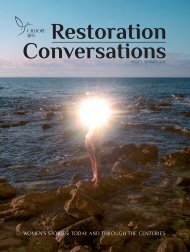
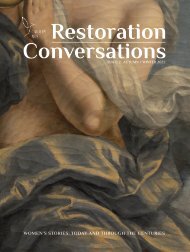

 Change language