

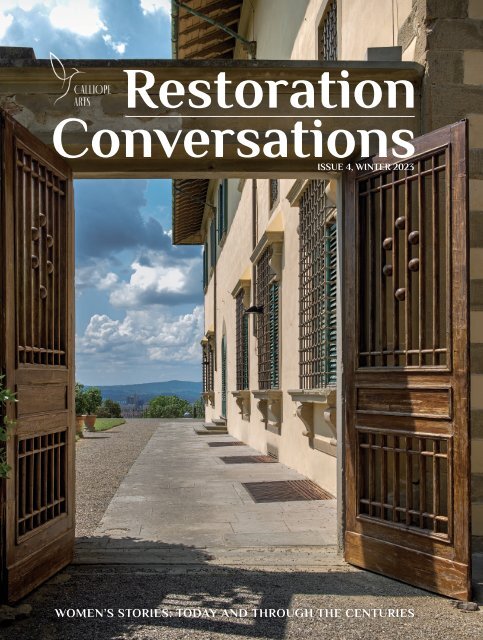
Restoration Conversations magazine - Winter 2023
Restoration Conversations is a digital magazine spotlighting the achievements of women in history and today. We produce two issues a year: Spring/Summer and Fall/Winter. Violinist Ruth Palmer and scholar Claudia Tobin seek – through their research and performance – to bring female composers and poetic-minded ‘freedom fighters’ to the fore. In her new book Women at Work from 1900 to Now, author and curator Flavia Frigeri leaves no field of female achievement unexplored. Artemisia’s censored allegory from the Casa Buonarroti Museum has her legs back (digitally) and is using them to get to her Genoa show ‘Artemisia: Courage and Passion’ at Genoa’s Palazzo Ducale. Conservator Eugenia Di Rocco strives to safeguard the Wulz sisters’ iconic images from Alinari Foundation for Photography – because photography can vanish, if not painstakingly protected, and English painter Cecily Brown seeks to translate the silent tribulations of a third-century saint into a language called ‘colour’ at Florence’s Museo Novecento and painter Paula Rego’s Garden of Delights comes to London’s National Gallery. The women found in Issue 4, perform, safeguard, uncover and share the achievements of their historic counterparts: Maria Luisa Raggi’s capriccio scenes, Ethyl Smyth’s The March of Women, Lavinia Fontana’s Queen of Sheba, Maryla Lednicka-Szczytt’s Black Angel. Their stories are more relevant than ever. Restoration Conversations magazine and cultural broadcast is supported by Calliope Arts – a not-for-profit organisation based in Florence and London that promotes public knowledge and appreciation of art, literature and social history from a female perspective, through restorations, exhibitions, education and cultural initiatives. Other issue highlights: women composers of late nineteenth and early twentieth centuries like Ethel Smyth and Florence Price. Learn more about Vernon Lee, Italian women painters, women's monumental palaces in Florence, and artisans at work to rediscover the historical legacies of women. Restoration Conversations magazine and cultural broadcast is supported by Calliope Arts – a not-for-profit organisation based in Florence and London that promotes public knowledge and appreciation of art, literature and social history from a female perspective, through restorations, exhibitions, education and cultural initiatives.
Restoration Conversations is a digital magazine spotlighting the achievements of women in history and today. We produce two issues a year: Spring/Summer and Fall/Winter. Violinist Ruth Palmer and scholar Claudia Tobin seek – through their research and performance – to bring female composers and poetic-minded ‘freedom fighters’ to the fore. In her new book Women at Work from 1900 to Now, author and curator Flavia Frigeri leaves no field of female achievement unexplored.
Artemisia’s censored allegory from the Casa Buonarroti Museum has her legs back (digitally) and is using them to get to her Genoa show ‘Artemisia: Courage and Passion’ at Genoa’s Palazzo Ducale. Conservator Eugenia Di Rocco strives to safeguard the Wulz sisters’ iconic images from Alinari Foundation for Photography – because photography can vanish, if not painstakingly protected, and English painter Cecily Brown seeks to translate the silent tribulations of a third-century saint into a language called ‘colour’ at Florence’s Museo Novecento and painter Paula Rego’s Garden of Delights comes to London’s National Gallery.
The women found in Issue 4, perform, safeguard, uncover and share the achievements of their historic counterparts: Maria Luisa Raggi’s capriccio scenes, Ethyl Smyth’s The March of Women, Lavinia Fontana’s Queen of Sheba, Maryla Lednicka-Szczytt’s Black Angel. Their stories are more relevant than ever.
Restoration Conversations magazine and cultural broadcast is supported by Calliope Arts – a not-for-profit organisation based in Florence and London that promotes public knowledge and appreciation of art, literature and social history from a female perspective, through restorations, exhibitions, education and cultural initiatives.
Other issue highlights: women composers of late nineteenth and early twentieth centuries like Ethel Smyth and Florence Price. Learn more about Vernon Lee, Italian women painters, women's monumental palaces in Florence, and artisans at work to rediscover the historical legacies of women.
Restoration Conversations magazine and cultural broadcast is supported by Calliope Arts – a not-for-profit organisation based in Florence and London that promotes public knowledge and appreciation of art, literature and social history from a female perspective, through restorations, exhibitions, education and cultural initiatives.

Transform your PDFs into Flipbooks and boost your revenue!
Leverage SEO-optimized Flipbooks, powerful backlinks, and multimedia content to professionally showcase your products and significantly increase your reach.
<strong>Restoration</strong><br />
<strong>Conversations</strong><br />
ISSUE 4, WINTER <strong>2023</strong><br />
WOMEN’S STORIES: TODAY AND THROUGH THE CENTURIES<br />
<strong>Winter</strong> <strong>2023</strong> • <strong>Restoration</strong> <strong>Conversations</strong> 1
Publisher<br />
Calliope Arts Foundation<br />
London, UK<br />
Managing Editor<br />
Linda Falcone<br />
Contributing Editor<br />
Margie MacKinnon<br />
Design<br />
Fiona Richards<br />
FPE Media Ltd<br />
Video maker for RC broadcasts<br />
Francesco Cacchiani<br />
Bunker Film<br />
www.calliopearts.org<br />
@calliopearts_restoration<br />
Calliope Arts<br />
2 <strong>Restoration</strong> <strong>Conversations</strong> • <strong>Winter</strong> <strong>2023</strong>
From the Editor<br />
Today’s women, featured in this issue of <strong>Restoration</strong> <strong>Conversations</strong>, have done<br />
their share of searching, and that may well be the reason they find themselves<br />
pictured between these pages. Violinist Ruth Palmer and scholar Claudia Tobin<br />
seek – through their research and performance – to bring female composers and<br />
poetic-minded ‘freedom fighters’ to the fore. In her new book Women at Work<br />
from 1900 to Now, author and curator Flavia Frigeri leaves no field of female<br />
achievement unexplored. Conservator Eugenia Di Rocco strives to safeguard the<br />
Wulz sisters’ iconic images from Alinari Foundation for Photography – because<br />
photography can vanish, if not painstakingly protected, and English painter Cecily<br />
Brown seeks to translate the silent tribulations of a third-century saint into a<br />
language called ‘colour’ at Florence’s Museo Novecento.<br />
These women, and others found herein, perform, safeguard, uncover and share the<br />
achievements of their historic counterparts: Ethyl Smyth’s The March of Women,<br />
Lavinia Fontana’s Queen of Sheba, Maryla Lednicka-Szczytt’s Black Angel. Their<br />
stories are more relevant than ever. So, there’s reason to celebrate in the new year,<br />
not least because Artemisia’s censored allegory has her legs back (digitally) and is<br />
using them to get to her Genoa show come 2024!<br />
Fondly,<br />
Linda Falcone<br />
Managing Editor, <strong>Restoration</strong> <strong>Conversations</strong><br />
<strong>Winter</strong> <strong>2023</strong> • <strong>Restoration</strong> <strong>Conversations</strong> 3
GRAZIE MILLE<br />
As the conversation around women’s achievements grows, we have more<br />
and more people to thank with every issue of the <strong>magazine</strong>. Not that we are<br />
complaining! It is wonderful to see this community expanding. Massive thanks to<br />
the people whose words fill these pages:<br />
Virtuosic violinist Ruth Palmer; curator, academic and author Claudia Tobin; Director<br />
of the Alinari Phototography Foundation Claudia Baroncini; members of the 5,000<br />
Negatives team Eugenia Di Rocco and Pamela Ferrari; National Gallery (London)<br />
curator Priyesh Mistry; Museo Novecento’s artistic director and curator Sergio Risaliti;<br />
National Gallery of Ireland’s curator Aoife Brady and conservator Maria Canavan; art<br />
historian and dean emerita of the National Gallery (Washington) Elizabeth Cropper;<br />
Towards Modernity co-curator Ilaria Sgarbozzo; Consuelo Lollobrigida, professor<br />
and art historian; the Opificio delle pietre dure’s senior paper conservator, Simona<br />
Calza; and Costantino D’Orazio, art historian and curator of Artemisia Gentileschi,<br />
Courage and Passion at the Palazzo Ducale in Genoa.<br />
Thank you to all who enthusiastically participated in the ‘Palace Women’ project<br />
as artisans, photographers, tour guides, educators and otherwise, with special<br />
mention to institutional partners the British Institute in Florence and Il Palmerino<br />
Cultural Association, as well as co-sponsors Alice Vogler and Donna Malin.<br />
With the exhibition Artemisia in the Museum of Michelangelo drawing to a close,<br />
we would like to extend a heartfelt thank you to ‘Artemisia UpClose’ co-sponsor<br />
Christian Levett and to Casa Buonarroti’s Museum Director Alessandro Cecchi<br />
and Foundation President Cristina Acidini. Grazie mille also to designer Massimo<br />
Chimenti and his team at Culturanuova for creating the perfect showpiece for our<br />
‘Artemisia UpClose’ project. We are delighted that part of this exhibition will carry<br />
on in Genoa.<br />
4 <strong>Restoration</strong> <strong>Conversations</strong> • <strong>Winter</strong> <strong>2023</strong>
CONTENTS WINTER <strong>2023</strong><br />
MUSIC AND A VOICE<br />
6 Close Encounters<br />
14 The Words We’d Like to Meet<br />
20 Notable Women<br />
24 You Oughta Be In Pictures<br />
AT WORK IN HISTORY<br />
32 Palace Women Find Common Ground<br />
36 5,000 Negatives<br />
42 Time Travel at Florence’s Opificio<br />
48 The Big Reveal<br />
54 Three Wishes<br />
58 Mission Accomplished<br />
FORERUNNERS PRESS FORWARD<br />
62 Trailblazer, Rule Breaker<br />
68 The Star of the Show<br />
74 Courage and Passion<br />
WOMEN INSPIRED<br />
80 The Colour is Brown<br />
86 The Painting in the Dining Room<br />
92 Women at Work<br />
98 Two New Books<br />
<strong>Winter</strong> <strong>2023</strong> • <strong>Restoration</strong> <strong>Conversations</strong> 5
Close<br />
Encounters<br />
A conversation with violinist Ruth Palmer<br />
Let’s begin at the end. The last work in the<br />
programme for ‘Scoring Suffrage’, a recital<br />
of music by women composers held at<br />
the Lyceum in Florence in September,<br />
was ‘Piece for Ruth’, by Venezuelan<br />
pianist and composer Gabriela Montero.<br />
The ‘Ruth’ in question is Ruth Palmer,<br />
the acclaimed violinist, and one half of<br />
‘Scoring Suffrage’s’ creative team, with<br />
whom I was now having a coffee at the<br />
Hayward Gallery on London’s South<br />
Bank. I asked her if any one of the pieces<br />
in the recital was more challenging than<br />
the others. “They all have their own<br />
challenges in different ways,” she said.<br />
For example, “the Montero has one tricky<br />
bit, but it was written for me, so I can<br />
do what I want with it.” Had she known<br />
that Montero was going to write it for<br />
her? “I asked her to write it for me,” she<br />
replied, and proceeded to recount the<br />
improbable story of their initial meeting.<br />
“I used to live not far from here on<br />
Fleet Street,” Ruth recalled. “One day,<br />
as I was crossing the road to go to the<br />
stationer’s, I was hit by a scooter that<br />
sent me literally flying horizontally<br />
over the bus lane.” The scooter driver,<br />
Richard, had been in a terrible hurry to<br />
get somewhere and had filtered down<br />
the wrong side of the road. Luckily, Ruth<br />
was fine but for a few scratches. As it<br />
happened, a police officer had witnessed<br />
the accident and asked if she wanted<br />
to press charges. Ruth declined, saying<br />
she wouldn’t press charges so long as<br />
6 <strong>Restoration</strong> <strong>Conversations</strong> • <strong>Winter</strong> <strong>2023</strong>
Richard agreed to come to her next Wigmore<br />
Hall recital. And even though he didn’t attend the<br />
recital, the two stayed in touch.<br />
Some two years later, Richard’s brother Sam<br />
wrote to Ruth, hoping to speak to her about a<br />
project he had been thinking about. He had<br />
seen In Search of the Messiah, a film in which<br />
Ruth starred as a violinist seeking out the world’s<br />
most prestigious violins, which had aired on arts<br />
networks throughout the world. “He was quite<br />
excited about it,” explained Ruth, “and wanted to<br />
discuss some ideas he had for his own project.”<br />
Ruth told Sam the conversation would have to<br />
wait, as she was on her way to visit her cousin in<br />
Lexington, Massachusetts.<br />
No problem, Sam replied. As it happens, I am<br />
going to Lexington myself. “And it turned out<br />
that he was living with Gabriela Montero around<br />
the corner from my cousin. So, I met her in her<br />
kitchen eating pumpkin pie. We got talking and<br />
eventually I said, ‘Will you write me a piece?’ She<br />
agreed, and we played it together a year later, in<br />
New York.”<br />
Earlier that morning, Ruth and I met to check<br />
out a venue for a reprise of ‘Scoring Suffrage’<br />
in London. Our destination was the 1901 Arts<br />
Club, a rehearsal and performance space created<br />
by philanthropist, conductor and violinist Joji<br />
Hattori. (As a young violinist Ruth won a Hattori<br />
Foundation prize which, in a further coincidence,<br />
was presented to her by the person who had<br />
recommended the 1901 Arts Club to me – a friend<br />
I met while we were both walking our dogs on<br />
Hampstead Heath.) The club occupies a lovingly<br />
restored schoolmaster’s residence in a street of<br />
small Victorian terraced houses and is decorated<br />
Above: Ruth Palmer in ‘Scoring<br />
Suffrage’ at Florence’s Lyceum.<br />
Photo by Marco Berni<br />
<strong>Winter</strong> <strong>2023</strong> • <strong>Restoration</strong> <strong>Conversations</strong> 7
Below: Ruth Palmer and<br />
pianist Alessio Enea in ‘Scoring<br />
Suffrage’ at Florence’s Lyceum.<br />
Photo by Marco Berni<br />
in the style of a European Salon. Its intimate<br />
size and salon-like atmosphere seem ideal for<br />
the nineteenth and early twentieth-century<br />
repertoire of ‘Scoring Suffrage’. Ruth had brought<br />
her violin with her and set about testing the<br />
space’s acoustics. We were soon rolling up two<br />
rugs on the original wooden floor and pulling<br />
back a heavy curtain behind the grand piano.<br />
After another sound check, Ruth seemed satisfied<br />
with the result, although the improvement in<br />
resonance was lost on my untrained ears.<br />
‘Scoring Suffrage’ was conceived not solely as<br />
a musical event, rather, it is a weaving together<br />
of the music, literature and personal stories of<br />
women whose lives and careers overlapped<br />
with women’s suffrage movements in Europe.<br />
Through the narration of letters, poetry and other<br />
writings, Ruth’s partner in this project, curator and<br />
academic Dr Claudia Tobin (see feature on p. 14),<br />
provides the context in which woman composers<br />
were working and creating the soundtrack that<br />
accompanied women’s growing political and<br />
expressive freedom. The third member of the<br />
team was London-based pianist Alessio Enea,<br />
who accompanied Ruth in the performance.<br />
On this day in the Hayward’s cafe, we would<br />
talk about the works of the six female composers<br />
featured in ‘Scoring Suffrage’: Fanny Mendelssohn<br />
(1805-1847), Clara Schumann (1819-1896), Ethel<br />
Smyth (1858-1944), Lili Boulanger (1893-1918),<br />
Florence Price (1887-1953) and Gabriela Montero<br />
(b. 1970). A single male composer, Maurice Ravel<br />
(1875-1937), made it on to the programme by virtue<br />
of the significance of two women to his work.<br />
The first piece in the programme was Fanny<br />
Mendelssohn’s ‘Adagio’, composed when she was<br />
just 18. Fanny is said to have excelled as a composer<br />
of short musical forms. This is not surprising<br />
given that, unlike her brother, the composer Felix<br />
Mendelssohn who travelled throughout Europe<br />
8 <strong>Restoration</strong> <strong>Conversations</strong> • <strong>Winter</strong> <strong>2023</strong>
From left to right:<br />
Top row: Fanny Mendelssohn, 1842,<br />
by Moritz Daniel Oppenheim and<br />
Lithograph of Clara Schumann, 1839,<br />
by Andreas Staub<br />
Middle row: Ethel Smyth and her dog,<br />
Marco, 1891 and Henri Manuel’s Portrait<br />
of Lili Boulanger, originally published in<br />
Comœdia illustré, 1913<br />
Bottom row: Florence Price and<br />
Gabriela Montero<br />
<strong>Winter</strong> <strong>2023</strong> • <strong>Restoration</strong> <strong>Conversations</strong> 9
Above: Processing<br />
suffragettes, c. 1908, World’s<br />
Graphic Press Limited, 36-38<br />
Whitefriars Street, Fleet Street,<br />
London. ‘Women’s Social and<br />
Political Union’ teams draw the<br />
carriage of released prisoners<br />
away from Holloway, LSE<br />
Library. Source: Wikimedia<br />
Commons<br />
with his orchestral compositions, Fanny was<br />
expected to stay home playing salon concerts.<br />
“Fanny was allowed to play the piano, as long<br />
as it supported her brother and made her more<br />
attractive as a marriage prospect. Teaching the<br />
piano was also an acceptable occupation for<br />
women, at a time when most professions were<br />
closed to women,” notes Ruth. Fanny’s ‘Adagio’<br />
“is tricky to get right. It’s a delicate balance of a<br />
slightly naïve, sweet and pleasant [melody] with a<br />
[calming] meditation, and to try and find exactly<br />
the right tempo to let it be a dream, and to open<br />
with it, is difficult.”<br />
Fanny Mendelssohn’s near contemporary, Clara<br />
Schumann, had much greater freedom to travel,<br />
performing in concerts throughout Europe as<br />
a highly celebrated pianist. From childhood to<br />
middle age, she produced a good body of work but,<br />
following the early death in 1856 of her husband,<br />
the composer Robert Schumann, Clara largely gave<br />
up composing, leaving a legacy of just 23 published<br />
works. In preparing to perform Clara Schumann’s<br />
‘Three Romances’ Ruth found that “it took a lot of<br />
personal energy to discover the depth in it. But I<br />
had played the same piece for another recital in<br />
France in May, and I worked quite a lot on it then,”<br />
adding, “it has been a year where I’ve begun to play<br />
more women’s repertoire.”<br />
Although she is now recognised as an important<br />
composer of the Romantic era, Schumann herself<br />
seemed to have absorbed the prevailing view that<br />
women did not have the ‘genius’ to create great<br />
music. “I once believed that I possessed creative<br />
talent,” she claimed, “but I have given up this idea;<br />
a woman must not desire to compose – there has<br />
never yet been one able to do it. Should I expect<br />
to be the one?” No doubt Clara would have been<br />
able to put more energy into her composing if<br />
she did not have eight children to provide for<br />
and a husband whose health was precarious. As<br />
Ruth comments, “When it comes to women, the<br />
perception of competence is always the issue.<br />
Not just in music, but everywhere. And it’s not<br />
just men, women can be just as sexist without<br />
realising it.”<br />
The work of English composer Ethel Smyth<br />
(see feature on p.14) was new to Ruth. “Her ‘Violin<br />
Sonata’ required the most preparation because<br />
10 <strong>Restoration</strong> <strong>Conversations</strong> • <strong>Winter</strong> <strong>2023</strong>
Left: Winnaretta Singer’s selfportrait,<br />
c.1885, Foundation<br />
Singer-Polignac, Paris.<br />
Source: Wikimedia Commons<br />
it is thirty minutes long. It also has a significant<br />
emotional content because there is a discussion<br />
in it – it is more like an essay than a short soliloquy.<br />
And there’s a lot to get together with the piano<br />
as well, the score is complicated.” Ruth continues,<br />
“As a musician, what I am always looking for is<br />
a musical challenge, regardless of who wrote it.<br />
I was really glad to get to know Smyth’s sonata,<br />
because it is an interesting piece of music that I<br />
can include in any programme or any situation.”<br />
Lili Boulanger’s ‘D’un matin de printemps’ was a<br />
piece that Ruth learned during the pandemic but<br />
had not performed. “It is the one that surprised<br />
me. The difficulty arises from the fact that it is so<br />
short – it’s there and then suddenly … it’s gone!”<br />
Sadly, this could also describe its composer’s life.<br />
A child prodigy, Lili Boulanger was the first female<br />
winner of the Prix de Rome composition prize<br />
in 1913. Between 1911 and 1918 she composed<br />
some two dozen works but, having suffered with<br />
chronic ill health throughout her life, she died at<br />
just 24 years of age.<br />
For Florence Price’s ‘Fantasie in G minor’<br />
(see feature on p.20), Ruth referred to ‘Roots’,<br />
a recording of Black US classical music by the<br />
young American violinist Randall Goosby.. “He<br />
plays it beautifully,” she says. “When I came to<br />
play it, I couldn’t make sense of it at first. But<br />
when you put it together with the poetry of<br />
Georgia Douglas Johnson, it suddenly comes<br />
alive. When you contextualise it, it sort of pops.”<br />
French composer Maurice Ravel snuck on<br />
to the programme in part because his career<br />
owes a huge debt to Winnaretta Singer, the<br />
sewing machine heiress, who was one of the<br />
most passionate supporters of his work. From<br />
1905 until 1931, Ravel performed and sometimes<br />
premiered his works in her salon. For ‘Scoring<br />
Suffrage’ Ruth performed Ravel’s ‘Tzigane’, which<br />
she describes as “an amazing piece.” It was both<br />
inspired by and dedicated to British-Hungarian<br />
violinist Jelly D’Aranyi who was one of the few<br />
celebrated women in the male-dominated world<br />
of classical violinists of the time. ‘Tzigane’ was<br />
just one of many pieces written especially for her.<br />
In 1922, and at the height of his career, Maurice<br />
Ravel met d’Aranyi in London at a private concert<br />
where she and Hans Kindler performed Ravel’s<br />
<strong>Winter</strong> <strong>2023</strong> • <strong>Restoration</strong> <strong>Conversations</strong> 11
Top: Riverside view of Florence on opening<br />
night. Photo by Marco Berni<br />
Above Jelly d’Aranyi in 1923.<br />
Source: Wikimedia Commons<br />
Right: Ruth Palmer testing acoustics at the<br />
1901 Arts Club in London,<br />
-Calliope Arts Archive<br />
‘Duo sonate’. Ravel persuaded d’Aranyi to stay<br />
on and play what were then popular Romani<br />
melodies for him, which she did well into the<br />
early hours of the morning. He was so taken with<br />
her performance that he promised to compose a<br />
concert piece for her and wrote “you have inspired<br />
me to write a short piece of diabolical difficulty,<br />
conjuring up the Hungary of my dreams. Since it<br />
will be for violin, why don’t I call it Tzigane?” The<br />
piece is indeed a challenge for the violinist and<br />
demands to be played by throwing caution to the<br />
wind. Ruth was certainly up to the task, showing<br />
off the range of her instrument as well as her<br />
own virtuosity.<br />
Winnaretta Singer enjoyed introducing her<br />
friends to each other and starting cultural<br />
collaborations across the arts. For Ruth, “the<br />
opportunity to collaborate with Claudia was<br />
probably the biggest draw on this project.<br />
Claudia is so knowledgeable, and she has an<br />
artistic character that allows her to connect the<br />
dots in a way that is instinctual. When I suggested<br />
pieces from the repertoire, she was able to find<br />
the connections among the various writers and<br />
poets and activists at the time. There was an<br />
12 <strong>Restoration</strong> <strong>Conversations</strong> • <strong>Winter</strong> <strong>2023</strong>
organic process to the way we found the links<br />
together. I learned that I could discover things as<br />
well. So that was fun.” The enjoyment that Claudia<br />
and Ruth experienced working in partnership on<br />
‘Scoring Suffrage’ recalls the final words of ‘The<br />
March of Women’, the suffrage anthem written by<br />
Cicely Hamilton and composed by Ethel Smyth:<br />
March, march, many as one<br />
Shoulder to Shoulder and friend to friend.<br />
MARGIE MACKINNON<br />
‘Scoring Suffrage’ was performed as part of the<br />
‘Palace Women’ programme organised by The<br />
British Institute of Florence, Il Palmerino Cultural<br />
Association and Calliope Arts This project is made<br />
possible thanks to the support of Enjoy, Respect<br />
and Feel Florence, funded by Italy’s Ministry<br />
of Tourism, the Fund for Development and<br />
Cohesion, the Municipality of Florence and Feel<br />
Florence. Special thanks to donors Alice Vogler,<br />
Donna Malin, Margie MacKinnon and<br />
Wayne McArdle.<br />
Described as ‘the most distinctive violinist<br />
of her generation’ (The Independent),<br />
violinist Ruth Palmer is praised for her<br />
‘intensity’ and ‘poetic grandeur’ (The<br />
Guardian).<br />
Her Direct-to-Disc LP of Bach is available<br />
on Berliner Meister Schallplatten. Earlier<br />
recordings’ critical acclaim includes<br />
‘impeccable astringent Bartók and warm,<br />
profound Bach’ (The Observer), while her<br />
Shostakovich recording won a Classical<br />
BRIT.<br />
She’s performed with James Ehnes,<br />
Sir Richard Rodney Bennett, Yutaka<br />
Sado, Carlo Rizzi, BBC Philharmonic,<br />
and at the British Embassy’s British<br />
Week in Havana, and for King Charles<br />
III (then Prince of Wales) and Queen<br />
Elizabeth II. She’s appeared on radio and<br />
television internationally. When Ruth<br />
collaborated with Rambert and Sydney<br />
Dance Companies, ‘it was sometimes<br />
a struggle to concentrate on the dance<br />
when the violinist was so compelling’<br />
(Sunday Telegraph).<br />
<strong>Winter</strong> <strong>2023</strong> • <strong>Restoration</strong> <strong>Conversations</strong> 13
Above: Scholar Claudia Tobin performs ‘Scoring Suffrage’ in Florence.<br />
Photo by Marco Berni<br />
Right: Dante Gabriel Rossetti’s portrait of his sister Christina, 1866,<br />
private collection. Source: Wikiart<br />
14 <strong>Restoration</strong> <strong>Conversations</strong> • <strong>Winter</strong> <strong>2023</strong>
The Words We’d<br />
Like to Meet<br />
Scholar Claudia Tobin on ‘Scoring Suffrage’<br />
CChristina Rossetti, Constance Smedley, Ethel Smyth, Vernon Lee,<br />
Cicely Hamilton, Charlotte Perkins Gilman, Emmeline Pankhurst,<br />
Marina Tsvetaeva and Anna Akmatova are just some of the<br />
women writers and social reformers forming part of Florence’s<br />
“Scoring Suffrage” performance. This brief conversation with<br />
British scholar Claudia Tobin will send you to the book shelf,<br />
to re-read ‘old friends’ or to reach for new voices you’ve never<br />
heard before. Amidst plays, poems, novellas, essays and letters,<br />
Claudia’s interview is an invitation to seek out the words of<br />
nineteenth- and early twentieth-century women. Their hopes,<br />
whether shattered or still shining bright, are awaiting discovery<br />
– in their own words.<br />
Were all the women featured social activists?<br />
The starting point for the Florence performance was the suffrage<br />
moment, but I think it’s important to note that these women are<br />
united by an extraordinary commitment to their art and the<br />
causes they supported, but they didn’t share the same political<br />
persuasions, and that message – even by itself – is relevant to<br />
today’s world. They were all ‘fighting spirits’ and they fought for<br />
suffrage or the right to express themselves, but they do not belong<br />
to one side of the political spectrum or a single political party,<br />
which became clear as our research unfolded. Christina Rossetti<br />
(1830-1894), for instance, was devoted to poetry – to the point<br />
that she didn’t marry to pursue it. She was religiously devout and<br />
supported humanitarian causes, striving to follow the Florence<br />
Nightingale model, and her poems are full of redemptive female<br />
<strong>Winter</strong> <strong>2023</strong> • <strong>Restoration</strong> <strong>Conversations</strong> 15
Left: Cover of Vernon Lee’s<br />
The Ballet of The Nations.<br />
1915 edition, from the library of<br />
Il Palmerino Cultural Association.<br />
Above: Constance Smedley,<br />
undated.<br />
Source: Wikimedia Commons<br />
Right: The Ballet of The Nations<br />
performed at Il Palmerino Cultural<br />
Association, 2019.<br />
Source: Il Palmerino Archive<br />
figures, but she was not in favour of votes for<br />
women, although she does concede that “mothers<br />
would make good members of Parliament”.<br />
Tell us about a highlight from ‘Scoring<br />
Suffrage’ that combines spoken word and<br />
music.<br />
In the performance, we explore the figure of<br />
the wanderer, the gypsy. So, we looked at the<br />
archetypal artist, the wandering minstrel – a<br />
figure of freedom and free movement - in a<br />
few different works of poetry and music. As a<br />
complement to Maurice Ravel’s ‘Tzigane’, I read<br />
Russian poet Marina Tsvetaeva’s ‘Our Sweet<br />
Companions – Sharing Your Bunk and Your<br />
Bed’. She was an exile, and suffered greatly in<br />
early twentieth-century Russia, and was deeply<br />
influenced by Pushkin’s narrative poem ‘The<br />
Gypsy’.<br />
Another piece I’d like to include in the future,<br />
on this same theme, is The Minstrel, which<br />
Constance Smedley collaborated on, in 1915,<br />
with her husband Maxwell Armfield. It features<br />
a wandering musician, in a country destroyed<br />
by war. Both Smedley and Armfield were<br />
committed pacifists, and in that same period,<br />
they set up experimental theatre companies<br />
in London, providing body-movement scripts.<br />
They had a vision of really strict choreography<br />
in their productions, for which Smedley<br />
provides drawings, envisioning them as a<br />
rhythmic structure.<br />
16 <strong>Restoration</strong> <strong>Conversations</strong> • <strong>Winter</strong> <strong>2023</strong>
From your description, Smedley’s experience<br />
sounds akin to that of Vernon Lee, also a pacifist,<br />
interested in aesthetics and the psychological<br />
implications of physical expression.<br />
Yes, their interests are very much related. Smedley<br />
and Lee shared the pacifist outlook – in the<br />
First World War. [Armfield wrote the introduction<br />
to Lee’s satirical play, The Ballet of the Nations,<br />
published in 1915, before The Minstrel.] Lee,<br />
Smedley’s circle, Virginia Woolf’s circle were well<br />
travelled. They had friends in Belgium, Germany,<br />
France and England. The nations were at war but<br />
they wanted their friendships to remain. In reality,<br />
Lee’s loss of popularity as an author is often said<br />
to be linked to the letters she wrote to friends<br />
advocating peace.<br />
‘Scoring Suffrage’ includes snippets of<br />
letters and essays by women, in addition<br />
to their poetry. How did these women’s<br />
correspondence contribute to their quest for<br />
freedom of expression?<br />
Ethyl Smyth and Vernon Lee became friends and<br />
ended up dedicating work to each other. Lee<br />
dedicated the play Ariadne in Mantua to Smyth,<br />
thanking her for her work and begging her for<br />
music. They were what Smyth called ‘female<br />
labourers in the field of art’ and they moved in<br />
the same circles.<br />
Their correspondence crossed to America<br />
too, to involve another figure Charlotte Perkins<br />
Gilman – a friend of Smyth’s. She was an American<br />
suffragette and writer who wrote political verse<br />
<strong>Winter</strong> <strong>2023</strong> • <strong>Restoration</strong> <strong>Conversations</strong> 17
18 <strong>Restoration</strong> <strong>Conversations</strong> • <strong>Winter</strong> <strong>2023</strong>
and songs for suffrage. Perkins Gilman cofounded<br />
The Women’s Peace Party, in 1915. Her<br />
novella The Yellow Wallpaper is haunting and<br />
vividly told. It speaks of a woman on the brink<br />
of madness, prescribed bed rest by her husband.<br />
She is not allowed to work and is held prisoner in<br />
her room, watching the peeling yellow wallpaper.<br />
In the programme, we cite a letter she wrote to<br />
Vernon Lee, thanking her for helping to spread<br />
the ideas she felt were important… not that they<br />
always agreed. They didn’t, because these women<br />
were complex figures.<br />
As an author and exhibition curator, you’ve<br />
often worked with the mixing of various<br />
media. How did this play out in the time<br />
period studied as part of the ‘Scoring<br />
Suffrage’ grant?<br />
There are instances in which music inspires<br />
words, and other cases in which words give way<br />
to silence, that then becomes sound or music.<br />
Virginia Woolf’s relationship with music is one<br />
interesting case study. In the late Nineteenth<br />
Century, many artists were interested in the<br />
intermingling of the senses, and started exploring<br />
fields like Synaesthesia. Kandinsky claimed to<br />
‘hear colours’, and French artist Sonia Delaney<br />
discusses the issue at length as well. The idea<br />
of [the brain processing information through<br />
unrelated senses] leads to the discussion of<br />
where one art form ends and the other begins. In<br />
this very fruitful period – in the late nineteenth<br />
and early twentieth century – there was the<br />
idea that music had the power to offer a sense<br />
of companionship. It was an invisible presence,<br />
a powerful voice… which reminds me of Russian<br />
poet Anna Akhmatova, who personified music as<br />
female, in her poem titled ‘Music’. I’m interested<br />
in where the different art forms begin and end<br />
and where they fuel and inspire other media,<br />
and it’s clear that music and poetry are natural<br />
companions and have been for a long time.<br />
Left, clockwise from top left: Vernon Lee by John Singer Sargent, 1881; Anna Akhmatova by Kuzma Petrov-Vodkin,<br />
1922; Ethyl Smyth by John Singer Sargent, 1901; Charlotte Perkins Gilman by Frances Benjamin Johnston, c. 1900.<br />
Source: Wikimedia Commons<br />
<strong>Winter</strong> <strong>2023</strong> • <strong>Restoration</strong> <strong>Conversations</strong> 19
Notable Women<br />
AComposers Florence Price and Ethel Smyth<br />
A supermoon illuminated the sky over the Arno as<br />
the music of women composers filled Florence’s<br />
Lyceum Club for the inauguration of ‘Palace<br />
Women – Oltrarno and Beyond’. Serendipity?<br />
Perhaps, but there is no doubt that the presence<br />
of this symbol of female energy added to the<br />
sense that ‘Scoring Suffrage’ (as the recital was<br />
called) was an exceptional event. Below, we take a<br />
closer look at two of the composers whose work<br />
featured in the recital.<br />
Near contemporaries from opposite sides<br />
of the Atlantic, Florence Price (1887-1953) and<br />
Ethel Smyth (1858-1944), fought against prejudice<br />
to have their compositions recognised and<br />
performed. The body of work they left behind is<br />
testament to their talent and perseverance.<br />
Portrait of Florence Price<br />
Looking at the Camera,<br />
undated, Papers Addendum<br />
(MC 988a). Special Collections,<br />
University of Arkansas<br />
Libraries, Fayetteville<br />
FLORENCE PRICE<br />
Florence Beatrice Smith was born into a<br />
prominent family in the Black community of<br />
Little Rock, Arkansas. Her mother was a talented<br />
singer and pianist who quickly recognised her<br />
daughter’s musical gifts and sent Florence to<br />
Boston to study at the New England Conservatory.<br />
In addition to excelling at her piano and organ<br />
studies, she took private lessons in composition<br />
with the school’s director. That Florence<br />
encountered discrimination along the way is<br />
evidenced by the fact that, in her final year at the<br />
Conservatory, she falsely registered as a Mexican<br />
resident in an effort to avoid harassment from<br />
segregationist Southern white students, not an<br />
unusual occurrence for students of colour. In<br />
fact, Florence’s background included a mixture<br />
of French, Indian, Spanish and African American<br />
ancestry, and she would draw from this “racial<br />
melting pot” in composing her music.<br />
Florence returned to Little Rock after<br />
graduation and married Thomas Price, an upand-coming<br />
lawyer. When racial tensions in the<br />
city later erupted in violence, the couple, with<br />
their two young daughters, joined the Great<br />
Migration of Blacks fleeing northward, eventually<br />
settling in Chicago. Florence continued to study<br />
composition, publishing four pieces for piano<br />
in 1928. When her marriage ended in divorce in<br />
1931, she supported her family by working as an<br />
organist for silent film screenings and composing<br />
jingles for radio advertisements.<br />
Her ‘break’ came when she won the 1932<br />
Rodman Wanamaker Award, a competition for<br />
Black composers, with her entry ‘Symphony<br />
No 1 in E minor,’ which was performed by the<br />
Chicago Symphony Orchestra as part of the<br />
World’s Fair in 1933. The Chicago Daily News’<br />
music critic described it as “a faultless work<br />
… that speaks its own message with restraint<br />
and yet with passion … worthy of a place in the<br />
regular symphonic repertoire.”<br />
20 <strong>Restoration</strong> <strong>Conversations</strong> • <strong>Winter</strong> <strong>2023</strong>
In explaining how Price went from relative<br />
obscurity to being showcased by a major<br />
orchestra, pianist and music historian Dr<br />
Samantha Ege notes that, “there’s this idea that<br />
this all-white, all-male orchestra just sort of<br />
magically took an interest in Price’s music, but<br />
actually it was Maude Roberts George working<br />
behind the scenes, supporting Price in getting the<br />
score finished and making sure the world could<br />
hear it.” Ege explains that both Price and George<br />
were part of an active network of Black women,<br />
many with conservatory training, who supported<br />
a growing musical community during the 1920s<br />
and 1930s. George’s support for Price extended to<br />
personally underwriting the cost of the Chicago<br />
Symphony performance.<br />
Even as she tirelessly composed new pieces,<br />
Price continued formal studies in harmony,<br />
orchestration and composition at the Chicago<br />
Musical College and the University of Chicago.<br />
Her music was performed by at least nine<br />
major orchestras, and her vocal and instrumental<br />
chamber music and piano compositions were<br />
sung by some of the great soloists of her day<br />
– including Marian Anderson who famously<br />
performed Price’s arrangement of a spiritual on<br />
the steps of the Lincoln Memorial in 1939, when<br />
she was barred on racial grounds from appearing<br />
in Washington’s Constitution Hall. Price also<br />
taught piano and mentored young composers.<br />
While she succeeded in publishing some of her<br />
scores, most were still in manuscript form at the<br />
time of her death.<br />
Price’s compositions clearly reflect the influence<br />
of her classical training. For those familiar with<br />
this repertoire, echoes of Brahms, Liszt and<br />
Chopin are evident in her work. Musicologists<br />
cite Dvorak’s ‘New World Symphony’ as the<br />
primary model for her first symphony. But what<br />
sets her compositions apart is the way in which<br />
she integrated musical idioms from outside the<br />
traditional orchestral world. In particular, she<br />
drew on the African American soundscape of<br />
church spirituals, plantation and folk songs with<br />
which she would have been familiar from her<br />
Southern childhood. Written descriptions cannot<br />
hope to capture the emotion of this music and<br />
encountering it for the first time is a pleasure that<br />
awaits the uninitiated. Ege, who has recorded<br />
many of Price’s pieces, says, “I wanted to recreate<br />
for the listener that sense of wonder I had when<br />
I first heard the music … It was a real invitation<br />
to listen … to enter this world with her … and I<br />
think it’s the way she treats African folk songs<br />
with such respect and sensitivity …” Ege adds that<br />
Price would have been aware that touring groups<br />
in the late Nineteenth Century had made the<br />
Negro spiritual an art form. Music that had once<br />
been denigrated because of its origins was seen<br />
in a new light in the concert hall.<br />
In 1943, Price wrote a letter to Serge Koussevitzky,<br />
the conductor of the highly regarded Boston<br />
Symphony Orchestra, hoping to encourage him<br />
to read some of her scores. Explaining her style,<br />
she told him, “I believe I can truthfully say that I<br />
understand the real Negro music. In some of my<br />
work I make use of this idiom undiluted. Again,<br />
at other times it merely flavors my themes. I<br />
have an unwavering and compelling faith that a<br />
national music very beautiful and very American<br />
can come from the melting pot just as the nation<br />
itself has done.” Unfortunately, Koussevitzky was<br />
not interested in programming any of her work.<br />
Price’s ‘Fantasie No. 1 in G minor’, which was<br />
performed as part of ‘Scoring Suffrage’, is a<br />
wonderful example of her ability to seamlessly<br />
insert recognisable African American themes<br />
into the highly structured form of classical<br />
European concert music. It is one of four<br />
‘Fantasies’, which at one time had been<br />
presumed lost. Fortunately for music lovers, in<br />
2009, a cache of dozens of boxes containing<br />
the composer’s letters and manuscripts was<br />
discovered in a long-neglected house in Illinois<br />
that had been Price’s summer refuge. That<br />
discovery heralded a renaissance in Price’s work<br />
and a renewed interest in performances and<br />
recordings of her extensive catalogue. Her “very<br />
beautiful and very American” music deserves to<br />
be heard by a much wider audience.<br />
<strong>Winter</strong> <strong>2023</strong> • <strong>Restoration</strong> <strong>Conversations</strong> 21
English composer and<br />
suffragette Ethel Smyth<br />
(1858-1944). Image from<br />
the United States Library<br />
of Congress’s Prints and<br />
Photographs division<br />
ETHEL SMYTH<br />
Her Majesty’s Prison Holloway is perhaps London’s<br />
most famous institution for women. In March 1912,<br />
it was the venue for an exceptional performance<br />
of the Suffragette anthem ‘The March of Women’.<br />
The chorus was sung by inmates marching in the<br />
quadrangle, while the anthem’s composer, Ethel<br />
Smyth, leaned out of her prison cell window to<br />
conduct them with her toothbrush. Smyth had<br />
been arrested two months earlier, along with her<br />
friend Emmeline Pankhurst, for throwing stones<br />
at the houses of politicians who opposed votes<br />
for women. Smyth herself took credit for teaching<br />
Pankhurst how to throw stones and practiced with<br />
her by aiming stones at trees near the home of a<br />
fellow activist. At the age of 52, Smyth had joined<br />
the Women’s Social and Political Union, founded<br />
by Pankhurst in 1903, to campaign for women’s<br />
suffrage. She took two years out from her musical<br />
career, by then well-established, to devote herself<br />
to the cause. This was typical of the passion and<br />
fearlessness with which Smyth approached every<br />
aspect of her life.<br />
Her determination not to be bound by social<br />
convention was apparent early on. Born in 1858<br />
into a well-to-do family in Victorian England – a<br />
time when it was unseemly for women of her class<br />
to have their own profession – Smyth overcame<br />
her father’s objections to her unshakeable desire<br />
to study music by locking herself in her room and<br />
refusing to eat or leave it until he relented. She<br />
was admitted to the Leipzig Conservatory in 1887<br />
and met some of the most renowned composers<br />
of the day, including Johannes Brahms, Clara<br />
Schumann, Antonin Dvorak and Pyotr Tchaikovsky.<br />
The latter would eventually recognise Smyth as<br />
“one of the few women composers whom one<br />
can seriously consider to be achieving something<br />
valuable in the field of musical creation.”<br />
Tchaikovsky’s backhanded compliment typifies<br />
the prejudice faced by female composers. Her<br />
work was not evaluated on its own merits but as<br />
that of a “woman composer”. While some critics<br />
praised the “masculinity” of her more powerful<br />
compositions, others complained that her work<br />
was lacking in the feminine charm to be expected<br />
of woman, whatever her other accomplishments.<br />
Following her formal education, Smyth<br />
travelled throughout Europe, mainly in Germany<br />
and Italy, refining her style, falling in and out of<br />
love and cultivating friendships with patrons,<br />
musicians and other intellectuals who were part<br />
of the artistic milieu of the time. She returned<br />
to London in 1889 where she composed works<br />
ranging from choral arrangements and chamber<br />
music to orchestral pieces and operas. Her<br />
first of six operas, ‘Fantasio’, debuted in 1898 in<br />
Weimar, Germany. Despite the insidious prejudice<br />
against women as composers, Smyth was able<br />
to get many of her works performed, thanks to a<br />
combination of talent, support from conductors<br />
such as Sir Thomas Beecham, and her own<br />
formidable ambition.<br />
Smyth’s ‘Sonata for Violin and Piano in A<br />
minor’, composed in 1887 and dedicated to her<br />
friend, Lili Wach, the daughter of composer Felix<br />
22 <strong>Restoration</strong> <strong>Conversations</strong> • <strong>Winter</strong> <strong>2023</strong>
Mendelssohn, was the centrepiece of ‘Scoring<br />
Suffrage’. A review of its first performance in 1887<br />
praised the musicians while declaring that the<br />
work itself lacked originality and was a slavish<br />
copy of Brahms, a critique that Smyth dismissed<br />
in her memoir Impressions that Remained saying,<br />
“A listen to the piece will prove just how wrong<br />
the reviewers were!” When violinist Ruth Palmer<br />
(see feature on p. 6) first looked at Smyth’s violin<br />
sonata, she thought, “There’s so much Brahms<br />
here. Where’s the Smyth? But when you get to<br />
know it, you realise, actually, she’s got so much<br />
personal power and narrative in that piece.<br />
She is not Brahms at all. It’s just that that is the<br />
vernacular that she was speaking in because<br />
that’s what was going on in Europe at the time.<br />
But she brings her own voice to the music and<br />
she says something original with it.”<br />
In 1912, Smyth began to lose her hearing,<br />
eventually giving up composing as a result. She<br />
turned from music to writing, completing ten<br />
mostly autobiographical volumes. In them, she<br />
writes openly about her love affairs, many with<br />
famous women, including Emmeline Pankhurst,<br />
writers Virginia Woolf and Edith Somerville, and<br />
the heiress Winnaretta Singer. Her only male<br />
lover is said to have been Henry Brewster, the<br />
librettist of some of her operas, with whom she<br />
had a lifelong friendship. It is disappointing (if<br />
not surprising) to discover that, according to<br />
biographer Dr Leah Broad, Smyth held bigoted<br />
opinions about race, subscribing to the belief in<br />
white English superiority, despite having faced<br />
prejudice throughout her life because of her<br />
gender and sexuality. In this, she went along with<br />
views that were prevalent at the time.<br />
Yet there is no denying Smyth’s many<br />
accomplishments. She was the first woman to<br />
have an opera (‘The Forest’) staged at the New<br />
York Metropolitan Opera, in 1903. In 1922, She<br />
was named Dame Commander of the Order of<br />
the British Empire, the first female composer<br />
(and possibly the only one with a criminal<br />
record!) to be given the title of Dame. She was<br />
the first woman to receive an honorary degree<br />
in music from Oxford University, in 1926. More<br />
recently, Smyth was the first woman composer to<br />
have an opera staged at Glyndebourne, in 2022.<br />
Their production of Smyth’s 1906 magnum opus,<br />
‘The Wreckers’, attracted rapturous reviews (and<br />
favourable comparisons to Benjamin Britten’s<br />
‘Peter Grimes’) for the staging and for the work<br />
itself, with the Financial Times critic claiming,<br />
“there is no English opera written before or after<br />
‘The Wreckers’ that can match Smyth’s openhearted,<br />
unapologetic, no-holds-barred passion.”<br />
Smyth’s final major work, a choral symphony<br />
called ‘The Prison’ was first performed in 1930 but<br />
only recorded 90 years later. That recording, by<br />
Chandos, won a Grammy in 2021.<br />
Among her many accolades, I like to think<br />
that Dame Ethel would have been particularly<br />
‘chuffed’ to have been given a seat at Judy<br />
Chicago’s Dinner Party (1974-79). In this groundbreaking<br />
installation artwork, a triangular table<br />
with place settings for 39 significant women<br />
from history and myth, Smyth finds herself in the<br />
company of Sojourner Truth, Georgia O’Keefe,<br />
Artemisia Gentileschi and her dear friend,<br />
Virginia Woolf, among others. Representing her<br />
work as both a composer and a champion of<br />
women’s rights, Smyth’s place setting includes<br />
musical motifs such as a plate in the form of<br />
a grand piano, a treble clef incorporating her<br />
initials and a metronome. On the runner, a tweed<br />
suit has been laid out, as if being tailored. This<br />
is a reference to Smyth’s preference for dressing<br />
in a ‘masculine’ style, and, perhaps, to her wish<br />
to be considered as worthy a composer as any<br />
of her male counterparts.<br />
Passionate composer, radical activist, prolific<br />
writer and non-conforming lover of women (and<br />
at least one man), Dame Ethel Smyth would be<br />
a fascinating guest at any fantasy dinner party.<br />
MARGIE MACKINNON<br />
<strong>Winter</strong> <strong>2023</strong> • <strong>Restoration</strong> <strong>Conversations</strong> 23
24 <strong>Restoration</strong> <strong>Conversations</strong> • <strong>Winter</strong> <strong>2023</strong>
“You oughta be<br />
in pictures”<br />
Banca d’Italia showcases 75 years of women in art<br />
Towards Modernity [Verso la Modernità] is a survey show that encompasses<br />
75 years of shifting culture. All but six of its works are painted by male<br />
artists who echo the winds of social change affecting female representation<br />
in art. From the iconic mother figure, to the ‘new nude’ and the burgeoning<br />
‘modern woman’, this show at Florence’s Banca d’Italia, on via dell’Oriolo,<br />
is open for free guided tours through on-line appointment, until 10 March<br />
2024. Curated by Ilaria Sgarbozza and Anna Villari, the exhibition<br />
displays paintings and sculpture that reflected and shaped the female<br />
experience in Italy from 1871 to the mid-1900s...<br />
<strong>Winter</strong> <strong>2023</strong> • <strong>Restoration</strong> <strong>Conversations</strong> 25
Angel of the Hearth?<br />
The stairwell of the Banca d’Italia building is<br />
impressive to say the least – an imposing<br />
upward-moving swirl of marble that rises<br />
slowly, like the triumphant notes of an Italian<br />
march for unification. The Black Angel at the<br />
foot of the stairs stands out as a small but<br />
striking contrast to this otherwise stone-white<br />
world. “We chose to begin the Towards<br />
Modernity exhibition with this wonderful<br />
example of the Ritorno all’ordine movement,”<br />
says exhibition co-curator Anna Villari. “By the<br />
1920s, artists in Italy were already responding to<br />
what they considered the destruction of<br />
figurative art by the avant-garde currents,<br />
and were calling for a return to the human<br />
figure, which was cleaner and sharper than in<br />
previous decades, as with The Black Angel.”<br />
In 1922, Polish sculptor Maryla Lednicka-<br />
Szczytt – who eventually made her living<br />
carving decorative figureheads for the bow of<br />
cruise ships – debuted in Paris during the city’s<br />
heyday, and while there, she worked<br />
with designer Adrienne Gorska, whose more<br />
famous sister is Tamara de Lempicka.<br />
Following Lednicka-Szczytt’s move to Italy and<br />
her solo exhibition in Milan, in 1926, she was<br />
highly acclaimed by critics and collectors. The<br />
Black Angel was purchased by entrepreneur<br />
Riccardo Gualino, whose enviable collection was<br />
later acquired by the Banca d’Italia.<br />
Lednicka-Szczytt’s sculpture is thought to be<br />
a nod to the ballet Les Sylphides, which was<br />
performed in 1909 by Diaghilev’s Ballet Russes,<br />
featuring Chopin’s music. While in Italy, the<br />
artist frequented the ‘Novecento Group’, brought<br />
together by art critic Margherita Sarfatti, one of<br />
Mussolini’s lovers. A supporter of the Fascist<br />
Regime, Sarfatti was a friend to artists seeking<br />
what she called “modern classicism”. [Incidentally,<br />
Sarfatti – as a woman of Jewish ancestry – was<br />
later a victim of Mussolini’s 1939 Racial Laws and<br />
forced to flee to the United States. Her passage<br />
out of Italy was not blocked by government<br />
officials]. Despite Maryla Lednicka-Szczytt’s<br />
popularity between the two world wars, the<br />
sculptor met a regrettable end. After fruitlessly<br />
pursuing her art in New York in the early 1940s,<br />
she sank into poverty and oblivion. Unable to<br />
26 <strong>Restoration</strong> <strong>Conversations</strong> • <strong>Winter</strong> <strong>2023</strong>
Opposite page: Maryla Lednicka-Szczytt, 1922.<br />
The Black Angel,<br />
Banca d’Italia Collection, Florence<br />
Above, left: Monumental staircase at Banca<br />
d’Italia on via dell’Oriolo<br />
Above, right and Left: Stairwell with The Black<br />
Angel.<br />
Photos courtesy of Florence’s Banca d’Italia<br />
<strong>Winter</strong> <strong>2023</strong> • <strong>Restoration</strong> <strong>Conversations</strong> 27
Below, left: Silvestro Lega’s<br />
Maternity (1881-82)<br />
Below, right: Luciano Ricchetti’s<br />
Two Little Mothers (c. 1940)<br />
maintain her previous success, Lednicka-Szczytt<br />
committed suicide in 1947. Lednicka-Szczytt’s<br />
authorship of The Black Angel – which for<br />
decades was as overlooked as the artist herself<br />
– was rediscovered in 2013 by scholar Gioia Mori,<br />
after being incorrectly attributed to De Lempicka<br />
in the 1990s.<br />
Mothers and matrons<br />
The show’s more traditional section ‘Domestic<br />
Dimensions’ starts with a lovely 1881 work called<br />
Maternity. Salvatore Lega portrays his sister-inlaw<br />
and nephew, drawing on one of Western Art’s<br />
most iconic themes: mother and child. Although<br />
the lady pictured has all the traditional sweetness<br />
of a Madonna, the discreet movement of her<br />
hand, as she re-fastens her collar post breastfeeding,<br />
brings the work into the modern realm<br />
of discrete realism.<br />
Le due mammine, authored by Luciano<br />
Ricchetti in 1940, is interesting from a historical<br />
perspective. Its protagonist looks like an ancient<br />
Roman matrona in modern garb, holding a wellfed<br />
infant on her lap. This matron and child<br />
share the scene with a much younger little<br />
mamma – as the painting’s title suggests – who<br />
is sitting in the lower left corner, caring for her<br />
baby doll. Ricchetti’s painting is best read in<br />
the context of the Battle for Births [1925-1938],<br />
a propaganda-based operation and economic<br />
incentives campaign spearheaded by Mussolini,<br />
which strove to increase Italy’s population<br />
from 40 million, in 1927 to 60 million by 1950.<br />
A nation, to be strong, needed many men; and<br />
women could participate in Italy’s new-fangled<br />
imperial expansionism by bringing many souls<br />
into the world.<br />
28 <strong>Restoration</strong> <strong>Conversations</strong> • <strong>Winter</strong> <strong>2023</strong>
Not far away, is another matronly figure, this<br />
time with no child in tow. Ardengo Soffici’s Water<br />
Girl, an imposing and very successful painting,<br />
fits well into the Ritorno all’ordine movement. “In<br />
this period, there was also a return to depicting<br />
Italic or Etruscan women. Artists focused on Italy’s<br />
peasant culture and its attachment to the land,”<br />
Vallari explains. “Even the ceramic wares and the<br />
jug in this painting highlight Italian traditions,<br />
albeit in a modern way.”<br />
In this section we also find the exhibition’s<br />
‘posterchild’, A Girl Sewing. Villari admits<br />
that the decision to make this 1927 oil the show’s<br />
keynote image sparked debate. Was the picture too<br />
traditional? In the end, they went with it. Leonetta<br />
Pieraccini Cecchi’s delightful, faceless rendition<br />
can be compared to Vanessa Bell’s Portrait of<br />
Virginia Wolf. Pieraccini Cecchi was an artist and<br />
tongue-in-cheek writer whose published diaries<br />
immortalised the top intellectuals of her day –<br />
she was even married to one, Emilio Cecchi.<br />
Starting in 1902, Pierracini Cecchi studied with<br />
iconic Macchiaioli painter and Accademia di Belli<br />
Arti professor Giovanni Fattori – just as women<br />
were starting to unbar the academy’s doors.<br />
“Fattori taught freedom,” Villari says. That is<br />
precisely why the anti-academy master was<br />
relegated to teaching the Women’s Section, which<br />
was seen as a punishment – by administrators,<br />
not necessarily by Fattori himself. In A Girl<br />
Sewing, viewers can revel in the figure’s bare feet<br />
– women had conquered the domestic sphere<br />
many centuries earlier, but finally, they were<br />
allowed to feel at home there.<br />
Above: Installation shot of<br />
Towards Modernity. Banca<br />
d’Italia Collection, Florence.<br />
Photos courtesy of Florence’s<br />
Banca d’Italia<br />
<strong>Winter</strong> <strong>2023</strong> • <strong>Restoration</strong> <strong>Conversations</strong> 29
Left: Felice Casorati’s Clelia (1937) and Marisa<br />
Mori’s Study of a Nude (1928).<br />
Below: Nella Marchesini’s Sleeping Woman<br />
(c. 1920)<br />
The nudes in the room<br />
It is impossible to explore art by women in<br />
twentieth-century Italy without wandering<br />
through Felice Casorati’s somewhat eerie<br />
moonscape. His desexualised, almost robotic<br />
nude on show evidences a huge change from<br />
more traditional portrayals of female nudes in<br />
Italy. This 1937 canvas is displayed in comparison<br />
with a softer but still modern nude, created in 1928,<br />
by his former student Marisa Mori, a Florentine<br />
painter best known for her ‘art affairs’ with shortlived<br />
Futurism and its second iteration Areal<br />
Painting – in a world where flight was new and<br />
speed a path to follow. Casorati’s Scuola Libera<br />
di Pittura in Turin – set up in 1927, largely thanks<br />
to Gualino’s funding – was quite the opposite<br />
of speed, however. In the exhibition catalogue,<br />
Sgarbozza describes Casorati’s work, “His cold,<br />
suspended atmospheres in elementary and<br />
geometrical settings, along with his intellectual<br />
rigour, present a modernity that is a far cry from<br />
the changeability of the Impressionists and the<br />
dynamism of the Futurists.” In person,<br />
Anna points to what is arguably the most<br />
exciting nude in the room. It is by Nella<br />
Marchesini – Casorati’s first pupil, who was<br />
eventually asked to manage the school for a<br />
period, along with fellow-artist Lalla Romano.<br />
Displayed on a table at eye-level, Marchesini’s<br />
bold nude, from 1928, was a practice piece. “She<br />
was exercising her hand,” Villari explains,<br />
“She painted on both sides, because she was<br />
saving on materials. The nude on the front recalls<br />
Mantegna’s Dead Christ [in Milan’s Pinacoteca<br />
di Brera] and the woman on the verso is a nod<br />
30 <strong>Restoration</strong> <strong>Conversations</strong> • <strong>Winter</strong> <strong>2023</strong>
Above and right: Woman Sitting on the Ground<br />
(1928). Banca d’Italia Collection, Florence.<br />
Photos courtesy of Florence’s Banca d’Italia<br />
to Giorgione’s Tempest.” Interestingly, the flipside<br />
is painted upside-down and made more<br />
easily viewable thanks to a large mirror set on<br />
the table. It makes for a simple but ingenious<br />
solution, in a show where, overall, the works fit<br />
well in their space.<br />
Marchesini achieved considerable acclaim at<br />
the Venice Biennale and Rome’s Quadriennale<br />
during her time and, like many women painters<br />
of her day, she modelled for other artists. In the<br />
words of her painter friend Enrico Paulucci, “She<br />
looks like she just stepped out of a Piero della<br />
Francesca panel”. As far as her own reflections<br />
on life and painting are concerned, Marchesini<br />
writes, “Art is the polar star, one of constant<br />
devotion, defended from the burdens of everyday<br />
life, and in harmony with our lives’ affections.”<br />
LINDA FALCONE<br />
<strong>Winter</strong> <strong>2023</strong> • <strong>Restoration</strong> <strong>Conversations</strong> 31
‘Palace Women’<br />
Find Common Ground<br />
Photographers and Crafters Tribute<br />
Historic Women in Tuscany<br />
32 <strong>Restoration</strong> <strong>Conversations</strong> • <strong>Winter</strong> <strong>2023</strong>
What does Eleonora Toledo, a Spanish-born<br />
WDuchess with eleven children, have in common<br />
Wwith an ex-patriot poet who called her sole son<br />
W‘Pen’, a name referencing the instrument both<br />
WBrownings loved best? What does Cosimo I’s<br />
Wfavourite daughter, Isabella – who until very<br />
Wrecently was thought to have been murdered in<br />
Wbed by her jealous husband – have in common<br />
with Elizabeth Brewster Hildebrand, who lived<br />
and painted in idyllic San Francesco di Paola,<br />
some five centuries later? What common ground<br />
is shared by seventeenth-century French Princess<br />
Cristina di Lorena – who built a paradise of sorts<br />
at Villa La Petraia – and British writer and pacifist<br />
Vernon Lee, who sought to escape an outbreak<br />
of cholera, at the turn of the last century, by<br />
settling at Il Palmerino, the country house where<br />
the ‘Palace Women’ exhibition was featured in the<br />
autumn of <strong>2023</strong>?<br />
This small-scale show, forming part of the<br />
‘Palace Women’ programme, organised by the<br />
British Institute of Florence, Calliope Arts and<br />
Il Palmerino, was imagined for this Florentine<br />
colonica once frequented by the twentiethcentury’s<br />
sharpest minds, including Oscar Wilde,<br />
Edith Wharton and Virginia Woolf. The show<br />
featured photographs and handmade objects by<br />
modern-day crafters inspired by the female icons<br />
who lived and worked in the monumental venues<br />
of Cerreto Guidi, Villa La Petraia, Villa La Quiete,<br />
San Francesco di Paola, Palazzo Pitti and Poggio<br />
Imperiale.<br />
Palace Women’s ‘common ground’ is that all of<br />
the historic women featured were ‘creators of<br />
culture’, in a world where moveable property –<br />
not necessarily property itself – formed part of<br />
women’s realm of power. Grand Duchess Vittoria<br />
della Rovere is one of the most significant<br />
examples. A Medici by birth and by marriage,<br />
she was betrothed while still in the cradle, as<br />
heir to the coveted Duchy of Urbino. However, in<br />
an easily anticipated twist of history, Ferdinando<br />
II’s marriage to the twelve-year-old girl did not<br />
enable her land to be annexed to the Tuscan<br />
Opposite page: Medici Villa La Petraia by Carmen Cardellicchio.<br />
Above: Workshop Students by Viola Parretti<br />
<strong>Winter</strong> <strong>2023</strong> • <strong>Restoration</strong> <strong>Conversations</strong> 33
Below, from left to right: Negar<br />
Azhar Azari by Olga Makarova;<br />
Kirstie Mathieson by Valentina<br />
Bellini; Brenda Luize Roepke<br />
by Carmen Cardellicchio, Ayako<br />
Nakamori by Valentina Bellini.<br />
All photos courtesy of Gruppo<br />
Fotografico Il Cupolone and<br />
Calliope Arts Archive<br />
Grand Duchy. Before the cousins tied the knot,<br />
Vittoria’s properties were swooped up by the Papal<br />
powers, because a girl heir made manoeuvring of<br />
this sort easy. But the young Vittoria did keep her<br />
‘moveable properties’, which included pictures by<br />
Titian and Rafael, now at the Pitti Palace. Perhaps<br />
posterity is lucky that her marriage ended up being<br />
unhappy, because the ‘separate life’ she led from<br />
her paedophilic husband engendered one of the<br />
earliest ‘colonies’ devoted to women’s creativity, up<br />
at Poggio Imperiale. While there, Vittoria sought out<br />
talented women in the fields of painting, literature,<br />
embroidery, music and more. In a word, she<br />
provided women painters, poets and composers<br />
with training, as well as the commissions they<br />
needed to build their own legacies.<br />
Anna Maria Luisa de’ Medici, raised by her<br />
grandmother Vittoria, was also a final heir – this<br />
time of the Medici clan. The value of moveable<br />
property and the need to carve out one’s place in<br />
the future were two of her grandmother’s most<br />
valuable lessons. As an adult, Anna Maria Luisa<br />
conceived and signed the famous ‘Family Pact’,<br />
which barred Medici property from ever leaving<br />
Florence, independent of the ruling families that<br />
took over the territory through the centuries.<br />
For this genius gesture, locals and travellers are<br />
eternally grateful. Florence is Florence thanks to<br />
her foresight.<br />
Considering how objects of cultural value were<br />
paramount to these women’s stories, was it not<br />
fitting to conceive grants for artisans using their<br />
palazzi as a starting point? Three grants were<br />
awarded to members of Florence’s international<br />
artisans’ community for this purpose. The ‘Intreccio<br />
Creativo’ collective combined wood, cord, fabric,<br />
grès and watercolour woodblock prints to create<br />
an installation called Tablescape, worthy of<br />
Elizabeth Browning’s guests at Casa Guidi; Negar<br />
Azhar Azari, a Florentine artist of Persian descent,<br />
created a ring and pendant inspired by the many<br />
windows of Poggio Imperiale’s façade. Brenda<br />
Luize Roepke designed jewellery fit for Cristina di<br />
Lorena, in white gold and diamonds. Our student<br />
grant project, which funded hands-on workshops<br />
at the Liceo Artistico Statale di Porta Romana e<br />
Sesto Fiorentino, took inspiration from the figure<br />
of Eleonora di Toledo, as students designed<br />
‘wallpaper’ for the Grand Duchess’s chambers, reinventing<br />
the pomegranate motif embroidered<br />
on several of Eleonora’s most memorable gowns.<br />
Another noteworthy part of the ‘Palace<br />
Women’ programme involved a grant awarded<br />
to the amateur photography association Gruppo<br />
34 <strong>Restoration</strong> <strong>Conversations</strong> • <strong>Winter</strong> <strong>2023</strong>
Fotografico Il Cupolone, whereby thirteen women<br />
photographers spent a month visiting key villas<br />
and palaces whose identity is closely linked to<br />
women’s history. For instance, photographers<br />
Daniela Giampa and Sabina Bernacchini were<br />
commissioned to immortalise scenes from the<br />
former convent of San Francesco di Paola, where<br />
German sculptor Adolf Von Hildebrand educated<br />
his five daughters (and one son) in an early version<br />
of what we’d now call ‘home schooling’. Of course,<br />
most non-villa homes do not have the likes of<br />
Richard and Cosima Wagner to supper, invite Clara<br />
Schumann or Henry James for tea, or befriend<br />
the likes of Helen Gladstone, the British Prime<br />
Minister’s daughter. Von Hildebrand’s daughters<br />
made the most of their unique education and<br />
were artistically inclined: Irene Georgii Hildebrand<br />
became a sculptor, whilst Eva and Lisl (Elizabeth<br />
Hildebrand Brewster) were painters.<br />
Photographer Paola Curradi captured corners<br />
of Villa La Quiete, where Anna Maria Luisa de’<br />
Medici chose to live towards the end of her life, as<br />
part of the Montalve Community, a laic sisterhood,<br />
and one of the earliest examples of non-ordained<br />
communities for educated women. Their Ricordi,<br />
or log books, date from the congregation’s<br />
founding in 1650 to the late 1980s and represent a<br />
‘quiet’ but extremely important page in women’s<br />
history. These volumes contain intimate snippets<br />
of life from Medici family visits, including stories<br />
of Anna Maria Luisa playing innocent jokes on<br />
the Montalve sisters. According to one note, she<br />
brings them chocolate – a New World delicacy,<br />
the likes of which they had likely never seen.<br />
The stories ‘brought back’ by the project’s<br />
photographers are far too numerous to explore<br />
here, but each picture they authored has its own<br />
story to tell – from Curradi’s Red-walled Pharmacy<br />
at Villa La Quiete, to Bernacchini’s Deep-blue<br />
Bedroom, where Rosa Vercellana, King Vittorio<br />
Emanuele II’s ‘middle-class’ morganatic wife, slept<br />
at La Petraia,. The project ‘Palace Women’, and the<br />
pictures it engendered, are like seeds for future<br />
conversations on the women of Tuscany and how<br />
their legacy takes root and blooms in our own<br />
lives today.<br />
LINDA FALCONE<br />
The ‘Palace Women’ project was made possible<br />
with the generous support of Alice Vogler, Donna<br />
Malin, Margie MacKinnon and Wayne McArdle,<br />
with the support of the Municipality of Florence,<br />
‘Enjoy Respect and Feel Florence’, the FCS and<br />
Italy’s Ministry of Culture.<br />
<strong>Winter</strong> <strong>2023</strong> • <strong>Restoration</strong> <strong>Conversations</strong> 35
“5,000 Negatives”<br />
Safeguarding the Wulz sisters’ legacy at FAF<br />
Above: The digitalisation process of ‘5,000 Negatives’ at Art Defender, October <strong>2023</strong><br />
36 <strong>Restoration</strong> <strong>Conversations</strong> • <strong>Winter</strong> <strong>2023</strong>
Like many women artists of centuries<br />
past, the Wulz sisters, Wanda (1903-1984)<br />
and Marion (1905-1993), followed in their<br />
grandfather and fathers’ footsteps (photographers<br />
Giuseppe and Carlo Wulz, respectively). Both girls<br />
showed precocious talent behind the camera<br />
lens, at a time when photography was still largely<br />
considered a craft, not an art form in its own<br />
right. Often represented as twins, Wanda and<br />
Marion were Carlo’s models from the cradle<br />
onwards. When his photo-ready babies grew<br />
into intriguing young women, Wanda and Marion<br />
became two of Carlo’s Three Graces. To say the<br />
sisters were photogenic is an understatement.<br />
In their household, photography was a game, a<br />
constant switching of costumes and scenes, and<br />
they had several ‘life-changing’ opportunities to<br />
stand behind the camera rather than in front of it.<br />
Wanda is celebrated as a top exponent of<br />
futurist photography, for her experimental flair<br />
and daring overlays, like the ultra-famous Cat and<br />
I. Marion, who has become a centre of attention<br />
only recently, was interested in photo reportage,<br />
capturing historic WWII liberation scenes from<br />
the window of the Wulzs’ flat, in the manner of<br />
Elizabeth Browning and Casa Guidi Windows.<br />
Although Marion produced photography rather<br />
than poetry, her historical images were poetic,<br />
in their own way. When the sisters took over the<br />
family’s successful photography studio in Trieste<br />
in 1928, they continued the family’s portraiture<br />
business, adding to an exceptional archive that<br />
features top figures of their day, from celebrity<br />
athletes and entertainers, to nobility and top<br />
exponents of fashion and culture.<br />
October <strong>2023</strong> marked the start of a new<br />
collaborative project called ‘5,000 Negatives’,<br />
aimed at safeguarding the sisters’ legacy, through<br />
the creation of an inventory and the restoration,<br />
digitalisation and improved archive accessibility<br />
of the Wulz Photographic Studio Archive of<br />
Trieste, a treasure trove of negatives, prints and<br />
archival documentation acquired by Fondazione<br />
Alinari per la Fotografia (FAF) in 1986. This project,<br />
developed by FAF, is made possible thanks to a<br />
grant from Fondazione CR Firenze and Calliope<br />
Arts Foundation.<br />
In a recent interview, FAF Director Claudia<br />
Baroncini shares the project’s raison d’être.<br />
“Photographic archives need to be digitised, in<br />
order to preserve captured images, which are<br />
extremely fragile. We need to remember that<br />
images can actually disappear. They can vanish!<br />
Our ambition is to preserve them forever. On<br />
another level, digitalisation is important because<br />
it allows for accessibility. Let’s face it, negatives<br />
are not immediately understandable. They<br />
are not readable the way prints are. So on the<br />
one hand, digitalisation allows us to faithfully<br />
reproduce an object – in this case ‘a negative’ –<br />
using technology.<br />
But enjoyment is also a critical factor when it<br />
comes to preserving culture. Therefore, during<br />
the digitalisation process, we transform the<br />
negative into its positive image – otherwise, all<br />
you would see of the collection are ‘little black<br />
stamps’. Cultural preservation is not just about<br />
preserving an object, it involves making that<br />
object available to the public – and not just to a<br />
circle of specialists. This transferral respects and<br />
reflects the negatives’ original use. Historically,<br />
the purpose of a negative was to be printed in<br />
the positive. Analysis and sharing of the positives<br />
we acquire is phase two of this project.”<br />
Spring / Summer <strong>2023</strong> • <strong>Restoration</strong> <strong>Conversations</strong> 37
Coincidently, an all-woman team is involved<br />
in this multi-faceted endeavour and <strong>Restoration</strong><br />
<strong>Conversations</strong> had the opportunity to talk with<br />
two of its players, in addition to Dr Baroncini. For<br />
several months, Pamela Ferrari, head of digital<br />
acquisitions at the Florence-based company<br />
Centrica, set up ‘shop’ at Art Defender, a vast,<br />
high-security art vault in Calenzano, where a<br />
plethora of Florence museums and institutions,<br />
including FAF, hold their most precious instorage<br />
works. Ferrari describes her work in<br />
lay terms, “We created a photographic set up<br />
on site, fitted with a 100-megapixel camera to<br />
acquire 5,200 Wulz negatives, through retroillumination<br />
using a lit panel.”<br />
Right. The reasoning behind the project and<br />
the basics of its execution sounded simple<br />
enough so far. We were ready to speak with<br />
photography restorer Eugenia Di Rocco, and<br />
zero in on what she and the ‘5,000 negatives’<br />
team have learned about the Wulz’s process.<br />
Aboe: Wanda and Marion Wulz photographed as children by their father Carlo<br />
We know the Wulz sisters – particularly<br />
Wanda – frequently manipulated negatives<br />
to achieve ‘futuristic effects’ like movement,<br />
or used overlay with very successful<br />
results. Were the Wulzs pioneers as far as<br />
image editing is concerned?<br />
Eugenia di Rocco: The Wulz sisters worked<br />
largely with portraiture and heavily modified<br />
their photographs in the post-production phase.<br />
They were not the only photographers to do so,<br />
of course. For the whole of the 1900’s, prior to the<br />
advent of digital equipment, dry-plate negatives<br />
were altered by adding varnishes, temperas<br />
and graphite. The Wulzs would add or subtract<br />
elements to and from their images, applying cutout<br />
silhouettes in black or red paper to areas<br />
they wanted to cover. They would also ‘make<br />
38 <strong>Restoration</strong> <strong>Conversations</strong> • <strong>Winter</strong> <strong>2023</strong>
up’ their sitters, so to speak, with a preparatory<br />
varnish, using either a greasy coloured impasto<br />
or a transparent solution. They would improve<br />
people’s skin, in tone and smoothness, by using<br />
these colouring agents, which addressed the<br />
negatives’ colour contrasts. Another option was<br />
for them to use a yellow, red or orange filter, on the<br />
negatives’ glass side. The sisters often marked up<br />
their negatives with a soft pencil – to cancel out<br />
wrinkles, improve a person’s profile, or eliminate<br />
puffy cheeks, baggy eyes or a double chin. Today,<br />
we use Photoshop digitally, but they did their work<br />
in the dark room. All of this intervention aimed to<br />
improve the ‘positive’ and make their clients happy.<br />
Could you describe what the negatives look<br />
like and tell us more about the kinds of<br />
materials the Wulz sisters used?<br />
EDR: In this restoration, we had to be very<br />
careful. To the non-expert eye, the patina on the<br />
Wulzs’ negatives could be confused with a dirt<br />
layer. Again, through analysis, we learned how<br />
they developed a masking system for purposes<br />
of contrast, on the glass support side. Most of<br />
the collection’s objects are dry-plate negatives,<br />
which differ from an earlier technique, namely<br />
the collodion wet-plate process. With dry-plate<br />
negatives image is created using gelatine and<br />
silver salts on glass. Dry-plate negatives are<br />
Above, left: Wanda and<br />
Marion Wulz pictured with a<br />
friend while leafing through a<br />
book (c. 1920), photo by Carlo<br />
Wulz<br />
Top right: Wanda Wulz,<br />
Marion Wulz and Bianca<br />
Baldussi as the Three Graces<br />
(c.1920), photo by Carlo Wulz<br />
Above, right: Portrait of<br />
Wanda Wulz at the mirror<br />
(c. 1950), photo by Marion<br />
Wulz<br />
All photos © Archivi Alinari,<br />
Florence<br />
<strong>Winter</strong> <strong>2023</strong> • <strong>Restoration</strong> <strong>Conversations</strong> 39
larger than film negatives, which came later. They<br />
are typically postcard size, and the Wulz sisters<br />
used three sizes [9 x 12 cm, 10 x 15 cm and 13 x<br />
18]. These plates were industrially produced and<br />
sold in standard dimensions. The technique’s<br />
heyday was from 1880 to 1950, but it continued<br />
to be used until the 1970’s. Despite being heavy,<br />
inconvenient and fragile, photographers were<br />
slow to give up the dry-plate technique because<br />
of the high quality images it rendered.<br />
Can you tell us about the restoration<br />
process? How do the Wulzs’ materials affect<br />
your work today?<br />
EDR: I restored the collection’s broken negatives<br />
by reassembling their glass plates, worked on<br />
those that were bent – to correct image distortion<br />
– and revisited negatives that had been poorly<br />
restored in the past. Fortunately, the Wulz Archive<br />
is in good condition, so most of my work involved<br />
cleaning. Because of their patinas, it was mostly<br />
a ‘dry clean’ using soft brushes, controlled air jets<br />
and microfiber cloth. All the products we use,<br />
including the paper in which the dry plates are<br />
packed and stored, have to be verified as being<br />
compatible with photographic materials. I have<br />
a degree in Mathematics and Physical Sciences,<br />
but my training is mostly chemical. Photographic<br />
restoration is largely a question of chemistry.<br />
40 <strong>Restoration</strong> <strong>Conversations</strong> • <strong>Winter</strong> <strong>2023</strong>
Opposite page: Trieste: Yugoslavian tank with<br />
some partisans in Via Dante (2 May 1945), photo<br />
by Marion Wulz © Archivi Alinari, Florence<br />
Left: First procession dedicated to Corpus Christi<br />
after the war, in Trieste. The photograph, taken<br />
from above, frames the intersection of Via<br />
Dante and Corso Italia (20 June 1946), photo<br />
by Marion Wulz; Marion and Wanda Wulz with<br />
Bianca Baldussi (c. 1920), photo by Carlo Wulz<br />
All photos © Archivi Alinari, Florence<br />
Why did you decide to become a photography<br />
conservator?<br />
EDR: I have always been interested in photographic<br />
manipulation of the negative and in the manual<br />
skills involved. Despite its inherent science, this<br />
is a very emotional job, and I find it very exciting,<br />
independent of the importance attributed to<br />
a certain photographer. Pictures are a window<br />
onto the past, and whoever found themselves<br />
behind a camera lens was actually ‘there’, living<br />
that moment. That person’s presence can be felt,<br />
along with the image they are recording. I am<br />
very happy when I work. Of course, there are<br />
times when fear or doubt edges its way into my<br />
mind, but I have a team to turn to – from those in<br />
the dark room with me, to the experts working to<br />
acquire the image digitally, and even the scholars<br />
and administrators at Fondazione Alinari per la<br />
Fotografia. Photographs are dear to people. They<br />
encapsulate our affections and our history. They<br />
bear witness to our experiences, and all those<br />
factors are what make this project pure joy.<br />
LINDA FALCONE<br />
<strong>Winter</strong> <strong>2023</strong> • <strong>Restoration</strong> <strong>Conversations</strong> 41
Time travel at<br />
Florence’s Opificio<br />
Artist Maria Luisa Raggi and the restoration of art on paper<br />
Above: Senior paper conservator Simona Calza and Linda Falcone watch the restoration process<br />
The Opificio delle Pietre Dure is a fortress<br />
palace that now protects nothing but<br />
artwork. Its conservators restore canvas<br />
and panel paintings, polychrome wood statuary,<br />
photography and art objects in paper, parchment<br />
and leather. I have visited its paintings section<br />
on several occasions over the past 15 years, and<br />
never leave without remembering what intrepid<br />
Zen warriors conservators are. Who else has the<br />
guts to give new gold to Giotto? A body like me<br />
would get goose bumps about it, but in their<br />
world, the only hair that stands on end is that of<br />
their wild boar brushes. I’ve seen them remove<br />
the weight of the 1966 flood from Vasari’s Last<br />
Supper and watched them restore Da Vinci’s<br />
Adoration of the Magi, while laying belly-down on<br />
a mattress suspended above the work, to better<br />
reach its mid-section. In their space, a Jackson<br />
Pollock is made to wait its turn alongside the likes<br />
of Beato Angelico, because even Action Painting<br />
has to turn passive prior to Opificio healing.<br />
42 <strong>Restoration</strong> <strong>Conversations</strong> • <strong>Winter</strong> <strong>2023</strong>
Above: A Maria Luisa Raggi<br />
tempera from the Museo Civico<br />
di Prato, under restoration<br />
The mission in mind, for our June 13 <strong>Restoration</strong><br />
<strong>Conversations</strong> broadcast on site, had little to do<br />
with grand religious themes or the greatest alltime<br />
revolution in painting. We were there, in<br />
search of a woman artist who created miniatures<br />
on paper, and I was fresh from a phone call with<br />
Roman art historian and university professor<br />
Consuelo Lollobrigida, who provided generous<br />
clues to understanding Maria Luisa [Luigia] Raggi<br />
(1742-1813). Since 2016, the Opificio has restored<br />
36 works by Raggi, of the over 80 attributed<br />
to her – including many by Consuelo – who<br />
chanced upon several works she recognised<br />
as Raggi’s at an antique dealer’s. Thanks to that<br />
fortuitous encounter, Raggi met her champion,<br />
and Consuelo published the artist’s seminal<br />
monograph, Maria Luigia Raggi. Il Capriccio<br />
Paesaggistico tra Arcadia e Grand Tour, in 2012.<br />
The artist once noted as ‘eighteenth-century<br />
landscape artist’, in a number of institutional<br />
collections, now has a name and a story.<br />
Consuelo recounts the vicissitudes of this<br />
Genovese nun who escaped from her convent<br />
to live in Rome with a sympathetic uncle, where<br />
she spent several years painting scenes strewn<br />
with ruins for Grand Tour travellers. It is likely she<br />
worked in a tiny workshop in vicolo Cacciabove,<br />
near Palazzo Raggi, and that her upper-echelon<br />
uncle Ferdinando’s generous gifts to the local<br />
parish dissuaded its priest from reporting her<br />
presence in the neighbourhood, when conducting<br />
the annual ‘census of souls’ required of him by<br />
the Catholic church.<br />
“Maria Luisa Raggi is a simple figure, at first<br />
glance,” Lollobrigida says, “She repeatedly paints<br />
a series of similar landscapes and capprici,<br />
for the whole of her career, reproducing the<br />
landscape as she saw it. These joy-filled scenes<br />
are brimming with life, but they also express her<br />
spiritual perspectives; they are works of light and<br />
illustrate the quest for freedom – even mental<br />
freedom. Through her landscapes, this cloistered<br />
<strong>Winter</strong> <strong>2023</strong> • <strong>Restoration</strong> <strong>Conversations</strong> 43
Top: A pentimento by Il Volteranno from a Roberto<br />
Longhi Foundation drawing<br />
Above: Leticia Montalbano and Alessia Bianchi examine<br />
drawings under restoration<br />
Turchine nun – who, in her youth, was forced into<br />
one of the strictest cloistered orders of all time –<br />
travels through the ‘open spaces’ of her dreams.<br />
To use a term from modern-day psychology, Maria<br />
Luisa Raggi’s artworks were a form evasion.”<br />
It was with those words in mind that the RC<br />
crew alit upon the Opificio delle Pietre Dure.<br />
Once a Medici workshop for inlaid semi-precious<br />
stone work or mosaico fiorentino, the Opificio<br />
was founded in 1588 by Grand Duke Ferdinando I.<br />
It took on the mantel of its modern-day vocation,<br />
as one of the top three restoration laboratories in<br />
the world, after being used as an ‘emergency room<br />
for art victims’ of the 1966 flood, as desperate city<br />
administrators sought out a large space in which<br />
to collect and protect the over 14,000 artworks<br />
damaged by 600,000 tons of rubble and mud that<br />
invaded the city, with the Arno’s historic flooding<br />
on November 4. The flood was like no siege the<br />
city had ever seen.<br />
Today, the Opificio, which operates under the<br />
Italian Ministry for Cultural Heritage, is also<br />
a Higher Education Research Centre whose<br />
programme lasts five years. Headed by director<br />
and senior conservator Letizia Montalbano, it<br />
also involves a year-and-a-half thesis project,<br />
post course. Three of Montalbano’s five student<br />
restorers were on site for the broadcast – all<br />
44 <strong>Restoration</strong> <strong>Conversations</strong> • <strong>Winter</strong> <strong>2023</strong>
of them young women, with wise hands and<br />
daunting problems to solve.<br />
We are led through their workstations by<br />
senior paper conservator Simona Calza and, on<br />
some level, it is an exercise in time travel. One<br />
student, Sabrina, grinds yellow pigment into<br />
egg yolks, according to a fourteenth-century<br />
recipe by painter Cennino Cennini, because she<br />
needs to recreate a binding agent similar to the<br />
one used on the tempera work she is restoring,<br />
which once served as a stone mosaic pattern for<br />
a wardrobe door. Her peer Alessia is conducting<br />
microscopic analysis – alongside Dr Montalbano.<br />
They examine charcoal, red-chalk and ink<br />
preparatory drawings by renowned fresco artist<br />
Baldassarre Franceschini, from the Church of<br />
Santissima Annunziata and Fondazione Roberto<br />
Longhi. The artist’s acidic, iron-based ink is eating<br />
holes through the 370-year-old paper. Therein lies<br />
Alessia’s dilemma.<br />
Nearby, a third student restorer, Giorgia, is<br />
grappling with a spine-less codex from the early<br />
Above: Mixing pigments for the restoration of a<br />
Florentine mosaic pattern at the Opificio delle<br />
Pietre Dure (below)<br />
<strong>Winter</strong> <strong>2023</strong> • <strong>Restoration</strong> <strong>Conversations</strong> 45
Above: A post-grad student<br />
restores codex from<br />
Florence’s National Library<br />
1300s, in parchment – the support used for writing<br />
in Europe before the arrival of paper. Parchment,<br />
you’ll remember, is made from animal skin, not<br />
plant fibres, hence its recognisable thickness.<br />
“She is unsure whether these pages were<br />
made from a lamb or an adult sheep, but its fur<br />
follicles are still visible, despite the parchment’s<br />
smoothness,” Calza explains. “We chose to show<br />
you these choir-book pages which contain Laude,<br />
or sung praises, honouring history’s holy women.<br />
This codex is from Florence’s National Library<br />
and was once part of Santa Spirito’s collection,”<br />
Calza adds. “Rather than in Latin, it was written<br />
in ‘the vulgar tongue’, since it was produced not<br />
long after Dante made his revolutionary decision<br />
to write his Divina Commedia in the volgare [the<br />
Florentine dialect that later became the national<br />
language of Italy.]”<br />
During our journey through the centuries, this<br />
all-woman team of experts and students have one<br />
challenge in common: paper and parchment are<br />
among the most delicate artworks ever produced.<br />
46 <strong>Restoration</strong> <strong>Conversations</strong> • <strong>Winter</strong> <strong>2023</strong>
Their extreme reactivity is culprit. Temperature<br />
changes, humidity and the lack of a ground layer,<br />
as with painting, makes organic paper highly<br />
susceptible to cupping and cracking.<br />
Finally, we reach Maria Luisa Raggi’s 21<br />
temperas from the Museo Civico di Prato, set out<br />
on a high table. Their attributions are new, from<br />
2012. The growing number of Raggi attributions<br />
is largely thanks to Lollobrigida’s copious<br />
research. “The grand tour was fashionable in<br />
Raggi’s time and noble persons at the time would<br />
start their Grand Tour of the Mediterranean in<br />
Rome, before travelling further, even as far as the<br />
northern shores of Africa,” Calza explains. “They<br />
would immerse themselves in the landscape of<br />
Rome, fascinated by its wealth of ruins. Using<br />
very immediate brush stokes, Raggi was able<br />
to create a sense of gentleness, but also reality,<br />
because this is probably how people lived at<br />
the time, merging with nature, which was very<br />
‘Arcadian’, in that they depict that idyllic world<br />
known as ‘Arcadia’, that painters and poets<br />
sought to recreate in their works.”<br />
It is useful to note that Raggi was painting during<br />
the onset of the Industrial Revolution, followed<br />
by the French Revolution, when ancient ways of<br />
life began to give way to the modern world. Her<br />
luminous tempera works are reminiscent of an<br />
era that was no more, even at the time she was<br />
painting it. “Raggi depicts pastoral and bathing<br />
scenes and landscapes reminiscent of the Latin<br />
poets,” Calza notes. “They capture everyday<br />
life and the passing of seasons. Her figures are<br />
working the land, basking in the summer sun,<br />
or busy with the harvest. She paints an ancient<br />
Roman soldier gazing a pond, a peasant leaning<br />
on his staff, a woman bitten by a snake – who<br />
appears to be dancing, but is actually running.<br />
In the distance, her scenes continue down<br />
meandering roads, and the more we look, the<br />
more we find new stories to tell.”<br />
For me, Raggi’s whimsical scenes exude a degree<br />
of whimsy and delight that defies their size. But<br />
for everyone, I believe Calza’s last comment is<br />
indicative of the whole Opificio experience: the<br />
more we look, the more we find stories to tell –<br />
new and old. No matter their age these art-based<br />
tales and the works they engendered are forever<br />
striving to stand the tests of time.<br />
LINDA FALCONE<br />
Above: Postgrad student<br />
Sabrina mixes pigment<br />
All photos by Bunker Film,<br />
Calliope Arts Archive<br />
<strong>Winter</strong> <strong>2023</strong> • <strong>Restoration</strong> <strong>Conversations</strong> 47
Above: Artemisia Gentileschi’s Allegory of Inclination, after restoration, Casa Buonarroti Museum, ph. O. Caruso; Digital reconstruction via scientific research, ph M.<br />
Chimenti and Culturanuova, from a photo by O. Caruso<br />
48 <strong>Restoration</strong> <strong>Conversations</strong> • <strong>Winter</strong> <strong>2023</strong>
The Big Reveal<br />
Florence exhibition Artemisia in the Museum of Michelangelo<br />
Artemisia’s nude Allegory of Inclination was revealed after a year-long<br />
restoration, in the show Artemisia in the Museum of Michelangelo at Florence’s<br />
Casa Buonarroti. This international endeavour was designed to spotlight the<br />
painter’s prolific Florentine period and the iconic women-on-canvas that gave<br />
Artemisia her start. A 400-year-old fingerprint, a newly visible bellybutton, the<br />
original contours of Artemisia Gentileschi’s censored painting… and more.<br />
A VIRTUAL QUEST TO UNCOVER<br />
ARTEMISIA’S ORIGINAL<br />
Artemisia Gentileschi’s Allegory of Inclination,<br />
the keynote artwork at the conservationbased<br />
exhibition Artemisia in the Museum of<br />
Michelangelo (27 September to 8 January 2024)<br />
held at Casa Buonarroti in Florence, Italy – was<br />
rendered more beguiling by the censoring of<br />
the original nude allegorical figure, nearly 50<br />
years after she painted it, by order of Leonardo<br />
Buonarroti a descendent of Michelangelo. The<br />
addition of heavy swirling veils to cover the nudity<br />
was intended to preserve the modesty of the<br />
female inhabitants of the house. “The possibility<br />
of ‘unveiling’ this figure virtually, revealing the<br />
image originally painted by Artemisia turned<br />
an ‘ordinary’ restoration into a quest to discover<br />
the woman behind the veils,” explains Wayne<br />
McArdle, co-founder of the project’s co-sponsor<br />
Calliope Arts, in partnership with English art<br />
collector and philanthropist Christian Levett.<br />
THE BIG QUESTION<br />
Why remove the veils virtually, not physically?<br />
“The Artemisia UpClose project – which brought<br />
together Italian, American, Canadian and British<br />
philanthropists, curators, and conservation<br />
experts – was conceived knowing that the<br />
censoring cover-up would not be removed<br />
for two reasons,” explains head conservator<br />
<strong>Winter</strong> <strong>2023</strong> • <strong>Restoration</strong> <strong>Conversations</strong> 49
Elizabeth Wicks. “First, the removal of the thick<br />
layers of oil paint applied by Il Volterrano less<br />
than five decades after the original could put<br />
Artemisia’s delicate glazes just underneath<br />
the over-paint at risk. Second, the veils were<br />
applied by an important late Baroque artist<br />
and are now part of the painting’s history.<br />
<strong>Restoration</strong> scientists probed the painting at<br />
sixteen depths, nanometer by nanometer. The<br />
reflectograph penetrated the upper drapery,<br />
and we could see Artemisia’s pentimenti –<br />
the places in which she changed her mind. It<br />
took an x-ray to see through the white lead<br />
pigment covering the figure’s thighs – but, in<br />
the end, we got it: a science-based image of<br />
Artemisia’s original.”<br />
Top: Detail during cleaning in UV Fluorescence showing dark repaints on flesh<br />
Above: Installation view of the exhibition<br />
THE REVEAL<br />
Research and chemical analysis allowed<br />
Artemisia UpClose team members to identify<br />
Artemisia’s pigments and painting technique.<br />
Conservators learned, for instance, that she was<br />
sparing with her precious lapis lazuli pigment.<br />
It was more costly than gold at the time, and<br />
Artemisia used very little of it on the parts of the<br />
blue sky which would later be covered by the<br />
architectural framework of the Casa Buonarroti<br />
gallery ceiling. Removal of centuries of grime<br />
and repainting revealed the figure’s navel – not<br />
visible previously – and on the figure’s calf,<br />
Wicks discovered a fingerprint dating back to<br />
the painting’s creation “The fingerprint was<br />
made when the original paint was wet, and it<br />
is highly likely that of Artemisia herself.” Before<br />
completing work on the painted surface, a full<br />
structural conservation of the painting was<br />
carried out.<br />
Because the painting has been displayed<br />
‘belly-down’ on the ceiling since its creation<br />
50 <strong>Restoration</strong> <strong>Conversations</strong> • <strong>Winter</strong> <strong>2023</strong>
four centuries ago, the restoration involved<br />
consolidation of the paint layers, improving<br />
both the surface distortions and those of<br />
the canvas, the application of a double set of<br />
canvas strips to the perimeter of the original<br />
canvas and the substitution of the strainer with<br />
an expandable stretcher, which allowed for<br />
controlled tension of the canvas.<br />
A HEROINE AMONG HEROINES<br />
The Florence exhibition puts Artemisia at ‘eye<br />
level’, as visitors have the opportunity to see<br />
Artemisia’s powerful women up-close, for the<br />
first time. “Throughout history, artists have<br />
been not only the gatekeepers but also the<br />
creators of culture,” explains the project’s cosponsor,<br />
Christian Levett, a British collector and<br />
founder of the Femmes Artistes du Musée de<br />
Mougins (Spring 2024) and the Levett Collection<br />
house-gallery in Florence, which houses<br />
artworks by the leading exponents of Abstract<br />
Expressionism. “This was true of Artemisia in<br />
her day, when she began to put heroines at the<br />
centre of her canvases. What is special about<br />
Artemisia is that she continues to be a driving<br />
force for culture today, and this exhibition and<br />
restoration reveal the abilities that complement<br />
her iconic personality.” In Florence, Artemisia<br />
found herself within the social circle and<br />
influence of the poet Michelangelo the Younger.<br />
Here, she would become the first woman painter<br />
to be admitted to the Accademia delle Arti del<br />
Disegno, make the acquaintance of Galileo<br />
Galilei and earn commissions from the upper<br />
echelons of Florentine society, including Grand<br />
Duke Cosimo II. Particularly worthy of note<br />
is Artemisia’s Penitent Mary Magdalene, from<br />
the Palatine Gallery (Uffizi Galleries), recently<br />
restored at the Opificio delle Pietre Dure.<br />
Above: X-ray image of Artemisia’s Allegory of Inclination by Teobaldo Pasquali<br />
<strong>Winter</strong> <strong>2023</strong> • <strong>Restoration</strong> <strong>Conversations</strong> 51
THE HEART OF THE EXHIBITION<br />
‘Artemisia in the Museum of Michelangelo’, curated<br />
by museum director Alessandro Cecchi and<br />
designed by Massimo Chimenti of Culturanuova,<br />
was presented in three rooms on the ground<br />
floor of Casa Buonarroti. “That singular Allegory<br />
of Inclination painted in 1616, as a commission<br />
from Michelangelo Buonarroti the Younger,<br />
symbolically launched a series of celebratory<br />
images hailing the virtues of Michelangelo<br />
Buonarroti – the ‘divine’ artist and poet on the<br />
ceiling of the Gallery in the family home is at the<br />
heart of this exhibition dedicated to Artemisia<br />
Gentileschi and her time in Florence,” explains<br />
Cristina Acidini, president of the Casa Buonarroti<br />
Foundation. “We hope Artemisia UpClose will<br />
represent the first in a long series for the recovery<br />
of the paintings in the Casa Buonarroti Gallery<br />
and its adjoining seventeenth-century rooms,”<br />
adds exhibition curator and museum director<br />
Alessandro Cecchi. “The Allegory of Inclination,<br />
Artemisia’s first recorded work commissioned in<br />
Florence, and the show, in general, explains how<br />
52 <strong>Restoration</strong> <strong>Conversations</strong> • <strong>Winter</strong> <strong>2023</strong>
Above: The Gallery ceiling at Casa Buonarroti Florence, photo by Serge Domingie<br />
this painting fits into the iconological programme<br />
conceived by Michelangelo the Younger for<br />
the Galleria di Casa Buonarroti, with the aim of<br />
representing the Renaissance master’s many<br />
extraordinary qualities.”<br />
The volume in English, Artemisia UpClose (The<br />
Florentine Press, September <strong>2023</strong>) which contains<br />
essays by world-renowned Artemisia scholars,<br />
including Mary D. Garrard and Elizabeth Cropper,<br />
will be accompanied by a series of publications in<br />
Italian entitled “Buonarrotiana” (2024) containing<br />
research by specialists on Artemisia and her<br />
era. “We want to make Artemisia Gentileschi a<br />
household name and to generate interest in<br />
her groundbreaking artworks. Artemisia is the<br />
‘gateway drug’ for early women artists,” says<br />
Margie MacKinnon project co-donor and cofounder<br />
of Calliope Arts. “Her backstory is so<br />
dramatic, her paintings so powerful and her<br />
accomplishments so impressive, people wonder,<br />
‘Why haven’t I heard of her before, and who are<br />
the other women artists I need to learn about?’”<br />
<strong>Winter</strong> <strong>2023</strong> • <strong>Restoration</strong> <strong>Conversations</strong> 53
Three Wishes<br />
An Exhibition Walk-about with Elizabeth Cropper<br />
Ever since reading Elizabeth Cropper’s<br />
description for the 2020 London National<br />
Gallery show on Artemisia, where she<br />
recounts her escape from Florence on horseback<br />
to avoid paying the Grand Duke for pigment for<br />
paintings he commissioned but never received,<br />
I’ve wanted to meet her – the scholar, not the<br />
fugitive rider. Dr Cropper’s presence in Florence,<br />
on the occasion of Artemisia in the Museum<br />
of Michelangelo, provided the chance to ‘talk<br />
Artemisia’ on camera. Her forty years studying<br />
the artist, from the archives to the museum<br />
spotlight, made our <strong>Restoration</strong> Conversation an<br />
unforgettable event.<br />
Looking back on it now, I felt like Aladdin<br />
entering the Cave of Wonders. Did Cropper<br />
accept ‘the gig’ knowing she’d be Genie to my<br />
Aladdin? Of course not, but she did grant at<br />
least three wishes by addressing fundamental<br />
questions Artemisia lovers the world over have<br />
often wondered about. The show, which made<br />
Artemisia-related archives available to the public,<br />
gave us the opportunity to explore archival<br />
sources and what they meant in the artist’s life.<br />
.<br />
Why was Artemisia paid so much more than<br />
the other allegory painters?<br />
Artemisia was the first to be signed up among the<br />
artists doing Casa Buonarroti’s allegorical scenes<br />
around the gallery ceiling’s edges. She received<br />
the first down payment. Buonarroti the Younger<br />
provided each one of them with a prepared<br />
canvas and some ultramarine. The ledger is<br />
another phenomenal treasure which allows us<br />
to see the actual words on the page, regarding<br />
payments to Artemisia, which begin in 1615. It<br />
involves double-entry bookkeeping, so it’s filled<br />
on both sides.<br />
We have to go back to the Accademia del<br />
Disegno to understand the reasons behind<br />
this choice. All the people called to paint the<br />
allegories, were the ‘giovani’ of master painters,<br />
‘il giovane di Allori’, for instance. Artemisia is<br />
nobody’s ‘giovane’ at this point. When she arrives<br />
in Florence, she is a fully-fledged painter who<br />
set herself up with her own studio, inside her<br />
house. She successfully gets this commission<br />
from Buonarroti who really wants to celebrate<br />
and recognise her. Giovane is almost a technical<br />
Right: Michelangelo Buonarroti’s plan for the<br />
gallery ceiling, photo by Olga Makarova<br />
54 <strong>Restoration</strong> <strong>Conversations</strong> • <strong>Winter</strong> <strong>2023</strong>
<strong>Winter</strong> <strong>2023</strong> • <strong>Restoration</strong> <strong>Conversations</strong> 55
Above: Artemisia in the<br />
Museum of Michelangelo<br />
exhibition<br />
term in the academy, and very often the role of<br />
‘il giovane’ was to execute allegorical images for<br />
Medici festivals or city celebrations. The literal<br />
translation for giovane is ‘young’ – some of these<br />
painters were close to her age [Artemisia was 20]<br />
– but it also meant they were subordinate to a<br />
master, and she was not subordinate to a master.<br />
That is not just a kind of psychological or social<br />
statement; it has to do with how much she should<br />
be paid. It was only right that a painter who was<br />
not anybody’s giovane should earn more.<br />
In Michelangelo the Younger’s account books,<br />
he mentions sending a servant, Francesco,<br />
to Artemisia’s home with a small amount of<br />
money, which she received while still in bed,<br />
after delivering her new-born child. Several<br />
decades ago, you were the first to study<br />
Artemisia as a mother. What can you tell us<br />
about that?<br />
EC: Many people had read this document but<br />
nobody thought, ‘This must mean there is a child<br />
somewhere’, so I rushed off to the Baptistery<br />
Archives and did indeed find the child – her<br />
third, little Cristofano, for whom Cristofano Allori<br />
stood as Godfather, and then, from there, I was<br />
able to go backwards and forwards and find more<br />
children which, for me, just increased my regard<br />
for Artemisia, and my sense of respect for how she<br />
managed to really push through the challenges<br />
she faced. She had five children that we know of.<br />
I found the baptized children, but Sheila Barker,<br />
another scholar, went and looked in the deaths<br />
archive and found another one, a little girl called<br />
Agnola, who was buried before she was baptised.<br />
We think that perhaps she was called Agnola for<br />
Michelangelo Buonarroti, whom Artemisia refers<br />
to as compare or Godfather. In one beautiful<br />
undated letter [also in the show], she refers to him<br />
as “Magnifico Compare”. Godfather is an elastic<br />
term. It may literally mean that you stood at the<br />
baptismal font and held the baby, but it can also<br />
mean a wider range of not biological family but<br />
social family – someone you feel very close to<br />
56 <strong>Restoration</strong> <strong>Conversations</strong> • <strong>Winter</strong> <strong>2023</strong>
Left: Buonarroti the Younger’s accounting book<br />
Photos by Mehdi Ben Temime<br />
and, obviously, in the absence of her own father,<br />
her own mother (and her husband’s not much<br />
help) Artemisia thinks of him as her compare.”<br />
Where did Artemisia get the theme for<br />
‘Inclination’?<br />
A darling sketch forming part of the Casa<br />
Buonarroti Archives is one of a whole series<br />
Michelangelo Buonarroti the Younger made for<br />
the entire Gallery ceiling. It is fascinating to watch<br />
him change his mind and develop his ideas. You<br />
can see how many times he crosses things out.<br />
This isn’t a complete design, but you can see his<br />
handwriting where it says ‘Inclinazione’ and then,<br />
in different ink underneath it, he writes ‘Artemisia’.<br />
There’s an upside-down little stick figure with a<br />
star and a compass, but you can also see little<br />
things on the feet which are pulley-like objects<br />
one would use in shipping and military mechanics,<br />
which Buonarroti the Younger originally thought<br />
would be an interesting thing to put on the<br />
Inclination’s feet. This is one of the areas where<br />
I do feel their excitement with Galileo, who<br />
was friend and colleague to both Michelangelo<br />
the Younger and Artemisia. It comes into play<br />
because Galileo is not only deeply interested in<br />
magnetism, he’s also interested in mechanics and<br />
pulleys. In this case, these pulleys were seen as a<br />
mechanical ways to help the allegorical figure rise<br />
to the clouds. Her ascent was to be a mechanical<br />
process, but, visually and conceptually wasn’t a<br />
great idea!”<br />
The Big Reveal” and “Three Wishes” is adapted<br />
from the Artemisia UpClose Press Release and<br />
“<strong>Restoration</strong> <strong>Conversations</strong> with Elizabeth<br />
Cropper”. Both were originally released, in print<br />
and by broadcast, on September 27, <strong>2023</strong>, penned<br />
and conducted by Linda Falcone<br />
<strong>Winter</strong> <strong>2023</strong> • <strong>Restoration</strong> <strong>Conversations</strong> 57
Mission<br />
accomplished<br />
Courtyard snaps from the opening<br />
On September 27, <strong>2023</strong>, exactly one year after Artemisia’s Allegory of Inclination was<br />
removed from the Gallery ceiling at Casa Buonarroti, an intimate group of project<br />
participants and friends celebrate the inauguration of the show Artemisia in the<br />
Museum of Michelangelo in Casa Buonarroti’s courtyard.<br />
58 <strong>Restoration</strong> <strong>Conversations</strong> • <strong>Winter</strong> <strong>2023</strong>
Opposite page: ‘Artemisia UpClose’ sponsors Wayne<br />
McArdle, Margie MacKinnon and Christian Levett<br />
This page, starting clockwise from upper left: M.<br />
Chimenti, A. Cecchi, E. Wicks, M. MacKinnon, L.<br />
Falcone and W. McArdle; Conservator Elizabeth Wicks<br />
with finished painting; Casa Buonarroti president,<br />
director and curator C. Acidini, A. Cecchi and M.<br />
Marongiu; R-A MacKinnon and D. Salloum<br />
<strong>Winter</strong> <strong>2023</strong> • <strong>Restoration</strong> <strong>Conversations</strong> 59
60 <strong>Restoration</strong> <strong>Conversations</strong> • <strong>Winter</strong> <strong>2023</strong>
Opposite page: A happy group of friends<br />
celebrating the exhibition opening; Exhibition<br />
designer M. Chimenti discusses the show with<br />
sponsors, as Ruth-Ann MacKinnon and Carol<br />
Annett look on; FAF curator M. Sesti and CB<br />
curator E. Lombardi enjoy the evening;<br />
Upstairs in the Gallery; C. Marino moved by<br />
Artemisia’s Magdalene<br />
This page: E. Wicks, A. Vogler and C. Marino in<br />
the foreground; <strong>Restoration</strong> team members T.<br />
Pasquali and L. Conti; C. Levett and project<br />
coordinator L. Falcone; INO and CNR team of<br />
scientists, an all-woman team; FAF president<br />
G. Van Straten , the ADDFI’s G. Bonsanti and<br />
the Region’s C. Giachi standing in the<br />
foreground<br />
<strong>Winter</strong> <strong>2023</strong> • <strong>Restoration</strong> <strong>Conversations</strong> 61
Above: Lavinia Fontana, c. 1575-80, The Wedding Feast at Cana . Digital Images Courtesy of the Getty’s Open Content Programme<br />
Right: Lavinia Fontana, 1577 Self-Portrait at the Virginal . Accademia Nazionale di San Luca, Roma. Photo by Mauro Coen<br />
62 <strong>Restoration</strong> <strong>Conversations</strong> • <strong>Winter</strong> <strong>2023</strong>
Trailblazer,<br />
Rule Breaker<br />
Lavinia Fontana at the National Gallery of Ireland<br />
Lavinia Fontana (1552-1614) was the first<br />
woman in Europe to become a professional<br />
painter. She grew up and painted for most<br />
of her life in the enlightened city of Renaissance<br />
Bologna, while her husband looked after the house<br />
and their eleven children. On a visit to Dublin<br />
earlier this year, <strong>Restoration</strong> <strong>Conversations</strong> had<br />
the pleasure of viewing the National Gallery of<br />
Ireland’s eye-opening exhibition of her works, in<br />
the company of curator Aoife Brady and restorer<br />
Maria Canavan, who offered their insights on the<br />
artist’s works, her artistic practice and the time in<br />
which she lived.<br />
One of the exciting aspects of mounting<br />
a major monographic exhibition is the<br />
opportunity to locate and bring together<br />
paintings from private collections, to<br />
advance the scholarship around the artist<br />
and possibly even make new attributions to<br />
add to her known body of work. Was this the<br />
case with the Fontana exhibition?<br />
AB: Yes. Myself and Babette Bohn, who is one of the<br />
leading specialists on the milieu of women artists<br />
of Bologna more broadly, made the attribution to<br />
Fontana of The Wedding Feast at Cana, a painting<br />
that appeared on the market in 2022. Nicholas Hall<br />
in New York brought it to my attention, and I saw<br />
it and it struck me immediately as characteristic<br />
of Fontana’s early style. And then I was able to<br />
identify some preparatory drawings by Vasari<br />
that Lavinia’s father also used in his own iteration<br />
of the Marriage Feast of Cana, which we now<br />
believe must have been in the family collection.<br />
And so, Davide Gasparotto, a good colleague of<br />
mine who is head of paintings at the Getty, got in<br />
touch about the painting. And I was able to say,<br />
‘Yes! I think it is [a Fontana],’ and others supported<br />
this, so they purchased it.<br />
Then, by an act of absolute serendipity, I came<br />
across the compositional study [for the painting]<br />
in Rob Smeets’ Gallery! It was so important, from<br />
my point of view, to have the two objects in the<br />
same public collection so they can be viewed<br />
together, because we don’t often get these kinds of<br />
insights into women artists’ workshop practices.<br />
I think any kind of serious consideration of their<br />
‘making’ is often overtaken by a preoccupation<br />
with biography. Writers focus on gender, both<br />
in modern and even early modern scholarship.<br />
Maria’s research [into Lavinia’s practice] spurred<br />
us on and we were able to carry the focus on<br />
<strong>Winter</strong> <strong>2023</strong> • <strong>Restoration</strong> <strong>Conversations</strong> 63
Above: Lavinia Fontana, c.1578<br />
Portrait of Carlo Sigonio,<br />
Archivio Fotografico del Museo Civico di Modena<br />
Photo by Paolo Terzi<br />
Right: Lavinia Fontana,<br />
Saint Francis Receicing the Stigmata<br />
workshop practice through into the exhibition.<br />
The Getty was very kind to lend us both objects<br />
not long after they had accessioned them into<br />
their collection. So, it was very special.<br />
Several motifs recur in Fontana’s works. For<br />
example, the backgrounds of her portraits<br />
often include features such as window<br />
frames and open doorways. These can be<br />
seen in her Portrait of Carlo Sigonio as well<br />
as her own Self-portrait at the Virginal. Was<br />
this a device that was common to many other<br />
artists at that time?<br />
AB: This was a sort of formula that was popularised<br />
by artists like Giulio Romano, so it would have<br />
come down to Bologna via Mantua, toward the<br />
end of the Sixteenth Century. It is something that<br />
even people who are specialists in the period are<br />
fascinated by when it comes to Lavinia. One of<br />
my colleagues, Raffaella Morselli, described them<br />
as ‘Lavinia’s escape rooms’, which I thought was<br />
great. But this is a motif that people in Bologna<br />
were commonly including in portraiture at the<br />
time, and oftentimes it was just a window or some<br />
kind of small ancillary space in the background.<br />
You see it in the portrait by Prospero Fontana<br />
in the first room. Lavinia exploits it to a much<br />
higher degree, and she becomes preoccupied<br />
with creating convincing illusionistic space. If<br />
you look at many of her portraits of men, you can<br />
see incisions mapping out the perspective, and<br />
the architectural features of the doorways are all<br />
carefully incised. They become more elaborate,<br />
these sorts of corridors of rooms with mysterious<br />
scenes in the background.<br />
The Bolognese call these ‘portraits in context’<br />
as they’re often of professional people with the<br />
tools of their trade. This creation of illusionistic<br />
space is sometimes known as quadratura<br />
painting. What you see with Lavinia is that the<br />
64 <strong>Restoration</strong> <strong>Conversations</strong> • <strong>Winter</strong> <strong>2023</strong>
scenes happening in the background are hard<br />
to interpret, so they force you to look again and<br />
spend a little bit more time mulling over what is<br />
going on.<br />
MC: There’s a bit of humour to them. Perhaps it is<br />
a Northern influence. They are little genre scenes.<br />
AB: It may be that they relate to something<br />
specific to the commissioner, but we may never<br />
know.<br />
Fontana’s Saint Francis Receiving the<br />
Stigmata is unusual in that it is a rare<br />
landscape painting which differs significantly<br />
in style and subject-matter from her other<br />
works. Would it have been challenging to<br />
attribute this to her if not for the signature?<br />
AB: Definitely. Landscape is not something [she<br />
is known for]. Lavinia’s visual horizons were<br />
limited in her early career. She didn’t develop a<br />
very specific style at the beginning, in the same<br />
way that many male artists, who were able to<br />
travel and absorb [the natural and artistic world]<br />
would have. So we see her really changing quite<br />
dramatically throughout her career. Even looking<br />
at pictures that are signed, you can line them up<br />
beside each other and the size will range from<br />
large to small, the palette will noticeably be quite<br />
different. In the 1590’s, when her father passes<br />
away and she is no longer having children, she<br />
starts to explore new ways and exhibits a little bit<br />
more creative freedom. It is not a linear evolution<br />
in the same way we might expect from male Old<br />
Masters.<br />
MC: And you can see her levels of confidence<br />
fluctuating in producing certain types of painting.<br />
Her practice was so reliant on the portraiture<br />
business that, by the end, she could almost do<br />
it with her eyes closed. But with landscapes<br />
she didn’t have the same level of instruction or<br />
opportunity to practice. In the Queen of Sheba<br />
<strong>Winter</strong> <strong>2023</strong> • <strong>Restoration</strong> <strong>Conversations</strong> 65
Above: First intermezzo of the<br />
play La Pellegrina: Harmony<br />
of the Spheres, from 1589<br />
Medici wedding, stage design<br />
by Bernardo Buontalenti<br />
Above: Lavinia Fontana, 1592 Venus and Cupid<br />
Réunion des Musées Métropolitains Rouen Normandie, Musée des Beaux-Arts<br />
66 <strong>Restoration</strong> <strong>Conversations</strong> • <strong>Winter</strong> <strong>2023</strong>
(see feature on p. 66) there is a landscape in the<br />
background, and you can tell that she’s unsure<br />
where she wants to put things. She ends up<br />
having these repeated elements from other<br />
works and then the rest of it might be a bit vague.<br />
One of the more unexpected styles in the<br />
exhibition is represented by Fontana’s erotic<br />
painting, Venus and Cupid. The model for<br />
Venus has been identified as Bolognese<br />
noblewoman Isabella Ruini. At a time when<br />
the Catholic Church’s Counter-Reformation<br />
teachings were very much in favour of<br />
promoting wholesome ‘family values’, how did<br />
Fontana get away with painting an eroticised<br />
version of a prominent society figure?<br />
AB: There was an emerging market in the late<br />
Sixteenth Century and Bologna was home to a<br />
large professional class who wanted pictures for<br />
their houses. Fontana and other artists responded<br />
to this largely with portraiture, but then they<br />
recognised the demand for these erotic pictures.<br />
And while the church could see that mythological<br />
painting was not really okay, they were prepared<br />
to tolerate it if there was an educational basis to it.<br />
This loophole allowed artists to create these erotic<br />
paintings that were thinly veiled as mythological,<br />
erudite subjects. It is essentially recognised by<br />
many modern scholars as the birth of what we<br />
would describe as pornography. These pictures<br />
were created for domestic spaces and hung<br />
behind curtains. [Fontana’s Venus and Cupid] is<br />
an allegorical portrait of a known woman, Isabella<br />
Ruini. In this instance, I think this is a woman<br />
who probably trusted Lavinia in a way that she<br />
wouldn’t have trusted a male artist to capture her<br />
image in such a salacious way. And the fact that it<br />
was painted by a woman would have made it all<br />
the more titillating. Actually, what’s funny about<br />
it is that most of her erotic paintings are not<br />
signed. So she’s not advertising the fact that she’s<br />
doing them. She’s relying on her close network<br />
of patrons [to get these commissions] but they’re<br />
not something she’s painting in a public way.<br />
The thing about Lavinia is that, from the start<br />
of her career, even as devout an artist as she<br />
was when depicting religious subject matter,<br />
she was also strategic, and she was recognising<br />
opportunities and exploiting them. From the<br />
beginning Prospero [her father and first teacher]<br />
was marketing her to the local scholars of<br />
Bologna. This was a class that he had connections<br />
with through his wife, whose family owned a<br />
publishing house, and because he himself was<br />
illustrating their treatises. Then, later on, Lavinia<br />
saw these elite cliques of women beginning to<br />
form in Bologna. Again, it is a very particular<br />
moment for women, and she moved her studio<br />
to the other side of the city, so that it intersected<br />
the streets that all of their palaces were on. She<br />
named her children after them and made them<br />
their godparents. So we see this pattern emerge<br />
that nothing happened in Lavinia’s career by<br />
accident. When you look at her altarpieces, you<br />
think, ‘Oh, my gosh, what a devout artist,’ but in<br />
reality she’s following the money. She’s looking<br />
for opportunities at every turn.<br />
MC: Whatever way she could pay the bills, I<br />
think she would be happy enough to give it a try.<br />
MARGIE MACKINNON<br />
The catalogue of the exhibition, Lavinia Fontana:<br />
Trailblazer, Rule Breaker by Aoife Brady, Yale/<br />
National Gallery of Ireland, <strong>2023</strong>, was chosen as<br />
one the Best Visual Arts Books of <strong>2023</strong> by the<br />
Financial Times.<br />
<strong>Winter</strong> <strong>2023</strong> • <strong>Restoration</strong> <strong>Conversations</strong> 67
Above: Lavinia Fontana, 1599<br />
The Visit of the Queen of Sheba to King Solomon<br />
National Gallery of Ireland, Dublin<br />
68 <strong>Restoration</strong> <strong>Conversations</strong> • <strong>Winter</strong> <strong>2023</strong>
The Star of the Show<br />
Lavinia Fontana’s Queen of Sheba<br />
The recent exhibition of works by the Bolognese<br />
Mannerist painter Lavinia Fontana (1552-1614) at<br />
the National Gallery of Ireland began and ended<br />
with Fontana’s largest and most ambitious work,<br />
The Visit of the Queen of Sheba to King Solomon<br />
(1599). The painting’s extensive restoration,<br />
sponsored by the Bank of America, had begun not<br />
long before the arrival at the Gallery of curator<br />
Aoife Brady, a specialist in early Italian and Spanish<br />
paintings. Together, those two events lit the spark<br />
for the highly praised monographic exhibition of<br />
Fontana’s works which ran from May to August<br />
this year. Over five rooms, Fontana’s works were<br />
displayed thematically, from ‘Men’ to ‘Allegory and<br />
Myth’, all leading to the final room showcasing<br />
her ‘Crowning Glory’, the monumental canvas<br />
inspired by the Biblical account of the legendary<br />
Queen’s visit to Jerusalem.<br />
Displaying all of Fontana’s mastery, The Visit of<br />
the Queen of Sheba to King Solomon has held a<br />
central place in the Gallery for well over a century,<br />
but much of its history remains a mystery. The<br />
subject-matter of the work is clear from its title,<br />
and the attribution to Fontana has never been in<br />
doubt. What remains unknown about the work<br />
is who commissioned it, who were the ‘models’<br />
for its two eponymous figures, and where was<br />
it hiding between the time of its completion in<br />
1599 and the first documented mention of it in<br />
the late eighteenth century in an inventory of<br />
artworks in the Zambeccari collection in Bologna?<br />
Painted in oil on canvas, the work measures 252 x<br />
327 centimetres - approximately eight by ten feet<br />
– which would have made it hard to miss if it<br />
had been hanging in even the darkest corner of<br />
a palazzo. And yet there seems to have been no<br />
mention of it in letters, diaries or inventories for<br />
over a hundred years.<br />
It is believed the painting remained in the<br />
Zambeccari collection until 1859 when it was<br />
purchased via an intermediary by Prince<br />
Napoleon Bonaparte, first cousin of Napoleon<br />
III, and sent, most likely rolled up for transport,<br />
to the Palais-Royal in Paris. Its residence in the<br />
French capital was to prove short-lived. The<br />
revolutionary government known as the Paris<br />
<strong>Winter</strong> <strong>2023</strong> • <strong>Restoration</strong> <strong>Conversations</strong> 69
Left: Detial showing the Queen from Lavinia Fontana, 1599,<br />
The Visit of the Queen of Sheba to King Solomon<br />
National Gallery of Ireland, Dublin<br />
Commune that had seized power in March 1871<br />
was brutally suppressed just two months later by<br />
the French army. During la semaine sanglante (the<br />
Bloody Week) of intense fighting, fire consumed<br />
buildings throughout Paris, including the Palais-<br />
Royal. Fontana’s Queen of Sheba was one of the<br />
few paintings that was rescued from the blaze,<br />
having suffered relatively minor damage. From<br />
Paris, the painting made its way to London where<br />
it was sold in 1872 by Christie’s auction house<br />
for £100 to the National Gallery of Ireland. Even<br />
at today’s equivalent of £14,000, it was an astute<br />
purchase, and the painting quickly became the<br />
centrepiece of the Gallery’s Italian collection.<br />
A version of the legend of the Queen’s visit to<br />
King Solomon, the ruler of ancient Israel who was<br />
thought to have reigned from 970-931 BCE, exists<br />
in many religious traditions. The story relates<br />
that when the fame of Solomon’s wisdom and<br />
wealth reached the distant land of what was then<br />
called Saba (now Yemen and Ethiopia), the queen<br />
decided to travel to Jerusalem to test the validity<br />
of these claims for herself. She is said to have<br />
arrived at Solomon’s court with a great retinue<br />
and camels bearing spices, gold and precious<br />
stones. On being presented to King Solomon,<br />
the Queen posed several thorny riddles to<br />
him, which he apparently answered to her<br />
70 <strong>Restoration</strong> <strong>Conversations</strong> • <strong>Winter</strong> <strong>2023</strong>
satisfaction. In one retelling it was claimed that<br />
when she arrived, the Queen mistook the glass<br />
floor of Solomon’s throne room for water. Lifting<br />
her skirts to avoid getting them wet, she revealed<br />
her hairy legs, for which the King reprimanded<br />
her. (If there is any truth to this tale, it begs the<br />
question of how other women were managing to<br />
keep their legs hairless back in the days before<br />
razors and depilatory creams!)<br />
The Queen of Sheba has long been a popular<br />
subject in art and literature. Her visit to King<br />
Solomon is depicted in Lorenzo Ghiberti’s<br />
bronze doors to the Florence Baptistery and in<br />
frescoes by Benozzo Gozzoli in the Campo Santo<br />
in Pisa. Another interpretation of the visit was<br />
painted by Flemish painter Lucas de Heere in<br />
1559, just 40 years before Fontana completed her<br />
work. Commissioned for the Choir of St Bavo’s<br />
Cathedral in Ghent, it has been conserved in situ<br />
ever since. References to the Queen in literature<br />
can be found in Boccaccio’s On Famous Women,<br />
Christine de Pizan’s The Book of the City of Ladies<br />
and the American short story writer O. Henry’s<br />
‘The Gift of the Magi’. And yet, among historians,<br />
the Queen’s existence is still disputed.<br />
The painting in the NGI’s collection has<br />
undergone several restorations, the first of<br />
which took place in London in preparation for its<br />
transportation to Dublin. This included repairing<br />
the damage done by the fire in Paris, as well as<br />
the construction of a new frame designed to<br />
facilitate the move. The painting was displayed<br />
in the Gallery for almost a century before any<br />
further interventions occurred. During this<br />
time, it suffered deterioration from atmospheric<br />
dust and grime, and the deleterious effects of<br />
cigar and cigarette smoke which would have<br />
pervaded the Gallery. A second restoration, in<br />
1967, was enabled by the establishment of the<br />
Gallery’s in-house conservation team, supported<br />
by the expertise of a group of restorers from<br />
Rome who brought with them the most up-todate<br />
techniques and theories combining the<br />
art and science of restoration. The most recent<br />
restoration, carried out from 2018 to 2021, much of<br />
it during Covid lockdowns, by conservators Maria<br />
Canavan and Letizia Marcattili, included “the first<br />
technical and scientific analysis of the painting<br />
and a conservation treatment that would restore<br />
stability to the structure and make legible the<br />
many indistinct details meticulously painted by<br />
Fontana in the sixteenth century.”<br />
In Fontana’s composition, the focus is on the<br />
figure of the Queen of Sheba, just slightly offcentre,<br />
to the left, and her retinue of ladies-inwaiting,<br />
each one a portrait of a sixteenth-century<br />
noblewoman, which fills up the rest of the canvas<br />
to the right. In the past, it had been noted that these<br />
women appear to have impossibly long necks,<br />
somehow detached from their bodies, perched<br />
awkwardly atop delicate lace ruffs and (allegedly)<br />
betraying a lack of anatomical knowledge on<br />
<strong>Winter</strong> <strong>2023</strong> • <strong>Restoration</strong> <strong>Conversations</strong> 71
Fontana’s part. However, the technical analysis<br />
“demonstrates that, in fact, Fontana adjusted the<br />
location of the women’s heads deliberately, and<br />
that they were originally lower down and in a<br />
more natural position… In fact, there are many<br />
pentimenti scattered across this composition to<br />
suggest that she revised aspects of her painting<br />
numerous times.” If the models for these women<br />
were noblewomen of Bologna who were among<br />
Fontana’s patrons, she would have had a reason<br />
to feature them more prominently than a strictly<br />
accurate portrayal would allow.<br />
Another significant discovery revealed by the<br />
conservation was the inscription of a year – 1599<br />
– on the base of the ornate clock seemingly<br />
held by the third noblewoman in the Queen’s<br />
retinue. Like some of the other anatomical<br />
anomalies in the painting, the hand that holds<br />
the clock is bizarrely placed, making it difficult to<br />
say with certainty to whom it belongs. Nor is it,<br />
surprisingly, the sort of carefully manicured hand<br />
one might expect of a woman who is otherwise<br />
meticulously coiffed and attired. The year, 1599,<br />
is important in providing a precise date for the<br />
completion of the painting and gives credence to<br />
the view that the painting remained in Fontana’s<br />
studio when she departed for Rome in 1603.<br />
There are a few clues to the identification of<br />
the two principal figures in Fontana’s work. The<br />
scene is not ancient Jerusalem but a sixteenthcentury<br />
Italian court, with all the fabrics, furniture,<br />
jewellery and fashions of a contemporary<br />
Renaissance court. An early theory, advanced by<br />
art historian Luigi Lanzi, suggested that Fontana’s<br />
King and Queen are portraits of the Duke and<br />
Duchess of Mantua (then Vincenzo I Gonzaga and<br />
Eleonora de’ Medici). Although this theory held<br />
sway for two centuries, Aoife Brady presents a<br />
convincing argument that, in fact, the two figures<br />
are the then Duke and Duchess of Ferrara, Alfonso<br />
II d’Este and his wife, Margherita Gonzaga. “Ferrara<br />
was home to one of the most important humanist<br />
courts in the Renaissance… The union of Alfonso<br />
and Margherita [his third wife] formed a political<br />
alliance between the rival Houses of Este and<br />
Gonzaga and the couple became important<br />
patrons of art and music.” Comparisons of known<br />
portraits of Alfonso and Margherita to Fontana’s<br />
King and Queen give further weight to Brady’s<br />
argument.<br />
The ’Ferrara theory’ might also explain why<br />
Fontana’s work seems to have languished in<br />
her studio after its completion in 1599. The<br />
union between Margherita and Alfonso had<br />
been childless and, without an heir, the Duchy of<br />
Ferrara collapsed on the Duke’s death in 1597. As<br />
Brady explains, “Since the date inscribed on the<br />
clock suggests that she was still working on the<br />
painting upon Alfonso’s death, it may be that the<br />
person who commissioned it no longer wanted a<br />
large-scale representation of a court that, by the<br />
time Fontana completed it, had ceased to exist.”<br />
A jewel in the crown of the National Gallery of<br />
Ireland’s collection, Fontana’s Queen of Sheba is<br />
more dazzling than ever following the restoration<br />
that spawned a blockbuster exhibition and a host<br />
of educational, cultural and other outreach events<br />
centred around the artist and her work. “We were<br />
delighted to have the opportunity to do this<br />
restoration,” explains Maria Canavan, “because<br />
we were able to demonstrate that a single project<br />
like this can grow into something bigger and can<br />
engage people who wouldn’t ordinarily come to<br />
the Gallery.”<br />
MARGIE MACKINNON<br />
[Quotations are from The Crowning Glory, Lavinia<br />
Fontana’s Queen of Sheba and King Solomon,<br />
National Gallery of Ireland, 2021]<br />
72 <strong>Restoration</strong> <strong>Conversations</strong> • <strong>Winter</strong> <strong>2023</strong>
COMPARISONS AND<br />
CRAFTSMANSHIP<br />
The newly restored Queen of Sheba debuted<br />
at the National Gallery of Ireland’s exhibition<br />
Lavinia Fontana: Trailblazer, Rule Breaker (<strong>2023</strong>)<br />
which included a number of noteworthy<br />
mythological paintings and portraits. Fontana<br />
often combined the two genres and used<br />
contemporary figures as models for her biblical<br />
and allegorical works.<br />
Undoubtedly, Fontana was a role model for<br />
Artemisia, since the Bolognese artist was hailed<br />
as the first professional woman painter in Italy<br />
to work outside a convent. We include two of<br />
the show’s Judith and Holofernes paintings, for<br />
readers to compare with the Gentileschis’ more<br />
Caravaggesque versions, created some fifty<br />
years later, on p.77.<br />
The artisans among our readers will want to<br />
take a good look at Fontana’s San Pellegrino<br />
work, which Count Carlo Cesare Malvasia<br />
described as ‘Judith illuminated by a torchlight’.<br />
The protagonist’s pectoral shield is laden with<br />
cameos and Carnelians – representing courage<br />
– and its central pendant bears a tiny peacock,<br />
the Christian symbol of Resurrection. Fontana’s<br />
second Judith, from Bologna, is also worth<br />
poring over with a crafter’s eye. The sheen of<br />
Fontana’s translucent robe work and delicate<br />
jewels almost make one forget the headless<br />
body in the background!<br />
.<br />
Top: Lavinia Fontana, Judith and Holofemes (c. 1595),<br />
Fondazione San Pellegrino<br />
Above: Judith Holofernes, (c. 1595-1600), Museo Davia Bargellini<br />
<strong>Winter</strong> <strong>2023</strong> • <strong>Restoration</strong> <strong>Conversations</strong> 73
Courage and Passion<br />
Artemisia comes to Genoa from around the world<br />
Until April 2024, the Doge’s Apartments in<br />
Genoa’s Ducal Palace is hosting Artemisia<br />
Gentileschi, Courage and Passion, a<br />
vastly ambitious show curated by art historian<br />
Costantino D’Orazio, on the 400th anniversary<br />
of Orazio Gentileschi’s sojourn in the wealthy<br />
port city once known as ‘La Superba’. Those<br />
who have visited Artemisia in the Museum<br />
of Michelangelo at Casa Buonarroti will be<br />
tempted to take a northbound train to Liguria,<br />
for a ‘world tour’ of Artemisia-related works<br />
from Naples and Pommersfelden, to Texas and<br />
Beirut. It is a celebration of Artemisia’s talents,<br />
an exploration of her father Orazio’s influence,<br />
and a study of the impact both Gentileschis had<br />
on Counter-reformation painters. Yet, most of<br />
all, the exhibition acknowledges Artemisia as<br />
Caravaggio’s true heir. With masterful brushwork<br />
and dramatic story-telling, Artemisia knows how<br />
to ‘steal the show’ – even when it is her own.<br />
The canvases in Courage and Passion are<br />
displayed in ten sections whose titles’ key<br />
words are exactly that – keys. A good glimpse<br />
at Artemisia’s ‘Revenge’ and her ‘Threatened<br />
Women’ gives way to a celebratory visual<br />
discussion of her ‘Heroines’ and ‘Legacy’. We<br />
find biblical Susanna who is threatened with<br />
slander if she does not “lie with the elders”<br />
– in a scheme later exposed by the prophet<br />
Daniel. We see Cleopatra, who would rather slit<br />
her wrists than face Roman capture, and meet<br />
two renditions of Philistine slave Delilah who<br />
diminishes Samson’s strength by cutting his hair.<br />
Paintings featuring the deeds and misdeeds of<br />
history’s women were popular in Europe’s most<br />
enviable collections during Artemisia’s era, and<br />
she paints them with great narrative strength,<br />
and in step with market demands.<br />
Perhaps the most popular heroine in the<br />
Gentileschis’ time is biblical Judith, who enters<br />
the enemy camp by feigning allegiance and<br />
leaves as liberator of her people, with the<br />
Assyrian general’s head in a basket. Exhibition<br />
curator Costantino D’Orazio, who has brought<br />
together father-daughter versions from Terni<br />
and the Vatican Museums, admits “I’m very proud<br />
of this comparison”. <strong>Restoration</strong> <strong>Conversations</strong><br />
sat down with Dr D’Orazio, in December, for<br />
some insight on the show’s rebel spirit.<br />
Artemisia has received considerable<br />
attention in recent years, what do you feel<br />
you are adding to the discourse, through the<br />
Genoa show?<br />
Costantino D’Orazio: From the 1960s onwards,<br />
Artemisia received an ever-increasing amount<br />
of attention, but the lens through which she was<br />
seen was always aimed in one of two directions.<br />
There are those who contemplated Artemisia’s<br />
personal story and transformed her into a<br />
feminist icon. In contrast, other art historians<br />
– mostly Italian – virtually refused to see the<br />
Right: Artemisia Gentileschi, 1610, Susanna and the Elders<br />
Pommersfelden, Kunstsammlungen Graf von Schönborn<br />
74 <strong>Restoration</strong> <strong>Conversations</strong> • <strong>Winter</strong> <strong>2023</strong>
<strong>Winter</strong> <strong>2023</strong> • <strong>Restoration</strong> <strong>Conversations</strong> 75
dramatic, human side of Artemisia, preferring to<br />
focus solely on her artistic talent. With this show,<br />
I feel that, for the first time, we are merging<br />
both approaches, taking into consideration the<br />
vicissitudes of Artemisia’s life and her artistic<br />
merit, as we strive to understand how the two<br />
are intertwined. The show’s aim is to explore<br />
insight on her life and work, in parallel.<br />
Can you give us an example of how this goal<br />
plays out in the show?<br />
CD: The exhibition begins with two canvases<br />
representing the same subject, Susanna and the<br />
Elders. The first, from 1610, was painted before<br />
Artemisia’s rape. It’s a nude, and likely a selfportrait,<br />
created with the help of Artemisia’s<br />
father. The painting’s protagonist tries to defend<br />
herself, but she is unsuccessful. Nearly forty<br />
years later, in Naples, Artemisia takes on the<br />
same subject (1649). Her palette has changed<br />
and is more Caravaggesque. Susanna no longer<br />
succumbs to the violence. She is completely<br />
self-aware, and with a single determined<br />
gesture, she keeps the perpetrators at a<br />
distance. These two pictures alone, encapsulate<br />
the story of how Artemisia’s gaze, palette and<br />
iconography have changed. Leading up to the<br />
Naples picture, Artemisia had an intense career,<br />
she had formed her own bottega and worked<br />
for great courts. She has come into her own, as<br />
an entirely different artist.<br />
You have brought together numerous<br />
works by Artemisia, including three new<br />
attributions. What can you tell us about<br />
them?<br />
CD: The show hosts 50-odd works, 23 of which<br />
are authored by Artemisia, including three<br />
new attributions advanced by renowned art<br />
historian and Artemisia scholar Riccardo<br />
Lattuada, who forms part of our Scientific board.<br />
I believe exhibitions are places where novelties<br />
Top: Artemisia Gentileschi, 1610-1615, Samson and Delilah,<br />
private collection<br />
Above: Artemisia Gentileschi, 1620-1625, Samson and Delilah,<br />
private collection<br />
76 <strong>Restoration</strong> <strong>Conversations</strong> • <strong>Winter</strong> <strong>2023</strong>
and new research can be studied and proposed.<br />
The display of these new Artemisia attributions<br />
also sends an important message, namely,<br />
that there is still a lot to discover, and I like it<br />
that our show has something to offer to the<br />
debate, as far as authorship is concerned. Two<br />
of new attributions – from private collections<br />
in England and Rome – are inspired by the<br />
Samson and Delilah story, while the other, from<br />
the Fondazione Orintia Carletti Bonucci in<br />
Perugia, depicts Paolo and Francesca [iconic<br />
lovers famously found in Dante’s Inferno].<br />
If you could choose one thing you’d like the<br />
public to know about the exhibition, what<br />
would it be?<br />
We have a noteworthy section on Genovese<br />
artists, curated by Anna Orlando, in which<br />
we focus first on Orazio Gentileschi’s time in<br />
Genoa, from 1621 to 1625. His sojourn essentially<br />
marks the arrival of Caravaggio’s style in local<br />
artistic circles, influencing artists like Domenico<br />
Fiasella, Gioacchino Assereto and Bernardo<br />
Strozzi. Caravaggio himself spent a month in<br />
Genoa, but he met with virtually no one, and left<br />
no works in his wake. Instead, the art of both<br />
Gentileschis made its mark on the city.<br />
Although Artemisia never worked in Genoa,<br />
her paintings were collected in this financial<br />
capital in the seventeenth and eighteenth<br />
centuries, and they are a wonderful window<br />
onto Caravaggism for the region’s artists.<br />
Artemisia’s fame is precocious and powerful.<br />
She – not her father – is Caravaggio’s true heir.<br />
Artemisia is very skilful at constructing a space<br />
without the help of architecture. The body of<br />
her characters penetrate the canvas, defining<br />
its volume and depth. Cleopatra, from a Belgian<br />
collection, is a case in point. The protagonist’s<br />
legs almost rupture the canvas, and the volume<br />
of the figure’s body expresses true power. That<br />
is what Artemisia learned from Caravaggio.<br />
Top: Artemisia Gentileschi, 1640-1645, Cleopatra,<br />
private collection, Naples<br />
Above: Orazio Gentileschi, 1615-1621, Saint Cecilia Playing the Spinet and an Angel<br />
Umbria National Gallery, Perugia<br />
<strong>Winter</strong> <strong>2023</strong> • <strong>Restoration</strong> <strong>Conversations</strong> 77
Left: Orazio Gentileschi, 1622<br />
Madonna and Sleeping Child in a Landscape<br />
Musei di Strada Nuova – Palazzo Rosso, Genoa<br />
Below: Orazio Gentileschi, c. 1620<br />
Portrait of a Young Woman as a Sibyl<br />
Museum of Fine Arts, Houston<br />
In ‘Artemisia in her Father’s Workshop’, we<br />
see Artemisia, the model. She is Baby Jesus<br />
in Orazio Gentileschi’s Annunciation. He has<br />
10-year-old Artemisia pose as Saint Cecilia,<br />
the young patron of music. Finally, his grownup<br />
daughter becomes priestess and prophet<br />
in Portrait of a Young Woman as a Sybil.<br />
What can you tell us about this section?<br />
CD: The practice of painters using their<br />
daughters as models was not rare, especially for<br />
those who worked in the manner of Caravaggio,<br />
in workshops inside their homes. It was normal<br />
and desirable for children to pose, because they<br />
didn’t have to be paid, but what is unique in<br />
Artemisia’s case, is that she continues to be<br />
Orazio’s model, even after she no longer lives<br />
with him. He painted the Sybil portrait when<br />
she was already married and in Florence, for<br />
instance. If I were to push our conversation<br />
outside the bounds of art history and into the<br />
realm of supposition, we could say that Orazio’s<br />
enduring reliance on Artemisia’s face was<br />
indicative of his obsession for her. Many of his<br />
female protagonists have Artemisia’s rounded<br />
chin, her close-set eyes – she remains forever<br />
clear in his memory, and is his model, albeit, not<br />
literally, for the whole of his career. [Readers<br />
can look to Orazio’s Lot and his Daughters and<br />
Danaë and the Shower of Gold, at the Getty<br />
Museum in Los Angeles, widely considered two<br />
examples of this trend.]<br />
Artemisia often modelled for herself as well,<br />
and many of her painting’s protagonists<br />
appear to have her features. What can you<br />
tell us about that?<br />
Yes, another very common practice in her era<br />
was for female painters to model for themselves.<br />
Think of Sofonisba Anguissola, whose selfportraiture<br />
became a genre in its own right;<br />
in fact, her father sold them very successfully.<br />
There is some self-portraiture among male<br />
78 <strong>Restoration</strong> <strong>Conversations</strong> • <strong>Winter</strong> <strong>2023</strong>
painters, but self-portraiture forms part of the<br />
oeuvre of every single known female artist.<br />
Women artists often depicted themselves for<br />
economic reasons. In Naples, Artemisia – who<br />
was already an established painter at the time<br />
– wrote to Antonio Ruffo, asking for money so<br />
that she could provide advance payment to five<br />
female models. So, self-portraiture was a form<br />
of training but it was also a way to avoid renting<br />
other people’s bodies. We also have to consider<br />
that, until the 1870s, women could not study<br />
human anatomy live.<br />
You have recently been working with<br />
Florence’s Casa Buonarroti Museum<br />
to bring the newly restored Allegory of<br />
Inclination to the Genoa show, along with<br />
Pitti’s Penitent Magdalene. Why have you<br />
decided to bring these ‘late-comers’ to<br />
the show, nearly three months after its<br />
opening?<br />
CD: A historic opportunity presented itself<br />
with the restoration of Artemisia’s Allegory of<br />
Inclination and its removal from the ceiling,<br />
thanks to ‘Artemisia UpClose’ [sponsored and<br />
conceived by Calliope Arts and Christian Levett,<br />
in collaboration with Casa Buonarroti Museum<br />
and Foundation]. The fact that the painting is<br />
not on the ceiling right now, represents an<br />
extraordinary opportunity. Dr Acidini, Casa<br />
Buonarroti Foundation President, was a huge<br />
supporter of the painting travelling to join<br />
us. We are also happy to share the ‘Artemisia<br />
UpClose’ restoration and the decision to<br />
remove the veil digitally, rather than physically<br />
(See p. 46). Artemisia’s Florentine period is her<br />
best. She paints alone, with no collaborators.<br />
She measures herself against exceptional<br />
masters and stands comparison to them. In a<br />
word, Artemisia’s work absorbed the Roman<br />
environment through her father, but, she is a<br />
Florentine soul.<br />
LINDA FALCONE<br />
Artemisia Gentileschi, Courage and Passion is<br />
promoted and organized by Arthemisia with<br />
Palazzo Ducale Fondazione per la Cultura, the<br />
Municipality of Genoa, and the Region of Liguria.<br />
Top: Orazio Gentileschi, c. 1622, Judith and her Maidservant with Holofernes’ Head<br />
Vatican Museums, Vatican City<br />
Above: Artemisia Gentileschi, 1640-1645, Judith and Abra with Holofernes’ Head<br />
Fondazione Cassa di Risparmio, Terni<br />
<strong>Winter</strong> <strong>2023</strong> • <strong>Restoration</strong> <strong>Conversations</strong> 79
The Colour is Brown<br />
On Tuesdays mornings, Florence’s Museo<br />
Novecento is a meditative place.<br />
Founded at the start of the Thirteenth<br />
Century, the complex predates the Basilica of<br />
Santa Maria Novella, whose glinting marble façade<br />
stares at the museum’s shady arcade from across<br />
the square. The venue, which is now a museum<br />
and centre for modern and contemporary art,<br />
was initially a hostel for pilgrims and beggars<br />
(dedicated to Saint Paul). Later, in 1345, it morphed<br />
into a fully-fledged hospital, managed by<br />
Franciscan tertiaries and named for Saint Francis.<br />
Today, I have come for a different saint, however.<br />
An abbot of admirable stoicism, he is pictured<br />
in the Temptations of Saint Anthony, to which<br />
ultra-acclaimed British painter Cecily Brown<br />
dedicated a decade of brain-space. Brown’s 30-<br />
work show in the Tuscan capital is the product<br />
of a conversation that started six years ago with<br />
Sergio Risaliti, the Museo Novecento’s artistic<br />
director – also the show’s curator – who has been<br />
working as culture consultant to Florence mayor<br />
80 <strong>Restoration</strong> <strong>Conversations</strong> • <strong>Winter</strong> <strong>2023</strong>
Curator Sergio Risaliti speaks ‘Cecily’<br />
at Museo Novecento<br />
Dario Nardella for the last ten years, “to bring<br />
Florence into the modern world”.<br />
The plan is for us to walk through Brown’s show<br />
together, and I await his arrival in what was once<br />
the structure’s cloister. Despite its contemporary<br />
art installations, the Museo Novecento’s space<br />
still has a monastery feel that the Leopoldine<br />
suppression of religious orders in 1870 did<br />
not manage to erase. Readers of <strong>Restoration</strong><br />
<strong>Conversations</strong> will be interested to know that<br />
Pietro Leopoldo, upon claiming the space as state<br />
property, transformed it into a school for girls –<br />
aged 6 to 16 – whom the Grand Duke wished to<br />
see educated “in the first duties of religion and<br />
catechism, the rules of decency and cleanliness<br />
appropriate to the state of the girls, reading,<br />
writing, the abacus, and women’s work of knitting,<br />
sewing and the weaving of both ribbons and<br />
veils, linen and woollen cloth of all kinds and silk<br />
cloths wide and narrow”.<br />
One day, I will learn more about this space<br />
known, until recently, as Le Scuole Leopoldine,<br />
Above: Museo Novecento<br />
during the Jenny Saville<br />
exhibition<br />
<strong>Winter</strong> <strong>2023</strong> • <strong>Restoration</strong> <strong>Conversations</strong> 81
Above: Mark Hartman<br />
Portrait of Cecily Brown<br />
Right: Cecily Brown, 2022-23<br />
Run Away Child, Running Wild<br />
because the Grand Duke’s intentions were<br />
upheld – more or less – until the school closed,<br />
just over a century later, in 1975. That is not<br />
today’s job, of course. Today, I am here to see<br />
what ‘ribbons and veils’ Brown is weaving in her<br />
mostly Abstract works that Risaliti traces back to<br />
“post-impressionism, starting with Cezanne and<br />
passing through late Monet and towards Abstract<br />
Expressionism, including Pollock and de Kooning”<br />
[Willem, not Elaine].<br />
More soft-spoken than I anticipated, Risaliti<br />
surprised me, as he does most. “Despite Cecily<br />
Brown’s vibrancy and her exciting vitality, she is<br />
exceptionally rigorous,” he says, as we cross the<br />
threshold of the first room. Rigorous is not a word<br />
I expected to encapsulate a show whose title<br />
promises ‘a bit of a mess’: Temptations, Torments,<br />
Trials and Tribulations. Risaliti reads the surprise in<br />
my face. “I say this because she was born an artist,<br />
and she knows how to avoid ruining a painting.<br />
She throws an untold number of colours onto<br />
canvases that are packed with pictorial gestures<br />
and chromatic nuances. There’s almost an ecstasy<br />
involved, a delirium or fury, but the artist does not<br />
succumb to it – or more accurately, the painting<br />
does not succumb to it. Cecily is always controlled,<br />
and she generates a new form of perfection… To<br />
understand her work,” Risaliti suggests, “think of<br />
the evolution of classical music from Mahler and<br />
late Beethoven to contemporary Jazz and even the<br />
sounds of Led Zeppelin. What appears cacophonic<br />
or is perceived as a threat to harmony and<br />
composure is simply a new world that has never<br />
been seen before.”<br />
I’m well aware that Risaliti likes bringing new<br />
worlds to ‘old spaces’, so thus far, I’m following his<br />
discourse. He brought Jeff Koons’ stainless steel<br />
Pluto and Proserpina to Piazza della Signoria way<br />
back in 2015, and, one year later, sought to realign<br />
the “plates of the piazza’s scale” by installing Jan<br />
Fabre’s giant turtle, Searching for Utopia, not far<br />
from the Neptune fountain. “I wanted to offer<br />
82 <strong>Restoration</strong> <strong>Conversations</strong> • <strong>Winter</strong> <strong>2023</strong>
<strong>Winter</strong> <strong>2023</strong> • <strong>Restoration</strong> <strong>Conversations</strong> 83
Above, left: Ela Bialkowska,<br />
OKNO Studio, <strong>2023</strong>.<br />
Sixteenth-century depiction of<br />
St. Anthony, after an engraving<br />
by Martin Schongauer<br />
Above, right: Cecily Brown,<br />
2010. The Temptation of St.<br />
Anthony (after Michelangelo)<br />
citizens a landmark, to introduce completely<br />
new scenery and correct the square’s imbalance,”<br />
Risaliti explains. “Tourists seemed to slide away<br />
into the void, at the corner of the Loggia de’<br />
Lanzi, and Fabre’s sculpture provided a point<br />
of attraction, of magnetism, that prevented that<br />
from continuing to happen. It was a healthy<br />
shock for the citizenry, but, eventually, I think they<br />
assimilated it.” The list of Risaliti’s contemporary<br />
“points of attraction” is growing as Florence<br />
museums – from the Bardini and Forte Belvedere<br />
to the Museo del Opera del Duomo and Casa<br />
Buonarroti – open their monumental gates to<br />
the modern world. Risaliti brought Jenny Saville’s<br />
Michelangelo-inspired works to these last two<br />
venues in 2022, and Saville’s art proves one of<br />
his most deeply ingrained convictions, “Artists<br />
of today love, understand and have profoundly<br />
assimilated the great Renaissance and Italian<br />
traditions. Therefore, they naturally create<br />
connections with the past.”<br />
The modern artist’s fascination with the Old<br />
Masters lies at the core of Brown’s show as well.<br />
“There is this idea that from the early Twentieth<br />
Century onwards, when art lost its more<br />
figurative element and forfeited its more classical<br />
foundations, it somehow lost its value,” Risaliti<br />
explains. “In the eyes of many, Abstractionism<br />
was something created, more out of daring than<br />
from skill. Certainly, I acknowledge our debt to<br />
the great personalities of the past, as does Cecily,<br />
who contradicts traditional models of order and<br />
symmetry by reinventing them completely. Yet,<br />
she manages to produce a harmony that is equal<br />
to that of a Renaissance painting. In a work like<br />
The Aspiring Subordinate, I see the same search<br />
for chromatic harmony, the same forms of tension<br />
and movement, that you find in a Baroque work<br />
by Luca Giordano or Corrado Giaquinto, because<br />
of the exuberance and quality of her colours and<br />
the way she develops energy.<br />
A quality like ‘la perfezione’ is the product of<br />
a process, apparently, and Brown works on her<br />
paintings for several years. “Cecily goes back to her<br />
canvases and completes them, years later, adding<br />
that brushstroke of blue or white, or this squiggle<br />
and that slash mark,” the show’s curator says. “One<br />
day, she told me, ‘I have a painting brain’. It means<br />
she does not think about herself divorced from<br />
painting or recognise herself, if not as a painter.”<br />
84 <strong>Restoration</strong> <strong>Conversations</strong> • <strong>Winter</strong> <strong>2023</strong>
But what of her method, I ask, and what of<br />
my stoic saint? “Cecily’s work starts with a sort<br />
of infatuation,” explains Risaliti, “She becomes<br />
enchanted by a work from the past. It might be a<br />
painting by Degas, a work by Bosch, a Tintoretto –<br />
and that piece gives rise to years of creativity. She<br />
worked on the image of Saint Anthony Abbott<br />
resisting temptation for a decade, and it ended up<br />
being the cycle she wanted to present in Florence.<br />
Saint Anthony is her initial inspiration. In the<br />
original engraving from the fifteenth century, he is<br />
the centre of gravity, and around him, and there is<br />
centrifugal and centripetal activity, created by the<br />
monsters. At a certain point, Brown frees herself<br />
from the figurative element; she disconnects<br />
from it, without denying the compositional forces<br />
underlying the image.”<br />
Above: Cecily Brown, <strong>2023</strong>, The Aspiring Subordinate<br />
We reach the lofty ‘chapel’ room, empty except<br />
for a small plate attributed to Michelangelo from<br />
the Kimbell Art Museum, in Fort Worth, Texas and<br />
a small-scale painting that Risaliti found last year,<br />
while wandering through Florence’s antiques fair,<br />
the Biennale dell’Antiquariato. Now in a private<br />
collection, it is considered an early copy, by a<br />
sixteenth-century Flemish painter, according to<br />
an attribution by Cristina Acidini. “I’ve exhibited<br />
it here in the chapel, as a surprise for Cecily, and<br />
she was really happy to see it,” Risaliti says. Then,<br />
he shares an incident involving Michelangelo,<br />
recounted by both Vasari and Condivi.<br />
Michelangelo was still an adolescent, aged 13 or<br />
14, and doing his apprenticeship in the bottega of<br />
Ghirlandaio. “He was assigned a task to test his<br />
painting ability, namely to reproduce, in colour, an<br />
engraving by Martin Schongauer, depicting the<br />
temptation of Saint Anthony. Vasari and Condivi<br />
tell us that in order to get the monsters’ colours<br />
right, he went to fish market, to study the scales<br />
of every fish on sale there. Michelangelo looked<br />
to life, as always.”<br />
“Looking to life” in Florence today, I have to ask<br />
whether Risaliti has encountered resistance to<br />
his efforts to “rejuvenate Florence’s relationship<br />
with the past”. The Museo Novecento puts on<br />
fifteen to twenty exhibitions a year, not counting<br />
the art its artistic director installs in other<br />
venues city-wide, including Palazzo Vecchio,<br />
the Museo Innocenti and Santa Croce. No. He<br />
has not encountered resistance. “When you<br />
speak to cultured people who love art and<br />
propose serious projects that are mediated and<br />
pondered, where the objective is not to clash,<br />
shock or engender provocation… when you<br />
seek connection, between a story of today and<br />
one from the past, the doors open. The mind is<br />
full of prejudices, but the sensitive, creative side<br />
of ourselves is much more open to dialogue.”<br />
Well stated, Sig. Risaliti, and lovely to see British<br />
New York-based Brown in a place whose quiet<br />
both challenges and embraces such measured<br />
turbulence. I’m already looking forward to our<br />
conversation on Louise Bourgeois, whose Museo<br />
Novecento show is scheduled to open come June.<br />
LINDA FALCONE<br />
<strong>Winter</strong> <strong>2023</strong> • <strong>Restoration</strong> <strong>Conversations</strong> 85
The Painting in the Dining Room<br />
Paula Rego’s Garden of Delights<br />
In 1991, the Sainsbury Wing of London’s<br />
INational Gallery opened to the public. Along<br />
Iwith the Renaissance treasures to be discovered<br />
Iin this newly designed space was a large work<br />
Iby Paula Rego,<br />
Crivelli’s Garden (1990-91). The<br />
Ipainting, more than nine metres in length, had<br />
Ibeen specially commissioned – not for one of<br />
Ithe prestigious exhibition rooms - but for the<br />
Imuseum’s new restaurant. Was this a slight to<br />
Ian artist with a growing reputation who was<br />
then ‘having a real moment’ following her major<br />
survey show at the Serpentine Gallery?<br />
There is a long tradition of Renaissance<br />
masters creating ‘last supper’ frescoes in convent<br />
dining halls where the resident friars or nuns<br />
could contemplate Jesus’s final meal in silence<br />
while enjoying their own repasts. One of the<br />
world’s most celebrated artworks, Leonardo’s<br />
Last Supper (1495-1498), was painted for the<br />
refectory of Santa Maria delle Grazie in Milan.<br />
Andrea del Castagno’s Ultima Cena (1445) in the<br />
Convent of Sant’Apollonia and Andrea del Sarto’s<br />
1526 masterpiece for the Church of San Salvi<br />
(otherwise known as the Last Supper Museum of<br />
Andrea del Sarto) also come to mind. The only<br />
painting by a woman that depicts this subject,<br />
Plautilla Nelli’s Last Supper (1550), was created for<br />
the refectory of her convent, Santa Caterina da<br />
Siena, and is now exhibited in the Museum of<br />
Santa Maria Novella in Florence.<br />
On the other hand, a more recent restaurant<br />
commission had a less felicitous outcome. In<br />
1958, Mark Rothko was asked to create a series<br />
of paintings for the Four Seasons Restaurant in<br />
New York’s Seagram Building, designed by Mies<br />
van der Rohe. Ambivalent from the outset, Rothko<br />
(presciently) ensured that his contract would<br />
allow him to back out of the deal and recover his<br />
paintings if necessary. Rothko struggled to realise<br />
his vision for the series and sought inspiration<br />
on a trip to Italy. “I realized that I was much<br />
influenced subconsciously by Michelangelo’s<br />
walls in the staircase room of the Medicean<br />
Library,” he said. On returning to New York, the<br />
artist dined at the Four Seasons with his wife to<br />
get a feel for the space where the murals would<br />
be exhibited. Far from acting as an incentive, the<br />
experience reinforced his disdain for capitalist<br />
values and, that same evening, he cancelled the<br />
commission, declaring, “anybody who will eat that<br />
kind of food for those kinds of prices will never<br />
look at a painting of mine.”<br />
86 <strong>Restoration</strong> <strong>Conversations</strong> • <strong>Winter</strong> <strong>2023</strong>
Above: Installation shot of Paula Rego’s Crivelli’s Garden (1990–1) at the National Gallery of London’s exhibition by the same name<br />
© Paula Rego, photo by The National Gallery, London<br />
<strong>Winter</strong> <strong>2023</strong> • <strong>Restoration</strong> <strong>Conversations</strong> 87
Above: Carlo Crivelli, 1491,<br />
Madonna of the Swallow,<br />
altarpiece from S. Francesco dei<br />
Zoccolanti, Matelica,<br />
The National Gallery, London,<br />
photo by The National Gallery,<br />
London<br />
Paula Rego was similarly ambivalent when she<br />
was asked to become the first participant in the<br />
National Gallery’s Associate Artist programme<br />
which would lead to the Crivelli commission. She<br />
initially declined the offer explaining that, as the<br />
Gallery’s collection was so male dominated, there<br />
was not a lot she could do with it. Then, a week<br />
later, she reversed course and said that, because<br />
the collection was so male dominated, she would<br />
absolutely be able to find things there to work<br />
with. As for the restaurant commission, Rego<br />
understood the irony, as a woman artist, of being<br />
shown in that space, as opposed to the collection<br />
upstairs. But she relished the idea of ‘sneaking<br />
in’ through the back door, the kitchen door,<br />
to counteract the overwhelmingly masculine<br />
influence of the gallery experience which, on<br />
past visits, had left her feeling queasy. Rego was<br />
given studio space in The National Gallery for<br />
two years, beginning in January 1990. In addition<br />
to the restaurant commission, her residency also<br />
resulted in an exhibition, Tales of the National<br />
Gallery, which was presented in the Sunley Room<br />
(December 1991-March 1992).<br />
Crivelli’s Garden, which would be Rego’s largest<br />
ever public commission, hung in the dining room<br />
for 30 years – until it was taken down to facilitate<br />
the ongoing renovation of the Sainsbury Wing.<br />
Happily, it was not consigned to storage but earlier<br />
this year became the focal point of an exhibition<br />
located in the central part of the Gallery. It was<br />
displayed together with the work from which<br />
its name derives, Carlo Crivelli’s Madonna of<br />
the Swallow (after 1490). Like Rothko, Rego<br />
found inspiration in a Renaissance master. “The<br />
opportunity to subvert the male gaze inherent<br />
to the history of painting was one too tantalising<br />
for Paula to resist,” says the exhibition’s curator<br />
Priyesh Mistry.<br />
Rego’s mural-like work, painted on five<br />
canvases, depicts a series of spaces, delineated<br />
by columns, archways and staircases. They<br />
are decorated with blue and white tiles and<br />
populated almost exclusively with female figures<br />
in various groupings and a range of sizes. The<br />
figures are mostly clothed in muted browns and<br />
greys, colours chosen deliberately so as not to<br />
overwhelm the restaurant setting. The scene<br />
shifts from one panel to the next, disappearing<br />
around corners and fading into distant seascapes.<br />
Its characters represent women from myths,<br />
fables and biblical stories, as well as people from<br />
Rego’s life, including women who were working<br />
at the Gallery during her residency.<br />
At first glance, it is not easy to see the connection<br />
between Rego’s work and the Crivelli altarpiece.<br />
The Madonna of the Swallow, created for the<br />
Odoni family chapel in the Franciscan church at<br />
Matelica in the Marche region of Italy, depicts the<br />
Virgin Mary and the Christ Child, together with<br />
Saints Jerome and Sebastian. The choice of saints<br />
reflects the interests of the painting’s patrons,<br />
one a theologian, the other a soldier. In the<br />
predella, on which the painting ‘rests’, those two<br />
saints appear again, along with Saint Catherine of<br />
Alexandra and Saint George. Saints Jerome and<br />
88 <strong>Restoration</strong> <strong>Conversations</strong> • <strong>Winter</strong> <strong>2023</strong>
Catherine represent theological learning. Saint<br />
Sebastian, the patron saint of soldiers, is joined<br />
by Saint George, another military saint. Crivelli<br />
has used the common Renaissance technique<br />
of expanding the stories of the figures in the<br />
altarpiece with narrative scenes in the predella<br />
providing details of their lives.<br />
According to Mistry, Rego spent hours in<br />
the company of then-curator Colin Wiggins,<br />
soaking up the Gallery’s extensive collection of<br />
Renaissance works, “talking about the artworks,<br />
picking out details, perhaps laughing about them<br />
and discussing them in different ways. And I think<br />
they would often return to Crivelli,” says Mistry.<br />
“He is a painter that appeals to so many artists<br />
because his figuration and his way of depicting<br />
space is so peculiar. And what’s really amazing<br />
about Crivelli is his linear perspective, which<br />
recedes far into the distance.” Mistry points out<br />
the architectural features of the predella panel<br />
showing Saint Sebastian being shot with arrows.<br />
“There is something interesting about the way<br />
Crivelli is able to build a world that you feel that<br />
you can enter.” This, he explains, is what created<br />
the stage for Crivelli’s Garden. Rego “imagined<br />
creating another kind of complex, quite mazelike<br />
garden for her to host women saints, for the<br />
women to occupy these spaces and to be able<br />
to tell their stories.” The scale of the painting<br />
certainly allows the viewer to enter into that<br />
space, especially in the exhibition setting.<br />
The work also celebrates the tradition of<br />
storytelling with which Rego grew up in her native<br />
Portugal. “Crivelli’s Garden is quite identifiably<br />
set within a Portuguese garden, by virtue of the<br />
distinctive blue and white tiles which you see<br />
almost everywhere in Portugal,” Mistry points<br />
out. “The tiles are significant because they<br />
hold stories within the images that they depict,<br />
adding another layer of narrative.” Rego had a<br />
Catholic upbringing and, in addition to religious<br />
stories, she absorbed folklore from her aunt<br />
and grandmother. She had conducted extensive<br />
research into fairy tales and fables from around<br />
the world, all of which fed into her artistic practice.<br />
Among the references immediately evident in<br />
Crivelli’s Garden are Aesop’s ‘The tortoise and<br />
the hare’ and ‘The ant and the grasshopper’ at<br />
the base of the fountain in the first panel. In the<br />
next panel the mythological ‘Leda and the Swan’<br />
adorn a column. The thirteenth century treatise<br />
The Golden Legend became another resource for<br />
Rego in preparing for the commission. Used by<br />
many of the same masters whose works are found<br />
in the Gallery, this collection of biographies of<br />
Christian saints provided a tangible connection<br />
to artists of the past.<br />
On the right-hand side of the painting, two<br />
women are engaged in a private conversation.<br />
The older, taller woman is passing on a secret to<br />
the woman in white, her message hidden behind<br />
her raised hand and the intimacy of the moment<br />
Above: Carlo Crivelli, 1491, Predella of Madonna of the Swallow, altarpiece from S. Francesco dei Zoccolanti, Matelica, The National Gallery, London.<br />
Photo by The National Gallery, London<br />
<strong>Winter</strong> <strong>2023</strong> • <strong>Restoration</strong> <strong>Conversations</strong> 89
conveyed by her other hand gripping the arm of<br />
her younger companion. A small figure in the<br />
corner of the panel clothed in animal skin and<br />
holding a lamb (attributes of John the Baptist)<br />
gives us a clue to the protagonists. This is a<br />
version of the Visitation, a meeting between the<br />
Virgin Mary, then pregnant with Jesus, and her<br />
cousin Elizabeth (then in her eighties), pregnant<br />
with John the Baptist. This pivotal event, marking<br />
the transition from the Old to the New Testament,<br />
is often depicted with the two women bathed in<br />
supernatural light, but here, as Mistry comments,<br />
“Rego renders it almost ordinary … a private<br />
matter, a secret of concern shared between two<br />
relatives.” In Rego’s hands it becomes a relatable<br />
moment: two women who have found themselves<br />
pregnant in unexpected circumstances. No<br />
wonder they have secrets to share!<br />
Rego called the diminutive character in the<br />
painting’s lower right corner its ‘anchor figure’.<br />
Also known as ‘the reader’, she looks out from<br />
the canvas rather than at the book in her lap,<br />
whose pages are left blank. A beautifully executed<br />
pencil drawing of this figure was included in the<br />
exhibition, along with several other preparatory<br />
drawings, and the care that Rego took over this<br />
one in particular is evident. With her dark hair,<br />
direct gaze and head tilted toward the painting, the<br />
reader could be a substitute for Rego, inviting the<br />
viewer to take in the dramas unfolding around her.<br />
In fact, she was modelled on Ailsa Bhattacharya<br />
(also the model for the young girl painting the<br />
snake), one of several members of the National<br />
Gallery’s education team who Rego invited to sit<br />
for her. “Paula based the characters in Crivelli’s<br />
Garden on women that surrounded her in her<br />
life, and used their characters or the way that she<br />
perceived these people to inform which roles they<br />
would take within the painting,” says Mistry.<br />
The book on the reader’s lap recalls Rego’s<br />
preoccupation with fairy tales and storytelling.<br />
For Mistry, the reader is “a nod to the power<br />
inherent in stories that are passed down through<br />
the matriarchal lineage. Under Salazar’s regime<br />
in Portugal where Paula grew up, women didn’t<br />
have many rights, but there was an extraordinary<br />
resilience within the Portuguese women, and the<br />
communication of stories from one generation<br />
to the next allowed this form of resilience to<br />
continue.” It is also tempting to interpret the<br />
90 <strong>Restoration</strong> <strong>Conversations</strong> • <strong>Winter</strong> <strong>2023</strong>
ook’s blank pages as symbolic of the unwritten<br />
stories of women throughout the ages, and<br />
perhaps especially the stories of women artists.<br />
Elsewhere in the painting, a young and<br />
troubled-looking Judith deposits what we assume<br />
to be Holofernes’ head into an apron held open<br />
by her maid, a sleeping Samson is oblivious to<br />
his fate as Delilah looms over him, and virtuous<br />
Martha efficiently wields her broom while her<br />
penitent sister Mary sits below her on the steps,<br />
adopting the pose of Rodin’s Thinker. Rego<br />
focuses on the moments before or after the<br />
dramatic action, forcing us to think about what<br />
is going on in the minds of these protagonists.<br />
Among the more obscure figures is Saint Mary<br />
of Egypt, the figure in the central panel, next to a<br />
lion. Like Mary Magdalene, Mary of Egypt was a<br />
‘fallen woman’ who retreated to the desert after<br />
she had renounced her life of sin. Rego portrays<br />
her, says Mistry, as “this aged woman, covered by<br />
a wealth of matted hair, almost like Cousin It from<br />
the Addams Family.” Ancient sources recount that,<br />
on her death, the monk who was struggling to<br />
dig her grave under the burning sun was given<br />
assistance by a passing lion, thus acknowledging<br />
her repentance and conferring nobility on her.<br />
In the preface to the exhibition’s catalogue,<br />
Paula Rego’s son, Nick Willing, recounts, “I<br />
remember my mother being told more than once<br />
that a great male artist could paint the female<br />
experience as well as, if not better than, a woman.”<br />
Rego would not have needed any help to prove<br />
the fallacy of this claim; it is simply impossible<br />
to imagine a male artist having created Crivelli’s<br />
Garden with its multi-layered narratives portrayed<br />
from a distinctively female perspective, its<br />
symbolism, the rich cast of female characters,<br />
intergenerational relationships representing the<br />
transmission of knowledge – from mother to<br />
daughter, teacher to student, and the divulging<br />
of secrets from one expectant mother to another.<br />
Having initially found a way into the National<br />
Gallery’s patriarchal collection from a side door,<br />
Rego’s work will eventually be exhibited in a<br />
more permanent place in the National Gallery<br />
when it reopens in 2024. Sadly, Rego died before<br />
the exhibition was mounted, but Mistry relates<br />
that, “she was thrilled at the prospect of being<br />
able to take her rebellious garden out and show<br />
it alongside one of the old master paintings<br />
within the collection.” While her work may owe<br />
a debt to the old masters, her contemporary<br />
retelling of timeless stories is uniquely her own.<br />
MARGIE MACKINNON<br />
Curator Priyesh Mistry is Associate Curator of<br />
Modern & Contemporary Projects at the National<br />
Gallery, London where he works towards an<br />
ambitious programme to integrate contemporary<br />
art within the context of the museum and its<br />
historic collections.<br />
Left and above: Details from<br />
Paula Rego’s Crivelli’s Garden<br />
(1990–1). Presented by English<br />
Estates, 1991 © Paula Rego,<br />
photo by The National Gallery,<br />
London<br />
<strong>Winter</strong> <strong>2023</strong> • <strong>Restoration</strong> <strong>Conversations</strong> 91
Above: Cover of Flavia Frigeri’s new book featuring art by Jann Haworth and Liberty Blake<br />
92 <strong>Restoration</strong> <strong>Conversations</strong> • <strong>Winter</strong> <strong>2023</strong>
Women at Work<br />
Portraits in Words and Pictures<br />
A new publication from the National Portrait<br />
AGallery, AWomen at Work, 1900 to Now, ‘celebrates<br />
Athe professional accomplishments of women<br />
Awho have made their mark on history because of<br />
Atheir determination, talent and unique approach<br />
Ato life.’ It begins with tennis player Charlotte<br />
ACooper who, at the 1900 Paris Games, became the<br />
Afirst female Olympic champion in an individual<br />
Aevent, winning the Ladies’ Singles and the Mixed<br />
ADoubles titles. She was renowned for her mental<br />
strength and ability at the net and was one of<br />
the few women to serve overhead. Deaf from<br />
the age of 26, she reached the singles final at<br />
Wimbledon 11 times, winning in 1895, 1896, 1898,<br />
1901, and 1908. Her victory at almost 38 years<br />
of age in 1908 makes her the oldest woman to<br />
claim the title and one of only a few to do so<br />
after having children. She is memorialised at the<br />
tennis museum at Wimbledon by a single object:<br />
a silver dressing-table powder compact awarded<br />
as ‘3rd prize’ in 1912.<br />
The volume ends with the <strong>2023</strong> unveiling of the<br />
seven-panel mural Work in Progress, which was<br />
created by artists Jann Haworth and Liberty Blake<br />
in collaboration with communities throughout<br />
the United Kingdom. The mural showcases 130<br />
inspiring women who, over the course of many<br />
centuries and across numerous disciplines, have<br />
made significant contributions to British history<br />
and culture. A blank silhouette in the seventh<br />
panel represents the many women, past and<br />
future, who also deserve to be recognised. Just<br />
like this mural, women’s history is a ‘work in<br />
progress’, with the stories of those who have<br />
been omitted or written out still to be told.<br />
In addition to verbal portraits of individual<br />
women, who range from a little known secret<br />
agent to Royal Academician Tracey Emin, the<br />
book includes insightful essays on the challenges<br />
faced by women who worked as social activists,<br />
photographers, scientists, writers, artists and<br />
designers. Editor Flavia Frigeri is quick to point<br />
out that “while a deliberate choice has been<br />
made to focus on women who have joined the<br />
paid labour force, this is in no way meant to<br />
disavow the work that women do within the<br />
household … [where] women still shoulder the<br />
majority of unpaid domestic labour, irrespective<br />
of how much they earn.”<br />
In her essay, ‘Hidden Heroines of Design’,<br />
Alice Rawsthorn provides a literal example of a<br />
woman being airbrushed out of the story. She<br />
recounts that when a group photograph of British<br />
architects was taken to promote a 2014 BBC<br />
documentary series called The Brits Who Built<br />
the Modern World, it included one woman, Patty<br />
Hopkins, along with five of her male colleagues.<br />
When it came to promoting the third episode of<br />
the series, the network, without any explanation,<br />
simply deleted Hopkins from the photograph.<br />
<strong>Winter</strong> <strong>2023</strong> • <strong>Restoration</strong> <strong>Conversations</strong> 93
Above: Tracey Emin’s<br />
The Doors, <strong>2023</strong>,<br />
National Portrait Gallery,<br />
London © Olivier Hess<br />
“The lady vanished,” says Rawsthorn, “leaving<br />
five white cis men to represent the BBC’s choice<br />
of the nation’s most influential architects.” It is<br />
worth noting that this occurred less than ten<br />
years ago when it might have been expected that<br />
the programme makers would have been aware<br />
that such narrow representation would not reflect<br />
well on them, nor fairly represent the profession<br />
at the time.<br />
Women have had to overcome barriers to entry<br />
in almost every profession. In the design world,<br />
mentorship and collaboration with experienced<br />
colleagues are necessary for establishing the<br />
credibility to secure commissions and to gain<br />
access to production facilities. When the<br />
gatekeepers are men with little inclination to<br />
admit women, it becomes difficult to find a way<br />
into the profession. As an exception to this,<br />
Rawsthorn cites the “glorious anomaly of a group<br />
of women’s suffrage campaigners during the<br />
late Nineteenth and early Twentieth Centuries.”<br />
Among them were cousins Agnes and Rhoda<br />
Garrett who, having finally managed to secure<br />
apprenticeships with an architect, were then<br />
thwarted by being banned from ‘unladylike’<br />
building sites. They chose a new tack by opening<br />
their own interior design company which<br />
promoted a style of decoration that would make<br />
it easier for women to clean their homes, freeing<br />
up time for other, more interesting, activities.<br />
Among the Garretts earliest clients were Agnes’<br />
two sisters, Elizabeth Garrett Anderson (Britain’s<br />
first qualified female doctor) and Millicent<br />
Fawcett (a suffrage campaigner). These women,<br />
in turn, recommended the design firm to their<br />
friends, including Fanny Wilkinson who became<br />
the first woman to practise landscape design in<br />
the UK. Agnes went on to design the interior<br />
of the New Hospital for Women as well as the<br />
Ladies’ Residential Chambers which provided<br />
accommodation for single professional women<br />
in London.<br />
94 <strong>Restoration</strong> <strong>Conversations</strong> • <strong>Winter</strong> <strong>2023</strong>
Above: Mary Somerville by James Rannie Swinton, 1848<br />
© National Portrait Gallery, London<br />
Right: Agnes Garrett by Olive Edis. c. 1900s<br />
© National Portrait Gallery, London<br />
Design became an important element in the<br />
cause of women’s suffrage. The purple, green and<br />
white sashes worn by suffrage advocates created<br />
an easily recognisable visual identity. This colourcoded<br />
identity was used in creating the Holloway<br />
Brooch, designed by leading suffrage campaigner<br />
Sylvia Pankhurst, and awarded to militants upon<br />
their release from Holloway Prison. Ethel Smyth,<br />
composer of ‘The March of Women,’ would<br />
become one such recipient. (See feature on p. 20).<br />
As Rawsthorn explains, “By constructing a circular<br />
economy of clients, funders and collaborators<br />
within the suffrage movement, Agnes and<br />
Rhoda Garrett, Fanny Wilkinson, Sylvia Pankhurst<br />
… [and others] circumvented the male design<br />
establishment.” Their imagination, ingenuity and<br />
courage continue to serve as an example for<br />
women today.<br />
In her essay on early women scientists, Emma<br />
Chapman notes that, when given the task of<br />
drawing a scientist, the great majority of children<br />
– whether girls or boys – draw a picture of a man.<br />
She then points out the irony of this situation,<br />
given that the word ‘scientist’ was invented<br />
specifically to describe work that had been<br />
carried out by a woman. That woman, the Scottish<br />
polymath Mary Somerville (1780-1872), was a<br />
highly respected mathematician and philosopher<br />
who wrote books on a wide range of subjects. In<br />
his review of Somerville’s second book On the<br />
Connexion of the Physical Sciences, historian<br />
and noted neologist William Whewell could not<br />
compare her to other ‘men of science’ and so he<br />
coined ‘scientist’ as a term that allowed for the<br />
possibility of both men and women contributing<br />
to scientific knowledge.<br />
Despite her accomplishments and renown, Mary<br />
Somerville was ineligible for membership of any of<br />
the professional bodies that regulated education,<br />
publications and academic appointments within<br />
the sciences. The Royal Astronomical Society’s<br />
charter, for example, referred to members using<br />
<strong>Winter</strong> <strong>2023</strong> • <strong>Restoration</strong> <strong>Conversations</strong> 95
Above, left:Sir William Herschel and Caroline Herschel. William<br />
polishing a telescope element, probably a mirror and Caroline<br />
Herschel adds lubricant. Colour lithograph by A. Diethe, ca. 1896.<br />
Image: Wikimedia Commons<br />
Above, right: Portrait of Hertha Ayrton, Girton College, University of<br />
Cambridge; Supplied by The Public Catalogue Foundation<br />
Opposite page: Tennis player Charlotte Cooper<br />
© International Tennis Hall of Fame<br />
male pronouns, and this was sufficient to deny<br />
women full membership, although Somerville<br />
was made an honorary member in 1835. Other<br />
female scientists suffered similar indignities.<br />
Caroline Herschel’s astronomical discoveries won<br />
her the RAS’s Gold Medal in 1828, but she was not<br />
permitted to present the results of her work to<br />
the Society. That honour was given to her brother,<br />
William. Hertha Ayrton, who gained international<br />
recognition for her research into artificial lighting,<br />
was unsuccessful in her bid for membership of the<br />
Royal Society because, as a married woman, she<br />
had no personhood under law.<br />
Considering that these and many other<br />
women have gone largely unrecognised,<br />
despite their significant contributions to<br />
96 <strong>Restoration</strong> <strong>Conversations</strong> • <strong>Winter</strong> <strong>2023</strong>
scientific advancement, it is not surprising that,<br />
even now, children are more likely to picture<br />
men, rather than women, as scientists. Female<br />
role models are essential for girls to imagine<br />
themselves in these positions. The National<br />
Portrait Gallery is working to redress the gender<br />
imbalance in its collection by filling in the gaps<br />
in representation of women. Women at Work<br />
provides a fascinating glimpse of just some of<br />
the women in Britain’s past whose achievements<br />
deserve to be celebrated. It is important not<br />
only to read about them but also to come face<br />
to face with their images in the museum. As<br />
schoolchildren wend their way through the<br />
halls of the Gallery, it is vital for boys and girls<br />
to see that just as many women as men have<br />
shaped the nation’s artistic, intellectual, social<br />
and political history.<br />
One of the first women’s colleges at Oxford<br />
University, established in 1879, was named after<br />
the first ‘scientist’, Mary Somerville. Perhaps<br />
Wimbledon could consider naming one of their<br />
courts after the remarkable Charlotte Cooper,<br />
whose record string of eight trips to the<br />
Wimbledon finals lasted 90 years, until Martina<br />
Navratilova earned her ninth finals appearance<br />
in a row in 1990.<br />
MARGIE MACKINNON<br />
Flavia Frigeri (ed.), Women at Work, 1900 to Now,<br />
National Portrait Gallery Publications, <strong>2023</strong><br />
<strong>Winter</strong> <strong>2023</strong> • <strong>Restoration</strong> <strong>Conversations</strong> 97
Two New Books for 2024…<br />
PALACE WOMEN<br />
Creators of Culture in Florence<br />
Eleonora di Toledo’s purchase of an Oltrarno home and the<br />
emergence of Florence’s artisan district. Cristina di Lorena’s creation<br />
of a Medici wonderland at Villa La Petraia. Vittoria della Rovere’s role<br />
in supporting women’s art at Poggio Imperiale. Anna Maria Luisa de’<br />
Medici’s stroke of legal genius which linked Florence to an eternal<br />
Renaissance. Elizabeth Browning’s perspective from the windows of<br />
Casa Guidi, where she called for freedom and claimed it for herself.<br />
Fifteen women photographers and eight contemporary artisans<br />
rediscover female influencers in their Tuscan palaces, villas or<br />
garden oases and produce artisanal works or pictures celebrating<br />
their untold legacies. From the former convent of San Francesco di<br />
Paola, to the once-hunting lodge of Isabella de’ Medici, this keepsake<br />
volume explores multiple venues, where ‘palace women’ – from<br />
the sixteenth century to the present day – have carved their place<br />
in history as creators of culture, giving new meaning to the everrelevant<br />
aspiration: ‘a room of one’s own’.<br />
Photos: Gruppo Fotografico Il Cupolone<br />
Author/Editor: Linda Falcone<br />
The Florentine Press, <strong>2023</strong><br />
ARTEMISIA UPCLOSE<br />
A day in the life of Artemisia... today<br />
Artemisia Gentileschi’s Allegory of Inclination (1616) tributes the<br />
genius of Michelangelo, gives a nod to Galileo, and bears a striking<br />
resemblance to Artemisia herself. During its conservation at Casa<br />
Buonarroti, the canvas was removed from its ceiling heights, and<br />
placed at eye-level in the Florentine home-museum where Artemisia<br />
worked while five months pregnant, receiving a salary three times<br />
that of her male counterparts, and earning the esteem of her patron,<br />
Michelangelo the Younger.<br />
Artemisia UpClose documents this once-in-a-lifetime encounter<br />
and celebrates a project that encompasses research, restoration<br />
and an exhibition, in which world-renowned curators, conservators,<br />
philanthropists, art historians, restoration scientists and the artloving<br />
public come together to discover the untold mysteries of an<br />
extraordinary artist and her censored artwork, painted over with<br />
draping not long after its creation, now unveiled – virtually – for<br />
the world.<br />
Authors: Cristina Acidini, Alessandro Cecchi, Elizabeth Cropper,<br />
Mary Garrard, Margie MacKinnon, Elizabeth Wicks, Linda Falcone (ed.)<br />
The Florentine Press, <strong>2023</strong><br />
98 <strong>Restoration</strong> <strong>Conversations</strong> • <strong>Winter</strong> <strong>2023</strong>
A day in the life...<br />
Crafters Jane Harman and Ilaria Ceccarelli from the collective<br />
‘Intreccio Creativo’ meet up for work at Harman’s studio in<br />
Pelago to discuss the installation Tablescape for the Palace<br />
Women exhibition at Cultural Association Il Palmerino (October-<br />
December <strong>2023</strong>). Creativity always starts with conversation!<br />
Photo by Viola Parretti, Gruppo Fotografico Il Cupolone<br />
Front cover:<br />
A Portal at Villa La Petraia by Viola Paretti<br />
© Gruppo Fotografico Il Cupolone and Calliope Arts Archive<br />
Back cover:<br />
Wanda and Marion Wulz pictured with a friend while leafing through a book (c. 1920)<br />
by Carlo Wulz © Archivi Alinari, Florence<br />
<strong>Winter</strong> <strong>2023</strong> • <strong>Restoration</strong> <strong>Conversations</strong> 99
100 <strong>Restoration</strong> <strong>Conversations</strong> • <strong>Winter</strong> <strong>2023</strong>


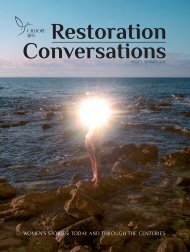
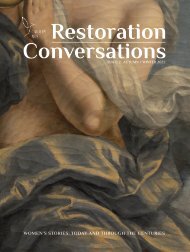

 Change language