

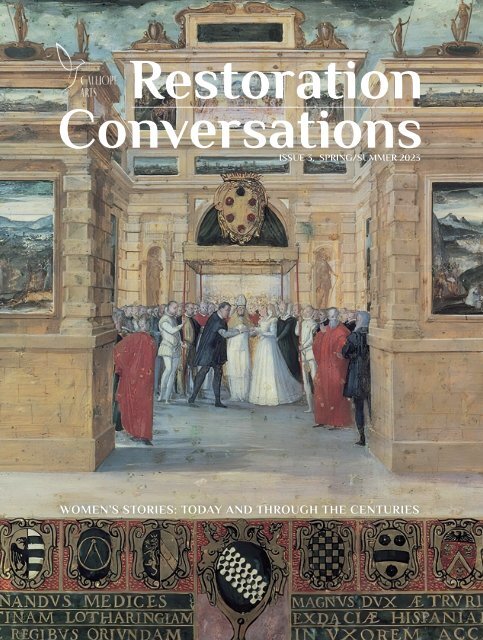
Restoration Conversations magazine - Spring-Summer 23
Restoration Conversations is a digital magazine spotlighting the achievements of women in history and today. It is released twice a year: Spring/Summer and Fall/Winter. Read ‘Friends and Strangers’, Margie MacKinnon’s article on the London-based exhibitions of painters Alice Neel and Lynette Yiadom-Boakye. This series of ‘meetings’ with modern-day and historic women – both familiar and largely unknown. Joan Mitchell painted in France, and Catherine de’ Medici introduced the fork to that country. We are indebted to Anna Maria Luisa de’ Medici who saved Florence’s art from being sold off bit by bit, once her family dynasty reached its end. We recognise many of the women included in Jann Haworth and Liberty Blake’s seven-panel monumental Work in Progress, at London’s soon-to-be reopened National Portrait Gallery. Nicole-Reine Lepaute calculated a comet’s arrival more accurately than Halley himself. Lee Miller, best known by some as merely ‘a Surrealist muse’, had the guts to bathe in Hitler’s bathtub, the day his death was announced – while working as a ‘combat photographer’, reporting from his Munich flat. Then we have the modern-day women – custodians of culture and sharers of knowledge. Wendy Grossman’s efforts to uncover the contributions of surrealist Adrienne Fedelin in ‘Hidden in Plain Sight’ is a case in point, and the same is true of art historians Ellen Landau and Joan Marter, in their new book Abstractionists, the Women on the Levett Collection in Florence. Other issue highlights: An interview with Flavia Frigeri, the art of Rosalba Carriera, women's self portraits at the Uffizi and beyond, Galileo's friendship with Christine of Lorraine, a Medici duchess, Natacha Fabbri and her musings on the Moon in science and literature, a conversation with Jennifer Higgie on Hilma af Klint, and the Artemisia Gentileschi restoration. Restoration Conversations magazine and cultural broadcast is supported by Calliope Arts – a not-for-profit organisation based in Florence and London that promotes public knowledge and appreciation of art, literature and social history from a female perspective, through restorations, exhibitions, education and cultural initiatives.
Restoration Conversations is a digital magazine spotlighting the achievements of women in history and today. It is released twice a year: Spring/Summer and Fall/Winter. Read ‘Friends and Strangers’, Margie MacKinnon’s article on the London-based exhibitions of painters Alice Neel and Lynette Yiadom-Boakye. This series of ‘meetings’ with modern-day and historic women – both familiar and largely unknown. Joan Mitchell painted in France, and Catherine de’ Medici introduced the fork to that country. We are indebted to Anna Maria Luisa de’ Medici who saved Florence’s art from being sold off bit by bit, once her family dynasty reached its end. We recognise many of the women included in Jann Haworth and Liberty Blake’s seven-panel monumental Work in Progress, at London’s soon-to-be reopened National Portrait Gallery.
Nicole-Reine Lepaute calculated a comet’s arrival more accurately than Halley himself. Lee Miller, best known by some as merely ‘a Surrealist muse’, had the guts to bathe in Hitler’s bathtub, the day his death was announced – while working as a ‘combat photographer’, reporting from his Munich flat. Then we have the modern-day women – custodians of culture and sharers of knowledge. Wendy Grossman’s efforts to uncover the contributions of surrealist Adrienne Fedelin in ‘Hidden in Plain Sight’ is a case in point, and the same is true of art historians Ellen Landau and Joan Marter, in their new book Abstractionists, the Women on the Levett Collection in Florence. Other issue highlights: An interview with Flavia Frigeri, the art of Rosalba Carriera, women's self portraits at the Uffizi and beyond, Galileo's friendship with Christine of Lorraine, a Medici duchess, Natacha Fabbri and her musings on the Moon in science and literature, a conversation with Jennifer Higgie on Hilma af Klint, and the Artemisia Gentileschi restoration.
Restoration Conversations magazine and cultural broadcast is supported by Calliope Arts – a not-for-profit organisation based in Florence and London that promotes public knowledge and appreciation of art, literature and social history from a female perspective, through restorations, exhibitions, education and cultural initiatives.

Transform your PDFs into Flipbooks and boost your revenue!
Leverage SEO-optimized Flipbooks, powerful backlinks, and multimedia content to professionally showcase your products and significantly increase your reach.
<strong>Restoration</strong><br />
<strong>Conversations</strong><br />
ISSUE 3, SPRING/SUMMER 20<strong>23</strong><br />
WOMEN’S STORIES: TODAY AND THROUGH THE CENTURIES<br />
<strong>Spring</strong> / <strong>Summer</strong> 20<strong>23</strong> • <strong>Restoration</strong> <strong>Conversations</strong> 1
Publisher<br />
Calliope Arts Ltd<br />
London, UK<br />
Managing Editor<br />
Linda Falcone<br />
Contributing Editor<br />
Margie MacKinnon<br />
Design<br />
Fiona Richards<br />
FPE Media Ltd<br />
Video maker for RC broadcasts<br />
Francesco Cacchiani<br />
Bunker Film<br />
www.calliopearts.org<br />
@calliopearts_restoration<br />
Calliope Arts<br />
2 <strong>Restoration</strong> <strong>Conversations</strong> • <strong>Spring</strong> / <strong>Summer</strong> 20<strong>23</strong>
From the Editor<br />
‘ Friends and Strangers’, the title of Margie MacKinnon’s article on the London-based<br />
exhibitions of painters Alice Neel and Lynette Yiadom-Boakye could be used to describe<br />
the whole of <strong>Restoration</strong> <strong>Conversations</strong>. Indeed, our <strong>Spring</strong> 20<strong>23</strong> issue comprises a<br />
series of ‘meetings’ with modern-day and historic women – who are, in some measure, both<br />
familiar and largely unknown. Many of their ‘facts’ may be known to us: we recall that Joan<br />
Mitchell painted in France, and that Catherine de’ Medici introduced the fork to that country.<br />
We may acknowledge our indebtedness to Anna Maria Luisa de’ Medici who saved Florence’s<br />
art from being sold off bit by bit, once her family dynasty reached its end, or recognize many<br />
of the women included in Jann Haworth and Liberty Blake’s seven-panel monumental Work<br />
in Progress, at London’s soon-to-be reopened National Portrait Gallery. At the same time,<br />
each woman featured in these pages is like a world waiting to be discovered. Nicole-Reine<br />
Lepaute calculated a comet’s arrival more accurately than Halley himself. Lee Miller, best<br />
known by some as merely ‘a Surrealist muse’, had the guts to bathe in Hitler’s bathtub, the<br />
day his death was announced – while working as a ‘combat photographer’, reporting from<br />
his Munich flat.<br />
Then we have the modern-day women – custodians of culture and disseminators of knowledge<br />
– the writers, curators and scholars whose words populate this issue. A special mention is<br />
due to Dr Wendy Grossman, who shares with us her quest to rediscover Adrienne Fedelin.<br />
Her article ‘Hidden in plain sight’ is the <strong>magazine</strong>’s first-ever unsolicited submission – a<br />
small but significant sign of growth. As we conclude this issue, whose preparation ‘devoured<br />
the hours, as if the Sun were hungry’, I am reminded of Carl Jung and his discussion on how<br />
to identify one’s vocation in life: “What did you do as a child that made the hours pass like<br />
minutes? Herein, lies the key to your earthly pursuits,” the Swiss psychoanalyst wrote. As my<br />
adult-self looking back on the girl who ‘made <strong>magazine</strong>s’ during playtime with cutouts and<br />
glue, I can only say how grateful I feel to see our minutes pass so quickly. Enjoy the issue!<br />
Fondly,<br />
Linda Falcone<br />
Managing Editor, <strong>Restoration</strong> <strong>Conversations</strong><br />
<strong>Spring</strong> / <strong>Summer</strong> 20<strong>23</strong> • <strong>Restoration</strong> <strong>Conversations</strong> 3
GRAZIE MILLE<br />
As it says on the cover, conversations are at the heart of what we do to fulfil our<br />
mission of creating a greater awareness and appreciation of the achievements<br />
of women in the arts and sciences. Thank you to the curators, authors, art historians<br />
and art conservators who took the time to sit down and explain their work to<br />
us for this issue: Lorenzo Conti, Natacha Fabbri, Flavia Frigeri, Wendy Grossman,<br />
Jennifer Higgie, Paola Lucchesi, Angela Oberer, Barbara Salvadori, Claudia Tobin<br />
and Elizabeth Wicks.<br />
We are also grateful to the institutions that have shared with us images from their<br />
exhibitions and collections: in London, the National Portrait Gallery, Tate Modern,<br />
Tate Britain and the Barbican Art Gallery; in Paris, the Fondation Louis Vuitton;<br />
in Dresden, the Gemaldegalerie Alte Meister; and in Florence, Casa Buonarroti<br />
Museum and Palazzo Strozzi.<br />
Grazie mille for the ongoing support of our partner Christian Levett and our<br />
friends and collaborators at Bloomberg Philanthropies, the British Institute of<br />
Florence, the Casa Buonarroti Museum and Foundation, Il Palmerino Cultural<br />
Association, The Florentine and the Museo Galileo.<br />
To the many visitors of the on-site restoration of Artemisia Gentileschi’s Allegory<br />
of Inclination at Casa Buonarroti, thank you for your enthusiastic (and sometimes<br />
deeply emotional) response to this project.<br />
Finally, we extend a very personal and fond acknowledgment to Monica Martin<br />
who describes <strong>Restoration</strong> <strong>Conversations</strong> as “the most beautiful <strong>magazine</strong> I have<br />
ever seen” and who continues to support our work as she begins her 100th year.<br />
4 <strong>Restoration</strong> <strong>Conversations</strong> • <strong>Spring</strong> / <strong>Summer</strong> 20<strong>23</strong>
CONTENTS: SPRING/SUMMER 20<strong>23</strong><br />
PORTRAITS AND DIALOGUES<br />
Self-representation and ‘conversations’ on canvas<br />
6 London’s National Portrait Gallery Re-opens<br />
14 Work in Progress: A Monumental Women’s Mural<br />
20 Friends and Strangers: Alice Neel and Lynette Yiadom-Boakye<br />
28 The Paradox of Rosalba Carriera<br />
36 Before the selfie: Women’s self portraits<br />
42 Reflections on the Monet — Mitchell Exhibition<br />
PAGES OF HISTORY<br />
Legacies, letters, archives and books<br />
48 Murders and Marriages: Catherine de‘ Medici<br />
54 A Letter to Madame Christine, from Galileo<br />
60 Hidden in Plain Sight: Adrienne Fidelin<br />
68 A Moveable Feast: Abstractionists, the Women<br />
74 Three Women: Many Moons<br />
80 The Other Side<br />
IN FOCUS TODAY, IN FLORENCE<br />
Follow Calliope Arts at every step<br />
84 ‘Inclination’ Update: Structure Changes<br />
89 Artemisia’s Palette<br />
94 Palace Women: Oltrano and Beyond<br />
98 Calliope Arts News in Brief<br />
<strong>Spring</strong> / <strong>Summer</strong> 20<strong>23</strong> • <strong>Restoration</strong> <strong>Conversations</strong> 5
Above: Installation shot of Vanessa Bell’s Portrait by Duncan Grant going back into the National Portrait Gallery. Photo: David Parry, National Portrait Gallery<br />
6 <strong>Restoration</strong> <strong>Conversations</strong> • <strong>Spring</strong> / <strong>Summer</strong> 20<strong>23</strong>
From Courtesans to<br />
Conceptual Artists<br />
Women in the frame at London’s re-vamped<br />
National Portrait Gallery<br />
AAfter a three-year renovation, London’s National Portrait<br />
Gallery will re-open on June 22nd, 20<strong>23</strong>. NPG’s Chanel Curator<br />
for the Collection, Dr Flavia Frigeri, spoke to Margie MacKinnon<br />
about the Reframing Narratives: Women in Portraiture project<br />
(supported by the CHANEL Culture Fund), which aims to<br />
highlight the often overlooked stories of individual women who<br />
have shaped British history and culture.<br />
<strong>Spring</strong> / <strong>Summer</strong> 20<strong>23</strong> • <strong>Restoration</strong> <strong>Conversations</strong> 7
Above: Dr. Flavia Frigeri, Chanel Curator for the Collection<br />
Photo: Isabelle Young<br />
At the start of this project, what was<br />
the balance between male and female<br />
representation at the NPG?<br />
“There were approximately 50,000 men in the<br />
collection and about 16,000 women,” Frigeri<br />
points out, “so there was a big disparity. The NPG<br />
is a history museum which means that the sitter<br />
always comes first: who is depicted in the portrait<br />
is always more important than who painted the<br />
portrait. Portraiture is something that is its own<br />
micro-environment within the macro sphere of<br />
art. Historically, the people who would have their<br />
portrait painted were people of means, the upper<br />
class. Even the women who were depicted by<br />
male artists were often from a very specific class<br />
– so it is already creating a tiered system.<br />
The goal of enhancing the visibility of women<br />
as part of the re-organisation of the NPG,” says<br />
Frigeri, “is very much a collective endeavour.<br />
I have been working with a team of curators,<br />
organised by historical period, and they were<br />
already thinking about the place of women<br />
within the re-hang. The way visibility is going<br />
to manifest itself is that, obviously, you’re going<br />
to have some of the ‘greatest hits’ on the walls.<br />
You can expect to see Elizabeth I, you can expect<br />
to see Vanessa Bell and Virginia Woolf. But, then,<br />
what we have tried to do as a team has been to<br />
weave in stories of women that are perhaps more<br />
unexpected. The difficulty is that sometimes we<br />
don’t necessarily have the best portraits for the<br />
best stories.<br />
“We are also thinking about how to educate<br />
people in terms of how to read portraits because,<br />
naturally – and this is something I also fall prey<br />
to – you walk into a room, you see a portrait in<br />
a gilded frame and immediately you think that is<br />
8 <strong>Restoration</strong> <strong>Conversations</strong> • <strong>Spring</strong> / <strong>Summer</strong> 20<strong>23</strong>
the most important person in the room. Whereas<br />
it is more of a struggle to see a small photograph,<br />
with no gilding, as being in the same league. So<br />
[when the image isn’t enough] we will be using<br />
other kinds of media that will help to tell the<br />
story in a more nuanced way.”<br />
Apart from royalty, who was the first woman<br />
in the collection?<br />
“The first woman in the collection,” Frigeri<br />
notes, “was Elizabeth Hamilton, a courtesan … I<br />
recently gave a talk in Berlin about this and I was<br />
explaining how the first man in the collection<br />
was Shakespeare. Then I had to admit to the fact<br />
that the first woman was, yes … which doesn’t take<br />
away from her as a woman. The founding fathers<br />
of the NPG were very specific when they wrote<br />
their constitution and I should stress fathers –<br />
no woman was involved. A portrait had to depict<br />
someone of worthiness, achievement, recognition<br />
and fame … and for decades women didn’t really<br />
fit any of those categories, unless they were royal<br />
or attached to the royals somehow.”<br />
When did the collection start opening up?<br />
“Until the 1960’s you could only show the portrait<br />
of someone who had been dead for at least ten<br />
years. The idea was that you needed ten years<br />
to be sure that the achievements of that person<br />
were lasting. But this rule was lifted in the 1960’s<br />
as the need to include more contemporary artists<br />
became apparent. So that is when the collection<br />
started becoming a bit more eclectic in range. In<br />
the 1970’s the trend was to collect mostly women<br />
in the arts, so we have dancers, we have writers, a<br />
lot of actors … there weren’t that many women in<br />
science – that’s a big gap.”<br />
Above: Elizabeth Hamilton, Countess de Gramont by John Giles Eccardt,<br />
after Sir Peter Lely (18th century, based on a work of c. 1663)<br />
© National Portrait Gallery, London<br />
<strong>Spring</strong> / <strong>Summer</strong> 20<strong>23</strong> • <strong>Restoration</strong> <strong>Conversations</strong> 9
Is it possible there were fewer women<br />
scientists because their male colleagues<br />
were taking credit for their work?<br />
“Yes,” Frigeri agrees, “there was some of that and it’s<br />
something we have been looking into. We recently<br />
acquired a portrait of Anne McLaren, one of the<br />
women who was instrumental in developing the<br />
science necessary for IVF. She was working with<br />
her husband at University College London for a<br />
long time and was less known than him. McLaren<br />
is an example of someone that we have recently<br />
been able to bring into the collection. For me, this<br />
is important because it is a way to push against<br />
the grain of the founding fathers and say, look,<br />
these are women worthy of that recognition.”<br />
Did the advent of photography have an<br />
impact on the collection?<br />
“It made a huge difference,” says Frigeri, “because,<br />
in a way, photography is the most emancipatory<br />
medium of them all. Photography allowed<br />
women to establish their own portrait studios.<br />
So, even if they had the ambition to go on and<br />
do more avant-garde photography, they were<br />
able to support themselves financially through<br />
their studio. The affordability of photography<br />
drove up the demand for portraits, so it became a<br />
sustainable business.<br />
We have great examples of women like Rita<br />
Martin and Lallie Charles establishing a portrait<br />
studio called The Look which was around the<br />
corner from Regent’s Park and was incredibly<br />
successful. Alice Hughes had a studio on Gower<br />
Street up in Bloomsbury and, at one point, she<br />
employed 50 women assistants. We have many<br />
of these women photographers in the collection,<br />
so it is a very strong area, dating from the 1900’s.<br />
It all began with Julia Margaret Cameron doing<br />
in photography what the Pre-Raphaelites were<br />
doing in painting.”<br />
Another aspect of the project focusses on the<br />
acquisition of new works by women. What<br />
were your guiding principles in choosing<br />
these works?<br />
“I thought about how I could make acquisitions<br />
that were relevant enough and substantial enough<br />
in the long term without ‘breaking the bank’. What<br />
Above: Dame Anne McLaren, photographer unknown, gelatin silver print, 1958, National Portrait Gallery, London<br />
10 <strong>Restoration</strong> <strong>Conversations</strong> • <strong>Spring</strong> / <strong>Summer</strong> 20<strong>23</strong>
Above: Ace (retrieved) from ‘The Photomat Portrait Series’ by Susan Hiller, 1972-3<br />
© The Estate of Susan Hiller. Purchased with kind support from the CHANEL Culture Fund for ‘Reframing Narratives: Women in Portraiture’, 2022<br />
were the things that the portrait gallery wouldn’t<br />
usually collect because they wouldn’t necessarily<br />
be seen as priorities? There was a focus on selfportraiture,<br />
created by artists who were working<br />
with a very feminist conceptual slant. These are<br />
self-portraits, but they are doing lots of other<br />
things on the side.<br />
“In Susan Hiller’s work she was taking her selfportrait<br />
using different photobooth machines<br />
around London and then collecting them. The idea<br />
is – she was taking agency away from herself and<br />
lending it to the machine, and each photobooth<br />
produces a very different kind of image. There is<br />
this piecing together of mechanically produced<br />
images, but also the suggestion that no person<br />
is a single image. We are all made up of lots of<br />
different layers. So, there is a conceptual element<br />
to this work. If you were to see it at the Tate<br />
you would probably read it with very conceptual<br />
language, but here you’re just looking at a portrait<br />
that is not a traditional portrait.<br />
“Rose Finn-Kelcey’s self-portrait is similar. You<br />
cannot see it from this image but there is a cut<br />
in the middle of the image because this was the<br />
pre-Adobe days and she had to glue and stitch<br />
together two images. This is her seated at Marble<br />
Arch at Speaker’s Corner. In this case, she is very<br />
much thinking about the fact that women have<br />
traditionally been left out of all the places where<br />
public speaking happens. She is reclaiming this<br />
space for women in terms of public speaking,<br />
but she is also thinking that the absence of that<br />
space has meant that women had a lot more<br />
existential, private speaking happening within<br />
themselves – so it’s a conversation, or internal<br />
dialogue, between the two selves.<br />
<strong>Spring</strong> / <strong>Summer</strong> 20<strong>23</strong> • <strong>Restoration</strong> <strong>Conversations</strong> 11
Above: Självporträtt, Åkersberga by Everlyn Nicodemus, 1982<br />
© the artist, courtesy of Richard Saltoun Gallery<br />
Purchased with kind support from the CHANEL Culture Fund<br />
for ‘Reframing Narratives: Women in Portraiture’, 2022<br />
“I was able to acquire this beautiful small<br />
portrait of Celia Paul,” Frigeri continues, “and then<br />
this wonderful portrait by Everlyn Nicodemus<br />
called Självporträtt, Åkersberga. This is a selfportrait<br />
she made in 1982 when she was living in<br />
Sweden and had recently given birth to a young<br />
daughter and was struggling with her marriage.<br />
She paints all of these different faces to suggest<br />
the many faces she needs to wear at once –<br />
mother, artist, lover and so forth. This is actually<br />
the first self-portrait by a black artist to enter the<br />
collection.<br />
“And then there is Maeve Gilmore, an exceptional<br />
artist. I love the intensity of her expression and I<br />
love that she is holding with such assertiveness<br />
this piece of charcoal, and just looks at you. And<br />
looking at you really says, this is my place as an<br />
artist. These are some of the works that I have<br />
been bringing into the collection with a focus<br />
on self-portraiture. They are small in number in<br />
terms of acquisitions but they are quite radical in<br />
starting the discourse and taking it in different<br />
directions.”<br />
When the National Portrait Gallery reopens,<br />
more than 200 portraits of women made after<br />
1900 and over 100 portraits created during that<br />
time by women will be exhibited. Adding to that<br />
number will be the newly commissioned Work in<br />
Progress, a group portrait of 133 notable women<br />
created by Jann Haworth and Liberty Blake. (See<br />
feature on p. 14). RC<br />
12 <strong>Restoration</strong> <strong>Conversations</strong> • <strong>Spring</strong> / <strong>Summer</strong> 20<strong>23</strong>
Above: Preparatory study for Divided Self by Rose Finn-Kelcey, 1974<br />
© The Estate of Rose Finn-Kelcey. Courtesy of Kate MacGarry Gallery<br />
Purchased with kind support from the CHANEL Culture Fund<br />
for ‘Reframing Narratives: Women in Portraiture’, 2022<br />
Left: Portrait, Eyes Lowered by Celia Paul, 2019<br />
© Celia Paul. Courtesy of the artist and Victoria Miro<br />
Purchased with kind support from the CHANEL Culture Fund<br />
for ‘Reframing Narratives: Women in Portraiture’, 2022<br />
<strong>Spring</strong> / <strong>Summer</strong> 20<strong>23</strong> • <strong>Restoration</strong> <strong>Conversations</strong> 13
Work in Progress<br />
The origins of the NPG’s monumental new mural<br />
14 <strong>Restoration</strong> <strong>Conversations</strong> • <strong>Spring</strong> / <strong>Summer</strong> 20<strong>23</strong>
In 1967, Jann Haworth and her then husband Peter Blake designed the cover for<br />
the Beatles’ Sgt. Pepper album, which features the band surrounded by a cast of<br />
characters, from Bob Dylan and Marilyn Monroe to Albert Einstein and Shirley<br />
Temple. Revisiting the cover some years later, Haworth realised it included only<br />
twelve women and, of those, half were fictional. She decided to create a new<br />
women-centred mural featuring women from all different fields who had been<br />
catalysts for change. By the time she found sponsorship for this project it was<br />
2016. In the run-up to the American election, when it seemed, in Haworth’s view,<br />
all but inevitable that Hillary Clinton would win, it was, in the artist’s words, “a<br />
Ipotent moment” to celebrate all that women had achieved.<br />
<strong>Spring</strong> / <strong>Summer</strong> 20<strong>23</strong> • <strong>Restoration</strong> <strong>Conversations</strong> 15
Liberty Blake. Photograph courtesy of the National Portrait Gallery<br />
Jann Haworth. Photograph courtesy of the National Portrait Gallery<br />
Of course, the election did not play out as she<br />
anticipated, but Haworth and her daughter,<br />
Liberty Blake, started work on the mural, which<br />
has now grown from its initial 28 feet to 60 feet<br />
in width. Made up of over 300 portraits, created<br />
by 250 participants, the mural was designed so<br />
that it can be transported from place to place<br />
and continually expanded – in other words, it is a<br />
Work in Progress.<br />
Meanwhile in London, in a break between Covid<br />
lockdowns, the National Portrait Gallery’s Flavia<br />
Frigeri “snuck out” of her Bayswater flat to visit a<br />
gallery in Mayfair where Jann Haworth was having<br />
a show. “It triggered my memory because I had<br />
seen the original Work in Progress a few years<br />
before and I thought, this could be a great thing<br />
to do in communities around the country. We<br />
commissioned Jann and Liberty to do a new Work<br />
in Progress for the NPG, celebrating 133 women. It<br />
would be a pantheon of women from Elizabeth I all<br />
the way to Vivienne Westwood and Malala.<br />
“We worked with partner institutions across the<br />
country and each institution hosted a workshop.<br />
The idea was that every person who participated<br />
in the workshops would choose an image and<br />
then make a stencilled portrait. Artists would tune<br />
in via Zoom and they would guide the participants<br />
in cutting out their images and stencilling them<br />
with colours. The stencilled portraits were sent to<br />
Jann and Liberty in Utah where they spent three<br />
months mounting them all on seven giant panels.<br />
“When you come into the National Portrait<br />
Gallery, there will be a gallery about historymakers<br />
and one whole wall will be our mural.<br />
This will set the tone for the way we want you<br />
to think about women, the way we want you to<br />
see women and the way we want to put women<br />
at the forefront. And, if you look at the top of the<br />
seventh panel, you will see an empty silhouette.<br />
Because this is a ‘work in progress’, we don’t want<br />
to suggest that this is the complete pantheon. It<br />
is a pantheon that you can keep adding to, and<br />
you can imagine whoever you want in that blank<br />
space. We are also working closely with the artists<br />
on a series of resources that we’re going to make<br />
available to schools and families so that people<br />
can go home and make their own mural. “These<br />
trailblazing women of the past,” says Frigeri, “are<br />
role models for the future.” RC<br />
Work in Progress by Jann Haworth and Liberty<br />
Blake, 2021-2. Acrylic on paper collaged on panels.<br />
Commissioned by Trustees with kind support<br />
from the CHANEL Culture Fund, 2021.<br />
16 <strong>Restoration</strong> <strong>Conversations</strong> • <strong>Spring</strong> / <strong>Summer</strong> 20<strong>23</strong>
PANEL 1<br />
Organic farmer Eve Balfour, businesswoman Anita Roddick, writer Vera Brittain, pianist Shulamith Shafir, artist and<br />
writer Mary Delany, Hospice Movement founder Cicely Saunders, peace activist Mairead Corrigan Maguire, poet<br />
and writer Sylvia Plath, sculptor Alison Wilding, writer and illustrator Beatrix Potter, surgeon Louisa Aldrich Blake,<br />
photographer Julia Margaret Cameron, classicist Mary Beard, novelists Jane Austin, Virginia Woolf and more…<br />
PANEL 2<br />
Actor and comedian Dawn French, writer and feminist Mary Wollstonecraft, nurse and army medical service reformer<br />
Florence Nightingale, Queen Elizabeth I, political activist Sylvia Pankhurst, activist for women’s rights Ishbel Hamilton-<br />
Gordon, actress Vivien Leigh, chemist and astronaut Helen Sharman, fossil collector Mary Anning, fashion model<br />
Twiggy, educator for race equality Jocelyn Barrow and more…<br />
<strong>Spring</strong> / <strong>Summer</strong> 20<strong>23</strong> • <strong>Restoration</strong> <strong>Conversations</strong> 17
PANEL 3<br />
Mental illness physician Helen Boyle, printer and writer Eleanor James, aeronautical engineer and aviator Lilian Bland, traveller<br />
and botanical artist Marianne North, pianist Harriet Cohen, aviator Amy Johnson, comedian Gina Yashere, athlete Rachel Atherton,<br />
photographer Yevonde, novelist Olivia Manning, painter Bridget Riley, social reformer Octavia Hill, archaeologist Gertrude Bell and<br />
fashion designer Mary Quant and more…<br />
PANEL 4<br />
Poet laureate Carol Ann Duffy, cartoonist Kate Charlesworth, artist Sonia Boyce, playwright Caryl Churchill, children’s writer Eva<br />
Ibbotson, actress Emma Thompson, Alice Liddell, inspiration for Lewis Carroll’s Alice in Wonderland, nurse Elizabeth Anionwu, space<br />
scientist Maggie Aderin-Pocock, chemist and crystallographer Rosalind Franklin, film director Gurinder Chadha, writer Agatha<br />
Christie, poet Christina Rossetti and more…<br />
PANEL 5<br />
Sprinter Ethel Scott, historian Joan Thirsk, abolitionist Ellen Craft, Minnie Lansbury, writer Zadie Smith, Paralympic athlete and<br />
broadcaster Tanni Grey-Thompson, designer and painter E.Q. Nicholson, portrait painter Mary Beale, co-founder of Girl Guides<br />
Agnes Baden-Powell, writer J.K Rowling, Boxer and Olympian Nicola Adams, human rights lawyer Shami Chakrabarti, activist and<br />
writer Mala Sen, tennis player Charlotte Cooper and more…<br />
18 <strong>Restoration</strong> <strong>Conversations</strong> • <strong>Spring</strong> / <strong>Summer</strong> 20<strong>23</strong>
PANEL 6<br />
Sculptor Barbara Hepworth, suffragette leader Emmeline Pankhurst, artist and curator Lubaina Himid, singer-songwriter Amy<br />
Winehouse, painter Vanessa Bell, suffragette Sophia Duleep Singh, physicist and radio astronomer Jocelyn Bell Burnell, comedian<br />
and disability rights activist Barbara Lisicki, ballet dancer Margot Fonteyn, actor Olivia Colman, children’s poet and writer Grace<br />
Nichols, model for Pre-Raphaelite artists Fanny Eaton and more…<br />
PANEL 7<br />
Actress Julie Andrews, illustrator Jessie M. King, journalist and historian Jan Morris, painter Joan Eardley, nurse and business woman<br />
Mary Seacole, artistic director and champion of disability arts Jenny Sealey, singer-songwriter Kate Bush, artist Eileen Agar, social<br />
reformer and theatre manager Emma Cons, artist Gillian Wearing, journalist Kate Adie, artist Paula Rego, electrical engineer and<br />
inventor Hertha Ayrton, cellist Jacqueline du Prè and more…<br />
<strong>Spring</strong> / <strong>Summer</strong> 20<strong>23</strong> • <strong>Restoration</strong> <strong>Conversations</strong> 19
Friends and Strangers<br />
Portraits by Alice Neel<br />
and Lynette Yiadom-Boakye<br />
Two London exhibitions, one just ended, the<br />
other ongoing, illustrate the continuing<br />
allure of portrait painting in Western art<br />
and its possibilities for radical re-invention.<br />
Tate Britain recently hosted Fly in League with<br />
the Night, a show of some 80 paintings and<br />
works on paper created by London-born artist<br />
Lynette Yiadom-Boakye. At the Barbican, works<br />
from the American painter Alice Neel’s 60-year<br />
career are currently on display under the title<br />
Hot off the Griddle.<br />
In their own way, each of these artists brought,<br />
or brings, a revolutionary approach to portrait<br />
painting. Neel explained that one of her reasons<br />
for painting “was to catch life as it goes by, right<br />
hot off the griddle”. She welcomed sitters into<br />
her home, chatted away to them, and invited<br />
them to share their own stories. She painted<br />
figuratively when the prevailing trend favoured<br />
Abstract Expressionism. While the AbEx artists<br />
created works that reflected their reactions to a<br />
period of tumultuous change, Neel hid her own<br />
struggles behind a smile and brought out the<br />
feelings of her subjects. “I paint to try to reveal<br />
the tragedy and joy of life,” she said.<br />
Despite appearances to the contrary, Yiadom-<br />
Boakye’s paintings are not portraiture in the<br />
traditional sense. The subjects are not real<br />
people, but creations of the artist’s imagination,<br />
based on a combination of memory, family<br />
snapshots, images from <strong>magazine</strong>s collected in<br />
scrapbooks and details of paintings. A writer, as<br />
well as an artist, Yiadom-Boakye says, “I write<br />
about the things I can’t paint and paint the things<br />
I can’t write about …”. These fictional, nameless<br />
strangers seem every bit as full of humanity as<br />
Neel’s living, breathing sitters.<br />
ALICE NEEL<br />
Born at the turn of the last century, Alice Neel<br />
grew up in a small town in Pennsylvania. Her<br />
parents were not artists and she had little<br />
exposure to culture, but, somehow, she knew<br />
from a young age that she would become an<br />
artist. In 1921, she began her art studies at the<br />
Philadelphia School of Design for Women (also<br />
known, because of its conservative reputation, as<br />
the ‘Philadelphia School for Designing Women’).<br />
She met Cuban artist Carlos Enriquez Gomez at<br />
a summer art course in 1924, and they married<br />
the following year. Their first child, a daughter<br />
named Santillana, tragically died just before her<br />
first birthday. By then the couple had moved<br />
to New York where Neel soon had a second<br />
daughter, Isabetta. Husband and wife continued<br />
to paint but struggled to support themselves,<br />
moving to ever cheaper accommodation. In<br />
May of 1930, Gomez took Isabetta with him to<br />
Havana, telling Neel he would send money back<br />
to enable her to join them. The money never<br />
materialised, and Neel only saw her daughter a<br />
handful of times after that.<br />
20 <strong>Restoration</strong> <strong>Conversations</strong> • <strong>Spring</strong> / <strong>Summer</strong> 20<strong>23</strong>
Above, left: Alice Neel. 1977. Mary D. Garrard.<br />
© The Estate of Alice Neel<br />
Courtesy of The Estate of Alice Neel<br />
Above, right: Alice Neel, 1960. Frank O’Hara.<br />
© The Estate of Alice Neel<br />
Courtesy of The Estate of Alice Neel<br />
<strong>Spring</strong> / <strong>Summer</strong> 20<strong>23</strong> • <strong>Restoration</strong> <strong>Conversations</strong> 21
This trauma seems to have informed much<br />
of Neel’s work and underscores the difficulty<br />
experienced by so many female painters of<br />
combining life as an artist with motherhood.<br />
Following the stock market crash and during<br />
the period of the Great Depression in the 1930’s,<br />
life was punishingly hard. Countless artists,<br />
including Neel, were saved from starvation by<br />
the government-sponsored Federal Art Project<br />
which paid unemployed artists a small salary in<br />
exchange for producing works of art to decorate<br />
public buildings. The deprivation of these times<br />
produced in Neel a “desire to bear witness to<br />
the hardships of life as experienced by most<br />
Americans” in that decade. Neel’s salary from the<br />
Art Project allowed her to secure an apartment<br />
which she also used as studio space. At the same<br />
time, she joined the Communist Party, an event<br />
that would later lead the FBI to open a file on her<br />
and even show up at her door to investigate her,<br />
having identified Neel as a ‘romantic, Bohemian<br />
type Communist’. Characteristically, she was<br />
sanguine about the encounter and asked if<br />
the agents would be interested in sitting for a<br />
painting. (They declined.)<br />
In the 1940’s, when up-and-coming artists such<br />
as Lee Krasner, Elaine de Kooning and Grace<br />
Hartigan were moving downtown to convert<br />
lofts into studios and creating pioneering works<br />
of Abstract Expressionism, Neel moved north to<br />
Spanish Harlem and persisted with figurative<br />
painting, largely dismissed as an artist out of step<br />
with the times. But it was there that she met the<br />
subjects for her works, however unfashionable<br />
they may have been. She was, she said, “not<br />
against abstraction, but against saying that Man<br />
himself has no importance.”<br />
Neel’s T.B. Harlem (1940) is a comment on<br />
the epidemic of TB that had broken out in<br />
overcrowded areas of New York. It depicts an<br />
unnamed young man who is recovering in a<br />
tuberculosis hospital. Before effective antibiotics<br />
were widely available, TB treatment was brutal.<br />
Left, top: Alice Neel, 1940. T.B. Harlem. © The Estate of Alice Neel<br />
Courtesy of The Estate of Alice Neel<br />
Left: Alice Neel, 1943. The Spanish Family. © The Estate of Alice<br />
Neel. Courtesy of The Estate of Alice Neel<br />
22 <strong>Restoration</strong> <strong>Conversations</strong> • <strong>Spring</strong> / <strong>Summer</strong> 20<strong>23</strong>
The bandage on the left of the man’s chest is<br />
from a thoracoplasty, a surgical procedure which<br />
involved removing several ribs and collapsing<br />
the affected lung. The painting is simple, with a<br />
muted colour palette, making the blood seeping<br />
out from under the bandage more evident. The<br />
plain background draws the viewer towards the<br />
man’s face, which registers a resigned stoicism.<br />
He is just one man among many suffering a<br />
similar fate.<br />
The loss of her mother, in 1954 at the age of<br />
86, sent Neel into a deep depression that lasted<br />
over the next few years and, in 1958, she began<br />
to see a therapist for the first time. Neel credits<br />
her therapist with encouraging her to be more<br />
ambitious with her work and “getting it into the<br />
world”. She summoned the courage to approach<br />
the poet Frank O’Hara, then a curator at the<br />
Museum of Modern Art, to sit for her. The picture<br />
appeared in ARTnews alongside an enthusiastic<br />
review describing how “her paintings cast a spell’.<br />
This marked a turning point in Neel’s career,<br />
and she began to paint more recognisable figures,<br />
including Andy Warhol. His portrait reveals Neel’s<br />
remarkable ability to get her sitters to trust<br />
her, allowing her to paint them with all their<br />
vulnerabilities. In Warhol’s case, this included<br />
showing the scars that had resulted from a vicious<br />
assault by Valerie Solanas, a former member of<br />
Warhol’s Factory entourage.<br />
Other well-known faces amongst Neel’s sitters<br />
included feminists Kate Millet (whose portrait<br />
Neel was commissioned to paint for the cover<br />
of Time <strong>magazine</strong>), Mary D. Garrard (known<br />
for her ground-breaking studies of Artemisia<br />
Gentileschi) and Linda Nochlin (author of ‘Why<br />
are there no great women artists?’) Neel’s ability<br />
to disarm seems not to have worked on Garrard,<br />
who looks particularly ill-at-ease in the familiar<br />
blue and white striped chair. Still wearing her<br />
hat, coat and scarf, she looks directly at the artist,<br />
as if daring her to reveal anything beyond her<br />
inscrutable surface. Nochlin is painted with her<br />
young daughter, Daisy. Apparently, Neel was keen<br />
to portray Nochlin as both an intellectual and a<br />
mother. She told the eminent art historian, “you<br />
don’t look anxious, but you are anxious”. Perhaps<br />
she was projecting her own maternal anxiety<br />
onto her sitter.<br />
Neel would have to wait until 1974, when she<br />
was 74 years old, to have the first retrospective<br />
exhibition of her work, which was held at the<br />
Whitney Museum of Art in New York. The<br />
Barbican art director, Will Gompertz, describes<br />
Neel’s portraits as “the very opposite of an<br />
Instagram image … You can’t photograph what<br />
Alice Neel painted. Her ability to simultaneously<br />
show a sitter’s conscious and unconscious state,<br />
and imperceptibly morph the two, was a magic<br />
trick of sorts … She didn’t simply paint faces, she<br />
revealed souls.”<br />
Right: Alice Neel, 1929. Alice Neel at the age of 29.<br />
© The Estate of Alice Neel<br />
Courtesy of The Estate of Alice Neel<br />
<strong>Spring</strong> / <strong>Summer</strong> 20<strong>23</strong> • <strong>Restoration</strong> <strong>Conversations</strong> <strong>23</strong>
Above: Lynette Yiadom-Boakye, 2011. Condor and the Mole, Arts Council Collection, Southbank Centre, London. © Courtesy of Lynette Yiadom-Boakye<br />
Right: Installation shot at the Tate, Madeline Buddo<br />
24 <strong>Restoration</strong> <strong>Conversations</strong> • <strong>Spring</strong> / <strong>Summer</strong> 20<strong>23</strong>
LYNETTE YIADOM-BOAKYE<br />
British artist Lynette Yiadom-Boakye, born in<br />
London in 1977 to Ghanaian parents, is one<br />
of a number of artists who have transformed<br />
portraiture over the last decade. Her recent<br />
exhibition at London’s venerable Tate Britain<br />
follows earlier shows in Munich, Basel and New<br />
York, among others. Some of her works are also<br />
featured in the Reaching for the Stars exhibition<br />
at Florence’s Palazzo Strozzi.<br />
Yiadom-Boakye’s works, while recognisably<br />
part of the continuum of European portraiture,<br />
are innovative in their subject-matter, style and<br />
atmosphere. Most notably, rather than working<br />
with live models, Yiadom-Boakye draws from her<br />
experience as a writer to create her own fictional<br />
subjects. In doing so, she turns the aphorism that<br />
‘portraits are the one genre of art in which the<br />
subject is more important than the artist’ on its<br />
head. “Over time,” she says, “I realised I needed<br />
to think less about the subject and more about<br />
the painting. So I began to think seriously about<br />
colour, light and composition.”<br />
The artist also subtly subverts traditional<br />
portraiture in rejecting the genre’s conventional<br />
function of not only creating a likeness, but<br />
conveying the sitter’s class and status, usually by<br />
including symbolic objects denoting education,<br />
wealth and power – or their opposites. Yiadom-<br />
Boakye’s subjects are difficult to place within a<br />
social group or culture or a specific place or time<br />
period. This timeless quality is deliberate, as it<br />
requires the viewer to engage with the subject<br />
and to use their curiosity to project their own<br />
interpretations and imagine the story behind the<br />
painting.<br />
The canvases depict young men and women,<br />
by themselves or in small groups, many larger<br />
than life-sized. The scale adds to the quality of<br />
the work. Very broadly and confidently painted,<br />
the compositions are intriguing, drawing the<br />
viewer in. “Her painting of dark skin in shadow,<br />
circumambient gloaming or night is superb,” says<br />
critic Laura Cumming. “She makes a strong virtue<br />
of contrapposto, chiaroscuro and the sumptuous<br />
sinking of oil into linen.”<br />
<strong>Spring</strong> / <strong>Summer</strong> 20<strong>23</strong> • <strong>Restoration</strong> <strong>Conversations</strong> 25
Above, left: Lynette Yiadom-Boakye, 2018<br />
To Improvise a Mountain. Private Collection<br />
© Courtesy of Lynette Yiadom-Boakye<br />
Photo: Marcus Leith<br />
Above, right: Lynette Yiadom-Boakye, 2014<br />
Citrine by the Ounce. Private Collection<br />
© Courtesy of Lynette Yiadom-Boakye<br />
A young male dancer stretches at the barre while<br />
his friends engage in conversation nearby, two girls<br />
play in the rockpools along a beach, absorbed in their<br />
activity and each other, a woman with an elaborate<br />
frilly collar stares out unblinkingly from the canvas<br />
– is she willing you to come closer or daring you to<br />
stay away? In Penny for Them (2014), another woman<br />
resting her chin in her hand is lost in thought. In<br />
each case, the audience may be reminded of a<br />
painting they have seen or a memory from their own<br />
life. It is up to us to give these characters their story.<br />
Tate Britain is home to a collection of British<br />
artworks dating back to 1545. Seeing a whole<br />
gallery there filled with her work is a powerful<br />
experience. “That Yiadom-Boakye’s subjects happen<br />
to be Black, reflecting her own identity, reminds us<br />
of the overwhelming whiteness of the tradition of<br />
[European portraiture],” notes the museum’s Director,<br />
Alex Farquharson. Yiadom-Boakye points out that,<br />
“Blackness has never been other to me. Therefore,<br />
I’ve never felt the need to explain its presence in the<br />
26 <strong>Restoration</strong> <strong>Conversations</strong> • <strong>Spring</strong> / <strong>Summer</strong> 20<strong>23</strong>
work anymore than I’ve felt the need to explain my<br />
presence in the world, however often I’m asked.”<br />
Despite their many differences – in background,<br />
style and subject matter – Neel and Yiadom-Boakye<br />
have both succeeded in ‘bringing out whatever their<br />
subjects have in common with the rest of humanity’,<br />
the goal that art historian Erwin Panofsky identified as<br />
the central desire of Renaissance artists. Neel talked<br />
to her subjects as if they were old friends, allowing<br />
them to relax and drop their guard so that she could<br />
catch something of their inner nature. Yiadom-<br />
Boakye’s fictional sitters are enigmatic ‘strangers’ on<br />
whom we can project our own thoughts and desires.<br />
By thinking about what we see in them, we learn<br />
something about ourselves. RC<br />
Above, left: Lynette Yiadom-Boakye, 2020<br />
Razorbill, Tate<br />
© Courtesy of Lynette Yiadom-Boakye<br />
Above, right: Lynette Yiadom-Boakye, 2017<br />
In Lieu of Keen Virtue<br />
© Courtesy of Lynette Yiadom-Boakye, Corvi-Mora, London<br />
and Jack Shainman Gallery, New York<br />
Alice Neel: Hot off the Griddle is at London’s Barbican<br />
Art Gallery until 21 May 20<strong>23</strong><br />
Reaching for the Stars is at Palazzo Strozzi, Florence,<br />
until 18 June 20<strong>23</strong><br />
<strong>Spring</strong> / <strong>Summer</strong> 20<strong>23</strong> • <strong>Restoration</strong> <strong>Conversations</strong> 27
Above: Rosalba Carriera, A Black-haired Lady with a Thin Gold Necklace. © Gemäldegalerie Alte Meister, Staatliche Kunstsammlungen Dresden. Photo: Elke Estel/ Hans-Peter Klut<br />
28 <strong>Restoration</strong> <strong>Conversations</strong> • <strong>Spring</strong> / <strong>Summer</strong> 20<strong>23</strong>
Artemisia’s<br />
‘A Rare Talent’<br />
The paradox of Rosalba Carriera<br />
I<br />
have not come across another artist that<br />
has been so completely neglected after so<br />
much success.” Angela Oberer is talking<br />
about Venetian painter Rosalba Carriera (1673-<br />
1757), a celebrated artist in her day and one<br />
of the most successful women artists of any<br />
era. Known as the ‘first painter of Europe’, her<br />
pastels were highly admired by 18th-century<br />
European collectors, and prominent foreign<br />
visitors to Venice and Grand Tourists were<br />
eager to sit for portraits by her. An astute<br />
entrepreneur, she set new trends in style and<br />
technique, and was admitted to membership<br />
of three art academies.<br />
For one hundred years after her death,<br />
Carriera continued to enjoy recognition and<br />
influence as an accomplished artist. And<br />
then, as dramatically as it had risen, her star<br />
plummeted, and she lapsed into relative<br />
obscurity. Carriera’s story presents us with a<br />
paradox: how did she achieve her remarkable<br />
professional and financial success at a time<br />
when so few women were able to make a living<br />
at their art, and how did she subsequently<br />
come to be all but forgotten?<br />
On the 350th anniversary of Carriera’s birth<br />
and the eve of a major exhibition of her work<br />
in Dresden, Angela Oberer, a professor and<br />
art historian who has authored two books on<br />
“<br />
Carriera, gave a talk at the British Institute of<br />
Florence about her interest in a painter who<br />
was highly sought-after as a miniaturist and<br />
portrait painter, but who subsequently fell out<br />
of fashion.<br />
Oberer has been researching Carriera<br />
for over ten years. “I had a special interest<br />
in sisters,” she explains. “I have an older<br />
sister, and I just wanted to understand this<br />
funny relationship … so I was looking for a<br />
painter with one or more sisters. And then I<br />
stumbled across that self-portrait of Carriera<br />
with her sister Giovanna.” (See feature on<br />
p .36). A fortuitous match between researcher<br />
and subject seemed all but inevitable when<br />
Oberer tracked down two volumes at the<br />
Biblioteca Laurenziana in Florence containing<br />
transcriptions of Carriera’s correspondence<br />
and diaries – a cache of documents comprising<br />
over 800 pages. In other words, a scholar’s<br />
dream come true. Combing through this<br />
archive over several years has enabled Oberer<br />
to understand how Carriera achieved her<br />
renown, despite all the usual impediments to<br />
be overcome as a female artist.<br />
Carriera’s early life and training remain<br />
something of a mystery. Unusually for female<br />
artists of her era, she did not come from an<br />
artistic family. Although various scholars have<br />
<strong>Spring</strong> / <strong>Summer</strong> 20<strong>23</strong> • <strong>Restoration</strong> <strong>Conversations</strong> 29
Left: Rosalba Carriera, 1730/31<br />
Self-portrait as Winter<br />
Photo: Katrin Jacob<br />
& Wolfgang Kreische<br />
Right, clockwise from top left:<br />
Rosalba Carriera, A Young<br />
Gentleman in a Puffy Blue<br />
Coat<br />
Photo: Elke Estel<br />
& Hans-Peter Klut<br />
Rosalba Carriera, c. 1725/30<br />
A Lady with a Parrot on her<br />
Right Hand (Allegory of<br />
Eloquence)<br />
Photo: Marina Langner<br />
& Wolfgang Kreische<br />
Rosalba Carriera, c. 1735/40<br />
A Venetian from the House of<br />
Barbarigo (Caterina Sagredo<br />
Barbarigo)<br />
Photo: Marina Langner<br />
& Wolfgang Kreische<br />
Rosalba Carriera, 1730<br />
Archduchess Maria Theresia<br />
of Habsburg<br />
Photo: Elke Estel<br />
& Hans-Peter Klut<br />
All images © Gemäldegalerie<br />
Alte Meister, Staatliche<br />
Kunstsammlungen Dresden<br />
tried to identify who her first teachers might<br />
have been, Oberer notes that, “So far, we don’t<br />
have any documents to state definitively who<br />
she studied with, if anyone. Maybe she was<br />
mainly self-taught?”<br />
Carriera began her career helping her<br />
mother with her embroidery and lace-making<br />
business. When snuff-taking became popular<br />
during the second half of the 17th century,<br />
Carriera took advantage of the opportunity<br />
to begin painting miniatures for the lids of<br />
snuffboxes. She not only had a particular talent<br />
for working at this scale, but she benefitted<br />
from a dearth of miniaturists in her home city<br />
of Venice, where her male contemporaries were<br />
busy competing for lucrative commissions for<br />
altarpieces, city views and fresco painting.<br />
Showing further initiative, Carriera became<br />
one of the first painters to use ivory instead<br />
of vellum as a support for miniatures. “She<br />
got a name for her miniatures very quickly<br />
and, one curious and fun fact is that some of<br />
30 <strong>Restoration</strong> <strong>Conversations</strong> • <strong>Spring</strong> / <strong>Summer</strong> 20<strong>23</strong>
<strong>Spring</strong> / <strong>Summer</strong> 20<strong>23</strong> • <strong>Restoration</strong> <strong>Conversations</strong> 31
Rosalba Carriera, Female Study Head in Grey-purple Coat<br />
© Gemäldegalerie Alte Meister, Staatliche Kunstsammlungen Dresden<br />
Photo: Elke Estel & Hans-Peter Klut<br />
the letters mention that forgeries of her work<br />
were already being offered for sale in Venice,”<br />
Oberer observes.<br />
Carriera was also quick to spot an<br />
opportunity in Venice’s growing tourist trade.<br />
The city was an obligatory stop on the Grand<br />
Tour undertaken by young sons and daughters<br />
of the nobility, as well a favourite destination<br />
for other prominent visitors and diplomats.<br />
Carriera used her networking skills to develop<br />
a market for portraits. Once again, her genius<br />
for innovation came to the fore as she began<br />
producing these portraits in pastel, a medium<br />
that had, until then, been used mainly for<br />
preparatory drawings.<br />
Carriera’s popularity helped to encourage<br />
the production of high-quality pastel sticks<br />
in varied textures and in a greater range of<br />
colours than had previously been available.<br />
Pastel portraits came to be seen as equivalent<br />
in quality to oil portraits; they offered other<br />
advantages as well: the materials were<br />
cheaper and easier to transport, portraits could<br />
be executed quickly as there was no drying<br />
time, and fewer sittings were required, a boon<br />
to both artist and subject. On the other hand,<br />
pastel is a notoriously fragile medium, subject<br />
to fading when exposed to light. Unlike oils,<br />
pastels’ vulnerability to fading is increased<br />
because they are not protected by a varnish,<br />
nor are the powdery components surrounded<br />
by a resin. The works had to be covered with<br />
glass, but this was not available in a large<br />
format. “Carriera’s portraits have a kind of<br />
standard size”, notes Oberer. “They didn’t get<br />
much higher than around 60 centimetres.”<br />
Great care was required when shipping them<br />
to their owners. “Carriera had a beautiful way<br />
of sending off her portraits with a little token,<br />
tucked between the painting’s wooden support<br />
and the canvas liner, placed there to protect it<br />
on its journey.” One such token was a tiny print<br />
of the three Magi, thought to be appropriate<br />
guardians because of their association with<br />
long, difficult journeys.<br />
32 <strong>Restoration</strong> <strong>Conversations</strong> • <strong>Spring</strong> / <strong>Summer</strong> 20<strong>23</strong>
Her visit to Paris in 1720-21, as the guest of the<br />
influential collector and connoisseur Pierre<br />
Crozat, sparked a widespread interest in<br />
portraits in pastel that continued throughout<br />
eighteenth-century Europe. While in Paris,<br />
Carriera painted the French artist Antoine<br />
Watteau, as well as numerous portraits of the<br />
French nobility including the young Louis<br />
XV. She was elected a member of the Paris<br />
Academy by acclamation, the first foreigner<br />
and only the fifth woman to receive that<br />
honour. While this event is recorded in her<br />
diary, Carriera seems not to have been overly<br />
excited by it. “This was objectively one of the<br />
most incredible events in her life,” remarks<br />
Oberer, “and she just basically writes ‘I was<br />
accepted in the Academy by a great majority’”.<br />
This tendency towards self-effacement was<br />
also evidenced by her inclination to downplay<br />
her impressive financial success. She seems to<br />
have taken the view that her prospects would<br />
benefit from remaining modest about her<br />
accomplishments (and wealth) and presenting<br />
herself to the art world as a quiet, unassuming<br />
spinster.<br />
While preferring, as much as possible, to live<br />
and work in Venice, which helped to reduce her<br />
expenses, Carriera made a long journey to the<br />
royal court in Vienna, Austria, in 1730. There,<br />
she enjoyed the patronage of Emperor Charles<br />
VI, who amassed a large collection of more<br />
than 150 of her pastels. These would later form<br />
the basis of the collection of the Alte Meister<br />
Gallery in Dresden, still the owner of the largest<br />
number of works by the artist. Pastel was<br />
prized for the lifelike quality it conferred on<br />
its subjects and for its ability to reflect, rather<br />
than absorb, light. Carriera’s pastels were<br />
noted in particular for their radiant palettes<br />
and velvety finish. She also brought her skills<br />
as a miniaturist to the finer details. Part of<br />
the appeal of owning a portrait by Carriera<br />
was the identifiable style of the paintings. As<br />
Carriera’s renown grew, her sitters clamoured<br />
to be painted with what Oberer has called the<br />
Rosalba Carriera, 1720/21. King Louis XV of France<br />
© Gemäldegalerie Alte Meister, Staatliche Kunstsammlungen Dresden<br />
Photo: Marina Langner & Wolfgang Kreische<br />
<strong>Spring</strong> / <strong>Summer</strong> 20<strong>23</strong> • <strong>Restoration</strong> <strong>Conversations</strong> 33
Carriera ‘mask’. Oberer argues that the fashion<br />
to be painted ‘by Carriera’ developed into a<br />
desire to ‘be a Carriera’. The ‘sameness’ of her<br />
portraits, noted by some critics, was not due to<br />
a lack of skill or imagination on Carriera’s part,<br />
but simply a consequence of compliance with<br />
the desires of her clients.<br />
Key to Carriera’s success was her acumen as<br />
a businesswoman. “She knew very well how<br />
to organise her business, with the help of her<br />
sister and her mother,” says Oberer. “There<br />
were so many people involved, so many<br />
letters to write and answer, so many packages<br />
to prepare. And there were copies to be made,<br />
because her sister made a lot of copies of the<br />
portraits.” The nerve centre of this operation<br />
was Carriera’s palazzo on the Grand Canal.<br />
Recognised professionally by prestigious<br />
art academies, she was an innovator in her<br />
use of ivory, her popularising of pastels<br />
and her ‘branding’ of the Carriera style.<br />
She had numerous followers, and her<br />
impact continued to be felt for decades<br />
after her death.<br />
Among the documents that Oberer studied<br />
was a room-by-room inventory of the contents<br />
of this property which provided clues as<br />
to how Carriera carried on her business.<br />
The main room, facing out onto the canal,<br />
contained over 30 paintings (mainly pastels),<br />
five mirrors, 14 chairs (but no table), and an<br />
array of porcelain cups and Chinese trays for<br />
serving the then-exotic beverages tea, coffee<br />
and chocolate. This was not just a living room,<br />
Oberer concluded. “It was her studio, it was<br />
her museum and sales room. It was the room<br />
where she received guests and held concerts.”<br />
(In addition to her artistic talent, Carriera was<br />
an accomplished musician.) One can imagine<br />
aristocratic visitors sipping hot chocolate from<br />
delicate chinoiserie cups and inspecting the<br />
rosy-cheeked portraits displayed on the walls,<br />
all the while pondering how they might look<br />
as ‘a Carriera’.<br />
Rosalba Carriera achieved everything<br />
that is thought necessary to be considered<br />
a ‘great artist’. Recognised professionally<br />
by prestigious art academies, she was an<br />
innovator in her use of ivory, her popularising<br />
of pastels and her ‘branding’ of the Carriera<br />
style. She had numerous followers, and her<br />
impact continued to be felt for decades after<br />
her death. But when the Rococo style gave<br />
way to Neoclassicism, Carriera’s name and<br />
her influence were dismissed. What accounts<br />
for this? The light and playful style of the<br />
Rococo period became associated with the<br />
superficiality of France’s ancien regime and all<br />
the frivolity and excesses that encompassed.<br />
It was, perhaps, easy to overlook works that<br />
lacked a seriousness of purpose and ignored<br />
the economic and social realities of life. There<br />
is also the fact that the paintings themselves,<br />
because of their fragility, were difficult to<br />
transport without risk of damage and, as a<br />
result, were not exhibited widely. Until now, the<br />
only monographic exhibition of her work was<br />
held in 1975, in Karlsruhe.<br />
And then there is the question of gender.<br />
Carriera was treated as a rarity as a woman<br />
artist. She endured offensive descriptions<br />
of her appearance by critics who seemed<br />
to suggest that her artistic talent had a<br />
direct inverse relationship to her perceived<br />
unattractiveness. “Just as nature was miserly in<br />
her external gifts all the more did she endow<br />
her with very rare internal talents which<br />
she cultivated with every care,” Anton Maria<br />
Zanetti the Younger wrote of Carriera in 1771.<br />
Unmarried, childless, as sublimely talented<br />
as she was (apparently) lacking in beauty, it<br />
was easy to think of Carriera as something<br />
of an aberration and perhaps, for this reason,<br />
easier to forget. The upcoming exhibition in<br />
Dresden of Carriera’s works and the soon-tobe-published<br />
book by Angela Oberer on the<br />
artist will go some way to redress the balance.<br />
By coincidence, in 1948, another trendsetting<br />
woman art entrepreneur, Peggy Guggenheim<br />
(who also had to put up with disparaging<br />
comments on her appearance), would<br />
purchase the palazzo next door to what had<br />
been Carriera’s residence on the Grand Canal.<br />
That palazzo became the home of the Peggy<br />
Guggenheim Collection, one of the most<br />
visited museums in Venice. Two remarkable<br />
women who became next-door neighbours<br />
across the centuries, successful despite the<br />
odds against them. RC<br />
34 <strong>Restoration</strong> <strong>Conversations</strong> • <strong>Spring</strong> / <strong>Summer</strong> 20<strong>23</strong>
Rosalba Carriera, Mary with her Left Hand on her Breast. © Gemäldegalerie Alte Meister, Staatliche<br />
Kunstsammlungen Dresden. Photo: Wolfgang Kreische<br />
You can watch the video recording of Angela Oberer’s lecture Rosalba Carriera:<br />
The First Painter of Europe on the Calliope Arts YouTube channel This is one of a<br />
series of lectures on women artists at the British Institute of Florence sponsored<br />
by Calliope Arts.<br />
Rosalba Carriera by Angela Oberer, part of the Lund, Humphries series ‘Illuminating<br />
Women Artists’ will be published on June 15, 20<strong>23</strong>.<br />
Celebrating the 350th anniversary of her birth, the exhibition Rosalba Carriera –<br />
Perfection in Pastel is on at the Alte Meister Gallery in Dresden from 9 June to 24<br />
September 20<strong>23</strong>.<br />
<strong>Spring</strong> / <strong>Summer</strong> 20<strong>23</strong> • <strong>Restoration</strong> <strong>Conversations</strong> 35
Above: Anna Waser, 1691, Self-portrait at the Age of 12. Kunsthaus, Zürich, Wikimedia Commons<br />
36 <strong>Restoration</strong> <strong>Conversations</strong> • <strong>Spring</strong> / <strong>Summer</strong> 20<strong>23</strong>
Before the Selfie<br />
A few words on women’s self-portraits<br />
I“I have been paying a lot of attention to how women artists<br />
chose to depict themselves. Every decision is very deliberate in<br />
self-portraits. In the age of the ‘selfie’, where any one of us can<br />
just pick up a phone and take a ‘self-portrait’, I think it becomes<br />
even more pivotal to understand the meaning of those portraits<br />
and those choices,” says Flavia Frigeri, who has spent the past<br />
two and a half years thinking about how women are represented<br />
at Britain’s National Portrait Gallery.<br />
A self-portrait is never just a likeness of the artist, but a female<br />
self-portrait is particularly loaded. The artist often displays the<br />
tools of her trade – a palette, a paintbrush and easel – or includes<br />
objects, such as flowers or elaborate fabrics, to show off her<br />
particular skills as a painter. She may even include her children,<br />
identifying as a mother. She might present an ‘air-brushed’<br />
version of herself, either out of vanity or for marketing purposes.<br />
But, most importantly, she creates a calling card that says, ‘I am a<br />
woman and I am an artist’.<br />
The self-portraits of women artists sometimes depict their family<br />
members – usually fathers or uncles, also in the painting trade,<br />
as a symbol of standing. More rarely, they paint their children or<br />
mothers beside them. Rolinda Sharples’ 1820 self-portrait with<br />
mother Ellen, at the Bristol City Art Museum and Gallery, is one<br />
delightful example. Painting one’s master was equally common<br />
in early self-portraiture, as a way of claiming one’s spot as ‘true<br />
heir’ to the craft. Such is the case of Anna Waser’s 1691 painting<br />
at the Kunsthaus in Zürich once known by its original title: Selfportrait<br />
in the artist’s twelfth year, painting the portrait of her<br />
teacher Johannes Sulzer. At Stockholm’s Nationalmuseum, Mimmi<br />
Zetterström’s self-portrait from 1876 is equally worthy of note.<br />
She paints herself working alone, yet, in this colourful scene, her<br />
atelier or workroom, is a character-of-sorts – and the walls speak<br />
volumes about her prolific nature as a painter.<br />
<strong>Spring</strong> / <strong>Summer</strong> 20<strong>23</strong> • <strong>Restoration</strong> <strong>Conversations</strong> 37
Left: Alice Neel, 1980. Self-Portrait<br />
© The Estate of Alice Neel<br />
Courtesy of The Estate of Alice Neel<br />
Above: Rolinda Sharples, 1820<br />
Self-portrait with the Artist’s Mother Ellen Sharples<br />
Bristol City Museum and Art Gallery, Wikimedia Commons<br />
Many of the artists featured in this issue of<br />
<strong>Restoration</strong> <strong>Conversations</strong> have created one or<br />
more self-portraits that provide us clues to their<br />
personalities. Alice Neel completed her first selfportrait<br />
at the age of 80. “All my life I’ve wanted to<br />
paint a self-portrait,” Neel declared. “But I waited<br />
until now, when people would accuse me of<br />
insanity rather than vanity.” She painted herself<br />
nude, and presents herself as both artist, holding<br />
a paintbrush, and subject, seated in the striped<br />
blue and white chair that featured in many of<br />
her portraits. Not unlike her subjects, she looks<br />
slightly awkward, with her feet splayed and her<br />
torso leaning forward rather than relaxing into<br />
the chair. But the tilt of her chin seems to say, ‘this<br />
is who I am – an artist who tells it like it is.’<br />
Rosalba Carriera was another artist who did<br />
not shy away from painting herself in old(er)<br />
age. Indeed, as Jennifer Higgie points out in The<br />
Mirror and the Palette, in Carriera’s 1730-31 pastel<br />
Self-Portrait as ‘Winter’, she “depicted herself<br />
not only as someone who has aged, but as the<br />
embodiment of the passing of the seasons, as if<br />
she were not only a woman but a landscape as<br />
well.” She is not troubled with vanity. Her grey<br />
hair matches the fur draped around her neck; no<br />
rouge brightens up her cheeks or enhances her<br />
slightly pursed lips [Editor’s note: this painting is<br />
featured at Carriera’s Dresden: show, p. 30]. We<br />
acquire more insight into her inner life with her<br />
1715 Self-portrait Holding a Portrait of her Sister.<br />
Here, again, she presents an unvarnished ‘warts<br />
38 <strong>Restoration</strong> <strong>Conversations</strong> • <strong>Spring</strong> / <strong>Summer</strong> 20<strong>23</strong>
Above: Rosalba Carriera, 1709<br />
Self-portrait Holding a Portrait of her Sister<br />
Uffizi Galleries, Florence<br />
Right: Mimmi Zetterström, 1876, Self-portrait<br />
Nationalmuseum, Stockholm<br />
Wikimedia Commons<br />
and all’ version of herself, but the fact that she<br />
includes her sister in the picture demonstrates<br />
the importance of this relationship and the depth<br />
of feeling between them. And this is all the more<br />
so when we consider that this was the painting<br />
Carriera contributed to the Medici collection of<br />
self-portraits at the Uffizi Gallery in Florence.<br />
Initiated by Cardinal Leopoldo de’ Medici in<br />
the seventeenth century, this extensive collection<br />
comprises some 1,800 paintings. Until it was<br />
closed for renovations in 2016, 600 self-portraits<br />
were exhibited in the Vasari Corridor, which<br />
connects the Palazzo Vecchio, via the Uffizi and<br />
the Ponte Vecchio, to the Palazzo Pitti on the other<br />
side of the Arno River. Because the Medici Grand<br />
Dukes were particularly keen to collect female<br />
self-portraits, this prestigious series boasts the<br />
highest concentration of works by women artists<br />
available for public viewing in the world. For<br />
anyone fortunate enough to have taken it, the<br />
‘Vasari Corridor tour’ was revelatory – who knew<br />
there were so many recognised female painters<br />
going back to the 1500’s?<br />
When the Vasari Corridor reopens, at a date yet to<br />
be disclosed, it will no longer house the self-portrait<br />
collection. Perhaps the women’s self-portraits will<br />
be dispersed throughout the collection across<br />
different periods. Or perhaps they will be part of<br />
a rotating group of self-portraits in a designated<br />
gallery. But it seems certain that the impact of<br />
concentrating so many works of and by women in<br />
a unique part of the museum will be lost.<br />
<strong>Spring</strong> / <strong>Summer</strong> 20<strong>23</strong> • <strong>Restoration</strong> <strong>Conversations</strong> 39
40 <strong>Restoration</strong> <strong>Conversations</strong> • <strong>Spring</strong> / <strong>Summer</strong> 20<strong>23</strong>
One self-portrait that is missing from<br />
the Medici collection is that of Artemisia<br />
Gentileschi. This is surprising given that she<br />
lived and worked in Florence for seven years<br />
and was patronised by Cosimo II de’ Medici.<br />
It sometimes appears as if every female<br />
protagonist in her paintings, whether saint,<br />
Biblical heroine or allegorical figure, is mooted<br />
as a possible ‘self-portrait’. This applies to her<br />
‘Allegory of Inclination’ currently the subject of<br />
a restoration at Casa Buonarroti. Commissioned<br />
by Michelangelo the Younger, and planned<br />
by him in every detail, the commission was<br />
“particularly audacious,” in the words of art<br />
historian Sheila Barker, “because it called for<br />
female nudity in a canvas meant for semipublic<br />
display … Had it been painted by a man,<br />
the female nudity would have been perceived<br />
as an allegorical attribute; however, because it<br />
was painted by an attractive young woman, the<br />
nude body could be taken as a literal reference<br />
to the artist’s own body.”<br />
Barker goes on to explain that “rather than<br />
trying to forestall that inevitable association,<br />
Artemisia embraced it by giving her own<br />
idealised facial features to the nude figure.<br />
In reality, that nude figure, which is seen<br />
from below and, therefore, required difficult<br />
foreshortening, was necessarily made with the<br />
assistance of a female model …”<br />
Artemisia would have been pleased to be<br />
identified with the allegorical figure in the<br />
Inclination because she aspired to be seen<br />
as possessing the same attributes that were<br />
associated with Michelangelo. But it seems to<br />
beg the question, when is a self-portrait not a<br />
self-portrait …? RC<br />
Above: 15th-century depiction of Roman painter Iaia at work, from<br />
Giovanni Boccaccio’s De Mulieribus Claris<br />
Bibliothèque nationale de France. Wikimedia Commons<br />
Left: Artemisia Gentileschi, 1615. Allegory of Inclination<br />
Casa Buonarroti Museum, Florence,<br />
under restoration by Calliope Arts and Christian Levett<br />
FURTHER READING:<br />
Barker, Sheila, Artemisia Gentileschi,<br />
Lund Humphries, London, 2022<br />
Higgie, Jennifer, The Mirror and the Palette,<br />
Weidenfeld & Nicolson, London, 2021<br />
<strong>Spring</strong> / <strong>Summer</strong> 20<strong>23</strong> • <strong>Restoration</strong> <strong>Conversations</strong> 41
All About Joan<br />
Reflections on the Monet-Mitchell exhibition<br />
at Fondation Louis Vuitton<br />
By Margie MacKinnon<br />
When I told an artist friend about my (then)<br />
upcoming weekend in Paris, the highlight<br />
of which was to be a visit to the Monet–<br />
Mitchell exhibition, she briefly deflated my spirits<br />
by saying she had found the show disappointing.<br />
The juxtaposition of the American’s works next<br />
to those of the great French master, she opined,<br />
did not enhance Mitchell’s paintings, but made<br />
them seem ‘derivative’. I am happy to report<br />
that my own impression was quite the opposite.<br />
The exhibition was a wonderful showcase of<br />
Mitchell’s works, and she had no trouble holding<br />
her own when viewed ‘in dialogue’ with one of<br />
Impressionism’s greatest exponents.<br />
FLV’s artistic director, Suzanne Page, a visitor<br />
to Joan Mitchell’s home in Vétheuil in 1982,<br />
claimed that the artist “hated” being compared<br />
to Claude Monet, but such comparisons were all<br />
but inevitable given that, for many years, Mitchell<br />
lived in a house whose terrace overlooked the<br />
residence where Monet spent the final years of<br />
his life. Her view was the landscape that he often<br />
painted. Many Abstract Expressionist painters,<br />
including Mitchell, were inspired by Monet’s<br />
large-scale works, such as his celebrated water<br />
lilies series. Perhaps Mitchell, who was intensely<br />
competitive, thought she could not come out on<br />
top in such a comparison, given Monet’s exalted<br />
stature in the art world.<br />
Born in 1925, Mitchell grew up in a well-to-do<br />
family in Chicago. According to Mary Gabriel in<br />
her authoritative chronicle Ninth Street Women,<br />
Joan’s mother was distant, and her father was so<br />
disappointed she was not a boy that he wrote the<br />
name ‘John’ on her birth certificate. Perhaps in a<br />
bid to win her father’s approval, Mitchell took up<br />
a variety of sports – figure skating, diving and<br />
tennis – at which she excelled. She attacked her<br />
art studies at the School of the Art Institute of<br />
Chicago with equal determination.<br />
Upon graduation she won a travelling fellowship<br />
and a print prize that led to her first mention in<br />
ArtNews. By 1950, Mitchell was in New York where<br />
she soon wangled an introduction to Willem de<br />
Kooning, who would have a major influence on<br />
her early work. She joined the group of artists,<br />
Right: Installation<br />
views of Joan Mitchell<br />
Retrospective. Courtesy of<br />
Fondation Louis Vuitton<br />
42 <strong>Restoration</strong> <strong>Conversations</strong> • <strong>Spring</strong> / <strong>Summer</strong> 20<strong>23</strong>
<strong>Spring</strong> / <strong>Summer</strong> 20<strong>23</strong> • <strong>Restoration</strong> <strong>Conversations</strong> 43
Below: Joan Mitchell, 1971. Plowed Field, Fondation Louis Vuitton, Paris © The Estate of Joan Mitchell<br />
including Grace Hartigan and Elaine de Kooning,<br />
that congregated at the Cedar Bar. In 1951, the<br />
three of them, together with Lee Krasner and<br />
Helen Frankenthaler would be the only women<br />
to be included in what would become known as<br />
the ‘Ninth Street Show’, a seminal moment in the<br />
American Abstract Expressionist movement in art.<br />
I arrived at the Fondation Louis Vuitton, on<br />
the edge of the Bois de Boulogne, some thirty<br />
minutes before the time designated on my<br />
ticket. The clear skies promised by the weather<br />
forecast gave way to a grey drizzle, but even<br />
this didn’t dampen my spirits. The Fondation’s<br />
Frank Gehry-designed building is a mesmerising<br />
confection of geometric curves and lines. The<br />
architect took his inspiration from the lightness<br />
of late nineteenth-century glass and garden<br />
architecture, and the building’s twelve glass sails<br />
play with the light and reflections of water from<br />
the basin in which it stands, creating an ideal<br />
setting for this exhibition.<br />
I hadn’t realised that, as well as the Monet–<br />
Mitchell dialogue on the upper floors, the<br />
museum was hosting a retrospective of Mitchell’s<br />
work, beginning with an untitled abstract painting<br />
from 1950 that was quite similar to the one she<br />
exhibited at the ‘Ninth Street Show’. Nearby<br />
was The Bridge, 1956, Mitchell’s first polyptych,<br />
which became her signature form from the early<br />
1960’s onward. A note beside the work explains<br />
that the title “invokes a mix of references, to the<br />
bridges her grandfather built in Chicago, her first<br />
New York apartment under Brooklyn Bridge, and<br />
the bridges of Paris … as well as her frequent<br />
transatlantic crossings.”<br />
While some of the early paintings are almost<br />
monochromatic, many of the later works are<br />
brimming with colour. Ode to Joy, 1970-71,<br />
combines vibrant yellows and blues in what<br />
could be an abstract bouquet of flowers. The<br />
title invokes the final movement of Beethoven’s<br />
Ninth Symphony, as well as a poem of the same<br />
44 <strong>Restoration</strong> <strong>Conversations</strong> • <strong>Spring</strong> / <strong>Summer</strong> 20<strong>23</strong>
Above: Joan Mitchell, 1983. Detail, La Grande Vallee XIV (For a Little While), Centre Pompidou, Paris, Musée National d’Art Moderne/Centre de création industrielle<br />
© The Estate of Joan Mitchell. Below: Claude Monet, 1916-1919. Les Agapanthes, Courtesy of Musée Marmottan Monet, Paris<br />
name by Frank O’Hara. Mitchell would say that,<br />
“music, poems, landscape and dogs make me<br />
want to paint. And painting is what allows me<br />
to survive.” Plowed Field, 1971, is an imposing<br />
triptych combining blocks of earthy greens and<br />
deep yellows. Highlights of pinks, maroon and<br />
teal unite the three panels in what Mitchell said<br />
was a “homage to Vincent perhaps …”<br />
When Mitchell moved permanently to Vétheuil,<br />
late in 1968, the landscape surrounding her large<br />
property had a dramatic effect on her work.<br />
Describing the huge sunflowers, almost three<br />
meters high, that surrounded the house, she<br />
said, “they look so wonderful when young and<br />
they are so moving when they are dying. I don’t<br />
like fields of sunflowers. I like them alone, or, of<br />
course, painted by Van Gogh.” Her admiration for<br />
him is evidenced in Two Sunflowers, 1980, a large<br />
diptych of brilliant golden yellows.<br />
The dialogue between the artists began on<br />
the upper levels. Monumental works by each<br />
of them, placed side by side, allowed visitors to<br />
<strong>Spring</strong> / <strong>Summer</strong> 20<strong>23</strong> • <strong>Restoration</strong> <strong>Conversations</strong> 45
Left: Claude Monet, 1916-1919. Nymphéas, Huile sur<br />
toile, Courtesy of Musée Marmottan Monet, Paris<br />
Left, bottom: Installation views of Joan Mitchell<br />
Retrospective. Courtesy of Fondation Louis Vuitton<br />
Yellow diptych on the right is Two Sunflowers, 1980<br />
46 <strong>Restoration</strong> <strong>Conversations</strong> • <strong>Spring</strong> / <strong>Summer</strong> 20<strong>23</strong>
Above: Joan Mitchell, 1976. Quatuor II for Betsy Jolas, Paris, Musée national d’art moderne, Centre Pompidou, en dépôt au musée de Peinture et de Sculpture, Grenoble<br />
Courtesy of Joan Mitchell Foundation © The Estate of Joan Mitchell<br />
draw comparisons between them, noting obvious<br />
similarities as well as areas of divergence. There<br />
was a familiar magnificence to Monet’s watery<br />
landscapes of blues, greens and violets – for who<br />
has not seen at least a reproduction of some of<br />
the many paintings of his gardens at Giverny?<br />
Monet worked for ten years on the huge canvases<br />
of his Agapanthus triptych, brought together here<br />
for the first time since 1956. He had been “wild<br />
with the need to put down what I experience. To<br />
render what I feel,” he said, “I totally forget the<br />
most basic rules of painting – if they even exist.”<br />
Monet’s last works, painted when his eyesight<br />
was failing, became ever more abstract. Though<br />
he could barely see, he continued to paint from<br />
memory and imagination. The influence on<br />
Mitchell’s works, in form and colour, is evident<br />
but, in her hands, the landscape dissolves into<br />
pure abstraction.<br />
The final room contained the dreamlike<br />
experience of Mitchell’s La Grande Vallee. Painted<br />
between 1983 and 1984, the cycle is made up of<br />
21 paintings. As curatorial notes explain, “they<br />
are characterised by the density of the pictorial<br />
surfaces. The sparseness of the whites and<br />
the lack of perspective are unique. The artist’s<br />
distinctive chromatic range is evident: cobalt<br />
blue and rapeseed yellow prevail alongside a<br />
multitude of greens, pinks and purples.” This<br />
series of works was exhibited in two stages by<br />
Mitchell’s gallerist, Jean Fournier, in 1984. It has<br />
never been shown in its entirety. At FLV, ten of<br />
the paintings had been assembled, making it the<br />
largest display since the cycle’s first presentation.<br />
The inspiration for these paintings was a<br />
memory twice removed from the artist. Mitchell<br />
had never seen ‘la grande vallee’ herself. It had<br />
been described to her by a friend as a special<br />
place she had visited in childhood with a cousin,<br />
who, shortly before his death, had longed to<br />
return there. “Painting is the opposite of death,”<br />
said Mitchell. “It permits one to survive. It also<br />
permits one to live.”<br />
For me, La Grande Vallee was the highest of the<br />
exhibition’s many highlights. To stand immersed<br />
in the colours bursting from Joan Mitchell’s<br />
canvasses was a life affirming experience.<br />
Nothing derivative about it. RC<br />
FURTHER READING:<br />
Gabriel, Mary, Ninth Street Women<br />
Little, Brown and Co., New York, 2018<br />
<strong>Spring</strong> / <strong>Summer</strong> 20<strong>23</strong> • <strong>Restoration</strong> <strong>Conversations</strong> 47
Murders and<br />
marriages<br />
Catherine de’ Medici goes ‘full circle’<br />
By Linda Falcone<br />
Catherine de’ Medici, one of history’s<br />
most famous queen consorts, brought<br />
the fork to France, along with porcelain<br />
tableware, and imported new-world<br />
specialties the court had never seen,<br />
including chocolate, coffee, even<br />
potatoes. She introduced the wearing of<br />
underwear, donned the country’s first pair<br />
of high-heeled shoes on her wedding day,<br />
and brought in fads like perfumed gloves<br />
– which she was rumored to use against<br />
her enemies, when politics warranted a<br />
touch of poison.<br />
It took Catherine and Henry II nearly a<br />
decade to get pregnant, after the couple<br />
wed in 1533 – both at fourteen – while<br />
the boy was still the Prince of Orléans.<br />
When Catherine finally conceived, it was<br />
not thanks to the diviners, magicians and<br />
medics who worked for years to boost<br />
her fertility, borrowing from their gilded<br />
books of rules and remedies. The potion<br />
recorded as helping the queen was her<br />
chef’s bird-giblet broth, whose benefits<br />
were apparently enduring. Catherine<br />
ultimately produced ten children, seven<br />
of whom survived to ‘marriageable age’.<br />
When Henry II was accidently killed<br />
during a jousting match, in 1559, she<br />
served as regent for two of her kingly<br />
sons – Francis II and Charles XI – who<br />
ascended to the throne while underage,<br />
and would continue to exercise<br />
considerable influence over the French<br />
court, even after her third son Henry III<br />
was crowned, in adulthood.<br />
48 <strong>Restoration</strong> <strong>Conversations</strong> • <strong>Spring</strong> / <strong>Summer</strong> 20<strong>23</strong>
Above: Francesco Bianchi Bonavita,<br />
1627. Detail, The Wedding of<br />
Catherine de’ Medici to Duke Henri<br />
of Orleans, Private Collection<br />
Right: Il Volterrano, 1636-1646.<br />
Catherine de’ Medici and her Son<br />
Medici Villa, La Petraia, Tuscany<br />
<strong>Spring</strong> / <strong>Summer</strong> 20<strong>23</strong> • <strong>Restoration</strong> <strong>Conversations</strong> 49
Left: Workshop of François Clouet, 1561<br />
Catherine de’ Medici and her Children,<br />
Strawberry Hill House<br />
Below: : Édouard Debat-Ponsan, 1880<br />
One Morning at the Gates of the<br />
Louvre, Musée d’Art Roger-Quilliot,<br />
Clermont-Ferrand, France<br />
Right: Yvan Lastes, 2012<br />
Château de Chenonceau, view from<br />
the northeast, showing the chapel and<br />
library, Wikimedia Commons<br />
50 <strong>Restoration</strong> <strong>Conversations</strong> • <strong>Spring</strong> / <strong>Summer</strong> 20<strong>23</strong>
In novels and films, including Alexandre<br />
Dumas’ La Reine Margot, Catherine is portrayed<br />
as supreme antagonist, who pushes her unwilling<br />
daughter Marguerite into a loveless marriage to<br />
Henri of Navarre, a prominent member of the<br />
Huguenots, a French Protestant group. Strangely,<br />
just days after the couple’s wedding, in 1572,<br />
Catherine is blamed as being the mastermind<br />
behind the Saint Bartholomew Day’s massacre<br />
– during which thousands of Protestants were<br />
brutally murdered in Paris, at the hands of<br />
Catholic nobles. Doubts remain regarding the<br />
extent of Catherine’s alleged involvement in this<br />
bloody incident, which is, in any case, indicative<br />
of the religious strife that plagued the country<br />
throughout her reign and regency.<br />
Partly heightened for fictional purposes,<br />
the scheming side of Catherine’s personality<br />
is downplayed or even disregarded, in her<br />
hometown today. Indeed, she is highly regarded,<br />
more for her cultural contributions, than for<br />
her political maneuvering. Catherine was a<br />
true Medici daughter, in her belief that the<br />
production of art, performances, architecture<br />
and fine artisanship would divert the French<br />
monarchy from its otherwise inevitable decline,<br />
already underway, prior to her arrival. One of<br />
her most notable achievements was her support<br />
of the development of ballet, brought to France<br />
through her patronage, following its debut in<br />
Italy. The Ballet Comique de la Reine, which<br />
she commissioned in 1581, is celebrated as the<br />
first-ever ballet de cour. Catherine’s passion<br />
for architecture, which she discovered after the<br />
age of 40, is also well noted, albeit much of her<br />
architectural legacy has since been destroyed.<br />
She designed the Tuileries herself, inspired by<br />
Florence’s Pitti Palace, and Chenonceaux, which<br />
she expanded, after booting her late husband’s<br />
mistress Diane De Poitiers from the chateau, is<br />
known as her ‘unfinished masterpiece’.<br />
Plots and patronage aside, another of Catherine’s<br />
legacies lies in her skillful marriage negotiations.<br />
Although the Medici never made good on the<br />
<strong>Spring</strong> / <strong>Summer</strong> 20<strong>23</strong> • <strong>Restoration</strong> <strong>Conversations</strong> 51
Above: Salimbeni Ventura, XVI century. Wedding of Grand Duke Ferdinand I de’ Medici to Christine of Lorraine, National Archives of Siena<br />
Right: Orazio Scarabelli, c. 1589. Naumachia in the Court of Palazzo Pitti, documenting the wedding of Ferdinand I de’ Medici and Christine of Lorraine, the MET, New York<br />
52 <strong>Restoration</strong> <strong>Conversations</strong> • <strong>Spring</strong> / <strong>Summer</strong> 20<strong>23</strong>
dowry the French royals were promised when<br />
she tied the knot, Catherine knew that weddings<br />
were a highest-bidder business, and the oldest<br />
form of political strategy. In her world, wives<br />
were the way to guarantee generations of<br />
power. Though Catherine was unsuccessful in<br />
convincing England’s Queen Elizabeth I to marry<br />
one of her frail sons, she did manage to place<br />
two of her own daughters in strategic marriages<br />
meant to ensure the continuance of the House<br />
of Valois. Catherine’s daughter Elizabeth was wed<br />
to the ultra-powerful Philip II of Spain; Claude,<br />
her second-born – known as Claudia, in Italy –<br />
was given in marriage to Charles III of Lorraine.<br />
Their spirited daughter Christine was Catherine’s<br />
favourite.<br />
Like Catherine herself, little Christine lost her<br />
mother in infancy. To her grandmother’s delight,<br />
she was highly intelligent, and historians have<br />
made it a point to emphasize that she was<br />
not a beauty, at least by the standards of her<br />
contemporaries. Catherine, whom the French<br />
people had snubbed as a ‘shopkeeper’s daughter’<br />
before cluing into the resourcefulness of her<br />
character, knew that being a ‘beauty’ was not<br />
everything. She had gained the court’s respect<br />
eventually, and it had not been because of the<br />
gowns she’d brought, which were so-bejeweled<br />
no fabric was needed as lining. Pretty or not,<br />
her darling Christine was bred for Florentine<br />
marriage. Gaining a foothold in Catherine’s native<br />
city would allow the older woman to return ‘full<br />
circle’ to the land of her youth – at least in spirit.<br />
The opportunity they were waiting for presented<br />
itself following the death of Florence’s Grand Duke<br />
Francesco and his second wife Bianca Cappello.<br />
Catherine proposed Christine as ‘candidate’, when<br />
the late ruler’s brother, Cardinal Ferdinando, cast<br />
off ‘the cloth’, and began seeking a woman with<br />
whom to secure the dynasty’s continuance.<br />
Catherine was convinced the pair would get along<br />
well, ultimately. They did, in fact. Never mind that<br />
Ferdinando may have been the one to put the<br />
‘strange’ in the strange circumstances surrounding<br />
Francesco and Bianca’s death, possibly through<br />
arsenic poisoning.<br />
Christine de Lorraine married Ferdinando<br />
through proxy, and the conditions of that<br />
agreement were negotiated by Queen Catherine<br />
herself, but the bride did not arrive in Florence,<br />
until nearly two years after their union was<br />
made official, first due to her father’s death, and<br />
later, because she refused to leave the ailing<br />
Catherine’s bedside.<br />
Christine finally made the trip to Florence,<br />
in 1589, after her grandmother’s funeral. She<br />
entered Medici wonderland, fittingly prepared<br />
for a month-long nuptial celebration full of<br />
public festivals, of a scale and grandeur that<br />
only the Medici could muster. Pitti’s courtyard<br />
was purposely flooded for the reenactment of a<br />
naval battle in which Christian ships stormed a<br />
Turkish fort. The verses of Dante, Ovid, Plato and<br />
Plutarch were woven together in six ‘intermezzi’<br />
performances, whose overall message was<br />
meant to ward off evil and open the gates of a<br />
Golden Age made possible through a new Medici<br />
marriage. Their wedding can only be compared to<br />
the modern reader’s idea of a world fair. Christina<br />
was a French princess and a Medici – she had<br />
all the background she’d ever need to drive the<br />
Duchy forward. Poetry, pageantry, performance<br />
and craftsmanship – any media was worthy, when<br />
it came to welcoming a marriage whose destiny,<br />
was ‘written in the stars’, a good omen, many<br />
believed, for subjects and sovereigns alike. RC<br />
<strong>Spring</strong> / <strong>Summer</strong> 20<strong>23</strong> • <strong>Restoration</strong> <strong>Conversations</strong> 53
Above: Stefano Della Bella, 1656. Galileo and Personifications of Astronomy, Perspective and Mathematics<br />
Frontispiece for the Works of Galileo Galilei, Kupferstichkabinett, Berlin<br />
Inset: One of two extant telescopes used by Galileo, 1609. Galileo Museum, Florence<br />
54 <strong>Restoration</strong> <strong>Conversations</strong> • <strong>Spring</strong> / <strong>Summer</strong> 20<strong>23</strong>
The telescope,<br />
a thorny issue<br />
S<br />
A<br />
letter to Madame Christine<br />
SEEKING SOLUTIONS<br />
In a 1656 etching by Florentine artist Stefano<br />
della Bella, the personifications of Astronomy,<br />
Perspective, and Mathematics give their undivided<br />
attention to Galileo’s instruments, without so<br />
much as a glance towards the stars he strives<br />
to explain. This whimsical work, created for<br />
the frontispiece of The Works of Galileo Galilei,<br />
published some 14 years after the scientist’s<br />
death, shows Professor Galileo on bended knee.<br />
He may be seeking grace or recognition from the<br />
ladies before him, and his supplication would<br />
be no surprise. For a good four hundred years,<br />
from the Renaissance to the French Revolution,<br />
allegorical figures populated the higher spheres<br />
of scholarship, no matter the discipline. Virtues<br />
and Learning could transport humans to great<br />
heights and, to do so, they adopted the female<br />
form, like Liberty with her flag unfurled, or<br />
Justice, the blind but all-seeing lady who would,<br />
eventually, set things right.<br />
By nature, the lady allegories are inspirers,<br />
and they served the Pisan scientist well. Yet, in<br />
1615, Galileo, as a supporter of the sun-centred<br />
theories of Copernicus, needed more than<br />
inspiration – he needed protection. His studies,<br />
The Sidereal Message, authored five years earlier<br />
were ground-breaking for ‘the Earth revolves<br />
around the Sun’ idea, which displeased the<br />
Clergy who advocated the geocentric cosmos<br />
described in Biblical verses. With the rest of the<br />
world still believing in a geocentric Universe,<br />
Galileo needed friends in high places. Christine<br />
de Lorraine was one, Galileo thought, for science<br />
was among the Grand Duchess’s many interests.<br />
A PATRON, A PROFESSOR<br />
Galileo and Christine of Lorraine held each<br />
other in high esteem, perhaps they would have<br />
been friends – had their ranks, genders and<br />
era permitted it. It was she who had called him<br />
in from Padua – then part of another country<br />
– to tutor the Medici<br />
heirs. Overseeing<br />
the education of<br />
her children –<br />
and Christine<br />
produced ten<br />
of them with<br />
Ferdinando I –<br />
was a ‘duchess<br />
duty’ which<br />
she transformed<br />
<strong>Spring</strong> / <strong>Summer</strong> 20<strong>23</strong> • <strong>Restoration</strong> <strong>Conversations</strong> 55
into an achievement. Her children were to have<br />
a classic education, yet it would also include<br />
modern languages and cutting-edge scientific<br />
theory. In some ways you could say that having<br />
Galileo as her staffer, starting in the summer of<br />
1605, was mutually beneficial.<br />
For Christine, as a seventeenth-century dynasty<br />
wife, astronomy was key. The boundless skies<br />
above her head was like landscape unclaimed,<br />
and what better way to live in perpetuity than<br />
to link her boys’ names to the stars? Galileo,<br />
on his end, wanted political protection (and<br />
economic security!) in a world fast approaching<br />
the Inquisition, and the discovery of Jupiter’s four<br />
moons helped to secure it, for he christened his<br />
moons the ‘Medicean stars’ and dedicated The<br />
Sidereal Message to Christine’s oldest son, the<br />
Grand Duke Cosimo II. As a boy of 14, Cosimo<br />
II had what Galileo considered a mathematical<br />
mind. The scientist gifted him his military compass<br />
and telescope, as a personal token. Incidentally,<br />
Cosimo II became Grand Duke at 19, but he would<br />
die young and without great popularity. One of<br />
the lasting legacies of his rule (1609 to 1621) was<br />
the protection he provided his former tutor, who<br />
despite the Inquisition, was allowed to continue<br />
to study in Tuscany relatively undisturbed.<br />
Cosimo II appointed Galileo “Philosopher and<br />
Mathematician” of the Medici court in Florence<br />
and supported his research in astronomy and<br />
physics.<br />
A letter for Madame Christine<br />
In addition to her love for the stars, Christine’s<br />
Catholicism made her a well-suited Medici wife<br />
– for issues of papal power, not faith – but as<br />
Dowager, she was criticised for her acquiescence<br />
to Roman power. Still, piety seems to have been<br />
a genuine personal concern, in addition to her<br />
real desire to understand how viable science<br />
could stand in contrast with Scripture. She<br />
asked Galileo’s pupils to elucidate this issue<br />
on several occasions, and ultimately, Galileo’s<br />
response came in letter form. “The Letter to the<br />
Grand Duchess Christina of Lorraine” associates<br />
56 <strong>Restoration</strong> <strong>Conversations</strong> • <strong>Spring</strong> / <strong>Summer</strong> 20<strong>23</strong>
the Grand Duchess’ name with the thorny issue<br />
of the dialogue between science and religion,<br />
explains Natacha Fabbri, professor of History of<br />
Science and a project coordinator at Florence’s<br />
Galileo Museum, and an author of several books<br />
on Copernican theory. “One of the so-called<br />
‘Copernican letters’, it is a small treatise, in which<br />
Galileo claimed the autonomy of scientific study<br />
from religion, defending himself and the other<br />
Copernican astronomers from the charge of<br />
heresy. Galileo argued the need to distinguish<br />
two different fields: Biblical interpretation and<br />
scientific research. When discussing astronomical<br />
matters, research should be led by ‘sensory<br />
experience’ and ‘mathematical demonstration’,<br />
not by the traditional interpretation of the Bible<br />
provided by Church forefathers. In one famous<br />
line to Christine, he writes, ‘The Bible teaches how<br />
to go to heaven, not how the heavens go’.”<br />
CHRISTINE AND THE COSMOS<br />
The Grand Duchess Dowager never answered<br />
the letter,” Natacha says, “and perhaps her silence<br />
was wise.” Not long after the letter was penned,<br />
Copernicus’ book On the Revolutions of the Celestial<br />
Orbs (1543) was listed on the Index of Prohibited<br />
Books, with the clause “forbidden until corrected”,<br />
and Heliocentrism was declared heretical. Galileo’s<br />
trial was 16 years away, but his letter – which<br />
circulated in manuscript form for some 20 months<br />
before being published in Latin – would ultimately<br />
be a piece of ‘evidence’ used against him.<br />
As for Christine, the jury is still out on<br />
whether she is the bigot she was painted as,<br />
posthumously. Modern-day art historians like<br />
Adelina Modesti and Christina Strunck remind<br />
today’s ‘audiences’ that historical women who<br />
are not forgotten, are often remembered as weak<br />
or wily, or at best power-hungry and bigoted. As<br />
Left: Cristofano Allori<br />
c. 1609. Cosimo II, Grand Duke<br />
of Tuscany<br />
Museo del Prado<br />
Wikipedia Commons<br />
Above: Jacques Callot, c. 1614<br />
The Marriage of Ferdinand I<br />
de’ Medici and Christine of<br />
Lorraine<br />
National Museum of Western<br />
Art, Tokyo<br />
<strong>Spring</strong> / <strong>Summer</strong> 20<strong>23</strong> • <strong>Restoration</strong> <strong>Conversations</strong> 57
Above: First intermezzo of the<br />
play La Pellegrina: Harmony<br />
of the Spheres, from 1589<br />
Medici wedding, stage design<br />
by Bernardo Buontalenti<br />
Grand Duchess and Dowager, Christine does not<br />
fit into the first categories and she may have<br />
been the latter, but, in this forum the question<br />
better posed is this: Did she actually have power<br />
enough to intercede in Galileo’s favour? Would a<br />
response letter from her have helped or further<br />
harmed her Pisan friend?<br />
We do know that a number of Galileo’s peers<br />
thought it inappropriate for him to address a<br />
scientific treatise-of-sorts to a lay person (and<br />
a woman) – whatever her political rank might<br />
be. They doubted the Grand Duchess’s ability<br />
to understand the content of his letter or fully<br />
grasp the repercussions of his science. Certainly,<br />
Christine was no mathematician, but it bears<br />
remembering that her introduction to the cosmos<br />
– or at least her day’s conception of it – did<br />
not begin with her employment of Galileo. The<br />
subject had intrigued her since that first lavish<br />
performance of ‘The Harmony of the Spheres’,<br />
staged at the Uffizi theatre on one of her many<br />
wedding days (celebrated over a month and a half<br />
in the spring of 1589). The show was one of her<br />
first lessons in cosmology. “Traditionally, Medici<br />
family weddings were celebrated with parades<br />
and performances representing planets, stars and,<br />
more generally, the heavens,” Natacha explains.<br />
“The Medici’s interest in the cosmos was rooted<br />
in the name of the dynasty’s founder Cosimo I,<br />
and reminiscent of the well-established tradition<br />
whereby the universe was seen as the perfect<br />
model for rulers and politicians to follow.” These<br />
set designs were crafted by none other than<br />
painter and draughtsman Bernardo Buontalenti,<br />
whose universe was largely allegorical. Natacha<br />
describes as it as an “apotheosis of deities and<br />
beautiful nature, surrounded by celestial sirens<br />
that moved circularly around the personification<br />
of Harmony, singing to recall the perfection and<br />
beauty of the heavens.”<br />
Sirens aside, Christine’s nuptials brought her<br />
close to the cosmos in another way as well.<br />
58 <strong>Restoration</strong> <strong>Conversations</strong> • <strong>Spring</strong> / <strong>Summer</strong> 20<strong>23</strong>
In addition to the never-ending wedding<br />
pageant he planned, Ferdinando I commissioned<br />
a ‘cosmological model’ that celebrates their<br />
union. The revered Antonio Santucci, Galileo’s<br />
predecessor as Chair of the Mathematics at<br />
the University of Pisa, designed the 3-meter<br />
high gilded beech wood model, which took five<br />
years to complete, from 1588 to 1593. Its outer<br />
celestial sphere contains seven inner spheres<br />
designed to rotate around the central planet<br />
Earth. The system moves through the sidereal<br />
belt – the 12 signs of the zodiac – decorated<br />
with mythological and astronomical symbols, a<br />
reminder that astronomers were also astrologers<br />
in Christine’s day.<br />
“Santucci’s cosmological model is a<br />
representation of the geocentric universe. It<br />
is also a ‘mechanical’ universe, as its planetary<br />
spheres could be set in motion with the crank<br />
on one side [now lost], and God the Father,<br />
depicted inside the sphere, supervises their<br />
perfect movements.” Santucci, Galileo writes<br />
in his 1615 letter to Christine, would become a<br />
convert to the Copernican theory late in life, and<br />
his model has become a feat of craftsmanship<br />
and engineering, not cosmology. Such are the<br />
Tuscan winds of change.<br />
In conclusion, the Letter to Madame Christine<br />
brings shifting viewpoints to the fore. Christine,<br />
a ‘pious woman’, in her time, was dismissed as<br />
a bigot, in the centuries that followed. Galileo,<br />
shunned in his day by most of the Catholics<br />
who counted, is now a ‘secular saint’. His relic on<br />
display in a glass case – his middle finger – is the<br />
most frequently visited ‘conversation piece’ at the<br />
Galileo Museum. RC<br />
Watch the Museo Galileo’s video:<br />
Representing the Harmony of the Sphere<br />
at the Medici Court: https://www.youtube.<br />
com/watch?v=uA7mTMMhLcU<br />
Above: Detail of Cosmological<br />
model by Antonio Santucci,<br />
Medici court cosmographer<br />
and the predecessor of Galileo<br />
Galileo Museum, Florence<br />
<strong>Spring</strong> / <strong>Summer</strong> 20<strong>23</strong> • <strong>Restoration</strong> <strong>Conversations</strong> 59
60 <strong>Restoration</strong> <strong>Conversations</strong> • <strong>Spring</strong> / <strong>Summer</strong> 20<strong>23</strong>
‘Hidden in plain sight’<br />
Adrienne Fidelin, a quest for rediscovery<br />
By Wendy A. Grossman<br />
As cultural institutions grapple with their<br />
role in perpetuating racial inequality,<br />
reckoning with the many ways Black figures<br />
have been marginalized throughout art history<br />
has become an increasingly critical and timely<br />
undertaking. Such is the case of Guadeloupean<br />
dancer and model Adrienne “Ady” Fidelin, whose<br />
ubiquitous visual presence animating various<br />
accounts of Surrealism contrasts starkly with her<br />
glaring absence in accompanying written texts.<br />
Her erasure in modernist narratives lays bare art<br />
history’s implication in the societal devaluation<br />
of the lives and contributions of people of color.<br />
Celebrated in French avant-garde circles in<br />
the interwar period and heralded today as the<br />
first Black model to grace the pages of a major<br />
American fashion <strong>magazine</strong>, Fidelin nonetheless<br />
virtually disappeared from the public record for<br />
three-quarters of a century. She was also the<br />
previously unidentified subject of a striking 1937<br />
painting by Pablo Picasso, Femme assise sur fond<br />
rose et jaune, II.<br />
FINDING ADY<br />
The project of recovering Adrienne Fidelin’s<br />
story was sparked by my decades-long research<br />
on Man Ray, the white American artist who<br />
introduced his partner Ady to an international<br />
vanguard community. While her significance in<br />
the artist’s life was evident in his work during his<br />
last five years in Paris before fleeing the German<br />
occupation in 1940, her story was nowhere to be<br />
found when I began my quest. No trace of her<br />
birth or death dates or record of her arrival in<br />
France. No evidence documenting her dancing<br />
and modeling aspirations or how and when<br />
the two lovers met. No information about what<br />
became of her once she disappeared from the<br />
avant-garde spotlight. All that existed were a<br />
smattering of archived correspondence and a<br />
plethora of mesmerizing images compelling me<br />
to learn more about her.<br />
Clues about Fidelin’s story emerged slowly<br />
over the course of years of investigation. My<br />
launching point was a photograph by Man Ray<br />
Left: Man Ray, 1937.<br />
Adrienne Fidelin<br />
Collection Marion Meyer, Paris<br />
© Man Ray 2021 Trust / ADAGP,<br />
Paris<br />
<strong>Spring</strong> / <strong>Summer</strong> 20<strong>23</strong> • <strong>Restoration</strong> <strong>Conversations</strong> 61
Left: Pablo Picasso, 1937<br />
Femme assise sur fond jaune et rose II (Portrait de femme)<br />
© 2021 Estate of Pablo Picasso / ADAGP, Paris<br />
Above: Pablo Picasso, 1937. Portrait de Lee Miller en<br />
Arlésienne, © 2021 Estate of Pablo Picasso / ADAGP, Paris<br />
Right, top: “The Bushongo of Africa sends his hats to Paris”<br />
Text: Paul Eluard; Photographs: Man Ray, Harper’s Bazaar,<br />
September 15, 1937. Collection of the author<br />
© Man Ray 2021 Trust / ADAGP, Paris<br />
Right, bottom: Roland Penrose, 1937. Four Women Sleeping<br />
(Lee Miller, Adrienne Fidelin, Nusch Eluard and Leonora<br />
Carrington). Print from colour reversal film<br />
© Roland Penrose Estate, England 2021<br />
in which the model is posed in an exoticized<br />
manner sporting a Congolese headdress.<br />
Reproduced in a 1937 spread in Harper’s Bazaar,<br />
this image unceremoniously positioned her as<br />
a transgressor of the intransigent racial barriers<br />
in the fashion industry. The image, an exemplar<br />
of Man Ray’s Mode au Congo series of similarly<br />
adorned European models, opened a window into<br />
the avant-garde’s fascination with African art and<br />
diasporic culture that inflected the way in which<br />
they envisioned and represented this figure.<br />
In piecing together the puzzle of Fidelin’s<br />
life, I examined hundreds of photographs in<br />
private and public collections, combed through<br />
biographies and memoires of prominent<br />
individuals with whom she interacted, and<br />
mined various archives. I subsequently joined<br />
forces with Sala E. Patterson, a writer and<br />
equally indefatigable researcher who shared my<br />
preoccupation with this lost figure. Together we<br />
unearthed records in Guadeloupe enabling us<br />
to confirm her birth date of March 4, 1915. This<br />
led to other facets of her life falling into place:<br />
her lineage in the family tree of one of the oldest<br />
Creole families on the island, her transit to France<br />
in the wake of the 1928 cyclone that devastated<br />
the Caribbean and killed her mother, her passion<br />
for traditional Antillean dance as a devotee of the<br />
vibrant diasporic entertainment scene in Paris,<br />
and her dedication during the occupation of Paris<br />
in protecting property and artwork Man Ray was<br />
forced to leave behind. Uncovered records traced<br />
the arc of her estrangement from the avantgarde<br />
and her relocation to Albi in the South of<br />
France, where she spent the last decades of her<br />
life in obscurity. The timing of our discoveries<br />
62 <strong>Restoration</strong> <strong>Conversations</strong> • <strong>Spring</strong> / <strong>Summer</strong> 20<strong>23</strong>
was serendipitous, aligning as they did with<br />
the groundbreaking exhibition at the Musée<br />
d’Orsay in 2019, Le modèle noir. Ady’s inclusion<br />
in this endeavor dedicated to illuminating the<br />
significance of the Black figure in Western art<br />
brought renewed attention to her story.<br />
CAPTURED ON CANVAS<br />
Roland Penrose’s Four Women Sleeping, which<br />
places Ady nestled between three prominent<br />
figures in the history of Surrealism, was one<br />
of the first images I selected to feature in the<br />
d’Orsay exhibition. The British Surrealist created<br />
this theatrically staged photograph during a<br />
summer retreat of a group of select friends in<br />
Cornwall, England in July 1937. In this tightly<br />
framed composition, the four women are<br />
captured in a somnambulant state of suspended<br />
<strong>Spring</strong> / <strong>Summer</strong> 20<strong>23</strong> • <strong>Restoration</strong> <strong>Conversations</strong> 63
animation, illustrating the centrality of the<br />
female muse and dreams in Surrealist thought<br />
and practice. It should be noted, however, that<br />
all these women were more than just ‘muses’.<br />
Nusch Eluard was a French performer, model,<br />
and artist who later became active in the French<br />
Resistance during the war. The American Lee<br />
Miller had a multifaceted photographic career,<br />
highly-regarded for her avant-garde, fashion,<br />
and war correspondent work. The British born<br />
artist Leonora Carrington had a long and prolific<br />
career as a painter and novelist and is credited<br />
with bringing a female perspective to the maledominated<br />
Surrealist movement.<br />
Selecting images of Fidelin to showcase in the<br />
d’Orsay exhibition provided a catalyst for my<br />
pursuit of a long-held suspicion that somewhere<br />
in the trove of Picasso’s work an unidentified<br />
image of this striking woman awaited discovery.<br />
I came to this notion based on a rich cache<br />
of photographs chronicling the gathering of<br />
an avant-garde group of friends in the small<br />
hamlet of Mougins near Cannes in Southern<br />
France during August and September, 1937. Ady<br />
is a vivacious presence in a significant number<br />
of these images by Man Ray and other fellow<br />
vacationers Penrose, Miller, and the photographer,<br />
artist, and Picasso’s partner, Dora Maar. Copious<br />
images illustrate the warm reception this<br />
newcomer received by members of this elite<br />
circle. Ady also appears in playful photographs<br />
alongside Picasso, suggesting the intimacy long<br />
associated with this hedonistic community of<br />
creatives. It was thus unfathomable to me that<br />
she would not have inspired the Spanish artist<br />
to portray her, as he did with the other women<br />
present during this sojourn.<br />
My efforts to confirm this hunch were aided<br />
by Picasso’s propensity to date his canvases<br />
not just by year, but also by specific month and<br />
64 <strong>Restoration</strong> <strong>Conversations</strong> • <strong>Spring</strong> / <strong>Summer</strong> 20<strong>23</strong>
Left: Man Ray, 1937, Roland Penrose, Adrienne Fidelin, Pablo Picasso, Dora Maar<br />
Centre Pompidou, MNAM-CCI AM 1994-394 (4424). © Man Ray 2021 Trust / ADAGP, Paris<br />
Below: Man Ray, 1937. Adrienne Fidelin with washboard (with his framing marks)<br />
Collection Musée Picasso. © Man Ray 2021 Trust / ADAGP, Paris<br />
day. This meant that I could narrow the search<br />
to works created in Mougins between August<br />
and September 1937, the intersecting time frame<br />
of Man Ray and Ady’s visit. Colleagues in the<br />
archives at the Musée Picasso in Paris helped<br />
limit possible candidates to a handful of portraits<br />
of unattributed sitters. I immediately recognized<br />
Ady in Femme assise sur fond jaune et rose, II,<br />
due to several elements. Picasso’s distinctive<br />
rendering of the figure’s hair texture, her<br />
complexion, and the tonality of the torso beneath<br />
the colourful overlay are all markers of racial<br />
difference indicating that a woman of colour<br />
was the inspiration for this painting. Moreover,<br />
the manner in which the subject is depicted<br />
clearly contrasts with the way in which the artist<br />
represented the white women in other portraits<br />
he created during the 1937 Mougins gathering.<br />
I thus determined that Ady, as the only person<br />
of colour present at this assembly—or, for that<br />
matter, evidently elsewhere in Picasso’s personal<br />
orbit during this period—was indisputably the<br />
prime candidate to be this painting’s model.<br />
MAN RAY’S PHOTOGRAPH<br />
As enticing as these clues were in attributing<br />
Fidelin as the subject of Femme assise, the<br />
most compelling evidence substantiating<br />
this identification came from Man Ray’s<br />
contemporaneous photograph. In this image,<br />
Ady holds a washboard as she stands against the<br />
backdrop of the stark white wall of the Hôtel Vaste<br />
Horizon where they all resided. I subsequently<br />
discovered a small print of the image on<br />
cardstock in the correspondence archives at<br />
the Musée Picasso, accompanied by a note<br />
from Man Ray to Picasso on the verso. Although<br />
this correspondence postdated the painting, it<br />
established an acknowledged link between the<br />
two artists’ interests in the subject and their<br />
<strong>Spring</strong> / <strong>Summer</strong> 20<strong>23</strong> • <strong>Restoration</strong> <strong>Conversations</strong> 65
Man Ray, 1937. Adrienne Fidelin, Pablo Picasso, Dora Maar, Centre Pompidou, MNAM-CCI AM 1994-394 (4428) © Man Ray 2021 Trust / ADAGP, Paris<br />
respective representations. This association was<br />
further reinforced with the confirmation that<br />
Picasso owned an enlarged, vintage print of this<br />
work, one of many Man Ray photographs in his<br />
personal collection now housed in Paris at the<br />
Musée Picasso.<br />
My continued perusal of auction records would<br />
result in the discovery of the most compelling<br />
evidence supporting my case: on a narrowly<br />
cropped version of this composition sold at<br />
auction in 2015 Man Ray had inscribed “Arr.<br />
Picasso” on the bottom of the photographic frame<br />
alongside his signature. Presumably shorthand<br />
for “Arrangement Picasso,” this annotation draws<br />
a definitive line between the subject of Man<br />
Ray’s photograph and Picasso’s portrait. Whether<br />
implying that Picasso himself posed Ady for the<br />
photoshoot or that the artist employed a copy of<br />
the photograph as an aide-mémoire in composing<br />
his painting, the annotation corroborated my<br />
proposition that she is the subject of the canvas<br />
in question, translated into paint with the aid Man<br />
Ray’s photographic efforts.<br />
CONNECTING THE DOTS<br />
How did Adrienne Fidelin’s identity as the<br />
subject of a portrait by Pablo Picasso—one of<br />
the most prodigious, prestigious, and thoroughly<br />
scrutinized artists of the twentieth century— go<br />
unnoted for so long? Several considerations factor<br />
into this dynamic. First is the relative obscurity of<br />
a painting that remained in the artist’s personal<br />
collection until his death in 1973. Rarely exhibited<br />
and infrequently reproduced, it has been out of<br />
the public’s eye since last seen in a travelling<br />
exhibition of the collection of Maya Ruiz-Picasso<br />
66 <strong>Restoration</strong> <strong>Conversations</strong> • <strong>Spring</strong> / <strong>Summer</strong> 20<strong>23</strong>
in Japan in 1985. Moreover, the erasure of Fidelin<br />
in major writings about Man Ray, Picasso, and<br />
other artists whose lives she touched has played<br />
a significant role in her disappearance.<br />
As Denise Murrell pointedly observed in the<br />
catalog for Posing Modernity, the provocative<br />
exhibition that helped generate a resurgence<br />
of interest in the history of the Black model in<br />
Western art: “In the absence of narratives that<br />
animate viewer curiosity and interest, [Black<br />
figures] become invisible even while in plain<br />
view.” Ady’s story is a quintessential case in point.<br />
Recovering her neglected story has taken on<br />
added significance in the context of magnifying<br />
struggles today for racial equality and efforts to<br />
give voice to those whose stories have gone<br />
untold. Bringing attention to Picasso’s painting—<br />
and establishing its current location—will amplify<br />
efforts to ensure that Adrienne Fidelin is no<br />
longer hidden in plain sight. RC<br />
Independent scholar Wendy A. Grossman,<br />
Ph.D. is an art historian, writer, educator,<br />
and curator affiliated with The Phillips<br />
Collection in Washington D.C. She has<br />
taught at The University of Maryland,<br />
George Washington University, NYU<br />
Washington DC Campus, and Middlebury<br />
College.<br />
She has lectured internationally and<br />
published widely on topics in the history<br />
of photography, twentieth-century.<br />
European and American Modernisms, the<br />
intersections between non-Western and<br />
Western art, Dada, Surrealism, contemporary<br />
art, the artist Man Ray and his partner, the<br />
Guadeloupean dancer and model Adrienne<br />
Fidelin.<br />
From 2021-2022, Dr. Grossman was<br />
an Andrew Mellon Senior Fellow at the<br />
Metropolitan Museum of Art advancing her<br />
research on Fidelin. An article and video<br />
she completed during her fellowship titled<br />
“Mode au Congo: Travails of the Traveling<br />
Hats” is featured on the Museum’s website.<br />
READ THE FULL STORY<br />
“Unmasking Adrienne Fidelin: Picasso, Man<br />
Ray, and the (In)Visibility of Racial Difference”<br />
in Modernism/modernity 5, April 24, 2020:<br />
https://doi.org/10.26597/mod.0142 and follow<br />
the campaign to find Picasso’s painting.<br />
@findingady on Instagram.<br />
<strong>Spring</strong> / <strong>Summer</strong> 20<strong>23</strong> • <strong>Restoration</strong> <strong>Conversations</strong> 67
A Moveable Feast<br />
Abstraction Expressionists: The Women<br />
Above: Amaranth Ehrenhalt, 1962. Jump in and Move Around, the Levett Collection, Florence<br />
68 <strong>Restoration</strong> <strong>Conversations</strong> • <strong>Spring</strong> / <strong>Summer</strong> 20<strong>23</strong>
“Painting is inconvenient. It is slow and may<br />
require a whole life,” Pat Passlof once wrote.<br />
There is no doubt the New York-based<br />
painter was referring to the life of an artist, but<br />
her axiom could also apply to the collector, the<br />
art historian, and the art connoisseur – whose<br />
lives become intertwined with that of an artist,<br />
through the artworks they acquire, study and<br />
enjoy. The 2,000-piece Levett Collection, a<br />
labour of love, comprises some 120 sculptures<br />
and paintings by American Women Abstract<br />
Expressionists. This Florentine collection,<br />
which we had the honour of featuring during<br />
a <strong>Restoration</strong> <strong>Conversations</strong> broadcast with<br />
collector Christian Levett, last September, is now<br />
the subject of a notable new book, Abstraction<br />
Expressionists: The Women, by Ellen G. Landau<br />
and Joan M. Marter (20<strong>23</strong>, Merrell Publishers,<br />
New York-London).<br />
If you manage to start this book at the<br />
beginning, then kudos for the self-control. Those<br />
without it, will start in the middle, opening to the<br />
section called ‘The Women’, just like the tome’s<br />
subtitle. That’s where the celebration is already<br />
underway. Even those late to the party will have<br />
time to savour it, as the section’s ‘moveable feast’<br />
lasts 125 pages. Therein, all curtains are pulled<br />
aside, and the artists’ flying colours are fully<br />
revealed. The term ‘flying’ is used literally here,<br />
and the idiom can be paired with a quote by East<br />
Coast artist Amaranth Ehrenhalt, “I try to create<br />
that which does not sleep, but rather looks like<br />
it is constantly in motion: Dancing, vibrating,<br />
gyrating, shimmering, stretching, jumping.”<br />
Ehrenhalt ‘tries’ and succeeds, as with Jump In<br />
and Move Around, which poet laureate and art<br />
critic John Ashbery reviewed at the American<br />
Centre in Paris’ New Forces exhibition, in 1962,<br />
describing the artist’s “fluent brushwork, fluid<br />
colours and bustling composition” – only to<br />
tell her later, at a chance meeting, that her<br />
cryptic name had fooled him. He would not<br />
have “singled her out, had he known she was<br />
a woman”.<br />
Most of the works pictured are full-page; many<br />
are spread over two. Such utter generosity is a<br />
banquet for the senses, but it’s also an editorial<br />
choice that stems from sound historical<br />
reasoning. The Levett Collection’s Abstract<br />
Expressionist paintings were ‘American-born’,<br />
often by artists of European background or<br />
birth, who had lived through the devastation of<br />
the war years, whether first-hand or indirectly.<br />
From the 1950s onwards, after decades of lacking<br />
supplies, and centuries of mostly small easelwork<br />
and delicate miniatures, women conquered<br />
canvases that were bigger than themselves, in<br />
every way. Abstract Expressionism is dynamic,<br />
innovative, and large-scale, and although a<br />
book is not built to provide a sense of scale,<br />
somehow, this one manages it, enabling us to<br />
access the period’s landscape from a woman’s<br />
perspective. We can wander in freely, with no<br />
need to hoist ourselves ‘over the fence’, like<br />
these artists did.<br />
‘The Women’ section is generous in both word<br />
and deed. Artist quotes accompany each image,<br />
as these women speak of their quest, successes,<br />
challenges and vocation. French-born painter<br />
Yvonne Thomas’ description of the creative<br />
process provides a memorable example: “I<br />
found it easier to paint large pictures than<br />
small ones. It was the case with most of the<br />
painters, their gestural expression took a heroic<br />
<strong>Spring</strong> / <strong>Summer</strong> 20<strong>23</strong> • <strong>Restoration</strong> <strong>Conversations</strong> 69
Above, left: Grace Hartigan, 1951<br />
Cedar Bar (originally Aries)<br />
The Levett Collection, Florence<br />
Above, right: Betty Parsons, 1957<br />
Looking Out<br />
The Levett Collection, Florence<br />
Left: Michael Corinne West, 1949<br />
Nihilism<br />
The Levett Collection, Florence<br />
Right, top: Michael (Corinne) West, 1962<br />
Dancing Figure<br />
The Levett Collection, Florence<br />
Right, below: Louise Bourgouis, 1978<br />
Nest of Five<br />
The Levett Collection, Florence<br />
70 <strong>Restoration</strong> <strong>Conversations</strong> • <strong>Spring</strong> / <strong>Summer</strong> 20<strong>23</strong>
stand. Strong feeling — always wanting to be<br />
expressed through color, form, tension, impulse,<br />
spontaneity, and recognition of the accident —<br />
was very much a part of it. Meaning comes from<br />
many combined elements… the painting itself,<br />
at a certain point seems to acquire an identity<br />
of its own. When it happens, I know it is time<br />
to stop.”<br />
In a world so short of words, as far as<br />
pioneering women are concerned, these artists’<br />
musings make the heart sing, almost as loud as<br />
their paintings do. After ‘The Women’ section,<br />
the book’s authors make a well-pondered stop<br />
into the black-and-white world of ‘Chronology’,<br />
where Landau and Marter explore 30 years of<br />
historical context, in a nutshell.<br />
A few notes from that section to whet the<br />
appetite: In 1936, Corrine Michelle West is<br />
urged by Armenian-American painter Arshile<br />
Gorky to change her name to Michael, to avoid<br />
sounding “too much like a debutant’s daughter”.<br />
She took his advice, but ultimately refused his<br />
many marriage proposals. In 1937, Lee Krasner<br />
and Mercedes Carles (later Matter) would meet<br />
in jail after being arrested for protesting Work<br />
Projects Administration policies, devised under<br />
the New Deal. In 1946, Betty Parsons opened<br />
her gallery – thankfully. Just three years earlier,<br />
James Stern from Time <strong>magazine</strong> had refused<br />
to cover the ‘Exhibition by 31 women’ – held at<br />
Peggy Guggenheim’s new Manhattan venue ‘Art<br />
of This Century’ AoTC – because “there would<br />
never be a first-rate woman artist and women<br />
should stick to having babies.” Parsons was a<br />
respected artist in her own right, and her gallery<br />
(which stayed open until 1982) was a trendsetter<br />
on the New York scene, with ample room for<br />
the likes of Perle Fine, I. Rice Pereira and Janet<br />
Sobel, to name a few of the many trailblazing<br />
<strong>Spring</strong> / <strong>Summer</strong> 20<strong>23</strong> • <strong>Restoration</strong> <strong>Conversations</strong> 71
women she featured. Her insight into art<br />
trading, is another of the book’s many gems: “I<br />
was born with a gift of falling in love with the<br />
familiar… I have never made money because I<br />
saw things too far in advance. Actually, being<br />
an artist gave me the jump on other dealers<br />
– I saw things before they did. I have always<br />
been lucky enough to be in the right place at<br />
the right time… Most dealers love the money. I<br />
love the paintings… I have a gift for friendship,<br />
my friends don’t forget me… Painting is a<br />
compulsive thing with me; it’s a way of keeping<br />
alive… I have lived many lives and have enjoyed<br />
all of them.”<br />
Next, the authors share Artist Biographies,<br />
not too short, not too long, and rigorously<br />
accompanied by pictures of the period’s<br />
foremost female painters and sculptors, who<br />
by now are friends – not just with each other,<br />
but with the reader as well, for this volume is<br />
a bridge – or at least a solid stepping stone<br />
– between their world and our own. Yet, once<br />
all their stories are told, do take a moment<br />
to appreciate the final section, an index list<br />
at the back of the book labelled “Exhibitions,<br />
History and Publications”. Therein, you’ll find<br />
everywhere the Levett Collection’s works have<br />
been shown, and even if back matter doesn’t<br />
72 <strong>Restoration</strong> <strong>Conversations</strong> • <strong>Spring</strong> / <strong>Summer</strong> 20<strong>23</strong>
Far left: Helen Frankenthaler, 1951<br />
Circus Landscape<br />
The Levett Collection, Florence<br />
Left: Perle Fine, 1958-59<br />
<strong>Summer</strong> I<br />
The Levett Collection, Florence<br />
usually excite you, it should start to, for we need all<br />
the records we can get: artworks, and the women<br />
who author them, are best valued and remembered<br />
when their art is seen. The book’s copious index<br />
is also a testimony to the life of each painting…<br />
for art is not a static asset. The more it moves, the<br />
more fertile ground it has for growing.<br />
After you’ve explored the book’s belly to your<br />
heart’s content, make sure to back track and<br />
appreciate the two essays at the front: Ellen G.<br />
Landau’s “Working in a Different Way: Women<br />
and Abstract Expressionism” and “Abstract<br />
Expressionist Women in the Third Dimension” by<br />
Joan M. Marter. Both provide insight into these<br />
artists’ lives and times, including an overview on<br />
contemporary exhibitions and scholarship and<br />
a brief discussion of the movement’s New York<br />
and Bay Area contingents. Marter’s essay tackles<br />
the largely undiscovered world of mixed media<br />
women’s sculpture from the period, with familiar<br />
names and others to be discovered: Louise<br />
Bourgeois, Jeanne Reynal, Claire Falkenstien and<br />
Dorothy Dehner, among others.<br />
“The artists [in the Collection] were wild characters,<br />
their talent was enormous, their lives often a roller<br />
coaster, and their positivity against the social odds,<br />
something to behold. The Abstract Expressionist<br />
period began as one of immeasurable poverty,<br />
inhuman misery, and global devastation – but<br />
was then immediately followed by hope, change,<br />
optimism, joie de vivre, huge economic recovery<br />
and the birth of the modern-day art scene,” says<br />
Levett, in the book’s preface. “While US law at the<br />
time tried, socially and financially, to cajole women<br />
to stay at home and to push men out to work, these<br />
women really did not care about that and thought<br />
of themselves purely as artists. They wanted to<br />
excel, solely in that regard, and they did – at least<br />
at that time. All of these seemed to culminate in<br />
women creating some of the greatest artworks of<br />
the modern period, and for me now to be able to<br />
collect, research and live among these works can<br />
only be described as exhilarating.”<br />
The final word of Levett’s preface brings us to<br />
the book’s true beginning – perhaps its whole<br />
raison d’etre. The word itself seems a sigh of<br />
relief. Women were painting with their whole<br />
bodies. They were finding that creative space<br />
that made Helen Frankenthaler exclaim, fresh<br />
out of a Jackson Pollack show, ‘I wanted to live in<br />
this land’. Exhilarating – five syllables long and a<br />
key to understanding the period. The word is an<br />
invitation to reread the book once more – this<br />
time, from the beginning. RC<br />
<strong>Spring</strong> / <strong>Summer</strong> 20<strong>23</strong> • <strong>Restoration</strong> <strong>Conversations</strong> 73
Three women, many moons<br />
A new book by Natacha Fabbri<br />
WWe met Natacha Fabbri – author, scholar and<br />
historian – at Florence’s Museo Galileo, in the<br />
autumn of 2022, just weeks before she sent her<br />
most recent publication to press. The volume’s<br />
title, Profiles of Women on the Moon, evokes space<br />
travel and lunar dreamscape, but its subtitle brings<br />
us back to Earth again: ‘Reflections of Science,<br />
Philosophy and Literature’. We couldn’t wait to<br />
hear more about the ‘moon book’ Dr Fabbri would<br />
dedicate to her 11-year-old daughter Clotilde, “in<br />
whose face, I reflect my own, every day”.<br />
At Calliope Arts, our mission is to advance<br />
interdisciplinary knowledge on women’s<br />
achievements, and this quest, in Florence and<br />
London, has opened a pathway in which many<br />
disciplines converge. The organisation is not<br />
yet two years old, and the world of women<br />
astronomers is wholly uncharted territory, despite<br />
operating in a region that birthed both Antonio<br />
Santucci and Galileo. Natacha Fabbri, as an author,<br />
is the third woman referenced in this article’s<br />
title. In this piece, she is referred to by both her<br />
first and last names, just like the historical women<br />
she studies – in their case, to differentiate them<br />
from their fathers. However, it is both a privilege<br />
and ‘artistic licence’, to refer to all three women<br />
as friends.<br />
In Dr. Fabbri’s words, the first part of her<br />
book explores cosmic allegories and “female<br />
personifications of the Moon, as they appear in<br />
Renaissance codices and in places of worship<br />
or public gathering, or as they are portrayed<br />
on scientific instruments, in lunar and celestial<br />
cartography, […] or in artistic and literary works.”<br />
We find Urania – both goddess and muse –<br />
with her cloak of stars and cosmic globe. She<br />
is the source of all souls, the Queen of Heaven.<br />
Depictions of the Moon include the goddess<br />
Diana, born minutes before her Sun-god twin<br />
Apollo, and the ivy-crowned, boot-wearing lunar<br />
muse Thalia, whose smiling attribute is the mask<br />
of comedy.<br />
In addition to exploring the allegories, Natacha<br />
also aims to highlight historic flesh-and-blood<br />
“women who, following discoveries via the<br />
telescope and the establishment of the idea of<br />
the Moon as ‘another Earth’, contributed to the<br />
dissemination of a new image of the universe<br />
and strengthened the association between the<br />
Moon and women.” Maria Clara Eimmart and<br />
Nicole-Reine Lapaute are just two of sixteen<br />
scientists and astronomers the author references,<br />
as operating in Europe in the seventeenth and<br />
eighteenth centuries.<br />
Right: Maria Clara Eimmart, late seventeenth<br />
century. Depictions of celestial phenomena (Full<br />
Moon, the Appearance of Comments, Phases of<br />
Venus), Museo della Specola, Bologna<br />
74 <strong>Restoration</strong> <strong>Conversations</strong> • <strong>Spring</strong> / <strong>Summer</strong> 20<strong>23</strong>
<strong>Spring</strong> / <strong>Summer</strong> 20<strong>23</strong> • <strong>Restoration</strong> <strong>Conversations</strong> 75
Above: Maria Clara<br />
Eimmart, late seventeenth<br />
century. Depictions of<br />
celestial phenomena (Full<br />
Moon, the Appearance<br />
of Comments, Phases<br />
of Venus), Museo della<br />
Specola, Bologna<br />
Right: Nicole-Reine<br />
Lepaute, 1764<br />
Map of solar eclipse,<br />
Bibliothèque Nationale de<br />
France, Paris<br />
Maria Clara Eimmart (1676-1707) is best known<br />
for her 350-plus watercolours and drawings of<br />
the Moon’s phases, and well as for depictions of<br />
comets and the planets, especially Venus. Active<br />
in her teens and throughout her twenties, the<br />
young astronomer and artist made good use of<br />
the observatory her ‘eccentric’ father had built<br />
on the walls of Nuremberg, their native city. As<br />
the story goes, Georg Christoph Eimmart the<br />
younger – who served as director of the Maler-<br />
Akademie (Academy of Art) – spent most of his<br />
sizable earnings on scientific equipment. Even<br />
more importantly, he was not stingy with it. The<br />
young Maria Clara, a talented artist and engraver<br />
had the equipment at her disposal. Her artistic<br />
talents, at least, may not have surprised him, for<br />
his father and namesake, had been a painter and<br />
engraver as well.<br />
While nearly all of Maria Clara’s documented<br />
nature drawings have been lost to history, her<br />
moon-phase series, which she called Micrographia<br />
stellarum phases lunae, is often appreciated for<br />
its artistic merit. Dr Fabbri, however, discusses<br />
the collection from the viewpoint of its scientific<br />
accuracy and poses the questions it continues<br />
to conjure: “Maria Clara Eimmart’s panels depict<br />
various degrees of terrestrial brightness reflected<br />
on the Moon’s surface: the brightest being her<br />
depiction of the small crescent. However, it<br />
remains difficult to assert that Eimmart was<br />
familiar with Galileo’s research. More likely, the<br />
many accurate observations she made with a<br />
telescope at her father’s observatory, coupled<br />
with her great artistic talent, enabled her to<br />
reproduce an accurate depiction of the Moon’s<br />
varying degrees of brightness.”<br />
For Natacha, Eimmart’s ‘change in perspective’,<br />
is extremely relevant: “The precision with<br />
which Eimmart reproduced the celestial bodies<br />
under observation, benefiting, on the one hand,<br />
from a far more powerful telescope than those<br />
adopted by Galileo and, on the other, aided by her<br />
uncommon skill as a painter, led her to develop,<br />
what would have been – in the hands of Galileo –<br />
an argument supporting the Copernican System.<br />
Indeed, the changes in light Eimmart observed<br />
76 <strong>Restoration</strong> <strong>Conversations</strong> • <strong>Spring</strong> / <strong>Summer</strong> 20<strong>23</strong>
on the Moon show the movement of the Earth<br />
around the Sun. While the telescope could reveal<br />
the phases of Venus and Mercury (and later, those<br />
of Mars as well) visual evidence of what was<br />
happening on Earth was not possible, except by<br />
using the Moon as its mirror. Maria Clara Eimmart,<br />
more or less consciously, accomplishes this task.”<br />
As Profiles of Women on the Moon suggests,<br />
Eimmart is not the only woman astronomer whose<br />
farsightedness and skill led future generations<br />
to approach astronomical study from varying<br />
perspectives. The same could be said of French<br />
astronomer Nicole-Reine Lepaute (17<strong>23</strong>-1788), the<br />
daughter of a valet under the service of Marie<br />
Louise Élisabeth d’Orléans, Duchess of Berry. Born<br />
in the Palais du petit Luxembourg, Nicole-Reine<br />
continued to live there, even after she married<br />
court clockmaker Jean-André Lepaute, in 1748,<br />
whose pendulum models were a fixture in French<br />
observatories. He had been tasked to build an<br />
‘astronomical clock’ capable of calculating one’s<br />
latitude at sea, by pinpointing the departure point<br />
and determining how much of the Earth’s rotation<br />
a ship had travelled. Nicole-Reine’s calculations<br />
in support of her husband’s clockwork, brought<br />
her talents to the attention of up-and-coming<br />
astronomer Jérôme Lalande, commissioned to<br />
create a palace-top observatory.<br />
The problem Lalande presented to Nicole-Reine<br />
was to calculate the gravitational pull Saturn and<br />
Jupiter had on Halley’s comet. Together with<br />
Lalande, and another colleague, mathematician<br />
Alexis Clairault, she was able to determine the<br />
date of the comet’s approach, more accurately<br />
than Halley himself. “For six months we made<br />
calculations from dawn to dusk, sometimes even<br />
during the meals … The help given by Mme.<br />
Lepaute was such that, without her, I would not<br />
have been able to complete such a colossal<br />
enterprise,” Lalande would later write, in his 1803<br />
treatise Bibliographie Astronomique.<br />
The comet was not Madame Lapaute’s sole<br />
preoccupation over the course of her 25-year<br />
career. In the journal Connaissance des temps,<br />
she published calculations plotting the 1764<br />
solar eclipse and its journey through Europe, at<br />
<strong>Spring</strong> / <strong>Summer</strong> 20<strong>23</strong> • <strong>Restoration</strong> <strong>Conversations</strong> 77
Above: Georg Christoph<br />
Eimmart, c. 1720<br />
Planisphaerium Coeleste,<br />
celestial map<br />
Private collection<br />
Wikimedia Commons<br />
15-minute intervals, and calculated the transit of<br />
Venus across the solar disk three years earlier<br />
(now lost). A century after her death, Madame<br />
Lapaute’s work on the Moon would earn her<br />
a lunar crater as namesake, and Dr. Fabbri’s<br />
book emphasises the revolutionary nature of<br />
her research. Lapaute did not only look, she<br />
foresaw. “Galileo and all seventeenth- and<br />
eighteenth-century scholars who dealt with<br />
the phenomenon of cinereous light – the light<br />
with which the Earth illuminates the Moon by<br />
reflecting the rays of the Sun – had, in one way<br />
or another, observed the Earth on the face of the<br />
Moon Nicole-Reine Lepaute, on the other hand,<br />
is concerned with shadows,” Natacha writes.<br />
“She observes not only the Moon, but its<br />
connection to the Earth’s surface, and therefore,<br />
the Moon’s effect on the Earth’s face. The chart<br />
and the eclipses documented in her work do not<br />
represent a reproduction of what she observed,”<br />
the author continues. “Indeed, they are not a<br />
report of something that had already happened.<br />
Hence, her research is not a history-of-sorts<br />
intent on describing celestial events. Rather,<br />
Lepaute’s studies are a prediction, established<br />
based on calculations she made, which turned<br />
out to be correct.”<br />
Profiles of Women on the Moon – for now, in<br />
Italian only – is not a book for the beachside<br />
or the bedside table. The copious research it<br />
78 <strong>Restoration</strong> <strong>Conversations</strong> • <strong>Spring</strong> / <strong>Summer</strong> 20<strong>23</strong>
contains was developed as part of the Wallace<br />
Fellowship at I Tatti, the Harvard University Study<br />
Center of the Italian Renaissance, and it was<br />
designed for desktop reading with pen in hand<br />
and highlighter ready. Indeed, the sheer amount<br />
of study involved could pave the way to the Moon<br />
and back again. That said, Natacha, who may well<br />
be the smartest woman still on the planet, will be<br />
interested to know that the book left me feeling<br />
‘hopeless’ and hopeful at the same time. How<br />
little the average Josephine knows about science!<br />
Plato’s mermaids move us, yet we know virtually<br />
nothing of their antics. Algorithms have moved<br />
the stars, long before they dictated social media.<br />
The universe moves to the rhythm of math; alas,<br />
I am deaf to its music.<br />
There is hope too, however, and here is the<br />
source of it: there are women in this world who<br />
hear and speak the language of the stars – and<br />
their cosmic literacy is not a new phenomenon.<br />
Eimmart and Lepaute are just two of the many<br />
historic women Natacha brings to the fore, in<br />
myths and stories, and as pivotal members of lofty<br />
literary salons, and stringent scientific academies<br />
throughout the whole of Europe. They climbed<br />
city walls and they conjured dizzying sums on<br />
royal terraces. These women could interpret the<br />
light and shadow of celestial bodies the way you<br />
and I interpret a cloud crossing a friend’s face<br />
in a moment of misery. These women knew how<br />
to calculate columns of numbers that stretched<br />
for miles. They were human computers to whom<br />
‘technology’ meant sleepless nights and a mindsupported<br />
struggle. Therefore, it seems fitting for<br />
this ‘book review’ conclude with a telling quote<br />
by Jérôme Lalande, who describes his savant<br />
colleague as follows: “Madame Lepaute […] was<br />
too smart not to have the curiosity”. A point<br />
proven, Natacha, and so may it be for all of us. RC<br />
Dr. Natacha Fabbri is an historian of<br />
science and philosophy. She received<br />
her PhD from the Scuola Normale<br />
Superiore of Pisa and the National Scientific<br />
Habilitation for Associate Professor in<br />
History of Science. She also graduated in<br />
piano from the Conservatory of music in<br />
Florence.<br />
Postdoctoral fellow at several national<br />
and international research institutions,<br />
she is currently scientific coordinator<br />
of the section ‘Science’ for the Digital<br />
Ecosystem of Culture of Regione Toscana.<br />
She collaborates with Stanford University<br />
in Florence and is coordinator of several<br />
projects at the Museo Galileo.<br />
She has published books on the<br />
relationships between Science and<br />
Music and on the condemnation of<br />
Copernicanism. Her recently published<br />
book is titled Profili di donne sulla Luna<br />
(Pisa, Edizioni della Normale 2022).<br />
<strong>Spring</strong> / <strong>Summer</strong> 20<strong>23</strong> • <strong>Restoration</strong> <strong>Conversations</strong> 79
The Other Side:<br />
A journey into women,<br />
art and the spirit world<br />
A conversation with author Jennifer Higgie<br />
By Margie MacKinnon<br />
T<br />
“The word ‘spiritual’ is such a broad church, excuse<br />
the pun. It can encompass so many things,” says<br />
Jennifer Higgie. In the same vein, Higgie’s justpublished<br />
book, The Other Side encompasses an<br />
array of topics: art from pre-historic times to the<br />
present, a range of religious beliefs and spiritual<br />
practices; it also combines a variety of literary<br />
genres, from personal memoir to art history and<br />
philosophy. It is to her credit that she covers all<br />
this territory in a thoroughly engaging style that<br />
sweeps the reader along with her from Australia<br />
to London to Greece. She introduces a cast of<br />
fascinating characters and covers topics from the<br />
creative process to the meaning of abstraction<br />
and the relationship between spiritualism and<br />
women’s suffrage.<br />
Not so much a Covid book as a book that<br />
coincided with Covid, The Other Side was written<br />
after Higgie stepped down from 20 years as editor<br />
of frieze <strong>magazine</strong> in 2019, just before Covid hit.<br />
“I had been working at an incredible pace and<br />
was totally exhausted. I wanted to focus on<br />
writing and was really looking for a kind of reenchantment.<br />
Covid forced me not to travel and<br />
to get back to nature. I think I walked every inch<br />
of Hampstead Heath … It was a time of reflection<br />
in my life and [writing the book] was how I made<br />
sense of the last few years.”<br />
Having studied art in Australia in the 1980s<br />
and ’90s, Higgie recalls that talking about the<br />
relationship between spiritualism and art would<br />
then have been frowned upon. “Artists who used<br />
mediums or contacted the spirit world were<br />
dismissed for so long. But, in a way, that’s always<br />
been the artistic process. For some reason, some<br />
people grow up and want to make images, and<br />
there’s no rational explanation for it. The act of<br />
making art is alchemical, in that it is transforming<br />
one thing into another, be that an idea into an<br />
image or a globule of paint into something<br />
different. It is a magical process.”<br />
While one form of spiritualism or other has<br />
80 <strong>Restoration</strong> <strong>Conversations</strong> • <strong>Spring</strong> / <strong>Summer</strong> 20<strong>23</strong>
inspired art for centuries, from cave paintings<br />
to Renaissance frescoes, the book focusses<br />
principally on the ways in which arcane beliefs<br />
have influenced the art made by women over<br />
the past 150 years. The Victorian era in particular<br />
was an environment in which unexplained<br />
phenomena set imaginations racing, with rapid<br />
advancements in science – X-rays, electricity, the<br />
discovery of the atom - making almost everything<br />
seem possible. What other unseen forces might<br />
be at work?<br />
In 1871, Georgiana Houghton, a devout Christian<br />
who had taught herself to be a medium (possibly<br />
driven by the desire to contact the many family<br />
members who had pre-deceased her), rented The<br />
New British Gallery on Bond Street in London to<br />
display 155 of her ‘Spirit Drawings’, created on the<br />
advice of her spirit guides. “What an extraordinary<br />
woman,” says Higgie. “These pictures are like<br />
a cosmic Jackson Pollock. They must have<br />
seemed like a spaceship landing in the middle<br />
of London.” Contemporary critics described them<br />
as “tangled threads of coloured wool” and “like<br />
a canvas of Turner’s over which troops of fairies<br />
have been meandering, dropping jewels as they<br />
went.” Another claimed that the exhibition would<br />
“disgust all sober people with the follies which<br />
it is intended to promote”. If the artist of these<br />
radical pictures had been excluded from the arthistorical<br />
canon, Higgie wondered, who else was<br />
left out?<br />
As she journeyed into the nineteenth-century<br />
spiritual realm, Higgie soon encountered the<br />
concept of ‘Theosophy’. A fusion of the Greek<br />
‘theos’ (god) and ‘sophia’ (wisdom), it is best<br />
described as a movement that defies definition.<br />
Originating in 1875 in America, its overriding<br />
emphasis was on the study of the laws that govern<br />
the universe. “One of the many good things about<br />
Theosophy was it didn’t discriminate in terms of<br />
gender, race or creed,” Higgie points out. “It was<br />
the first Western belief system that took a great<br />
Above: Georgiana Houghton,<br />
1862. The Eye of God<br />
Victorian Spiritualists’ Union<br />
Melbourne, Australia<br />
<strong>Spring</strong> / <strong>Summer</strong> 20<strong>23</strong> • <strong>Restoration</strong> <strong>Conversations</strong> 81
Above, left: Hilma af Klint, 1907. The Ten Largest, Group IV, No. 7, Adulthood. Courtesy of The Hilma af Klint Foundation, on show at the Tate’s exhibition: Hilma af Klint<br />
and Piet Mondrian (20 April –3 September 20<strong>23</strong>). Above, right: Piet Mondrian, 1909–1910. Red Amaryllis with Blue Background. Private Collection, on show at the<br />
Tate’s exhibition: ‘Hilma af Klint and Piet Mondrian’ (20 April –3 September 20<strong>23</strong>)<br />
interest in Eastern religions. It was the<br />
beginning of a New Age movement. And<br />
that’s why artists were so interested in<br />
it. It was saying, ‘the world as we’ve been<br />
taught to make sense of it is perhaps<br />
more complex than that. Maybe there<br />
are other belief systems that can help us<br />
understand that there are different ways<br />
of representing this world.’”<br />
One of the founding members of<br />
the Theosophical Society was Madame<br />
Blavatsky, a Russian emigree to the United<br />
States. Not an artist herself, she is by far<br />
the most colourful character in the book.<br />
A woman who re-invented herself many<br />
times over, she was the subject of several<br />
biographies, all of which tell a different<br />
story of her life. “In one of her own pieces<br />
of writing,” notes Higgie, “she claimed that<br />
she was a virgin, despite having had two<br />
husbands, many lovers and at least one<br />
child.” All of which seems contradictory<br />
to Theosophy’s motto that “there is no<br />
religion higher than the truth”, yet it is<br />
important to consider that Blavatsky’s<br />
words and works are often symbolic.<br />
Although lacking credibility with<br />
respect to her own life, Madame<br />
Blavatsky’s writings on Theosophy<br />
and the search for the ‘eternal truth’<br />
that underpinned the material and<br />
spiritual worlds were widely read by<br />
the intelligentsia on both sides of the<br />
Atlantic, including Thomas Edison,<br />
evolutionary biologist Alfred Russel<br />
Wallace, Marie Curie, Mohandas Gandhi,<br />
Oscar Wilde and W.B. Yeats.<br />
In the art world, her acolytes included<br />
Piet Mondrian, Wassily Kandinsky and<br />
Hilma af Klint. Science and spirituality –<br />
and art – were not seen as distinct from<br />
each other, but as disciplines that were<br />
overlapping and intertwined. Mondrian<br />
and Kandinsky would go on to be<br />
championed as pioneers of European<br />
abstraction. Kandinsky himself would<br />
claim that a painting he produced in<br />
1911 (since lost) was the world’s first<br />
ever abstract picture. Meanwhile,<br />
Hilda af Klint, who Higgie describes<br />
as “my gateway drug into this spiritual<br />
world” had been making what might<br />
objectively be considered ‘abstract’ art<br />
as early as 1906. Her large egg-tempera<br />
work, Adulthood from the series the<br />
‘Ten Largest’ is filled with unidentifiable<br />
shapes – a large yellow balloon-like<br />
figure occupies the centre of the picture,<br />
surrounded by geometric shapes and<br />
delicately curving forms that bring to<br />
mind botanical specimens. Af Klint “had<br />
no idea what the painting was supposed<br />
to depict,” she said, but the process of<br />
82 <strong>Restoration</strong> <strong>Conversations</strong> • <strong>Spring</strong> / <strong>Summer</strong> 20<strong>23</strong>
Above, left: Hilma af Klint, c. 1890. Botanical Drawing. Courtesy of The Hilma af Klint Foundation, on show at the Tate’s exhibition: Hilma af Klint and Piet Mondrian<br />
(20 April –3 September 20<strong>23</strong>). Above, top right: Vasily Kandinsky, 19<strong>23</strong>. Solomon R. Guggenheim Museum, New York, Solomon R. Guggenheim Founding Collection<br />
© 2018 Artists Rights Society (ARS), New York/ADAGP, Paris. Above, right: The author, Jennifer Higgie and her the cover of her book<br />
making it was an exchange between her<br />
and her spirit guide.<br />
While Kandinsky and Mondrian were<br />
seen as having revolutionised the<br />
history of art, af Klint was overlooked<br />
during her lifetime and only received<br />
wider recognition in the 1980s. The split<br />
between the male ‘abstract ‘painters<br />
and the female ‘spiritual’ painters was<br />
reinforced by men such as Alfred<br />
Barr who became the first director<br />
of New York’s Museum of Modern<br />
Art. Barr and the art critic Clement<br />
Greenberg were extremely influential in<br />
framing the discourse around modern<br />
art. According to Higgie, “they saw<br />
modernity as something that should<br />
be shaped by rationalism. Discussions<br />
around abstraction tended to focus on<br />
a painting’s formal qualities: its texture,<br />
colour, light, line and so on. If esoteric<br />
or religious beliefs were acknowledged,<br />
they were framed as youthful<br />
aberrations.” In the 1970s, the eminent<br />
and influential critic Rosalind Krauss<br />
(a follower of Greenberg) confessed to<br />
finding it “indescribably embarrassing<br />
to mention art and spirit in the same<br />
sentence.”<br />
Happily, as Jennifer Higgie says, “with<br />
this new generation of artists, as well as<br />
the recognition of a lot of historic women<br />
artists, there is a much greater openness<br />
to different ways of being in the world<br />
and different ways of representing it<br />
through art. Each of the artists that I<br />
talk about in the book has a unique<br />
relationship to spiritualism. Some of<br />
them privilege dreams, some are very<br />
religious, then others are interested in<br />
the idea of different realms with different<br />
energies. It is a really positive thing.”<br />
A new show at the Tate Modern,<br />
entitled ‘Forms of Life’ brings together<br />
the works of Hilma af Klint and Piet<br />
Mondrian. The curators do not shy<br />
away from acknowledging that both<br />
artists shared an interest in new ideas<br />
of scientific discovery, spirituality and<br />
philosophy, and that both invented their<br />
own languages of abstract art rooted in<br />
nature. These artists found a new way of<br />
seeing the world – and now the world<br />
is finding a new way to see their art. RC<br />
Jennifer Higgie, The Other Side: A Journey<br />
into Women, Art and the Spirit World,<br />
Weidenfeld & Nicolson, 20<strong>23</strong><br />
Hilma af Klint & Piet Mondrian, Forms of<br />
Life is at Tate Modern from 20 April to<br />
3 September 20<strong>23</strong><br />
<strong>Spring</strong> / <strong>Summer</strong> 20<strong>23</strong> • <strong>Restoration</strong> <strong>Conversations</strong> 83
84 <strong>Restoration</strong> <strong>Conversations</strong> • <strong>Spring</strong> / <strong>Summer</strong> 20<strong>23</strong>
‘Inclination’ update<br />
Artemisia, algae and structural support<br />
Our ‘Artemisia UpClose’ restoration team<br />
continues its conservation of Artemisia<br />
Gentileschi’s Allegory of Inclination at<br />
Casa Buonarroti, a 360-degree project supported by<br />
Calliope Arts and Christian Levett, in collaboration<br />
with Casa Buonarroti Museum and Foundation. As<br />
its final act begins, we’d like to shine a spotlight<br />
on a fundamental but lesser-known element of<br />
conservation: structural restoration.<br />
An art aficionado’s untrained eye is usually<br />
drawn to a painting’s ‘right-side up’, naturally<br />
focusing on restoration of the artist’s image<br />
and the painstaking techniques used to clean<br />
the paint layers and improve picture readability.<br />
Yet image aside, conservators pose a number of<br />
questions that may not occur to those not in the<br />
know: how does a painting’s strainer influence its<br />
overall health? Does improving canvas tension<br />
play a role in protecting a painting for posterity?<br />
Artemisia’s Inclination has spent hundreds of<br />
years ‘belly-down’, inside the ceiling framework<br />
of the museum’s gallery – has the sheer force of<br />
gravity affected the painting’s condition?<br />
With these questions in mind, the team’s head<br />
conservator Elizabeth Wicks provides insight on<br />
protecting Artemisia’s work from a structural<br />
perspective.<br />
“All of the Gallery ceiling paintings present<br />
similar problems – the canvases are sagging in the<br />
middle and the paint and preparation layers show<br />
extreme cracking and cupping of the surface. We<br />
know from documents in the Casa Buonarroti<br />
Archives that Michelangelo the Younger asked<br />
his carpenter to prepare supports for the artists<br />
commissioned, from old pieces of recycled wood.<br />
In the case of the Inclination, the wood support<br />
for the canvas is a strainer, made of five pieces<br />
of unfinished soft wood nailed together, rather<br />
than a stretcher, which has joins and corner keys<br />
allowing the stretched canvas to be placed into<br />
tension. This is important, especially for paintings<br />
placed on the ceiling which have ‘lived’ for over<br />
four hundred years with their canvas fibers<br />
continuously moving, due to their exposure to<br />
the constant flux of temperature and humidity.<br />
Since preparation and paint layers are rigid and<br />
cannot move at the same rate as the canvas,<br />
they end up cracking and cleaving away from<br />
the canvas support. Eventually, if the structural<br />
problems aren’t addressed, the paint will flake<br />
away from the canvas.<br />
Different factors are taken into account when<br />
deciding whether to substitute an original part<br />
of the painting – in this case the strainer. In<br />
Left: Protecting the painting’s brushwork before its<br />
placement inside the vacuum envelope<br />
All photographs: Olga Makarova, Calliope Arts Archive<br />
<strong>Spring</strong> / <strong>Summer</strong> 20<strong>23</strong> • <strong>Restoration</strong> <strong>Conversations</strong> 85
Clockwise from top left: Conservators Elizabeth Wicks and Lorenzo Conti attach strips of artificial<br />
silk to the edges of Artemisia’s original canvas<br />
Creating protective layers around the painting before placing it inside the vacuum envelope<br />
Lorenzo and Elizabeth’s ‘high five’ with Artemisia<br />
Conservator Lorenzo Conti attaches the canvas to the new custom-made stretcher<br />
86 <strong>Restoration</strong> <strong>Conversations</strong> • <strong>Spring</strong> / <strong>Summer</strong> 20<strong>23</strong>
Left: Using the precision conservation mat with the vacuum envelope<br />
Above: Coordinator Linda Falcone, Foundation president Cristina Acidini,<br />
Sponsors Margie MacKinnon, Wayne McArdle and Christian Levett<br />
with conservators Elizabeth Wicks and Lorenzo Conti<br />
Artemisia’s case the original wood support was<br />
weak and out of plane and would have required<br />
major revamping to enable it to function properly.<br />
In the end, the decision reached has to reflect<br />
what is best for the health of the painting, so<br />
we decided to replace the old strainer with a<br />
new expandable stretcher, custom-built from a<br />
template of the original strainer, which will be<br />
kept in the Casa Buonarroti Archives.”<br />
Elizabeth worked with Lorenzo Conti, structural<br />
conservator of paintings on canvas, to develop<br />
Artemisia’s structural ‘make-over’. Here, while still<br />
in the midst of the process, Lorenzo describes the<br />
many steps involved:<br />
“The structural problems affecting the<br />
canvas had also caused very visible cracking<br />
and cupping of the paint layers, which was<br />
extremely pronounced, thereby hindering the<br />
correct reading of the image. As one of our<br />
first steps aimed at addressing this problem,<br />
we attached strips of polyester canvas to the<br />
edges of the original, in order to attach it to a<br />
working stretcher. At this point, with the painting<br />
in gentle tension, we applied a solution of Jun-<br />
Funori to the canvas reverse and let it evaporate<br />
[Editor’s note: In Japanese, Jun means ‘pure’ and<br />
funori is a glue-like substance made with red<br />
algae.] Already at this stage of the process, we<br />
saw a definite improvement in the canvas which<br />
relaxed, causing the distortions of the paint layers<br />
to improve. After this preliminary phase, we<br />
addressed the problem of loss of cohesion in the<br />
paint layers and their adhesion to the support.<br />
For this process, we used an acrylic resin brushed<br />
onto the reverse of the canvas and reactivated<br />
it with moderate heat. Next, we created a semirigid<br />
vacuum envelope around the painting and<br />
the gentle heat was applied with a precision<br />
conservation mat pad, which transfers controlled<br />
heat to the artwork.<br />
The precision mat placed on the canvas reverse<br />
was heated to 55 degrees Celsius, reactivating the<br />
resin so that it would re-adhere the preparation<br />
and paint layers to the support. Then, to retain the<br />
tension of the canvas obtained with the working<br />
stretcher on the final stretcher, we applied a<br />
second edge lining, using strips of artificial silk.<br />
The next stage involves placing the painting<br />
face-down on a cushioned and protected surface.<br />
The final stretcher is positioned along the<br />
perimeter of the silk edge strips. Once they are<br />
and attached to the stretcher, we’ll be ready to cut<br />
the canvas strips from the working stretcher and<br />
to attach the painting to the final stretcher.” RC<br />
<strong>Spring</strong> / <strong>Summer</strong> 20<strong>23</strong> • <strong>Restoration</strong> <strong>Conversations</strong> 87
Left, above,: Allegory of Inclination, detail in<br />
raking light before conservation<br />
Photo: Ottaviano Caruso<br />
Left: Allegory of Inclination, detail in raking<br />
light after structural conservation treatment<br />
Photo: Elizabeth Wicks<br />
88 <strong>Restoration</strong> <strong>Conversations</strong> • <strong>Spring</strong> / <strong>Summer</strong> 20<strong>23</strong>
What pigments<br />
made up<br />
Artemisia’s palette?<br />
An interview with chemist Dr. Barbara Salvadori<br />
Chemist Dr. Barbara Salvadori, a member of the ‘Artemisia UpClose’ team, is a researcher at Italy’s<br />
National Research Council (CNR), the country’s largest public research institution. In this interview,<br />
she shares ‘colourful’ discoveries.<br />
You are working at the millimetre level, in<br />
your detective work on Artemisia’s Allegory<br />
of Inclination. Can you tell us about your<br />
team’s initial discoveries?<br />
Our work comprises a multi-technique approach,<br />
which combines non-invasive and micro-invasive<br />
analyses, including Fibre Optics Reflectance<br />
Spectroscopy, Fourier-Transform infrared<br />
spectroscopy, X-ray fluorescence and Scanning<br />
Electron Microscopy. The combination of these<br />
techniques provides important information about<br />
Artemisia’s painting, including how the canvas<br />
was prepared, how she executed the paint layer,<br />
and most specifically, the pigments she used.<br />
Because of our analysis of Artemisia’s blue, we<br />
now know that, for her blue skies, she used<br />
ultramarine, a pigment made with lapis lazuli.<br />
In this case, the pigment has to be ground from<br />
hard stone, into granules that were more or less<br />
fine, depending on the shade being sought. Our<br />
Above: Detail of Artemisia’s sky. The background is painted using ultramarine blue, a pigment derived<br />
from lapis lazuli. Note its small blue grains mixed with lead white. The yellow-coloured streaks are<br />
attributable to old varnish<br />
<strong>Spring</strong> / <strong>Summer</strong> 20<strong>23</strong> • <strong>Restoration</strong> <strong>Conversations</strong> 89
Left, top: Dr Barbara Salvadori performing the chemical<br />
analysis of samples with a FTIR microscope<br />
Photo: Olga Makarova<br />
Left, bottom: Cooling of the FTIR array detector with<br />
liquid nitrogen, necessary for chemical imaging<br />
Photo: Olga Makarova<br />
Note: All CNR pigment pictures represent highmagnification<br />
(50x) images of certain fields in<br />
Artemisia’s Allegory of Inclination at Casa Buonarroti,<br />
obtained using a digital microscope<br />
analysis of her blue also revealed that it contains<br />
white lead, a lead carbonate. She used it with the<br />
blue to achieve the exact hue she was looking for.<br />
Next, we have the earths. They were sold as<br />
pigments, which Artemisia used, harmonising<br />
her browns and reds. Painters would mix the<br />
earths, like ochre pigments, to achieve shading<br />
effects, as in the case of skin tones. We’ve also<br />
conducted analyses to help us better understand<br />
the painting’s yellows, a study which captured the<br />
attention of Barbara Berrie, Head of the Scientific<br />
Research Department at National Gallery of Art<br />
in Washington, who visited the restoration site at<br />
Casa Buonarroti this spring, with curators, restorers<br />
and tech managers from the US museum. We’ve<br />
found that Artemisia’s yellows not only contain<br />
lead and tin, but antimony. The presence of this<br />
element is surprising and was unexpected, and<br />
what it means is still under discussion. Our team<br />
– comprised of Donata Magrini and Sofia Brizzi,<br />
in addition to myself – generates data that is not<br />
solely for conservators, but it is most relevant<br />
to them, as they need information about the<br />
artist’s palette of colours, as well as ‘intel’ about<br />
the kind of varnish found on a canvas. Having<br />
this feedback helps conservators determine what<br />
agents to use during the cleaning process, or<br />
how to best proceed when old, yellowing varnish<br />
needs to be lessened or removed entirely.<br />
90 <strong>Restoration</strong> <strong>Conversations</strong> • <strong>Spring</strong> / <strong>Summer</strong> 20<strong>23</strong>
Right, top: The varnish, yellowed by time, is made of a<br />
natural terpene resin<br />
Right, middle: Detail of the figure’s mouth, made with red<br />
ochre (an iron oxide) mixed with lead white. Some grains<br />
of red pigment are clearly visible<br />
Right, bottom: Detail of the drapery covering the figure’s<br />
flesh. The pictorial layer is made using yellow ochre<br />
How did you become a researcher in the field<br />
of art conservation science?<br />
I am a chemist, and since my university days and<br />
research doctorate, I was interested in a variety<br />
of materials, from metals to paint. Since the<br />
beginning of my career, I have looked for ways<br />
to put my knowledge at the service of cultural<br />
heritage. I was able to do so, first at the Opificio<br />
delle Pietre Dure’s scientific laboratory, and now,<br />
with the National Research Council, where I<br />
have worked as a researcher since 2009. For me,<br />
curiosity is a guiding force because, in this type<br />
of work, we are ‘detectives’. One of our team’s<br />
commitments is to find out how to treat artworks<br />
in need, by developing methodologies for<br />
conservation and using investigative techniques<br />
that allow experts to use the process best suited<br />
for an artwork’s conservation. That is our research<br />
in brief. That’s the soul of it!<br />
The information that emerges through our<br />
work invites interaction with conservators, and<br />
this ‘conversation’ is aimed at finding solutions<br />
to specific problems. With Artemisia, my curiosity<br />
was more than technical! While working on the<br />
painting, I have been reading about her life,<br />
which has made it even more exiting to work<br />
‘with’ her. I had never met her before, so to speak<br />
– the Buonarroti painting is the first opportunity<br />
I’ve had to study her work close-up.<br />
<strong>Spring</strong> / <strong>Summer</strong> 20<strong>23</strong> • <strong>Restoration</strong> <strong>Conversations</strong> 91
Left, top: Detail of the figure’s hair, made with a<br />
mixture of yellow ochre (hydrated iron oxide) and<br />
earth<br />
Left, middle: Detail of the compass, yellow pigment.<br />
The pictorial layer contains lead, tin and antimony;<br />
Left, bottom: Detail of the clouds, made with lead<br />
white<br />
From an interview by filmmaker Olga<br />
Makarova, Artemisia UpClose<br />
“Based on our non-invasive analysis, we decided<br />
to proceed by executing the stratigraphic analysis<br />
of two micro-samples, taken selectively from<br />
fields of particular interest. The micro-samples<br />
were truly minimal – less than a millimetre each<br />
– and they were embedded in resin, polished<br />
and observed under an optic microscope and<br />
analysed using the FTIR technique. The instrument<br />
we have in the lab is fitted with a microscope,<br />
enabling us to execute chemical imaging using<br />
an array detector. Chemical imaging involves<br />
constructing a map showing the distribution of<br />
compounds found in each sample. It has high<br />
spatial definition and is extremely sensitive.<br />
Using this method, we were able to reconstruct<br />
the stratigraphy of the samples taken, which shed<br />
light on the artist’s execution techniques, through<br />
the characterisation of her preparatory layer, paint<br />
layers and how she distributed binding agents.”<br />
Italy’s National Research Council (CNR) is a<br />
multidisciplinary organisation that operates<br />
under the Ministry of Research performing studies<br />
in its own Institutes throughout the country. It<br />
employs more than 8,000 people, of whom half<br />
are researchers and technicians, in addition<br />
to training thousands of young researchers<br />
annually, during their post-graduate studies.<br />
Sesto Fiorentino, on the outskirts of Florence,<br />
hosts the branch of CNR’s Institute of Heritage<br />
Science (ISPC), in which Dr Salvadori works. RC<br />
92 <strong>Restoration</strong> <strong>Conversations</strong> • Autumn / Winter 2022
CRASH COURSE ON COLOUR: THE HISTORY BEHIND PIGMENTS<br />
WHITE LEAD,<br />
THE ‘DEADLY PIGMENT’<br />
The first-ever synthetic white<br />
pigment was made with white lead.<br />
Used since the Fourth Century BC, by<br />
the Egyptians, Greeks and Romans,<br />
it was made by exposing lead to an<br />
acidic fluid, which transformed it into<br />
alkaline lead carbonate. This white<br />
deposit was scraped off and made<br />
into a powder. Its opacity, density and<br />
‘warm glow’, when mixed with oil, was<br />
beyond compare.<br />
Its highly toxic dust particles<br />
caused the common ailment<br />
‘Painter’s Colic’, known today as<br />
lead poisoning. Despite disrupting<br />
the nervous system and being a<br />
trigger for mental illness, it was the<br />
only white pigment used in Europe<br />
until the 1800s. Also an ingredient<br />
of cosmetics and ointments, it was<br />
banned in art supplies surprisingly<br />
late – in the 1970s.<br />
BLUE SKIES AHEAD,<br />
LAPIS LAZULI<br />
In his fifteenth-century art treatise,<br />
Book of the Arts, Tuscan painter<br />
Cennino Cennini describes<br />
ultramarine as “a noble colour,<br />
beautiful, the most perfect of all<br />
colours”. This pigment, from the semiprecious<br />
stone lapis lazuli, made the<br />
most lavish paint on the palette,<br />
which was usually saved for ‘special’<br />
segments of religious paintings, like<br />
the blue of the Madonna’s robes.<br />
Transported to Europe through<br />
Venetian ports – from ‘beyond the sea’<br />
as its name suggests – ultramarine<br />
was more precious than gold, and its<br />
main ingredient was extracted from<br />
the mountains of Badakhshan, in<br />
Afghanistan, amongst other hard-toreach<br />
locations. ‘Wordies’ will know<br />
that lapis is ‘stone’ in Latin, while<br />
lazuli is a Latin derivation of the<br />
Persian term lājevard, meaning ‘sky’<br />
or ‘heaven’.<br />
EARTHS AND OCHRES,<br />
THE OLDEST OF ALL<br />
First used some 250,000 years ago,<br />
earth pigments continue to be<br />
common today. The Greek term<br />
‘ochros’ means ‘yellowish’ but shades<br />
can range from yellow to red and<br />
brown, depending on the amount of<br />
iron oxide in this natural pigment –<br />
brown being at the top of the scale.<br />
‘Spanish red’ and ‘Naples yellow’ are<br />
familiar earth pigments, although the<br />
latter is no longer in use, because<br />
poisonous.<br />
Prior to 1990, every child with<br />
a serious crayon box was familiar<br />
with the colours ‘burnt sienna’ and<br />
‘raw umber’ (from Umbria), which are<br />
reminiscent of Italy’s art traditions<br />
and landscape. The colour ‘raw<br />
umber’ was retired from the Crayola<br />
crayon box in 1990, whereas in<br />
20<strong>23</strong>, consumers voted to ‘Save the<br />
Shade’, rescuing ‘burnt sienna’ from<br />
being replaced with more modernsounding<br />
shades, like ‘mango tango’<br />
and ‘jazzberry jam’ – now also in the<br />
crayon box.<br />
Above, left to right: Greek wall painting with white and red lead, Tomb of the Diver, 470 BC, Area Tempa del Prete in Paestum, Italy<br />
Lapis lazuli to flaunt papal wealth. Matteo Giovanetti, 1340s. Ceiling of the Saint-Martial Chapel, Saint John Tower, Palais des Papes, Avignon, Vaucluse, France. Photo: Jean-Marc<br />
Rosier; Detail of one of the Rock Paintings in the Serra da Capivara National Park, Piauí, Brazil, with early pigments. Photo: Artur Warchavchik. All images: Wikipedia Commons<br />
Autumn / Winter 2022 • <strong>Restoration</strong> <strong>Conversations</strong> 93
Palace Women:<br />
Oltrarno and Beyond<br />
Project grants for artists and artisans<br />
As Florence continues to enjoy the Uffizi Galleries’<br />
impressive show at Palazzo Pitti, Eleonora di<br />
Toledo and the Invention of the Medici Court<br />
in Florence, we at Calliope Arts are gearing up<br />
for the third annual edition of ‘Oltrarno Gaze’,<br />
with our co-organisers Cultural Association Il<br />
Palmerino and the British Institute of Florence.<br />
The project, whose past editions were conceived<br />
and funded in conjunction with Advancing<br />
Women Artists and its Legacy fund, will expand<br />
its scope in 20<strong>23</strong> to shed light, not only on female<br />
artists, but on notable women from various<br />
disciplines working in government, the arts,<br />
patronage, literature and philanthropy who lived<br />
or sojourned in the Oltrarno district and beyond,<br />
over the course of centuries. This year’s theme<br />
‘Palace Women’ places historic women in their<br />
physical context, and focuses on the ‘room of<br />
their own’ idea by associating female forerunners<br />
with the monumental venues in which they lived,<br />
worked and built their legacy.<br />
Eleonora de Toledo’s (1522-1562) purchase of<br />
the Pitti Palace triggered the emergence of the<br />
Oltrarno artisan district, as she needed expert<br />
craftsman to make a fitting and ‘healthy’ home for<br />
her growing family. The neighbourhood’s prestige<br />
grew and handcrafted industries flourished from<br />
the palace outwards, as other noble families<br />
sought over-the-river real estate, on which to<br />
build their own palazzi. The Grand Duchess’<br />
initial support would give rise to a bustling<br />
neighbourhood known for its dynamic creativity<br />
and revolutionary ideas. Several women settled<br />
in the district and became influencers – long<br />
before the word was invented.<br />
Before becoming Grand Duke Francesco I’s<br />
second wife, Venetian aristocrat Bianca Cappello<br />
(1548-87) had a home built for her on Via Maggio<br />
26, to be closer to her lover at the Pitti. Its façade’s<br />
motifs, exquisitely created by master Bernardino<br />
Poccetti, using the sgraffito technique, were<br />
an idealist’s version of Venetian marine life, in<br />
honour of Cappello’s lagoon city (a tribute that<br />
makes the Florentines feel snubbed, even today).<br />
On Via degli Serragli, artist Félicie de Fauveau<br />
(1801-1886) sought self-imposed exile from France<br />
and founded an atelier that became a magnet for<br />
travellers on the Grand Tour, where she marketed<br />
herself as a ‘vestal of sculpture’ combining fine<br />
art and craftsmanship, on a model developed by<br />
Benvenuto Cellini. Just a few block away, at much<br />
the same time, English poet Elisabeth Barrett<br />
Browning (1806-1861) settled at Casa Guidi, a<br />
home she decorated in red, white and green, to<br />
support a cause she held dear: Italian unification.<br />
The ‘Palace Women’ trail continues past Porta<br />
Romana, and leads to Villa del Poggio Imperiale<br />
another interesting case study, since the estate<br />
passed into the hands of several Medici women,<br />
through the generations, after being gifted to<br />
Isabella de’ Medici Orsini (1542-1576), Eleonora’s<br />
di Toledo’s and Cosimo I’s daughter. Maria<br />
Maddalena of Austria (1589-1631) and famed art<br />
patron Vittoria della Rovere (1622-1694) are two<br />
94 <strong>Restoration</strong> <strong>Conversations</strong> • <strong>Spring</strong> / <strong>Summer</strong> 20<strong>23</strong>
Above: View of ‘Eleonora di Toledo and the Invention of the Medici<br />
Court in Florence’, the Uffizi Galleries’ show, open at Palazzo Pitti,<br />
until May 14, Bronzino’s portraits of Eleonora di Toledo and Cosimo I<br />
in the foreground. Photo: Uffizi Galleries, installation<br />
Left: Ary Scheffer, 1829. Portrait of Fèlicie de Fauveau, Musée du<br />
Louvre. Photo: Wikimedia Commons<br />
of its most famous owners. On the slopes of<br />
Bellosguardo – also on the ‘other side of the river’<br />
– is the Hildebrand villa in San Francesco di Paola,<br />
which British musicians, artists and suffragettes,<br />
like Ethel Smyth (1858-1944) and Constance<br />
Smedley (1876-1941), considered their creative<br />
haunt in Florence, at the turn of the last century.<br />
Expect a unique calendar of events – including<br />
tours, lectures and a final exhibition, during this<br />
September-to-December programme which<br />
includes several grants in support of local culture<br />
and education. Co-funded by Margie MacKinnon,<br />
Wayne McArdle, Alice Vogler and Donna Malin,<br />
the project is also sponsored by the Municipality<br />
of Florence, as part of the programme ‘Enjoy,<br />
Respect and Feel Florence’, financed by the<br />
Ministry of Tourism, the Fund for Development<br />
and Cohesion of the Municipality of Florence and<br />
‘Feel Florence’. For our complete calendar visit:<br />
www.calliopearts.org.<br />
<strong>Spring</strong> / <strong>Summer</strong> 20<strong>23</strong> • <strong>Restoration</strong> <strong>Conversations</strong> 95
Below: Villa di Poggio<br />
Imperiale, frescos from Maria<br />
Maddalena of Austria’s<br />
reception room, with scenes<br />
of historic ruling women,<br />
apartments frescoed<br />
by Matteo Rosselli<br />
MUSIC RESEARCH GRANT AND<br />
PERFORMANCE<br />
A ‘Palace Women’ research grant has been<br />
awarded to writer and curator Claudia Tobin, with<br />
violinist Ruth Palmer and her pianist Alessio Enea.<br />
Together, they will set out to uncover and reveal<br />
“how music underscored the swell of women’s<br />
increasing liberties at the turn of the twentieth<br />
century”. According to Dr Tobin, they will focus<br />
on “the musical sisterhood between a network of<br />
European women artists, writers and music critics<br />
who took inspiration from Florence, including<br />
suffragette composer Dame Ethel Smyth (still<br />
best known for her ‘March of Women’ anthem);<br />
her friend, the writer and activist Vernon Lee<br />
(1856-1935); and suffragette, critic and playwright<br />
Constance Smedley.<br />
These pioneers demonstrated the transformative<br />
power of music on the mind and body, and paved<br />
the way for the freedom of expression women<br />
enjoy today.” Awardees will bring together material<br />
which connects archives in the UK and Florence,<br />
including at the Villa I Tatti Harvard Centre for<br />
Renaissance Studies, the Lyceum Club archive,<br />
the British Institute of Florence; and at Somerville<br />
College Oxford and the British Library in the<br />
UK. The first iteration of this combined lecture<br />
and recital, scheduled for September 29, 20<strong>23</strong><br />
will be presented at the Lyceum in Florence, of<br />
which these women were members; with further<br />
iterations planned for the Cambridge Festival<br />
of Ideas in the UK and inclusion at academic<br />
conferences on Vernon Lee.<br />
PHOTOGRAPHY GRANT<br />
Thanks to a photography grant and a good measure<br />
of buona volontà, award-winning Florentine<br />
photography association ‘Gruppo Fotografico<br />
Il Cupolone APS’ is already poised to capture<br />
each phase of our 20<strong>23</strong> programme. Ten women<br />
photographers, both professional and amateur,<br />
will continue the quest they began with last year’s<br />
edition of ‘Oltrarno Gaze’, whose photographs<br />
on women artists and artisans at work are<br />
immortalised in the book Florence in the Making<br />
(The Florentine Press, 2022). Via photo reportage<br />
an artistic images, the team is committed to the<br />
creation of a photographic archive spotlighting<br />
creativity linked to the ‘Palace Women’ theme,<br />
as artisans and art students find inspiration in<br />
96 <strong>Restoration</strong> <strong>Conversations</strong> • <strong>Spring</strong> / <strong>Summer</strong> 20<strong>23</strong>
Left: Façade of Bianca<br />
Cappello’s palace in the<br />
Oltrarno<br />
Photo: Wikimedia Commons<br />
the Florence palazzi (and gardens!) that female<br />
pioneers designed, developed and ‘populated’,<br />
according to their unique perspectives. From<br />
riverside to countryside, they will start with<br />
Oltrano sites and female-run workshops, before<br />
moving on to explore villas in other areas, once<br />
summer homes to Medici women, like Villa La<br />
Quiete – a favourite site of Anna Maria Luisa de’<br />
Medici (1667-1743), the last Medici heir – which<br />
also provided education opportunities for secular<br />
and religious women for centuries, including the<br />
Montalve congregation and their order’s founder<br />
Eleonora Ramirez de Montalvo (1602-1659). The<br />
team’s photographs will be exhibited, together<br />
with works of craftsmanship produced during the<br />
project, at ‘Palace Women’ a photography show at<br />
Cultural Association Il Palmerino, from October 15<br />
to November <strong>23</strong>, 20<strong>23</strong>.<br />
TRAINING AND PRODUCTION GRANTS FOR<br />
STUDENTS AND PROFESSIONAL ARTISANS<br />
One of the Oltrarno’s most renowned public<br />
secondary schools dedicated to the arts is<br />
recipient of our Palace Women Students’ Grant.<br />
One fourth-year class of 18 students, and one<br />
post-high school programme of seven students<br />
at the Liceo Artistico Statale di Porta Romana<br />
e Sesto Fiorentino will benefit from a special<br />
programme focused on papermaking, art<br />
production, serigraphs and printing on textiles.<br />
This grant offers students the opportunity to<br />
attend workshops and visit the atelier of a sector<br />
professional. “Both hands-on, and theoretical,<br />
it focuses on conservation and project making<br />
– from conception to conclusion, in addition<br />
to providing students a unique exhibition<br />
opportunity,” says Paola Lucchesi, professional<br />
artisan who developed grant content, together<br />
with the Liceo Artistico’s professors Silvia<br />
Coppetti and Aude Vanriette.<br />
‘Palace Women’ also foresees a ‘production grant’<br />
for three local professional artisans inspired by<br />
the theme. Artisans who would like to apply to<br />
participate are invited to visit www.calliopearts.<br />
org to apply via our application form on-line.<br />
The three finalists will receive 500 euro each,<br />
for materials expenses, to produce an original<br />
work of craftsmanship, in their preferred media<br />
– stone, leather, metals, ceramics, glass, paper,<br />
fabrics and more. Finalists will be featured at Il<br />
Palmerino’s exhibition, in the book Palace Women<br />
(The Florentine Press, ed. L. Falcone, for release<br />
in October 20<strong>23</strong>) and a documentary short of the<br />
same name by Florence-based Russian videomaker<br />
Olga Makarova. RC<br />
<strong>Spring</strong> / <strong>Summer</strong> 20<strong>23</strong> • <strong>Restoration</strong> <strong>Conversations</strong> 97
Calliope Arts news in brief<br />
CALLIOPE DEBUTS ON BLOOMBERG CONNECTS<br />
Calliope Arts is happy to announce its debut on ‘Bloomberg Connects’, an app<br />
expanding access to art and culture by providing free digital guides to cultural<br />
organisations around the world. Calliope Arts is in good company; the Bloomberg<br />
Connects portfolio includes over 150 museums, historic sites, parks, gardens,<br />
galleries, public art, in cities and towns across four continents.<br />
Here’s a sampling of partners: Anne Frank House (Netherlands), The Courtauld<br />
(UK), Georgia O’Keefe Museum (US), Guggenheim Museum (US), La Biennale di Venezia (Italy), The<br />
Little Museum of Dublin (Ireland), MoMA | The Museum of Modern Art (US), Museum of Art &<br />
Photography (MAP) (India), The New York Public Library, Rembrandt House Museum (Netherlands)<br />
and many more. Download the app for free!<br />
A LEAGUE OF THEIR OWN…<br />
In 20<strong>23</strong>, Calliope Arts kicked off its first lecture series at the<br />
British Institute of Florence, which aims to share insight<br />
and research into female achievement in the fields of art,<br />
literature, science and more.<br />
In March, BIF Art History Director Jeremy Boudreau<br />
discussed women artists and the Grand Tour, in the lecture ‘A League of their own’. From the Uffizi<br />
Gallery’s opening in 1770, to the mid-1800s, their starting point was a petition to copy the Old<br />
Masters, and roughly 10% of painters copying in Florence during this period were female. Élisabeth<br />
Vigée Le Brun, Irene Duclos and Violante Siries Cerroti are just a sampling of the artists featured.<br />
Scholar Angela Oberer continued the series with a lecture on Rosalba Carriera, sharing the ‘secrets’<br />
of the painter’s success: “Carriera knew how to profit from foreigners’ presence in Venice, cultivating<br />
special relationships with intellectuals, artists, aristocrats, jewelers and their agents.”<br />
In May, art historian Lisa Kaborycha will introduce us to Brigida Balldinotti, “the most celebrated<br />
unknown writer of the Quattrocento”, whose epistles circulated widely in Florentine manuscript<br />
collections during the fifteenth century. This June, we look forward to a talk by ‘Artemisia UpClose’<br />
head conservator Elizabeth Wicks who will discuss the ‘rescue’ of Gentileschi’s Inclination (partially<br />
described on pp. 88-93). To view past lectures, please visit Calliope Arts’ YouTube channel.<br />
ARTEMISIA IN THE MUSEUM OF MICHELANGELO<br />
From September 27 to January 8, Casa Buonarroti will<br />
play host to the much-awaited show ‘Artemisia in the<br />
Museum of Michelangelo’, centred on the artist’s soonto-be<br />
restored Allegory of Inclination. The exhibition,<br />
sponsored by Calliope Arts and Christian Levett, will focus<br />
on Artemisia’s debut as a professional painter in the Florentine context, exploring the development<br />
of her social networks and the painting’s commission.<br />
Curated by museum director Alessandro Cecchi, it is also designed to provide an in-depth look at<br />
the painting’s restoration, shedding light on the extensive range of diagnostic techniques used to<br />
map the artist’s original life-sized nude figure and composition, as well as identifying later additions<br />
to the work. The exhibition catalogue will reveal the painting’s symbolism and its relevance to<br />
Artemisia, in forging her own identity as a painter, in addition to uncovering connections between<br />
Artemisia and ‘Michelangelo the Divine’. Catalogue authors include: Cristina Acidini, Sheila Barker,<br />
Alessandro Cecchi, Elizabeth Cropper, Mary Garrard, Margie MacKinnon and Elizabeth Wicks.<br />
(Ed. Linda Falcone. The Florentine Press, for release September 20<strong>23</strong>).<br />
98 <strong>Restoration</strong> <strong>Conversations</strong> • <strong>Spring</strong> / <strong>Summer</strong> 20<strong>23</strong>
A day in the life...<br />
The hands of Artemisia UpClose head conservator Elizabeth Wicks, as she<br />
protects the thickest brushwork of Artemisia’s Allegory of Inclination (mostly<br />
spots on Il Volterrano’s added veil), by brushing thin gesso fills over the<br />
brushstrokes to protect them during the ‘vacuum process’, which is critical to<br />
consolidating the painting’s layers, thereby protecting it from future damage.<br />
(Image: Olga Makarova)<br />
Front cover: Salimbeni Ventura, XVI century.<br />
Wedding of Grand Duke Ferdinand I de’ Medici to Christine of Lorraine,<br />
National Archives of Siena<br />
Back cover: Detail of Cosmological model by Antonio Santucci, Medici court cosmographer<br />
and the predecessor of Galileo. Galileo Museum, Florence<br />
<strong>Spring</strong> / <strong>Summer</strong> 20<strong>23</strong> • <strong>Restoration</strong> <strong>Conversations</strong> 99
100 <strong>Restoration</strong> <strong>Conversations</strong> • <strong>Spring</strong> / <strong>Summer</strong> 20<strong>23</strong>



 Change language