

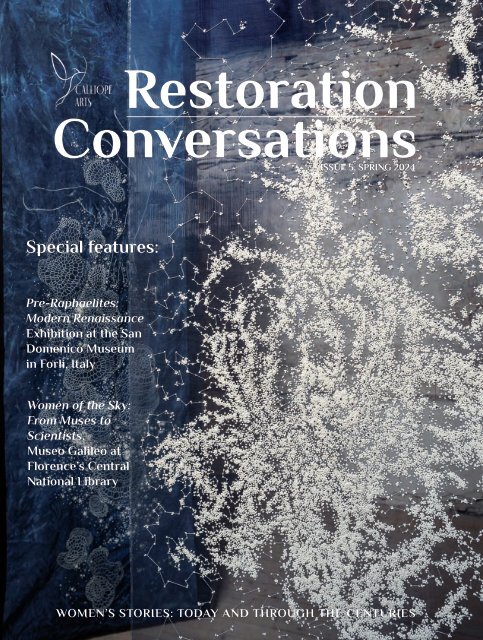
Restoration Conversations magazine - Spring 2024
Restoration Conversations is a digital magazine spotlighting the achievements of women in history and today. It releases two issues a year. Spring/Summer and Fall/Winter. The Spring 2024 Issue of Restoration Conversations welcomes a new column, ‘Personal Reflections: Writers and readers share connections’, set to become a regular feature of the magazine. It debuts in with Canada-based writer Carol Annett and how Florence Nightingale influenced her personal and family history. The women featured in this issue search the sky and scour the stores. Their pursuit of knowledge takes us from the Cephid stars and the comets of Caroline Hershel, to a rafter-filled attic-museum of the Capuchin monks in Florence, where works by painter Violante Siries are found, and a high-security art vault hosting the photography of Wanda and Marion Wulz. As far as exhibitions are concerned Angelica Kauffman breaks into the boys’ club at the Royal Academy, and textile artist Ilaria Marguti is on show at Florence's National Library. The pre-Raphaelite Brotherhood has sisters, like Evelyn De Morgan and Beatrice Parsons, and Tate Britain gets it right with their exhibition title ‘Now You See Us’ featuring artists like Emily Mary Osborn. Restoration Conversations magazine and cultural broadcast is supported by Calliope Arts – a not-for-profit organisation based in Florence and London that promotes public knowledge and appreciation of art, literature and social history from a female perspective, through restorations, exhibitions, education and cultural initiatives.
Restoration Conversations is a digital magazine spotlighting the achievements of women in history and today. It releases two issues a year. Spring/Summer and Fall/Winter. The Spring 2024 Issue of Restoration Conversations welcomes a new column, ‘Personal Reflections: Writers and readers share connections’, set to become a regular feature of the magazine. It debuts in with Canada-based writer Carol Annett and how Florence Nightingale influenced her personal and family history. The women featured in this issue search the sky and scour the stores. Their pursuit of knowledge takes us from the Cephid stars and the comets of Caroline Hershel, to a rafter-filled attic-museum of the Capuchin monks in Florence, where works by painter Violante Siries are found, and a high-security art vault hosting the photography of Wanda and Marion Wulz. As far as exhibitions are concerned Angelica Kauffman breaks into the boys’ club at the Royal Academy, and textile artist Ilaria Marguti is on show at Florence's National Library. The pre-Raphaelite Brotherhood has sisters, like Evelyn De Morgan and Beatrice Parsons, and Tate Britain gets it right with their exhibition title ‘Now You See Us’ featuring artists like Emily Mary Osborn.
Restoration Conversations magazine and cultural broadcast is supported by Calliope Arts – a not-for-profit organisation based in Florence and London that promotes public knowledge and appreciation of art, literature and social history from a female perspective, through restorations, exhibitions, education and cultural initiatives.

Transform your PDFs into Flipbooks and boost your revenue!
Leverage SEO-optimized Flipbooks, powerful backlinks, and multimedia content to professionally showcase your products and significantly increase your reach.
<strong>Restoration</strong><br />
<strong>Conversations</strong><br />
ISSUE 5, SPRING <strong>2024</strong><br />
Special features:<br />
Pre-Raphaelites:<br />
Modern Renaissance<br />
Exhibition at the San<br />
Domenico Museum<br />
in Forlì, Italy<br />
Women of the Sky:<br />
From Muses to<br />
Scientists,<br />
Museo Galileo at<br />
Florence’s Central<br />
National Library<br />
WOMEN’S STORIES: TODAY AND THROUGH THE CENTURIES<br />
<strong>Spring</strong> <strong>2024</strong> • <strong>Restoration</strong> <strong>Conversations</strong> 1
Publisher<br />
Calliope Arts Foundation<br />
London, UK<br />
Managing Editor<br />
Linda Falcone<br />
Contributing Editor<br />
Margie MacKinnon<br />
Design<br />
Fiona Richards<br />
FPE Media Ltd<br />
Video maker for RC broadcasts<br />
Francesco Cacchiani<br />
Bunker Film<br />
www.calliopearts.org<br />
@calliopearts_restoration<br />
Calliope Arts
From the Editor<br />
Let’s begin with something you can count on: a new column set to become<br />
a regular feature of the <strong>magazine</strong>. I’m referring to ‘Personal Reflections:<br />
Writers and readers share connections’, which debuts in this issue with<br />
Canada-based writer Carol Annett and how Florence Nightingale influenced<br />
her personal and family history. <strong>Restoration</strong> <strong>Conversations</strong> is true to its<br />
name, and our readers have much to tell us about the contributions of<br />
historic women to their own lives. With each new issue, we look forward<br />
to creating a chorus of women’s voices from past and present, with all the<br />
stories you hold most dear.<br />
The women featured in this issue search the sky and scour the stores.<br />
Their pursuit of knowledge takes us from the Cepheid stars and the<br />
comets of Caroline Herschel, to a high-security art vault hosting the<br />
Wulz’s photography. Women’s exhibitions are foremost in our minds this<br />
issue. Angelica Kauffman breaks into the boys’ club. The pre-Raphaelite<br />
Brotherhood has sisters, and Tate Britain gets it right with their exhibition<br />
title ‘Now You See Us’. I couldn’t have said it better myself. Enjoy the issue!<br />
Fondly,<br />
Linda Falcone<br />
Managing Editor, <strong>Restoration</strong> <strong>Conversations</strong>
GRAZIE MILLE<br />
Earlier this year, it was our pleasure, as donors, to take part in the launch of the<br />
Museo Galileo’s ‘Women of the Sky’ exhibition at Florence’s National Library. The<br />
exhibition perfectly reflects Calliope Arts’ mission to highlight and document women’s<br />
achievements in the arts and sciences. Thank you to Museo Galileo Director, Roberto<br />
Ferrari, who invited us to contribute to this project, and to co-curators, Natacha Fabbri,<br />
Simona Mammana and Caterina Guiducci, who produced an innovative and ambitious<br />
show covering centuries of women’s involvement in astrological discoveries. Ilaria<br />
Margutti’s embroidered artworks, which are a focal point of the exhibition, beautifully<br />
illustrate the interconnectedness of art and science – which happens to be the subject<br />
of the webinar series, ‘LIFE ON mARTS’, organised by Laura Caruso, project director at<br />
CasermArcheologica in San Sepolcro.<br />
Thank you to lead co-curator Peter Trippi who took the time to escort us around<br />
the once-in-a-lifetime exhibition, ‘Pre-Raphaelites: Modern Renaissance’ at the San<br />
Domenico Museum complex in Forlì (Fondazione Cassa dei Risparmi di Forlì and<br />
Grandi Mostre Fondazione Forlì) as well as to co-curator Elizabeth Prettejohn, the De<br />
Morgan Foundation Director, Sarah Hardy, and art historian Emma Merkling who shared<br />
their knowledge of, and passion for, the artists represented in the exhibition.<br />
In London and elsewhere in the UK, sincere thanks to co-curator Annette Wickham,<br />
to artist Sarah Pickstone and to donor Christian Levett for their insight into the works<br />
of Angelica Kauffman exhibited at the Royal Academy. We are grateful to Tate Britain for<br />
sharing images of their upcoming exhibition on four centuries of women artists, ‘Now<br />
You See Us’. We also appreciate the generosity of the De Morgan Foundation, the Watts<br />
Gallery Artists’ Village, the Herschel Museum of Astronomy in Bath and the Florence<br />
Nightingale Museum for allowing us to reproduce images from their collections.<br />
From further afield, thank you to contributors Carol Annett (Ottawa), Tanya Klowden<br />
(California) and Byron Hurst and Kelsea Blu Halfpenny (Australia) who have brought<br />
new voices to the conversation.<br />
We are always happy to collaborate with our friends at the Alinari Photography<br />
Foundation and appreciate the opportunity to have a behind-the-scenes look into their<br />
treasure trove of boxes all waiting to be plundered (in a good way).<br />
We’d also like to thank our partners The Florentine, for their efforts to promote and<br />
share Calliope Arts’ mission with our friends in Florence and beyond.<br />
4 <strong>Restoration</strong> <strong>Conversations</strong> • <strong>Spring</strong> <strong>2024</strong>
CONTENTS SPRING <strong>2024</strong><br />
WOMEN AND THEIR QUESTS<br />
6 Personal Reflections on Florence Nightingale<br />
Writers and readers share connections<br />
14 The ‘Starfish Syndrome’<br />
Searching the art vaults for things to save<br />
20 Astronomy for Everyone<br />
Co-curator Natacha Fabbri shares ‘Women of the Sky’<br />
26 From Astral Beings to Female Agents<br />
Florence’s National Central Library speaks volumes<br />
34 Brilliant Lights<br />
The comets of Caroline Herschel<br />
42 Starlight and a Spool of Thread<br />
An interview with textile artist Ilaria Margutti<br />
BEING SEEN<br />
48 Pre-Raphaelites: Modern Renaissance<br />
Live at the exhibition with co-curator Peter Trippi<br />
58 Eggs and Shades of Gold<br />
Painter Christiana Herringham, in focus<br />
66 Soul Sister<br />
Evelyn De Morgan’s spiritual quest<br />
74 Breaking into the Boys’ Club<br />
Angelica Kauffman at the Royal Academy<br />
81 It’s Not Just About the Art<br />
Sarah Pickstone on the importance of Angelica Kauffman<br />
86 The Unfinished Space<br />
An interview with CasermArcheologica curator<br />
Laura Caruso<br />
92 Now You See Us<br />
Women artists from 1520–1920 at Tate Britain<br />
98 Artemisia in Australia<br />
<strong>Spring</strong> <strong>2024</strong> • <strong>Restoration</strong> <strong>Conversations</strong> 5
Personal Reflections...<br />
on Florence Nightingale<br />
Writers and readers share connections
In 1974, I quit nursing training halfway through<br />
the program. I never had the honour of saying<br />
the Nightingale Pledge, which my mother recited<br />
when she graduated from nursing in 1949. So,<br />
what sparked my interest in Florence Nightingale<br />
almost 50 years after I became a nursing school<br />
dropout? It began with a statue my husband<br />
noticed on a trip to Italy in 2023.<br />
All along the walls of the nave of the Basilica<br />
of Santa Croce in Florence, Italy, there are<br />
monuments to great Italians, mainly men,<br />
including Dante, Galileo, Leonardo da Vinci,<br />
Machiavelli, Marconi, Michelangelo and Rossini.<br />
Outside the church, embedded in one wall of<br />
the cloisters that enclose a quadrangle of lawn,<br />
is a memorial to a woman. An oval medallion<br />
frames the two-foot high figure, sculpted in white<br />
Carrara marble, of a woman wearing flowing<br />
robes and carrying a small oil lamp. She is the<br />
legendary Florence Nightingale – the Lady with<br />
the Lamp. Why was there a memorial to this<br />
nineteenth-century English woman, who was not<br />
even Roman Catholic, at Santa Croce? I knew<br />
nothing about the woman behind the legend but<br />
I vowed to learn more, especially since she was<br />
my mother’s personal heroine.<br />
Florence Nightingale (1820–1910) became famous<br />
in her own lifetime as a nursing superintendent<br />
for the British Army during the Crimean War<br />
(1853–1856) and as an advocate for public health<br />
reform. In 1913, three years after she died, British<br />
expatriates in Florence, Italy commissioned Francis<br />
William Sargant to create a memorial at the Basilica<br />
of Santa Croce to honour her in the city where she<br />
was born. Her first official biography, The Life of<br />
Florence Nightingale, by British writer Sir Edward<br />
T. Cook, was published to worldwide acclaim that<br />
same year.<br />
Subsequent biographers writing about<br />
Florence Nightingale are blessed and cursed<br />
with an over-abundance of archival material.<br />
The British Library holds 200 bound volumes<br />
representing an archive about a single individual<br />
second only in size to that of Prime Minister<br />
Gladstone. Claydon House in Buckinghamshire<br />
holds a huge collection of her family letters.<br />
The London Metropolitan Archives maintains<br />
a repository connected with the running of<br />
the training school founded in her name<br />
at St. Thomas’ Hospital in 1860. Around the<br />
world there are over 200 smaller holdings of<br />
Nightingale papers.
Left: Photograph of Florence Nightingale<br />
by Henry Hering. National Portrait<br />
Gallery, London<br />
According to one of her more recent<br />
biographers, Mark Bostridge, previously unknown<br />
letters emerged after her death. Basing his story<br />
on this vast collection of reference material, he<br />
did well to keep his single volume, Florence<br />
Nightingale: The Woman and Her Legend, under<br />
800 pages.<br />
Florence Nightingale was born on 12 May 1820<br />
in Florence, Italy, where her wealthy family was<br />
on an extended European holiday. Brought up in<br />
rural England with an older sister in Derbyshire<br />
and Surrey, Florence was a sensitive, spiritual<br />
child who loved animals and showed sympathy<br />
for the poor and the sick from an early age.<br />
Florence’s father, who believed in higher<br />
learning for women, supervised the education<br />
of his daughters at home. Florence was a<br />
brilliant student, becoming proficient in French,<br />
Italian, Greek, mathematics, history, philosophy<br />
and classical literature. Despite her privileged<br />
upbringing, Florence sought neither celebrity nor<br />
fortune. Rather, she came to focus her intelligence<br />
and humanitarian values on promoting public<br />
health and disease prevention for all.<br />
In 1847, seven years before she left for the<br />
Crimea, Florence travelled to Rome with family<br />
friends. There, she was introduced to Sidney<br />
Herbert, who would become a close friend. On<br />
this Roman holiday, Florence immersed herself<br />
in art and culture. At the Palazzo Barberini, she<br />
was profoundly moved by Guido Reni’s portrait of<br />
Beatrice Cenci, which is said to have been painted<br />
just before Beatrice was beheaded for conspiring<br />
to kill her abusive father. At the Sistine Chapel,<br />
8 <strong>Restoration</strong> <strong>Conversations</strong> • <strong>Spring</strong> <strong>2024</strong>
Florence lay on the floor and gazed up in ecstasy<br />
for hours. Yet the highlight of the trip for her was<br />
not a work of art. Florence obtained permission<br />
to go on a 10-day retreat at a convent. During her<br />
stay, she confided to Madre Santa Colombe that<br />
God had spoken to her.<br />
Florence felt God wanted her to serve others<br />
and she decided to answer that call by becoming<br />
a nurse. But nurses at that time were viewed as<br />
fallen women who were prone to drunkenness<br />
and sexual impropriety, as personified by Sarah<br />
Gamp, a character in Dickens’ 1843 novel Martin<br />
Chuzzlewit. Florence’s parents vehemently<br />
opposed her pursuing this vocation and urged<br />
her to marry. Still, Florence was determined. She<br />
refused all offers of marriage and eventually<br />
acquired the training she sought.<br />
On 22 August 1853, Florence Nightingale<br />
accepted a position as superintendent at the<br />
Institute for the Care of Sick Gentlewomen in<br />
Upper Harley Street, London. Supplemented by<br />
an income provided by her father, she was finally<br />
able to live independently and pursue her chosen<br />
career. Two months after she began working in<br />
Harley Street, Britain entered the Crimean War.<br />
The following year, her friend Sidney Herbert,<br />
as Secretary of State at War, asked Florence<br />
Nightingale to superintend Governmentsponsored<br />
nurses at the military hospital at<br />
Scutari, Turkey. In November 1854, she arrived at<br />
Scutari with 38 volunteer nurses.<br />
Appalled by conditions in the military hospital,<br />
Florence discovered that soldiers died more from<br />
infections resulting from poor hygiene, poor<br />
Below: Florence<br />
Nightingale at the<br />
Military Hospital at<br />
Scutari, 1855. Image<br />
kindly provided by the<br />
Florence Nightingale<br />
Museum, London<br />
<strong>Spring</strong> <strong>2024</strong> • <strong>Restoration</strong> <strong>Conversations</strong> 9
Above: Florence at the<br />
St. Thomas Nursing<br />
School surrounded by her<br />
students, 1860. Image<br />
kindly provided by the<br />
Florence Nightingale<br />
Museum, London<br />
nutrition, lack of supplies and improper waste<br />
disposal than from their battlefield wounds.<br />
Florence worked tirelessly to improve conditions<br />
in the hospital. Reports from wounded soldiers<br />
telling of her comforting presence propelled<br />
Florence to celebrity status back home. In February<br />
1855, an illustration titled “Miss Nightingale, in the<br />
Hospital at Scutari” appeared in The Illustrated<br />
London News depicting her nightly rounds.<br />
Though the Turkish ‘fanoos’ lantern that she<br />
carried was incorrectly pictured as a genie lamp,<br />
this was the image of the compassionate nurse<br />
that captured public imagination. The legend of<br />
the Lady with the Lamp was born.<br />
There was more to Florence Nightingale<br />
than this legend. Her work in military hospitals<br />
in Crimea was merely a prelude to the more<br />
important phase of her career in public health<br />
after the war. With her great analytical skills and<br />
knowledge of statistics, she set out to reform not<br />
only the profession of nursing but also Army<br />
and civilian health by advising the governments<br />
of Britain and India on improving the design<br />
of hospitals and workhouses and modernizing<br />
sanitary measures. During her lifetime, she<br />
published hundreds of pamphlets, books, reports<br />
and articles on subjects ranging from public<br />
health and nursing to religion and women’s<br />
oppression. Despite becoming an invalid due<br />
to chronic illness, she was able to carry out her<br />
ground-breaking work, including supervising the<br />
Nightingale School of Nursing, which was set up<br />
in 1860. The school’s success set the standard for<br />
nursing training around the world.<br />
In 1946, when my mother Marjorie graduated<br />
from high school in Canada, she wanted to attend<br />
university like her fiancé, Dick MacKinnon. Dick’s<br />
tuition at the University of British Columbia (UBC)<br />
was paid for by the Canadian government as a<br />
benefit for his service in the Royal Canadian Air<br />
10 <strong>Restoration</strong> <strong>Conversations</strong> • <strong>Spring</strong> <strong>2024</strong>
Left: Marjorie Ruppel, a<br />
graduate of the Royal<br />
Columbian School<br />
of Nursing in New<br />
Westminster, BC, 1949<br />
Force in WW II. There was no money for Marjorie<br />
to go to university, so she applied to a school of<br />
nursing, which provided room and board. She<br />
and my Dad eloped because married women<br />
were not eligible to enter nursing school.<br />
She enrolled under her maiden name at the<br />
Royal Columbian School of Nursing in New<br />
Westminster, BC. While her secret husband<br />
boarded with her mother and attended UBC,<br />
Marjorie lived in the nurses’ residence and trained<br />
at the hospital. On 28 April 1949, Mum attended<br />
her graduation. After medals and diplomas were<br />
handed out, and before she gave the valedictory<br />
speech, all the graduates recited the Nightingale<br />
Pledge. Her mother and grandmother watched<br />
proudly. I was there too, in a way, because Mum<br />
was pregnant with me at the time.<br />
Over 20 years later, in 1970, I graduated from<br />
a Canadian university with a degree in biology<br />
and took a job as a lab technician in a medical<br />
research hospital. I hated working with test tubes<br />
and before long, decided to go into a field that<br />
offered more contact with people – nursing. If I<br />
remained in Canada, I would have to do nursing<br />
training at a university, which I couldn’t afford<br />
then. So, I chose a hospital-based program<br />
in England, in which classroom lectures were<br />
integrated with work experience, and students<br />
were paid a stipend.<br />
In 1972, I enrolled at Wolfson School of Nursing<br />
at the now closed Westminster Hospital in<br />
London. Settling into my tiny room at Wigram<br />
Nurses’ Home, I had to learn that the gas fire<br />
was not self-igniting – you had to light a match<br />
after turning the knob! Spotting a photo of my<br />
boyfriend on my chest of drawers, a teaching<br />
sister gushed “Ooh, who’s the dishy bloke?”<br />
During the next year-and-a-half, interspersed<br />
with weeks of classroom learning, I was Nurse<br />
MacKinnon, working on medical, surgical and<br />
<strong>Spring</strong> <strong>2024</strong> • <strong>Restoration</strong> <strong>Conversations</strong> 11
Left: Carol as a student nurse at the<br />
Wolfson School of Nursing, 1972, and<br />
below, at her home in Canada, <strong>2024</strong><br />
Right: A lamp for ‘The Lady of the Lamp’<br />
c. 1850, ph. Florence Nightingale Museum,<br />
London<br />
children’s wards. In obstetrics, I assisted midwives<br />
delivering babies. In the operating theatre, I<br />
observed a leg amputation and open heart<br />
surgery and I “scrubbed” for an appendicectomy.<br />
I walked to the hospital for day, evening, night<br />
and split shifts wearing a black cloak over a<br />
blue uniform, with a stiff cardboard collar, black<br />
tights, sensible shoes and a white paper cap.<br />
Had I completed the program, I would have<br />
earned my Westminster Hospital belt buckle and<br />
the headpiece, called a “frilly”, that Westminster<br />
graduates proudly wore. The rigorous, practical<br />
training met the standard set by Florence<br />
Nightingale to elevate nursing to a respectable<br />
profession beyond the disreputable stereotype<br />
portrayed in Dickens’ novel.<br />
I found the hospital environment exciting. But<br />
the shift hours, illness, and homesickness wore<br />
me down. So, I left the program, flew home and<br />
married the dishy bloke. After four more years of<br />
university and a one-year internship, I graduated<br />
as a registered dietician. I worked for over<br />
thirty years in publicly-funded, patient-centred<br />
hospitals with advanced sanitation and infection<br />
control procedures – measures that Florence<br />
Nightingale would have endorsed.<br />
Florence Nightingale is honoured every year<br />
around the world. Since 1965, International Nurses<br />
Day has been celebrated on her birthday, May 12.<br />
Mark Bostridge writes, “If we were to derive one<br />
simple lesson from Florence Nightingale’s life<br />
and work, it would stem from this single unifying<br />
thread: that society has a collective responsibility<br />
for the health of all its members.” In a time of<br />
global pandemics, Florence Nightingale’s vision is<br />
still relevant.<br />
After her children were grown, my mother<br />
returned to nursing, the profession she loved. But<br />
12 <strong>Restoration</strong> <strong>Conversations</strong> • <strong>Spring</strong> <strong>2024</strong>
FLORENCE NIGHTINGALE PLEDGE<br />
“I solemnly pledge myself, before God and<br />
in the presence of this Assembly, to pass my<br />
life in purity and to practice my profession<br />
faithfully. I will abstain from whatever is<br />
deleterious and mischievous and will not<br />
take or knowingly administer any harmful<br />
drug. I will do all in my power to maintain<br />
and elevate the standard of my profession<br />
and will hold in confidence all personal<br />
matters committed to my keeping, and all<br />
family affairs coming to my knowledge in<br />
the practice of my calling; with loyalty will<br />
I endeavour to aid the Physician in his work<br />
and devote myself to the welfare of those<br />
committed to my care.”<br />
The Nightingale Pledge, a modified version<br />
of the Hippocratic Oath, was first introduced<br />
in 1893 in Detroit, Michigan. Over the years,<br />
the phrasing has been changed to reflect the<br />
times. The version above, taken from the 1949<br />
yearbook of the Royal Colombian Hospital,<br />
is the one Marjorie Ruppel recited at her<br />
graduation.<br />
she had to quit when she developed symptoms<br />
of multiple sclerosis. As the disease progressed<br />
and she became hospitalized, my Dad became<br />
her devoted caregiver. When she was unable<br />
to hold a book, he would read to her. One of<br />
the books he chose was the inspiring story of<br />
Florence Nightingale. Dad knew she was Mum’s<br />
personal heroine. Now I’m a great admirer too. As<br />
Bostridge observes at the end of his biography,<br />
“For us, the lamp still burns.”<br />
CAROL ANNETT<br />
Carol Annett is a writer based in Ottawa,<br />
Canada. After a career of more than 30 years in<br />
the healthcare field, she now spends her time<br />
researching and writing about family history,<br />
with a particular emphasis on preserving<br />
women’s stories.<br />
<strong>Spring</strong> <strong>2024</strong> • <strong>Restoration</strong> <strong>Conversations</strong> 13
Above, left: Conservator Francesca Bongioanni<br />
at Art Defender with the newly found Wulz<br />
Studio sign, note that an additional Roman<br />
numeral was added to indicate the atelier’s<br />
location on the third floor<br />
Above, right: Exploring the Wulz archive, ladies<br />
from another era<br />
Left: FAF’s storage spaces at Art Defender<br />
All images: Olga Makarova<br />
14 <strong>Restoration</strong> <strong>Conversations</strong> • <strong>Spring</strong> <strong>2024</strong>
The ‘Starfish<br />
Syndrome’<br />
Searching the art vault for treasures to save<br />
What does it feel like to hunt through hundreds of boxes in search<br />
of stories that once belonged to twentieth-century photographers<br />
Wanda and Marion Wulz? It’s a thrill we’d like to share with<br />
readers, via this ‘backstage photo album’ by photographer and<br />
filmaker Olga Makarova, documenting Calliope Arts’ visit to Art<br />
Defender with the research team from Fondazione Alinari per la<br />
Fotografia, which safeguards and manages the world’s foremost<br />
photography collection on Italy, from the 1840s to today. They<br />
are intently exploring the Wulz Studio Archive, as part of our<br />
‘5,000 Negatives’ project aimed at research, restoration and<br />
digitalisation of works from the Wulz sister’s Trieste-based atelier.<br />
Before discussing the day’s treasure hunt, it’s best to tell you<br />
where we are on the map. Fondazione Alinari per la Fotografia –<br />
at home at Florence’s Villa Fabbricotti – is temporarily storing the<br />
bulk of its collections at Art Defender in Calenzano, as they await<br />
a more permanent place in central Florence equipped to house<br />
their massive photography archive. Art Defender, as its name<br />
suggests, is a high-security art vault in the Tuscan hinterland,<br />
whose contents are safe, because no one on the outside ever<br />
really knows what’s under lock and key inside the facility. Even<br />
‘non-human’ thieves, like fire, are no match for the vault’s hightech<br />
systems, which use neither foam nor water to put out flames,<br />
<strong>Spring</strong> <strong>2024</strong> • <strong>Restoration</strong> <strong>Conversations</strong> 15
Above, left: FAF director<br />
Claudia Baroncini<br />
exploring Alinari’s stores<br />
with Linda Falcone<br />
Above, right: Archivist<br />
Marta Magrinelli ponders<br />
documents that provide<br />
new clues<br />
because either of those elements would ruin art<br />
beyond repair – particularly photography. In case<br />
of fire, the system is programmed to deprive their<br />
warehouses of oxygen. It’s the only way, they say,<br />
to snuff out a blaze and to keep its stores safe.<br />
The only fire happening at Art Defender the<br />
spring morning of our visit was the flame of<br />
enthusiasm. If you think I’m being metaphorical,<br />
think again. Conservator Francesca Bongioanni<br />
unwrapped the Wulz studio office sign – what an<br />
appropriate way to start a search – and for all the<br />
wonder we felt, it could have been a signpost to<br />
heaven. “This archive has never been subject to<br />
full-scale research, reordering or restoration, so<br />
with ‘The 5,000 Negatives project’ we are heading<br />
in the right direction, one piece at a time,” says<br />
FAF director Claudia Baroncini. “Most of the Wulz<br />
boxes are just like they were received.”<br />
If you find that surprising, try this statistic on<br />
for size: Alinari’s stores are five million items<br />
strong, and 4,950,000 of these are photographic<br />
materials, many of which are one of a kind. Their<br />
vast collection is impressive, and the figure<br />
seems even more daunting when you consider<br />
that only three percent of the Alinari patrimony<br />
has been digitalised thus far. In short, one must<br />
be meditative when faced with all of their boxes,<br />
which somehow bring to mind the beached<br />
starfish story, ‘You’ll never be able to save them<br />
all,” one sceptical man told another who was<br />
throwing beached starfish back into the sea.<br />
“Well, I saved that one,” the other replied, and<br />
16 <strong>Restoration</strong> <strong>Conversations</strong> • <strong>Spring</strong> <strong>2024</strong>
Left , top and middle: FAF’s team uncovers the<br />
Wulz family archive’s hidden treasures, from<br />
lens to documents<br />
Left, bottom: A snapshot from the show<br />
‘Fotografe!’ at Villa Bardini (2022) with<br />
co-curator Emanuela Sesti at work<br />
All images: Olga Makarova<br />
that is how it feels to be confronted with<br />
the foundation’s priceless but innumerable<br />
boxes.<br />
On site that day, we have FAF’s director<br />
Claudia Baroncini, archivist Marta Magrinelli,<br />
archive conservator Francesca Bongioanni,<br />
and scientific coordinator Emanuela Sesti,<br />
who readers of <strong>Restoration</strong> <strong>Conversations</strong><br />
will remember as co-curator of ‘Fotografe!’,<br />
the dual exhibition at Villa Bardini and Forte<br />
Belvedere, Calliope Arts’ first Florentine<br />
project. All of these dedicated professionals<br />
are studying or safeguarding the Wulz<br />
Photography Studio Archive, a threegeneration<br />
concern, open in Trieste from<br />
1861 to 1981, which was passed down from<br />
highly successful studio photographer<br />
<strong>Spring</strong> <strong>2024</strong> • <strong>Restoration</strong> <strong>Conversations</strong> 17
Above: More treasures from the Wulz family archive<br />
Giuseppe Wulz, to his son Carlo, and to Carlo’s<br />
daughters Wanda and Marion.<br />
Although most of the photographs published<br />
with this article feature conservator Francesca<br />
Bongioanni at work, it is archivist Marta<br />
Margrinelli who provides us the words required<br />
to better understand these pictures. “With the<br />
Wulz Studio Archive, we are not solely dealing<br />
with photographs. We have their ledgers, albums<br />
and invoices, post cards, family correspondence,<br />
exhibition posters they saved, and even their<br />
passports and identity cards. What is most<br />
interesting is that Marion, the atelier’s surviving<br />
and lesser-known sister, was the one who sold<br />
the archive, but before handing it over to Alinari,<br />
she drafted a description of the items she held<br />
18 <strong>Restoration</strong> <strong>Conversations</strong> • <strong>Spring</strong> <strong>2024</strong>
most dear. The photographs’ attributions are<br />
based on her memory, and we know which of<br />
these belongings she cared most about, within<br />
the vast collection.”<br />
To me, this is particularly happy news. Marion<br />
was the quieter sister and, unlike Wanda, she was<br />
never courted by Futurism’s founder Marinetti as<br />
the darling of photodynamic photography. Marion<br />
often took pictures from her window, worked<br />
in the darkroom during the post-production<br />
phase, or shared the camera with her older<br />
sister, snapping photographs whose authorship<br />
is not always clear. I am glad to see her voice<br />
be heard through her efforts to document the<br />
studio’s treasures, a testimony to her grandfather<br />
and father’s work, but most of all, they are the<br />
memoirs of decades shared capturing the faces<br />
and fashions of bon-ton Trieste, where we are<br />
planning to go for the upcoming Wulz exhibition<br />
(in Trieste, <strong>2024</strong>-25) of which ‘5,000 Negatives’ is<br />
the starting point.<br />
LINDA FALCONE<br />
The ‘5,000 Negatives’ project, developed by FAF<br />
to safeguard and promote the works of Wanda<br />
and Marion Wulz, involves research, digitalisation<br />
and exhibition. It is made possible thanks to a<br />
grant from Fondazione CR Firenze and Calliope<br />
Arts Foundation. For more on the Wulz sisters, see<br />
<strong>Restoration</strong> <strong>Conversations</strong>, Autumn Issue 2023.<br />
<strong>Spring</strong> <strong>2024</strong> • <strong>Restoration</strong> <strong>Conversations</strong> 19
Astronomy for Everyone<br />
Co-curator Natacha Fabbri shares ‘Women of the Sky’<br />
Many of our readers will remember Museo<br />
Galileo curator Natacha Fabbri from our live RC<br />
broadcast last spring. This season, she has taken<br />
her curatorial talents a few doors down the river<br />
from her home museum, to bring us ‘Women of<br />
the Sky’ at Florence’s National Central Library,<br />
which displays fascinating holdings from both<br />
venues.<br />
<strong>Restoration</strong> <strong>Conversations</strong>: In ‘Women of the<br />
Sky’, there are many interesting depictions<br />
of allegorical women – particularly from the<br />
medieval times, including the allegories of<br />
Astronomy, Geometry and Arithmetic, but<br />
what about the flesh-and-bones women who<br />
studied the stars through the centuries?<br />
Natacha Fabbri: This exhibition begins in the 1500s<br />
and follows a path that is long and discontinuous,<br />
which is marked by success and by failure. We are<br />
exploring the progressive introduction of women<br />
into the field of Astronomy, and their struggle for<br />
equality. It is a quest that remains unfulfilled, even<br />
at the end of our focus period, at the beginning<br />
of the 1900s.<br />
RC: How did women’s access to the field<br />
begin?<br />
NF: One important part of the exhibition focuses<br />
on the ‘querelle des femmes’, literary works<br />
that argued for women’s intellectual and social<br />
equality. So the issue was initially both scientific<br />
and literary. French author Bernard Le Bovier de<br />
Fontenelle was the first exponent of this genre,<br />
which developed at the turn of the seventeenth<br />
century. These published texts were always written<br />
in dialogue form; they were either dedicated to<br />
women or featured women characters. Initially,<br />
women were always on the receiving end of the<br />
philosophical conversation about the heavens.<br />
The sky is discussed in a simplified manner,<br />
in what would be known today as Popular<br />
Astronomy. For example, they discuss the role<br />
of the Sun, and its relationship with the planets,<br />
and the woman character’s questions are naïve.<br />
These women characters are not knowledgeable,<br />
but they do show great interest, and more than<br />
that, great ability when it comes to understanding<br />
mathematical disciplines. The philosopher<br />
might conclude that women are not inferior, or<br />
20 <strong>Restoration</strong> <strong>Conversations</strong> • <strong>Spring</strong> <strong>2024</strong>
prescribe to the view that their lack of equality<br />
was actually a social problem due to lacunae in<br />
women’s formal education.<br />
RC: Speaking of equality, one of the sections<br />
of the show is ‘Astronomy for Everyone’. Can<br />
you tell us more about it?<br />
NF: One significant work in this section is by<br />
a woman author, Émilie du Châtelet (1706–<br />
1749), who translates and Newton’s Principia<br />
Mathematica, and her work adheres to the<br />
‘Science for everyone model’. In her view,<br />
scientific books needed to be addressed<br />
to everyone, and that included women and<br />
young people. One of the books displayed in<br />
this exhibition is the Italian translation of her<br />
Institutions de physique (1740), a manual on<br />
Newton’s physics and Leibniz’s philosophy that<br />
she wrote for her son – a young person – and<br />
was published only three years after the original<br />
French edition. We have also exhibited a very<br />
rare theatre play, Emilie du Châtelet, ou Point de<br />
lendemain, which was written in 1832, seventy<br />
years after her death. Despite being the play’s<br />
protagonist, she is not admired or held in high<br />
regard for her scientific works; instead, she is<br />
ridiculed for being frivolous and fickle in matters<br />
of love, as per the stereotype of the flighty and<br />
untrustworthy woman. She was a scientist and<br />
Above: Installation<br />
shots of ‘Women of<br />
the Sky’ with scientific<br />
instruments and art<br />
by Ilaria Margutti, phs.<br />
Federica Narducci<br />
<strong>Spring</strong> <strong>2024</strong> • <strong>Restoration</strong> <strong>Conversations</strong> 21
Above: The press<br />
conference for the<br />
exhibition ‘Women of<br />
the Sky’ at Florence’s<br />
National Central Library,<br />
ph. Federica Narducci<br />
a philosopher, yet she was not accepted to the<br />
Academy of Paris, and was harshly criticised for<br />
her sentimental life. Was Voltaire – her lover –<br />
ever criticised for his sentimental life? That’s the<br />
question!<br />
RC: Florence’s National Central Library has<br />
a strong link to the Galileo Museum because<br />
the biblioteca is home to the great majority of<br />
Galileo’s manuscripts. Does the ‘Women of the<br />
Sky’ exhibition give a nod to Galileo and how?<br />
NF: The library has a host of literary and scientific<br />
works of immense value, a sampling of which we<br />
are delighted to share in this exhibition. One of<br />
the most exciting manuscripts on show is a letter<br />
by Margherita Sarrocchi (c. 1560–1617). A writer,<br />
not a scientist, she authored epic poetry in verse,<br />
but she excelled in mathematics and science as<br />
well, and Galileo frequented her salon in Rome.<br />
She used science as a way to access the upper<br />
echelons of society and participated in scientific<br />
discourse not normally accessible to women.<br />
Her contemporaries claimed she was one of<br />
the first woman to observe the sky through<br />
Galileo’s telescope. It’s important to note that<br />
many philosophers of her time refused to look<br />
inside the telescope because they considered it<br />
a creator of illusions – illusions that contradicted<br />
everything philosophers had believed and<br />
discussed for 2,000 years.<br />
Male philosophers taught and published<br />
according to a pre-established view, but she was<br />
not bound to one herself, because she did not<br />
share their academic training, Natacha explains.<br />
Sarrocchi freely defended the truth of Galileo’s<br />
novel celestial discoveries. In the letter we are<br />
exhibiting, she laments being kept at the margins<br />
of scientific discourse. She writes to Galileo,<br />
saying that when she presented the truths he<br />
22 <strong>Restoration</strong> <strong>Conversations</strong> • <strong>Spring</strong> <strong>2024</strong>
told during a discussion on Astrology [then<br />
considered Astronomy’s younger sister], she was<br />
denigrated, and rather than being considered<br />
an academic, she was looked upon with an air<br />
of suspicion. Ultimately, even Sarrocchi’s highsociety<br />
freedom was curbed by a decree by the<br />
Holy See. In 1616, the geocentric model of the<br />
universe was condoned by the Church, and she<br />
backpedals, out of fear of taking a position against<br />
it. [Sarrocchi met Galileo Galilei in 1611, the year<br />
after he published Sidereus Nuncius. Seven of<br />
their letters survive at the NCL in Florence.]<br />
RC: The National Central Library welcomed<br />
your suggestion to exhibit contemporary art<br />
alongside their historic manuscripts. Ilaria<br />
Margutti’s artwork inspired by Henrietta<br />
Leavett’s research is noteworthy. What can<br />
you tell us about Leavett from the ‘equal<br />
rights’ standpoint?<br />
NF: We have one page from one of Leavitt’s ledgers<br />
in the show. As you know, Leavett was considered<br />
a ‘woman computer’, and she formed part of what<br />
was known as ‘Pickering’s Harem’ because she was<br />
one of many female human computers working<br />
at Harvard under Charles Edward Pickering.<br />
They were tasked with cataloguing the stars<br />
based on photographic glass plates taken from<br />
the university’s observatories. Remember that<br />
these women were considered manual labourers<br />
– mere manual labourers – not professional<br />
astronomers. Imagine that in just one hundred<br />
years, there were more than 150 women who<br />
worked at the observatory in this role – and<br />
one hundred of them were operative from 1875<br />
to 1920. The same was true in the Observatory<br />
of Lyon and Paris. Women were welcome in this<br />
field because they were considered more detailoriented<br />
than men, more precise and meticulous<br />
– and less expensive. Oftentimes, they were the<br />
Above: Margie MacKinnon<br />
and Wayne McArdle,<br />
Calliope Arts co-founders,<br />
with lead co-curator<br />
Natacha Fabbri at the<br />
exhibition,<br />
ph. Federica Narducci<br />
<strong>Spring</strong> <strong>2024</strong> • <strong>Restoration</strong> <strong>Conversations</strong> 23
24 <strong>Restoration</strong> <strong>Conversations</strong> • <strong>Spring</strong> <strong>2024</strong>
ones carrying out the calculations and making<br />
the observations, whereas the men would publish<br />
these women’s findings in their own name.<br />
RC: You once said that you dreamed of hosting<br />
this show in the National Central Library’s<br />
Sala Dante because of the room’s circular<br />
vault, which evokes a ‘Temple of Astronomy’.<br />
The library embraced and built upon your<br />
ideas for the show. For you, ‘Women of the<br />
Sky’ is a dream come true. How will the dream<br />
continue, once the exhibition is over?<br />
NF: Yes, the Sala Dante lends itself well to the<br />
‘temple of astronomy’ idea, and I immediately<br />
imagined Ilaria Margutti’s canvases inspired by<br />
Henrietta Swan Leveatt displayed. We contacted<br />
the library’s directors and my co-curators and<br />
they loved the idea. With regards to the show’s<br />
legacy for the future, we’ve created a number<br />
of short film clips that can be accessed in the<br />
exhibition via QR codes, which will remain<br />
as documentary evidence of ‘Women of the<br />
Sky’. Thanks to an invitation from the National<br />
Central Library, we – Museo Galileo – have<br />
created a digital library of all the texts in the<br />
show, that can be consulted from afar, via the<br />
museum’s website. The hope is that by being<br />
virtually available to everyone, these materials<br />
will become a study tool for schools, so that<br />
young people can have a medium through<br />
which to study these works and the era in which<br />
they were produced. That is a dream I hold dear,<br />
that what we have created here will become a<br />
valuable resource for future generations.<br />
LINDA FALCONE<br />
Left and above: Guests<br />
enjoy the show curated by<br />
Natacha Fabbri, Simona<br />
Mammana and Caterina<br />
Guiducci at Florence<br />
National Central Library,<br />
phs. Federica Narducci<br />
<strong>Spring</strong> <strong>2024</strong> • <strong>Restoration</strong> <strong>Conversations</strong> 25
26 <strong>Restoration</strong> <strong>Conversations</strong> • <strong>Spring</strong> <strong>2024</strong>
From Astral Beings<br />
to Female Agents<br />
Florence’s National Central Library speaks volumes<br />
Two curators from Florence’s National Central Library supported lead curator<br />
Natacha Fabbri, from Museo Galileo, in her conception and design of the ‘Women<br />
of the Sky’ exhibition (see p. 20). The NCL collection is home to some nine million<br />
volumes, occupying 100 kilometres’ worth of shelf space. With the exhibition’s<br />
theme in mind, this three-woman team scoured the collections to find the items<br />
and ideas that would best represent all kinds of women – historical, allegorical<br />
and modern – who take us to the moon and stars, throughout the centuries.<br />
In exhibition section ‘The Body is Celestial’, co-curator<br />
Simona Mammana explores the ‘astral tradition’<br />
in early modern literature. “‘Astral’ in this context<br />
refers to identifying the body of one’s beloved with<br />
celestial bodies, most commonly the Sun and stars,”<br />
Simona explains. “The motif of ‘woman like the Sun’,<br />
which emerged as part of the Dolce Stil Novo literary<br />
movement [in the thirteenth and fourteenth centuries],<br />
finds its maximum expression in Petrarch’s Canzoniere,<br />
in which the poet describes his beloved Laura in verses<br />
allusive to Christ’s light. They also refer to classical<br />
descriptions of Daphne, whom the Sun God Apollo<br />
loved. Petrarch’s poetry is filled with astral motifs: a<br />
woman’s eyes are like rays, or they are ‘adorned with<br />
stars’ and so on.”<br />
“By the 1500s, when several female writers came to<br />
the fore, Petrarch was already being read in a portable<br />
format, and the Canzoniere is pictured in many portraits<br />
of women. One famous example at the Uffizi is Andrea<br />
del Sarto’s Young Woman Holding a ‘Petrarchino’ (1528).<br />
Once a book was printed as a miniature – once it was<br />
pocket-sized – it inevitably became accessible to a<br />
larger audience, and therefore, to a growing circle of<br />
women,” Simona explains. “Poets like Chiara Matraini<br />
(1515–1604) and Veronica Gambara (1548–1550) built<br />
upon Petrarch’s poetics by claiming ownership of it and<br />
adapting its conventions to their own gaze. Essentially,<br />
a man was no longer doing the telling. These female<br />
poets also compared their own beloved to the Sun, as<br />
in one letter on show by poet Vittoria Colonna (1492–<br />
1547) who mourns her husband with the phrase, “il mio<br />
bel sole si è oscurato, my beautiful sun has gone dark”.<br />
Lucchese poet Chiara Matraini (1515–1604), in her Rime<br />
et Prose, published in 1555, also turns Petrarch’s rhetoric<br />
on its ear. In her work, men, not women, are at the<br />
centre of astral comparisons.”<br />
Left: Florence’s National Central Library, Pietro Mascagni, La Luna, ballata, 1913. Milan, Sonzogno, Music collection 1924.3378<br />
<strong>Spring</strong> <strong>2024</strong> • <strong>Restoration</strong> <strong>Conversations</strong> 27
The Sun is not the only celestial body to be<br />
reckoned with, of course. “At the end of the<br />
section ‘Astral Personifications’, we’ve included a<br />
vast repertoire of divine figures from sixteenthcentury<br />
illustrated texts, which served as a<br />
reference for poets, painters and scholars. These<br />
works provided iconographical clues on how<br />
to depict divine principles or human virtue and<br />
vice. Vincenzo Cartari’s Images of the Gods and<br />
the Ancients is full of female personifications<br />
associated with stars, revealing their influence<br />
on human nature and existence,” says Simona.<br />
“In this book, published in Venice in 1592,<br />
Cartari represents ‘Night’ as a woman wearing<br />
a robe laden with stars, with astrolabe in hand.<br />
She is nurse to Death and Sleep, brothers and<br />
inseparable companions.”<br />
Simona also points us to Cesare Ripa’s Della<br />
novissima iconologia, published for the first time<br />
in 1593. Astronomy, as an allegory, only appears<br />
in its 1625 edition, in sync with the scientific<br />
upheaval of Galileo’s times, but Simona focuses<br />
her attention on another personification, that of<br />
Inconstancy. Incostanza is represented as a robed<br />
woman with a half-moon in her hand, standing<br />
on top of a crab. “She is associated with the<br />
waves of the sea and the Moon, which is unstable<br />
and triggers changes of temperament,” Simona<br />
continues. “Woman’ is lunar not solar. Rather<br />
than being a giver of warmth, she is ‘cold and<br />
humid’ and, therefore, inferior to man. Women<br />
were seen as psychologically unstable, envious<br />
and inconsistent in Ripa’s depictions.” This<br />
theory is prevalent in Italian literature, as in the<br />
case of Ariosto’s epics, and women’s mutability<br />
needed some sort of a quick fix. “In the show,<br />
we have samples of sixteenth-century medicinal<br />
and pharmaceutical recipes by author Giovanni<br />
Marinelli, as well as his ‘cosmetic solutions’ to<br />
counteract women’s flawed nature. He discusses,<br />
for instance, how to preserve a woman’s beauty<br />
through treatments for her eyes, and other parts<br />
of the body, some of which were repeatedly<br />
featured in Petrarchan literature – a woman’s hair,<br />
face, eyes, chest and neck.”<br />
Shouldering the weight of both the Moon<br />
and the stars is a burden that only Dante’s<br />
Beatrice can carry weightlessly. That may be<br />
Above, left to right: Texts<br />
from Florence’s National<br />
Central Library<br />
Chiara Matraini, Rime<br />
et prose, 1555. Lucca,<br />
Vincenzo Busdraghi.<br />
Palatino Collection<br />
2.3.1.17;<br />
Vincenzo Cartari, Le<br />
Imagini de i Dei de gli<br />
antichi, 1592. Venice,<br />
Marcantonio Zaltieri,<br />
Palatino Collection<br />
29.1.6.26;<br />
Cesare Ripa,<br />
‘Inconstancy’, Iconologia<br />
overo Descrittione di<br />
diverse imagini cavate<br />
dall’antichità, & di<br />
propria inventione,<br />
1603. Palatino Collection<br />
22.2.6.18<br />
Right: Dante Alighieri,<br />
Amos Nattini from La<br />
Divina Commedia e<br />
le imagini di Amos<br />
Nattini Paradiso, 1936<br />
Milan, Istituto nazionale<br />
dantesco, F.19.32<br />
28 <strong>Restoration</strong> <strong>Conversations</strong> • <strong>Spring</strong> <strong>2024</strong>
<strong>Spring</strong> <strong>2024</strong> • <strong>Restoration</strong> <strong>Conversations</strong> 29
30 <strong>Restoration</strong> <strong>Conversations</strong> • <strong>Spring</strong> <strong>2024</strong>
why co-curator Caterina Guiducci takes us back<br />
into Heaven, as soon as she comes into the<br />
conversation, by sharing a large-format work<br />
by Amos Natali depicting Paradise, as seen in<br />
the Divine Comedy’s first canto. “Natali’s figures<br />
have the majestic nature of Michelangelo and<br />
his works are characterised by the very modern<br />
muted tones of the early 1900s. He depicted the<br />
entire Divine Comedy with exactly 100 images…<br />
one per canto, and his works were published<br />
in several editions and formats. Ours is 87<br />
centimetres long and each volume weighs 27<br />
kilograms [nearly 60 pounds].”<br />
Caterina, who is a ‘paper person’ par excellence,<br />
spends a moment revelling in the object’s<br />
material beauty. These pieces are her ‘babies’,<br />
after all. “Although the book was produced in<br />
the age of industrialised paper, its pages are<br />
handmade, because the composition aimed to<br />
reclaim ancient techniques. In the pictured scene,<br />
we see Beatrice with Dante, and she is looking<br />
towards the Sun. The solar sphere is opposite the<br />
earth – as its polar opposite. Natali’s watercolour<br />
scenes are perfect, when it comes to representing<br />
the passage from the Earth to the sky, from green<br />
to the gold of the Sun’s orb. Beatrice, as a woman,<br />
is the agent that connects the poet to Heaven, but<br />
not only that, she is a vehicle that transports the<br />
soul to higher dimensions. For Dante, women are<br />
the driving force in the journey towards Heaven.”<br />
Those interested in Beatrice as a conveyer of<br />
both science and spirituality will appreciate an<br />
additional observation Simona interjects here:<br />
“At a certain point in the Divine Comedy, Dante’s<br />
Beatrice goes from being a muse, to being a<br />
scientist. She abandons her role as inspirer and<br />
explains the secrets of the universe to Dante.<br />
Hers is a lesson in Natural Philosophy.”<br />
The clarity with which these modern-day<br />
women express these lofty ideas impress me just<br />
Below: Galileo Galilei,<br />
Letter to Christina<br />
of Lorraine, 1897.<br />
Padua, Salmin, Rare<br />
Books collection 343.7<br />
Florence’s National<br />
Central Library<br />
Left: Giuseppe Zangone, Donne sulla luna, canzone one-step, 1933. Trieste, Fabbri, Music collection 1935.191<br />
<strong>Spring</strong> <strong>2024</strong> • <strong>Restoration</strong> <strong>Conversations</strong> 31
Above, left: Santo<br />
Santonocito, Come la<br />
luna, canzone, 1924.<br />
Florence, Forlivesi, Music<br />
collection 43.11<br />
Florence’s National<br />
Central Library<br />
Above, right: Ugo<br />
Franceschi, Ride la luna!<br />
Fox-trot canzone, 1925.<br />
Florence, Saporetti e<br />
Cappelli, Music collection<br />
1926.109. Florence’s<br />
National Central Library<br />
Right: Florence’s National<br />
Central Library on the day<br />
of the show’s opening,<br />
ph. Federica Narducci<br />
as much as their historical counterparts, real or<br />
allegorical. Caterina, as far as this exhibition is<br />
concerned, was in charge of pouring over the<br />
National Libraries vast collections to select the<br />
most impactful items for display. She seems to<br />
appreciate my acknowledgement of her ‘Dante<br />
tome’ as a thrilling art object and leads me over<br />
to the next source of excitement.<br />
“We have the letter Galileo wrote to Grand<br />
Duchess Christina of Lorraine, published by<br />
an editor in Padua, in 1894,” Caterina says. And<br />
although that may not sound overly thrilling, I will<br />
tell you this: the little book is 13 millimetres long,<br />
the size of a thumbnail, and it is shown under a<br />
magnifying glass, the only way it is fully visible.<br />
“Each page contains just nine lines,” Caterina<br />
explains. “Imagine that to print the book, its<br />
letters had to be placed on each tiny page using<br />
tweezers, and the whole process brings to mind<br />
the expression ‘made for the eyes of a fly’. Besides<br />
its unique size, this work is important because<br />
it is illustrative of seventeenth-century women’s<br />
interest in science, an idea that is central to one<br />
of the show’s special sections. Women were<br />
not only muses and figures of the stars, they<br />
were commissioners of scientific research, and<br />
through their patronage, many women made<br />
science more accessible.”<br />
Caterina curated the show’s ‘musical section’,<br />
dedicated to songbooks and sheet music whose<br />
cover images are associated with the Moon.<br />
With these publications, we are catapulted back<br />
into the modern world, so to speak, with covers<br />
from the end of the nineteenth century to 1961.<br />
32 <strong>Restoration</strong> <strong>Conversations</strong> • <strong>Spring</strong> <strong>2024</strong>
“These covers were created using the graphic<br />
arts, and we are looking at how the image of<br />
women has changed from the 1800s to today<br />
– in clothes and attitude,” says Caterina. “The<br />
nineteenth-century image of women is staticlooking<br />
and composed, and as time goes on, we<br />
suddenly find ourselves in the 1930s, with women<br />
perched on the moon in their bathing suits<br />
and then, by the 1960s, we see young women<br />
with ruffled hair and ruffled attitudes!” These<br />
covers, displayed in the hallway section directly<br />
outside the Sala Dante, are a delight, as was our<br />
conversation. From starry floor-length garments<br />
to bikinis, from inspirers of higher sentiments,<br />
to science-minded patrons that make the money<br />
flow – it’s a wide and varied universe of women.<br />
LINDA FALCONE<br />
Caterina Guiducci manages the National Central Library of<br />
Florence’s Reference Rooms and Music Room sector, which host<br />
ancient books, special collections, music, maps and bibliographic<br />
materials. Caterina is committed to supporting scholars in research<br />
and is personally involved in selecting reference materials for<br />
acquisition and for curating the collection’s electronic databases.<br />
She also works as an archivist, in support of the library’s protocol<br />
office, through document management and as an archives<br />
administrator.<br />
Simona Mammana heads the National Central Library’s Public<br />
Services sector. She is also cultural events and communications/<br />
PR coordinator. She is involved in the general management of the<br />
library’s warehouses hosting modern printed books – a collection<br />
of almost 9 million volumes. “Our collection grows 1.5 kilometres<br />
per year in terms of shelf space,” Simona explains, “because, by law,<br />
the library receives a copy of everything published in Italy.”<br />
<strong>Spring</strong> <strong>2024</strong> • <strong>Restoration</strong> <strong>Conversations</strong> 33
Brilliant Lights<br />
The comets of Caroline Herschel<br />
C/2020 F3 is the official designation of the brightest comet in the northern<br />
hemisphere since Comet Hale-Bopp in 1997. Known more familiarly as NEOWISE,<br />
this long-period comet was discovered during the pandemic on March 27, 2020.<br />
Throughout the month of July that year, it was bright enough to be visible to the<br />
naked eye and was widely photographed by professional and amateur observers.<br />
Scientist and author Tanya Klowden was one of those attempting to photograph<br />
NEOWISE on a trip to Joshua Tree National Park in California. Here, she recounts how<br />
all the excitement over the pandemic’s own comet kept her thinking about Caroline<br />
Herschel, an astronomer known for her comet discoveries as much as for being, like<br />
many early female astronomers, her brother’s exceptionally skilled assistant.<br />
34 <strong>Restoration</strong> <strong>Conversations</strong> • <strong>Spring</strong> <strong>2024</strong>
Far left: C/2020 F3 (NEOWISE)<br />
photographed from Germany<br />
on July 14, 2020 , ph. SimgDe,<br />
Wikimedia Commons<br />
Left: Sir William Herschel and<br />
Caroline Herschel, A. Diethe,<br />
c. 1896 (William is polishing a<br />
telescope element – probably a<br />
mirror – and Caroline Herschel<br />
adds lubricant) © Wellcome<br />
Library no. 4183i<br />
CCaroline Herschel (1750–1848) was never<br />
expected to amount to much of anything. With<br />
a face scarred by smallpox and standing only<br />
4 feet and 3 inches tall, her marriage prospects<br />
were poor, her mother forbade her to learn the<br />
skills she would need to work as a governess, and<br />
so instead she was trained to carry out domestic<br />
labour in her family home, a role she would hold<br />
through her childhood and teen years, and again<br />
return to late in life, as her family dismissed her<br />
considerable accomplishments.<br />
In between the years of forced domesticity,<br />
Caroline Herschel demonstrated a multi-faceted<br />
extraordinariness. Though she was born into<br />
a family of musicians, she was not offered the<br />
same opportunities for musical training as<br />
her brothers, the eldest two moving from their<br />
native Germany to England (specifically to Bath)<br />
to work as conductors and composers in their<br />
own right. Mercifully, following her father’s death,<br />
her brother William sent for her to join him in<br />
England to keep his own household instead of<br />
their mother’s. She did not speak the language<br />
and was intimidated by the customs and ways of<br />
the English people initially, but her brother had<br />
ideas far beyond housework. He began training<br />
her to sing and she proved every bit as musically<br />
adept as her siblings. In short order, she became<br />
the solo soprano in his oratorios, and he grew<br />
busy managing her burgeoning singing career.<br />
<strong>Spring</strong> <strong>2024</strong> • <strong>Restoration</strong> <strong>Conversations</strong> 35
Caroline Herschel (1750–1848) was never<br />
expected to amount to much of anything. With<br />
a face scarred by smallpox and standing only<br />
4 feet and 3 inches tall, her marriage prospects<br />
were poor, her mother forbade her to learn the<br />
skills she would need to work as a governess, and<br />
so instead she was trained to carry out domestic<br />
labour in her family home, a role she would hold<br />
through her childhood and teen years, and again<br />
return to late in life, as her family dismissed her<br />
considerable accomplishments.<br />
In between the years of forced domesticity,<br />
Caroline Herschel demonstrated a multi-faceted<br />
extraordinariness. Though she was born into<br />
a family of musicians, she was not offered the<br />
same opportunities for musical training as<br />
her brothers, the eldest two moving from their<br />
native Germany to England (specifically to Bath)<br />
to work as conductors and composers in their<br />
own right. Mercifully, following her father’s death,<br />
her brother William sent for her to join him in<br />
England to keep his own household instead of<br />
their mother’s. She did not speak the language<br />
and was intimidated by the customs and ways of<br />
the English people initially, but her brother had<br />
ideas far beyond housework. He began training<br />
her to sing and she proved every bit as musically<br />
adept as her siblings. In short order, she became<br />
the solo soprano in his oratorios, and he grew<br />
busy managing her burgeoning singing career.<br />
She was offered a permanent position as a soloist<br />
in Birmingham following her performances of<br />
the soprano solos of Handel’s ‘Messiah’, but she<br />
refused to be conducted by any musician other<br />
than her brother.<br />
Today we might still speak of noted<br />
eighteenth-century soprano Caroline Herschel,<br />
but her brother’s conducting diminished<br />
precipitously when he developed a fascination<br />
with astronomy. As a musician with an interest<br />
36 <strong>Restoration</strong> <strong>Conversations</strong> • <strong>Spring</strong> <strong>2024</strong>
Far left: Caroline Herschel Memoir Manuscripts<br />
© The Herschel Museum of Astronomy, Bath<br />
Preservation Trust<br />
Left: A portrait of Caroline Herschel with an<br />
illustration of planets in the solar system<br />
© The Herschel Museum of Astronomy Bath<br />
Preservation Trust<br />
in natural philosophy, William began reading<br />
Robert Smith’s treatises, first on harmonics,<br />
and then on optics. The latter book described<br />
the construction of the telescope and William<br />
quickly fell down that rabbit hole, soon trading<br />
his time at the harpsichord to grind mirrors and<br />
lenses and build his own telescopes. Caroline<br />
found herself unable to continue her music<br />
practice as her brother, at all hours, asked for her<br />
assistance in the matter of building telescopes<br />
and then, naturally, recording the observations<br />
made through these same devices.<br />
Recording astronomical observations is<br />
challenging work, requiring speed, accuracy and<br />
clarity in dark of night to leave a record that could<br />
at all be deciphered the next morning. Caroline<br />
called this “minding the heavens”. These were her<br />
mornings, as her brother abandoned music to<br />
spend his time studying and cataloging double<br />
stars and discovering Uranus along the way. (I am<br />
inserting a pause here so that you may snicker.<br />
There. That’s out of the way.) He actually tried to<br />
name it Georgium Sidus but that’s not nearly so<br />
funny. In fact, William received a royal appointment<br />
as a court astronomer for discovering Uranus.<br />
While William studied objects of particular interest,<br />
he assigned Caroline the task of methodically<br />
sweeping the night sky in search of anything<br />
unusual. It was while engaged in this somewhat<br />
tedious task that Caroline made her first and<br />
second significant discoveries within a single night.<br />
The first was a nebula which was not recorded in<br />
the Messier catalog (itself a list of objects observed<br />
by French astronomer Charles Messier that were,<br />
to his frustration, definitely not comets) and the<br />
second an ellipse galaxy in close proximity to the<br />
Andromeda galaxy. Messier had actually observed<br />
the galaxy (M110) about a decade before but had<br />
not included it in his catalog, so Caroline is still<br />
credited with the independent discovery M110.<br />
<strong>Spring</strong> <strong>2024</strong> • <strong>Restoration</strong> <strong>Conversations</strong> 37
Above, left: Stargazing<br />
from the garden of the<br />
Herschel Museum of<br />
Astronomy<br />
Above right and right:<br />
Sculptures in the<br />
Herschel Museum of<br />
Astronomy garden<br />
All images © The<br />
Herschel Museum<br />
of Astronomy, Bath<br />
Preservation Trust<br />
As William continued to enlist Caroline<br />
in the work of recording his astronomical<br />
observations, he (or probably, they) built a<br />
telescope specifically for Caroline to use to<br />
search for comets. Comet-fever was sweeping<br />
astronomical circles and broader society in the<br />
eighteenth century in a very similar fashion to<br />
the pandemic’s NEOWISE-borne craze. Caroline<br />
discovered no less than eight comets over<br />
an eleven-year span and independent of the<br />
clerical work she did for her brother. She was<br />
for a long while regarded as the first woman<br />
to discover a comet. While astronomer Maria<br />
Kirch had discovered a comet over eighty years<br />
before Caroline, her husband published it with<br />
his own work and despite noting that she found<br />
it while he lay sleeping, he was given the credit<br />
for the discovery for many years.<br />
Caroline’s first comet, Comet C/1786 P1 was a<br />
hyperbolic comet. It only ever passed through our<br />
solar system once. Immediately upon recording<br />
its location in the sky in detail, Caroline wrote<br />
directly to two prominent members of the Royal<br />
Astronomical Society with the news, apologizing<br />
for not going through her brother, as he was out of<br />
the country delivering a telescope. The Society’s<br />
president, secretary, and other significant London<br />
astronomers undertook the journey to Slough so<br />
that she could show the comet to them directly.<br />
William returned home to find that his diminutive<br />
and shy sister was now famous, and the royal<br />
family summoned him to Windsor Castle to show<br />
them his sister’s comet.<br />
Following the discovery and her brother’s<br />
devoting less time studying astronomy and<br />
more to courting and subsequently marrying a<br />
38 <strong>Restoration</strong> <strong>Conversations</strong> • <strong>Spring</strong> <strong>2024</strong>
neighboring widow, Caroline boldly asked her<br />
brother to petition the King for a salary in her<br />
own right. Officially, the salary was granted by<br />
Queen Charlotte, as Caroline was ‘the ladies’<br />
comet hunter’. It was both the first independent<br />
income that Caroline had ever earned in her life<br />
and the first time a woman had been paid as an<br />
astronomer.<br />
Caroline’s second comet, Comet 35P/Herschel-<br />
Rigollet, was determined to be periodic in<br />
1939 when it was observed again by French<br />
astronomer Roger Rigollet, and thus bears both<br />
their names. It has a 155-year period, which means<br />
it will visit the Earth again in 2092. Comets three,<br />
four, five, and six were also hyperbolic. Comet<br />
seven was observed by Messier about a decade<br />
before Caroline spotted it, and some years later,<br />
German astronomer Johann Encke was able to<br />
determine it was only the second period comet<br />
ever discovered (Halley’s comet being the first).<br />
With his prediction that it would appear again<br />
at the end of May 1822 confirmed in early June<br />
<strong>Spring</strong> <strong>2024</strong> • <strong>Restoration</strong> <strong>Conversations</strong> 39
Above: Child with<br />
solarscape in the<br />
garden of the Herschel<br />
Museum of Astronomy<br />
© The Herschel Museum<br />
of Astronomy, Bath<br />
Preservation Trust<br />
of the same year, the comet was named Comet<br />
2P/Encke. Comet Encke has an extremely short<br />
period of 3.3 years and was last visible in 2020 in<br />
the southern hemisphere. Northern hemisphere<br />
comet-chasers would have seen it in 2023, as<br />
Caroline Herschel did.<br />
Caroline’s final comet discovery, in 1797, was<br />
also hyperbolic, but it passed extremely close to<br />
the Earth and presented a spectacular view to the<br />
naked eye at its closest. Caroline was so eager to<br />
share the information on this discovery with the<br />
Royal Astronomer, Nevil Maskelyne, that rather<br />
than trust sending the news by post, she slept for<br />
one hour, then saddled her horse and rode for six<br />
straight hours through the night to present the<br />
information to him in person. I imagine this was<br />
very much like Paul Revere’s ride except about<br />
astronomy, and also side-saddle. Her excitement<br />
over the comet put her in the typical Austenheroine<br />
position of having to stay at the Royal<br />
Astronomer’s home for several days to recover<br />
from her wild journey.<br />
After her brother’s death, Caroline returned<br />
to Germany and, though she continued to make<br />
some astronomical observations, she was largely<br />
relegated back to being the household servant.<br />
She spent time reorganizing and rewriting the<br />
nebula catalog she had collaborated on with her<br />
brother and shared many of his observations with<br />
her nephew, who stayed in England and carried<br />
what was now the Herschel tradition of astronomy<br />
forward. In 1828, the Royal Astronomical Society<br />
40 <strong>Restoration</strong> <strong>Conversations</strong> • <strong>Spring</strong> <strong>2024</strong>
It is difficult to gaze up at the fleeting spectacle of a comet<br />
whizzing by and not think about Caroline. There are<br />
billions of dusty snowballs rocketing through our solar<br />
system unnoticed in the darkness and cold of space. It is<br />
only as one or another comes streaking toward the sun<br />
that the powerful illumination warms it and brings its<br />
distinctive glow, a brilliant point of light with a glorious<br />
train trailing behind it.<br />
presented her with the Gold Medal for the<br />
catalog and her celestial discoveries. She was the<br />
first woman to be granted this prestigious award.<br />
The second woman to receive this honour (for<br />
her work on galactic rotations), Vera Rubin, was<br />
awarded her medal in 1996. Caroline also was<br />
awarded an honorary (not a full) membership<br />
in the Royal Astronomical Society in 1835. She<br />
and Mary Somerville became the first women<br />
to be awarded this honour. While she continued<br />
to receive accolades in her later years, she had<br />
stopped her observations some four years prior<br />
to receiving the Royal Astronomical Society<br />
medal. She died twenty years after drawing her<br />
astronomical studies to a close, at the age of 97.<br />
It is difficult to gaze up at the fleeting spectacle<br />
of a comet whizzing by and not think about<br />
Caroline. There are billions of dusty snowballs<br />
rocketing through our solar system unnoticed in<br />
the darkness and cold of space. It is only as one<br />
or another comes streaking toward the sun that<br />
the powerful illumination warms it and brings its<br />
distinctive glow, a brilliant point of light with a<br />
glorious train trailing behind it. It is in that moment<br />
that we are transfixed by the spectacle, by the<br />
splendour of it, and as we gaze, the comet speeds<br />
past, into darkness, into obscurity once again.<br />
Like many of the great women of science<br />
Caroline, too, faded into obscurity. Unremarkable<br />
in their seeming ordinariness, they all needed the<br />
light to shine. In the moment of discovery, we are<br />
astounded, amazed by their brilliance, and for a<br />
season no one can look away. Then, a heartbeat,<br />
two, three, and too many are forgotten, retreating<br />
into darkness again.<br />
We do not know which of the uncountable<br />
billions in the darkness will one day shine, only that<br />
there are always more waiting to be discovered,<br />
surprising us, enchanting us with their dazzling<br />
light. Nor do we know which will vanish from<br />
our view, too fleetingly faded, too quickly gone.<br />
Still, for each woman in obscurity, each comet<br />
that has not yet had its moment to shine, we can<br />
do as Caroline did. We can record the brilliance<br />
of those that shine before us, share their stories,<br />
name them so they will not be forgotten when<br />
they have left us. When we recognize they are<br />
extraordinary they show us how to shine. And,<br />
just as with NEOWISE, we all need that remarkable<br />
light in the world. It is what guides us through<br />
the darkness that otherwise would engulf us.<br />
TANYA KLOWDEN<br />
Tanya Klowden is a scientist, art<br />
historian, designer and parent. She<br />
holds graduate degrees in Physics<br />
and Art History and has written<br />
topics ranging from technology<br />
and climate change to the roles of<br />
women in the sciences and arts. As<br />
she writes, she seeks to amplify the<br />
voices that have been diminished<br />
or marginalized through history.<br />
<strong>Spring</strong> <strong>2024</strong> • <strong>Restoration</strong> <strong>Conversations</strong> 41
42 <strong>Restoration</strong> <strong>Conversations</strong> • <strong>Spring</strong> <strong>2024</strong>
Starlight and<br />
a Spool of Thread<br />
An interview with textile artist Ilaria Margutti<br />
Italian artist Ilaria Margutti abandoned her paint<br />
box for needle and thread seventeen years ago.<br />
With her fabric-art series The Swan Variables,<br />
on show until June 8 at the Florence-based<br />
exhibition ‘Women of the Stars’ (see p. 20 and<br />
26), Margutti looks to US astronomer Henrietta<br />
Leavitt and stitches her way to the stars.<br />
<strong>Restoration</strong> <strong>Conversations</strong>: Until 2007,<br />
you thought of yourself as a painter, but<br />
now, embroidery is your favourite form of<br />
expression. To start, what can you tell us<br />
about embroidery as a traditional craft?<br />
Ilaria Margutti: For generations, women used to<br />
embroider together, and their circle was one of<br />
listening – a place where lessons were passed<br />
on. These women explored myths, told fairy tales,<br />
and shared life lessons, so the embroidery circle<br />
was a place where young women were educated<br />
by word-of-mouth, and this process lasted<br />
from ancient times onwards, until the Women’s<br />
Liberation movement. In Italy – until about 50<br />
years ago, girls learned to embroider at school.<br />
During my grandmother’s generation, nuns<br />
taught this rigorous technique and, initially, I saw<br />
it as a skill devoid of creativity. Because women<br />
used to embroider in convents, or at home with<br />
their families and did not travel, I saw it as an<br />
activity that would limit my own emancipation.<br />
My perspective has changed! I now approach<br />
embroidery from an unconventional angle.<br />
With my work, I strive to convey the female<br />
perspective, using a traditionally female task as<br />
the starting point, because embroidery is part of<br />
women’s historical identity and education, but I<br />
am bringing it into a contemporary context.<br />
RC: How were you initiated into this craft,<br />
and how have you made it an art form?<br />
IM: I always considered myself a painter, until I<br />
met embroiderer Rosalba Pepi, who was 10 years<br />
my senior, and she introduced me to embroidery,<br />
which is full of symbolism. The needle and thread<br />
bind things. They are used to sew up wounds.<br />
Left: The Swan Variables by Ilaria Margutti, featured in the show ‘Women of the Sky’ at Florence’s National Central Library, <strong>2024</strong>, ph.Paola Iacopetti<br />
<strong>Spring</strong> <strong>2024</strong> • <strong>Restoration</strong> <strong>Conversations</strong> 43
Above: Portrait of Ilaria Margutti, 2020,<br />
ph. Silvia Noferi<br />
Right: Works from the ‘Mend of Me’ series<br />
by Ilaria Margutti, 2008–2013,<br />
photo by the artist<br />
They create beauty on uniform fabric and inspire<br />
works dedicated to the female identity. Rather<br />
than choosing painting or photography, which<br />
were primarily developed by men, I choose<br />
embroidery, which has a feminine quality,<br />
and I make it become progress, a message,<br />
a language… and even a revolution, because<br />
the aim of my embroidery is not to produce<br />
something decorative.<br />
RC: As part of your artistic journey, you<br />
have often depicted creative women using<br />
embroidery, what can you tell us about your<br />
series Mend of Me?<br />
IM: One of my first series involved portraits of<br />
women who posed as if they were stitching the<br />
contours of their own faces and bodies. These<br />
were real women – my artist friends – painters,<br />
poets and photographers. These images of<br />
women ‘embroidering’ themselves helped me to<br />
44 <strong>Restoration</strong> <strong>Conversations</strong> • <strong>Spring</strong> <strong>2024</strong>
eflect on embroidery – not just as a technique –<br />
but as an artistic language. It comprises all those<br />
traditionally female attributes of labour, of waiting<br />
and expectation, of the ability to listen and the<br />
capacity to access one’s inner world, and in so<br />
doing, to face the world beyond ourselves. As an<br />
art form, it involves the tenacity and resistance<br />
you need to bring a job to completion, even<br />
one that apparently serves no end, because it is<br />
not for ‘consumption’. Its purpose is meditation,<br />
concentration and internal exploration.<br />
LF: What is the story behind The Swan<br />
Variables series, on show at the exhibition<br />
‘Women of the Sky’?<br />
IM: I have been an enthusiast of Quantum Physics<br />
for many years, and of Astrophysics as a result of<br />
that, because all things are strongly interlinked.<br />
I am self-taught in this field, via publications<br />
written for general audiences, because I do not<br />
have a proper background in Mathematics. Fritjof<br />
Capra’s The Tao of Physics was a seminal text for<br />
me, among others. Embroidery is an appropriate<br />
medium with which to explore themes like<br />
Physics and Astrophysics, because these sciences<br />
are founded upon the principle of relationship. I<br />
was looking for a source of inspiration in which<br />
particle physics and embroidery could find a<br />
meeting point, when I discovered Henrietta<br />
Leavitt’s story, thanks to a book [by George<br />
Johnson] called Miss Leavitt’s Stars. Henrietta<br />
Swan Leavitt (1868–1921) was part of a group<br />
of human calculators – mostly women – who<br />
worked at Harvard, and each of them had a very<br />
specific task: to catalogue information gathered<br />
from observatories associated with the university.<br />
Henrietta was tasked with cataloguing a certain<br />
kind of star, the Cepheids, and my seven panels,<br />
Variables of the Swan, are a tribute to her process.<br />
<strong>Spring</strong> <strong>2024</strong> • <strong>Restoration</strong> <strong>Conversations</strong> 45
RC: Why do you find Leavitt’s work so<br />
moving?<br />
IM: On the Harvard University website, I found<br />
the notebooks, logs and reports Leavitt kept.<br />
In her largest ledger, she catalogued 1,777 stars.<br />
I believe that number seven is no accident.<br />
The number seven symbolises transformation,<br />
passage and metamorphosis. Cataloguing is<br />
meticulous work that demanded Henrietta’s<br />
untold dedication, faith in science and,<br />
especially, the ability to sit for hours on end,<br />
fully immersed in these plates’ details. It was<br />
as if Leavitt were embroidering – not knowing<br />
how useful her work would be. I thought, “This<br />
woman touched Infinity with her fingers!”<br />
RC: What is one thing we should remember<br />
about Leavitt’s work?<br />
IM: Thanks to Leavitt’s discoveries, the sky<br />
became three-dimensional! It was no longer<br />
flat, like a stretched piece of cloth. Henrietta’s<br />
repetitive, almost obsessive cataloguing was,<br />
ultimately, the only way to see that the Cepheids’<br />
brightness is cyclical. The photographs<br />
46 <strong>Restoration</strong> <strong>Conversations</strong> • <strong>Spring</strong> <strong>2024</strong>
Far left : A panel from The Swan Variables, <strong>2024</strong>, ph. Silvia Noferi<br />
This page: Details from The Swan Variables nos. 6 and 7 by Ilaria<br />
Margutti<br />
and negative plates Leavitt studied were from<br />
different periods, which allowed her to explore<br />
and record these stars’ maximum and minimum<br />
brightness, giving scientists a yardstick by which<br />
to measure the distance between the stars.<br />
[American astronomer Edwin] Hubble applied<br />
what Leavitt learned by observing Cepheids to<br />
determine that the Andromeda Nebula was in<br />
another galaxy, beyond the Milky Way. This was<br />
1933, not even that many years ago! Her research<br />
made it possible to calculate Andromeda’s<br />
distance from our galaxy, and to confirm… that<br />
the universe is in a state of constant expansion.<br />
LINDA FALCONE<br />
For more on Ilaria Margutti in her many hats:<br />
www.ilariamargutti.com<br />
<strong>Spring</strong> <strong>2024</strong> • <strong>Restoration</strong> <strong>Conversations</strong> 47
48 <strong>Restoration</strong> <strong>Conversations</strong> • <strong>Spring</strong> <strong>2024</strong><br />
Left: Isabella and the<br />
Pot of Basil, William<br />
Holman Hunt, 1867–<br />
1868, San Francisco,<br />
Fine Arts Museums of<br />
San Francisco
‘Pre-Raphaelites:<br />
Modern Renaissance’<br />
Live at the exhibition with co-curator Peter Trippi<br />
TThe only problem with the Forlì show at the San<br />
Domenico Museum, ‘Pre-Raphaelites: Modern<br />
Renaissance’ is that you may never come out<br />
of it. The hundreds of pictures temporarily on<br />
display are worth a thousand words apiece, but<br />
seeing them all together renders even the most<br />
loquacious of visitors speechless. As for me,<br />
‘overwhelming’ appears to be the only adjective<br />
left in my word-bag. Therefore, during my prebroadcast<br />
walk-through with lead co-curator<br />
Peter Trippi, I stick to the big-picture questions:<br />
Why does Raphael figure in the movement’s<br />
name? Why was the Brotherhood so fascinated<br />
with Florence? Why were those well-read boys<br />
rebelling against art’s status quo? And what of the<br />
women, on and off canvas, who inspired or built<br />
upon the movement, during its different phases?<br />
Peter is a fast-paced New York curator, <strong>magazine</strong><br />
editor, scholar and friend. He is a straight-talker<br />
and, despite that, an absolute sucker for anything<br />
pre-Raphaelite, a movement he first encountered<br />
in a Scottish classroom, in his early twenties. It was<br />
a sleepy afternoon, he says, and all of a sudden,<br />
“there was this slide”. It was William Holman<br />
Hunt’s Isabella and a Pot of Basil. “I knew nothing<br />
of the Pre-Raphaelites, but I was suddenly very<br />
awake, ‘She’s carrying around what in a pot?’” [The<br />
culprit painting featuring Boccaccio’s Isabella and<br />
the plant that took root in her dead lover’s head<br />
is in the exhibition for all to see, especially those<br />
in Italy, who know that a train trip from anywhere<br />
to Forlì is relatively simple.]<br />
The show, which Peter curated with British<br />
scholar Elizabeth Prettejohn (see p. 58) and a team<br />
of experts from Italy, the US and Britain, including<br />
Cristina Acidini and Francesco Parisi, is sheer<br />
success, and a dream come true for all involved.<br />
I find the exhibition a dimensional door into<br />
another time, and not just because its curators<br />
achieved the daunting feat of bringing numerous<br />
masterworks by fifteenth-century greats into<br />
visual conversation with the nineteenth-century<br />
fellowship that emulated them. It is successful<br />
because it manages to break the time-space<br />
barrier, allowing us to partake of Beato Angelico’s<br />
angelic bread-breaking, and by forcing us to stand,<br />
much like Narcissus at the well, entranced by our<br />
own image – which in this case, is not personal,<br />
<strong>Spring</strong> <strong>2024</strong> • <strong>Restoration</strong> <strong>Conversations</strong> 49
Above: The Last<br />
Moments of Raphael,<br />
Henry Nelson O’Neil,<br />
1866, Bristol, Bristol<br />
Museums, Bristol<br />
Museum & Art Gallery<br />
but collective – for the power of story, whether<br />
human or divine, is an irresistible reflection at<br />
which we must stare, until someone saves us by<br />
breaking the spell.<br />
Perhaps as a call back to earth, Peter answers<br />
my first question by finding the one thing ‘wrong’<br />
with the exhibition. “I’m frustrated we didn’t move<br />
a 1860s picture by Henry O’Neil, The Last Moments<br />
of Raphael to the beginning of the show,” he says.<br />
“In the scene, a dying Raphael is gazing out the<br />
window at Rome, but he’s also looking at his<br />
unfinished painting, The Transfiguration. It was<br />
that picture that painters John Everett Millais and<br />
William Holman Hunt criticised as being terrible<br />
because, in their minds, Raphael’s assistants had<br />
ruined it. If only Raphael had lived longer, they<br />
thought, because lesser talents ‘mucked it up’<br />
and ‘mucked up’ everything else for 250 years<br />
following his death. Raphael did a fantastic job<br />
– but that work was hijacked, simply because his<br />
assistants were not as good. They made it overarticulated,<br />
and for the Brotherhood’s founders,<br />
they lost the mojo.”<br />
“That painting cuts to the heart of why ‘pre-<br />
Raphael’ matters,” Peter continues. “‘Post-Raphael’<br />
was the problem. That is the pivot point, 1520. The<br />
early death of Raphael, at 37, was the fiasco to<br />
which the Brotherhood was responding, as they<br />
were fans of high Raphael, and by the time the<br />
1840s rolled around, they were still mourning the<br />
death of the master. The Pre-Raphaelites revered<br />
the greats of the past, and they cultivated a love<br />
affair with history’s characters by ‘channelling’<br />
their heroes into existence, depicting what they<br />
50 <strong>Restoration</strong> <strong>Conversations</strong> • <strong>Spring</strong> <strong>2024</strong>
did and how they lived. They saw the Old Masters<br />
as human beings, and imagined the painters and<br />
sculptors in Lives of the Artists, and painted the<br />
anecdotes Vasari described. It was not just about<br />
admiring their art. The Pre-Raphaelites wanted to<br />
depict moments from their heroes’ lives.”<br />
Peter’s last statement provides a segue into<br />
the Florence connection. “The British flocked to<br />
Florence after Italy’s unification, after things had<br />
settled down and it was safer to purchase property<br />
and enjoy the Tuscan seasons, far from foggy, sooty,<br />
industrial England. By the end of the nineteenth<br />
century, we are looking at the idea of the love<br />
affair between Britain and Italy, which was founded<br />
upon mutual respect. No one was clearing out the<br />
churches… of course, some Italian dealers were<br />
selling off noble- and church-owned artworks to<br />
rich Brits and Americans, but this was capitalist,<br />
not imperialist—just saying some of your readers<br />
might object, if you ignore that reality!”<br />
“The Italians were looking back at Britain, and<br />
vice versa. This love of the Italian narrative and<br />
its depictions in British art were supported by<br />
these artists’ background in Romanticism and<br />
Antiquarianism – that was a pre-condition, or a<br />
foot in the door. In other words, they were ripe<br />
for falling in love with narratives by Dante and<br />
Boccaccio. Dante Gabriel Rossetti’s father was<br />
a political exile, who fled from Italy to the UK<br />
in the 1820s – running for his life. He taught<br />
Italian language and literature and Dante was<br />
his specialty. Dante Gabriel Rossetti was actually<br />
called Gabriel, but he flips his first and middle<br />
name around, because Dante is foremost in his<br />
mind. He was a young man and the ringleader,<br />
the dynamo of the group, sharing Dante with<br />
Left: Entrance to San<br />
Domenico Museum,<br />
with Evelyn De Morgan’s<br />
Medea on the facade<br />
<strong>Spring</strong> <strong>2024</strong> • <strong>Restoration</strong> <strong>Conversations</strong> 51
Above: Installation<br />
view of the exhibition<br />
‘Pre-Raphaelites. Modern<br />
Renaissance’ at Forlì’s<br />
San Domenico Museum,<br />
ph. Museo Civico San<br />
Domenico, <strong>2024</strong><br />
his buddies. He’s translating Dante’s works into<br />
English, and he was a poet, so he had the right<br />
gift for doing that, and these stories are an engine<br />
of excitement. Boccaccio had been treated by<br />
Keats… they all knew his works. They knew Blake<br />
and Shelley and were enthralled by the love-anddeath<br />
aspect. There was great awareness of death<br />
in Victorian life, because people died all around<br />
you. Young death was completely normal at that<br />
time. The narrative of an author like Dante, his<br />
colour and intensity are incredibly pictorial.<br />
Just to say the words ‘circles of hell’ is thrilling.<br />
Therefore, in the show, we see Divine Comedy<br />
lovers Paolo and Francesca, again and again and<br />
again. In almost every section, we see that motif,<br />
and the pathos is delicious.”<br />
British narratives – the Arthurian legend – are<br />
everywhere as well. “The Lady of Shalott was an<br />
adapted Italian tale, but stories featuring Lancelot<br />
and Galahad were rock-solid Celtic, whose<br />
definition is, of course, fluid and includes Brittany<br />
and Wales, but these narratives are emphatically<br />
British with a capital B,” Peter explains. “The stories<br />
the pre-Raphaelites painted converged with the<br />
Gothic revival in the 1830s, and this is the ‘crunch<br />
moment’ in which people are embracing these<br />
ideas. There is new interest in the Middle Ages and<br />
Britain’s medieval heritage. Sir Thomas Malory’s<br />
Le Morte d’Arthur had been around for centuries,<br />
but by the 1800s, its stories are being told across<br />
Europe… all European countries are beginning to<br />
tell their national tales, as with the troubadours<br />
in France, with their sixteenth-century luteplayers<br />
and enchanting ladies. The Arthurian<br />
legends were taken as Britain’s contribution to<br />
the dialog. These young men in their twenties<br />
52 <strong>Restoration</strong> <strong>Conversations</strong> • <strong>Spring</strong> <strong>2024</strong>
– the Brotherhood’s original members – were<br />
reading all the time. This was pre-cinema and<br />
theatre performances were not as accessible as<br />
one might think. You read if you wanted to be<br />
entertained. Once the sun was gone, it was time<br />
to read… and these kids really read. They were<br />
middle class and had the privilege of owning<br />
books. Reading was a passion, as was making<br />
these stories come alive. Our show delves into<br />
the depiction of these narratives, in both the fine<br />
arts and the decorative arts, through painting,<br />
ceramics, glass and furniture, which makes it<br />
more experiential and comprehensible not just<br />
to the traditional gallery-goer.”<br />
As our walk through the show progresses, the<br />
question for which I’ve come seems to resound<br />
off every wall, independent of the artists whose<br />
paintings are hung there: ‘What of the women?’<br />
Peter’s answer is detailed but matter-of-fact. “That<br />
the history of nineteenth-century art is filled with<br />
women being depicted is no surprise. They had<br />
long been vessels of meaning, objects of desire<br />
and great admiration, and they symbolised noble<br />
things like Love, Liberty and Faith. These painters<br />
begin to surprise us in the 1840s, as they use<br />
women in painting and sculptures to tell stories.<br />
One ‘pro-active’ example might be The Eve of<br />
Saint Agnes in the Holman Hunt room, where we<br />
see a young damsel in distress, just before she<br />
and her beloved escape from a drunken party in<br />
a castle, where she was being held prisoner.<br />
There is ‘girl power’ going on in many of these<br />
pictures. In the Edward Burne-Jones room, we<br />
find Sidonia, the enchantress, in charge, with<br />
beguiling evil on her mind. The femme fatale is<br />
another theme – not a big surprise. By the time<br />
Above: Beatrice<br />
Parsons, Annunciation,<br />
1897–1899, Provo,<br />
Brigham Young<br />
University Museum of<br />
Art, purchased with a<br />
grant from Thomas R.<br />
and Diane Stevenson<br />
Stone, 2007<br />
<strong>Spring</strong> <strong>2024</strong> • <strong>Restoration</strong> <strong>Conversations</strong> 53
Above: Marianne Preindlsberger Stokes, Angels Entertaining the Holy<br />
Child, c. 1893, Provo, Brigham Young University Museum of Art,<br />
purchased with a grant from Roy and Carol Christensen, 2015<br />
54 <strong>Restoration</strong> <strong>Conversations</strong> • <strong>Spring</strong> <strong>2024</strong>
we get to the later period, we start to see more<br />
heroic figures, like Evelyn De Morgan’s Ariadne,<br />
a victim left behind to wait with great patience<br />
and fortitude, until Bacchus comes along. Evelyn<br />
De Morgan’s Medea is another powerful figure,<br />
whether or not you approve of the character<br />
killing her children. We find Hera, the wife<br />
of Zeus, the patron of weddings, brides – all<br />
positive things – in a work by Marie Spartali<br />
Stillman. The respect for women as professional<br />
artists was fraught at the beginning of our story,<br />
and Stillman is an outlier as both an artist and<br />
a model. She was well born and independently<br />
wealthy; proper women were not supposed to<br />
be models. It was not a ‘polite’ profession, and<br />
she breaks that trend.”<br />
Peter shares two pictures in particular, by artists<br />
I do not know. “Beatrice Parsons is not a famous<br />
name,” he says, “and we are delighted to be<br />
able to tell new stories even to ‘nerds’ like me…<br />
fresh names. Parsons was well known in Britain<br />
and published as an illustrator and fine artist,<br />
especially in horticulture, which was extremely<br />
important in British life. She won prizes and<br />
exhibited regularly, and is present in the show<br />
with a touchstone Pre-Raphaelite narrative,<br />
The Annunciation. She transfers the story from<br />
the Holy Land to an English country garden<br />
in summer, with lilies in full bloom. Her deft<br />
handling of the Archangel Gabriel is noteworthy.<br />
We are in the 1890s, and that figure captures a<br />
glowing supernatural feel, in step with British and<br />
French symbolist art at that time. She captures<br />
a mix of the netherworld and the natural world,<br />
drawing from her own creativity which bears<br />
the influence of John William Waterhouse, who<br />
served as a Royal Academy Schools instructor,<br />
while Parsons was studying there.”<br />
“Marianne Stokes is from Graz, Austria<br />
originally, but comes to France, as protégé of<br />
the rock-star-famous artist Jules Bastien-Lepage,<br />
whose Joan of Arc at the Metropolitan you will<br />
know. He so beautifully mixes Impressionism<br />
and Symbolism. Stokes brought this approach to<br />
<strong>Spring</strong> <strong>2024</strong> • <strong>Restoration</strong> <strong>Conversations</strong> 55
Britain and was much admired there. She was not<br />
just ‘the wife’, and she was, in many ways, a better<br />
artist than her painter-writer husband Adrian<br />
Scott Stokes. Marianne was already in the zone<br />
of naturalistic scenes with supernatural figures,”<br />
says Peter. “She’s got that believable, natural,<br />
glowing mother and child, entertained by almost<br />
eerie angels, who are not quite Siamese, but they<br />
are not entirely normal either. There’s the startled<br />
baby who brings us into the picture, sharing this<br />
spectacle of sound and sight. It is magic before<br />
our eyes.”<br />
That last statement, is utterly accurate and<br />
where we find our end. See the show. Watch the<br />
broadcast. Seek out all these captivating stories<br />
that are ours for the taking, in a way that can’t<br />
quite be captured. Like magic.<br />
LINDA FALCONE<br />
The exhibition ‘Pre-Raphaelites: Modern<br />
Renaissance’ is organised by the Fondazione<br />
Cassa dei Risparmi di Forlì, in partnership with<br />
the Municipality of Forlì. It is co-curated by<br />
Peter Trippi and Liz Prettejohn, with co-curators<br />
Cristina Acidini and Francesco Parisi, with General<br />
Director Gianfranco Brunelli. The curatorial team<br />
also includes Tim Barringer, Stephen Calloway,<br />
Véronique Gerard Powell, Charlotte Gere and<br />
Paola Refice.<br />
This ‘<strong>Restoration</strong> Conversation’ broadcast is<br />
sponsored by Calliope Arts in partnership with<br />
The Florentine, the De Morgan Foundation, Watts<br />
Gallery, the Fondazione Cassa dei Risparmi di<br />
Forlì and Grandi Mostre Fondazione Forlì. To<br />
view the programme, visit: youtube.com/@<br />
calliopeartsrestoration<br />
56 <strong>Restoration</strong> <strong>Conversations</strong> • <strong>Spring</strong> <strong>2024</strong>
Peter Trippi is editor-in-chief of Fine Art Connoisseur, the American<br />
<strong>magazine</strong> that serves collectors of contemporary and historical<br />
realist art, and president of Projects in 19th-Century Art, a firm he<br />
established to pursue research, writing, and curating opportunities.<br />
Based in New York City, Peter previously directed the Dahesh Museum<br />
of Art there, headed development teams at the Brooklyn Museum<br />
and Baltimore Museum of Art, and – with Prof. Liz Prettejohn of the<br />
University of York – has co-curated international touring exhibitions<br />
and publications of 19th-century British art devoted to J.W.<br />
Waterhouse and the studio houses created by Lawrence, Laura, and<br />
Anna Alma-Tadema. In 2021 Peter co-curated – with Nancy Carlisle—<br />
the exhibition Artful Stories: Paintings from Historic New England.<br />
One of its works – Marie Spartali Stillman’s Hera—is now on view in<br />
the Pre-Raphaelites exhibition we are discussing in this broadcast.<br />
Below: Peter Trippi and Linda Falcone during their <strong>Restoration</strong><br />
Conversation about the exhibition ‘Pre-Raphaelites. Modern<br />
Renaissance’ at Forlì’s San Domenico Museum, ph. Francesco<br />
Cacchiani, Bunker Film<br />
<strong>Spring</strong> <strong>2024</strong> • <strong>Restoration</strong> <strong>Conversations</strong> 57
Eggs and Shades of Gold<br />
Painter Christiana Herringham, in focus<br />
Co-curator and scholar Elizabeth Prettejohn recounts pre-Raphaelite<br />
painter Christiana Herringham’s recipe for success, in the following<br />
interview, conducted by Linda Falcone. It involves a bit of Botticelli and a<br />
fourteenth-century crafters’ handbook called Il libro dell’arte.<br />
Above: Cennino Cennini’s Il Libro dell’arte from the early 1400s<br />
In the context of our exhibition<br />
‘Pre-Raphaelites: Modern Renaissance’,<br />
visitors notice that, as they go through, there<br />
are more and more women artists as time goes<br />
on. Women were also becoming increasingly<br />
skilful at interpreting the Renaissance<br />
material they were working with. Christiana<br />
Herringham (1852–1929) is a third-generation<br />
pre-Raphaelite artist, working in the 1880s, or<br />
even up to 1910, right at the end of our period.<br />
Herringham made a fundamental contribution<br />
to the study of Italian Renaissance art, as well<br />
as creating her own compelling work.<br />
Thinking about materials and techniques<br />
was important in the pre-Raphaelite period,<br />
and British artists sought out resources that<br />
could give them the information they needed<br />
about a new way of studying. Cennino<br />
58 <strong>Restoration</strong> <strong>Conversations</strong> • <strong>Spring</strong> <strong>2024</strong>
Above: The Combat of Love and Chastity, Gherardo di Giovanni del Fora, c. 1480s, The National Gallery of Art, London, ph. Wikimedia<br />
Cennini’s Libro dell’arte from the very early 1400s<br />
is a key document. As we now know, a woman,<br />
Mary Philadelphia Merrifield, provided us with<br />
the first English translation of it, publishing this<br />
very important text in English in 1844. Women<br />
were often translators, and translation continues<br />
to be regarded as a secondary profession, but it<br />
shouldn’t be. While nineteenth-century men were<br />
studying their Greek, Latin and the Classics, the<br />
women were becoming highly skilled in modern<br />
languages. Ultimately, they were intermediaries,<br />
building bridges between countries in the<br />
modern world, as in the case of Britain and Italy.<br />
Merrifield published her translation of Cennini’s<br />
text eight years before Herringham was even<br />
born, so by the time she, Christiana, emerges<br />
as an artist in the 1880s and 1890s, and starts to<br />
conduct her own experiments in tempera, she<br />
builds on the previous generation of female<br />
scholarship. Herringham’s own translation of<br />
Cennini’s seminal work, published in 1899, is<br />
closely related to her practical experience with<br />
the tempera medium.<br />
The first thing to note about the artist is the<br />
beauty of the way she used tempera, reinventing<br />
and remaking this Italian Renaissance medium,<br />
for her own time. It wasn’t easy to convince our<br />
Italian colleagues that it was important to include<br />
Herringham’s paintings in the exhibition, but that<br />
was before they had seen them, and understood<br />
how wonderful her works are, or the role they<br />
play in this story. We ended up including three<br />
of her signed works in tempera. We don’t know<br />
when they were made, but we know the exact<br />
dates of the Italian Renaissance works they are<br />
based on, which is the wrong way around! Usually<br />
<strong>Spring</strong> <strong>2024</strong> • <strong>Restoration</strong> <strong>Conversations</strong> 59
Above: Florence’s Opificio delle Pietre Dure continues to use Cennini’s recipe when restoring tempera works,<br />
ph. <strong>Restoration</strong> <strong>Conversations</strong> episode, Francesco Cacchiani, Bunker Film<br />
more recent art is better documented than ‘the<br />
older stuff’, but that is not what we see in this<br />
case, with Botticelli and Gherardo di Giovanni<br />
del Fora. Christiana’s copy of Gherardo’s The<br />
Combat of Love and Chastity – in the National<br />
Gallery of London as of 1885 – demonstrates<br />
how her execution is remarkably accomplished.<br />
With many copies, you think, ‘That is nice, as a<br />
record, but it doesn’t measure up to the original’.<br />
This one measures up to the original! If you’ve<br />
read about Herringham, you know she was a<br />
sophisticated scholar of Italian Renaissance<br />
materials and technique, so you may think she<br />
put her knowledge into practice by making<br />
studious copies that are dry and scholarly. We<br />
might imagine her dutifully trying to recreate<br />
something, when, in fact, what you see is alive,<br />
exciting… and extremely beautiful, as well as being<br />
very faithful to the Pre-Raphaelite precedent.<br />
One of the premises of our show was that we<br />
would not attempt to borrow Italian Renaissance<br />
works from British collections, only from Italy,<br />
so the exhibition features another wonderful<br />
work by Gherardo, from the Galleria Sabauda in<br />
Turin. His Triumph of Chastity was not the work<br />
Herringham was copying from, which makes the<br />
comparison even more interesting. There is the<br />
suggestion that Chastity – which is the female<br />
figure – is going to be victorious, and this is<br />
indeed what happens in the poetic source, a<br />
series of poems by Petrarch called Triumphs.<br />
Chastity is the upright figure with the confident<br />
60 <strong>Restoration</strong> <strong>Conversations</strong> • <strong>Spring</strong> <strong>2024</strong>
Above: Triumph of Chastity, Gherardo di Giovanni del Fora, c.1485 at ‘Pre-Raphaelites. Modern Renaissance’, Museo di San Domenico, Forlì,<br />
ph. Wikimedia, Musei Reali di Torino<br />
stride, and she is gaining the upper hand, which<br />
we can assume was pleasing to Herringham, as<br />
a campaigner for women’s suffrage, engaged in<br />
feminist causes. She wasn’t a militant person,<br />
but liked the idea of the female figure being<br />
victorious in this mythical battle. For visitors<br />
to the exhibition, being able to look at the two<br />
paintings together gives a strong sense of what<br />
Christiana was doing and the sheer brilliance<br />
involved in being able to respond to the earlier<br />
source and making it come alive again.<br />
You can see how sensitively she is capturing<br />
the technique needed for working in tempera,<br />
recreating the medium based on her study of<br />
Cennini and other sources. Tempera is a difficult<br />
medium. It is quick drying, and requires a sure<br />
touch, absolute precision. You need a steady hand<br />
and relatively quick work, in very fine detail. One<br />
of the reasons she made her copy of the National<br />
Gallery painting was to demonstrate that it was<br />
possible to make it using tempera. There was an<br />
open debate among scholars in her era about<br />
whether Gherardo’s work was tempera or oil,<br />
because it seemed too refined, its execution too<br />
perfected and complete. Herringham’s picture is<br />
an experiment, which shows that ‘it can be done’<br />
in that medium. In 2018 and 2019, her claims<br />
about Gherardo’s work were proven beyond the<br />
shadow of a doubt, through technical analysis<br />
with tools that did not exist in her day.<br />
We have two other Botticelli-based works<br />
by Christiana, which are different in character.<br />
<strong>Spring</strong> <strong>2024</strong> • <strong>Restoration</strong> <strong>Conversations</strong> 61
CHRISTIANA IN CONTEXT<br />
When asked which artist she would like<br />
to discuss for a ‘focus’ article in this<br />
issue of <strong>Restoration</strong> <strong>Conversations</strong>,<br />
Elizabeth Prettejohn answered without<br />
a moment’s hesitation, “Christiana<br />
Herringham!”. The following is her<br />
‘in-a-nutshell’ description of the artist’s<br />
life, as a painter and social advocate.<br />
“Christiana Herringham was an artist<br />
and advocate for women’s causes,<br />
including suffrage and higher education.<br />
In addition to her Renaissance-inspired<br />
works, Herringham produced flower<br />
paintings – traditional for women –<br />
and was interested in architectural<br />
detail in the Ruskin vein. Later in life,<br />
she cultivated an interest in Indian art,<br />
through an important set of copies of<br />
the Ajanta cave paintings. That process<br />
was difficult and vexed, as the last<br />
major work she did, before succumbing<br />
to mental illness and spending the<br />
remainder of her life in institutions of<br />
various kinds… a sad end to the story.<br />
Christiana felt that her contribution<br />
had been pointless, but it hadn’t.<br />
Above: King Bimbisāra, Queen, and Attendants<br />
seated within a palace pavilion c. 1911, Christiana<br />
Herringham, Plate I, ph. Copy from the Ajanta<br />
Frescoes, The Victoria Web, Jacqueline Banerjee<br />
62 <strong>Restoration</strong> <strong>Conversations</strong> • <strong>Spring</strong> <strong>2024</strong>
She enjoyed considerable public success<br />
in her younger years, a typical pattern<br />
for women artists of her period, before<br />
they go out of the picture, at the<br />
beginning of the twentieth century. In<br />
fact, most of them were excluded from<br />
public display or scholarly research,<br />
until the last decade.<br />
In 1901, Christiana co-founded the<br />
Society of Painters of Tempera, and<br />
became a founding committee member<br />
of The Burlington Magazine two years<br />
later. She contributed to creating<br />
institutions supporting the advancement<br />
of women, throughout her life, cofounding<br />
the Women’s Guild of Arts in<br />
1907. Christiana’s physician husband<br />
Wilmont Herringham shared her<br />
vocation to support women’s colleges<br />
and universities and, after her death,<br />
he gifted almost all of her work [more<br />
than 160 paintings] to Newnham College,<br />
one of the first women’s colleges<br />
at Cambridge University, and the<br />
University of London’s Bedford College<br />
[also a women’s college, now called<br />
Royal Holloway and Bedford College].”<br />
Botticelli was a new interest for artists in the<br />
second half of the nineteenth century. He was<br />
not particularly treasured or valued by earlier<br />
generations, but when he garners increased<br />
attention in the 1860s, she helps interpret his<br />
distinctive character and mystique for nineteenthcentury<br />
audiences. In her Head of the Magdalene,<br />
after Sandro Botticelli, she takes the head and<br />
shoulders of Mary Magdalene, who forms part of a<br />
larger ensemble from a Sant’Ambrogio altarpiece<br />
at the Uffizi, and chooses to concentrate solely<br />
on the Magdalene’s head. Mary Magdalene was<br />
famous for having golden locks, and Christiana’s<br />
approach to the golden tonalities for her hair and<br />
halo produces a haunting result that is mystical…<br />
magical. Through this very careful copy of the<br />
figure chosen, and by bringing out this golden<br />
tonality, Herringham is making it into a work of<br />
art in its own right. I think a contemporary artist<br />
would really see the point to this endeavour –<br />
taking the fragment of a larger composition and<br />
transforming it into a story all by itself.<br />
Christiana’s role in making Botticelli visible<br />
has been forgotten, due to the fame of betterknown<br />
artists, including Evelyn De Morgan, who<br />
responds quite directly to the big allegories, like<br />
the Botticellian work Flora. Christiana’s copy of<br />
<strong>Spring</strong> <strong>2024</strong> • <strong>Restoration</strong> <strong>Conversations</strong> 63
Left: Christiana Herringham, Head of the Magdalene,<br />
after Sandro Botticelli 1445–1510, c. 1897, Egham,<br />
Royal Holloway, University of London at ‘Pre-<br />
Raphaelites. Modern Renaissance’, Museo di San<br />
Domenico, Forlì<br />
Botticelli’s Portrait of Smeralda Bandinelli, at the<br />
Victoria and Albert Museum, is not allegorical or<br />
mythological. It is a portrait – quite a simple thing,<br />
and Christiana has copied the entire painting<br />
accurately and sympathetically. Dante Gabriel<br />
Rossetti found the painting on the art market<br />
at a bargain price [something like 15 shillings!]<br />
because Botticelli wasn’t all that famous.<br />
He purchased it and the painting informed his<br />
art-making for the rest of his life – the diaphanous<br />
drapery of the figure’s dress can be found in many<br />
of Rossetti’s later works, and the same can be said<br />
of the way the figure’s gaze catches your eye. The<br />
Herringham copy is so beautiful I wonder if many<br />
people walking past it would recognise it is not an<br />
original Botticelli. Numerous scholars have written<br />
on the Botticelli revival, and you can certainly say<br />
that artists’ interest in Botticelli is a solid reason<br />
why he shoots up in fame. Christiana Herringham’s<br />
role in his rise to fame is significant and forgotten,<br />
and we need to bring that to the fore.<br />
ELIZABETH PRETTEJOHN<br />
64 <strong>Restoration</strong> <strong>Conversations</strong> • <strong>Spring</strong> <strong>2024</strong>
Elizabeth Prettejohn is Professor of History of Art at the University<br />
of York. Her research is motivated by curiosity about the status of<br />
British art within art-historical narratives about modernism and<br />
modernity. Her books include The Art of the Pre-Raphaelites, Beauty<br />
and Art 1750-2000, Art for Art’s Sake, and most recently Modern<br />
Painters, Old Masters: The Art of Imitation from the Pre-Raphaelites<br />
to the First World War. She has co-curated exhibitions on<br />
Dante Gabriel Rossetti, Lawrence Alma-Tadema, Dante Gabriel<br />
Rossetti and John William Waterhouse. Her co-curated exhibition<br />
Pre-Raphaelites: Modern Renaissance is on view at the Museo<br />
Civico San Domenico Forlì until 30 June <strong>2024</strong> (see p. 48).<br />
Above, left: Sandro Botticelli, Portrait of Smeralda Brandini,<br />
c. 1475, Victoria and Albert Museum, London, ph. Wikimedia<br />
Above: Christiana Herringham, Portrait of Smeralda<br />
Bandinelli, copy after Botticelli, c. 1880–1897, Egham, Royal<br />
Holloway, University of London<br />
<strong>Spring</strong> <strong>2024</strong> • <strong>Restoration</strong> <strong>Conversations</strong> 65
Soul Sister<br />
Evelyn De Morgan’s<br />
spiritual quest<br />
Evelyn Pickering De Morgan (1855–1919) is<br />
one of the Pre-Raphaelite ‘Sisters’ included<br />
in the exhibition in Forlì which is featured<br />
on page 48. Determined to become an artist from<br />
an early age, De Morgan defied the wishes of<br />
her parents and the conventions of her class to<br />
study art and make a living from her painting.<br />
She chose to be known by her middle name,<br />
Evelyn, which was then a name used by both men<br />
and women, an ambiguity she shared with her<br />
friend, the writer Vernon Lee. De Morgan spent a<br />
lot of time in Florence and, like the original Pre-<br />
Raphaelite Brothers, was influenced by the great<br />
Renaissance Masters she was able to study there.<br />
An excellent draughtsman, De Morgan was<br />
meticulous in her representations of the human<br />
body, making numerous preparatory sketches<br />
for her works. Rich in classical, mythological<br />
and biblical symbolism, her canvases are large,<br />
often featuring a single female figure. Her later<br />
works are heavily influenced by her deeply held<br />
spiritual beliefs and her commitment to pacifism.<br />
She exhibited throughout her life and was a<br />
66 <strong>Restoration</strong> <strong>Conversations</strong> • <strong>Spring</strong> <strong>2024</strong>
commercially successful artist, earning enough<br />
to support her husband William in his ceramics<br />
business. After her death, Evelyn’s works fell out<br />
of fashion and her sister, Wilhelmina Stirling, set<br />
out to acquire as many of them as she could,<br />
creating what would become the De Morgan<br />
Foundation collection.<br />
To learn about the background of this hugely<br />
talented and enigmatic painter, I spoke with the<br />
De Morgan Foundation’s Director, Sarah Hardy,<br />
and with Emma Merkling, an art historian who<br />
is currently working on a book on De Morgan,<br />
based on her PhD thesis. I began by asking Sarah<br />
if Evelyn can accurately be described as a Pre-<br />
Raphaelite artist.<br />
SH: It depends on how you want to use the<br />
term Pre-Raphaelite. To absolute purists, that term<br />
describes the seven Pre-Raphaelite members<br />
who set up the Brotherhood and used the initials<br />
‘PRB’ on their artworks. In that sense, Evelyn is<br />
not a Pre-Raphaelite. But we have to understand<br />
what a major impact these chaps had on the art<br />
world and art criticism, on how people consumed<br />
and interacted with art in public spaces and,<br />
consequently, on the generations of artists that<br />
followed. We can definitely say that she paints in<br />
the Pre-Raphaelite style in some of her pictures.<br />
And she had familial links to the Brotherhood<br />
that brought her into the orbit of those artists.<br />
MM: What was her family background and<br />
how did she get her art training?<br />
SH: Evelyn was born in 1855 in London to parents<br />
of a high social status. Her mother was from the<br />
landed gentry and her father was a barrister. She<br />
and her three siblings had a very comfortable<br />
upbringing. When she decided she wanted to<br />
be an artist, there are varying accounts of how<br />
easy or difficult that was for her. [Her mother,<br />
who would have liked to see Evelyn presented at<br />
court, reportedly said, ‘I want a daughter, not an<br />
artist!’] Eventually she enrolled at the National Art<br />
Training School [now the Royal College of Art] for<br />
about six months. Then, in 1873, she gained entry<br />
to the Slade School, after passing their rigorous<br />
entrance examination.<br />
Left: Evelyn Pickering<br />
De Morgan, Flora, 1894,<br />
Trustees of the De Morgan<br />
Foundation<br />
Above: Evelyn Pickering<br />
De Morgan, Ariadne in<br />
Naxos, 1877, Trustees of the<br />
De Morgan Foundation<br />
<strong>Spring</strong> <strong>2024</strong> • <strong>Restoration</strong> <strong>Conversations</strong> 67
Right: Evelyn Pickering De Morgan,<br />
Angel of Death I, 1881,<br />
Trustees of the De Morgan Foundation<br />
MM: Her timing seems to have been<br />
fortuitous, as I think the Slade School had<br />
only opened its doors to female students a<br />
couple of years before?<br />
SH: Yes, it was a perfect coincidence for her<br />
because she was just the right age to be admitted<br />
at that time. And the whole ethos at the Slade was<br />
that male and female students should be taught<br />
on precisely the same terms, giving everyone<br />
equal opportunities.<br />
MM: Did that include life drawing?<br />
SH: Yes. I read the Slade prospectus for the first<br />
time after University College London [of which the<br />
Slade is a part] scanned their early prospectuses.<br />
I had some time on my hands during lockdown<br />
and I read that women were permitted in the life<br />
drawing room, but not after 5pm.<br />
MM: Who knows what might have happened<br />
after 5pm!<br />
SH: Indeed. The mind boggles. But it was fairly<br />
enlightened of them to put the men and women<br />
on an equal footing. In any event, Evelyn<br />
flourished at the Slade, winning numerous prizes<br />
and scholarships. Her first exhibited painting, St.<br />
Catherine of Alexandria, was shown at the Dudley<br />
Gallery soon after she completed her studies at<br />
the Slade. One critic at the time said, ‘You know,<br />
it’s an amazing piece of work, so you’re going to<br />
be very surprised to learn that it’s by a young<br />
woman.’ Even as quite a young artist she really<br />
did stand up very well against the male artists she<br />
would have been measured against.<br />
MM: When did Evelyn first travel to Italy?<br />
SH: Soon after graduating, in 1876, we know that<br />
she went on an independent trip to Italy with<br />
her cousin Gertrude, who was a sculptor. Her<br />
maternal uncle, John Rodham Spencer-Stanhope,<br />
another Pre-Raphaelite painter, was already<br />
established there. She was able to get support<br />
from him to ease the family’s opinion of what<br />
it meant to be an artist, particularly for a young<br />
woman. Spencer-Stanhope had been a pupil<br />
of George Frederic Watts, the great Victorian<br />
painter [who also tutored Evelyn in his home<br />
studio] and had met Dante Gabriel Rossetti in<br />
Oxford in the 1850’s. Together with a group of<br />
artists including Edward Burne-Jones and William<br />
Morris, they created murals for the ceiling of the<br />
Oxford Union, which was the debating society.<br />
So, Evelyn had that influence in her formative<br />
years as an artist.<br />
MM: One of Evelyn’s works in the Forlì<br />
exhibition is Flora (1894) her iconic painting<br />
of the Roman goddess of flowers, which is<br />
clearly inspired by Botticelli’s Primavera and<br />
The Birth of Venus. Is that work part of the<br />
De Morgan Foundation collection?<br />
SH: Yes. I heard they were putting on this<br />
spectacular show, and one of the first times I<br />
spoke to [lead co-curator] Peter [Trippi] about it, he<br />
said, ‘we’re doing it in Italy so that we can have<br />
the Old Masters there, as they can’t travel to the<br />
UK.’ They put in the request to the De Morgan<br />
Foundation to borrow the artworks and we were<br />
very happy to support them. Flora was painted in<br />
68 <strong>Restoration</strong> <strong>Conversations</strong> • <strong>Spring</strong> <strong>2024</strong>
<strong>Spring</strong> <strong>2024</strong> • <strong>Restoration</strong> <strong>Conversations</strong> 69
Left: Evelyn Pickering<br />
De Morgan, Evening<br />
Star over the Sea,<br />
c. 1910–1914, Trustees<br />
of the De Morgan<br />
Foundation<br />
Right: Evelyn Pickering<br />
De Morgan, Aurora<br />
Triumphans, 1886,<br />
Bournemouth, Russell-<br />
Cotes Art Gallery &<br />
Museum<br />
Italy, so it is wonderful to think that, after all this<br />
time, it’s back in the country of its origin. There<br />
are so few of De Morgan’s paintings in public<br />
collections because the Foundation’s got most of<br />
them. I consider that a lot of my job is to take<br />
part in these exhibitions and to share the artwork<br />
as widely as possible – so that we can celebrate<br />
Evelyn De Morgan as I believe she should be<br />
celebrated.<br />
In my conversation with Emma Merkling, I was<br />
interested in finding out more about Evelyn’s<br />
personal life, particularly her friendship with<br />
Vernon Lee, the writer, social activist and fellow<br />
pacifist who made her home at Il Palmerino in the<br />
hills above Florence, and her relationship with<br />
her husband, the ceramicist William De Morgan.<br />
MM: Most of the letters and diaries of Evelyn<br />
and William, which might have provided insights<br />
into their private thoughts and recollections,<br />
seem to have been either lost or destroyed.<br />
What do you think became of them?<br />
EM: She could well have destroyed her letters<br />
and diaries, or left instructions for people to<br />
do so. She was an intensely private person. For<br />
example, her spiritualism was a deeply personal<br />
and private belief. She was not a public member<br />
of the Society for Psychical Research, and she<br />
did not talk about it publicly. She published her<br />
book of spirit writings anonymously. I think she<br />
was someone who thought that her art should,<br />
in some way, speak for itself. So, in the absence<br />
of diaries, any work on De Morgan, as with many<br />
other women artists, becomes like detective work,<br />
which I find quite fun.<br />
70 <strong>Restoration</strong> <strong>Conversations</strong> • <strong>Spring</strong> <strong>2024</strong>
MM: What have you been able to learn about<br />
her friendship with Vernon Lee?<br />
EM: Lee was a fantastic source of information<br />
about De Morgan’s personality – what she’s talking<br />
about, where she’s going and what she’s looking<br />
at. This comes from Lee’s letters home, mostly.<br />
It seems that Lee and Evelyn spent more time<br />
together before her marriage, but later, Lee makes<br />
a point of saying that she likes spending time<br />
with Evelyn and William as a couple because they<br />
don’t make her feel ‘like a third wheel’.<br />
Writing to her mother, in June 1881, Lee reports,<br />
“In the evening [the poet] Mary [Robinson] & I<br />
went to Evelyn Pickering. She has a mother &<br />
sisters, but for all one sees, appears to be all alone<br />
in a huge handsome house in Bryanston Square.<br />
She is looking quite pretty. Her pictures in the<br />
Grosvenor are on the whole extremely hideous;<br />
but she had a very fine thing in the studio. We<br />
sat on perch chairs (the things models sit on)<br />
and talked for a long time. She is very clever,<br />
imaginative, theorising, the most comic contrast,<br />
with her theories of poetical subject, to John<br />
[Singer Sargent]. I must get them together.”<br />
In a May 1883 letter to Mary Robinson, Lee<br />
describes an idyllic afternoon spent with Evelyn<br />
in Florence: “This morning on returning from the<br />
Office, it being Sunday, I found Evelyn Pickering,<br />
who proposed we should go into the country.<br />
So, she stayed to lunch & we took a cab to S.<br />
Margherita. We remained up there over an<br />
hour, walking about under the olives, picking<br />
<strong>Spring</strong> <strong>2024</strong> • <strong>Restoration</strong> <strong>Conversations</strong> 71
lovely purple orchids, and lying about in the<br />
shade on the grass. It was the first perfectly<br />
lovely & very hot day; you can’t think how<br />
exquisite everything looks, all the trees, vines,<br />
corn lush & tender green with already their<br />
summer sparkle; even the big mulberry trees<br />
quite green, and the wheat full of poppies.<br />
And the olives quite silver white (close upon<br />
flowering) against the pure, pale sky. How I<br />
wish you could have stayed to see it, and to<br />
feel the sun which made the grass quite hot<br />
to lie upon.”<br />
Evelyn met William De Morgan in August<br />
1883 and, following a long engagement, they<br />
married in 1887. After their marriage, Evelyn<br />
and William chose to spend half of each year,<br />
from late October to May, in Florence, while the<br />
summer months were spent at their home and<br />
studio in Chelsea.<br />
EM: Do you know the story of how they met?<br />
They were at a fancy dress party. And she was<br />
dressed as a tube of Rose Madder [a red paint].<br />
And William De Morgan apparently goes up<br />
to her and says, ‘I must be madder still.’ I love<br />
that story. I love trying to picture her in this<br />
tube of paint. And then her wedding dress<br />
was scarlet.<br />
Above: Evelyn Pickering De Morgan, Portrait of<br />
William De Morgan Holding a Vase, 1909,<br />
Trustees of the De Morgan Foundation<br />
72 <strong>Restoration</strong> <strong>Conversations</strong> • <strong>Spring</strong> <strong>2024</strong>
MM: It is lovely that they found each other<br />
and had an equal, supportive relationship.<br />
EM: I think their partnership was more central to<br />
both of their artistic practices than is generally<br />
understood. While he’s making his suite of<br />
moonlight pots, she’s painting works like<br />
Evening Star over the Sea that have this lustrous,<br />
shimmering quality that are also about the<br />
moonlight. As they’re working side by side there is<br />
a crossover of what they’re interested in. William’s<br />
death [in 1917] was devastating to her. I cried in the<br />
British Library reading some of her letters to May<br />
Morris after his death. To think of someone who<br />
was as bright and imaginative and theorising as<br />
Vernon Lee describes her writing these disjointed,<br />
desperate letters … they are pure grief.<br />
MM: In her work, Evelyn seems to have a<br />
preoccupation with death. Given that her<br />
husband was 16 years her senior, was she<br />
anticipating how bereft she would be without<br />
him?<br />
EM: Her interest in death predates her meeting<br />
William. Her painting, The Angel of Death I, from<br />
1880 is, I think, one of her most beautiful works.<br />
As a spiritualist, she believed that death was a<br />
threshold. Death is actually the beginning of<br />
the journey towards the ultimate truth, which is<br />
what the spiritual life is seeking. I think Evelyn’s<br />
Portrait of William De Morgan Holding a Vase,<br />
painted in 1909, has quite a lot to do with death. It<br />
is a super commemorative work. The vase that he<br />
holds looks like a funerary urn. William’s name<br />
is inscribed in the tiles on the left; then, on the<br />
right, you have things that are going to remain<br />
after his death – his books, carefully sorted and<br />
labelled, with the ink and letters beneath them.<br />
The plate and the urn are objects that he made,<br />
which will outlive him. She is trying to summon<br />
some essence of William onto the canvas that<br />
will survive him and shine out as something<br />
that is always active, in a process of being and<br />
becoming. She’s trying to find a way to summon<br />
his soul into visibility.<br />
MARGIE MACKINNON<br />
For more information on the De Morgan<br />
Foundation’s collection, exhibitions and events,<br />
visit www.demorgan.org.uk<br />
Quotations are from Sophie Geoffroy and<br />
Amanda Gagel, Selected Letters of Vernon Lee,<br />
1856-1935, Routledge, 2023.<br />
<strong>Spring</strong> <strong>2024</strong> • <strong>Restoration</strong> <strong>Conversations</strong> 73
Breaking into<br />
the Boys’ Club<br />
Angelica Kauffman at the Royal Academy<br />
Above: Exhibition installation photo, ‘Angelica Kauffman’ at the Royal Academy of Arts, London (1 March – 30 June <strong>2024</strong>) © Royal Academy of Arts, London / David Parry<br />
74 <strong>Restoration</strong> <strong>Conversations</strong> • <strong>Spring</strong> <strong>2024</strong>
A<br />
recent article in The Guardian newspaper<br />
declared that one of the oldest members’ clubs in<br />
the world, the venerable Garrick Club, founded in<br />
London in 1831, remains a bastion of male elitism<br />
almost 200 years after it was established. The<br />
club’s membership list is comprised of the great<br />
and the good from the legal establishment, the<br />
upper reaches of politics and the art world.<br />
Women are admitted to the club only as guests<br />
and, while they may be permitted to eat in the<br />
dining room, they must choose their meals from<br />
a menu without prices and are not allowed to pay<br />
for anything whatsoever. Some members claim<br />
that work is never discussed at the Garrick, so<br />
there is no question of excluding women from<br />
important networking opportunities afforded<br />
the ‘gentlemen’. Other, more forthright, members<br />
concede that business is often conducted there –<br />
but that it is ‘good form’ not to be blatant about it.<br />
The Garrick was named in honour of<br />
the actor David Garrick, whose acting and<br />
management at the Theatre Royal, Drury Lane, in<br />
the previous century, had by the 1830s come to<br />
represent a golden age of British drama. In 1764,<br />
Garrick’s portrait was painted in Naples by the<br />
23-year-old Angelica Kauffman, currently the<br />
subject of a monographic exhibition at London’s<br />
Royal Academy. As one of its two female<br />
founding members (the other being Mary<br />
Moser), Kauffman saved the Royal Academy from<br />
starting out as an exclusively male institution<br />
– although she and Moser would remain the<br />
only female Academicians until Laura Knight’s<br />
admission in 1936. And Kauffman would have<br />
to wait 250 years to have a solo show at the<br />
Academy she helped to found.<br />
The show’s co-curator, Annette Wickham,<br />
makes the point that because this is Kauffman’s<br />
first show at the RA, “we intentionally made it<br />
a chronological overview of her whole career,<br />
rather than a more thematic presentation,<br />
because we felt that she still needed a bit of an<br />
introduction to a UK audience.”<br />
Surprisingly, there are three portraits of men<br />
among Kauffman’s earliest works. Surprising<br />
because it would have been unusual at the time<br />
for men to sit for a portrait by a female artist<br />
and almost unseemly for a woman, and quite<br />
a young woman at that, to be in such close<br />
contact with a male subject. Wickham notes<br />
that it is likely that Kauffman would have been<br />
chaperoned for these sittings, most probably<br />
by her father, the Austrian portrait and fresco<br />
painter Johann Joseph Kauffman. “These early<br />
portraits are of friends and acquaintances – the<br />
interesting, famous people with whom she was<br />
crossing paths in Italy. There is an informality to<br />
them. With Garrick, there is this idea of a kind<br />
of familiarity and ease that is quite striking. He<br />
is just turning around in his chair as though he<br />
wants to chat to her.” Kauffman’s 1764 portrait<br />
of German art historian Johann Winckelmann is<br />
similarly intimate. “She’s depicted Winckelmann<br />
in his house coat,” says Wickham, “as though he<br />
has just sat down to study a great thought that<br />
he needs to record, and it feels as if Kauffman is<br />
present in that moment. She has stripped away all<br />
the theatricality of a typical Grand Tour portrait.<br />
There is nothing in the background and the only<br />
indication of his great standing as a classical<br />
scholar is the little bas relief, underneath his<br />
book, of the Three Graces.”<br />
<strong>Spring</strong> <strong>2024</strong> • <strong>Restoration</strong> <strong>Conversations</strong> 75
Above: Gallery view of Portrait of Joshua Reynolds, 1767. On<br />
loan from National Trust Collections (Saltram House, The Morley<br />
Collection) ph. David Parry © Royal Academy of Arts, London<br />
Left: Angelica Kauffman, Portrait of Johann Joachim<br />
Winckelmann, 1764. Kunsthaus Zurich, Gift of Conrad Zeller, 1850<br />
© Kunsthaus Zurich<br />
The third male portrait is of Joshua Reynolds,<br />
the RA’s first President and Kauffman’s great<br />
supporter. The two quickly developed a friendship<br />
after Kauffman’s arrival in London, where her<br />
reputation as a precociously talented painter and<br />
multi-linguist (she spoke at least four languages)<br />
preceded her. Wickham comments that “there is<br />
a lovely familiarity in the Reynolds portrait. She<br />
dresses him up in a sort of Van Dyck costume,<br />
referencing the ‘great swagger portraits’ that<br />
Reynolds was looking to produce himself. She<br />
surrounds him with books, some by his friend Dr<br />
Johnson, as well as publications that he himself<br />
contributed to.” A bust of Michelangelo in the<br />
background appears to be whispering in his ear,<br />
offering inspiration. Wickham continues, “This<br />
work is a step in between her early portraits and<br />
the slightly more formal ones that she painted for<br />
aristocratic patrons. Reynolds returned the favour<br />
by painting Kauffman’s portrait, and then, when it<br />
came to his 1780 RA self-portrait in his academic<br />
robes, he used the bust of Michelangelo, and the<br />
same table full of books. So, there is an artistic<br />
conversation between the two that goes back and<br />
forth. It is not just Kauffman looking to Reynolds<br />
– he looks to her work and incorporates aspects<br />
of it into his own.”<br />
Like Reynolds, Kauffman was an advocate of<br />
history painting which, for Kauffman, provided<br />
the opportunity to feature female protagonists<br />
– Cleopatra Adorning the Tomb of Mark Antony,<br />
Penelope at Her Loom and The Death of Alcestis<br />
are among the works exhibited. Some reviewers<br />
have suggested that Kauffman’s heroines are<br />
too demure, that they “represent female agency,<br />
dignity under pressure, without challenging<br />
male power”, as the Financial Times’ critic put<br />
it. Wickham acknowledges that “it seems people<br />
want her to be more rebellious and more<br />
revolutionary. Kauffman has been described as a<br />
76 <strong>Restoration</strong> <strong>Conversations</strong> • <strong>Spring</strong> <strong>2024</strong>
Left: Angelica Kauffman, Cleopatra<br />
Adorning the Tomb of Mark Antony,<br />
c.1765. The Burghley House Collection<br />
© The Burghley House Collection<br />
‘stealth revolutionary’ by the artist Ellen Harvey.<br />
I love the subtleties at work in her paintings.<br />
It is fascinating to see how she subverts<br />
expectations, but often just slightly. The women<br />
are very much at the centre of the canvases and<br />
their stories are being highlighted in a way they<br />
would not be otherwise.”<br />
In The Death of Alcestis, Kauffman gives the<br />
ancient Greek heroine a heroic deathbed scene<br />
which dominates the composition. In order<br />
to live beyond the day he was fated to die, her<br />
husband Admetus has been told he must find<br />
someone to die in his stead. Exemplifying the<br />
virtue of unwavering loyalty, his wife is the only<br />
person to volunteer. According to Wickham, “in<br />
other depictions of this story Alcestis is often<br />
already dead or has her eyes closed. Here, the<br />
couple look into each other’s eyes, which draws<br />
more attention to Alcestis’s choice to sacrifice<br />
herself. When you unpack it, there’s more<br />
subtlety and a bit of subversion of the norms.”<br />
(Spoiler alert: Alcestis is eventually rescued from<br />
the underworld by Heracles.)<br />
Kauffman portrays Cleopatra as a woman in<br />
mourning, not as the seductive femme fatale so<br />
often seen through the male gaze. Her Penelope,<br />
endlessly waiting for the return of Odysseus,<br />
is the quintessential long-suffering wife, and<br />
the expression of the little dog at her feet who<br />
shares her gloominess injects some humour<br />
into the picture. “Kauffman had to be quite<br />
careful about how these women were portrayed,”<br />
explains Wickham. “She had already been the<br />
subject of unwanted gossip [in part because<br />
of her close relationship with Reynolds] and<br />
making works that might be seen as titillating<br />
would have been problematic for her. Also, it is<br />
important to look at the context that she was<br />
working in. Her representations were consistent<br />
with the Neoclassical style that was prevalent<br />
<strong>Spring</strong> <strong>2024</strong> • <strong>Restoration</strong> <strong>Conversations</strong> 77
at the time.” Restraint and clarity of form were<br />
prized above all.<br />
The focus on women in Kauffman’s history<br />
paintings brings to mind Artemisia Gentileschi,<br />
another painter whose works feature strong<br />
female protagonists. It is interesting to speculate<br />
on whether Kauffman came across or even<br />
copied some of Artemisia’s works during her<br />
time in Italy. While there is no evidence that this<br />
was the case, Wickham notes that “the fact that<br />
she foregrounded women so much and had this<br />
interesting take on how they were presented does<br />
suggest that Kauffman could have been familiar<br />
with [the celebrated Baroque artist]. She knew<br />
a lot of other creative women at the time, and<br />
she would have been interested in precedents.”<br />
Kauffman, in turn, would have an important<br />
influence on the female artists who followed her,<br />
providing ample proof that women could in fact<br />
have a career as an artist. Maria Hadfield Cosway,<br />
whose career Kauffman encouraged, was seen<br />
as her natural successor and she might have<br />
achieved greater success in the art world if her<br />
husband, the Academician Richard Cosway, had<br />
permitted her to paint professionally. Elisabeth<br />
Vigée Le Brun, who met Kauffman in Rome,<br />
recalled in her memoirs that seeing the latter’s<br />
self-portrait at the Uffizi in Florence gave her<br />
courage in pursuing her own artistic ambitions.<br />
Kauffman was represented in the Uffizi’s<br />
famed self-portrait gallery by two pictures. The<br />
first, acquired by the gallery in 1772, is one of<br />
two early paintings in which Kauffman appears<br />
in a traditional costume of the Bregenz Forest,<br />
Above: Exhibition installation photos, ‘Angelica Kauffman’ at the Royal Academy of Arts, London (1 March – 30 June <strong>2024</strong>) © Royal Academy of Arts, London / David Parry<br />
78 <strong>Restoration</strong> <strong>Conversations</strong> • <strong>Spring</strong> <strong>2024</strong>
Left: Angelica Kauffman, Self-portrait<br />
with Bust of Minerva, c. 1780-1781<br />
Grisons Museum of Fine Arts, on deposit<br />
from the Gottfried Keller Foundation,<br />
Federal Office of Culture, Bern<br />
her father’s Austrian homeland. Painted in 1757,<br />
Kauffman later considered that the work was<br />
“unworthy of herself”. The Uffizi then accepted<br />
a second portrait which she completed in 1787.<br />
In the intervening years, Kauffman had become<br />
much more conscious of controlling her own<br />
image. The second portrait presents the artist<br />
as a ‘vestal virgin’, a timeless, symbolic image as<br />
both creator and muse. And not just any muse.<br />
With the chalk between her fingers and the board<br />
on her lap, Kauffman is personifying disegno, the<br />
‘father’ of all the visual arts. A bold move that was<br />
rewarded when her portrait was chosen to hang<br />
next to that of Michelangelo himself at the Uffizi.<br />
Beneath Kauffman’s carefully cultivated<br />
and rather benign exterior was a shrewd<br />
businesswoman and a skilled networker. Following<br />
her marriage to Venetian painter Antonio Zucchi<br />
in 1781, Kauffman returned to Italy, where her<br />
portraits were much in demand by the aristocracy<br />
as well as Grand Tourists. In Rome she presided<br />
over a salon that was frequented by artists, actors,<br />
opera singers and writers, most notably Johann<br />
Wolfgang von Goethe, the German poet, novelist<br />
and scientist. She received commissions from<br />
her female friends and fellow creatives who she<br />
painted with the same allegorical approach used<br />
in portraying herself, including the Portraits of<br />
Domenica Morghen and Maddalena Volpato as<br />
Muses of Tragedy and Comedy and Portrait of<br />
Emma, Lady Hamilton, as Muse of Comedy.<br />
Kauffman’s prodigious output was documented<br />
in a book kept by Zucchi, recording her works<br />
and income. Unfortunately, what is missing from<br />
this archive is Kauffman’s own voice. Two years<br />
before her death in 1807, she burnt her letters<br />
and other documents. Having been the subject<br />
of scurrilous gossip, particularly during her<br />
time in London, she had reason to worry about<br />
how her private thoughts might be construed<br />
by biographers. She had been the object of<br />
ridicule in a painting by Irish artist Nathaniel<br />
Hone. Known as The Conjurer, the work depicts<br />
an old man, with a girl at his knee, ‘conjuring’ a<br />
picture from an array of old prints. This was a<br />
dig at Reynolds – known for his liberal recycling<br />
of motifs from the Old Masters – but the girl’s<br />
pose also mimics Kauffman’s painting Hope,<br />
painted in 1765 and published as a print in<br />
England in 1775. When the Academy proposed<br />
to include The Conjurer in their 1775 Annual<br />
Exhibition, Kauffman threatened to remove her<br />
<strong>Spring</strong> <strong>2024</strong> • <strong>Restoration</strong> <strong>Conversations</strong> 79
Left: Angelica Kauffman, Portraits<br />
of Domenica Morghen and<br />
Maddalena Volpato as Muses<br />
of Tragedy and Comedy, 1791.<br />
National Museum in Warsaw<br />
MNW, ph. Piotr Ligier<br />
© Collection of National Museum<br />
in Warsaw<br />
paintings and quit the Academy. A ballot of the<br />
Council followed, with the Academicians voting<br />
overwhelmingly in favour of Kauffman – an<br />
indication of her standing within the institution<br />
as a highly regarded artist, and confirmation that<br />
she was not merely a token woman member.<br />
Kauffman’s status was further cemented with<br />
her commission to paint four roundels, depicting<br />
the ‘Elements of Art’, as part of the decorative<br />
scheme of the Royal Academicians’ Council<br />
Room in purpose-built apartments at Somerset<br />
House, the Academy’s first home (see feature on<br />
p. 81). From their new home in the Front Hall of<br />
Burlington House, Kauffman’s allegorical figures<br />
representing Design, Composition, Colour and<br />
Invention greet today’s visitors as they enter the<br />
Royal Academy. Welcome to the club.<br />
MARGIE MACKINNON<br />
Supported by principal sponsor Christian Levett<br />
and Musee FAMM, ‘Angelica Kauffman’ at London’s<br />
Royal Academy is on until 30 June <strong>2024</strong>.<br />
As this article was going to print, The Guardian<br />
reported that women could finally become<br />
members of the Garrick Club within months,<br />
193 years after it was founded, following a new<br />
interpretation of the club’s rules which clarifies<br />
that there is no specific prohibition on women<br />
joining the Club.<br />
Annette Wickham is Curator of Works on Paper<br />
for the Royal Academy Collection and co-curator<br />
of the Angelica Kauffman exhibition. She has<br />
curated and contributed to numerous displays<br />
and exhibitions at the Academy including ‘Daniel<br />
Maclise: The Waterloo Cartoon’ and ‘Constable,<br />
Gainsborough and Turner and the Making of<br />
Landscape’. Annette has published on aspects<br />
of the Royal Academy’s history, its Collections<br />
and its Schools.<br />
80 <strong>Restoration</strong> <strong>Conversations</strong> • <strong>Spring</strong> <strong>2024</strong>
It’s Not Just About<br />
the Art<br />
Artist Sarah Pickstone on the importance of Angelica Kauffman<br />
I“If these paintings were by a man, today we<br />
would not look at them at all,” claims Financial<br />
Times critic Jackie Wullschlager. She is referring<br />
to the works of Angelica Kauffman, the celebrated<br />
Neoclassical artist who had to wait over 250 years<br />
for a solo exhibition at London’s Royal Academy,<br />
the institution of which she was a founding<br />
member. Laura Cumming, in The Guardian,<br />
damns Kauffman with faint praise, commenting<br />
that this “elegant and selective exhibition does<br />
not overstate her gifts.”<br />
I am interested in hearing the reaction<br />
of contemporary artist Sarah Pickstone to<br />
Wullschlager’s and Cumming’s assessments.<br />
Pickstone was commissioned to create two<br />
works inspired by Kauffman’s ceiling roundels<br />
based on the ‘Elements of Art’. The ‘Elements’<br />
had been removed from the gallery’s grand<br />
entrance hall to be restored in anticipation of<br />
the RA’s reopening for its 250th anniversary.<br />
In September 2018, three of the roundels went<br />
back up on the ceiling while the fourth, Design,<br />
was exhibited in the newly created Collections<br />
Gallery. Pickstone’s version, entitled Belvedere,<br />
was installed in the ceiling of the entrance hall<br />
where it was exhibited for one year. At the same<br />
time, The Rainbow, a six-metre-wide homage to<br />
Kauffman’s Colour, occupied a wall along the<br />
corridor leading to the RA’s Grand Café.<br />
Right: Sarah Pickstone, The Rainbow, 2018, Royal Academy of Arts,<br />
London, ph. Justine Trickett<br />
<strong>Spring</strong> <strong>2024</strong> • <strong>Restoration</strong> <strong>Conversations</strong> 81
Sitting in my kitchen, and fortified with builder’s<br />
tea and banana bread, Pickstone does not hesitate.<br />
“They’re missing the point,” she says, referring to<br />
Kauffman’s critics. “The Royal Academy, as with<br />
its other current exhibition ‘Entangled Pasts’,<br />
which questions its role in colonialism, is doing<br />
something that it hasn’t done before. The RA is<br />
assessing its own history as an institution. That is<br />
why it is really relevant that Kauffman is shown.<br />
The point is that the museum’s job is not just to<br />
show taste, and what is valid in terms of current<br />
taste or intellectual thinking. The museum’s<br />
job can also be to educate and, in this case, to<br />
reposition the history of its institution as well.”<br />
Are people tiring of the narrative that<br />
accompanies exhibitions of women artists –<br />
the familiar story of their being excluded from<br />
drawing classes and apprenticeships, the success<br />
against the odds and the inevitable fading into<br />
obscurity? “It almost seems as if the pendulum<br />
has swung too far,” she agrees, “it’s another show<br />
about another woman artist. And Kauffman is a<br />
safe target at whom to aim superficial judgments<br />
because at first glance she is not easy to<br />
understand. Her work has a light touch which is<br />
not at all fashionable. It seems different because<br />
it’s both theatrical and nuanced. It helps if you<br />
understand the context.”<br />
Kauffman was influenced by the theatre and the<br />
poetry and music of her time. A gifted musician,<br />
she famously depicted her own struggle to<br />
choose between her two competing passions in<br />
her Self-portrait at the Crossroads Between the<br />
Arts of Music and Painting, 1794. Unlike Artemisia<br />
Gentileschi (to whom Wullschlager unfavourably<br />
compares her), Kauffman is not a ‘photographic<br />
artist’. “I do prefer Gentileschi as an artist,” says<br />
Pickstone. “She brings an aggression and drama<br />
to her work. There is a filmic quality to it that<br />
matches contemporary taste. But the comparison<br />
Left: Sarah Pickstone, The Rainbow, 2018,<br />
Royal Academy of Arts, London, ph. Justine Trickett<br />
Above: Angelica Kauffman, Colour, 1778-80,<br />
ph. John Hammond<br />
© Royal Academy of Arts, London<br />
82 <strong>Restoration</strong> <strong>Conversations</strong> • <strong>Spring</strong> <strong>2024</strong>
with Kauffman is not helpful because she’s a very<br />
different artist from a different century.<br />
“I think the four roundels that Kauffman<br />
painted for the ceiling are brilliant. And I love<br />
imagining the conversations that might have<br />
taken place between her and [Joshua] Reynolds<br />
[the first President of the Academy] – how she<br />
could incorporate some of the ideas they talked<br />
about into the works. I know as an artist, if you’re<br />
sitting in the studio late at night, you’re talking<br />
about art. I’m sure many of her ideas fed into<br />
the Discourses. That cross pollination happens –<br />
artists rarely work in isolation.” Reynolds is famous<br />
for the Discourses he delivered to students of the<br />
Royal Academy on the education of artists and<br />
the nature of the creative process. Given their<br />
strong friendship (and Kauffman’s reputation as<br />
‘the most cultured woman in Europe’), it is not<br />
fanciful to think that he and Kauffman would<br />
have discussed the theoretical underpinnings<br />
of Invention, Composition, Colour and Design,<br />
as well as how they might be personified. In the<br />
end, Kauffman radically broke with tradition by<br />
personifying all four as women – who are not<br />
passive but actively painting and drawing.<br />
When Pickstone was approached about<br />
working on her own version of the ‘Elements’, she<br />
began by looking at the newly restored Kauffman<br />
works in the RA storage. “It is astonishing to have<br />
the work in front of you, to see the back of it,<br />
where the linen attaches to the original stretcher.<br />
I particularly enjoyed working on Design because<br />
it is about the female gaze. Kauffman has shifted<br />
the controlling viewpoint to that of the woman<br />
artist. What could be more contemporary? This is<br />
a woman drawing a male torso, and it’s the male<br />
ideal, but the man is turned away from her.” It is<br />
also perhaps a dig at her fellow Academicians<br />
Above: Angelica<br />
Kauffman, Self-portrait<br />
at the Crossroads<br />
between the Arts of<br />
Music and Painting,<br />
1794. National Trust<br />
Collections (Nostell<br />
Priory, The St. Oswald<br />
Collection) through a<br />
grant from the Heritage<br />
Lottery Fund 2002,<br />
ph. John Hammond<br />
© National Trust Images<br />
<strong>Spring</strong> <strong>2024</strong> • <strong>Restoration</strong> <strong>Conversations</strong> 83
Above: Angelica Kauffman,<br />
Design, 1778–80,<br />
ph. John Hammond © Royal<br />
Academy of Arts, London<br />
Right: Sarah Pickstone,<br />
Belvedere, 2018, Royal<br />
Academy of Arts, London,<br />
ph. Justine Trickett<br />
who, in line with social convention, prevented<br />
her and Mary Moser from drawing in the life<br />
room – as is graphically depicted in Johann<br />
Zoffany’s group portrait of the founding members<br />
in which Kauffman and Moser are represented<br />
by two sketches high on the wall, where even<br />
their sightless eyes can’t glimpse the nude male<br />
models seated below.<br />
Pickstone made her homage to Kauffman’s<br />
Colour larger than life in order to give her<br />
greater visibility. “When people walk into the<br />
museum, they don’t look at the ceiling. I wanted<br />
to fill the allotted space to match her reputation<br />
at the time. The idea was – once you see it, you<br />
can go back and look up. It wasn’t supposed to be<br />
a beautiful painting, it was meant to draw people’s<br />
attention, which it did brilliantly. Halfway through<br />
the work, the figure became too big within the<br />
picture space and I realised I had to return to the<br />
original painting. It was as though Angelica was<br />
saying, Hey – pay attention! You have to be more<br />
faithful to my original. At one stage, I thought I’d<br />
lost it. But, in the end, it worked.”<br />
During her lifetime, Angelica Kauffman’s<br />
art influenced artistic thinking, not just within<br />
her circle of creative female friends, but also<br />
amongst her fellow Academicians. In the years<br />
since her death, appreciation for her Neoclassical<br />
pictures has waxed and waned. Yet, she has<br />
never faded away and, since 1780, her work has<br />
been presented in some 30 solo exhibitions. She<br />
continues to inspire contemporary artists such<br />
84 <strong>Restoration</strong> <strong>Conversations</strong> • <strong>Spring</strong> <strong>2024</strong>
as Sarah Pickstone and Kaye Donachie. In Selfportrait<br />
in the Character of Design Listening to<br />
the Inspiration of Poetry, Kauffman, allegorically<br />
representing Design, leans in attentively to the<br />
muse of Poetry. The painting captures a moment<br />
of inspiration and possibility. Writing in RA<br />
Magazine, Donachie says, “through her visual<br />
narrative, Kauffman engages with the myth of<br />
poetry as a conduit for artistic revelation …<br />
Women need each other and urge each other on,<br />
whether in friendship or mutual inspiration.”<br />
“Kauffman may not be to everyone’s taste,”<br />
says Pickstone, but the RA show is “an incredibly<br />
interesting exhibition, beautifully curated with<br />
works that illustrate the breadth of her artistic<br />
project.” Among those who would agree with this<br />
view is Christian Levett, the exhibition’s principal<br />
sponsor. “Kauffman inspired generations of<br />
women artists who came after her,” he notes.<br />
“This exhibition will reward anyone who takes<br />
the time to study the works and to understand<br />
the narratives and quiet drama that Kauffman<br />
brought to them.”<br />
MARGIE MACKINNON<br />
Sarah Pickstone is a London-based artist, author<br />
and teacher at the Royal Drawing School (among<br />
others). A screen print, commissioned by the RA<br />
entitled Angelica, which is a composite of all four<br />
of Kauffman’s ‘Elements’, is available to purchase<br />
from her studio. Info@sarahpickstone.co.uk<br />
<strong>Spring</strong> <strong>2024</strong> • <strong>Restoration</strong> <strong>Conversations</strong> 85
The Unfinished Space<br />
An interview with CasermArcheologica curator<br />
Laura Caruso<br />
When you are in the business of rediscovering<br />
and promoting the contributions of women in the<br />
fields of art, science and history, Virginia Woolfe’s<br />
idea of ‘a room of one’s own’ is like currency, a<br />
token of exchange for use almost everywhere.<br />
Yet, as an author, I have been toying with the<br />
concept for a long time, because as any writer<br />
with a looming deadline knows, there never<br />
seems to be the space in which to get writing.<br />
More than 30 years ago, in fact, my university<br />
reading list included a book for writers by US<br />
author Janine Goldberg and to paraphrase, on<br />
every page, she basically told us: “Get to it!”<br />
Goldberg knew that any self-respecting writer<br />
would much prefer to clean out their wardrobe,<br />
make a casserole for the hungry, or even paint<br />
the Tom Sawyer fence, before sitting down to that<br />
daunting blank page. Goldberg initially thought<br />
her own resistance was space-based. She needed<br />
a room to write in peace, and to raze the writer’s<br />
block, she had the builders in. They installed<br />
crown moulding and plush carpets. And when<br />
they were done making a studio-sized Writer’s<br />
Paradise, Goldberg found she couldn’t write<br />
there. It was too perfect, she said. To actually get<br />
something on her page, she had to escape to a<br />
café every morning, to comfortably write in the<br />
midst of imperfection.<br />
The brand of imperfection to which Goldberg<br />
was referring, those three decades ago, is the<br />
kind that can be found at the ‘unfinished’ creative<br />
space called CasermArcheologica, located in the<br />
Tuscan town of San Sepolcro.<br />
In 2013, after a visit to the abandoned Palazzo<br />
Muglioni, artist and professor Ilaria Margutti<br />
(see p. 42) got permission to use it. With elbow<br />
grease and good will, Ilaria and her students from<br />
‘Città di Piero’ high school cleaned up the betterlooking<br />
spaces and hosted their first student<br />
shows there. Municipal firefighters would ruin<br />
their fun just two years later, in 2015, by deeming<br />
the building unfit for public access. From there,<br />
the quest for the palazzo’s accessibility officially<br />
began, thanks to an ‘urban regeneration project’<br />
involving the town’s municipality and numerous<br />
other players, with Ilaria Margutti and Laura<br />
Caruso at the forefront. To get the money they<br />
needed, Caruso, a professional curator, started<br />
applying for public grants… and winning them.<br />
<strong>Restoration</strong> <strong>Conversations</strong> sat down with Laura<br />
Caruso to learn more about the unique exhibition<br />
space she helped create.<br />
86 <strong>Restoration</strong> <strong>Conversations</strong> • <strong>Spring</strong> <strong>2024</strong>
Left: Laura Caruso, ph. Silvia Noferi<br />
Below: The abandoned Palazzo Muglioni which is now home to<br />
CasermArcheologica, ph. CasermArcheologica archives<br />
<strong>Restoration</strong> <strong>Conversations</strong>: While renovating<br />
the building as a venue for art and cultural<br />
conversation, what kind of a space were you<br />
trying to achieve?<br />
Laura Caruso: When Ilaria first became<br />
acquainted with the building, it was empty, and<br />
had been stripped. She saw it without windows,<br />
without flooring, without shutters. But she has<br />
the artist’s gaze, and she became committed to<br />
renovating the space, because she could see<br />
what it was going to be! We decided to design a<br />
building project that would look ‘unfinished’, to<br />
give the venue an imperfect face… the kind that<br />
triggers creativity. That was a deliberate choice,<br />
because the space itself has many stories to tell.<br />
The building was once a noble residence –<br />
Buitoni heiress Minerva Muglioni was the last to<br />
live here. On its first floor, for a time, it was the<br />
first laboratory for industrially produced pasta,<br />
hosting all of Buitoni’s state-of-the-art machinery.<br />
Then it became headquarters for the Carabinieri –<br />
barracks for Italy’s military police, and later, in the<br />
1980s, it was a school gymnasium. So, we wanted<br />
to preserve its ‘many hats’. Instead of covering<br />
evidence from the past with a fresh layer of paint,<br />
we decided to renovate it in a way that would tell<br />
its layered history.<br />
CasermArcheologica’s walls are stratified<br />
under recent stucco, and in some places, you<br />
can see decorative details emerge, like a phoenix<br />
from the fire. It is a dialogue with the whole<br />
of San Sepolcro, and one of our guiding goals<br />
is the passage of knowledge and experience<br />
through the generations… almost from an<br />
archaeological perspective. The whole building<br />
has an ‘archaeological feel’. History’s layers reveal<br />
themselves here.<br />
<strong>Spring</strong> <strong>2024</strong> • <strong>Restoration</strong> <strong>Conversations</strong> 87
Above: Installation views of Art book ‘diaries’ by San Sepolcro high school students, various editions, ph. CasermArcheologica Archives<br />
Right: Students enjoying their hanging display, ph. Massimo Radicchi<br />
88 <strong>Restoration</strong> <strong>Conversations</strong> • <strong>Spring</strong> <strong>2024</strong>
RC: Tell us more about CasermArcheologica’s<br />
first shows.<br />
LC: We organised our first book art show, with<br />
Ilaria’s students from a high school in San<br />
Sepolcro specialised in science. Maria Lai was<br />
one of the names she introduced to students,<br />
before they began a six-month project, in which<br />
they crafted words and pictures for their own art<br />
journals. These were not to be ‘private’ objects,<br />
as journals often are. The invitation was to<br />
display them, to use them as an instrument of<br />
awareness and self-awareness. We have been<br />
doing student shows of this sort for 10 years<br />
running, and each year we change the exhibition<br />
design. Now, with 1,300 square meters, we have<br />
space in which to experiment!<br />
RC: Although you started as a student venue,<br />
CasermArcheologica is principally a space<br />
for professional artists. How does that work?<br />
LC: Well, firstly, we pay our artists as professionals.<br />
We pay our collaborators and those who design<br />
and impart our seminars – because we ask<br />
for a significant commitment that needs to<br />
be recognised, even financially. All too often,<br />
culture at the grass-roots level is not properly<br />
compensated. We cannot expect people to use<br />
the best, most productive hours of their day for<br />
us, without compensation, says Laura. Culture can<br />
feed the world, but it won’t, unless we consider<br />
culture a job, and not a hobby.<br />
RC: What kind of works have you exhibited<br />
recently and which of your upcoming events<br />
should be on our readers’ mind screen for the<br />
future?<br />
LC: One interesting Narrative Photography<br />
show, ‘Corpo Celeste’ (Celestial Body) by resident<br />
photographer and poet Alessandra Baldoni,<br />
features portraits of students from San Sepolcro.<br />
<strong>Spring</strong> <strong>2024</strong> • <strong>Restoration</strong> <strong>Conversations</strong> 89
Baldoni has an aesthetic eye. She studies shapes<br />
and finds surprising structural affinities. The<br />
artist combines her portraits with fragments of<br />
local artworks or ‘details’ from today’s world. For<br />
instance, Baldoni compared the image of an agave<br />
from the Herbal Medicine Museum – the Aboca<br />
Museum in San Sepolcro – with a galaxy from<br />
NASA’s archives and a turban worn by a young<br />
student from the Ivory Coast. In another artwork,<br />
she pairs a young woman wearing a yellow coat<br />
with an artwork featuring yellow birds, captured<br />
at the Diocesan Archive of San Sepolcro.<br />
Our projects always begin with the artists’<br />
ideas, and within that context, I have to say,<br />
Ilaria is our ‘poetic engine’. In short, we look for<br />
shows with the strength to generate something,<br />
like workshops or lectures, providing a window<br />
onto new worlds. All of our exhibitions are sitespecific,<br />
all of them seek to involve the public,<br />
not just as observers but as participants. Through<br />
the installations we exhibit, artworks become<br />
instruments enabling people to understand what<br />
they are seeing and how it is relevant to them.<br />
Above and right: CasermArcheologica,a community space, ph. Elisa Nocentini; Monica Dengo and Satsuki Hatsushima at work in Japan, ph. Marco Mensa<br />
90 <strong>Restoration</strong> <strong>Conversations</strong> • <strong>Spring</strong> <strong>2024</strong>
This spring the venue is hosting ‘Books by Hand’,<br />
an exhibition and a week-long workshop [first<br />
edition starting May 18] that brings together two<br />
calligraphers from Italy and Japan, Monica Dengo<br />
and Satsuki Hatsushima. “Japanese ideograms and<br />
Italic writing are very different; the awareness in<br />
their gestures is their meeting point.<br />
The phrase ‘meeting point’ seems an appropriate<br />
end for our interview, because although we<br />
generally think of a ‘room of one’s own’ as a quiet<br />
oasis of alone time, it is actually a ‘meeting point’,<br />
first with one’s self, and then with the world. For<br />
what does an artist want with a lonely room, if not<br />
the space to conceive or craft something that will<br />
eventually make its way into the world?<br />
We shall see more of you, CasermArcheologica,<br />
for surely, the conversation will continue.<br />
LINDA FALCONE<br />
Laura Caruso (b. 1979), is project manager and director of<br />
CasermArcheologica, together with Ilaria Margutti. Since 2010<br />
she has been curating training and audience engagement for<br />
the project ‘Wandering Spectators’. Since 2016, Laura has been<br />
part of the management team of the Spectator Festival in Arezzo.<br />
She is the creator, together with Saverio Verini, of ‘Art Sweet Art’,<br />
artist residencies in private homes, accessible to visitors.<br />
CasermArcheologica is the organiser of LIFE ON mARTS:<br />
“Models of Science Teaching Through the Arts”, a webinar series<br />
in English dedicated to the creation of new models of learning<br />
science through the arts.<br />
<strong>Spring</strong> <strong>2024</strong> • <strong>Restoration</strong> <strong>Conversations</strong> 91
Above: Emily Osborn, Nameless and Friendless, 1857 © Tate<br />
92 <strong>Restoration</strong> <strong>Conversations</strong> • <strong>Spring</strong> <strong>2024</strong>
‘Now You See Us’<br />
Women artists from 1520-1920 at Tate Britain<br />
Nameless and Friendless, painted by Emily Mary<br />
Osborn in 1857, contains an entire Dickensian<br />
novel within its frame. At its centre is a young<br />
female artist (YFA). Dressed in black, she could<br />
be in mourning for her father or husband – a<br />
casualty of the Crimean War? – and is now the<br />
sole support for her family which includes the boy<br />
beside her, perhaps her younger brother. Their<br />
muddy clothes and the umbrella dripping on the<br />
floor tell us they have walked some distance in<br />
the cold and wet to get here. YFA is hoping to<br />
sell the work, which she had carefully wrapped<br />
up in her ‘studio’ and is now in the hands of<br />
the art dealer. She fidgets with the string of her<br />
parcel as she awaits his appraisal. Her downcast<br />
expression and her brother’s beseeching look<br />
speak of their desperation and the expectation<br />
that the work will be rejected. The dealer’s<br />
sceptical face and the downward glance of his<br />
assistant on the ladder suggest their pessimism<br />
is justified. YFA herself is being appraised by two<br />
dodgy characters in top hats who look up from<br />
their perusal of a print of a ballet dancer in the<br />
style of Degas – any unaccompanied woman in a<br />
public space is fair game.<br />
Dickens would have found suitably lubricious<br />
names for these two ‘gentlemen’. The shop’s<br />
other patrons ignore YFA. In the corner, a clerk<br />
enters figures in his account book. A welldressed<br />
woman and her son have concluded<br />
their business and turn their backs on her as they<br />
exit the shop. It looks as if a carriage is waiting to<br />
take them home. The painting’s title suggests that<br />
the story does not end well.<br />
Osborn’s work is part of an exhibition entitled<br />
‘Now You See Us’, which will open in May this<br />
year at Tate Britain and run until mid-October.<br />
The exhibition includes some 200 works by 100<br />
women artists (mostly – but not all – British)<br />
painted between 1520 and 1920. It promises to be<br />
a ‘must-see’ show for anyone lucky enough to be<br />
in London at that time.<br />
From the court painter of Tudor monarchs<br />
(Levina Teerlinc) to a war artist of the First World<br />
War (Laura Knight), the exhibition follows women<br />
on their journeys to becoming professional<br />
artists, challenging what it meant to be a working<br />
woman of the time by going against society’s<br />
expectations – having commercial careers as<br />
artists and taking part in public exhibitions. Many<br />
<strong>Spring</strong> <strong>2024</strong> • <strong>Restoration</strong> <strong>Conversations</strong> 93
Above: Elizabeth Butler, The Roll Call, 1874. Royal Collection Trust © His Majesty King Charles III, <strong>2024</strong><br />
of them, including Osborn, also championed equal<br />
access to art training and academy membership<br />
for women artists.<br />
When Lady Elizabeth Butler’s The Roll Call<br />
was shown in 1874 at the Royal Academy<br />
Summer Exhibition, it became so popular that<br />
a policeman had to be stationed next to the<br />
painting in order to regulate the crowds that<br />
came to see it. The work, which was eventually<br />
acquired by Queen Victoria, depicts a row of<br />
beleaguered troops, regrouping after a battle<br />
during the Crimean War, an unusual subject for<br />
a woman artist. Previously, the many religious<br />
paintings Butler had submitted to the RA had<br />
been rejected, but with the favourable reception<br />
of her war paintings, she began to focus almost<br />
exclusively on military subjects.<br />
94 <strong>Restoration</strong> <strong>Conversations</strong> • <strong>Spring</strong> <strong>2024</strong>
Butler’s battle scenes were generally realistic in<br />
detail, with aspects such as confusion, injuries and<br />
exhaustion being convincingly portrayed. As part<br />
of her extensive research, the artist purchased<br />
soldiers’ equipment and uniforms, read first-hand<br />
accounts from the war, and interviewed veterans.<br />
For a later painting based on an account of<br />
the Battle of Waterloo, Butler went so far as to<br />
study the anatomy of horses at the circus and<br />
to observe smoke patterns at army training<br />
exercises. She wrote in her autobiography that<br />
she “never painted for the glory of war, but to<br />
portray its pathos and heroism.” Butler’s Listed<br />
for the Connaught Rangers, a poignant depiction<br />
of child soldiers in Ireland, was exhibited at the<br />
Royal Academy in 1879, the same year that she<br />
came within two votes of being admitted as an<br />
Academician. Despite popular and critical success<br />
<strong>Spring</strong> <strong>2024</strong> • <strong>Restoration</strong> <strong>Conversations</strong> 95
(noted art critic John Ruskin praised her work’s<br />
“refinement”), that honour eluded her.<br />
The show includes oil paintings,<br />
watercolours, pastels, sculptures, photography and<br />
‘needlepainting’. Along with familiar names like<br />
Artemisia Gentileschi, Angelica Kauffman, Rosa<br />
Bonheur and Vanessa Bell, there are lesser-known<br />
artists such as Joan Carlile, one of Britain’s first<br />
professional portrait painters whose works are<br />
held by the National Portrait Gallery, and Ethel<br />
Sands, a painter of still lifes and interior settings,<br />
who was known as a hostess for the cultural elite,<br />
including John Singer Sargent, Henry James and<br />
Virginia Woolf.<br />
Among the lesser-known artists is Rebecca<br />
Solomon. Born into an artistic Jewish family in<br />
London’s east end in 1832, Solomon studied art<br />
at the Spitalfields School of Design, while her<br />
two brothers were able to enrol at the Royal<br />
Academy Schools. Despite being a single Jewish<br />
woman in Victorian society, Solomon achieved<br />
success as an artist, working first in the studio<br />
of John Everett Millais (one of the original Pre-<br />
Raphaelite Brothers) as a painter of draperies,<br />
and later with the second wave Pre-Raphaelite<br />
artist, Edward Burne-Jones.<br />
Solomon’s narrative-style paintings demonstrated<br />
her familiarity with class, ethnic and gender<br />
Left: Rebecca Solomon, A Young Teacher, 1861,<br />
ph. Tate and the Museum of the Home<br />
96 <strong>Restoration</strong> <strong>Conversations</strong> • <strong>Spring</strong> <strong>2024</strong>
Far left: Ethel Sands,<br />
Tea with Sickert,<br />
1911–12, ph. Matt<br />
Greenwood and<br />
Seraphina Neville<br />
© Tate<br />
Left: Vanessa Bell,<br />
Still Life of Dahlias,<br />
Chrysanthemums<br />
and Begonias, 1912,<br />
ph. Philip Mould and<br />
Company, London<br />
discrimination. She was particularly sensitive<br />
to the plight of women and minorities, and she<br />
brought a humanising sentiment to her works<br />
which appealed to prospective purchasers.<br />
Her painting The Governess, exhibited at the<br />
Royal Academy in 1854, compares the lives of<br />
two women within a Victorian home. One is an<br />
isolated working-class woman with no prospects<br />
for marriage or children of her own, the other,<br />
married to a prosperous husband, basks in the<br />
light of his admiration in the comfort of their<br />
well-appointed home.<br />
The Young Teacher is another of Solomon’s<br />
works that focus on social issues and marginalised<br />
groups. At first glance, it appears to show a young<br />
Black woman reading to two white girls in her<br />
charge. There is a warm familiarity amongst<br />
the group with the younger girl nestled on the<br />
woman’s lap while her sister rests her hand on<br />
the woman’s shoulder. On closer inspection, it<br />
becomes clear that the teacher in the story is the<br />
older of the two girls who is helping her Black<br />
maid to read. The shelves of books behind the<br />
maid emphasise the learning from which she<br />
has been excluded by her lack of education.<br />
The model for the maid was Fanny Eaton, a<br />
Jamaican-born woman who sat for many of the<br />
Pre-Raphaelites.<br />
Solomon never married and was living with<br />
her brother Simeon, also an artist, when he was<br />
arrested and prosecuted for indecency in 1873.<br />
The subsequent disgrace tarnished her own<br />
career and left her struggling to make a living.<br />
In 1886, Solomon died, aged 54, from injuries<br />
sustained after being run over by a hansom cab<br />
on the Euston Road in central London. Poor, and<br />
rumoured to be afflicted with alcoholism, it was<br />
as if Solomon had become the subject of one of<br />
her own paintings.<br />
MARGIE MACKINNON<br />
‘Now You See Us’ reflects Tate Britain’s commitment<br />
to expanding the canon by highlighting the<br />
contribution of women artists and diversifying<br />
British art history. The show will run from 16 May<br />
to 13 October <strong>2024</strong>.<br />
<strong>Spring</strong> <strong>2024</strong> • <strong>Restoration</strong> <strong>Conversations</strong> 97
Artemisia in Australia<br />
Left: Kelsea Blu Halfpenny Self-portrait after Artemisia,<br />
<strong>2024</strong>, ph. Sydney’s Hazelhurst Arts Centre<br />
Artemisia “<br />
restoration is inspiring students<br />
worldwide,” writes Byron Hurst, chairman<br />
of Sydney’s Hazelhurst Arts Centre, in a<br />
press release he shared with Calliope Arts this<br />
spring. “The study of historical women artists by<br />
young female artists is gathering pace in Australia<br />
where students are studying the likes of Garzoni,<br />
Nelli and Gentileschi. Kelsea Blu Halfpenny is a<br />
student at De La Salle College in Cronulla and she<br />
is enjoying her first ‘15 minutes of fame’ with her<br />
graduation work on show at the gallery. Kelsea’s<br />
work, Self-portrait after Artemisia was inspired by<br />
Gentileschi’s self portraits.<br />
‘I followed the restoration of Artemisia’s Allegory<br />
of Inclination online through Calliope Arts and<br />
Casa Buonarroti,’ says Kelsea. [The young artist<br />
is referring to ‘Artemisia UpClose’ sponsored and<br />
conceived by Calliope Arts and Christian Levett,<br />
in conjunction with Casa Buonarroti Museum<br />
and Foundation]. ‘Artemisia’s good housekeeping<br />
and careful use of blue fascinated me,’ Kelsea<br />
remembers. ‘When the canvas came down for<br />
restoration, it was evident that Artemisia didn’t<br />
waste a scrap of the precious pigment. I found<br />
this related particularly well to my work, as I made<br />
liberal use of blue in the dress I am depicted in.<br />
The colour blue is self-referential for me, due to<br />
the association with my name!’<br />
The reference for Artemisia’s painting was<br />
Cesare Ripa’s illustrated Iconologia. Pittura was<br />
portrayed in those pages as gagged, in reference to<br />
the fact that painting is mute. ‘Artemisia stripped<br />
off the gag and I have replicated that gesture to<br />
give historical and contemporary women artists a<br />
voice,’ Kelsea concluded.”<br />
98 <strong>Restoration</strong> <strong>Conversations</strong> • <strong>Spring</strong> <strong>2024</strong>
A Day in the Life...<br />
Conservator Francesca Bongioanni, from the Alinari Foundation for<br />
Photography, is at work amongst the organisation’s stored treasures<br />
at Art Defender in Calenzano. A digital scan of a vintage snap can give<br />
away important hidden details, unseen by the naked eye. For more on<br />
Calliope Arts’ ‘5,000 Negatives’ project featuring early twentieth-century<br />
photographers Wanda and Marion Wulz, see p. 14.<br />
Front cover:<br />
Ilaria Margutti’s Variables of the Swan, ph. Elisa Nocentini, <strong>2024</strong><br />
Back cover:<br />
Installation view of the exhibition ‘Pre-Raphaelites. Modern Renaissance’ at Forlì’s<br />
San Domenico Museum, ph. Museo Civico San Domenico, <strong>2024</strong>
100 <strong>Restoration</strong> <strong>Conversations</strong> • <strong>Spring</strong> <strong>2024</strong>


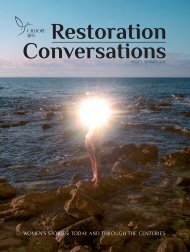

 Change language