


Restoration Conversations magazine - Spring 2025
Restoration Conversations is a digital magazine, produced by Calliope Arts, spotlighting the achievements of women in history and today. It has two issues a year Spring/Summer and Fall/Winter. The Spring 2025 issue delves into the Innocenti Hospital’s historic archives, in search of stories and ‘tokens’ belonging to its girl foundlings; then, we revel in the before-and-after glory of eighteenth-century painter Violante Siriès Cerroti’s newly restored Reading Madonna – never published before. Florence’s Museo Sant’Orsola ushers our readers into the world of contemporary art production with three artists at work for the venue’s upcoming show: Mireille Blanc, Shubha Taparia and Cécile Davidovici. In England, we meet Harriet Loffler, curator of Cambridge University’s Women’s Art Collection, and contemplate John Singer Sargent’s satin-clad ‘dollar princesses’ at Kenwood House, before venturing ‘Beyond Bloomsbury’, the Carrington exhibition at Chichester’s Pallant House Gallery. The issue travels to Elizabeth Von Arnim’s turn-of-the-twentieth-century garden in the mind of modern-day garden designer Maria Chiara Pozzana. Flavia Arlotta’s family share ‘Inner Gardens’ at the painter’s historic home, and author Katia Lysy recounts what it took for writer Iris Origo and her husband Antonio to grow a ‘Paradise in Tuscany’. We are transported from the Neolithic Age, to a world without stars, thanks to cosmologist Roberto Trotta’s book Starborn, before finding ourselves amidst the pages of Days of Light, through author Megan Hunter’s ‘personal reflections’ on her novel, liberally inspired by artist Vanessa Bell and her daughter Angelica Garnett.
Restoration Conversations is a digital magazine, produced by Calliope Arts, spotlighting the achievements of women in history and today. It has two issues a year Spring/Summer and Fall/Winter.
The Spring 2025 issue delves into the Innocenti Hospital’s historic archives, in search of stories and ‘tokens’ belonging to its girl foundlings; then, we revel in the before-and-after glory of eighteenth-century painter Violante Siriès Cerroti’s newly restored Reading Madonna – never published before. Florence’s Museo Sant’Orsola ushers our readers into the world of contemporary art production with three artists at work for the venue’s upcoming show: Mireille Blanc, Shubha Taparia and Cécile Davidovici.
In England, we meet Harriet Loffler, curator of Cambridge University’s Women’s Art Collection, and contemplate John Singer Sargent’s satin-clad ‘dollar princesses’ at Kenwood House, before venturing ‘Beyond Bloomsbury’, the Carrington exhibition at Chichester’s Pallant House Gallery.
The issue travels to Elizabeth Von Arnim’s turn-of-the-twentieth-century garden in the mind of modern-day garden designer Maria Chiara Pozzana. Flavia Arlotta’s family share ‘Inner Gardens’ at the painter’s historic home, and author Katia Lysy recounts what it took for writer Iris Origo and her husband Antonio to grow a ‘Paradise in Tuscany’.
We are transported from the Neolithic Age, to a world without stars, thanks to cosmologist Roberto Trotta’s book Starborn, before finding ourselves amidst the pages of Days of Light, through author Megan Hunter’s ‘personal reflections’ on her novel, liberally inspired by artist Vanessa Bell and her daughter Angelica Garnett.

Transform your PDFs into Flipbooks and boost your revenue!
Leverage SEO-optimized Flipbooks, powerful backlinks, and multimedia content to professionally showcase your products and significantly increase your reach.
Restoration
Conversations
ISSUE 7, SPRING 2025
WOMEN’S STORIES: TODAY AND THROUGH THE CENTURIES
Above: Flavia Arlotta, Still Life with Red Ribbon, c.1936. Colacicchi Family Collection
From the Editor
celebration of restoration and art production, our Spring 2025 issue delves into the
A Innocenti Hospital’s historic archives, in search of stories and ‘tokens’ belonging to
its girl foundlings; then, we revel in the before-and-after glory of eighteenth-century
painter Violante Siriès Cerroti’s newly restored Reading Madonna – never published
before. Florence’s Museo Sant’Orsola ushers our readers into the world of contemporary
art production with three artists at work for the venue’s upcoming show: Mireille Blanc,
Shubha Taparia and Cécile Davidovici.
In England, we meet Harriet Loffler, curator of Cambridge University’s Women’s Art
Collection, and contemplate John Singer Sargent’s satin-clad ‘dollar princesses’ at Kenwood
House, before venturing ‘Beyond Bloomsbury’, the Carrington exhibition at Chichester’s
Pallant House Gallery.
This issue of Restoration Conversations travels from the chestnut grove of farmer Miranda
Tomatis, in ‘Women Who Save the Earth’, to Elizabeth Von Arnim’s turn-of-the-twentiethcentury
garden in the mind of modern-day garden designer Maria Chiara Pozzana. Flavia
Arlotta’s family share ‘Inner Gardens’ at the painter’s historic home, and author Katia Lysy
recounts what it took for writer Iris Origo and her husband Antonio to grow a ‘Paradise in
Tuscany’.
We are transported from the Neolithic Age, to a world without stars, thanks to cosmologist
Roberto Trotta’s book Starborn, before finding ourselves amidst the pages of Days of Light,
through author Megan Hunter’s ‘personal reflections’ on her forthcoming novel, liberally
inspired by artist Vanessa Bell and her daughter Angelica Garnett.
Enjoy the issue!
Fondly,
Linda Falcone
Managing Editor, Restoration Conversations
Managing Editor
Linda Falcone
Publisher
Calliope Arts Foundation, London
Contributing Editor
Margie MacKinnon
Design
Fiona Richards
FPE Media Ltd
www.calliopearts.org
Instagram: @calliopearts_restoration
YouTube: Calliope Arts
Charleston Festival 2024, ph. Lee Robbins
4 Restoration Conversations • Spring 2025
CONTENTS SPRING 2025
PRESERVING CULTURE AND TRADITION
6 Little Meteors: the girls
12 Before and After
18 Women Who Save the Earth
24 A Spirit of Generosity
31 Relative Ties
HOW ARTISTS SEE THE WORLD
34 Chance Encounters
40 Gold Holds the Answer
46 The Eye of the Needle
54 John Singer Sargent’s ‘Dollar Princesses’
60 Carrington
WRITERS AND MINDSCAPES
68 Inner Gardens: Flavia Arlotta
74 La Foce. Paradise in Tuscany
82 Starting with the Stars
87 The mind behind Florence’s monumental green
94 Personal Reflections...on Vanessa Bell
Spring 2025 • Restoration Conversations 5
Little meteors:
the girls
Restoring tokens at the Innocenti Institute
The Innocenti Hospital’s historical archive comprises more than
13,000 documents and objects from the thirteenth to the twentieth
centuries, including ‘tokens’ that parents left with their foundling
children, as proof of identity. Located in the ancient refectory, the archive
hosts one of the world’s most unique archival collections, that of the
city’s foundling children, most of whom were girls.
As an update on the project ‘Florence’s Daughters at the Innocenti’,
sponsored by donors Connie and Doug Clark and Margie MacKinnon
and Wayne McArdle, Restoration Conversations had a dual interview on
site, with two members of the all-woman project team Antonella Schena,
Head of Archives and Museum/ Cultural Activities and services, and the
Innocenti Institute’s archivist Lucia Ricciardi.
6 Restoration Conversations • Spring 2025
The Innocenti Hospital’s historical archive,
ph. Marco Badiani, 2025
Spring 2025 • Restoration Conversations 7
Antonella Schena: ‘Florence’s Daughters’ is a
pilot project, because we are striving to develop
a lasting method, in order to research, transcribe,
restore and digitise the entire exhibitable
collection, starting with 100 tokens belonging
to little girls. The project is experimental, in the
sense that we’ve never worked with the 1900s
collection in this way before. For certain elements,
we know more about the 1400s, than we do about
the 1900s!
The documents and interviews linked to the
100 tokens selected were filled out by physicians,
from 1901 onwards. Inclusion of the mother’s data
was considered mandatory, while the father’s
was optional. These documents were created
so that the Innocenti Institute could understand
whether or not a foundling’s mother had suffered
from venereal diseases, like syphilis, or had other
relevant health problems.
Our tokens from the 1800s are stored in special
boxes, but in this case, and more specifically
from the 1890s onwards, we are working with
folders and files that are stapled together, which
always represents a challenge. Most of the paper
documents are not spotted or marred, but some
have circumscribed damage, often derived from
the simple fact that they are stored standing
upright, and not lying flat, which can cause
crinkling over time.
Several conservation issues are being
evaluated, and perhaps they will need to be
stored differently, with special paper and proper
separators, or even made-to-measure boxes.
These objects’ digitalisation will reduce the need
to handle them, if not for exhibition purposes.
Lucia Ricciardi: I’m happy to report, I found
documents for a baby called Calliope (see back
cover) among the tokens selected, and thought it
would be nice to tell you about her, considering
that this project stems from the Innocenti’s
partnership with the Calliope Arts Foundation.
She is the project’s namesake child! We have
an annotation about her father and know he
Below and right: Children’s tokens: Flora, 1901 and Maria Luisa, 1905. Courtesy of Istituto degli Innocenti, ph. M. Lanza
8 Restoration Conversations • Spring 2025
is archival and the second safeguards artistic
heritage. In the case of Baby Calliope’s token, it
involves fabric restoration, because of its pink bow
threaded through two Italian coins with holes in
the middle, one of which is cut. A metals restorer
will be involved as well. In this time period, each
baby had eight to ten sheets attached to their
case – and the paper has its own set of needs
from a restoration point of view.”
was a 25-year-old farmer. Her mother, aged 23,
is described as follows: ‘Poor. She attends to
rural tasks’. Both parents were from the Mugello
area, where Calliope was born and reportedly
baptised. The child was admitted on 13 February
1901, when she was ten days old. Baby Calliope’s
token is a complex one, because it’s made of
several different items. The first, called a ‘breve’,
is a miniature pin cushion-like object, once used
for devotional purposes. It likely contains prayers
or other kinds of texts, but they’ve never been
opened.
These messages were tucked inside the object,
and sewn up tight before being further sealed
with trimming. They constitute the token’s secret,
which we respect. Through restoration, will we be
able to look inside one or two, using radiographic
techniques? That remains a question for the
superintendency and the restoration team.
To understand the complexity of a restoration
like this one, where all one hundred tokens are
completely unique and comprised of multiple
materials, it’s important to note that two
superintendent offices are in charge of planning
and monitoring the restoration, together with
project conservators. The first superintendency
Antonella: The project is focused on the
Innocenti’s girls and its initial phase has involved
the census of our early twentieth-century tokens,
dating from 1900 to 1924. We are choosing from
an initial pool of 300 cases, whose files contain
both physical tokens and paper documentation.
The tokens themselves are not dissimilar from
those in our nineteenth-century collection. Yet,
from the turn of the century onwards, as official
paperwork became a mandatory condition
determining the Institute’s acceptance of children,
the presence of tokens diminished considerably.
After the anonymous abandonment of children
became illegal in 1875, and the Innocenti’s grated
‘foundling’s window’ closed forever, parents no
longer needed a severed coin or a bauble cut in
half, as a means of reclaiming their child. When
tokens stopped being considered a child’s identity
card, they became – as the name itself suggests
– a sign of their mother’s affection or symbolic
protection.
Lucia: Many early twentieth-century parents who
brought their children to the Innocenti had no idea
that foundling tokens were no longer ‘necessary’.
Perhaps they were told by their female elders
about age-old traditions linked to turning one’s
children over to the Institute’s care. During the
first two decades of the 1900s, it accepted roughly
700 children per year, 300 of which arrived with
tokens, called segnali, or ‘signs’ in Italian. Among
the 100 tokens chosen, those needing restoration
or conservation will be subject to treatment.
The choice of which ones to restore depends
on several factors; some are chosen for their
aesthetic quality, and others are selected for the
story they tell. Because the project involves a
small-scale exhibition at our museum, starting 5
November 2025, we have looked for tokens with
a certain degree of narrative power. We’d also
like to contextualise these tokens, and see what
story they collectively tell, as a reflection of their
historical period.
Spring 2025 • Restoration Conversations 9
10 Restoration Conversations • Spring 2025
caption
The Innocenti Hospital’s historical archive, ph. Marco Badiani, 2025
Above, left: Lucia Ricciardi . Right: Antonella Schena, phs. Marco Badiani, 2025
Lucia: A project like this one gives these little
girls relevance. They are given their own place
in history, however brief. Wouldn’t it be nice, if
each of us had our own physical page in history?
These girls sometimes lived no more than a few
days or even hours; they were meteors. But this
project affords them attention, salvaging them
from oblivion, and the gesture seems to stop –
even for a moment – the mad rush in which we
find ourselves, as members of the modern world.
If children, in general, had few rights at that time,
these children had even fewer. So, the project
enables them to emerge. It is about uncovering a
still hidden side of social history.
For several months, while working on the
project’s archival phase, we would pore over the
archives and talk to each other in hushed voices.
The whispering was a form of respect, I think.
Like the project’s sponsors, we are very keen
on giving solidity to these girls’ stories – as we
raise awareness about the small but significant
‘body of evidence’ that constitutes their life story.
Something similar was done with soldiers from
World War I, so that they would not remain a mere
list of names, and be remembered as people, not
numbers. I feel it is my duty to give these girls
the story to which they have a right. History with
a capital ‘h’ is made of many small stories, such
as theirs.
Antonella: 1900 to 1920 was a time of great
change, as far as social services for women are
concerned, albeit policies were usually formed
from the child’s perspective, not necessarily the
woman’s. At the dawn of the twentieth century,
the Innocenti started studying solutions to
keep mothers and babies together, by providing
them with external services, like childcare. As
physicians began to see maternal breast milk as
the primary safeguard against infant mortality,
national policies were rolled out throughout Italy,
to make breast-feeding by mothers mandatory for
the first few months of a child’s life. The Innocenti
Institute hosted two of the first-ever conferences
on this topic. Wet-nurses became a thing of the
past, even if artificial milk available at the time –
usually goat milk – could offer no real guarantees
of an infant’s survival.
Our history is comprised of many small stories
that are difficult to reconstruct. For ‘Florence’s
Daughters’, we are not talking about complete
histories or literary narratives. We have sparse
information, yet it was collected and it has been
preserved. Without this archive, we would know
nothing of them. It still fills me with wonder to see
how the Institute has managed to maintain these
ties through time, unlike other historic foundling
hospitals of its kind. In many ways, we are looking
at the history of the poor, the history of social
welfare – an important story to reconstruct and,
ultimately, to understand.
LINDA FALCONE
Spring 2025 • Restoration Conversations 11
Before and After
Conservator recounts
Violante Siriès’ restoration
In 1770 Violante Siriès became the first woman artist allowed to copy
works at the Uffizi Gallery. Of all the possibilities there were to choose
from, Siriès picked a small painting on copper by Venetian master
Francesco Trevisani, The Madonna Sewing. It must have been an image
close to Violante’s heart because, several decades earlier, she had painted
the Virgin Mary with a sewing cushion and needlework by her side, for
the Carthusian Monastery in Galluzzo, just outside of Florence. In Siriès’
Reading Madonna, the Virgin Mary is gazing down at an open book
placed on a table, or to be more precise, she is praying, because the large
volume, with its first three lines in Hebrew script, is obviously a prayer
book. The Madonna’s hands are clasped as she tilts her head downwards
in meditation. Lying under the book is the Virgin’s sewing cushion, with
a piece of white embroidery, needles and thread. She appears to have
just set down her work to pray. The painting is a clear depiction of the
monastic ideal: prayer and work. The monks’ active and contemplative
life is personified in this site-specific picture, created as the altarpiece
for the prior’s private chapel. The image of Mary alone and engaged in
prayer is an unusual one. But above her head, on the frescoed ceiling of
the chapel vault, is a dove, symbol of the Holy Spirit and the annunciation
of the birth of Christ.
12 Restoration Conversations • Spring 2025
Restoring hands, ph. Marco Badiani, 2025
Spring 2025 • Restoration Conversations 13
Above: Saint Catherine, before and after restoration, ph. Ottaviano Caruso
The Prior’s Chapel was frescoed in the 1600s
by Bernardino Poccetti, and then modernized in
the mid-eighteenth-century Rococo style with
gilded stucco work by Sebastiano Salvini, fresco
decoration in delicate hues by Bartolomeo Nesi,
and three paintings on canvas. The two smaller
oval paintings on the side walls of the chapel
were created specifically for the space, just like
the Reading Madonna. They depict the early
Christian martyrs Saint Catherine of Alexandria
and Saint Agnes. Catherine is identifiable by her
crown and the wheel of her martyrdom behind
her, while Agnes holds a lamb and the martyr’s
palm branch. Both saints are also depicted in the
cycle of Della Robbia’s glazed terracotta busts,
which decorate the Large Cloister adjacent to
the Prior’s private apartments. Saint Catherine of
Alexandria was a famed scholar and orator, while
Saint Agnes was known for her great piety – both
are fitting counterpoints to the Reading Madonna.
The restoration and study of the paintings was our
focus, as part of the Accademia Women project,
and our conservation process comprised the
active and the contemplative values inspired by
the paintings’ monastery setting. Besides complete
conservation of the three canvases, our aim was to
study and compare the paintings’ techniques and
stylistic qualities, utilizing findings gleaned from
diagnostic photography and scientific analysis,
in combination with our first-hand observations
during the restoration itself.
At the start of our project, the paintings were
covered with a thick layer of dirt and candlesmoke
deposits. The two ovals had been inserted
into their niches by glueing their stretchers to
wooden slats affixed to the plaster wall. The hot
14 Restoration Conversations • Spring 2025
glue dripped onto the canvas and contracted,
forming blisters in the paint layers of Saint Agnes
and partially glueing the canvas of Saint Catherine
to its stretcher, as well as damaging the painted
surface. The wooden frames of all three paintings
had been nailed directly onto the front of the
canvas. Reading Madonna had over 30 nail holes
of varying sizes in the paint layer. Its gilded frame
had evidently been removed during a previous
restoration, as we found both eighteenth-century
nails and more recent nails and screws. The
corners of the canvas were badly frayed and their
paint was actively flaking, and the same was true
in many other areas of the painting.
There were four larger tears in the canvas, three
of which had been patched from the reverse. The
patches were made of fine pink cloth formerly used
in book repair, carefully applied with vegetable
glue. These interventions may have been the
work of the monastery, which once specialized in
book and manuscript conservation. Paint losses
were evident around the tears, concealed from
the front by fills and clumsy repainting. The most
severe paint loss was the Madonna’s hands, most
probably damaged when a large bronze crucifix
fell off the altar and hit the painting. That damage,
and its subsequent repaint, which was itself
flaking away, are visible in the only extant photo
we found, which dates before 1994.
The ovals had numerous nail holes along the
edges and some minor holes in the central areas.
Fluctuations of temperature and humidity caused
the canvases to sag on their stretchers, with the
imprinting of the stretcher bars visible on the
painted surface. Cracking of the paint was plainly
visible in all three works, but so severe in Saint
Agnes as to render the image almost unreadable
and at risk of flaking.
Above: Reading Madonna, before and after restoration, ph. Ottaviano Caruso
Spring 2025 • Restoration Conversations 15
The wooden frames of all three paintings had been nailed
directly onto the front of the canvas. Reading Madonna
had over 30 nail holes of varying sizes in the paint layer.
Its gilded frame had evidently been removed during a
previous restoration, as we found both eighteenth-century
nails and more recent nails and screws
Before moving the paintings and their frames
from their niches, flaking areas were protected
with facing paper and cellulose adhesive. After
diagnostic photography and paint analysis of
micro samples, the cleaning of the thick layers
of dirt and smoke deposits was carried out using
a mild anionic surfactant. The layers of yellowed
natural resin varnish dating from the previous
restoration were removed with dilute solvent
solutions, whilst we monitored the process under
magnification and in UV light. The repaints and
fills were removed with solvent gels and through
the use of small scalpels. During this process,
we discovered original paint underneath the
repaints, which aided in reconstructing the
Madonna’s hands.
The structural conservation process achieved
its goal of re-adhering the layers and minimizing
cracking and distortions. The painted surfaces
were protected by facing paper, before removing
the paintings from their stretchers and cleaning
the reverse of the canvases, which included
the removal of the patches and glue. Tears and
holes were rewoven and reinforced with artificial
silk patches adhered with resin film. Next, we
mounted the paintings onto larger working
stretchers by attaching strips of polyester canvas
to the flattened tacking edges. Two types of
consolidants, one water-based and one resinbased,
were applied to the reverse of the paintings
to strengthen the canvas fibres and re-adhere the
paint to the canvas. To ensure the penetration of
the consolidant resin throughout the layers, the
paintings were placed under controlled heat and
low pressure with the use of a portable vacuum
pump and a conservation mat, a flexible silicon
pad with temperature sensors. The process
assured the controlled reactivation of the resin,
which was then allowed to cool under weight.
To protect the paintings once back inside their
niches, an isolating layer of polyester canvas was
stretched onto the new expansion stretchers
before mounting the paintings. After filling the
paint losses, retouching was carried out using
gouache colors and pure pigments ground in
non-yellowing varnish. The retouching on the
Madonna’s hands, using relief mapping of the
paint loss and comparing the hands with other
paintings by Siriès, remains identifiable as
restoration, when viewed from close-up.
Scientific analysis of micro-samples of paint
from the three works enabled us to identify
pigments and preparation layers consistent with
mid-eighteenth-century painters’ practice, with
the use of white lead, carbon black, red lead,
red lake, and earth colors. Observation under
magnification and diagnostic photography of
Reading Madonna confirm a painting technique
very similar to that of The Madonna Presents the
Christ Child to Santa Maria Maddalena dei Pazzi,
a large altarpiece painted by Siriès in 1767 and
restored in 2015-16. During that AWA-sponsored
project, we examined numerous paintings by
the artist. The brushstrokes, use of colour, canvas
preparation and even the adhesion problems in
the paint layers of Reading Madonna are consistent
with her oeuvre and with the previous work
restored. The style and brushwork of the Saint
Catherine shows many stylistic and technical
similarities with Siriès’ other work. However,
Saint Agnes appears to be by a different artist
altogether. Both the stretcher and the canvas type
16 Restoration Conversations • Spring 2025
Above: Saint Agnes, before and after restoration, ph. Ottaviano Caruso
are different in the two ovals, which is unusual, if
they were prepared or ordered by the same artist.
The brushwork is quick and loosely executed,
compared to the careful, meticulous rendering of
details in the other two paintings. The strokes that
create shadows and light on Agnes’ face are much
more defined than those used in modelling the
faces of Catherine and the Madonna. The extreme
cracking of the paint on Saint Agnes also points to
probable differences in the painting’s execution.
While not providing definitive answers to the
authorship of the ovals, our project has taken us
one step further in the exploration of Violante
Siriès’ oeuvre. We’re happy to be able to add
another piece of the puzzle to our understanding
of this intriguing artist, and to preserve her
paintings for generations to come.
ELIZABETH WICKS
The ‘Accademia Women: Violante’ project, executed
by restorers Elizabeth Wicks and Marina Vincenti,
was organized by the Accademia delle Arti del
Disegno and Syracuse University in Florence,
thanks to the support of the AWA Legacy Fund
and donors Connie Clark, Pam Fortune, Nancy
Galliher, Nancy Hunt, Margie MacKinnon, Donna
Malin and Alice Vogler. With special thanks to the
Soprintendenza Archeologia, Belle Arti e Paesaggio
per la città metropolitana di Firenze e le province
di Pistoia e Prato and the San Leolino Community
at Certosa di Firenze.
Spring 2025 • Restoration Conversations 17
Women Who
Save the Earth
Women farmers and ‘foodies’
take the road less travelled
Founder of the association ‘Wheat and Roses’, Barbara Nappini
is author of the book La natura bella delle cose (The Beautiful
Nature of Things) and the first woman president of Slow Food
Italy. Like the organisation she has headed since 2021, Barbara
is committed to food as a source of pleasure, sovereignty,
biodiversity and integrity – in a world of frenetic eating habits,
GMOs and mass industrial agriculture. With Slow Food since
2012, she is co-creator of the project ‘Women Who Save the Earth’
– an awareness-raising initiative which aims to give value and a
voice to women whose efforts cultivate and preserve the Earth’s
resources or produce food according to age-old traditions.
“Historically and for centuries, women were obliged to take
care of meal planning and food preparation. That was their
role, and they had virtually no choice in the matter,” says the
Florentine author. “Taking care of the family garden has always
been the prerogative of women as well, and they ran the pantry
– which we call ‘governare la dispensa’ in Italy – the key to
household ‘governance’. Women developed the ability to feed
large families on scarce economic resources. They learned
to collect ‘scraps’, to profess the ‘cult of the necessary’ and to
promote no-waste principles. These were all skills and values
women cultivated, as part of their historic role as caregiver”.
18 Restoration Conversations • Spring 2025
Above: Miranda Tomatis at her chestnut-drying hut, ph. Oliver Migliore
Perhaps today, if a woman is dedicated to food,
cooking and the land, it is more of a choice, selfdetermination.
In Barbara’s view, in these and
other spheres, women are extremely creative
and innovative, as they brave less-travelled
paths, and expand more ecologically-conscious
horizons on farms that embrace organic and
biodynamic methods, engaging in low-impact
livestock farming, or food production on an
artisanal scale.
Impressed by Slow Food’s activities and its
president’s interest in women in agriculture, the
Piedmont Equal Opportunity Department asked
Barbara and her team to develop an awarenessraising
project, which they ultimately called
‘Women Who Save the Earth’. These women were
presented at the World Earth Day in spring of
last year, and later at the ‘Terra Madre Salone del
Gusto’ conference in Turin in September 2024.
“We shortlisted a group of 10 women who work
to preserve the Earth’s biodiversity and fertility
– particularly in association with the food sector.
Among them, we find Bruna Ferro, a vine grower
who uses all-natural methods, integrating
polycultures of different plants and animals; Rita
Tieppo, a retired schoolteacher who coordinates
a hundred other teachers and brings vegetable
gardens into schools to teach children about
land cultivation and nutrition education; Elisa
Mosca, a young breeder of indigenous cows at
risk of disappearing, and producer of raw-milk
cheeses; Ariele Muzzarelli, a nomadic beekeeper,
protector of pollinating insects and regenerator
of fallow land; and Alice Cerutti, a grower of
historic rice varieties, protecting them from
extinction while creating an oasis of biodiversity
Spring 2025 • Restoration Conversations 19
Above: Elena Rodigari with her goats, ph. Oliver Migliore
for endangered plants and animals. “A small
action is the representation of what is possible,”
says Barbara Nappini. “Therein lies the courage
to make revolutionary choices.”
Among this agriculturally-minded network of
women, two stories particularly struck Barbara.
One is that of Elena Rodigari, a 28-year-old
shepherdess. As a young girl, she’d go with her
grandmother Mariuccia to her mountain cabin
in Val Chiusella, where her Nonna’s dozen goats
grazed. After her final high school exam, her
examiners asked what Elena was planning for
the future. She was ashamed to say she wanted
to become a shepherdess, even if her suitcase
was already packed and waiting at the foot of her
bed. She left for ‘greener pastures’ that very day.
“Around here they started calling me ‘La
Cravera’, the goat herder. I really liked it and
decided to call my farm that,” says Elena. The
farm is now fifty goats strong and counting, as
Elena works to develop her dairy business. Her
days start at 5am and work ends no earlier than
8pm: She cleans the stables, checks on newborn
kids, and feeds and milks her goats two or three
times a day. Barring thunderstorms, the goats
stay outside day and night in summer. In winter,
they graze a few hours each day, unless there
is snow or bad weather. Elena doesn’t deny
the difficulties that arise as a result of her life
choices: “I do everything by hand and our road
doesn’t even reach our house. Cars can’t make
it. I go by tractor.”
20 Restoration Conversations • Spring 2025
“For me, shepherding feels like free time,”
she says, when asked about her animals. “While
they are grazing, I am able to see whether or
not something is wrong with one of my goats.
If they have a problem, they look for me, and I
understand right away.”
Another of Barbara’s favourite stories is that
of Miranda Tomatis, 69, of Torre Mondovi. She is
a chestnut farmer working in the Ligurian Alps.
She shares her knowledge with preschool and
primary school students in the area through
educational activities, and hosts initiatives for
enthusiasts and hikers. Miranda cares for her
family’s chestnut groves, maintains an old-time
scau, or stone hut for drying chestnuts, like the
many that once dotted the forests of Piedmont,
and she recently bought another abandoned
chestnut grove with the intention of salvaging it.
From an early age, Miranda lived among her
grandmother’s chestnut groves and says, “My
grandmother was widowed at a very young age
with four children. Everyone contributed, even
the children, and in the autumn, chestnut picking
came first, then school. My grandmother’s
chestnut grove fed us, protected us.” Miranda
vowed to care for the grove until the end of her
days, and so she has.
“In the autumn months, I harvest the chestnuts,”
Miranda explains. “I stay at the chestnut grove all
day, because the work has to be done quickly.
After harvesting, we gather the burrs [prickly
chestnut husks]. Then, on winter afternoons,
Above: Slow Food Italia president Barbara Napini, ph. Alessandro Sgarito
Spring 2025 • Restoration Conversations 21
22 Restoration Conversations • Spring 2025
I dry the chestnuts. This work used to be done in
huts in the woods. We’d light a gentle fire and lay
the chestnuts on grates. They were beaten when
ready, to remove the husk. That work took 40
days, and sometimes we’d sleep in the huts on
a bed of leaves. Today, air drying speeds up the
work, but we are now seeing a return to more
natural methods. Taking care of the chestnut
grove is of fundamental importance to me. I
have always thought about doing my small part,
like the hummingbird.”
In conclusion, Barbara wishes to point out
that although these women’s contributions were
unknown before the project, they all share a
concern for the community. In other words, had
they not made this choice, the unique reality
they work to protect would have disappeared.
The herd would have been sold and slaughtered;
the pastures lost, the chestnut grove forgotten or
cut down. No one would be producing milk and
cheeses locally. Their small villages would have
been depopulated and their traditions forgotten.
“Among women’s gifts and skills is the ability
to create and regenerate their environment,
endowing it with meaning or beauty in many
forms,” says Nappini. “In that sense, women –
like those who ‘save the Earth’ – are the driving
force of silent but revolutionary change.”
CHIARA VOLTOLINI
Left: Ariele Muzzarelli and her bees, ph. Oliver Migliore. Above: Elisa Mosca with her cows, ph. Oliver Migliore
Spring 2025 • Restoration Conversations 23
24 Restoration Conversations • Spring 2025
A Spirit of
Generosity
Behind the scenes at
The Women’s Art Collection
The Women’s Art Collection at Cambridge University’s Murray
Edwards College has over 600 artworks by more than 300 women
artists. Housed in a strikingly modern purpose-built building which
opened in 1965, the Collection consists mainly of works donated by
artists, alumnae and supporters which are exhibited throughout the
college, allowing students to live and study surrounded by art. The
Collection is also open to the public. Restoration Conversations
had the pleasure of viewing the Collection in the company of
curator Harriet Loffler, who recounted the history of the college and
the origins of its unique art collection and shared her excitement
about an upcoming exhibition planned for 2026.
Left: Suzanne Treister, Discover the Secrets of the Universe, 1991 . On long term loan to The Women’s Art Collection © The artist
Spring 2025 • Restoration Conversations 25
Restoration Conversations: Your current
exhibition, which tells the story of The Women’s
Art Collection, is called Conversation not
Spectacle. Have the artists in this collection
become a bigger part of the conversation over
the thirty years since the collection began?
Harriet Loffler: Absolutely. Despite being the
largest collection of art by women in Europe, to
a certain extent, we are still undiscovered. And
I think we’re at an interesting moment where
people are starting to learn more about us and to
engage with our work. But it’s uncharted territory.
There are a lot of artists in our collection who
haven’t been subject to that much research, so it’s
a treasure trove. It feels like a charged moment
that is full of potential.
RC: What can you tell us about the history of
Murray Edwards College?
HL: The College was founded as New Hall in 1954
at the instigation of a group of very determined
individuals who wanted a college for women
because, at that point, Cambridge University had
the lowest proportion of female undergraduates
of any university in the UK. The university did not
admit women until the late 19th century, and then
it took another 70 years for women to be issued
with degrees.
Rosemary Murray, who was the founding
president, went on to become the first female vice
chancellor of Cambridge University. But, at the
time, nobody knew who she was because, when
students arrived at the College, Rosemary could
just as easily be found making the tea, emptying
the bin, or interviewing prospective students. The
College was renamed Murray Edwards in 2008 to
honour Murray, as well as the Edwards family who
provided a generous endowment.
RC: Given that many Cambridge colleges
date back to Tudor times and even earlier,
Murray Edwards stands out as a modern
presence amongst the more traditional college
buildings. What was the thinking behind its
distinctive design?
HL: Rosemary Murray appointed the architects
Chamberlin, Powell and Bon, who would go
on to design the Barbican in London, in the
then emerging Brutalist style. The College was
designed very much as a manifesto for the
education of women, with an intention of looking
up and aiming high. You feel that in the dome,
which is an iconic space, and then in the library,
which was seen as a kind of Temple to Learning
with this rising staircase in place of an altar. I
think it is fascinating that the importance of
women’s education is articulated in the fabric of
the building. Outside, instead of the traditional
Cambridge cloister, we have a fountain court
which is flooded with daylight.
RC: How did the College’s art collection come
about?
HL: The collection started when Mary Kelly,
the American conceptual feminist artist, was in
residence at New Hall as part of a programme
which placed artists into the Cambridge colleges.
Valerie Pearl, who was Murray Edwards’ president
at the time, wanted to bring more creativity into
the space where she was working, and Kelly had
just shown a conceptual work in London which
had caused considerable controversy. So, it was
a bold choice of the College. Kelly made a body
of work called Extase (1986), as part of a wider
series, Corpus, about women’s experience, which
was acquired by the College. That kick-started
something in the College community to think,
Okay, well, what else can we do? The response
was, Why don’t we ask women artists to donate
work? Ann Jones, who was an independent
curator and married to a fellow at the College, put
together a list of 46 artists and sent letters to each
of them asking for artworks.
RC: Who were the artists they first
approached?
HL: The artists were mainly British-based but
very intergenerational. Established artists like
Paula Rego were selected alongside Maud Sulter,
who was then an early-career artist. There wasn’t
26 Restoration Conversations • Spring 2025
really an overarching theme, so the collection is
eclectic, as you can imagine. They were mainly
looking for wall-based work. And, as much as we
would like to say that we took a radical feminist,
political approach, it really wasn’t that strategic. It
was just about adorning the walls of the College
with some work that would inspire the students
and might or might not be a financial asset.
RC: What was the response to the letters?
HL: I think Valerie and Ann were stunned at
the response as almost everybody said yes. It
was an amazing act of collective generosity:
the College received over 70 artworks. But it
is important to say that lots of artists couldn’t
afford to donate work. Elizabeth Vellacott, for
instance, and Suzanne Treister, initially said
no, although we are thrilled that they are now
represented in the collection.
One of the essays that accompanied the first
exhibition of all the donated works was by Marina
Warner, who was actually critical of the endeavour.
She problematised the ‘woman artist’ label, and
she also questioned why women should be
expected to donate their works. Would we ask
men to do that, she wondered. Among the first
Harriet Loffler, Spring Curator, 2025 The • Restoration Women’s Art Conversations Collection, ph. Lloyd Mann
27
Above: Rose Garrard, Models Triptych: Madonna Cascade, 1982 , The Women’s Art Collection © The artist
28 Restoration Conversations • Spring 2025
cohort to give, there was a resistance to being
known as a ‘woman artist’ rather than an artist,
but I think there’s a lot more ownership now of
that identity. There’s power in it now, which maybe
there hasn’t been in the past.
RC: How did the collection grow from there?
HL: There was a period of about 20 years when
the College just received donations. Artists
were recommending other artists. There was
an informal arrangement whereby artists could
have the exhibition space for free for a month
in return for a work. This became a sort of selforganised
open-source way to acquire new works.
As a result, there are a number of pieces in the
Collection that were not necessarily selected or
shortlisted. In more recent years, we’ve had a
curator in place, so there has been a shift from
the initial organic acquisition strategy to a focus
on choosing artworks that address themes of
inequality and question the rigid hierarchies
within the art historical canon and stereotypes
about women generally.
RC: One of the artworks that caught my eye
as we walked around the collection was the
piece in the stairwell with the frame that was
coming off the wall. What can you tell us about
that particular work?
HL: That is Rose Garrard’s Models Triptych:
Madonna Cascade (1982). Some time ago, Garrard
talked about an exhibition she had been to in
Nottingham in 1982 called the Women’s Art Show,
which was a historical exhibition of women
artists. She just couldn’t believe what she was
seeing, because she was like, There are all these
women artists! How did I not know about these
women? She said she had found her family, her
[artistic] genealogy.
Madonna Cascade is one of three works which
recreate self-portraits by women artists [the others
being Artemisia Gentileschi and Elisabeth Vigée
LeBrun] who were once highly regarded but fell into
posthumous obscurity. It shows Judith Leyster, the
Dutch Golden Age painter, holding her paintbrush
and palette, framed by cascading plaster figurines
of the Virgin and Child. Judith Leyster was almost
erased from history after her death, by dealers
who attributed her work to male contemporaries
like Franz Hals. The deconstructed frame suggests
a breaking away from the patriarchal art ‘his-story’
which has hitherto suppressed her. It literally
takes up space. And I think she is making a point
about the frameworks that women have to break
through in order to take up space, politically,
socially, domestically. I love that behind it you see
the bricks and mortar of the College. It’s a sort of
support structure for women across the centuries.
RC: Garrard’s work would have been one of
your earlier acquisitions. Can you tell us about
a work you have acquired more recently?
HL: Not long ago we acquired a performance
piece, Nativity (2022), by an artist called Rosa-
Johan Uddoh. This work is about Balthazar,
the Black wise man at the birth of Christ who
appears in lots of nativity scenes across Western
art history. Her piece was a kind of pantomime,
performed by three Black women. It examines the
role of people of colour within popular culture. I
love the idea of performing this every five years
and to see how it alters our perception of Nativity
plays which seem to be less and less a feature of
children’s education.
RC: What is it that you get when you acquire
a performance?
HL: That’s an interesting question, especially as
it pertains to acquisition and conservation and
all the things you think about when looking after
an accredited collection. In this case, we got a
box of props, a script, instructions, permission
to perform it again and a film documenting the
first performance.
Spring 2025 • Restoration Conversations 29
RC: As we are focussing on women and
gardens in this issue, could you tell us a bit
about the College gardens?
HL: The College was built around some quite
ancient woodland so, while the building is
modern, it is surrounded by some very mature
trees. The land was donated by the family of
Charles Darwin, and we still have his widow
Emma Darwin’s greenhouse with its original tiles.
Darwin’s granddaughter, Nora Barlow, was an
important botanist who lived on this site. A very
old plant specimen, the Aquilegia Nora Barlow,
which was named for her, is still grown here. Katie
Schwab, an artist we have commissioned for a
new project (see p.31) is thinking of drying some
of those flowers from the garden and making
paper which will be used in hand-printed designs.
There is a wonderful interplay between the
gardens and the architecture, with sight lines that
allow you to see the gardens while looking at the
art and to see the art from afar while sitting in
the garden. You will never see a Keep Off the
Grass sign here, and the students are encouraged
to pick the flowers. There is an amazing spirit of
generosity which runs through the College and
its Collection.
MARGIE MACKINNON
Left: Mabel Pryde Nicholson,
The Artist’s Daughter, Nancy as a Harlequin 1910,
The Fleming Collection
Right: Nancy Nicholson,
Auntie’s Skirts – The End, 1916
© Estate of Nancy Nicholson
30 Restoration Conversations • Spring 2025
Relative Ties
Three generations of creativity
Spring 2025 • Restoration Conversations 31
Above: Katie Schwab and the Studio Collective, Rag Rug, 2019, Horniman Museum and Gardens © The artist
“ I’m having the time of my life with this material,”
says curator Harriet Loffler, about an upcoming
exhibition at The Women’s Art Collection,
which will involve four women artists from three
generations of one family. “The exhibition will
bring together material from all four artists to
explore matrilineal lines – what gets inherited,
what gets passed on, what happens when we
collaborate with siblings.”
The starting point is EQ Nicholson (1908-1992), a
painter and textile and rug designer. Her designs
for fabric and wallpaper were much in demand and
some are still in commercial production today.
EQ Nicholson was influenced by her sisterin-law,
Nancy Nicholson (1899-1977) who worked
on textile design with her artist brother Ben
Nicholson and his wife, the sculptor Barbara
Hepworth. Nancy’s work was exhibited at the
Victoria and Albert Museum in 1976.
Nancy’s mother, Mabel Pryde Nicholson (1871-
1918) was a distinguished painter who frequently
used her children as models in striking, theatrical
poses. Mabel’s portrait of young Nancy as a
harlequin introduces the power and allure of
fabrics, costume and dress. The exhibition will
trace the importance of this impulse which
persisted in Nancy’s creative work.
The story continues with Louisa Creed, EQ
Nicholson’s daughter, who donated a rag rug cat
to The Women’s Art Collection in 2004. Creed
32 Restoration Conversations • Spring 2025
experimented with the traditional technique
of hooking, using strips of old clothes as a way
of recycling them, and has produced over 200
works, some of which can be seen in museums
throughout the UK.
In response to her research into the Nicholson
family’s many creative (but largely unknown)
women, and in anticipation of the Relative
Ties exhibition, Loffler decided to commission
contemporary artist Katie Schwab to make a new
work for the show. She is being supported in this
by Christian Levett, whose FAMM museum in
Mougins houses another of Europe’s significant
collections of art by women. Although Schwab is
not an artist in The Levett Collection at this point,
its eponymous owner notes that, “she is now
firmly on our radar. The Levett Collection and
FAMM have been building an ongoing and fruitful
partnership with The Women’s Art Collection over
the last two years. The upcoming exhibition,” says
Levett, “is a great opportunity to build on that,
and the venue is perfect for showcasing Katie
Schwab’s work.”
“There is something about bringing women’s
art together that has this incredible alchemy,” says
Loffler. “I can’t quite put my finger on it, but I
think it is extraordinary.”
MARGIE MACKINNON
Spring 2025 • Restoration Conversations 33
Mireille Blanc, Clémentine, 2023, ph. Mireille Blanc
34 Restoration Conversations • Spring 2025
Chance
Encounters
Artist and curator in conversation
A“All the works being created for Museo Sant’Orsola’s upcoming
exhibition (opening 5 September 2025) “aim to show visitors that our
future museum will strive to enhance the memory of the place. The
museum does not have a surviving collection, because the complex’s
cultural heritage has been dispersed, destroyed and forgotten,” says
Morgane Lucquet-Laforgue, Museo Sant’Orsola’s curator. “My guiding
question is this: How can we remember and share the history of
the place through contemporary action, and through the gaze of
contemporary art?”
“For centuries in Florence, artists were commissioned to produce, and
we’d like to continue that tradition. At the end of each show, we hope to
acquire one artwork per artist, to form the museum’s permanent collection,”
Morgane continues. “The twelve artists featured in our September 2025
show – eighty percent of whom are women – will be working in dialogue
with the space, including the excavation site, and several employ ancient
techniques once used or presented at Sant’Orsola.”
Spring 2025 • Restoration Conversations 35
Above, left: Lola Costa and life’s stages at Il Palmerino, Angeli Archive.
Right: Lola Costa, 1937, Tulips and playing cards
Above: Mireille Blanc, Leonardo Bianchi, Alessandro Bianchi in the Bianco Bianchi scagliola studio in Pontassieve, ph. Cinestudio, Italy 2025
The space was originally conceived as a convent,
became a tobacco manufacturing plant and,
in the 1960s was repurposed as housing for
refugees from Istria (the southern part of modernday
Croatia and Slovenia, and once Italian
territory): Hundreds of refugee families lived in
the complex for decades. Through the centuries,
it has hosted and witnessed thousands of lives.
“Right now, it’s a fascinating moment and the very
last time the future museum site will have such
large walls, and so much room, in which to create,”
Morgane explains. “When our September show
ends, this space will become a construction site,
as the venue is renovated. The new museum is
scheduled for inauguration at the end of 2026.”
As Morgane’s dozen trickle into Florence this
spring, to create their site-specific artworks,
Restoration Conversations is on site as well, for
interviews with the visiting artists (See pp. 40 and
46). In the first of this interview series, we met
French artist Mireille Blanc, for whom Morgane
is exploring the State Archives, including
the Napoleonic registers, to find documents
describing convent meals, which are certain
to inspire Mireille, as she produces her smallscale
works and one monumental piece for the
show. “I’ve followed Mireille’s work for quite
some time, with the idea that someday we would
work together. Two years ago, after meeting the
scagliola masters of the Bianco Bianchi workshop
in Pontassieve, a thought came to me: why not
put artist and artisans together, since Mireille
explores a lot of their same subjects – still life,
food, deserts, plates, tables and materiality,” says
36 Restoration Conversations • Spring 2025
Morgane. “Once you see their works together,
you will understand the link.”
Born in 1985, in Saint Avold, France, Mireille is
a figurative painter based in Paris. She teaches
at the National Academy of Art of Paris (École
Nationale Supérieure des Beaux-arts de Paris). She
is represented by Anne-Sarah Benichou Gallery
in the French capital and The Pill in Istanbul. Our
conversation started with reflections on her first
encounters at the Bianco Bianchi studio, which
just so happens to be an Italian variant of her own
surname Blanc.
“For the Museo Sant’Orsola, I am working with
Bianco Bianchi, in collaboration, not directly
in their studio, and we are creating a dialogue
between painting and scagliola. Their craft
involves making marble-like inlays with coloured
pigments, natural glues and selenite powder.
Having access to their studio, where this artisanal
work is passed down through generations, is
pushing me to think differently! I paint very
quickly, and my canvases are generally small – so
in one week’s time, I produce an artwork,” says
Mireille. “Seeing crafters working for months on a
single piece, their engraving process, the way they
mould matter to create a surface, it’s like watching
a layer of time form, and then be sanded down.”
When asked how the scagliola technique differs
from her own process and why she thinks the
project relevant, Mireille explains the following: “I
work in one go, with fresh paint that is never quite
dry. Scagliola is a very different process, and it is
useful for me to see the patterns inherent in this
craft. There is no room for ‘the accidental’, which
Spring 2025 • Restoration Conversations 37
so often characterises my own painting. But there
is an element of trompe-l’oeil in scagliola, which
is relevant to my work with illusions, and the
kitsch aspect in my paintings. I look at my subject
and see things from above, which tends to make
things more abstract, because it distances you
from them, which doesn’t happen when working
vertically, with a painting propped on an easel.
Artisans at the Bianco Bianchi studio and I share
the perspective of our vantage point.
With this project the Bianchi Bianchi studio will
start from my painting to create original work.
Some say scagliola is a dead artform, and others
said the same about painting in France, claiming
it was not contemporary. But painting or scagliola
are just tools… why should they be stuck in the
past, when it is simply a matter of what we choose
to do with them?”
Mireille’s art explores the idea of chance
encounters with everyday objects, which become
enigmatic and ambiguous. “We paint what we
are, and as a viewer, I push everyday objects
towards abstractionism – or at least make them
appear stranger. I believe that adopting a ‘new
gaze’ enables us to observe history and the past
with freer feelings. I need to paint, photograph
Above: Mireille Blanc, Anniv (J), 2024, ph. Mireille Blanc
38 Restoration Conversations • Spring 2025
Left: Mireille
Blanc, Grappe
(Marceau), 2024,
ph. Mireille Blanc
and crop, and with the visual framing of an image,
guide the gaze. I like to ‘disturb’ objects. I look
at items from humanity’s common past, things
that remind me of childhood and our collective
memory – not necessarily my own. I seek the
intimate nature of childhood objects, but my
choice of subjects is never pre-meditated. In a
word, I want to make mundane objects odd, and
familiar things visible.”
“I like to work with the end of things – after the
moment of celebration, after the cake is cut. My
destroyed-cake painting is one example,” Mireille
says. “I work with patterns in oil and find thick
impasto exciting. That is why I like to paint the
cream and frosting on cakes! People make cakes in
the shape of something else – like cars or castles
– and place funny, even eerie statues on top. My
work with all things kitsch is about limits – feeling
that I have taken an object that is disturbing, and
transforming it. I work with the strangeness of all
that is glittering, glowing and shiny. Essentially,
my work is about fascination and repulsion. I
strive to reach beyond expectations of good taste,
to overcome initial repulsion, and in this process,
I see painting as a way to sacralise, transcend and
elevate. Objects, after all, are keepers of stories,
like a souvenir.”
LINDA FALCONE
Spring 2025 • Restoration Conversations 39
Captions
40 Restoration Conversations • Spring 2025
Gold Holds the
Answer
CAn interview with artist Shubha Taparia
Curator and conceptual artist Shubha and restoration. I approached the
Taparia has lived in London for twentyfive
years, but it was in India, standing in restoration and later learned how this
technique as a symbolic form of
front of her ancestral home – a sevenstorey
wooden structure at the end of with Kintsugi, which aims to restore
idea is present in the Japanese culture
its multi-century life – that she posed a cracks using gold. In London, there
question that has guided her art journey
since: “What would it take to restore it?”
Then the answer came to her, as simple
and bright as the word itself: Gold.
Restoration Conversations: You often
use gold in your monumental artwork,
and that journey started in Ratlam, a
small city in central India. Where has it
taken you since?
Shubha Taparia: Among India’s ancient
manuscripts, there’s one text called
Swarna Tantra, which talks about gold as
a material symbolising transformation
are so many buildings that become
derelict, or are being repurposed, so
my question became: If the material or
physical world keeps changing, what
lives on in a place?
I use gold as a way of highlighting that
spirit – the spirit in the inanimate. My
future intervention for the upcoming
exhibition at Museo Sant’Orsola
(opening 5 September 2025) lends itself
to this idea perfectly, since the venue
is being rediscovered, after having
lived ‘many lives’, which are waiting to
be brought to the fore and restored to
collective memory.
Left: Shubha Taparia at work, ph. Michiko Isobe
Spring 2025 • Restoration Conversations 41
Above: Shubha Taparia, Palace Street, 2019
RC: Is there one work in particular that has
influenced your creative process in the long
term?
ST: There is one sculptural installation I did,
using a hand from a third-century sculpture
of a Buddha from China. During the Cultural
Revolution, the sculpture was broken down, and
this bronze hand – which I found by chance with
an antiques dealer in London – was all that was
left of it. The symbol of the Buddha was etched
on the palm, and on the other side, there were
what looked like hammer marks. Some worker
must have picked it up and used it as a hammer.
I bought it, selected granite rocks as a base and
displayed that hand – hammer marks showing
– as an installation. It is very interesting to me
how that hand survived, reached an artist and
became an artwork again… and to view it that
way. It was made for reverence to begin with,
and then it served a utilitarian purpose, and now,
once again, it is food for thought. In a way, this
piece represents my observation and belief that
the spirit of something is what survives.
RC: Tell us more about your work with gold
and what it means to you?
ST: At a certain point of distillation, art becomes
universal across cultures. I feel like there are lots
of things that divide us – we continuously talk
about how we are different, but we do need some
people who show the unifying factors in human
beings, and that is the hope for peace. Gold is
something that everyone understands and has
for millennia. In every culture, gold is seen as a
symbol of regeneration, enlightenment, the light
of God, or wisdom, so it’s a very special material
that never tarnishes and, in that sense, there is
an eternal quality to it.
42 Restoration Conversations • Spring 2025
When I work on paper, I apply 24-karat gold leaf.
When using gold on the walls directly, or on
materials like tarpaulin, I use gold leaf that has
the feel of 24-karat gold. The most difficult thing
about working with gold is that it is used a lot
for decoration. I have to be very cautious and
only use as much as required. Very often, when
I start a project, those working with me will say,
“Oh, should we put a little bit here? It will look
nice.” And I say, “That’s not the point. It doesn’t
have to ‘look nice’ – it shouldn’t be ornamental.”
RC: Have you ever returned to India to
produce ‘gold’ art?
ST: I’ve done photographic works of the spice
factories in Kerala, which is by the sea. It was
known for its spice trade around the world. Many
of them are crumbling, but their warehouses are
still used to store spices. Because I was unsure
of how long the buildings would last, I started to
wish I could highlight their spirit somehow.
In this case, I did not work with the physical
buildings, but with printed photographs and
gold leaf, so these were fictional landscapes,
something that doesn’t exist in reality, but it exists
for me, because I’ve transferred it onto paper. It
was incredible because the photographed walls
and the colours of that artwork are identical
to those of the building where the works
were displayed in the former Hotel Averard, a
temporary exhibition space across from Hyde
Park, where I’d put actual gold on the walls.
And you couldn’t tell if the walls hosting those
photographs were part of Kerala’s heritage – and
this was in London! The conversation between
art-in-two-places emphasised the universality of
the idea of the spirit.
Below: Shubha Taparia, The Averard Hotel, Slate Projects, London 2016
Spring 2025 • Restoration Conversations 43
44 Restoration Conversations • Spring 2025
RC: What does your creative process look
like?
ST: In terms of process, I just get visions of final
artworks. Something comes as a vision to me,
and I don’t even know how it will be executed,
or very often I don’t have the necessary skills.
It’s almost like working backwards: I’ve already
seen the final piece, and know what it will look
like. It’s like time travel in quantum space. Then
I say, “Okay, how would it come into existence?”
Fifteen years ago, when I began making
lenticular prints, an artwork came to me as a
vision. Then, I did research on what I had seen,
to understand what technology I’d need to create
that particular effect, and I must have made 50
phone calls about lenticular prints. During the
last one, a lab owner told me to go see him and
we’d experiment. Once I have that vision of a
thing, the process is very challenging, but that’s
where my purpose and my growth lie.
RC: What does it feel like to be an art ‘time
traveller’? How do you access these visions?
ST: I can tell you about the time I was doing a
huge installation, which was eighteen metres
long and six metres high and I was working with
scaffolding and light technicians and all these
people. There were days on end, in which nothing
worked. The team would come to me and ask,
“What are you smiling about? Nothing is going as
it should”, and I would answer, “But I know there is
an end, and I’ve seen it”. I tell myself, ‘If I don’t stay
calm and enjoy this process, then there is nothing
for me to gain from my art”.
That’s all there is to my artwork. Once the
work is made, it’s a ‘third person’ for me. At
that point, that art is for other people. I am very
objective about it. I can say, “Oh look, this is so
good”, or otherwise. What I had to get out of it
is the process. Artwork serves as a reminder, but
I am detached from it. I find it is important to
avoid over-excitement, and to keep my reactions
measured. In the art gallery business with my
husband, he sometimes says, “Oh, aren’t you
happy about this big sale?” I say, “Yes, I’m thankful
that it happened, but let’s move on.” An excess
of emotions slows down my process, and that’s
not the point. The point is simply to continue
the journey.
RC: For the Museo Sant’Orsola show, you’ve
been awarded an artist’s grant by the
Calliope Arts Foundation, in partnership
with the museum. Could you tell us what you
and the museum are planning in terms of the
work’s execution?
ST: I have help whenever I have a very largescale
work to do, because my brain works at a
much faster pace than my hands! With Museo
Sant’Orsola, we plan to involve the art student
community and the general public of Florence in
the gilding process, giving them the opportunity
to become a meaningful part of the work.
LINDA FALCONE
Left: Shubha Taparia, Picadilly, 2021
Spring 2025 • Restoration Conversations 45
The Eye of
the Needle
Textile storytelling with
artist Cécile Davidovici
CCome autumn 2025, Paris-based French artist Cécile Davidovici is
expected in Florence, where her works will form part of the threemonth-long
12-artist exhibition opening at the Museo Sant’Orsola
on 5 September 2025 (see pp. 34 and 40). A self-taught embroidery
artist with an eye for innovation, Cécile adopts a process that’s both
meditative and modern. She is the recipient of an artist production
grant, supported by Calliope Arts, in partnership with the museum.
The artist shares insights on her 7-year career, from her first approach
to needlework, to her collaborative artworks today.
Right: Cécile Davidovici at work at Museo Sant’Orsola , ph. Cinestudio Italy © Museo Sant’Orsola
46 Restoration Conversations • Spring 2025
Restoration Conversations: You studied theatre
in Paris and film in New York, and went on to
become an award-winning film writer. Why
did you shift your artistic energy from moving
pictures to the textile arts?
Cécile Davidovici: I was working as a writer, film
director and editor, and first discovered embroidery
for fun, as a hobby. The tangible and tactile element of
embroidery was a game-changer for me, because it is
absent from film, which is more abstract. When I lost
Spring 2025 • Restoration Conversations 47
48 Restoration Conversations • Spring 2025
When I lost my mother twelve years ago, I began
to feel that something was missing from my
artistic practice. Embroidery gave me the touch I
was missing from her. I didn’t mentalise it at the
time… I reached that understanding later
my mother twelve years ago, I began to feel that
something was missing from my artistic practice.
Embroidery gave me the touch I was missing from
her. I didn’t mentalise it at the time… I reached
that understanding later.
For my first body of works, I drew from VHS-tape
home videos from my childhood and explored
family themes, where each scene was meant to
tell a story. ‘Textile’ and ‘Text’ have the same root
texere, which means to weave, so the transition
made sense. Telling a story with an embroidered
image is a very different exercise than telling it
with a series of moving images, but I’m always
looking for new ways to evolve, in terms of how I
might do it. Today, I am less literal.
RC: You’ve often called embroidery a meditative
process. Can you tell us more about your art
production from that angle?
CD: Embroidery involves repeating the same
gesture over and over again, and as a meditative
state, it has helped me. Artistically, I am interested
in talking about time – bridges in time between
the past and the present and into some sort of
eternity, but as I embroider, it is just me in the
moment and in a meditative mood. Today, things
go so fast; embroidery is a counterpoint. In fact, if
I don’t embroider for a few days, I start to feel like
I need to, because it brings me a sense of peace.
You might call it ‘soft concentration’. The mind
stays focused but it’s not strenuous or intense. In
a word, I find it a calming practice.
I also feel a real sense of connection by doing
something traditionally practiced by women
through the ages. It is about escaping, and being
with yourself. It is about having time to think, and
not being simply overwhelmed by household
chores, or being at home but never actually being
present. I think that’s what women of the past
may have used it for.
RC: Historically, embroidery has been
considered one of the ‘minor arts’. How is that
preconception changing today and what is
your perspective on the difference between
craftsmanship and the fine arts?
CD: Embroidery is really unique and I find working
with this media today a special experience. It
is a media traditionally associated with women,
but historically, artistic creation has largely been
the domain of men. My aim is to move this
craft beyond its conventional links to delicate
embroidery or domestic decor, and to redefine
it as a powerful form of artistic expression. To
be part of this change is incredible, as I help
shift embroidery’s standing, by positioning it
as a media capable of creating works of art, not
craftsmanship. What rings true for any work
of art applies to embroidery as well: you have
to ask yourself what you are trying to provoke
and express. The artisanal nature of needlework
is changing. There are so many textile arts. It
is about what you want the viewer to feel or to
react to, because art is not just about technique,
it’s about intention.
Left: Cécile Davidovici, Project 1988, 2019
Spring 2025 • Restoration Conversations 49
Above and right: Cécile Davidovici, La Jeune Fille Au Miroir, a self-portrait from 2022
RC: First, let’s start with technique. You’ve
brought innovations to your field with a
practice you call ‘thread painting’. Tell us more
about it.
CD: As the name suggests, thread painting
involves using thread to achieve a painterly effect.
With needlework, mixing colours is a challenge,
because if you try to ‘blend’ threads, you risk
getting a ‘hairy’ effect. With painting you can mix
or even erase colours, but with thread, it can’t
be done, so I’ve managed to achieve a blending
effect by using a cross-stitch with thinned thread.
For instance, the cotton thread I use is comprised
of six strands, and I take it apart and embroider
with one strand at a time.
Lighter thread helps me achieve the nuances
I’m looking for, which is very important especially
with portraits and for flesh tones. The skin has so
many colours to interpret and translate, because
of how light interacts with it.
The embroidery of my initial works was very dense
and thick, and I did not achieve a wide range of
hues. Now, I have a wall hosting 500 colours, but
I have started dyeing thread – to get more of the
shades I am looking for. Five hundred colours
sound like a lot, but you need many more in
embroidery to attain the versatility of what paint
can do.
RC: You mention portraits and the rendering
of skin tones. How would you describe your
portraiture?
CD: Today – this year – I am doing less portraits,
perhaps because people like them so much.
I don’t want to get stuck doing just one thing.
But I do recognise there’s a sort of magic that
happens with portraiture. What I want is for
the viewer to look at the portraits I create, and
to see themselves. In my dual portraits, both
figures represent an alternative version of the
50 Restoration Conversations • Spring 2025
Spring 2025 • Restoration Conversations 51
52 Restoration Conversations • Autumn 2024
Above: . Cécile Davidovici, Portrait of a constant dream IX, 2021. Left: Davidovici and Ctiborsky, Tant de siècles et pas un souvenir
same person. The faces are exactly the same,
but different, because I can’t embroider the same
figure twice. With needlework, even if I try to
be exact, there will always be variations, in the
colours, in the threads. What a person does with
their life is based largely on their heritage, but
my dual portraits are a symbol, that you can take
different paths, with what you have in hand. I
believe portraiture is about transmitting what lies
inside us – what we are, and what we carry.
RC: For the Museo Sant’Orsola exhibition,
you’ll be working with your partner, French
film director and visual artist David Ctiborsky,
with whom you’ve created a number of works,
including your widely acclaimed still-life or
‘silent life’ series, called La vie silencieuse.
What is your collaborative process, and what
can we expect at the museum?
CD: We’re preparing two pieces with mixed
media – mixed layers imaginary architecture and
landscape, that will invite the viewer to walk
through time and space, as they interact with the
pieces. We thought about the concept together.
Now David is creating the compositions. Ultimately,
we print those images on fabric and I embroider
them.. Some parts are completely covered with
thread and others remain uncovered, which gives
depth to the work. We like the viewer to see the
underlying layer, for it to peek through, so you
can see how the work was built. David adds to
the conversation and enriches my technique by
introducing elements of light or shadow to the
original image. Our art develops as a constant
dialogue. We don’t see our work as two separate
phases.
Our research residency last year at Museo
Sant’Orsola was a whole new world. Very rarely
does an artist have the opportunity to respond
to such a huge space – and beyond its size,
we’d like to enter into dialogue with its layered
landscape, which is still visible. Our two pieces
are conceived in order to interact with the place
and with each other. One of them is large scale,
which is a nice challenge for this technique.
LINDA FALCONE
Spring 2025 • Restoration Conversations 53
Left: John Singer
Sargent, Margaret Hyde,
Nineteenth Countess of
Suffolk, 1898, courtesy of
Historic England
54 Restoration Conversations • Spring 2025
John Singer Sargent’s
‘Dollar Princesses’
A fresh look at portraits from the Gilded Age
In the years between 1880 and 1920, some
400 marriages took place between American
women and European aristocrats. It was
understood that the women, daughters of
nouveau riche industrialists from Britain’s
erstwhile colony, were seeking social status and
titles in exchange for a much-needed influx of
cash into the depleted coffers of titled European
families. The women were sneeringly referred
to as ‘Dollar Princesses’, lumped together as
having no individuality or interest beyond the
size of their dowries.
Whatever other attributes they may have
possessed, one thing many of the so-called
‘Dollar Princesses’ did have in common was to
have their likenesses painted by the foremost
portrait painter of the day: John Singer Sargent,
an American-born, French-trained artist who
lived and worked mainly in London. A new
exhibition at Kenwood House in London will
bring together 18 of Sargent’s portraits of these
young American ex-pats.
The timing of the exhibition is auspicious
because 2025 marks the centenary of Sargent’s
death in 1925. Kenwood House and its estate,
which adjoins Hampstead Heath, was the home
of Lord Mansfield and is now a picture gallery
overseen by English Heritage. Their collection
includes Sargent’s portrait of Daisy Leiter,
originally of Chicago, who would become
the nineteenth Countess of Suffolk on her
marriage to Henry Howard. As part of a gift
to the nation from the Countess, Kenwood
acquired the Sargent portrait which now hangs
conspicuously in the main stairway of the
house.
Curator Wendy Monkhouse explains that, “the
reason we’re doing the show is that it’s never
been done before. Of all the Sargent shows
that have happened, nobody’s actually done
the ‘Dollar Princesses’. So it seemed exciting
because, with Daisy Leiter’s portrait, we have
an extraordinary key work. Then, when I started
looking into the heiresses who sat for Sargent,
I started to wonder if the generalisations about
them held up. The research began and, looking
at them one by one, it became clear that only
a few fit the stereotype behind the ‘cash for
coronets’ tag.”
Commissioned as a birthday gift from her
parents, Daisy’s portrait was exhibited in the
1898 summer show at the Royal Academy. Daisy,
a nineteen-year-old with “the loveliest eyes in
Washington,” looks directly out at the viewer in
Spring 2025 • Restoration Conversations 55
Above: The Music Room at Kenwood in Hampstead, London. Courtesy of Kenwood House
a fabulous Worth gown. “It was not a marriage
portrait,” says Monkhouse, “as in, it was not a
portrait to get a husband, nor was it a portrait
upon a marriage. Sargent didn’t keep sitter
books, so it is difficult to know exactly when and
where it was painted.” Daisy brought youth and
beauty to her marriage to the Duke of Suffolk, as
well as funds to restore Charlton Park, the family
seat in Wiltshire, which had fallen into disrepair
ever since the family had backed the wrong side
in England’s Civil War. However, the marriage
was relatively short-lived, as Henry died in battle
during the first World War. Daisy raised their three
children on her own, never remarrying. A keen
horsewoman, it has been suggested that, later
in life, she became a helicopter pilot and flew
from her Cornish home to her suite at the Ritz
Hotel via the Battersea Heliport. “At the moment,
I’m trying to find her helicopter license,” says
Monkhouse, “because the Ritz story is told all
56 Restoration Conversations • Spring 2025
the time and I want to know, did she fly it herself
or not? Because if she actually knew how to fly a
helicopter, that’s quite impressive.”
Daisy’s most lasting accomplishment was
her bequest to the nation of the collection
of artworks from Charlton Park. The Suffolk
Collection, as it is known, occupies the upper
floor at Kenwood House and features royal and
family portraits spanning the sixteenth to the
nineteenth centuries, including an important
group of paintings by Jacobean portraitist
William Larkin.
Though some of the marriages were
undoubtedly transactional, others were
grounded in affection. Lyon Playfair, first Baron
Playfair, recalled in his memoirs that his wife,
the former Edith Russell of Boston, “has been to
me a constant source of support and sympathy,
both in my private and public life.” He was also
delighted that, through her family, he became
Spring 2025 • Restoration Conversations 57
Above: John Singer Sargent, Mrs. Wilton Phipps
(Jessie Wilton Phipps), c. 1884
© Steven DeWitt Lowy
Above, right: Lydia Chapman, Kristhel, 2022
Right: John Singer Sargent, Mary Crowninshield
Endicott Chamberlain, 1902. Gifted to the National
Gallery of Art, Washington DC by the sitter,
Mary Endicott Chamberlain Carnegie
58 Restoration Conversations • Spring 2025
acquainted with the highly intellectual mavens
of Boston society. “Longfellow, Emerson, Wendell
Holmes, Lowell, and other men of light and
leading I met at their house, forming many
pleasant friendships for the future.” Monkhouse
notes that, “Edith Playfair’s portrait from 1884
is the earliest in the show, and it’s absolutely
fantastic. She is wearing a fashionable gold
cuirasse bodice which is meant to look like the
sort of waistcoating piece of defensive armour
worn over the chest.”
Another trans-Atlantic union that excited a lot
of press interest was the 1888 marriage of Mary
Crowninshield Endicott of Salem, Massachusetts
to Joseph Chamberlain. Mary was a descendent
of John Endecott, the first governor of the
Massachusetts Bay Colony and Ellen Peabody
Endicott, granddaughter of one of the wealthiest
men in America, Captain Joseph Peabody. Her
impressive pedigree was much remarked
upon, with Mary’s brother suggesting that it
was, perhaps, the bridegroom who was a bit
too middle class. But with a substantial income
and estates of his own (although no peerage),
Chamberlain was not looking for a bride to
bail him out. By all accounts, the marriage was
a happy one, with Mary assuming social duties
and supporting her husband’s political concerns
after he became Colonial Secretary in 1895,
engaging in the quiet diplomacy that comes
from “orchestrating conversations over dinner
and mediating between people who wouldn’t
ordinarily get on,” says Monkhouse.
In her memoirs, Joyce Grenfell, a noted actor
and writer who had her own photographic portrait
done by Lord Snowden, dated the painting of her
grandmother, Jesse Wilton Phipps. “The Sargent
portrait of my grandmother hangs in our living
room,” she wrote. “It was painted in 1883, three
years after the birth of her eldest son, my father.
She was enchanting to look at even as an old lady,
and she was obviously remarkably good-looking
as a young woman when John Singer Sargent
painted her portrait. I love the picture, but I never
got close enough to my grandmother to love her
…But there were compensations about staying at
Chorleywood (her country house)… There was a
sponge cake of the most satisfactory consistency.
After a slice had been wrested from it, the cake
rose back to its original height, at least five inches
of it.” But before Mrs. Wilton Phipps became a
cake-baking grandma (or a grandma with a good
cook), she had a career as a municipal politician.
Phipps was elected to London County Council
in 1907, and served on the council’s education
committee, chairing it from 1923 to 1926, the first
woman to do so. In 1926, Phipps was made a Dame
Commander of the Order of the British Empire.
It is interesting to imagine Sargent at work in
his Tite Street studio in Chelsea darting back
and forth to his easel while painting portraits in
the time-honoured ‘sight-size’ tradition, which
requires the artist to stand at a distance to view
the canvas and the subject side-by-side, then
rush back to apply brushstrokes freely to the
canvas. What would the American heiresses
have made of the rather large painter, who
was otherwise unfailingly polite and charming,
retreating and advancing while staring at them
with fierce intensity?
One of the visitors to the exhibition will be
Charles Cecil, whose eponymous studio in
Florence aims to preserve and advance the
‘sight-size’ tradition of drawing and painting from
life, whose exponents have included Velazquez,
Reynolds and Gainsborough, as well as Sargent.
In 2022, works by students from the Cecil atelier,
including Lydia Chapman, were featured in the
exhibition ‘Portrait Dialogues’ at Villa Il Palmerino
in Florence, former home of the writer Violet
Paget, better known as Vernon Lee. Sargent
was a childhood friend of Lee’s and frequently
attended her weekly salons there. His loosely
painted portrait of her, dedicated to “my friend
Violet” reveals something of her intellectual
nature and preference for ‘masculine’ attire.
No one will mistake her for a ‘Dollar Princess’.
In her essay, ‘The Psychology of an Art Writer,’
Lee, whose views on art were influenced by her
relationship with Sargent, wrote that, “a great
picture is made to be seen at several goes.” It is
time to take another look at the heiress portraits
– beyond the technique, beyond the fashion –
to discover the women regarding us confidently
from the canvas.
MARGIE MACKINNON
Spring 2025 • Restoration Conversations 59
Carrington
Bloomsbury’s shooting star
While Vanessa Bell was being celebrated at the MK Gallery (see p.95),
another Bloomsbury figure, Dora Carrington (1893-1932), had her own
exhibition at the Pallant House Gallery in Chichester. As in life, Carrington
received less attention than the slightly older and better-known Bell.
But, as co-curator of the Carrington exhibition Anne Chisholm explains,
“we felt that people should be reminded that she was a very gifted and
considerable artist. Because she didn’t produce all that many works, and
because so many of them had gone missing, her standing as a painter
had got a bit sidelined. So, we thought it was high time to have another
look.”
Chisholm explains that she first became interested in Carrington while
working on a biography of Frances Partridge, who was to become the
second wife of Carrington’s husband, Ralph. “Carrington kept attracting
my attention,” she says, “but as Frances was my focus, I would have to
push her out of the way; but I did find her intriguing. When I was starting
work on the biography, I went to see Catherine Carrington, the artist’s
sister-in-law, who was then approaching 90 and living in a small cottage
near Lewes in Sussex. There, on the wall, was the pencil drawing of Noel,
[Catherine’s husband and Dora’s brother]. I thought it was one of the most
beautiful drawings I had ever seen. And I still think so.” Done while she
was still a student, Noel Carrington (c.1912) shows Carrington’s mastery of
the Slade techniques, as taught by drawing master Henry Tonks who was
himself profoundly influenced by Michelangelo.
She had been an indifferent pupil at the Bedford School for Girls
but her artistic talent had shone through enough for her mother to
encourage her move to the Slade, which the older woman imagined as
a sort of finishing school for proper young ladies. Carrington, who was
only too anxious to shake off her mother’s conventional, petit-bourgeois
pretensions and strong religious views, was delighted to find that, in
fact, the Slade provided exactly the sort of bohemian environment in
which she could re-invent herself. She quickly dropped her first name,
which she considered to be redolent of ‘Victorian sentimentality’, and
was known thereafter within her circle simply as ‘Carrington’. Defying the
conventions of the time, she cut her hair into a short bob, becoming one
of the first ‘Cropheads’ (a term coined by Virginia Woolf), along with fellow
students Dorothy Brett and Barbara Hiles.
60 Restoration Conversations • Spring 2025
Above: Dora Carrington, Noel Carrington, c.1912, Trustees of the Cecil Higgins Art Gallery (The Higgins Bedford)
Spring 2025 • Restoration Conversations 61
Above: View of the exhibition, courtesy of Pallant House Gallery
Unlike Bell, whose experience at the Slade was
disappointing, Carrington was a star student,
winning prizes and scholarships. She was a
popular figure with the other young artists,
both male and female. “She was,” according to
Chisholm, “mesmerising, and people did fall for
her tremendously; she had a kind of power to
attract.” Her fellow student, Mark Gertler, fell
completely under her spell and her failure to
reciprocate his passion, Chisholm says, “drove
him nearly mad. But, despite their tortured
romance, they did have a very strong artistic
connection. They were two gifted young painters
who helped each other in the early days” and
maintained a lifelong friendship.
In the exhibition, Carrington’s 1919 portrait
Mrs Box is shown next to Gertler’s 1913 portrait
of The Artist’s Mother, which have undeniable
similarities in style, composition and subjectmatter.
Carrington and Gertler were selfproclaimed
outsiders, aware that they differed
from other members of the Bloomsbury Group
in terms of class and educational background.
Chisholm notes that, “like many key Bloomsbury
people, David Garnett [who would later edit an
edition of Carrington’s letters] thought she was
socially and intellectually not quite up to them.
They were fearful snobs. One of the problems
was that her style of painting was very different
from that of Vanessa Bell and Duncan Grant. And
it was Roger Fry and Clive Bell who were the
arbiters of Bloomsbury artistic taste.” The 1910
exhibition Manet and the Post-Impressionists,
organised by Roger Fry and Clive Bell, was
a pivotal event that sparked the Modernist
era in British art. “But,” notes Chisholm, “while
Carrington attended the exhibition and admired
Cézanne and the other French artists in the
show, she wasn’t nearly as affected by them as
the other Bloomsbury artists were. Her work
remained more realistic, with a strong bias
towards the representational.”
62 Restoration Conversations • Spring 2025
Above: Dora Carrington, Mrs Box, 1919, The Higgins Bedford
Spring 2025 • Restoration Conversations 63
Above: Dora Carrington, Lytton Strachey Reading, 1916 © National Portrait Gallery, London
The most important person in Carrington’s life
was one of the Bloomsbury Group’s founders,
the writer Lytton Strachey, best known for his
biographical study, The Eminent Victorians. They
famously met in 1915 at a house party in Sussex
given by the Bells where Strachey was a fellow
guest. Describing that weekend in a letter to her
friend Christine Kuhlenthal, Carrington wrote:
Duncan Grant was there, who is much the
nicest of them & Strachey with his yellow face
& beard, ug ! We lived in the kitchen & cooked
& ate there. All the time I felt one of them
would turn into mother & say ‘what breakfast at
10.30! Do use the proper butter knife!’ But no.
Everything was behind time. Everyone devoid
of table manners, & and the vaguest cooking
ensued. Duncan earnestly putting remnants
of milk pudding into the stock pot! They were
astounded because I knew which part of the leek
to cook! What poseurs they are really.
Carrington at first rebuffed Strachey’s
advances only to fall completely and irrevocably
in love with him soon afterwards. The fact that
he was a well-known homosexual did nothing to
dampen her passion. She would eventually go
on to marry Ralph Partridge and have affairs with
other men and women, but Lytton was the person
she chose to spend her life with. Carrington’s
Lytton Strachey Reading (1916), which is part
of the National Portrait Gallery’s collection, is
an intimate and finely observed portrayal that
reflects the artist’s deep feelings towards the
sitter, while Strachey’s delicate elongated fingers
and total absorption in his book identify him as
a man of letters.
64 Restoration Conversations • Spring 2025
The artist’s later work defies categorisation.
As Chisholm says, “There isn’t necessarily a
distinctive Carrington style because she painted
in so many different styles. Comparing the Farm
at Watendlath (1921) to Spanish Landscape with
Mountains (c.1924), for example, you wonder
how these could be by the same painter.” The
former, a moody English landscape with two
tiny enigmatic figures in the foreground, came
second only to a David Hockney in a public vote
taken in 2014 on the most popular work in British
museums. Spanish Landscape, on the other
hand, is a surrealistic dreamscape radiating heat
from its vivid sensual forms.
Carrington’s artistic output encompassed
a wide variety of forms. Even before she had
left the Slade, she was commissioned to paint
frescoes at Ashridge House, a stately home in
Hertfordshire. She was a skillful printmaker,
producing four wood-cuts to illustrate Leonard
and Virginia Woolf’s first Hogarth Press
publication. She worked as a designer at the
Omega Workshops, the project established by
Roger Fry, Vanessa Bell and Duncan Grant to
bring modern art into designs for the home. She
also designed tiles, cut book plates and painted
inn signs. More than anything, she devoted her
creative energy to transforming the homes she
Above: Dora Carrington, Farm at Watendlath, 1921 © Tate
Spring 2025 • Restoration Conversations 65
Above: Dora Carrington, Iris Tree on a Horse, c.1920s, The Ingram Collection, Courtesy of The Ingram Collection
lived in with Strachey. She painted furniture and
created trompe-l’oeil decorations to enhance
their shared environment. She was so successful
in this that she was showered with requests to
embellish friends’ homes as well. A full-size
trompe-l’oeil window on an exterior wall at
Biddesden House, portraying a maid peeling
an apple while the cat beside her looks up at a
canary in a cage, can still be seen today. The work
was a welcome home present to Diana Guinness
(formerly Mitford) after the birth of her son.
Carrington rarely signed or exhibited her
works. “She was almost masochistically selfeffacing,”
says Chisholm. “Her work came from
the heart, and she feared exposing too much
of herself. She dreaded criticism and not being
good enough.” Still, she found a way to earn some
money from her art by selling an innovative
style of ‘tinsel paintings’. Adapting a Victorian
technique of painting on glass, Carrington
created her own small works on glass to which
she would add foil (which came from cigarette
packets and sweet wrappers). After painting the
outline of the design onto the back of the glass,
she glued on foil within the outlines, adding
further paint as necessary to cover the whole
surface. Although it was fiddly work, she was
able to produce these quirky, luminous pictures
quickly and sell them profitably at Fortnum &
Mason and other shops. Her small picture of Iris
Tree on a Horse (c.1920), “turns a tiny portrait of
a friend into a timeless legendary adventure in
miniature,” says author Ali Smith. (The picture
sold at auction for £10,625 in 2011.)
A much-published photograph shows
Carrington cavorting naked on a plinth at
66 Restoration Conversations • Spring 2025
Garsington Manor, home of Ottoline and Philip
Morrell. She looks directly at the camera and
appears to be uninhibited and carefree. In most
other photographs, Carrington is either looking
away from the camera or peering out shyly from
behind her fringe. “She was shy, she was retiring,
and then suddenly,” exclaims Chisholm, “she’s
naked on a plinth! That is why the woman is so
fascinating. You can’t pin her down. You can’t
pin her down artistically, sexually or emotionally.
She’s quicksilver.”
The Garsington photo was taken in 1917, the
year that Carrington and Strachey set up house
at Tidmarsh Mill House in Berkshire, possibly the
happiest time of her life. After a short illness,
Lytton Strachey died in January 1932. Carrington
took her own life just a few months later, unable,
it seems, to contemplate life without him. She
was 38 years old.
No exhibition of her work was held until 1970,
thirty-eight years after her death. Until now,
her most recent solo exhibition took place at
the Barbican in London. Sadly, the budget for
that show did not stretch to a catalogue. That
absence has been made up for with the Pallant
House’s beautiful volume of reproductions of
her paintings and decorative objects, along
with essays by scholars who have re-examined
the significance of her multi-faceted work, and
friends whose memories of her convey the deep
affection in which she was held.
MARGIE MACKINNON
Spring 2025 • Restoration Conversations 67
Inner Gardens:
Flavia Arlotta
An interview with
Francesco Colacicchi and Alta MacAdam
Walking up the wide but wooded
path, to the Colacicchi house on via
dell’Osservatorio, was my first taste
of Spring this year. It was also the closest I will
ever get to fulfilling a childhood dream: to be
able to step inside a painting and into another
world. Francesco Colacicchi and his wife,
author Alta MacAdam, opened their home for
this interview, and to discuss, with co-curator
Federica Parretti and myself, the September
2025 show at Il Palmerino, featuring Francesco’s
mother, painter Flavia Arlotta, co-organised by
Il Palmerino Cultural Association and Calliope
Arts Foundation, in collaboration with the British
Institute of Florence.
Francesco is a painter, like his mother Flavia,
and his father Giovanni Colacicchi, an artist who
achieved considerable acclaim in Italy’s largely
unexplored Novecento period. To say the family
home is a wunderkammer (or cabinet of wonders)
is an understatement. Its shells, bottles, baubles,
cups, rocks and glassware all seem to have their
painted alter egos, and the walls are hung with
works by all three of the family’s artists, that tease
the visitor by mirroring the world outside the
frame. “It took me a moment to make the house
my own,” Alta admitted – “but what a home it is!”
Francesco works by the window in a sunlit
corner of the room, “where I feel good”, he says.
He produces zen-like still-life works, that are
properly described in these liberally translated
words by Maria Cristina François: “In your
paintings, I breathe air, poetry, solitude and light. I
feel better, and wish I never had to leave them. I’d
like to stay inside them, and find myself, as if by
some spell, painted too.”
Restoration Conversations: “You learned
the rudiments of painting from both your
mother and father. How would you describe
Flavia’s work?”
Francesco Colacicchi: “My mother’s painting
is linked to the home sphere, like many stilllife
artists, and the objects she collected are a
symbol of her way of being. Often, my mother
would choose a corner of the house, set a scene
68 Restoration Conversations • Spring 2025
Above: Francesco Colacicchi’s corner-studio, ph. Margie MacKinnon, 2025
Spring 2025 • Restoration Conversations 69
70 Restoration Conversations • Spring 2025
and paint it, but her objects seemed to fit, and
looked like they had always been there; they
never looked like arrangements. She learned how
to use colour from my father, but the way she
saw the world was entirely different. My parents’
use of light is one example. No other twentiethcentury
painter had my father’s ability to capture
light and shadow at a precise moment in time, or
‘recorded’ light quite like he did. The light in my
mother’s painting is beautiful, as if it comes from
the inside – an inner light.”
RC: “Flavia graduated from Florence’s
Accademia delle Belle Arti in 1935, and
participated in a number of collective
exhibitions, including shows at Palazzo
Strozzi and the Galleria dell’Arte Moderna
in Rome. Her Girl in a White Dress is part of
the Gallery of Modern Art’s collection at the
Pitti Palace. What can you tell us about your
mother’s portraiture?”
FC: “Flavia was very good at understanding
people’s psychology, and created wonderful
portraits because of it. To make a good portrait, you
have to understand the personality of the person
being painted, and perhaps my mother was better
at it than my father, who tended to focus more on
the task’s formal or classic elements. My mother
knew how to put the sitter at ease, and their
dialogue was completely different. Unfortunately,
here at home, we only have a little one – a
portrait of a girl – because, normally, portraits
were sold to the sitter. In Mother’s Little Girl in
a Red Coat – who was probably 11 or 12 years
old at the most – the sitter is approaching the
brink of womanhood. Her attitude, the placement
of her hand… her slightly pouty mouth – it’s a
masterpiece of psychology.”
RC: “Flavia wrote a war-diary memoir entitled
Ricordi, published in 2013, after her death.
During the war, your family spent time in
Valombrosa, guests of Nicky Mariano and
Bernard Berenson, and later moved to via
Marignolle, on the edge of Florence. Tell us
about Flavia during the war years.”
FC: “In 1944, Florence lived through what was
called ‘The Emergency’. The Allies arrived, the
English and American troops, to free us from nazifascism,
coming up from Sicily, and fortunately,
the Germans fled north. In August, the front
passed through Florence, and that period was the
Emergenza. Only women could leave the house.
Our whole family – I was two years old and my
older brother Piero was five – lived as refugees,
inside the Accademia delle Belle Arti. My father’s
candidacy for directorship there would have to
be approved by the Allies later. That building
seemed the safest of all places, to my parents and
other artists and professors with families in tow.
In fact, it was. At least it was not bombed.”
RC: “But your family home was bombed – this
house, in via dell’Osservatorio?”
FC: “Yes, because the partisans informed the
English and American troops that there were
enemy ammunition trucks in the neighbourhood,
near Villa della Petraia. They found no trucks here,
but saw the house, thought “maybe that’s the
place”, and bombed it. The first time it happened,
my mother was here, down in the cellar. When
she heard the explosions and understood what
was happening, she said, “I don’t want to die under
the rubble”, and went out into the garden, where a
bomb dropped no more than a few meters from
her, “like it was falling on my head”, she said. But
several days later, she came back again, on foot
from Piazza San Marco, with a wheel barrow,
determined to find us something to eat. She
found the house in ruins, but its main walls were
upright. Ultimately, my parents spent their whole
lives trying to rebuild the house, but a part of it
was never reconstructed.”
RC: “Tell us more about Flavia’s character and
your parents’ dynamic, as two painters living
under the same roof.
Left: Flavia Arlotta, Girl with a Red Coat, 1979, Colacicchi Family Collection, Florence
Spring 2025 • Restoration Conversations 71
FC: “Flavia was extremely courageous and
endowed with a real practical sense. She was
educated, culturally, by her journalist father Ugo.
Her mother, Russian sculptor Elena Albrecht Von
Brandenburg, abandoned the family when Flavia
was still young. She was brought up by a Russian
nanny, Duniascia, a woman of great strength and
affection, who became, in all practical terms, my
grandmother. Flavia had that same determined
Russian character.
My father was a sunny, joyous person, who
thought of nothing but painting. Flavia took care
of everything else. Flavia painted, raised her
family, managed this house. My mother drove
him, and us, wherever we needed to go. My father
didn’t even have a driver’s license, and for the
longest time, he thought ‘right of way’, was part of
the custom ‘ladies first’.
Her artistic process was different from my
father’s, whose method was ‘fare e finire’, or
painting to finish, all in one go, but Mother
worked on her paintings for a long time, leaving
them in stand-by, before taking them up again,
and a number of her pictures remain unfinished.
Without so many commitments, she would have
done more – but in spite of it all, she painted a
Above: Flavia with Piero and Francesco in Vallombrosa, 1943
72 Restoration Conversations • Spring 2025
Above: The Colacicchi home, ph. Linda Falcone, 2025
few hundred paintings, most of which survive.
The canvases she didn’t like, she’d immerse in a
tub of water, to remove the paint and reuse.”
Between sips of coffee poured from a pot that
may well be a ‘character’ in Flavia’s paintings, I
asked Alta, to elaborate on her mother-in-law’s
character as well. Our readers will know Alta
MacAdam as author of the ‘Blue Guides’ for Venice,
Rome and Florence. She is currently updating the
Florence guide, of which she says, “be patient”.
“Flavia was very energetic, nothing stood in her
way,” says Alta. “She could get through anything,
and if you came to her with a problem, she was
always there, to help sort it out… she took time
to relax and found time to talk. But Giovanni
took up lots of time – he did a lot of painting,
and had to, for there was not much money to be
had. Sometimes, I’d come in to find Flavia in her
overalls, trying to avoid being interrupted, but she
was always ready to be interrupted. Any time they
spent at the sea was her time to paint, sometimes
on summer holiday, and sometimes in winter –
especially later in life, as treatment for Giovanni’s
bronchial problems. I think she used painting as
a time to ‘switch off’. Inside her studio, she was
meditative, and inside her own world.”
LINDA FALCONE
Spring 2025 • Restoration Conversations 73
La Foce:
Paradise in Tuscany
The gardens at La Foce, Courtesy of La Foce
74 Restoration Conversations • Spring 2025
A new book by Katia Lysy sparks memories of her
grandparents Antonio and Iris Origo. “Iris was my
mentor,” says Katia, “I strive to preserve her memory.”
Spring 2025 • Restoration Conversations 75
Above: Katia Lysy, courtesy of La Foce
Restoration Conversations: You’ve once
said that your best advice, when it comes to
learning more about your grandmother Iris
Origo, is to read her autobiography, Images
and Shadows, where she talks about her
ivory-tower upbringing as an Anglo-expat in
Fiesole, as of 1910.
Katia Lysy: While living at Villa Medici as a
child, my grandmother used to say she felt
like a little parrot, obeying the instructions of
very educated and highly cultured people. Her
mother was Sybil Cutting, whose salon hosted
personalities like Edith Wharton, Somerset
Maugham, Henry James – and that whole expat
entourage, and they all disliked each other
and, most of all, they disliked their hostess, Iris’
mother. Still – they were expats in Florence, all
together, and they had a way of showing off and
showing each other up. Imagine the likes of
Bernard Berenson, who was likely Sybil’s lover
and a huge show-off, and all the ‘feuds’ that arose
between artists and art historians! They played
a game they called Conosci, presumably from
conoscere, to know. It was a sort of a charades
with artworks, so you’d act out something like
Benozzo Gozzoli’s Procession of the Magi, to
flaunt how well-learned you were. Growing up,
Iris had no real contact with the Italians at all,
and in a way, that still happens with the Anglo-
American community.
RC: Who was Antonio Origo, and how did
their shared dream at La Foce come about?
KL: My grandfather Antonio had a passion for
76 Restoration Conversations • Spring 2025
agriculture, which he studied and wanted to put
into practice, and my grandmother inherited her
philanthropic vein from her American side of
the family, the Cuttings. She had a real desire to
improve other people’s lot in life, and found the
way to do it through agriculture. My grandparents
bought the estate together, but all the money put
into it came from Iris, as my grandmother was
her family’s only heiress. Antonio could never
have bought it on his own.
Antonio came from an artistic, but also
flamboyant family – his father Clemente Origo
was a very good painter and bronze sculptor, who
won the silver medal at the World Fair in Paris in
1900, but since he was a marquis, he never gave
art his full attention. Antonio was an illegitimate
child, because Clemente fell in love with Rosa, an
amateur opera singer, and the couple ran away
together, but had to wait for her husband to die
before they could be married. So, the illegitimate
young Antonio was sent off to boarding school
in Switzerland – and although his parents were
affectionate, he was not allowed to be around, or
in sight. Eventually, that changed, with the death
of Rosa’s husband, but all of this is to say that,
like my grandmother, he grew up without ever
following a path he decided on himself. So, this
couple found each other – and knew they no
longer wanted to be removed from the world, as
they had been during their previous lives apart.
They wanted to make a difference in people’s
lives, and that’s how it all began.
Above: Katia’s grandmother Iris Origo at work , Courtesy of La Foce
Spring 2025 • Restoration Conversations 77
Aerial view of La Foce, Courtesy of La Foce
78 Restoration Conversations • Spring 2025
Spring 2025 • Restoration Conversations 79
RC: From La Foce estate, your grandparents
transformed an arid, poverty-stricken region
into what is now known as ‘quintessential
Tuscany’. They shaped and enriched the
area’s landscape, physically and culturally,
whilst transforming La Foce into what you
call ‘Paradise in Tuscany’ – the title of your
new book
KL: Through their work, La Foce became a
garden within a much larger ‘garden’. But, when
they first moved there, the garden was not a
priority. The garden came afterwards, only when
Iris’ American grandmother Margaret Lascelles
arrived, and found herself, with the couple and
their new baby, in this beautiful but crumbling
fifteenth-century villa, with only one bathroom.
“Okay,” she said, “You are having a garden, and I’m
giving you money for a pipeline to the spring” –
which was about 3 km away, off in the woods.
That spring still exists and my grandfather had
the reservoir built in the 1950s, which continues
to be the sole water source that feeds the
garden. Water was never taken from agriculture
– that was fundamental. Antonio and Iris agreed
that farming came first – the people who did the
farming came first. Water was their priority – not
for the garden, but for the region.
My grandmother was a fantastic organiser
and planner; she had intuition about who the
right people to work with would be. Antonio
worked with the peasants and the government,
leading the huge reclamation project the couple
had in mind. He did not care for the fascists
and considered them posturing idiots, but he
thought they were useful because they were
giving him a lot of money in support of the land
reclamation process, and giving him power over
a very reactionary people; with it, they made
a lasting mark on the region’s physical and
cultural heritage.
RC: Italy’s entrance into the war led Iris
to establish schools for local children, and
she is widely remembered locally for her
philanthropy. Tell us more.
KL: The school she opened had a Montessorilike
approach – which is rather weird in the
middle of fascist Italy, and before long, it became
a shelter for refugee children from Genoa and
Turin – the first cities to be bombed by the Allies
– which resulted in children living in the sewers
and so on. Iris got the idea from Britain, so it
wasn’t original… but such initiatives were new for
Italy, and she managed to have the children sent
to her thanks to support from members of the
Italian royal family. Iris was always conscientious
about writing to the children’s families. One
mother wrote her back to say: “My son is so
happy with you, can I send my daughter too?”
Iris’s book War in Val D’Orcia is the war diary
that culminates in the escape of these children
through mined fields, with Allied aircraft bombing
them, as they seek refuge in Montepulciano. Iris
and Antonio led 24 refugee children to safety,
along with their own daughters, plus local
youngsters from farmers’ families. They must
have been 60 in all. When the war was over, in
the late forties, Iris took these two buildings and
decided to make the former kindergarten into
what she called La Casa dei Bambini, which
hosted 10 orphans at a time, in a small, familylike
setting. The structure remained open until
the late 1960s, and I can remember being cross,
because these children called my grandmother
Nonna, and I protested, “Only I get to call her
Nonna” – you know what children are like!
She only took slightly older children, the ones
nobody usually wants to adopt. I remember
there being a blind boy, a polio-injured girl with
leg braces, one boy who was half-Chinese... Iris’s
aim ultimately, was to find these children homes.
RC: You consider your grandmother your
mentor, and you found and edited your her prewar
diary, called A Chill in the Air, published in
2017, along with the re-publication of several
of her other books. What have you learned
from Iris Origo the writer?
KL: I always find her creative side amazing to
think about. My mother and aunt would say that
80 Restoration Conversations • Spring 2025
Above: Interior view of La Foce, Courtesy of La Foce
when Iris was writing, you did not disturb her.
If you knocked and went in, she would say, “Oh
Darling, yes, would you close the door behind
you, with yourself on the other side?” Her
approach to her writing was very focused and
creative. At the same time, she did not find that
practical matters took second place, and I think
that’s a reaction to her childhood. Some of her
works have become real classics thanks to her
ability to combine facts with a genuine empathy
for people, whether or not she liked them. But
my biggest take-away is that the life in the books
was the same as in real life; there was no border
between the two.
RC: Tell us more about your own book and
your work at La Foce today.
KL: My mother created the same kind of book
25 years ago and it’s always been a point of
reference for us – but the photographs have
evolved since then. I was setting the archives
right, and I found all the old photographs about
building the garden, before and after… I’d always
written about my grandmother, and I thought,
“She’s part of the story, but not the whole story,
I’d like to talk more about the garden itself.”
Cecil Pinsent, well-known as a garden architect,
was also a great architect of interiors, which
became evident during our restoration of the
property. Pinsent’s very solid underlying design
came out – aesthetics and functionality – and I
was hugely happy with it! As for my own role,
I am a preserver of culture. I strive to preserve
the memory of my grandmother, to maintain
the estate and its gardens and to uphold my
grandparents’ work.
LINDA FALCONE
Spring 2025 • Restoration Conversations 81
Starting with the stars
An interview with Starborn cosmologist Roberto Trotta
82 Restoration Conversations • Spring 2025
Roberto Trotta, professor of Theoretical Physics at the International School for
Advanced Study in Trieste, Italy, and a visiting professor at London’s Imperial
College, is the author of Starborn: How the Stars Made Us, and Who We Would
Be Without Them. He calls the book ‘a stylistic jolt’ for Italian audiences, as it makes
its springtime debut up and down the Boot, following best-selling editions across
the English-speaking world.
“‘No stars’ means we’d have no astronomy, no physics, no science and no technology.
That is the clear fil rouge that really hangs all of this together,” said Trotta at the start
of our interview. “You take away the fundamental building block of the stars, and
it all crumbles.” As Roberto takes us into the firmament and back again, from the
Neolithic age to a cautionary future, Restoration Conversations asks about women’s
roles in building humanity’s connection to the stars.
Restoration Conversations: You’ve done a
lot of thinking about what the world would
be like without stars. Where do women fit
into this thought process?
Roberto Trotta: Women have a prehistoric link
to the stars, but first I’d like to take a step back
and provide some background. We have to start
by considering the mystery surrounding our
Neanderthal cousins, who disappeared almost
instantaneously 42,000 years ago. Yet, they were
masters of fire and they had technology. Their
build was physically stronger than ours, they had
greater cranial capacity, and they had adapted well
to the glacial ages’ coming and going. So, it’s really
a mystery as to why we are here, instead of them.
My hypothesis is that the stars had something to
do with it – or that our ancestors’ obsession with
them did – because, if you start paying attention
to the stars, to the phases of the Moon, and to the
way things follow cycles, you can then learn to, if
not predict, at least correlate what is happening
in the sky or what will be happening in nature.
You can predict the availability of food and other
resources, the migration of wild animals, and
human fertility, particularly if you understand that
the Moon has a cyclical nature, 29.5 days, which is
mysteriously linked to a woman’s menstrual cycle,
a connection which has never been scientifically
explained, but is certainly a fact.
RC: In Starborn, you hypothesise that the
first astronomers were likely women. Tell
us more.
RT: We have evidence of counting, 25,000 years
ago, based on a unique artifact, a baboon fibula,
with 29 carved notches. We don’t know whether
the sequence continued, because the bone is
broken off at one end, but 29 notches are pretty
close to the length of the menstrual cycle and
the moon cycle, and we know that it was carved
on purpose and used at length because it’s very
smooth. Certainly, those most interested in
Left: Mary Fairfax, Mrs William Somerville, 1834, Scottish National Gallery, Google Arts & Culture asset
Spring 2025 • Restoration Conversations 83
Right: Margaret Sarah Carpenter,
Ada King, Countess of Lovelace,
1836, Government Art Collection.
following, understanding and keeping track of
the lunar calendar were women. We can reach
the conclusion that, not only were women the
very first pre-historic astronomers, they were
also the very first mathematicians.
RC: Your book spans centuries of knowledge,
in which you explore a ‘constellation’ of
women scientists including astronomers
like Annie Jump Cannon, who over the
course of 40 years, personally classified and
measured 200,000 stars, or Henrietta Leavitt
who was instrumental in determining the
relationship between period and luminosity
for the variables that then enabled Hubble to
discover the distance to Andromeda. From the
Eighteenth century onwards, it appears that
women were very much committed to making
research more accessible, even to scholars.
How did women increase the relevance of
pre-existing studies in various fields?
RT: We have stunning examples of women
who carved a place for themselves through
translations or by adding another dimension
to pre-existing studies, including self-taught
Scottish astronomer and mathematician Mary
Sommerville (1780–1872). Among other things,
she translated a fiendishly difficult treatise about
celestial astronomy by Pierre-Simon Laplace,
from French to English, and she made it so much
better in translation by adding copious notes,
plus much-needed explanatory material, that it
became the standard text of celestial mechanics at
both Cambridge and Oxford for several decades.
Anecdotally, there are a good number of female
science translators, partly because, for centuries,
women were largely excluded from giving their
own original contribution, due to a lack of formal
training and because they were thought of as not
being up to the task.
Another similar case was that of Lord Byron’s
estranged daughter, mathematician Ada Lovelace
(1815–1852). She was not an astronomer, but hers
is a case in point about translations. Ada Lovelace
died tragically young, at the age of 36 – just like
her father (whose poetry her mother forbade her
to read). Named Countess of Lovelace through
marriage, Ada was a brilliant mathematician,
and she became friends with Charles Babbage,
inventor of the first mechanical computer, that,
tragically, was never built. But the point is that
Babbage had an obsession – computing – and
that obsession was born among the stars. Ada
Lovelace was a great champion of Babbage’s ideas,
and she took his entirely unreadable treatises,
which had been published in French in the 1880s,
and translated them back into English. She added
a number of explanatory notes, that were twice
the length of the original work, regarding how the
computing machine Babbage had in mind should
work, and among those, in Note ‘G’, she includes
an algorithm to compute Fibonacci’s numbers. It
went down in history as the first-ever computer
programme, and Lovelace is recognised as the
first computer programmer in history.
RC: Your book skips over the experience of
contemporary women astronomers, who
you’ve suggested best speak for themselves,
as in the case of the first-person narrative
The Last Stargazers, by astrophysicist
Emily Levesque, who has had first-hand
experiences with all its characters. So, from
the early twentieth-century, you catapult us
into the future, where your real concern lies.
Could you tell us more about that?
RT: I look to the future, because I believe it
is necessary for us to recapture the cosmic
perspective. The stars cannot be an escape,
or drive a quest for cosmic consumerism or
colonisation, through technology. I want to
deconstruct that false narrative, and turn to the
stars to limit the hubris of our species. I want to
counter the idea of conquering the cosmos, or
treating the skies like an imperial Wild West, up
for grabs among the world’s space barons and
tech bros. There is an absence of the female
voice in this imperialist and AI-guided ego-trip,
84 Restoration Conversations • Spring 2025
Spring 2025 • Restoration Conversations 85
Left: Roberto Trotta
Below: Book cover for UK edition
that is exclusively male. We are paying the price
today for the lopsided, testosterone-fuelled
approach of the social media, and more recently
AI overlords: female voices are silenced, their
concerns overlooked, their perspective ignored.
Unfortunately, male dominance can be held up
as a cautionary tale, and, as part of that, I am
very wary of AI undermining human psychology,
and reducing our ability to feel, think, or have
meaningful relationships.
I subscribe to the idea of a ‘reverse’ overview
effect, as discussed by Samantha Harvey on
a BBC radio show we were on together. It’s
‘reverse’ because it grips you as you look up
into the sky, not down on planet Earth from
space, as with the overview effect that has
brought about a spiritual awakening in many an
Apollo astronaut. Harvey described astronomers
experiencing that feeling when they look at the
beauty, the fragility and the fundamental unity of
our planet. But that experience is not available
to everyone, unless you want to hitch a ride on
a space-baron rocket. Still – there is no shortage
of ways to be inspired and humbled or to feel
appropriately small, when looking up. For me,
the reverse overview effect involves looking
up at the uniqueness and the vast inhospitality
of the cosmos. Earth is a very special place. It
cannot be discarded, from a scientific or societal
point of view. Our stand is to be made here.
LINDA FALCONE
86 Restoration Conversations • Spring 2025
The mind behind
Florence’s
monumental green
Maria Chiara Pozzana at work, ph. Giovanni Breschi
On a quest to “connect history with
the future”, Maria Chiara Pozzana is
an author and university professor,
but her claim to fame is that of professional
garden designer and restorer of historical
gardens. She has led projects for forty years
including one at Villa Demidoff, where in 1985,
she employed specialists to uncover the park’s
ancient hydraulic system, which once fed its
fountains. “Everyone gets scared when you
bring in the archaeologists,” she explains,
“because it often means the work must stop as
ruins are uncovered. But in Italy, gardeners and
archaeologists must work together.”
When Dr Pozzana was commissioned to
design Villa Bardini’s garden – a project that ran
from 1996 to 2019 – she pored over unstudied
historical documents, and looked at relief
works, to recover the census of plants that
once grew there. “There was no garden; it was
pure wilderness! I led the efforts to recover the
garden’s central staircase, and we cut through
the brush, which triggered the discovery of the
Canale del Drago, and the villa’s Baroque garden,”
88 Restoration Conversations • Spring 2025
Above: Pozzana’s wisteria loggia at Villa Bardini, ph. Maria Chiara Pozzana
Dr Pozzana explains. “One of the solutions I
designed for Villa Bardini ended up becoming
very famous: the wisteria pergola, which marks
the coming of summer in Florence.”
Since the 1990s, she has populated the
garden of Villa della Gamberaia with “an
itinerary of colour” based on blooming
schedules, and according to a planting list
from the turn of the last century. The villa’s iris
staircase – which involved 900 iris plants and
help from the American University in Rome –
is what Dr Pozzana calls “a true restoration, in
the archaeological sense”.
Last year, when Dr Pozzana read Australianborn
English writer Elizabeth Von Arnim’s 21
books, “all in one gulp”, she discovered her
affinity with the novelist, which she calls “a
sentimental bond”. The following interview,
with one of the most brilliant minds behind
Florence’s monumental green, is interspersed
with snippets from Arnim’s first book
Elizabeth’s German Garden. It’s a liberty we’ve
taken here at Restoration Conversations,
because we cannot resist putting these two
‘green-thumbs’ together in animated ‘dialogue’
across the ages.
Spring 2025 • Restoration Conversations 89
Maria Chiara Pozzana: “As you read Von
Arnim’s first novel, you are transported back
to the mindset of the late 1800s in Germany,
as she seeks a way to express herself, beyond
having children. She was an English woman
living in Germany, but don’t forget that
German women of her era and social status
were in charge of their working estates, and
that meant things like overseeing the pigs, and
the production of sausages. Elizabeth’s garden
is linked to the art of escape. It is a place of
solitude, not loneliness. I strongly identify
with her garden as a true refuge, and with the
way she enters that space. She develops her
own personality in the garden and achieves
a measure of personal freedom, because she
uses it as a source of individual expression
and, ultimately, of joy.”
Elizabeth Von Arnim: “This is less a garden
than a wilderness. No one has lived in the
house, much less in the garden, for twentyfive
years, and it is such a pretty old place that
the people who might have lived here and
did not, deliberately preferring the horrors of
a flat in a town, must have belonged to that
vast number of eyeless and earless persons
of whom the world seems chiefly composed.
Noseless too, though it does not sound pretty;
but the greater part of my spring happiness is
due to the scent of the wet earth and young
leaves. I am always happy (out of doors be it
understood, for indoors there are servants
and furniture) but in quite different ways, and
my spring happiness bears no resemblance to
my summer or autumn happiness, though it
is not more intense, and there were days last
winter when I danced for sheer joy out in my
frost-bound garden, in spite of my years and
children. But I did it behind a bush, having a
due regard for the decencies.”
MCP: “Von Arnim garnered an incredible
amount of public acclaim with her first two
garden-inspired books. Twenty-one editions of
Elizabeth and her German Garden were printed
in its first year, between England and the
United States. The wealth and editorial success
she achieved was incredible, which makes
her alternating critical success surprising.
In fact, much like English author Vernon
Lee, Von Arnim was completely forgotten
after World War I, until the 1980s, when the
feminist publishing house Virago Press began
90 Restoration Conversations • Spring 2025
publishing her novels. The name Elizabeth von
Arnim was actually coined by that publisher,
because previously, the by-line of her books
was ‘Elizabeth of the German Garden’, so no
one would know who she was! Her real name
was Mary Annette Bouchamp, and, at first, she
hid her writing from her husband, who later
accepted her becoming an author, as long as
her identity remained undisclosed.
Today, she is often pegged as a ‘sentimental
writer’ but if you read between the lines of
her delightful garden talk, her political insight
is considerable, and her humour and irony
reveals her keen eye for the paradoxes of
human relationships, especially those between
men and women.”
Elizabeth Von Arnim: “Pansies seem to like
the place and so do sweet-peas; pinks don’t, and
after much coaxing gave hardly any flowers last
summer. Nearly all the roses were a success,
in spite of the sandy soil, except the tea-rose
Adam, which was covered with buds ready to
open, when they suddenly turned brown and
died, and three standard Dr. Grills which stood
in a row and simply sulked. I had been very
excited about Dr. Grill, his description in the
catalogues being specially fascinating, and no
doubt I deserved the snubbing I got. ‘Never be
excited, my dears, about anything,’ shall be the
advice I will give the three babies [girls] when
the time comes to take them out to parties, ‘or,
if you are, don’t show it. If by nature you are
volcanoes, at least be only smouldering ones.
Don’t look pleased, don’t look interested, don’t,
above all things, look eager. Calm indifference
should be written on every feature of your
faces. Never show that you like any one
person, or any one thing. Be cool, languid, and
reserved. If you don’t do as your mother tells
you and are just gushing, frisky, young idiots,
snubs will be your portion. If you do as she
tells you, you’ll marry princes and live happily
ever after.’”
MCP: “From January 1897 until her death, Von
Arnim wrote an extremely detailed diary every
day, and, at the same time, she kept a gardening
diary. No one has the love of flowers she
had. At one point she writes, ‘I don’t believe
a garden is ever finished’, and I know this
to be true. Elizabeth’s German Garden was
published at the start of 1898, and in her diary,
she calls the acceptance of her manuscript
Spring 2025 • Restoration Conversations 91
A garden view at Villa Gamberia, ph. Maria Chiara Pozzana
92 Restoration Conversations • Spring 2025
Above: The Apennine Colossus, ph. Giovanni Breschi
“the greatest joy I’ve known in my life”.
‘Elizabeth’ in the novels is an entirely different
person than Mary Annette Bouchamp of the
diaries. So, she created this German alter-ego,
a mirror personality, and it looks to me that
this character was her refuge whenever she
couldn’t bear her nobleman husband anymore
– her duties, her five children, or high-society
expectations.”
Elizabeth Von Arnim: “I have been much
afflicted again lately by visitors – not stray
callers to be got rid of after a due administration
of tea and things you are sorry afterwards that
you said, but people staying in the house and
not to be got rid of at all. All June was lost
to me in this way, and it was from first to last
a radiant month of heat and beauty; but a
garden where you meet the people you saw
at breakfast, and will see again at lunch and
dinner, is not a place to be happy in. Besides,
they had a knack of finding out my favourite
seats and lounging in them just when I longed
to lounge myself; and they took books out
of the library with them, and left them face
downwards on the seats all night to get well
drenched with dew, though they might have
known that what is meat for roses is poison for
books; and they gave me to understand that
if they had had the arranging of the garden it
would have been finished long ago – whereas
I don’t believe a garden ever is finished. They
have all gone now, thank heaven, except one,
so that I have a little breathing space before
others begin to arrive. It seems that the place
interests people, and that there is a sort of
novelty in staying in such a deserted corner of
the world, for they were in a perpetual state of
mild amusement at being here at all.”
LINDA FALCONE
Spring 2025 • Restoration Conversations 93
Personal reflections …
on Vanessa Bell
94 Restoration Conversations • Spring 2025
Taking inspiration from the influential Bloomsbury Group, author Megan
Hunter’s forthcoming novel, Days of Light, chronicles six pivotal days across
six decades. The book opens on Easter Sunday 1938. Ivy is nineteen and ready
for her life to finally begin. In the idyllic Sussex countryside, her bohemian family
and their friends gather for lunch, awaiting the arrival of a longed-for guest. It is a
single, enchanted afternoon that ends in tragedy. Days of Light moves through the
Second World War and the twentieth century on a radiant journey through a life
lived in pursuit of love and in search of an answer.
Restoration Conversations: With less than a
month until the publication of Days of Light,
what can you tell us about how your interest
in Vanessa Bell and Angelica Garnett became
the genesis of the novel?
Megan Hunter: I first really engaged with
Vanessa Bell as Virginia Woolf’s sister. Woolf is
the writer who has influenced my work the most,
and I became more aware of Bell in 2018 when
I gave a talk at a festival at Charleston about
my debut novel. We had a tour of the house at
night, and I had a very visceral reaction to the
house and the paintings. I had a sort of restless
excitement that indicated that a book could be
beginning to take shape. The tour guides were
telling us stories about the family, about their
relationships and the complexities of them. And
one of these complexities was the relationship
between Bell and her daughter Angelica and
the question of Angelica’s paternity. I immersed
myself in the lives of the people who lived at
Charleston, reading memoirs, letters, biographies,
and I became interested in Angelica’s life, partly
as the child of famous artists, and her struggle to
define her own identity in the face of this.
RC: Is Days of Light a biographical novel?
MH: I did write a sort of biographical version of
the book that didn’t really work. When I initially
approached the material, I was looking at all the
dates and thinking, when did he say this, and
when did she do that? It’s an approach to fiction
that, for me, didn’t come alive on the page. I
need to have the galvanizing force of fiction, of
a narrative that is free to take any shape. So,
in Days of Light, the artist character, Marina, is
not Vanessa Bell and Ivy is not Angelica Garnett.
I wanted to inhabit fictional characters rather
than my imagined versions of historical figures.
With the male characters, Angus and Bear, you
can perhaps see the inspiration more clearly, but
they are not the centre of the book.
RC: How did Bell’s art influence your writing?
MH: While writing, I became slightly obsessed
with a painting by Bell called Interior with
Two Women, which has a clothed woman and
a naked woman seated together in a room. It
wasn’t that I saw one of them as Vanessa and the
other as Angelica, but that the painting seemed
to be saying that every woman is, in some sense,
Left: Charleston Farmhouse. ph. Mark Antiquary, CC BY-SA 4.0
Spring 2025 • Restoration Conversations 95
Above, left: Interior shot of Charleston house, ph. Margie MacKinnon. Right: The nymph, ph. Wayne McArdle
an interior inhabited by at least two forms. What
I found wonderful about Bell’s life and her work
is how she had this sense of incorporating her
life into her work. She painted her children,
painted around her children and she had this
unwavering commitment to continue her artistic
practice.
RC: What can you tell us about your own
experience as an artist/mother?
MH: My journey into writing was very bound up
with my children. I was a young mother when I
started to write seriously, and initially I was just
writing notebooks which were about my life with
them. And so my first book is all about those early
days of motherhood. My children, in a way, have
been my muses. I couldn’t possibly say that they
prevented me from being a writer, it’s the opposite.
I used to try to write when I was younger, and I
struggled with it. I wanted to be a writer from
when I was about twelve. There were times in my
early 20s when I had time to write, a room – all
the things that you need – but I found that I didn’t
write anything that stuck, as it were. So, actually,
my journey into writing was through motherhood.
RC: There is a spiritual element to the
book which you have said is in some ways
autobiographical. Is the character’s turning
towards religion linked to the traumatic
event that occurs at the beginning of the
novel?
MH: Yes, in one sense, she’s on a quest for spiritual
truth to deal with the trauma, but it is the trauma
itself that provokes a sense of mystery. Her world
is shattered by this event and the rest of her life
unfolds according to that shattering and takes
unexpected turns. It was a way of following,
through that character, some of the things that
have shaped my life, one of which is religious
questing. Religious exploration is sometimes
sparked off by people who have had some kind of
difficulty in their early lives who are searching for
some other meaning in life. When I was younger,
I was very religious, and at one point trained to be
a priest, which is part of my autobiography that
I’m bringing into the light, because it is integral to
why I wrote the book. It is a book that allows for
the reality of faith.
96 Restoration Conversations • Spring 2025
AN EXCERPT FROM THE OPENING OF DAYS OF LIGHT
BY MEGAN HUNTER
When Ivy looked back, this was what she
remembered.
Joseph was singing. Here was a rare thing
her brother couldn’t do: his voice was tuneless,
rambling, reaching for a note as though for a
high ledge on a mountain. But the fact remained:
Joseph – their own plain, sensible Joseph – was
singing. He lay in his bed in the next room, the
painted walls sentinel around him, his window
open, already wafting sweetness. He was opening
his wide lips, feeling the vibration build in his
stomach, rise into his chest. Here was music: in
his throat, on his tongue, whistling through his
teeth. Ivy held her own breath to try to hear the
song more clearly. It was a low, almost continuous
sound, a bird on a summer night, an anonymous,
homeless tone, the sound of yearning itself.
Ivy pictured Joseph in his set at Oxford. The
two little rooms with their air of adolescent
disarray, his girlfriend a shape at the edges. Their
father, Gilbert, had given him a gramophone for
his twenty-first birthday, and surely Joseph would
dance his girl around the study, taking care not
to bump into the clumsy armchairs, the solemn
wooden desk. Joseph was a good dancer. He
would have his arm wrapped around her waist.
Ivy could see the waist – its deep dip of invitation,
its stretch into arm and shoulder – but above
this was a blur. Joseph had never described this
girl much beyond her name – Frances – and just
once after dinner and wine: lovely.
Over time, Ivy had filled this blur with figures:
a girl leaning to pick up a penny, rising like a
child who has stamped her gumboots into a
puddle, with a loose, opening smile. Or: a more
serious woman, wearing a beret at an angle, a
cigarette tucked between her fingers, lips poised
with experience. Sometimes the figure was
simple, even incestuous: herself or her mother.
Ivy did not berate herself for this. After all, after
today, these figures would vanish forever. Today,
the real Frances would visit for Easter.
Through her open window, Ivy could smell
the goodness of the garden outside, the truth of
another morning arriving. The birds made their
expectant, nervous morning calls; even they knew
about this day, Ivy felt. They sensed its particular
quality. How even at Cressingdon – the most
secular house in England, Mother had once called
it – Easter meant something. It meant something
to the trees, and to the greying statues of the
garden, their subtle turns only children could see.
When Ivy was six or seven, she had watched the
small nymph by the pond turn and wink at her. It
was, perhaps, the single most significant moment
of her childhood – magic proven, the shell of
reality cracked. But when she tugged, hard, on
her mother’s skirts, Marina only said of course,
darling, and moved away.
(Copyright Megan Hunter 2025. Reproduced
with kind permission of the author and Pan
Macmillon)
Spring 2025 • Restoration Conversations 97
Above : Angelica Garnett and Vanessa Bell taken in 1939. Picture from
Virginia Woolf Monk’s House photograph album
Right: Annie Dressner’s portrait of Megan Hunter
In January of this year, as part of its exhibition
Vanessa Bell, A World of Form and Colour, MK
Gallery organised a conference on Bell and her
career. This included a conversation between
Bell scholar Rebecca Birrell and novelist Megan
Hunter. Megan began by reading an excerpt
from Days of Light, not yet published at the time.
Calliope Arts was pleased to sponsor this talk
and the first ever reading from the book.
MARGIE MACKINNON
ABOUT THE AUTHOR
Megan Hunter is a prizewinning novelist, poet
and screenwriter. Her first novel, The End We
Start From, was published by Picador (UK) and
Grove Atlantic (US) in 2017 and translated into
ten languages. It was adapted for feature film by
Alice Burch, starring Jodie Comer and directed by
Mahalia Belo. Days of Light, published in the UK in
April 2025, is her third novel.
98 Restoration Conversations • Spring 2025
Front cover:
Cécile Davidovici, Portrait of a Constant Dream V, 2021
Opposite Contents page:
Shubha Taparia, Palace Street II, 2020
Contents page:
Marco Badiani, The Innocenti’s historical archive, 2025
Interior of Charleston House, ph. Margie MacKinnon
Villa Bardini, courtesy of Maria Chiara Pozzana
Back cover:
Token: ‘Calliope, 1901’ from The Innocenti Hospital’s historical archive
Ph. Marco Badiani, 2025
100 Restoration Conversations • Spring 2025


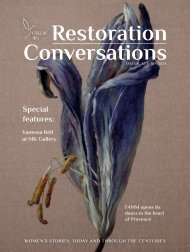

 Change language