

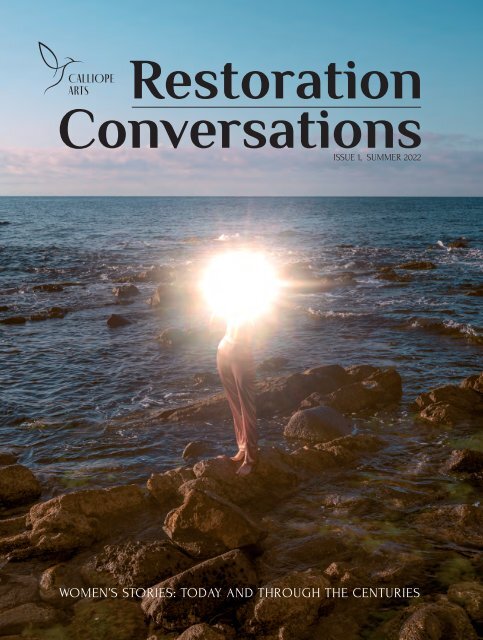
Restoration Conversations magazine- Summer 2022
Restoration Conversations is a digital magazine spotlighting the achievements of women in history and today. Issues are released twice a year: Spring/Summer and Fall/Winter. Restoration Conversations is a digital magazine spotlighting the achievements of women in history and today. We produce two issues a year: Spring/Summer and Fall/Winter. Contemporary Italian women photographers meet their historic counterparts at Florence’s Forte Belvedere and Villa Bardini Museum, during Fotografe! Women Photographers: Alinari Archives and Contemporary Perspectives, an exhibition showcasing one of the world’s most important photographic archives. This issue features interviews with emergent photographers Sofia Uslenghi and Federica Belli, and revolutionary women behind the camera in the early twentieth century – notably, the Wulz sisters, Futurist superstar Wanda, and her sister Marion Wulz. The exhibition 'New Women Behind the Camera' is at the National Gallery of Washington is also worthy of note, like Olive Cotton and Mae Fuller Keller. Readers will also want to view still-life painters from centuries past like Rachael Ruysch, Fede Galizia and Giovanna Garzoni. Artisans are at work in Florence to commemorate the achievements of women like those of painter Elizabeth Chaplin and Artemisia Gentileschi. One interview to share is that with Paris-based feminist art historian Sacha Llewellyn, on Laura Knight, celebrating the first in a series of shows on women in the arts at MK Gallery in Milton Keynes. The cycle continued with photographer Vivian Maier and her ‘Anthology’ exhibition, also discussed herein. The magazine ‘goes garden’ with a feature on Iris Origo and her far-reaching efforts to transform La Foce – an estate in the Tuscan hills, before focusing on other women discussed during the pilot course, ‘A Century of Women in the Arts: 1866-1966’ at the British Institute of Florence. From the Grand Tour to the unification of Italy, from the foundations of feminism, to the advent of the partisans, read up on the women who forged a century of change in Florence.
Restoration Conversations is a digital magazine spotlighting the achievements of women in history and today. Issues are released twice a year: Spring/Summer and Fall/Winter. Restoration Conversations is a digital magazine spotlighting the achievements of women in history and today. We produce two issues a year: Spring/Summer and Fall/Winter. Contemporary Italian women photographers meet their historic counterparts at Florence’s Forte Belvedere and Villa Bardini Museum, during Fotografe! Women Photographers: Alinari Archives and Contemporary Perspectives, an exhibition showcasing one of the world’s most important photographic archives. This issue features interviews with emergent photographers Sofia Uslenghi and Federica Belli, and revolutionary women behind the camera in the early twentieth century – notably, the Wulz sisters, Futurist superstar Wanda, and her sister Marion Wulz. The exhibition 'New Women Behind the Camera' is at the National Gallery of Washington is also worthy of note, like Olive Cotton and Mae Fuller Keller. Readers will also want to view still-life painters from centuries past like Rachael Ruysch, Fede Galizia and Giovanna Garzoni. Artisans are at work in Florence to commemorate the achievements of women like those of painter Elizabeth Chaplin and Artemisia Gentileschi.
One interview to share is that with Paris-based feminist art historian Sacha Llewellyn, on Laura Knight, celebrating the first in a series of shows on women in the arts at MK Gallery in Milton Keynes. The cycle continued with photographer Vivian Maier and her ‘Anthology’ exhibition, also discussed herein. The magazine ‘goes garden’ with a feature on Iris Origo and her far-reaching efforts to transform La Foce – an estate in the Tuscan hills, before focusing on other women discussed during the pilot course, ‘A Century of Women in the Arts: 1866-1966’ at the British Institute of Florence. From the Grand Tour to the unification of Italy, from the foundations of feminism, to the advent of the partisans, read up on the women who forged a century of change in Florence.

Transform your PDFs into Flipbooks and boost your revenue!
Leverage SEO-optimized Flipbooks, powerful backlinks, and multimedia content to professionally showcase your products and significantly increase your reach.
<strong>Restoration</strong><br />
<strong>Conversations</strong><br />
ISSUE 1, SUMMER <strong>2022</strong><br />
WOMEN’S STORIES: TODAY AND THROUGH THE CENTURIES<br />
<strong>Summer</strong> <strong>2022</strong> • <strong>Restoration</strong> <strong>Conversations</strong> 1
Publisher<br />
Calliope Arts Ltd<br />
London, UK<br />
Editor<br />
Linda Falcone<br />
Contributing Editor<br />
Margie MacKinnon<br />
Design<br />
FPE Media Ltd<br />
www.calliopearts.org<br />
2 <strong>Restoration</strong> <strong>Conversations</strong> • <strong>Summer</strong> <strong>2022</strong>
From the Editor<br />
We begin what Italians call ‘the beautiful season’ with our first-ever edition of <strong>Restoration</strong><br />
<strong>Conversations</strong>, the <strong>magazine</strong>. Issue One – <strong>Summer</strong> <strong>2022</strong> – is filled with photography,<br />
much like our year has been, and it is interview-heavy, as I hope the publication will often<br />
be, because conversation, more than anything else I know, brings new thought, that emerges from<br />
the very fact of having to express it. How many times, in life, have we caught ourselves saying, ‘This<br />
is occurring to me only now, as we speak’. The world of curators, artists, makers, and photographers<br />
is not a static place, one quickly learns, and conversation – an idea shared with utmost immediacy<br />
– is often the starting point of something lasting.<br />
When Margie MacKinnon and Wayne McArdle approached me one year ago, almost to the day, with<br />
the thought of founding Calliope Arts, they asked if I’d consider collaborating with them. My first<br />
recommendation was this: ‘We’ll need a <strong>magazine</strong>’.<br />
Why is that exactly? Because women – in the past and today – so often forget to document their<br />
achievements – in both words and pictures – and I do believe that someday, someone in search<br />
of their roots will want to know about the wonderful things that can happen in Florence, London<br />
and further afield, when committed people come together to discuss, explore and convey women’s<br />
perspectives in varied fields of expression.<br />
This issue spotlights the organisation’s new partnerships and projects, and captures a glimpse<br />
of the events, people and creative endeavours that have occupied our first year – from inside<br />
the classroom with ‘A Century of Women in the Arts: 1866-1966’, to the museum spotlight with<br />
‘Fotografe!’, there is much to discover within these pages.<br />
We are delighted to begin this issue with ‘the sun in our minds’ – to borrow the analogy so<br />
skilfully rendered through the lens of Federica Belli, one of the ten photographers on show at<br />
Forte Belvedere and Villa Bardini this summer, along with their pioneering counterparts from the<br />
fascinating Alinari Archive. Furthermore, in closing, I’d like to draw your attention to this issue’s<br />
final article, which spotlights Iris Origo’s titanic efforts to transform La Foce. It has a title that can<br />
easily double as my wish for Calliope Arts, this <strong>magazine</strong>, and all of its readers: may we prosper<br />
and grow, and, above all, may we stand united in this ‘Labour of Love’.<br />
Fondly,<br />
Linda Falcone<br />
Editor, <strong>Restoration</strong> <strong>Conversations</strong><br />
<strong>Summer</strong> <strong>2022</strong> • <strong>Restoration</strong> <strong>Conversations</strong> 3
CONTENTS<br />
SUMMER <strong>2022</strong><br />
EXHIBITIONS TO VIEW AND REMEMBER<br />
6 Three Women<br />
Knight, Pollard and Maier at MK Gallery<br />
16 Laura Knight and her Icons<br />
A conversaton with art historian Sacha Llewellyn<br />
22 Going Anywhere<br />
New Women behind the Camera<br />
28 Masters of the Genre<br />
Female artists ‘pause time’ at the Colnaghi Gallery<br />
34 Oltrano Gaze<br />
A dialogue in every medium<br />
WOMEN PHOTOGRAPHERS<br />
40 Why ‘Women’ Photographers?<br />
Margie MacKinnon tells the Backstory<br />
46 Exhibition Makers<br />
Co-curator Emanuela Sesti speaks on ‘Fotografe!’<br />
52 Philospophy and Photography<br />
Quotes from co-curator Walter Guadagnini<br />
56 Spotlight on Photographer Federica Belli<br />
Deciphering the cover photo<br />
A CENTURY OF WOMEN<br />
60 A Century of Women in the Arts<br />
62 Ten Women with Words or Pictures<br />
70 All Our Yesterdays<br />
Natalia Ginzburg<br />
74 A Labour of Love<br />
Iris Origo and the Transformation of La Foce<br />
<strong>Summer</strong> <strong>2022</strong> • <strong>Restoration</strong> <strong>Conversations</strong> 5
Three Women<br />
Knight, Pollard and Maier at MK Gallery<br />
Calliope Arts’ first <strong>Restoration</strong><br />
Conversation of <strong>2022</strong> focussed<br />
on the MK Gallery’s monographic<br />
exhibition of works by 20th century<br />
British artist, Laura Knight (1877–1970).<br />
For those who may be wondering, ‘MK’<br />
stands for Milton Keynes. Located<br />
some 55 miles northwest of central<br />
London, it was – until last month – a<br />
town of 230,000 souls. However, to<br />
mark the Queen’s Platinum Jubilee,<br />
Milton Keynes has now been granted<br />
the status of ‘City’, no doubt partly in<br />
recognition of its cultural dynamism.<br />
Milton Keynes was given the<br />
designation of New Town in 1967, part<br />
of a third wave of towns planned by<br />
the central government to relocate<br />
populations in poor or bombed-out<br />
housing (mostly from London) following<br />
the Second World War. The MK Theatre<br />
and Art Gallery first opened in 1999.<br />
Twenty years later, the Gallery was<br />
extended and re-modelled to include an<br />
art-house cinema. A space that buzzes<br />
with activity, it hosts conferences,<br />
workshops, children’s events and other<br />
community outreach programmes.<br />
‘Laura Knight: A Panoramic View’<br />
was one of the first post-lockdown<br />
exhibitions held at MK Gallery, and the<br />
first of a series of three shows focussing<br />
on women artists. The second, on<br />
display until 29 May, was devoted to<br />
the multi-faceted art of British artist<br />
and photographer Ingrid Pollard (b.<br />
1953). The final exhibition in the series<br />
will be a retrospective of the works of<br />
American photographer Vivian Maier<br />
(1926–2009).<br />
6 <strong>Restoration</strong> <strong>Conversations</strong> • <strong>Summer</strong> <strong>2022</strong>
Left: Laura Knight, The Cornish Coast, 1917,<br />
National Museum Wales<br />
Right, top: Laura Knight, Lubov Tchernicheva,<br />
1921. Private collection<br />
Right, bottom: Laura Knight, Chloe, 1926.<br />
Private Collection.<br />
LAURA KNIGHT<br />
The Laura Knight exhibition was<br />
the largest exhibition of the artist’s<br />
works since 1965, bringing together<br />
over 160 of her paintings, drawings,<br />
books and ceramics. It covered all of<br />
the important genres that comprise<br />
Knight’s prodigious catalogue –<br />
including scenes of domestic life in<br />
the fishing community of Staithes,<br />
Yorkshire, landscapes of Newlyn in<br />
Cornwall and, later, the Malvern Hills.<br />
Her love of behind-the-scenes grittiness<br />
was evident in her studies of the ballet,<br />
theatre and the circus. Her aptitude<br />
for portraiture was revealed in her<br />
earliest drawings, completed while still<br />
a student (the youngest ever admitted)<br />
at Nottingham Art College, as well as in<br />
her paintings of the Roma people she<br />
befriended at Epsom Race Course and<br />
the Black hospital staff she encountered<br />
on a trip with her husband to Baltimore.<br />
She was adept at portraying the female<br />
nude; this was a subject that remained<br />
very important to her, having been<br />
denied the opportunity as a student to<br />
take part in life drawing classes.<br />
A large portion of the exhibition<br />
was given over to Knight’s paintings<br />
of women at work, commissioned by<br />
the War Artists’ Advisory Committee.<br />
Also on display were her sketches and<br />
paintings from the Nuremberg trials –<br />
a commission she sought at almost 70<br />
years of age.<br />
<strong>Summer</strong> <strong>2022</strong> • <strong>Restoration</strong> <strong>Conversations</strong> 7
Laura Knight observed the world<br />
around her and chronicled it with realism<br />
and dynamism. She was one of the<br />
most famous and popular artists of her<br />
day. Contemporary audiences, whether<br />
re-visiting her work or viewing it for<br />
the first time, discovered a resonance<br />
in her depictions of marginalised<br />
communities and women at work – as<br />
performers, seamstresses or mechanics<br />
– and in scenes that recalled a country<br />
at war. As the exhibition came to a close,<br />
its curator, Fay Blanchard, was delighted<br />
to announce that ‘Laura Knight’ had<br />
become the most popular exhibition in<br />
MK Gallery’s history.<br />
Top, right: Laura Knight, Ella Ardelty on the High Trapeze,<br />
Undated. Private collection.<br />
Top , left: Laura Knight, Unfinished Portrait Vijayalakshmi<br />
Pandit, Undated. Royal Academy of Arts, London
Top left: Ingrid Pollard, Contenders (detail), 1995, Courtesy of the artist<br />
Top right: Ingrid Pollard, Self Evident (detail), 1992, courtesy of the artist.<br />
Above: Ingrid Pollard, Pastoral Interlude , 1987,<br />
Victoria and Albert Museum, London.<br />
INGRID POLLARD<br />
Following on from the success of the<br />
Laura Knight exhibition, the second<br />
show in MK Gallery’s series on women<br />
artists has already enjoyed one of the<br />
highest accolades in the British art world.<br />
Soon after ‘Ingrid Pollard, Carbon Slowly<br />
Turning’ was installed, it was announced<br />
that Ingrid Pollard’s exhibition had<br />
been shortlisted for the Turner Prize,<br />
a prestigious annual prize awarded<br />
to a British artist for an outstanding<br />
exhibition in contemporary art.<br />
As curator Gilane Tawadros explains,<br />
“Pollard is renowned for using portrait<br />
and landscape photography to question<br />
our relationship with the natural world<br />
and to interrogate social constructs<br />
such as Britishness, race, sexuality<br />
and identity. The title - Carbon Slowly<br />
Turning - invites us to reflect on<br />
geological time in relation to human<br />
time. A number of Pollard’s works reflect<br />
on the cyclical nature of history and<br />
human experience, where everything<br />
is subject to change, sometimes over<br />
hundreds of thousands of years, at other<br />
times in the blink of an eye.”<br />
Pollard’s work is the antithesis of<br />
Knight’s: it is complex, confrontational,<br />
thought-provoking and, sometimes,<br />
disturbing. As well as photography<br />
and video, the works include ceramics,<br />
collage and sculpture, complete with<br />
sound effects that grow increasingly<br />
menacing as the viewer nears the<br />
end of the exhibition to discover the<br />
<strong>Summer</strong> <strong>2022</strong> • <strong>Restoration</strong> <strong>Conversations</strong> 9
10 <strong>Restoration</strong> <strong>Conversations</strong> • <strong>Summer</strong> <strong>2022</strong>
final installation, ‘Bow Down and Very<br />
Low’, described by Hettie Judah in The<br />
Guardian as “a trio of kinetic sculptures,<br />
two of which (a pair of bending, scraping<br />
metal saws, and a body of knotted ship’s<br />
rope) appear to genuflect, and the third<br />
of which impotently swings a baseball<br />
bat. Behind them is a row of lenticular<br />
prints of a little Black girl in a white<br />
1940s dress, trapped forever as she bobs<br />
in and out of a curtsy.”<br />
In short, ‘Carbon Slowly Turning’ is<br />
an immersive experience that defies<br />
easy explanation and leaves a lasting<br />
impression.<br />
Left: Ingrid Pollard, There Was Much Interruption<br />
(detail), 2015, Courtesy of the artist.<br />
Right, top: Ingrid Pollard, The Valentine Days #1 ,<br />
1891/2017, Courtesy of Ingrid Pollard<br />
Right: Ingrid Pollard, Parabiosis,<br />
Government Art Collection<br />
<strong>Summer</strong> <strong>2022</strong> • <strong>Restoration</strong> <strong>Conversations</strong> 11
VIVIAN MAIER<br />
Enigmatic photographer Vivian Maier is the subject<br />
of MK Gallery’s third exhibition in the series, which<br />
will run from 11 June to 25 September <strong>2022</strong>.<br />
In 2007, while looking for historical photos of<br />
Chicago, local historian John Maloof stumbled<br />
upon a huge photographic cache whose author<br />
was unknown. Further investigation revealed<br />
that this collection of over 100,000 negatives<br />
represented 40 years of work by Vivian Maier, a<br />
woman who had been employed as a nanny by<br />
numerous families in the city. Like a latter-day<br />
Mary Poppins, Vivian had taken the children she<br />
looked after on journeys to different parts of the<br />
city – some glamorous, some less so. She took<br />
her camera everywhere she went and recorded<br />
the people and scenes she encountered. Many<br />
of the negatives were un-developed, and her<br />
work was never publicly shown. By the time the<br />
extent and distinctive quality of her work were<br />
discovered, Vivian had died.<br />
12 <strong>Restoration</strong> <strong>Conversations</strong> • <strong>Summer</strong> <strong>2022</strong>
Left: Vivian Maier, Self-portrait, New York, 1953<br />
When asked once what she did for a living,<br />
Maier replied, “I’m some kind of a spy.” Like<br />
other good street photographers, she blended<br />
into her surroundings without attracting too<br />
much attention. She had a gift for noticing<br />
little gestures, the details of a hat, the emotion<br />
of a situation; she captured childhood<br />
innocence and intimate encounters. Her<br />
photographs reflect compassion, humour and a<br />
Clockwise from top left: Vivian Maier, September 18, 1962;<br />
Vivian Maier, New York, July 27, 1954;<br />
Vivian Maier, New York, December 2, 1954;<br />
Vivian Maier, Self-Portrait, not dated<br />
All images Maloof Collection and Howard Greenberg Gallery, NY.<br />
<strong>Summer</strong> <strong>2022</strong> • <strong>Restoration</strong> <strong>Conversations</strong> 13
Above: Vivian Maier, Self-portrait, not dated<br />
Right: Vivian Maier, New York, 1954<br />
Both images Maloof Collection and Howard Greenberg Gallery, NY.<br />
14 <strong>Restoration</strong> <strong>Conversations</strong> • <strong>Summer</strong> <strong>2022</strong>
ecognition of the universality of the<br />
human condition. Apparently selftaught,<br />
her work is comparable to that of<br />
the professional photographers of her<br />
generation. And years before the ‘selfie’<br />
became ubiquitous, she experimented<br />
with self-portraits that show her image<br />
reflected in mirrors, shop front windows<br />
and shadows.<br />
‘Vivian Maier: Anthology’ promises<br />
to be a worthy successor to the Laura<br />
Knight and Ingrid Pollard exhibitions.<br />
“MK Gallery is delighted to have<br />
shown a yearlong presentation of solo<br />
exhibitions by three, very different,<br />
female artists,” says MK’s Head of<br />
Exhibitions, Fay Blanchard. “From<br />
remembering the historic achievements<br />
of Laura Knight, blazing the trail for<br />
women in the artworld, to Ingrid Pollard’s<br />
long-overdue recognition for being at<br />
the forefront of British contemporary<br />
art with the Turner Prize nomination, the<br />
audience response to these exhibitions<br />
has been extraordinary. We can’t wait<br />
to introduce them this summer to the<br />
work of Vivian Maier.”<br />
Bravo to MK Gallery for shining a<br />
spotlight on these three incredible<br />
artists. RC<br />
<strong>Summer</strong> <strong>2022</strong> • <strong>Restoration</strong> <strong>Conversations</strong> 15
16 <strong>Restoration</strong> <strong>Conversations</strong> • <strong>Summer</strong> <strong>2022</strong>
Laura Knight<br />
and her icons<br />
A conversation with<br />
art historian Sacha<br />
Llewellyn<br />
Though Laura Knight (1877-1970) would<br />
depict performing artists for the whole of<br />
her life, posterity would best remember<br />
her for her War Artists’ Advisory Committee<br />
commissions, where she recorded women’s vital<br />
role in the war effort. “No praise is too high for<br />
their staunchness,” Knight would say of those<br />
she depicted. These women, like the protagonist<br />
of Ruby Loftus Screwing a Breech-ring, would<br />
become icons in their own right, whose fame<br />
sometimes surpassed that of Knight herself.<br />
“Described by the Sunday Times in 1950 as ‘an<br />
adventurous woman who instinctively forced her<br />
way to the place where things were happening’,<br />
Laura Knight was noted as an artist who sought<br />
out very public subjects, and not just those<br />
traditionally associated with women’s art,” writes<br />
art historian Sacha Llewellyn, guest of our first<br />
‘<strong>Restoration</strong> Conversation’ broadcast in <strong>2022</strong>.<br />
Here’s Sacha’s take on some of Knight’s most<br />
dynamic subjects, gleaned from the transcript of<br />
her live interview.<br />
PLACING BETS ON WORKING WOMEN<br />
Knight travelled all over Britain to factories,<br />
workshops and airfields because she wanted<br />
to witness, first hand, the incredible work that<br />
women were doing to help with the war effort.<br />
She set up her paints on workbenches and, in her<br />
autobiography, she describes how she was often<br />
showered with sparks from the machines; she<br />
<strong>Summer</strong> <strong>2022</strong> • <strong>Restoration</strong> <strong>Conversations</strong> 17
endured these situations of great danger, noise<br />
and claustrophobia, but she relished being at the<br />
heart of the action.<br />
She recounts arriving in one factory and<br />
hearing that there were bets on the factory floor…<br />
that she wouldn’t last out the day. In fact, she<br />
lasted six weeks and everybody lost their money.<br />
The artist depicts women working with barrage<br />
balloons which Knight called ‘colossal silver<br />
toads’. On the right, you see a woman in a role of<br />
authority, which would have been unseen before<br />
the war. Knight is depicting every type of woman.<br />
One the artist’s most well-known pictures<br />
portrays worker Ruby Loftus operating the most<br />
dangerous machine used in the production of<br />
armaments – one false move, and it could turn out<br />
very ugly. Knight exhibited the work at the Royal<br />
Academy in 1943 and it was immediately voted<br />
‘Picture of the year’. The next day, it appeared in<br />
over eight British newspapers as an illustration of<br />
women in the war effort, and it was reproduced,<br />
subsequently, as a poster for factories up and<br />
down the country. In one vignette, Ruby Loftus<br />
explained how Laura Knight had spent the whole<br />
day drawing sketches of her and then finally<br />
choose her favourite - ‘the one with the most go’,<br />
she said.<br />
Paintings by Laura Knight at<br />
the Imperial War Museums<br />
Previous page: A Balloon site,<br />
Coventry 1943<br />
Above: Ruby Loftus Screwing<br />
a Breech-ring,<br />
Right: Laura Knight, The<br />
Nuremburg Trial, 1946.<br />
Overleaf: A Dressing Room<br />
at Drury Lane, 1951<br />
The Atkinson, Lord Street,<br />
Southport<br />
18 <strong>Restoration</strong> <strong>Conversations</strong> • <strong>Summer</strong> <strong>2022</strong>
<strong>Summer</strong> <strong>2022</strong> • <strong>Restoration</strong> <strong>Conversations</strong> 19
20 <strong>Restoration</strong> <strong>Conversations</strong> • <strong>Summer</strong> <strong>2022</strong>
NUREMBURG, ‘A STEP TOO FAR’<br />
At the end of World War II, Knight approached the<br />
War Advisory Committee, and asked if someone<br />
would be documenting Nuremberg; when she<br />
learned that no one had been tasked with the<br />
assignment, she got herself a commission for<br />
one picture of the famous proceedings. Knight<br />
was approaching her seventieth birthday, and she<br />
got on an aeroplane for the first time in her life<br />
and went to Nuremberg where she spent three<br />
months observing these trials.<br />
She was given a broadcasting box above<br />
the courtroom and she said she felt incredibly<br />
at home because it felt to her like a box at the<br />
theatre. At the same time, she said, ‘I can never<br />
forget the agony that would seize me as an<br />
onlooker alone in that box’. She made numerous<br />
charcoal drawings of all the main protagonists,<br />
including Hermann Goering who she said kept<br />
looking up at her.<br />
Part of the scene in the finished work is painted<br />
in the manner of a courtroom sketch, faithful<br />
to a genre of drawing used to memorialize<br />
proceedings. Then, suddenly, she departs from<br />
her usual realist style, as the mahogany pews<br />
give way to this extraordinary melodramatic<br />
landscape inspired by the bomb-devastated city<br />
of Nuremberg. Amongst the rubble, the naked<br />
bodies are heaped, one upon each other, which<br />
almost spill back into the courtroom.<br />
The War Advisory Committee was very<br />
confused when they saw the final painting and<br />
Knight had to write them to justify this aspect<br />
of it. She wrote that the scenes of destruction<br />
had to appear, for without them, it would not<br />
be Nuremberg. The death of millions and utter<br />
devastation uncovered during the trial are the<br />
sole topic of conversation, she said, wherever<br />
one goes, whatever one is doing. They thought<br />
she had gone a step too far and couldn’t really<br />
understand it. I think that must have been a<br />
terrible source of sorrow for her because she<br />
wanted the painting to be her magnus opus.<br />
OFF-STAGE ACCESS<br />
Beyond wartime workers, Knight was very<br />
interested in showing the professionalism of<br />
performers, and the magic world of the stage.<br />
Yet, she often focussed on intimate moments<br />
of preparation and the transformation from<br />
fact to fiction. She managed to get behind the<br />
scenes – backstage at the ballet and West End<br />
theatres, even at the circus, gaining a kind of<br />
privileged access to these arenas. While there,<br />
she developed an extraordinary sense of<br />
kinship with the female performers, and I think<br />
it’s because she so admired their dedication to<br />
their art, which mirrored her own dedication. The<br />
Dressing Room at Drury Lane is a prime example<br />
because it shows two ballerinas. One is putting<br />
her makeup on and the other is looking towards<br />
us with a sense of exhaustion and awareness.<br />
These scenes give us, the viewer, unique access<br />
to the process. RC<br />
Sacha Llewellyn, a Paris-based<br />
feminist art historian, studied<br />
History of Art at the Courtauld<br />
Institute of Art. In addition to<br />
co-founding Liss Llewellyn<br />
in 1991, she has worked<br />
internationally as a curator<br />
and author, and was the recipient of the William<br />
MB Berger Prize for British Art History in 2017. This<br />
episode of the ‘<strong>Restoration</strong> <strong>Conversations</strong>’ was<br />
organised by Calliope Arts, in partnership with<br />
the Royal Drawing School in London and Milton<br />
Keynes’ MK Gallery, in celebration of the artist’s<br />
retrospective show, ‘Laura Knight, A panoramic<br />
view’, curated by Fay Blanchard and Anthony<br />
Spira. Sacha’s essay, ‘Dame Laura’s One-Man<br />
Show’can be found in the exhibition catalogue.<br />
<strong>Summer</strong> <strong>2022</strong> • <strong>Restoration</strong> <strong>Conversations</strong> 21
Going anywhere<br />
New Women behind the Camera<br />
An Interview with Andrea Nelson<br />
In the 1930s, after a photo shoot in New York’s<br />
‘skid-row’ Bowery District, photographer<br />
Berenice Abbott was confronted with the<br />
comment, ‘Nice girls don’t go down on the<br />
Bowery’. Her answer? ‘Well, I’m not a nice girl. I’m<br />
a photographer. I go anywhere.’<br />
The opportunity to explore with a camera in tow<br />
enabled early twentieth-century women to access<br />
new freedoms. ‘What makes the ‘new woman’?’<br />
was the guiding question our ‘<strong>Restoration</strong><br />
Conversation’ organised in response to the ‘New<br />
Woman Behind the Camera’ exhibition, on show<br />
at the National Gallery of Art in Washington DC,<br />
last autumn.<br />
The event, co-organised by Calliope Arts and<br />
The Florentine, saw exhibition curator Andrea<br />
Nelson in conversation with presenter Linda<br />
Falcone and revealed a time of intense change as a<br />
group of 120-plus women created photographs of<br />
calm and drama. From the 1920s to the 1950s, they<br />
carved their professional careers, whether on the<br />
front-line in wartime or inside the fashion-studio:<br />
from surrealist self-portraits to the depiction of<br />
collective events that changed history.<br />
Here are Andrea’s word-pictures to shed light<br />
on a few exhibition highpoints:<br />
NEWLY OPENED DOORS<br />
“If we focus on the modern period, the 1920s and<br />
1930s, we start seeing more women starting to<br />
run their own studio businesses and taking their<br />
place behind the camera. We begin to know<br />
their names and they started signing their work.<br />
There was a great history of women’s studio<br />
photographers in cities like London, Vienna<br />
and Berlin and, in part, it was because they had<br />
the opportunity to attend schools. For example,<br />
in Germany, women were not allowed into the<br />
fine art academies until 19171919, but they were<br />
able to apply and enter a photography school.<br />
Photography was more accessible than some of<br />
the other fine arts. Initially, women were learning<br />
it as a more technical trade. It was a way to earn<br />
a livelihood.”<br />
IN THE STUDIO<br />
“The studio was an important pathway for women<br />
to enter the field of photography. The idea that<br />
they were well-suited for this type of photography<br />
is something that stretches back to the field’s very<br />
beginnings. Women were, of course, involved in<br />
studio photography from its earliest days – 1839<br />
onward, but they were often behind the scenes.<br />
22 <strong>Restoration</strong> <strong>Conversations</strong> • <strong>Summer</strong> <strong>2022</strong>
<strong>Summer</strong> <strong>2022</strong> • <strong>Restoration</strong> <strong>Conversations</strong> 23
They were the ones hand-colouring prints. They<br />
were mounting prints and retouching negatives.<br />
Oftentimes, we don’t know much about them, and<br />
their names were not recorded in history.<br />
One American example is photographer,<br />
Florestine Perot Collins, who was working in New<br />
Orleans where she ran a very successful studio from<br />
1920 to 1949. We see a portrait of her, as she models<br />
herself, as an independent ‘new woman’. She’s<br />
wearing fashionable clothes; she’s got a bejewelled<br />
clip in her hair; she’s sporting a short bobbed cut:<br />
it’s telling potential clients that she’s really modern…<br />
that she’s forward thinking and independent.”<br />
24 <strong>Restoration</strong> <strong>Conversations</strong> • <strong>Summer</strong> <strong>2022</strong>
Previous page: Homai Vyarawalla photographing<br />
Ganesh Chaturthi at Chowpatty Beach, Bombay, 1930s,<br />
Photographer unknown, Alkazi Collection of Photography<br />
Far left: Homai Vyarawalla, The Victoria Terminus, Bombay,<br />
1940s, Alkazi Collection of Photography<br />
Left: Florestine Perrault Collins, Mae Fuller Keller, 1920s,<br />
Dr Arthé A. Anthony collection<br />
Below: Olive Cotton, Teacup Ballet, 1935,<br />
The Sir Elton John Photography Collection<br />
MODERNIST FLAIR<br />
“Homai Vyarawalla’s wonderful modernist<br />
expression can be seen in the way she has<br />
composed this photograph. How she is framing<br />
the picture is very avant-garde. In the very back<br />
of the picture space is the Victoria Terminus,<br />
a famous train station in the colonial British<br />
architectural style that pulls from Indian tradition.<br />
It’s usually shown as a grand spectacle of a<br />
building but Vyarawalla pushes it to the back and<br />
is much more interested in the space in front of<br />
the train station. What’s framing our vision is a<br />
carriage – most likely a horse-drawn carriage<br />
(which are also called ‘victorias’) and then we see,<br />
in the middle-ground, a man pushing a cart. A<br />
tourist bus is off in the distance and there are<br />
people in the plaza maybe going to the train<br />
station. This play and practice of camera vision<br />
is wonderful. Vyarawalla said that she didn’t<br />
think she was doing anything special by being a<br />
woman photographer. It only occurred to her 50<br />
years later, when ‘everyone started making a big<br />
deal about it’.”<br />
<strong>Summer</strong> <strong>2022</strong> • <strong>Restoration</strong> <strong>Conversations</strong> 25
Above: Dorothea Lange, Japanese-American owned<br />
grocery store, Oakland, California, 1942,<br />
National Gallery of Art, Washington DC<br />
Right: Genevieve Naylor, São Januário Trolley, 1940s,<br />
National Gallery of Art, Washington DC<br />
26 <strong>Restoration</strong> <strong>Conversations</strong> • <strong>Summer</strong> <strong>2022</strong>
BEYOND LIMITS<br />
“Dorothea Lange was hired in 1942 to work for<br />
what was called the War Relocation Authority. Her<br />
assignment was to document some of the 125,000<br />
people of Japanese ancestry in the US who were<br />
forced to leave their homes and businesses and<br />
to relocate to camps, after the Japanese attacked<br />
Pearl Harbour in 1941. Lane was uneasy about the<br />
assignment from the get-go and was looking for<br />
ways to tell the whole story. She wanted to show<br />
the Japanese people in their settings, in their<br />
homes, to focus on what their livelihoods were<br />
and what they were being forced to give up.<br />
In the show, we have her photograph of a<br />
Japanese-American-owned grocery store in<br />
Oakland, California, whose owner, Mr. Matsuda,<br />
placed a large sign on the façade: ‘I am an<br />
American’. He put it up on December 8, 1941,<br />
so the day after Pearl Harbour. Lange was very<br />
consciously pushing the limits of the assignment.<br />
She also worked for Life <strong>magazine</strong>, to photograph<br />
at the Heart Mountain [internment camp], but her<br />
photographs were considered ‘too sympathetic’<br />
and were not published.”<br />
CITY CONSTRUCT?<br />
The ‘New woman’ faced a time of extreme political<br />
shifts and we see a number of women, oftentimes<br />
Jewish women fleeing the rise of Fascism,<br />
particularly in Germany. Hildegard Rosenthal was<br />
Swiss, but her husband was Jewish, so the couple<br />
fled Germany where she had set up a successful<br />
studio. They ended up settling in Brazil, and<br />
Rosenthal’s oeuvre has some 3,000 works from<br />
the period. Rosenthal was hired by the City of<br />
San Paulo’s municipal administration to portray<br />
the city as an up-and-coming metropolis on the<br />
edge of modernity.<br />
A single photograph can really impart a sense<br />
of the city. In Ladeira Porto Geral, rua 25 de Março<br />
(São Paulo 1940) There are three executives<br />
conversing on the right side and they’re next to<br />
a store that sells precision clothing, and then we<br />
see the action, or the interaction, that’s happening<br />
around the fruit vendor’s cart.<br />
Then, there a wonderful young woman, whose<br />
at the centre of the image, eating a slice of<br />
watermelon but really looking directly out at us…<br />
she’s looking directly at the photographer. She<br />
happens to be Rosenthal’s assistant, so they have<br />
a connection, and what seems like a completely<br />
spontaneous capturing of the city street is<br />
somewhat constructed. Photographers are using<br />
their eye and their camera, to give us a frame and<br />
a point of view. RC<br />
<strong>Summer</strong> <strong>2022</strong> • <strong>Restoration</strong> <strong>Conversations</strong> 27
28 <strong>Restoration</strong> <strong>Conversations</strong> • <strong>Summer</strong> <strong>2022</strong>
Masters of the Genre<br />
Female artists ‘pause time’ at the Colnaghi Gallery<br />
‘ Forbidden Fruit’ is the suggestive name of<br />
an exhibition of rare and unpublished still<br />
lifes by female Old Masters now on display<br />
at London’s Colnaghi Gallery. With luscious fruits<br />
on the verge of over-ripening, meticulously<br />
rendered insects crawling and flying across the<br />
canvases, and voluptuous bouquets spilling out of<br />
gleaming vases, these works are a feast for all the<br />
senses. The gallery, a leading dealer in Old Master<br />
paintings, founded in 1760, has assembled the<br />
works from private collections around the world,<br />
paying homage to the women who excelled in<br />
this most demanding of genres.<br />
Still life of flowers in a glass vase by Italian<br />
painter Giovanna Garzoni (1600–1670) combines<br />
tulips, daffodils, ferns and other specimens in a<br />
transparent glass vase that reflects a window;<br />
that reflection is, in turn, reflected in another<br />
part of the vase. Garzoni’s painting is at once a<br />
harmonious composition and a showcase for her<br />
skill at scientific illustration. The exhibition text<br />
recalls that, “this beautiful floral still life is noted<br />
in a 1690 record of the dowry of Margarita Rothier<br />
on the occasion of her marriage, and Margarita’s<br />
name is inscribed at the upper margin of this<br />
sheet of vellum.” Garzoni’s use of vellum as a base<br />
for her works gives them a distinctive luminosity<br />
in comparison to the darker backgrounds of the<br />
other paintings in the show.<br />
Mannerist artist Fede Galizia’s (c.1578–c.1630) Still<br />
life with apples, pears, figs and melon overflows<br />
with lush fruit which seem to spill off the canvas<br />
while a tiny fly with diaphanous wings in the lower<br />
corner hints at their ripeness. Galizia’s Still life<br />
of peaches, pears and figs with butterflies and a<br />
bumblebee suggests the influence of Caravaggio<br />
with a single light source dramatically bisecting<br />
the painting diagonally into two halves.<br />
Though known as far back as classical Roman<br />
times, still life emerged as an independent genre<br />
during the Renaissance, and had its heyday in<br />
the so-called ‘Dutch Golden Age’. Capturing a<br />
moment of ‘paused time’ these paintings featured<br />
collections of inanimate objects from flowers<br />
and fruit to porcelain vases, musical instruments<br />
and skulls, as well as animals and insects. Painted<br />
with precise realism, the works required technical<br />
virtuosity, with special attention given to texture<br />
and the reflective qualities of glass and ceramics.<br />
It was a genre at which women were particularly<br />
adept and for which they were justly celebrated.<br />
The works were often allegories representing<br />
the fleetingness of life, decay and, ultimately,<br />
death. Each element had its own symbolism: a<br />
lighted candle might represent the passing of<br />
time; a lemon, with its bright exterior but sour<br />
taste, might stand for the deceptive allure of<br />
earthly beauty; while shells would be intended to<br />
evoke Saint James, the patron saint of pilgrims.<br />
The compositions often combined flowers from<br />
different countries and even different continents<br />
in one vase. Vertiginous arrangements that<br />
appealed to the eye would have struggled to stay<br />
upright in real life.<br />
<strong>Summer</strong> <strong>2022</strong> • <strong>Restoration</strong> <strong>Conversations</strong> 29
Previous page: Rachel Ruysch, Bouquet of flowers in a glass vase<br />
on a marble table, 1748<br />
Above: Fede Galizia, Still Life of Peaches, Pears and Figs with<br />
Butterlies and a Bumblebee. Oil on panel<br />
Right, top: Iphigénie Decau, Née Milet-Moreau, Still Life of Fruit in<br />
a basket on a stone ledge c. 1815. Oil on canvas<br />
Right, bottom: Fede Galizia, Still Life of Apples, Pears,<br />
Cucumbers, Figs and a Melon, c. 1625 - 1630. Oil on panel<br />
30 <strong>Restoration</strong> <strong>Conversations</strong> • <strong>Summer</strong> <strong>2022</strong>
No exhibition of still lifes would be complete<br />
without the inclusion of Dutch master Rachel<br />
Ruysch (1664–1750). Here she is represented by<br />
Bouquet of flowers in a glass vase on a marble<br />
table, the last known work of her career, painted<br />
in 1748. This is a simple composition, compared<br />
to Ruysch’s more elaborate works that can be<br />
found in museums and collections throughout<br />
the world, but her mastery remains evident.<br />
The exhibition text records that, “this painting<br />
demonstrates the remarkable high quality to<br />
which Ruysch was still painting in old age. In<br />
addition to signing and dating the still life at<br />
lower right, the artist inscribed her age of 84 in<br />
the same location.”<br />
Other artists included in the exhibition are<br />
Clara Peeters, Louise Moillon, Iphigenie Decaux,<br />
Ursula Maddalena Caccia, Josefa de Obidos and<br />
Elisabetta Marchioni.<br />
<strong>Summer</strong> <strong>2022</strong> • <strong>Restoration</strong> <strong>Conversations</strong> 31
32 <strong>Restoration</strong> <strong>Conversations</strong> • <strong>Summer</strong> <strong>2022</strong>
Of particular interest is a small painting by<br />
Florentine artist Caterina Angela Pierozzi, signed<br />
and dated 1677. This exquisite miniature – the<br />
artist’s only known work – is not a still life but a<br />
depiction of The Annunciation inspired by the<br />
painting of the Annunciation by Fra Bartolomeo in<br />
the Basilica of Santissima Annunziata in Florence.<br />
Pierozzi was known to have worked for the Medici<br />
Grand Duchess Vittoria della Rovere, a great patron<br />
of female artists. Surrounded by a border of roses,<br />
tulips and lilies, the work reflects the Medici<br />
preoccupation with botanical illustrations. It is not<br />
known whether the unusual gold frame is original<br />
to the painting, but one can imagine it having<br />
been fashioned in a goldsmith’s shop on the Ponte<br />
Vecchio overlooking the Arno River. RC<br />
Opposite: Giovanna Garzoni, Still life of flowers in<br />
a glass vase c. 1640-1650. Tempera on vellum with<br />
traces of black pencil<br />
Above: Caterina Angela Pierozzi, The Annunciation<br />
Miniature, 1677. Tempera and gold leaf on vellum<br />
Forbidden Fruit: Female Still Life will be on<br />
display until June 24 at Colnaghi Gallery, London.<br />
<strong>Summer</strong> <strong>2022</strong> • <strong>Restoration</strong> <strong>Conversations</strong> 33
The Oltrarno Gaze 2020<br />
A dialogue in every medium<br />
There are times in life when one is lucky<br />
enough to see the birth of things, and to<br />
have the privilege of witnessing an idea<br />
quickly grow from a pretty premise to a fullfledged<br />
project – one that is born, raised, and<br />
flying the coop after a few months’ time. ‘Oltrarno<br />
Gaze <strong>2022</strong>’ denotes a series of events, exhibitions<br />
and educational grant programmes for women<br />
artists and artisans in Florence’s beloved artisans’<br />
district and beyond, that can best be summed up<br />
as ‘a collective call to make things’. This invitation,<br />
launched in Florence and the world in February<br />
<strong>2022</strong>, under the auspices of The British Institute<br />
of Florence and Cultural Association Il Palmerino,<br />
was made possible by the AWA Legacy Fund, and<br />
its guiding question to artisans and artists of<br />
today was simple: What do you want to say to<br />
female greats of the past?<br />
In the artisan district, in the ateliers of<br />
bookbinders, leatherworkers, goldsmiths,<br />
ceramicists and textile workers, answers were<br />
expressed in every medium: from dyed suede<br />
to handmade parchment, white gold, sapphire,<br />
and fired earthenware. US artisan Joy Franklin<br />
produced a North Star pendant, a nod to Artemisia<br />
Gentileschi’s compass in the artist’s Allegory<br />
of Inclination at Casa Buonarroti, Stephanie<br />
Lehmann’s crimson bag with handcrafted flowers<br />
is a celebration of Elisabeth Chaplin’s 1920s<br />
Self-portrait on display at the Pitti Palace, just a<br />
block or two from her studio in the heart of the<br />
Oltrarno. Margherita Martino de Norante traced<br />
Greta Garbo’s lips dozens of times with a 3D<br />
pen, and her innovative jewelry making process<br />
is a tongue-in-cheek ‘conversation’ with urbanminded<br />
Titina Maselli, a precursor to Pop Art.<br />
Their works, immortalized in a documentary<br />
short by Russian filmmaker Olga Makarova<br />
spotlights an issue also worth taking about: the<br />
international pull of a district like the Oltrarno.<br />
Margherita De Martino Norante, a Florentine<br />
artisan who shares studio space with creatives<br />
from all over the world, shared an interesting<br />
perspective on the international nature of the<br />
‘Oltrarno Gaze <strong>2022</strong>”, which brought together<br />
more than 45 participating artists, photographers<br />
Olga Makarova, Joy Franklin’s<br />
Northstar, 2021<br />
Olga Makarova,<br />
Garbo lips, 2021<br />
Irene Pini, Chaplin’s red, 2021<br />
34 <strong>Restoration</strong> <strong>Conversations</strong> • <strong>Summer</strong> <strong>2022</strong>
Spring <strong>2022</strong> • <strong>Restoration</strong> <strong>Summer</strong> <strong>2022</strong> <strong>Conversations</strong> • <strong>Restoration</strong> <strong>Conversations</strong> 35 35
Above: Valentina Bellini, In Amalia Ciardi Duprè’s studio, 2021<br />
Right: Alessandra Barucchieri, Il Palmerino in March, 2021<br />
36 <strong>Restoration</strong> <strong>Conversations</strong> • <strong>Summer</strong> <strong>2022</strong>
and artisans – more than half of whom were non-<br />
Florentines with strong ties to the city’s traditions.<br />
“International exchange is very Florentine and<br />
always has been”, says De Martino Norante. “In<br />
the time of the Medici, the dynasty brought artists<br />
from all over the world to Florence, because what<br />
we now consider ‘Florentine history’ was actually<br />
nothing more than a call for the best. The Medici<br />
wanted the very best artists to work in their court<br />
and gardens, it didn’t matter whether they were<br />
from Northern Europe or ‘foreign’ lands like Siena<br />
and Rome. Florence’s magnet-nature is not new.<br />
Florence is Florence because of the international<br />
element, not in spite of it. Artists and artisans<br />
work best in an environment of exchange.”<br />
‘Exchange’ was also a key word up at the<br />
exhibition space at Il Palmerino. In May and<br />
June, the villa and gardens that once hosted<br />
the cultural salon of British author Vernon Lee,<br />
became the venue of ‘Bridges’ a contemporary<br />
art show that brought together nine<br />
international women artists from Italy, Britain,<br />
Brazil, the US and France. “They used to say you<br />
could speak about any subject, in any language,<br />
in Vernon Lee’s salon, and all points of view<br />
were entertained,” says art historian Monica<br />
Shenouda, of the villa that welcomed the likes<br />
of Oscar Wilde, Edith Warton and John Singer<br />
Sargent, as well as Italy’s top minds of the day,<br />
including Mario Praz and Enrico Nencioni.<br />
The ‘Bridges’ exhibition which brought book<br />
art to the hillside venue was proof, that every<br />
language – even artistic languages – continues<br />
to be welcome, and understood there today.<br />
<strong>Summer</strong> <strong>2022</strong> • <strong>Restoration</strong> <strong>Conversations</strong> 37
38 <strong>Restoration</strong> <strong>Conversations</strong> • <strong>Summer</strong> <strong>2022</strong>
Left, top: Alessandra<br />
Barucchieri, Lydia Chapman at<br />
work, 2021<br />
Left: Francesca Cluney, Rea<br />
Stavropoulos in the studio,<br />
2021<br />
Above: Antonella Tomassi,<br />
Kirstie Mathieson at the<br />
wheel, 2021<br />
But the best news comes last: five months<br />
ago, fourteen women photographers, from<br />
the award-winning photography association<br />
Gruppo Fotografico Il Cupolone, were tasked<br />
with immortalising the ‘Oltrarno Gaze <strong>2022</strong>’<br />
programme, because ‘memory’, not just making,<br />
is another of the project’s guiding values.<br />
The fruits of their labours were exhibited<br />
in June at Florence’s new riverside venue<br />
for contemporary creativity, Sotto al British’.<br />
Additionally, these photographs form the<br />
backbone of a new photographic book, Florence<br />
in the Making, published by the Florentine Press,<br />
which includes highlights from 21 interviews<br />
conducted by Linda Falcone.<br />
This multi-pronged program made for a packed<br />
half-year, and Calliope Arts, as the project’s<br />
communications partner, celebrates the initiative<br />
for the conversations it has triggered, no matter<br />
the medium, the language, the generation or<br />
the century with which we most identify. That<br />
conversation is destined to continue. RC<br />
<strong>Summer</strong> <strong>2022</strong> • <strong>Restoration</strong> <strong>Conversations</strong> 39
Why ‘Women’<br />
Photographers?<br />
Calliope Arts’ Margie MacKinnon tells<br />
the ‘backstory’<br />
I<br />
first came across the name ‘Alinari’ on a family<br />
visit to Florence almost ten years ago. Looking<br />
for a change of pace from the more crowded<br />
Renaissance monuments, we decided to visit the<br />
Museum of Photography, which was then located<br />
in the ancient Spedale delle Leopoldine in Piazza<br />
Santa Maria Novella, now home to the Museo<br />
Novecento. As a showcase for the archives of<br />
the Fratelli Alinari studio, founded in 1852, the<br />
Museum offered a window onto Florence’s more<br />
recent history.<br />
The museum proved to be a welcome respite<br />
from the fourteenth century, and a fascinating<br />
encounter in its own right. The exhibition of<br />
vintage prints, negatives and daguerreotypes<br />
from the Alinari studio’s vast collection evoked<br />
a sepia-toned Florence from the mid-nineteenth<br />
century to the early 1900s, and the display<br />
of cameras, lenses, and other photographic<br />
paraphernalia and equipment illustrated how<br />
much the technical aspects of photography had<br />
evolved over the years. At the time, it did not<br />
occur to me to wonder if any of the images we<br />
were looking at had been created by women<br />
photographers and, if I had stopped to think<br />
about it, I would probably have assumed that<br />
most, if not all, of the photographers represented<br />
were men.<br />
I have since learned not only that women (in<br />
this case, mainly middle and upper class Western<br />
women) began using cameras from the moment<br />
they were invented, but also that photography<br />
is a medium that has always been relatively<br />
accessible to women – unlike the traditional fine<br />
arts of painting and sculpture. The timing of the<br />
advent of photography – in the mid-1800s – was<br />
favourable to women, coinciding with a gradual<br />
expansion of women’s freedom to become more<br />
active in the public sphere, and an increasing<br />
desire for independence. In the 1900s, the two<br />
world wars thrust women into more roles that<br />
were previously the exclusive domain of men.<br />
It also helped that the training required to<br />
become a photographer was flexible – with no<br />
need for a long apprenticeship. While some<br />
women, such as Wanda and Marion Wulz, had<br />
the opportunity to learn the necessary technical<br />
skills in studios or on vocational programs, the<br />
possibilities of the camera could be self-taught –<br />
discovered by trial and error, without any formal<br />
instruction. The camera itself was portable enough<br />
to take anywhere, and one could set up a darkroom<br />
in a spare closet or, as Julia Margaret Cameron did,<br />
in a chicken coop at the end of the garden.<br />
The status of photography, as more of a<br />
commercial enterprise than an art form, meant<br />
that the male art dealers, curators and museum<br />
directors who controlled the art marketplace<br />
did not concern themselves with photography’s<br />
popularity with women as an occupation. Women<br />
photographers were able to gain financial<br />
independence by setting up their own studios.<br />
40 <strong>Restoration</strong> <strong>Conversations</strong> • <strong>Summer</strong> <strong>2022</strong>
<strong>Summer</strong> <strong>2022</strong> • <strong>Restoration</strong> <strong>Conversations</strong> 41
Photos from the Alinari Archive,<br />
Florence<br />
Previous page: Wanda Wulz,<br />
Portrait, undated<br />
Above, from far left: Julia<br />
Margaret Cameron, Portrait of<br />
English playwright and poet<br />
Henry Taylor, 1865;<br />
Marion Wulz, Portrait of<br />
Wanda Wulz in motorcycle<br />
gear, 1930-1932;<br />
Marion Wulz, Irene Camber<br />
after her Olympic victory in<br />
fencing, 1952<br />
Bernardine Caroline Théodora<br />
Hirza Lejeune, Male portrait in<br />
uniform, 1853<br />
Some, like Gertrude Fehr, opened schools<br />
and influenced the development of this new<br />
profession.<br />
As photography gradually became recognised<br />
as a fine art in itself, women photographers<br />
were increasingly marginalised by photographic<br />
institutions and the art market. With a few<br />
exceptions, most of the ‘big names’ that were<br />
featured in exhibitions and books were men.<br />
Many women who had achieved some early<br />
success were subsequently neglected.<br />
Amongst the earliest pioneering women<br />
photographers was Anna Atkins, who made the<br />
world’s first photobook, ‘Photographs of British<br />
Algae: Cyanotype Impressions’, in 1853. Atkins, a<br />
British botanist who created exquisite cyanotype<br />
images capturing the outlines of plants, produced<br />
just 14 copies of her handbound book, signing<br />
them with her initials, ‘A.A.’ Her achievement<br />
was almost forgotten when it was later assumed<br />
that this stood for ‘Anonymous Amateur’. Czech<br />
photographer and member of the Bauhaus, Lucia<br />
Moholy, produced photograms with her husband,<br />
Laszlo Moholy-Nagy, although these were often<br />
attributed to him alone. Later the photographic<br />
archives Moholy left behind her when she fled<br />
to London in 1933 were published without being<br />
credited to her.<br />
These examples of previously celebrated women<br />
falling into obscurity were familiar to me from<br />
my involvement with Advancing Women Artists<br />
(AWA), a Florentine institution founded by U.S.<br />
philanthropist Jane Fortune. Over the course of 14<br />
years, AWA undertook the restoration of more than<br />
70 works of art by female artists who risked being<br />
erased from history. In doing so, AWA restored not<br />
only their paintings, sculptures and drawings, but<br />
also their life stories. After AWA closed its doors in<br />
2020, my partner Wayne McArdle and I founded<br />
Calliope Arts in order to continue to promote the<br />
achievements of women artists of all kinds by<br />
sponsoring restorations, exhibitions, educational<br />
programs and cultural initiatives.<br />
Calliope Arts’ first project, in 2021, was a<br />
42 <strong>Restoration</strong> <strong>Conversations</strong> • <strong>Summer</strong> <strong>2022</strong>
‘<strong>Restoration</strong> Conversation’ focussing on the<br />
National Gallery of Washington’s ‘The New<br />
Woman Behind the Camera’ photography<br />
exhibition. In a live broadcast, author Linda<br />
Falcone (AWA’s former Director) discussed the<br />
exhibition with its curator, Andrea Nelson. The<br />
exhibition brought together a wide range of<br />
photos taken between the 1920s and the 1950s<br />
by 120 international women photographers,<br />
highlighting their contributions to early<br />
twentieth century modernism and making a<br />
case for the overlooked significance of their<br />
innovative work.<br />
Around the same time, I was delighted to read<br />
the announcement that the Fondazione Alinari<br />
per la Fotografia had found a new home for its<br />
offices and archives in the Villa Fabbricotti and<br />
were looking for premises for a museum. That<br />
their new beginning in Florence coincided with<br />
the birth of Calliope Arts seemed serendipitous,<br />
and we sought them out as a partner for a future<br />
collaboration. The exhibition, ‘FOTOGRAFE!’<br />
presented and promoted by the Alinari Foundation<br />
and the Fondazione CR Firenze, in collaboration<br />
with the Municipality of Florence, combines two<br />
of the goals that underlie Calliope Arts’ mission:<br />
highlighting early works by women that have<br />
had only limited visibility and creating a dialogue<br />
between contemporary photographers and their<br />
historical counterparts.<br />
In addition to bringing lesser-known female<br />
artists to a wider audience, does a womenonly<br />
exhibition allow us to see that women<br />
photographers bring a perspective to their work<br />
that is unique to their gender? Is there such a<br />
thing as a ‘female gaze’ in a medium that relies on a<br />
mechanical means of creation? This question was<br />
put to Fiona Rogers, the newly appointed Curator<br />
of Women in Photography at London’s Victoria &<br />
Albert Museum, in an interview with the Financial<br />
Times. Ms Rogers responded that, while she does<br />
not believe that there is a “defining gender gaze,<br />
… there is a difference between the way a woman<br />
looks at the world and the way a man looks at<br />
<strong>Summer</strong> <strong>2022</strong> • <strong>Restoration</strong> <strong>Conversations</strong> 43
Photos from the Alinari Archive, Florence<br />
Above: Germaine Krull, Javanese Dancer, 1930<br />
Right: Helene Magdalena Hofmann, Three men<br />
raise their hats in salute, post 1904, Alinari Archives,<br />
Florence<br />
44 <strong>Restoration</strong> <strong>Conversations</strong> • <strong>Summer</strong> <strong>2022</strong>
the world, and I think that’s partially because of<br />
inherent unconscious biases that we’ve all had to<br />
experience over 2,000 years and more.”<br />
‘FOTOGRAFE!’ – on show in Florence at Villa<br />
Bardini and Forte Belvedere from June 17 to<br />
October 2, <strong>2022</strong> – celebrates the ways in which<br />
historic and contemporary women have been<br />
looking at the world through the lens of a camera<br />
– what they have chosen to see and how they<br />
have chosen to see themselves. Calliope Arts<br />
is delighted to support this exhibition and the<br />
continuing work of the Fondazione Alinari per la<br />
Fotografia in safeguarding its unique archive of<br />
work by women photographers.<br />
Margie MacKinnon<br />
President, Calliope Arts<br />
The exhibition is presented and promoted by<br />
the Alinari Foundation for Photography and the<br />
Fondazione CR Firenze, in collaboration with the<br />
Municipality of Florence. The rooms dedicated to<br />
the works of Wanda and Marion Wulz and Edith<br />
Arnaldi are sponsored by Calliope Arts.<br />
<strong>Summer</strong> <strong>2022</strong> • <strong>Restoration</strong> <strong>Conversations</strong> 45
46 <strong>Restoration</strong> <strong>Conversations</strong> • <strong>Summer</strong> <strong>2022</strong>
Exhibition Makers<br />
Co-curator Emanuela Sesti speaks on ‘Fotografe!’<br />
READY, SET... RESEARCH<br />
“The archives were our starting point for this<br />
exhibition. Through research, we first sought<br />
to understand the Alinari archives, from the<br />
early twentieth century onwards. Initially, we<br />
extrapolated three photographers whose archives<br />
are of particular interest: Wanda and Marion<br />
Wulz and Edith Arnaldi. Their collections contain<br />
vintage prints, and a wealth of other documents,<br />
including negatives, that need further study. The<br />
Wulz archive had been worked on, manipulated,<br />
and even compromised, but our job has been<br />
to rediscover their negatives, and see which<br />
match our vintage prints. We are also trying to<br />
differentiate between the works of Wanda and<br />
those of Marion, as the sisters often worked in<br />
tandem.<br />
Nothing had ever been done with Edith<br />
Arnaldi’s archive, and there are nearly 10,000<br />
negatives in the collection, so you can imagine<br />
the job of analysing them, one photogram at<br />
a time, and finding which ones are the most<br />
significant. Simply looking at the negative is not<br />
enough; we’ve done a first round of digitalisation,<br />
so we can now see her images, as if on a loop,<br />
in order to scrutinise every picture properly.<br />
This is the first stage of a larger project, initiated<br />
thanks to a development grant by Calliope Arts,<br />
and the idea is to press forward, after displaying<br />
our exhibition’s sampling of photographs.<br />
Digitalisation is a key part of the process. The<br />
archive is enriched by becoming accessible.”<br />
A RISING STAR ON NEW HORIZONS<br />
“Edith Arnaldi was this show’s rediscovery,<br />
because her forgotten photographic oeuvre<br />
is being reclaimed. Arnaldi was recognised as<br />
an artist and illustrator, and we now know that<br />
she often used photography when creating her<br />
illustrations. In fact, this year, her art is on show at<br />
the Venice Biennale. Lisa Hanstein has conducted<br />
an interesting photographic study of Arnaldi;<br />
research into her negatives and handwritten notes<br />
suggests that her photographs from 1930 to 1934<br />
are particularly significant. She immortalises the<br />
landscape and culture of several Italian regions –<br />
mostly in the south – Lazio, Abruzzi and Puglia.<br />
Hers was an anthropological and ethnographic<br />
study, and her subjects were mostly women.<br />
Arnaldi focussed on people at work, and on<br />
their religious practices, as can be seen in her<br />
photographs of processions. Her copious archive<br />
suggests that she had fully-fledged projects in<br />
mind, but we don’t know what purpose they might<br />
have served, because her diaries have been lost.<br />
She was also a traveller, who journeyed to several<br />
countries in Europe, and even Northern Africa in<br />
<strong>Summer</strong> <strong>2022</strong> • <strong>Restoration</strong> <strong>Conversations</strong> 47
48 <strong>Restoration</strong> <strong>Conversations</strong> • <strong>Summer</strong> <strong>2022</strong>
Photos from the Alinari Archive, Florence<br />
Previous pge: Edith Arnaldi-Rosa Rosà, Water<br />
bearer from Ciociaria, undated<br />
Left: Edith Arnaldi-Rosa Rosà, Young woman from<br />
Ciociara, 1937<br />
Right, top: Wanda Wulz, “Cat+I”, 1932<br />
Right, bottom: Marion Wulz, Dancer Alba<br />
Wiegele, undated<br />
the early 1930s, and then to Somalia in 1950<br />
and 1952. We are starting to realise that she<br />
was a pioneering photographer in the postwar<br />
period, a precursor of neo-realism, and<br />
her work in the show is of great interest.”<br />
REFLECTIONS OF THE SELF<br />
“The Wulz sisters already enjoy a degree of<br />
renown, especially Wanda, due to her ties with<br />
the Futurist movement and the fact that her<br />
works received high praise from Marinetti.<br />
Marion preferred to stay in the shadows, but<br />
the two sisters worked together, and their<br />
constant game of creating self-portraits and<br />
portraits of each other makes for a fascinating<br />
study – a few new instances have emerged,<br />
and many of their photographs are on view<br />
in the show. Self-portraiture and portraiture<br />
have always been well loved among women,<br />
yet I don’t mean to suggest that this genre<br />
choice is entirely gender-based.<br />
However, in the show, you’ll find<br />
contemporary photographers are drawn to it<br />
as well, although they seldom depict famous<br />
people – as was common in the 1900s. They<br />
look instead to the anonymous and unknown<br />
subject, and portraiture takes on a dimension<br />
linked to social research. One noteworthy<br />
segment of the show, in Villa Bardini, is called<br />
the ‘Social Portrait’ with works by Myriam<br />
Meloni, Arianna Arcara, and even Dorothea<br />
Lange, to name a few.<br />
<strong>Summer</strong> <strong>2022</strong> • <strong>Restoration</strong> <strong>Conversations</strong> 49
Arcara is not looking for illustrious faces,<br />
she looks for people outside the public sphere,<br />
casting aside glamour shots or those linked to<br />
more classic cannons. Sofia Uslenghi looks at<br />
metamorphosis, where she is transforming, in a<br />
series of black and white photos, in which she<br />
strongly identifies with nature. The same is true<br />
for Belli, who spotlights nature, through a game<br />
she plays with the lens, where she can rediscover<br />
and re-find herself.<br />
The show takes us on a journey through<br />
two venues; it begins at Villa Bardini and ends<br />
up in Forte Belvedere. Villa Bardini starts with<br />
pioneering women, and that segment of the show<br />
goes as far as 1950. At Forte Belvedere, we see<br />
some shots from the 1950s and 1960s and into the<br />
contemporary, but that venue’s starting point is<br />
actually a 1970 photographic sequence by Diane<br />
Arbus. Her photographs are emblematic, and her<br />
albino sword-eater is especially noteworthy, with<br />
her head thrown back so that we cannot see her<br />
face. Like several of the photographers on show,<br />
she works with the human figure, and its more<br />
hidden side, the side we don’t always see.” RC<br />
Above: Sofia Uslenghi, Metamorfosis # 2, 2018<br />
Right: Sofia Uslenghi, ART noJECT #12, 2021<br />
50 <strong>Restoration</strong> <strong>Conversations</strong> • <strong>Summer</strong> <strong>2022</strong>
<strong>Summer</strong> <strong>2022</strong> • <strong>Restoration</strong> <strong>Conversations</strong> 51
52 <strong>Restoration</strong> <strong>Conversations</strong> • <strong>Summer</strong> <strong>2022</strong>
Philosophy and photography<br />
Quotes from co-curator<br />
Walter Guadagnini<br />
“ Our idea was to trigger a dialogue, by<br />
finding contemporary photographers<br />
whose work displays certain affinities<br />
with Alinari’s historical archive. We chose ten<br />
women, from different movements – they are<br />
diverse, and so are the historic women on show.<br />
The contemporary artists are all ‘young’— using<br />
the term liberally, to mean ‘under forty’. They are<br />
all Italian, although they work all over the world.<br />
Our intent is to breathe new life into the works<br />
of the past, and see the works of the present<br />
under a different light. In ‘Women Photographers’,<br />
contemporary photographs are interspersed with<br />
historic photos and documents, so that their<br />
dialogue is direct, face-to-face, and hopefully, it<br />
will work!”<br />
“What is the difference between the images<br />
the photographers in this show produce and the<br />
pictures we all snap using our smart phones?<br />
Certainly, professional photographers have<br />
superior know-how and technique, but that is<br />
not all. The fundamental difference is attitude<br />
– an attitude towards photography, and the will<br />
to create long-term projects. You and I might<br />
snap a photograph of something that strikes us<br />
suddenly, for whatever reason. It is different with<br />
these photographers. They start with thought.<br />
<strong>Summer</strong> <strong>2022</strong> • <strong>Restoration</strong> <strong>Conversations</strong> 53
54 <strong>Restoration</strong> <strong>Conversations</strong> • <strong>Summer</strong> <strong>2022</strong>
Previous page: Giulia Parlato, Lizard, undated<br />
Far left: Giulia Parlato, In Preservation, In<br />
Destruction, undated<br />
Left: Francesca Catastini Petrus (Upsidedown),<br />
undated<br />
Photographers like Meloni create<br />
series that document years at a<br />
time. Ramistella is not looking to<br />
denounce – she wants to make<br />
us see. Parlato’s work takes us<br />
to places that are steeped in<br />
memory. They are fragments<br />
of the collective imagination.<br />
There’s perfection in what these<br />
photographers do, and it’s not<br />
merely because they control the<br />
image, it’s because, for them, an<br />
image is born from ideas... and<br />
once conceived, it generates new<br />
ideas. Their photographs are<br />
not necessarily more beautiful<br />
than ours, they just have more<br />
meaning.” RC<br />
<strong>Summer</strong> <strong>2022</strong> • <strong>Restoration</strong> <strong>Conversations</strong> 55
Spotlight on photographer<br />
Federica Belli<br />
Deciphering the cover photo<br />
“ My photograph, The Visionary, is part of<br />
a series, but it’s what I call the ‘mother<br />
photograph’, and everything else that<br />
comes after that, stems from it. Usually, my photos<br />
are born from a problem I am trying to solve. That<br />
series emerged during the Covid crisis, and the<br />
issue at hand was: How do we keep our spirits<br />
up and contribute to the world in a positive<br />
way? It represents my quest for enlightenment<br />
– to keep light in the mind – and avoid feeling<br />
overwhelmed by situations or yielding to selfdestruction.<br />
That photo was like a fragment of<br />
effort – and effort is what enables us to grow.<br />
I use this method for almost all pictures. My<br />
point of departure is often a question that I<br />
consider essential. If I don’t find an answer in<br />
words, I try to translate the feeling into something<br />
visual, that can be conveyed to other people.<br />
These series are never pre-fabricated. They end<br />
once my question ends, or they stop when I stop<br />
feeling close to an issue.<br />
My quest is always one that seeks proximity<br />
with people either physically or on a human level.<br />
It’s about being purely honest. And though it may<br />
seem strange, sometimes to get honesty, you<br />
have to construct your photograph. What it gives<br />
people emotionally is what counts the most. That<br />
is where the immediacy lies –not in the time it<br />
took to take the photograph. The photographer’s<br />
vision has to be very clear and, sometimes, it’s a<br />
long process before you get just the right image.<br />
Photography is like cooking. If you were to<br />
invent a recipe, it would be hard to get it perfect<br />
on the first try. You have to do a lot of tasting... and<br />
most importantly, your dish has to be tasted by<br />
those who will ultimately eat what you prepare.<br />
The person seeing the photo is more important<br />
than the photographer.<br />
The photograph The Moon (Doesn’t Sleep<br />
Tonight), is part of a series on adolescence that<br />
I started when I was an adolescent! I wanted to<br />
photograph my counterparts, because I felt it<br />
would help me understand them. Adolescence is<br />
such a strange time. You start to become aware<br />
of yourself, but you also begin to realise that you<br />
are not really aware of the world around you. The<br />
girl in the picture is my cousin. We were lying<br />
on the beach and the sun was going down and<br />
we were talking about the fears that come with<br />
summer’s end, the fear of going back to school.<br />
And I noticed the sand forming in a pattern to<br />
match her freckles and let the moment pass<br />
without getting up to take the photograph. A<br />
little while later, because I felt so close to her at<br />
that moment, I asked her to wait and decided to<br />
record that feeling on film. We took our time with<br />
the picture. We waited until the light was right.<br />
That picture is a ‘daughter’ of that moment, made<br />
more precise by our wanting to get it right.”<br />
56 <strong>Restoration</strong> <strong>Conversations</strong> • <strong>Summer</strong> <strong>2022</strong>
<strong>Summer</strong> <strong>2022</strong> • <strong>Restoration</strong> <strong>Conversations</strong> 57
Above: Federica Belli, The Lens (Through Which We See<br />
Ourselves) 2018<br />
Previous page: Federica Belli, The Moon (Doesn’t Sleep<br />
Tonight), 2020<br />
Left: Federica Belli, the photographer (Mondovı̀, b. 1998)<br />
58 <strong>Restoration</strong> <strong>Conversations</strong> • <strong>Summer</strong> <strong>2022</strong>
WHO IS ON THE BACK COVER?<br />
“Homesick 2 is part of a self-portrait series linked<br />
to the territory where my family is from: Sicily<br />
and Calabria,” explains photographer Sofia<br />
Uslenghi. “When I was 13, we moved up North, and<br />
years later, I found myself wanting to reconnect<br />
with that place in life where everyone recognises<br />
you and takes for granted that you’ll always be<br />
there. I’ve changed cities frequently, and mobility<br />
causes you to miss out on the chance to create<br />
relationships that bring together the whole family.<br />
Instead, you find yourself relating to people one<br />
on one. That series, which features the distinctive<br />
landscape of Calabria, offers me the opportunity,<br />
through photography techniques, to merge with<br />
my homeland, as part of the territory.” RC<br />
<strong>Summer</strong> <strong>2022</strong> • <strong>Restoration</strong> <strong>Conversations</strong> 59
A Century of<br />
Women in the Arts<br />
Calliope Arts joins forces with the British Institute<br />
of Florence for a new course in the History of Art<br />
Starting in July this year, students at the<br />
British Institute of Florence will have the<br />
opportunity to take a course that looks at<br />
women’s achievements in the century following<br />
the birth of Italy as a nation. Developed by<br />
BIF’s Head of Art History, Jeremy Boudreau, and<br />
supported by a development grant from Calliope<br />
Arts, the course will focus on artists, writers,<br />
activists and educators who made significant<br />
contributions to life in the Tuscan capital.<br />
In the century that began with Florence’s<br />
short-lived stint as capital of Italy and ended<br />
with the devastating flood of 1966, who were the<br />
women that were making a name for themselves<br />
in the city?<br />
Influenced by Reform movements in Great<br />
Britain, France and the United States, Italy’s first<br />
feminist biweekly journal La Donna (Woman)<br />
was launched in 1868. In Italy, the emancipation<br />
of women, known as ‘the woman’s Risorgimento’<br />
was closely linked to the unification of the Italian<br />
states in 1861. In this new political landscape,<br />
women hoped to break free of the traditional<br />
stereotypes to which they had been confined, and<br />
to play a more active role in the life of the nation.<br />
Italian feminists championed women’s suffrage,<br />
greater autonomy within marriage and reform of<br />
labour laws to protect women and children.<br />
In the century that followed, women slowly<br />
began to take steps towards equality and<br />
to acquire rights that men took for granted.<br />
However, it was not until after WW2 that women<br />
were given the right to vote in national elections<br />
and to be elected to government positions, and<br />
not until the 1970’s that laws were introduced<br />
regulating divorce and abortion. Even now, there<br />
is a gender pay gap of 11.5% in favour of men;<br />
and the percentage of women in the Italian<br />
parliament lags at around 36%. Italy, like so many<br />
other nations, is anchored on patriarchal legacies<br />
of past centuries.<br />
In this context, the achievements of the artists,<br />
writers and social activists in ‘A Century of<br />
Women in the Arts’ are all the more remarkable.<br />
At the turn of the last century, women writers<br />
were not highly regarded in the literary world<br />
and many published under male pseudonyms,<br />
women artists were still not permitted to attend<br />
life drawing classes, and other talented women<br />
were effectively barred from entering most<br />
professions. Despite many doors being closed to<br />
them – or perhaps because of this – the women<br />
covered in this course achieved success in many<br />
overlapping spheres.<br />
How was this possible? Paradoxically, Florence<br />
has a history of being more accommodating<br />
60 <strong>Restoration</strong> <strong>Conversations</strong> • <strong>Summer</strong> <strong>2022</strong>
to women artists than other European cities.<br />
Florence’s Accademia delle Arti del Disegno<br />
admitted more women, and far earlier, than<br />
London’s Royal Academy. Similarly, the Uffizi<br />
Gallery gave women permission to copy works of<br />
the Masters within a year of its opening in 1769, a<br />
practice enthusiastically taken up by professional<br />
female painters (such as Violante Siries Cerotti), as<br />
well as by women on the Grand Tour. In contrast,<br />
women seen copying at the Louvre in Paris as late<br />
as 1831 were looked at askance, their presence in a<br />
public space raising questions about their virtue.<br />
In Florence, the ex-pat community found it easier<br />
to ignore the social constraints with which they<br />
would have felt bound in their home countries.<br />
Women presided over the literary and intellectual<br />
salons of Bellosguardo and Fiesole, where the<br />
emerging trends of Futurism and Modernism<br />
were debated.<br />
The women covered in the course were driven<br />
by talent and conviction to express themselves<br />
and to change the world around them to reflect<br />
their lives – lives that were often difficult but<br />
never dull. Their achievements, though underappreciated,<br />
are significant, and their stories are,<br />
by turns, fascinating, entertaining and inspiring.<br />
In collaboration with the British Institute of<br />
Florence, Calliope Arts is pleased to be restoring<br />
these women to their rightful place in the history<br />
of art in Florence.<br />
A preview of some of the protagonists follows,<br />
with a closer look at writers and social activists<br />
Natalia Ginzburg and Iris Origo. RC<br />
Above: Emma Bardini,<br />
Paintbox, Cerreto Guidi<br />
Museum<br />
<strong>Summer</strong> <strong>2022</strong> • <strong>Restoration</strong> <strong>Conversations</strong> 61
62 <strong>Restoration</strong> <strong>Conversations</strong> • <strong>Summer</strong> <strong>2022</strong>
Ten women with<br />
words or pictures<br />
From the Grand Tour to the unification of<br />
Italy, from the foundations of feminism, to<br />
the advent of the partisans, meet the women<br />
who forged a century of change in Florence. The<br />
premise of the exciting new course ‘A Century of<br />
Women in the Arts: 1866-1966’, organised by The<br />
British Institute of Florence from July 4 to July 15,<br />
is to explore Florence’s ‘forgotten century’ from a<br />
woman’s perspective.<br />
Created by BIF Art History head Jeremy<br />
Boudreau, in collaboration with Calliope Arts, the<br />
course allows us to celebrate two of the ‘luxuries’<br />
of the 1900s. Firstly, the availability of images<br />
featuring artwork by women artists thanks to stillliving<br />
relatives and the presence of family-owned<br />
or institutional archives tasked with safeguarding<br />
these women’s legacy. Florence examples include<br />
the ‘Alessandro Bonsanti’ Contemporary Archive<br />
at the Gabinetto Vieusseux (which hosts wordand-picture<br />
collections by Adriana Pincherle and<br />
Leonetta Cecchi Pieraccini); Il Bisonte school and<br />
library, a treasure trove of art and information<br />
on co-founder Maria Luisa Guaita. Then, there<br />
are the Mori, Costa and Arlotta family archives,<br />
product of painstaking effort by these artists’<br />
heirs to keep their legacy alive.<br />
The second reason to delight in the study of<br />
twentieth-century women stems from the sheer<br />
volume of words available, written in their own<br />
hand, or gleaned from speeches, interviews and<br />
documentaries. This is a welcome change from<br />
the study of early modern women where ‘words’<br />
are lacking and clues must be gleaned from<br />
‘commission letters’ as with Giovanna Garzoni,<br />
‘trial books’ as with Artemisia Gentileschi,<br />
and even just through invoices – which allow<br />
scholars to see the quantity and quality of<br />
pigment purchased, as a clue to an artist’s creative<br />
process. The twentieth-century does something<br />
to mitigate the silence: words by women actually<br />
exist in great numbers – oh, the glory of it!<br />
Left: Elisabeth Chaplin, Double Self Portrait, 1918,<br />
Private collection<br />
<strong>Summer</strong> <strong>2022</strong> • <strong>Restoration</strong> <strong>Conversations</strong> 63
A TASTE OF WHAT’S IN STORE AT THE BIF<br />
The five quotes and five pictures here are to whet<br />
the appetite, because ‘A Century of Women in the<br />
Arts: 1866-1966’ is destined to have its second<br />
run, and we look forward to being the first ones<br />
to share the news in the near future: ‘Back by<br />
popular demand’. RC<br />
“The flux of life is pouring its aesthetic aspect into<br />
your eyes, your ears - and you ignore it because<br />
you are looking for your canons of beauty in<br />
some sort of frame or glass case or tradition.”<br />
– Mina Loy, artist, writer and poet<br />
“There was nothing on any of the canvasses that<br />
she would have liked to hide or conceal, nor was<br />
she ashamed of being thus exposed through<br />
her work, good or bad though it might be, the<br />
essence, the unique flavour of days when she<br />
had been happily engrossed in recreating a face<br />
or a garment, in inventing an effective light, in<br />
applying an expressive glaze.”<br />
– Anna Banti, writer in Artemisia<br />
“After a short period spent in Brussels as a guest<br />
of a neurological institute, I returned to Turin<br />
on the verge of the invasion of Belgium by the<br />
German army, Spring 1940, to join my family.<br />
The two alternatives left then to us were either<br />
to immigrate to the United States, or to pursue<br />
some activity that needed neither support nor<br />
connection with the outside Aryan world where<br />
we lived. My family chose this second alternative.<br />
I then decided to build a small research unit at<br />
home and installed it in my bedroom.”<br />
– Rita Levi-Montalcini, neurologist, scholar and<br />
Nobel laureate<br />
“You are our future, try to be like us, but better<br />
than we were. Try to do what we have failed to<br />
do, by creating an Italy that is truly founded upon<br />
justice and freedom “.<br />
– Teresa Mattei, partisan and politician<br />
“I had a very varied life and met some interesting<br />
people. Yet, now that I have come to the ‘end<br />
game’, the figures that are still etched in my mind<br />
are those of the people to whom I have been<br />
united by bonds of affection. Not only are they<br />
the people I remember most vividly, but I realize<br />
that it was through them, if I learned anything<br />
from life. Everything about my life that has not<br />
been lost in the fog has passed through the filter,<br />
not of my mind, but of my affections.”<br />
-Iris Origo, writer, from Images and Shadows<br />
64 <strong>Restoration</strong> <strong>Conversations</strong> • <strong>Summer</strong> <strong>2022</strong>
Fillide Levasti, Lunch at the Cascine, 1913. Private collection<br />
<strong>Summer</strong> <strong>2022</strong> • <strong>Restoration</strong> <strong>Conversations</strong> 65
66 <strong>Restoration</strong> <strong>Conversations</strong> • <strong>Summer</strong> <strong>2022</strong>
Left: Adriana Pincherle, Self Portrait, 1981,<br />
Gabinetto Scientifico Letterario G.P. Vieusseux<br />
Above: Flavia Arlotta Colacicchi, Still life with a box of dates, 1935,<br />
Alta and Francesco Colacicchi Collection<br />
<strong>Summer</strong> <strong>2022</strong> • <strong>Restoration</strong> <strong>Conversations</strong> 67
Above: Lola Costa, Basket of pomegranates, 1972<br />
Right: Leonetta Pieraccini Cecchi, In the Study,<br />
1926, Rome, Gallery of Modern Art<br />
68 <strong>Restoration</strong> <strong>Conversations</strong> • <strong>Summer</strong> <strong>2022</strong>
<strong>Summer</strong> <strong>2022</strong> • <strong>Restoration</strong> <strong>Conversations</strong> 69
All our Yesterdays<br />
Natalia Ginzburg (1916–1991)<br />
Writer, activist, politician<br />
Above: Photo of Leone and Natalia Ginzburg at the Municipal Library of Pizzoli<br />
70 <strong>Restoration</strong> <strong>Conversations</strong> • <strong>Summer</strong> <strong>2022</strong>
In 1941, the writer Natalia Ginzburg was sent<br />
to internal exile with her husband, Leone, by<br />
the Italian government, banished for their antifascist<br />
publications and activities. In her essay,<br />
‘Winter in the Abruzzi’, Ginzburg describes their<br />
sojourn in the remote village of Pizzoli with their<br />
three small children. In her trademark, deceptively<br />
simple style, the impressions she recorded of her<br />
new surroundings are spare and unflattering.<br />
She noted that, although some of the houses<br />
looked from the outside like small, elegant villas,<br />
on the inside “you would be astonished to find<br />
large dark kitchens with hams hanging from<br />
the ceilings, and vast, dirty, empty rooms.” The<br />
locals, whatever their station, wore drab clothes<br />
and worn-out shoes. The careworn faces of the<br />
women were indistinguishable to her. “Almost all<br />
of them had toothless mouths: exhaustion and<br />
a wretched diet, the unremitting overwork of<br />
childbirth and breastfeeding” had taken a visible<br />
toll. Even the weather was stark. “There are only<br />
two seasons in the Abruzzi: summer and winter.<br />
The spring is snowy and windy like the winter,<br />
and the autumn is hot and clear like the summer.”<br />
Ginzburg had been born into a family of<br />
left-wing intellectuals and grew up in a milieu<br />
of radical thinkers and writers, of culture and<br />
sophistication. The family apartment in Turin<br />
was a lively meeting place for Italian poets,<br />
painters and professors. With the advent of the<br />
war, the Ginzburgs’ circle of friends became<br />
active in defending the freedom of the press and<br />
combatting the evils of fascism. In Pizzoli, where<br />
she was to spend two years, Ginzburg was exiled<br />
from her home, her city, books, friends and what<br />
she described as her “real existence”. Letters with<br />
news of events from which she was excluded –<br />
marriages, deaths and everyday incidents – made<br />
her homesickness all the more painful.<br />
The family’s life in Pizzoli was stultifying. In<br />
winter, huddled together in the kitchen, the only<br />
room with a stove, Leone worked at the table<br />
while the children scattered their toys across the<br />
floor. During the afternoons, Natalia managed<br />
to get some writing done and, in 1942, her first<br />
novel, The Road to the City, was published, under<br />
a pseudonym, by Einaudi, the publishing house<br />
co-founded by Leone; she could not use her<br />
own name, as Italy’s new racial laws prohibited<br />
publications by Jews. Every evening, Natalia and<br />
Leone went for a walk, arm in arm, their feet<br />
sinking into the snow. As they passed, neighbours,<br />
who called Leone ‘the professor’, importuned him<br />
with questions, asking his views on everything<br />
from when the war would end to what the best<br />
season was for having teeth out.<br />
Venturing with her little ones into the white<br />
countryside in midwinter, the occasional person<br />
she met looked at the children with pity and “a<br />
general amazed disapproval that I should expose<br />
them to the cold and the snow.” For the Ginzburg<br />
children, who had no memory of the city, the<br />
<strong>Summer</strong> <strong>2022</strong> • <strong>Restoration</strong> <strong>Conversations</strong> 71
72 <strong>Restoration</strong> <strong>Conversations</strong> • <strong>Summer</strong> <strong>2022</strong><br />
high point of life in Pizzoli was the village shop,<br />
Giro’s, which “sold a bit of everything; groceries<br />
and candles, postcards, shoes and oranges.”<br />
People often dropped by the house, usually to<br />
ask for favours, but sometimes to offer them.<br />
The dressmaker would make a special kind of<br />
dumpling for them. “Her red face was absorbed<br />
in her work and her eyes shone with a proud<br />
determination. She would have burnt the house<br />
down to make her dumplings come out a success.”<br />
After the fall of Mussolini, in 1943, the Ginzburgs<br />
left Pizzoli for Rome where Leone continued to<br />
edit the Resistance newspaper L’Italia Libera. In<br />
November that year, he was picked up and taken to<br />
Regina Coeli prison. Three months after his arrest,<br />
Leone Ginzburg died as a result of beatings and<br />
torture, at the hands of the German police.<br />
In the years after the war, Natalia Ginzburg<br />
raised their children, and continued her career
as a writer, producing prize-winning novels, short<br />
stories and essays, many of which have been<br />
translated into English and re-issued. She was<br />
the first to translate Proust into Italian; her play<br />
The Advertisement opened in London at the Old<br />
Vic in 1968 with Joan Plowright in the leading<br />
role. She remained politically active throughout<br />
her life and, in 1983, was elected to the Italian<br />
Parliament as an Independent.<br />
Natalia Ginzburg’s writing has been praised as<br />
a model of clarity, naturalness and simplicity that<br />
has inspired her many admirers (who include<br />
Maggie Nelson and Rachel Cusk) and she has<br />
been described as a precursor to Elena Ferrante.<br />
Writing about everyday events with insight and<br />
subtle humour, she touched on themes of great<br />
import – war, relationships, loss, domesticity, art;<br />
and while trauma informs her work, it does not<br />
overpower it.<br />
In an article in the New Yorker, Cynthia Zarin<br />
commented, “there is something of Beckett in<br />
Ginzburg’s prose; of Chekhov, whom she greatly<br />
admired; and of Shakespeare’s late plays, in which<br />
tragedy most often occurs offstage. It is one of<br />
life’s mysteries that what makes tragedy both<br />
bearable and unbearable is the same thing—that<br />
life goes on.”<br />
Looking back at their time in the Abruzzi, Natalia<br />
wrote, “Faced with the horror of my husband’s<br />
solitary death, and faced with the anguish that<br />
preceded it, I ask myself if this happened to us<br />
– to us who bought oranges at Giro’s and went<br />
for walks in the snow. At that time, I believed in<br />
a simple and happy future, rich with hopes to be<br />
fulfilled, with experiences and plans to share. But<br />
that was the best time of my life, and only now<br />
that it has gone from me forever – only now do<br />
I realise it.” RC<br />
Top left: Inside the Ginzburg<br />
house in Pizzoli<br />
Left: Ceiling of the Ginzburg<br />
house in Pizzoli<br />
Above: Square in front of the<br />
house where the Ginzburg<br />
family lived<br />
All photos by Alessandro<br />
Chiappanuvoli<br />
<strong>Summer</strong> <strong>2022</strong> • <strong>Restoration</strong> <strong>Conversations</strong> 73
74 <strong>Restoration</strong> <strong>Conversations</strong> • <strong>Summer</strong> <strong>2022</strong>
A Labour of Love<br />
Iris Origo and the transformation of La Foce<br />
<strong>Summer</strong> <strong>2022</strong> • <strong>Restoration</strong> <strong>Conversations</strong> 75
It did not seem like a marriage made in heaven.<br />
The groom, Antonio Origo, was the illegitimate<br />
son of a cavalry officer and artist, the Marchese<br />
Clemente Origo, a friend of the poet and political<br />
adventurer Gabriele d’Annunzio. In the gossipy<br />
ex-pat community of Florence, Antonio was<br />
rumoured to be a fortune-hunter and philanderer.<br />
The bride, Iris Cutting, was the only child of<br />
Bayard Cutting, the scion of a wealthy American<br />
family which had made its fortune in real estate<br />
and railroads, and Sybil Desart, a member of the<br />
Anglo-Irish aristocracy.<br />
The wedding had been delayed for as long<br />
as possible by Sybil, who was dismayed that<br />
her prospective son-in-law was Italian, Roman<br />
Catholic and ten years older than her daughter.<br />
Eventually, in March 1924, the ceremony took place<br />
in what Iris’s biographer, Caroline Moorehead<br />
called the “extremely ugly chapel” on the family<br />
estate. Iris herself described the wedding guests<br />
as belonging to “that section of the British colony<br />
which looks as if it had been buried and dug up<br />
again for the occasion.” Sybil stayed in bed with<br />
a migraine.<br />
So far, so Henry James. But the marriage of Iris<br />
and Antonio did not play out like an Edwardian<br />
Previous page: La Foce estate<br />
Above: Studio photo of Iris<br />
Right: Iris and Antonio in the garden<br />
76 <strong>Restoration</strong> <strong>Conversations</strong> • <strong>Summer</strong> <strong>2022</strong>
novel. Both were outsiders who wanted to leave<br />
Florence and its social intrigues – Antonio to pursue<br />
his dream of farming and Iris to “find something<br />
useful” to do with her life. While it had its ups and<br />
downs (there were numerous affairs on both sides,<br />
for example), the main adventure of their shared<br />
life was the transformation of an ancient farming<br />
community in the remote Tuscan countryside.<br />
The young couple had set out to find a place<br />
with enough work to fill a lifetime and found<br />
what they were looking for in the estate of La<br />
Foce which was built in the late 15th century as<br />
a hospice for pilgrims and merchants traveling<br />
on the Via Francigena, the ancient road running<br />
from France to Rome. The task ahead of them<br />
must have seemed daunting, to say the least.<br />
The house itself, which had not been lived in for<br />
several years, had no electricity, no telephone, no<br />
indoor plumbing and stood in 3,500 acres of the<br />
poorest farming land in the province of Siena.<br />
Iris later described the view from the house as<br />
a “lunar landscape, pale and inhuman”. There<br />
were 25 farms on the estate which had suffered<br />
decades of neglect; some were inaccessible by<br />
road, they had leaky roofs and draughty windows,<br />
stuffed with old rags.<br />
<strong>Summer</strong> <strong>2022</strong> • <strong>Restoration</strong> <strong>Conversations</strong> 77
Above: The ‘lunar landscape’ of<br />
the Val d’Orcia<br />
Right: One of the old<br />
farmhouses<br />
Each tenant held his individual farm by the<br />
feudal system of mezzadria, according to which<br />
the farmer shared his produce with the proprietor<br />
and depended on him for equipment and capital.<br />
In truth, the barren, overworked soil produced<br />
very little, and owners were often indifferent to<br />
the living conditions of the tenants and their<br />
children, most of whom were desperately poor<br />
and illiterate. They were also superstitious and<br />
instinctively opposed to change of any kind.<br />
To say that this was outside of Iris’s experience<br />
is a massive understatement. She had lived a life<br />
of extreme privilege, thanks to inherited wealth<br />
on both sides of her family. Her father, who died<br />
when Iris was eight, had expressed a wish that she<br />
should be brought up “somewhere where she does<br />
not belong” in order to avoid developing a narrow<br />
patriotism that he feared would make her unhappy.<br />
Her mother decided that they would live just<br />
outside Florence, in Fiesole, where she acquired the<br />
Villa Medici, an impressive palazzo designed in 1450<br />
by Michelozzo for Cosimo de’ Medici. Here, Iris was<br />
educated by a private Classics tutor recommended<br />
by Bernard Berenson, and many friends of the<br />
family were other rich, sophisticated intellectuals.<br />
Antonio’s training had been in business and<br />
diplomacy, but he was an indifferent student at best.<br />
Now they would have to learn a new set of skills and<br />
forgo the attractions of Anglo-Florentine life. They<br />
were determined that together they would rebuild<br />
the farms and transform the bare clay fields that<br />
lay in the shadow of Monte Amiata into productive<br />
cropland.<br />
To his credit, Antonio threw himself<br />
enthusiastically into the work, slowly introducing<br />
modern farming techniques and a rational<br />
system of cultivation. Among the most urgent<br />
tasks were road building, modernising the farm<br />
buildings and raising money for equipment such<br />
as a tractor and combine harvester. In this he<br />
was aided by the fascist administration of Benito<br />
Mussolini which had an interest in assisting the<br />
backward agricultural regions of Italy – to the<br />
benefit of landowners - and at a cost that was,<br />
perhaps, overlooked in favour of the beneficial<br />
social changes that modernisation brought about.<br />
It was more difficult for Iris to adjust to her new<br />
life at La Foce. As a foreigner and still only twenty<br />
78 <strong>Restoration</strong> <strong>Conversations</strong> • <strong>Summer</strong> <strong>2022</strong>
<strong>Summer</strong> <strong>2022</strong> • <strong>Restoration</strong> <strong>Conversations</strong> 79
Above: Iris with children at La Foce<br />
Right: (top) Lunchtime;<br />
Bottom Getting a ride to school<br />
two, she did not relate as easily to the peasant<br />
women whose dialect and domestic rituals were<br />
unknown to her. She was nonplussed when the<br />
women walked for many hours to present her,<br />
the new padrona, with gifts of cheese and eggs,<br />
or asked her to recite prayers of intercession for<br />
sterile cows.<br />
Iris eventually found a way to be accepted<br />
through the children on the estate. It had always<br />
been intended that she and Antonio would not<br />
simply farm the land but would bring schooling<br />
and basic health care to the families living there.<br />
It became her project to convert the outbuildings<br />
next to La Foce’s main gates to classrooms, to<br />
assemble a library and to source benches, little<br />
tables and other supplies. She hired a teacher and<br />
provided her with a bicycle. The children from<br />
outlying farms were collected every morning<br />
by horse and cart; at mid-day they were given<br />
a proper lunch and then a second meal at four<br />
before they set off back home. As the children<br />
began to thrive, their mothers’ appreciation for<br />
the new padrona grew. Later additions included a<br />
80 <strong>Restoration</strong> <strong>Conversations</strong> • <strong>Summer</strong> <strong>2022</strong>
small medical clinic for emergencies or childbirth,<br />
an apartment for the resident nurse, evening<br />
classes for adults and a meeting place for workers<br />
on the estate called Dopolavoro (after work).<br />
Improvements to the house, farms and school<br />
continued over the course of the next fifteen<br />
years as Mussolini’s excesses and the threat of<br />
war became harder to ignore. But during that<br />
time Iris had overseen the creation of La Foce’s<br />
garden, designed by Cecil Pinsent, and even<br />
found time to write a well-received biography of<br />
the poet Giacomo Leopardi. Her next book would<br />
be her diary, War in Val d’Orcia, in which La Foce<br />
and its outlying farms would play a central role<br />
as a safe haven for orphaned children, Italian<br />
partigiani and, later, Allied soldiers making their<br />
way back to their units in southern Italy.<br />
Iris Origo could have chosen a much easier<br />
path. There were other, less exigent properties<br />
that she and Antonio could have purchased,<br />
where they might have lived lives of leisure and<br />
prosperity. How much poorer they, and we, would<br />
be if they had. RC<br />
<strong>Summer</strong> <strong>2022</strong> • <strong>Restoration</strong> <strong>Conversations</strong> 81
Grazie Mille<br />
We couldn’t be happier with all the events, broadcasts and exhibitions that<br />
Calliope Arts has been involved with since its launch in November 2021.<br />
Many people and organisations have contributed their time, expertise, artworks and<br />
enthusiasm to make the magic happen and we extend our heartfelt thanks to all of<br />
them, as well as to everyone who has tuned into our ‘<strong>Restoration</strong> <strong>Conversations</strong>’,<br />
read our newsletters, perused the new website and, now, read the inaugural issue of<br />
<strong>Restoration</strong> <strong>Conversations</strong> <strong>magazine</strong>. In particular, we would like to acknowledge:<br />
Giorgio van Straten, Claudia Baroncini, Emanuela Sesti and Rita Scartoni at the<br />
Fondazione Alinari per la Fotografia, Simon Gammell and Jeremy Boudreau at the<br />
British Institute of Florence, Marisa Gareffa at Sotto al British, Federica Parretti and<br />
Stefano Vincieri at Associazione Culturale Il Palmerino, the AWA Legacy Fund and<br />
Oltrarno Gaze <strong>2022</strong> participants, Fay Blanchard at MK Gallery, Sacha Llewellyn at<br />
Liss Llewellyn, Claudia Tobin at the Royal Drawing School, Andrea Nelson at the<br />
National Gallery of Art, Washington, DC, Chloe Stead and Eleanor Taylor at Colnaghi<br />
Gallery, London, Cristina Acidini, Dr Alessandro Cecchi, Elizabeth Wicks, Christian<br />
Levett, Alessandro Chiappanuvoli and all our friends at La Foce, The Florentine and<br />
The Florentine Press.<br />
82 <strong>Restoration</strong> <strong>Conversations</strong> • <strong>Summer</strong> <strong>2022</strong>
84 <strong>Restoration</strong> <strong>Conversations</strong> • <strong>Summer</strong> <strong>2022</strong>


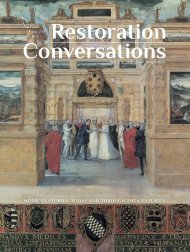
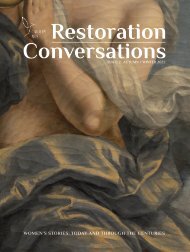

 Change language