

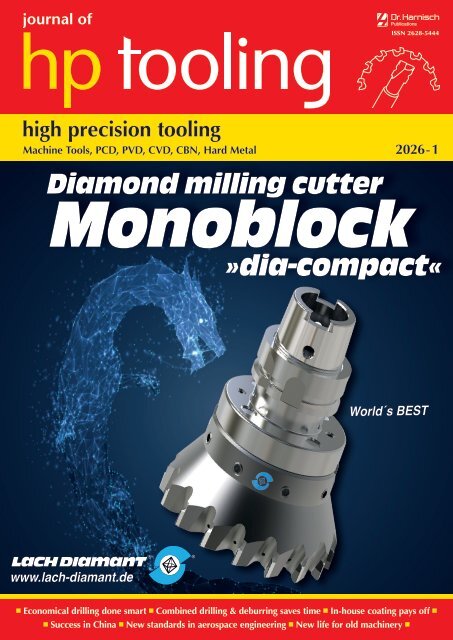
hp tooling 2026-#1
Economical drilling done smart ■ Combined drilling & deburring saves time ■ In-house coating pays off ■ ■ Success in China ■ New standards in aerospace engineering ■ New life for old machinery
Economical drilling done smart ■ Combined drilling & deburring saves time ■ In-house coating pays off ■
■ Success in China ■ New standards in aerospace engineering ■ New life for old machinery

Transform your PDFs into Flipbooks and boost your revenue!
Leverage SEO-optimized Flipbooks, powerful backlinks, and multimedia content to professionally showcase your products and significantly increase your reach.
ISSN 2628-5444<br />
high precision <strong>tooling</strong><br />
Machine Tools, PCD, PVD, CVD, CBN, Hard Metal <strong>2026</strong> – 1<br />
■ Economical drilling done smart ■ Combined drilling & deburring saves time ■ In-house coating pays off ■<br />
■ Success in China ■ New standards in aerospace engineering ■ New life for old machinery ■
GREEN EFFICIENT TECHNOLOGIES<br />
The independent media platform for<br />
energy supply, efficiency enhancement and<br />
alternative energy sources and storage<br />
Sustainable opportunities in process<br />
technology<br />
Circular economy in the industrial<br />
production process<br />
Topics H 2<br />
, Synthetic Fuels, Water,<br />
Solar & Photovoltaics, Wind Power,<br />
Bioenergy, Geothermal Energy, Battery<br />
Technology, System Integration and<br />
other alternative options<br />
■ Dr. Dr. Harnisch Publications Verlags GmbH ■ phone · Eschenstr. +49-(0)911-201 25 · 90441 80 ■ info@harnisch.com Nuremberg · Tel.: ■ www.harnisch.com +49 (0) 911 - 2018 0 ■ · Eschenstrasse info@harnisch.com 25, 90441 · www.harnisch.com<br />
Nuremberg, Germany ■
editorial<br />
Eric Schäfer<br />
editor-in-chief<br />
What’s coming up?<br />
What does <strong>2026</strong> have in store for the international tool<br />
and machine tool industry? Anyway, it’s set to be a busy year<br />
for trade fairs, with major exhibitions taking place in<br />
key markets around the world. The recently concluded<br />
IMTEX in India got things started. This will be followed<br />
by TMTS in Taiwan, showcasing how AI is driving<br />
innovation and sustainability in manufacturing. Later on<br />
SIMTOS will take place in South Korea, a country with a<br />
strongly export-oriented mechanical engineering industry.<br />
A similiar situation can be seen in Germany, where<br />
GrindingHub – the international hub for grinding<br />
technology and superfinishing – will take place in Stuttgart,<br />
in May. As reported on page 18 of this issue, the successful<br />
trade fair will hold its first event in America in 2027:<br />
GrindingHub Americas, which will be dedicated exclusively<br />
to grinding technology. In fall <strong>2026</strong> IMTS will also take<br />
place in the USA, a country characterized by dynamic<br />
market development, not least due to its strong domestic<br />
market. This will almost coincide with AMB in Germany.<br />
After that, BiMU will head to Italy, followed by JIMTOF<br />
in Japan at the end of October. The economic environment<br />
in Japan is challenging, but the outlook for special-purpose<br />
machinery is positive.<br />
By then it will be clear whether it has been a successful year<br />
for the industry and whether the trade fairs have provided<br />
the necessary impetus. You can find more information about<br />
these and other international trade fairs in our preview of<br />
upcoming events and in our market reports.<br />
Tool and machine tool manufacturing is a key industry<br />
in the global economy, and “the journal of <strong>hp</strong> <strong>tooling</strong>” is<br />
dedicated to this with all its high-precision machining<br />
processes, also apart from trade fairs. We will continue to<br />
showcase innovations in machine tools, tools, machining<br />
processes and components in our international trade<br />
journal. It is available in both the print edition and on digital<br />
channels, as well as in current, targeted newsletters.<br />
Stay tuned to find out what’s going on!<br />
Eric Schäfer<br />
editor-in-chief
table of contents<br />
cover story<br />
Poly – poly – or what? LACH DIAMANT looks back on 100 years<br />
Diamond contra diamond? A reflection on the versatility of diamonds 6<br />
materials & tools<br />
Economical drilling done smart 10<br />
Superior chip control during grooving and parting off 12<br />
A real game changer for efficient and reliable machining 13<br />
processes<br />
Combined drilling & deburring saves time and ensures safety 21<br />
On course for growth: in-house coating pays off 22<br />
Minimum quantity lubrication makes “green” production possible 24<br />
Understanding the role of abrasive technology in modern manufacturing<br />
written by Tom Dustman 26<br />
machining center<br />
Evermore counts on cylindrical grinding machines from STUDER 32<br />
Machining of difficult-to-cut and brittle materials 35<br />
Fast and economical machining of structural components 37<br />
New life for old machinery 38<br />
components<br />
Are software-defined CNC machines now entering job shops?<br />
written by Dr. Yavuz Murtezaoglu 42<br />
Compact space marvel with many features 44<br />
CAM Assist now used by over 1,000 machine shops globally<br />
to accelerate CNC programming with AI 47<br />
Making reverse engineering routine with seamless scan-to-CAD workflows 49<br />
news & facts 14<br />
fairs 5, 18, 19, 20<br />
impressum & company finder 51<br />
4 no. 1, <strong>2026</strong> February
fairs in alphabetical order<br />
AMB Stuttgart, Germany<br />
(September 15-19, <strong>2026</strong>)<br />
bauma Shanghai, China<br />
(November 24-27, <strong>2026</strong>)<br />
CCMT Beijing, China<br />
(April 21-25, <strong>2026</strong>)<br />
EPHJ Geneva, Switzerland<br />
(June 16-19, <strong>2026</strong>)<br />
FABTECH Toronto, Canada<br />
(June 9-11, <strong>2026</strong>)<br />
current status<br />
<strong>2026</strong><br />
<strong>2026</strong><br />
<strong>2026</strong><br />
<strong>2026</strong><br />
<strong>2026</strong><br />
FEIMEC Sao Paulo, Brazil<br />
(May 5-9, <strong>2026</strong>)<br />
FILTECH Cologne, Germany<br />
(June 30-July 2, <strong>2026</strong>)<br />
glasstec Düsseldorf, Germany<br />
(October 20-23, <strong>2026</strong>)<br />
GrindingHub Stuttgart, Germany<br />
(May 5-8, <strong>2026</strong>)<br />
Hannover fair Hanover, Germany<br />
(April 20-24, <strong>2026</strong>)<br />
HIMTEX Hyderabat, India<br />
(August 20-24, <strong>2026</strong>)<br />
IMTS Chicago, USA<br />
(September 14-19, <strong>2026</strong>)<br />
JIMTOF Tokyo, Japan<br />
(October 26-31, <strong>2026</strong>)<br />
MACH-TECH and Budapest, Hungary<br />
INDUSTRY DAYS (May 18-21, <strong>2026</strong>)<br />
METALEX Bangkok, Thailand<br />
(November 18-21, <strong>2026</strong>)<br />
MSV Brno, Czech Republic<br />
(October 6-9, <strong>2026</strong>)<br />
SIAMS Moutier, Switzerland<br />
(April 21-24, <strong>2026</strong>)<br />
SIMTOS Seoul, South Korea<br />
(April 13-17, <strong>2026</strong>)<br />
sps Nuremberg, Germany<br />
(November 24-26, <strong>2026</strong>)<br />
Stone+tec Nuremberg, Germany<br />
(Juni 17-20, <strong>2026</strong>)<br />
Surface Stuttgart, Germany<br />
Technology (May 5-7, <strong>2026</strong>)<br />
TMTS Taichung, Taiwan<br />
(March 25-28, <strong>2026</strong>)<br />
<strong>2026</strong><br />
<strong>2026</strong><br />
<strong>2026</strong><br />
<strong>2026</strong><br />
<strong>2026</strong><br />
<strong>2026</strong><br />
<strong>2026</strong><br />
<strong>2026</strong><br />
<strong>2026</strong><br />
<strong>2026</strong><br />
<strong>2026</strong><br />
<strong>2026</strong><br />
<strong>2026</strong><br />
<strong>2026</strong><br />
<strong>2026</strong><br />
<strong>2026</strong><br />
<strong>2026</strong><br />
trade fair dates as by end of January <strong>2026</strong>; we are not responsible for reliability of these dates<br />
no. 1, <strong>2026</strong> February<br />
5
cover story<br />
Poly – poly – or what?<br />
Diamond contra diamond?<br />
A reflection on the versatility of diamonds<br />
Horst Lach, born in 1940,<br />
runs the company<br />
LACH DIAMANT® – founded<br />
in 1922 by Jakob Lach –<br />
together with his son,<br />
Dipl.-Ing. Robert Lach.<br />
In the 1950’s engineering ingenuity made it possible to<br />
recreate this natural process in synthesis. The manufacturer<br />
General Electric succeeded in cultivating the so-called<br />
“Man Made TM ” diamond under almost 6,900 bar atmospheric<br />
pressure and at 3,500⁰ Celcius; a development which would<br />
lead to another industrial revolution within the quickly<br />
growing serial production industry.<br />
We cannot imagine today’s world without diamonds. Their<br />
hardness and invincibility make them a crucial cost-reducer<br />
for many tool applications in the industry – and their brilliance<br />
and everlasting beauty makes them fitting jewellry for<br />
our so much appreciated women.<br />
It starts with gemstones<br />
When preparing for the article “Diamond contra diamond?”,<br />
in 2021, I immediately (regrettably) found information on<br />
diamonds as much sought-after gemstones. For example, no<br />
buyer of a polished diamond (brilliant) with a weight of half<br />
a carat (1 ct = 0.2 gram) would expect that he only has to pay<br />
“double the price” for a whole carat. The value is not only<br />
determined by size and purity, the buyer must also take the<br />
extreme rarity of finding large diamonds into consideration.<br />
For generations this was typical for the gemstone business<br />
with natural diamonds.<br />
Of all companies, the “contra” aspect is now offered by a<br />
company formerly associated with “De Beers”. Produced in<br />
synthesis, or “in the laboratory”, the diamonds appear to have<br />
the purity of colour and clarity (factors of classification) of<br />
polished natural diamonds (brilliants); there is even a choice<br />
between white, blue or pink. And best of all: anyone, purchasing<br />
directly from this consortium, can calculate the price<br />
based on the carat weight from 0.25 to 2.0.<br />
for example: the price for<br />
0.25 ct = 200 US $<br />
0.5 ct = 400 US $<br />
1.0 ct = 800 US $<br />
et cetera, so that a 2-carat diamond would cost 1,600 US $.<br />
The troubled sales people at the diamond exchanges in<br />
Antwerp and London and jewellers should know that all of<br />
these “laboratory diamonds” are marked as such with microscopically<br />
small imprints in order to prohibit “fraudulent”<br />
mix-ups with natural diamonds.<br />
Diamond contra diamond – for example, natural diamond<br />
compared to polycrystalline diamond blades (PCD)<br />
Diamond contra diamond; for example a single natural<br />
diamond dresser compared to a diamond dressing roll<br />
6 no. 1, <strong>2026</strong> February
cover story<br />
for the first time at the Hanover trade show<br />
in spring 1973. With them, efficient turning<br />
machining of copper commutators (and their<br />
baked-in synthetic mica) was made possible<br />
for the first time.<br />
Once again a new technology was born.<br />
Compact diamond blocks – PCD – were the<br />
basis for the development of cutting tools,<br />
superior to carbide tools, for “faster turning,<br />
drilling and milling with synthetic<br />
diamonds”.<br />
As early as 1973 polycrystalline turning tools replaced the overturning<br />
of copper lamellas of rough and fine polished copper commutators<br />
Within the industry, the “contra” isn’t playing out as drastically<br />
In 1957 – after synthetic diamonds became first available – they were initially<br />
used as diamond grain for the development of new synthetic-resin bond<br />
diamond grinding wheels, and for the first time also for pre-grinding<br />
carbides. During the 1960’s, 1970’s and the 1980’s a multitude of innovations<br />
swept over the market, some of which could only be implemented within<br />
the industry with certain delays.<br />
What particularly comes to mind are polycrystalline synthetic diamonds<br />
(PCD), available since 1973. Simply put, they are synthetic diamond grains<br />
in a cylindrical shape which – under pressure and heat and combined with<br />
catalysers tungsten and cobalt – are pressed onto a round carbide plate (as a<br />
substrate), very similar to diamond synthesis.<br />
The first PCD plates had a diameter of only 3.2 mm. However, when they<br />
were mechanically segmented into rectangles, they were the basis for the<br />
so-called PCD cutting tools, successfully presented by LACH DIAMANT<br />
Turning of copper commutators is another<br />
“contra” argument in this reflection. Until the<br />
use of the first PCD dreborid® turning steel,<br />
copper commutators were turned exclusively<br />
with natural diamonds during fine polishing.<br />
With the result that I had to take my first car<br />
to the repair shop every 750 km to have the<br />
wiper motor exchanged; otherwise, the wiper<br />
could have failed during the next rain.<br />
And today? Problems with windscreen wiper<br />
motors? No thank you. PCD turning means<br />
they should last multiple car-lifetimes.<br />
A similar “contra” – clearly in favour of PCD –<br />
can be reported of turning motor pistons. Until<br />
the 1970’s I could observe high class automobiles<br />
broken down by the roadside when I<br />
was driving to the Hanover trade show, apparently<br />
due to piston seizure. At that time expert<br />
drivers were convinced they had to “break in”<br />
their brand-new cars on this route. If the<br />
motor could stand it, it was a good car…<br />
The introduction of polycrystalline cutting<br />
tools in the aluminum processing automobile<br />
industry also uncovered this “contra”<br />
in piston manufacturing as well as the insight,<br />
that the surface quality achieved during<br />
turning with polycrystalline cutting materials<br />
– instead of the thus far used natural diamonds<br />
– allowed for a perfect lubricating film<br />
which immediately prevented piston seizure<br />
to the greatest possible extent.<br />
Another argument in our reflection on<br />
“diamond contra diamond” brings composite<br />
and wooden materials and their respective<br />
industry into focus.<br />
Indirectly, carbide is partially involved in<br />
this example of “contra”, since diamond is<br />
also present in the grinding wheel for carbide:<br />
pars pro toto.<br />
PCD chip milling of glass fiber reinforced plastic (GRP) during an experiment<br />
in 1974 – compared to diamond-tipped tools, very little dust formation<br />
Early on, after the successful use of PCD<br />
turning, drilling and milling tools, other<br />
non-ferrous materials, such as aluminum and<br />
no. 1, <strong>2026</strong> February<br />
7
cover story<br />
PCD tool during front facing<br />
of an aluminum rim<br />
A diamond cut-off wheel,<br />
electroplated with diamonds during the<br />
cutting of a GRP (glass fiber reinforced<br />
plastic) component<br />
copper as well as some plastic materials were tried in experiments.<br />
Examples are soft and hard plastics, glass fiber and<br />
carbon fiber materials, electrographite carbons and miscellaneous<br />
wooden materials.<br />
The photo on the previous page was taken during these<br />
adventurous times. It shows a PCD end milling cutter during<br />
the chip machining of a GRP component.<br />
When the second productronica was held in Munich in<br />
1977, PCD tools for sawing/scoring/milling/drilling were<br />
demonstrated to an astonished audience on an Amacher<br />
electronic circuit board machine, which had been purchased<br />
especially for this purpose. It was so successful that for the<br />
time being – until the discovery of spark erosion – expectations<br />
of the relevant industry had to be disappointed.<br />
Other industries had now become just as curious and<br />
further experiments and construction continued diligently.<br />
For example, machining of carbon fiber components for the<br />
aircraft industry, which in turn should initiate revolutionary<br />
successes in the development of spiral drills, especially<br />
for one manufacturer. And a real “contra” should become<br />
clear during the machining of composite materials. A pro<br />
and contra for some imminent problem solutions. While<br />
using the same diamond material, different production<br />
and tool technologies created controversies. For the first<br />
time, PCD tools and the already “tradition-rich” diamondcoated<br />
electro-plated tools were in competition with one<br />
another.<br />
Special advantages of electro-plating<br />
Almost all profiles projected onto steel bodies can be coated<br />
with diamond and re-coated after wear in service. The<br />
diamond grains applied to the surface of the steel body allow<br />
good removal rates – depending on grain size – which is especially<br />
advisable for deburring tasks. They are versatile in use,<br />
like cut-off wheels up to high diameters, or for cutting GRP<br />
and other hard materials.<br />
The disadvantage: dust formation which must be extracted.<br />
LACH DIAMANT provides a special solution for hollow<br />
drills, featuring extraction directly at the tool.<br />
Special advantages of PCD<br />
As far as the geometries of the composite component to be<br />
machined allow, turning and milling operations can be performed<br />
efficiently and without any problems, and can therefore<br />
be recommended accordingly. Profile and drilling tools<br />
can constructively be equipped with PCD cutting edges,<br />
which is especially advantageous for larger production numbers.<br />
Further advantages result in comparison with electroplated<br />
diamond tools, e.g., grooving tools with exact tolerances<br />
for corners and radii for serial production. Chips,<br />
produced during machining, can be extracted very well.<br />
PCD blades can be reground several times.<br />
Diamond tools have become an intrinsic and valuable<br />
part in the world of technology, especially during the last<br />
50 years. The list of examples above could easily be extended<br />
– innovative spirit and (positive) thinking outside the box<br />
will con tinue to enrich “pro and contra” in many industries<br />
and many applications. For example, let’s think of the natural<br />
diamond as a single tool for dressing and profiling of grinding<br />
wheels – it was replaced as a single point dressing tool by<br />
a chain of innovations in serial production. Roughly in the<br />
order of the following developments: by the multi-point<br />
dresser, the Diamant-Fliese or rather dressing plate and – up<br />
to date – by diamond dressing rolls.<br />
When we focus at last on the diamond itself, we wonder<br />
whether it will really stay the hardest of all things? Personally,<br />
I am not so sure about that. A “contra” could be in the making<br />
here too. Recently the press featured a “glass” which supposedly<br />
could score even the surface of a diamond…<br />
Horst Lach<br />
further information: www.lach-diamant.de<br />
8 no. 1, <strong>2026</strong> February
AI era × diamond tools for<br />
semiconductor manufacturing<br />
materials & tools<br />
At the <strong>2026</strong> TMTS Taichung Machine Tool Show,<br />
King Ming Precision Tool Co., Ltd. will showcase its<br />
latest PCD (polycrystalline diamond) cutting tools.<br />
The company will present advanced machining solutions<br />
for hard and brittle materials.<br />
To address the challenges commonly encountered when machining<br />
silicon carbide, sapphire, aluminum oxide, tungsten<br />
carbide and other hard-brittle materials – such as insufficient<br />
efficiency and unstable accuracy when using diamond<br />
grinding pins or carbide tools – King Ming has launched a<br />
full series of PCD micro-diameter helical tools. The product<br />
lineup includes end mills, ball mills, drills and spot<br />
drills designed to meet a wide range of micro-machining<br />
requirements.<br />
The new PCD micro-diameter helical end mills feature a<br />
spiral cutting edge and multi-flute design. Compared with<br />
traditional diamond grinding pins, they significantly reduce<br />
cutting resistance, increase machining speed and shorten<br />
processing time – greatly enhancing productivity and competitiveness.<br />
With a high precision tolerance of ± 0.005 mm,<br />
these tools provide accuracy levels that grinding pins cannot<br />
achieve, making them ideal for machining hard-brittle<br />
materials.<br />
For drilling applications on ceramics, monocrystalline<br />
silicon (wafers) and tungsten carbide molds, King Ming<br />
also offers PCD micro-diameter helical drills. With diameters<br />
as small as 0.2 mm, these drills effectively solve the<br />
long machining time associated with diamond grinding-pin<br />
drilling and ensure both precision and efficiency with their<br />
± 0.005 mm tolerance – delivering faster and more reliable<br />
micro-hole machining.<br />
King Ming’s comprehensive diamond cutting tool solutions<br />
are widely used across AI smart manufacturing, semicon ductor<br />
wafers, 3C panels/mobile devices, precision machinery,<br />
aerospace parts, automotive and motorcycle components,<br />
and bicycle components.<br />
further information: www.tmts.tw<br />
Efficiency without compromise<br />
Gühring is adding a powerful, solid carbide<br />
circular milling cutter to its grooving tool range. The<br />
tool not only scores with perfect surface qualities and<br />
long tool lives, but also impresses with significantly<br />
smoother running compared to the competition.<br />
The solid carbide circular milling cutter features an innovative<br />
geometry: the combination of positive chip and axis angles,<br />
innovative uneven pitch and large chip spaces ensures<br />
maximum running smoothness and low cutting forces. This<br />
allows higher cutting parameters to be achieved and machining<br />
times to be reduced. And all this without compromise:<br />
users also benefit from excellent results in terms of surface<br />
quality.<br />
The circular milling cutter ensures short, controlled chip<br />
breaking, guaranteeing optimal chip removal. For this reason<br />
the tool ensures a reliable process when turning and milling<br />
internal contours with high cutting data and longer tool lives,<br />
making it an efficient alternative to groove turning.<br />
Strong as standard, flexible as a special design<br />
The circular milling cutters are available in all common<br />
designs and dimensions as standard, which means that users<br />
benefit from fast delivery times. Furthermore the circular<br />
milling cutters are designed with application-oriented undersizes<br />
(e.g. d1 = 7.8 mm for holes with a diameter of 8 mm),<br />
which allows holes and internal radii to be machined close to<br />
contour and effectively.<br />
further information: www.guehring.com<br />
no. 1, <strong>2026</strong> February<br />
9
materials & tools<br />
Economical drilling done smart<br />
The secret to the success of the machining company<br />
Zerspanungstechnik Mangner GmbH in Bad Laasphe,<br />
Germany, is targeted investment in optimization.<br />
Drilling has been made more efficient thanks to a<br />
large tool package from MAPAL. The package is made<br />
up of 110 TTD replaceable head drills along with a big<br />
stock of solid carbide heads.<br />
When Mike Mangner started his company in a small rented<br />
hall in 2013, tools still had to be changed by hand. The young<br />
company developed quickly. Just one year later the company<br />
bought its current and set up the first Hermle machines. As<br />
a traditional contract manufacturer, most of Mangner’s customers<br />
come from the tool and mouldmaking industry. The<br />
company offers them services like pressure die casting, sand<br />
casting and modelmaking. Most of the work is destined<br />
for the automotive industry. Apart from this parts are also<br />
produced for general machine engineering. Mangner’s<br />
customers come from all over Germany, but usually from<br />
their region.<br />
Meanwhile 15 machining centers can be found on the shop<br />
floor, most of them from Hermle. From the smallest 5-axis<br />
machine to the machining center for components as large as<br />
1 x 1 m, they cover a wide spectrum of components, two machines<br />
for every operator. Programming takes place directly<br />
at their workplaces. Mike Mangner’s optimization philosophy<br />
involves having many identical machines in operation.<br />
A next step in the standardization process involves making<br />
as many of the same tools as possible available for these machines.<br />
“With this concept, we are in a strong position and<br />
can employ our operators flexibly”, Mike Mangner explains.<br />
Examining the drill head of a TTD tool (from left):<br />
Dominik Geßner (production manager, Mangner),<br />
Uwe Rein (regional sales manager, MAPAL),<br />
Mario Schäfer, (assistant production manager, Mangner)<br />
and Mike Mangner (managing director, Mangner)<br />
Hirth serration from MAPAL enables high torque<br />
Dominik Geßner switched to Mangner as a production<br />
manager two years ago, bringing along his experience<br />
and contacts. MAPAL and their regional sales manager<br />
The Hirth serration of the TTD drill from MAPAL<br />
ensures the drill heads sit very securely; this enables<br />
optimal torque transfer as well as high changeover and<br />
radial run-out accuracies<br />
The large tool package from MAPAL for Mangner includes<br />
a total of 110 TTD replaceable head drills with diameters<br />
from 12 to 45 mm and lengths of up to 12 x D<br />
10 no. 1, <strong>2026</strong> February
materials & tools<br />
Uwe Rein was among them. Geßner advocated the use of TTD replaceable<br />
head drills, which he had come to know and appreciate over the years.<br />
The TTD replaceable head drill is the primary application for the TTS<br />
(Torque Transfer System) interface. The interface owes its stability to the<br />
radially arranged Hirth serration with 12 or 18 teeth, depending on the diameter<br />
of the adapted solid-carbide drill head being used. Due to the serration’s<br />
form closure, variable geometries of the replaceable head are possible. In<br />
addition, optimal torque transfer and high radial run-out and change-over<br />
accuracy are ensured.<br />
The replaceable drill head is secured by a threaded pin affixed to the side of<br />
the tool holder. This allows the drill bit to be changed directly in the machine.<br />
The positioning aid integrated in the serration ensures that the chip flutes<br />
and coolant transfer from the tool holder to the replaceable drill head match.<br />
With its cutting-edge geometry, the drill head has a quality and performance<br />
level similar to solid carbide drills.<br />
Machining time reduced<br />
“The true advantage of these drills comes into play in hardened materials,<br />
which it can machine reliably”, Geßner reports. “We achieve a long tool life<br />
here, which reduces our throug<strong>hp</strong>ut of drill bits.” At Mangner bores used<br />
to take place prior to hardening. By eliminating the need for an addi tional<br />
clamping step, set-up time has been reduced. This increases efficiency in<br />
manufacturing, thereby providing the company with added value.<br />
The previously used tool system had a particular weak point: if a solidcarbide<br />
drill head broke off, the drill bit holder was usually also damaged.<br />
In Geßner’s experience this has never happened with MAPAL. After breakage,<br />
work could always continue with a new drill head, limiting any resulting<br />
damage. “I primarily considered changing the tool system from a cost perspective”,<br />
says Mike Mangner, explaining why he chose MAPAL.<br />
More economical and sustainable<br />
Mangner uses the drills above all to pilot deep bores as well as complete bores<br />
for cooling, so-called coolant boost. While the normal lead geometry of the<br />
cutting edge is 140 °, MAPAL also offers variants for special applications. A<br />
180 ° tip can execute countersink bores, for example, which would otherwise<br />
only be possible with a milling cutter. Ball-nose drills enable radii at the end.<br />
Geßner reports that if handled with care, the drill heads can be reground up<br />
to three times by MAPAL. “This is very sustainable and lowers the average<br />
price per tool.”<br />
The tool package delivered by MAPAL includes diameters from 12 to<br />
45 mm, whereby the tool lengths are 3 x D, 5 x D, 8 x D and 12 x D. “We cover a<br />
certain diameter range with replacement head drills in increments of tenths”,<br />
Geßner specifies. “The tools would be unaffordable with drills made entirely<br />
of solid carbide.” The many sizes reflect the various requirements of manufacturing.<br />
Series of up to 100 parts are rare here. Typical lot sizes are between<br />
one and ten pieces. The material is often heat-resistant 1.2343 steel, but<br />
special materials, steel with varying degrees of hardness and aluminum are<br />
also processed.<br />
After the successful deployment of TTD drills, the cooperation between<br />
Mangner and MAPAL is set to continue. Reamers are already in use. Test<br />
finishing with milling cutters is also taking place. Uwe Rein thinks that<br />
high-feed cutting could be the next step.<br />
further information: www.mapal.com<br />
FILTECH<br />
June 30 – July 02, <strong>2026</strong><br />
Cologne – Germany<br />
The Filtration Event<br />
www.Filtech.de<br />
Platform<br />
for your<br />
success<br />
600+ Exhibitors<br />
Delivers<br />
solutions for<br />
current<br />
and future<br />
challenges<br />
Your Contact: Suzanne Abetz<br />
E-mail: info@filtech.de<br />
Phone: +49 (0)2132 93 57 60
materials & tools<br />
Superior chip control during<br />
grooving and parting off<br />
Paul Horn GmbH has introduced a new chip breaker<br />
geometry for the 274 tool system especially for grooving<br />
and parting off on sliding-head lathes.<br />
The sintered chip breaker geometry 1A optimizes chip control<br />
during turning, ensuring a high level of process reliability.<br />
The universal geometry is suitable for machining various<br />
materials. The indexable insert with two cutting edges is<br />
available in three cutting widths of 1 mm, 1.5 mm or 2 mm.<br />
Maximum grooving depth is between 3 and 6 mm. The insert<br />
is available in TH35 and IG35 grades. An extensive range of<br />
holders is available for adaptation to different types of lathe.<br />
A comprehensive range of holders is available for System 274<br />
HORN/Sauermann<br />
The geometry ensures a high level of process reliability<br />
thanks to optimal chip control<br />
When machining turned parts of small diameter, the center<br />
height of the tool must be precise. Even small deviations<br />
in the center height have a negative effect on the quality of<br />
the workpiece when machining very small parts. Ideally the<br />
machine operator should be able to index the insert without<br />
having to re-adjust the center height. With System 274,<br />
Horn offers excellent repeatability of less than 0.02 mm when<br />
turning the double-edged insert. This is made possible by<br />
precise peripheral grinding of the insert in conjunction with<br />
the stable insert seat.<br />
further information: www.horn-group.com<br />
12 no. 1, <strong>2026</strong> February
A real game changer for<br />
efficient and reliable machining<br />
materials & tools<br />
The trochoidal cutters (TPC) from LMT Tools<br />
offer outstanding cutting performance, extremely<br />
short machining times, and long service life, and are<br />
considered a key technology for efficient and reliable<br />
machining in a wide range of materials. The machine<br />
manufacturer TMQS from Büchen tested them<br />
in practice and used the TPC M for the first time in its<br />
production – with outstanding success.<br />
tangential transition, and a particularly wear-resistant cutting<br />
corner. The chip breakers ensure optimum chip removal<br />
and significantly reduce vibration, which has a positive effect<br />
on tool life. The cutting edges are located along the entire<br />
length of the tool and are almost completely immersed<br />
in the workpiece. This allows very large feed depths to be<br />
achieved. In the TMQS application, a feed depth of 35 mm<br />
was achieved with the TPC M – with a cutting edge length<br />
With their maximum axial engagement (Ø 3 x and Ø 5 x) and<br />
carefully coordinated geometries, the milling cutters in the TPC family<br />
deliver flawless performance in a variety of machining applications<br />
TMQS uses the TPC M from LMT Tools to machine a workpiece<br />
made of titanium 3.7165. Starting from a raw size of<br />
60 x 60 x 255 mm the wall thickness is reduced to 2 mm by<br />
roughing. The company had already been working with<br />
trochoidal milling cutters, but the switch to the TPC M has<br />
now resulted in a significant leap in performance: machining<br />
time has been cut in half, while tool life (235 min) and<br />
metal removal rate (approx. 40 mm³/min) have doubled. The<br />
result: higher productivity, lower unit costs and more stable<br />
pro cesses. “The TPC milling cutters from LMT Tools are a<br />
real game changer for us”, emphasizes Nico Brandt, CEO at<br />
TMQS. “We now manufacture complex titanium components<br />
faster, more economically and with significantly higher<br />
process reliability.”<br />
Optimized tool geometry and<br />
excellent chip removal<br />
The TPC M was developed by LMT Tools specifically for trochoidal<br />
milling in titanium and is precisely tailored to the<br />
process-specific requirements. The high-performance tools<br />
feature multiple cutting edges, multiple chip breakers with<br />
of 38 mm (12 mm tool diameter). A special cutting edge<br />
geometry with defined edge preparation and the latest coating<br />
enables high cutting speeds and guarantees maximum<br />
cutting performance and feed rates. Another advantage is<br />
the 2 mm long cutting edge. This allows the TPC M to be<br />
reground several times without compromising the maximum<br />
depth of cut.<br />
Excellent trochoidal milling in a<br />
wide range of materials<br />
“The TMQS application impressively demonstrates the outstanding<br />
performance of our HPC milling cutters. These<br />
powerful tools achieve the best milling results in any material<br />
and take trochoidal milling to a whole new level”, says<br />
Carsten Wegner, technical consulting and sales at LMT Tools,<br />
summarizing the advantages. In addition to the TPC M for<br />
titanium also cutting lengths of Ø 3 x and Ø 5 x are available<br />
for cast iron (ISO-K), steel and stainless steel (ISO-M), as well<br />
as high-temperature steels and superalloys.<br />
further information: www.lmt-tools.com<br />
no. 1, <strong>2026</strong> February<br />
13
news & facts<br />
Horn (Shanghai) Trading Co. Ltd. expands<br />
Horn (Shanghai) Trading Co. Ltd. was founded in 2012,<br />
sales activities began as early as 2013. For this purpose<br />
an office with an area of approximately 450 m 2 was<br />
rented on the ninth floor of a building in downtown<br />
Shanghai.<br />
Today HORN employs 26 people in China and achieved a<br />
sales volume of around € 12 million in 2025. Due to econo m ic<br />
growth and the increasing number of employees the office<br />
had become too small. Because of the growing and therefore<br />
heavy weight of the warehouse, a seminar room was used as<br />
storage space to reduce the floor space load. Therefore further<br />
growth was only possible at a very slow pace.<br />
On December 9, 2025, the HORN branch moved within<br />
the same district in Shanghai. The new, very modern space<br />
covers approximately 850 m 2 , making it almost twice as<br />
large as the previous location. In addition to more space for<br />
staff and storage, the entrance area includes a showroom.<br />
The new office space also contains professional training<br />
rooms that can be divided as required.<br />
The relocation of Horn (Shanghai) Trading Co. Ltd. marks<br />
another important step in the company’s growth in China<br />
and is also a clear commitment to the location. Markus Horn<br />
and Andreas Vollmer were together on site with their<br />
The relocation of Horn (Shanghai) Trading Co. Ltd. marks<br />
another important step in the company’s growth in China<br />
and is also a clear commitment to the location<br />
colleagues from Horn Shanghai for the inauguration.<br />
Li Xiayang, director of the district government in Shanghai,<br />
attended the event also.<br />
further information: www.horn-group.com<br />
Call for application<br />
EMVA Young Professional award <strong>2026</strong><br />
It is the goal of the European Machine Vision Association<br />
to support further innovation in industry, to contribute<br />
to the important aspect of dedicated machine vision<br />
education, and to provide a bridge between research<br />
and industry. The EMVA Young Professional Award<br />
is an annual award endowed with 1,500 € to honor<br />
the outstanding and innovative work of a student or<br />
a young professional in the field of machine vision or<br />
image processing.<br />
The EMVA specifically encourages students and young scientists<br />
to focus on challenges in the field of machine vision and<br />
to apply latest research results and findings in computer vision<br />
to the practical needs of industry. Applicants for the award<br />
<strong>2026</strong> are hereby invited to submit their work. The board of<br />
directors of the European Machine Vision Industry will<br />
select the winner of the award among all papers.<br />
The criteria of the works to be presented are:<br />
→ Outstanding or innovative work in the field of vision<br />
technology. Industrial relevance and collaboration with a<br />
company during the work is required. The targeted<br />
industry is free of choice.<br />
→ The work (master thesis or PHD thesis or equivalent<br />
level research) must have been undertaken within the last<br />
18 months at, or in collaboration with, a European<br />
institution. Meanwhile the student may have<br />
entered the professional field.<br />
To apply submit the following materials to the EMVA president,<br />
Dr Chris Yates, at ypa@emva.org until April 5, <strong>2026</strong>:<br />
→ a two-page abstract summarizing the innovation<br />
and the intended commercial benefit<br />
→ a one-page CV<br />
→ a copy of the master thesis or PhD thesis; if not<br />
yet finished or under publication restrictions<br />
→ please provide at least one accepted publication<br />
→ supportive letters of research supervisors and/or any<br />
collaborating company are welcomed but not mandatory<br />
The winner of the award will be announced at the EMVA Business<br />
Conference <strong>2026</strong> in June 18-20 in Stockholm, Sweden,<br />
giving the opportunity to present the awarded work to the<br />
machine vision industry leaders and special press representatives.<br />
In addition to the honor of the EMVA award endowed<br />
with 1,500 € and the publicity for the research work, is a free<br />
conference pass for the EMVA Business Conference, the coverage<br />
of all travel cost to Stockholm and a free pass for the<br />
European Machine Vision Forum in autumn <strong>2026</strong>.<br />
further information: www.emva.org<br />
14 no. 1, <strong>2026</strong> February
news & facts<br />
Switching to recycled materials<br />
Horn is gradually switching its packaging to recycled<br />
materials with immediate effect. The change from black<br />
to grey packaging is visually noticeable. The yellow<br />
labels are also largely made from recycled materials.<br />
Plastic packaging is an indispensable part of our modern society.<br />
It protects products, extends their shelf life and enables<br />
efficient logistics. But plastic packaging is also the subject of<br />
controversial discussions regarding its environmental impact<br />
and sustainability. Recycled material plays an important role<br />
in reducing the consumption of new raw materials and minimizing<br />
the environmental impact of plastic packaging. The<br />
reused plastic waste is from various sources, including used<br />
plastic packaging and industrial waste. Keyword: recycling.<br />
There are various recycling methods, such as mechanical<br />
recycling, chemical recycling and energy recovery. Mechanical<br />
recycling is the most common, but has its limitations<br />
in terms of the number of recycling cycles. It is not easy to<br />
say how often plastic can be recycled. It can be assumed that<br />
most plastics can generally be recycled several times through<br />
mechanical recycling.<br />
Most of the materials currently pass through the cycle once.<br />
The mixing of input materials from different sources ensures<br />
that the material quality of the end product is high. Quality<br />
control ensures that the recycled material meets the requirements.<br />
However, this development has not yet reached the<br />
same level as, for example, with PET (water bottles). For<br />
HDPE and PP this is only possible to a limited extent, as<br />
most of the material currently entering the cycle still is virgin<br />
material. It will take some time before 100 % of the material<br />
is permanently recycled.<br />
The dark grey recycled packaging that Horn purchases is<br />
processed by mechanical recycling and then compounded.<br />
This means that the shredded recycled material is melted<br />
down and processed with additives so that the material properties<br />
always remain the same. These additives help to stabilize<br />
and optimize the physical and chemical properties of<br />
the recycled material. This is important in order to keep the<br />
Horn is converting all its packaging to recycled materials<br />
HORN/Sauermann<br />
manufacturing processes stable. Through targeted measures<br />
and the right selection of additives, the performance of the<br />
recycled plastic can be stabilized and, if necessary, significantly<br />
improved.<br />
If the quality of the plastic can no longer be reproduced, it<br />
is further processed for less demanding applications or, as a<br />
last resort, sent for energy recovery to generate energy.<br />
Ultimately the goal is to maximize the recyclability of<br />
plastics while minimizing the use of new plastic in order to<br />
reduce the environmental impact.<br />
Arguments in favor of plastic packaging<br />
made from recycled plastic<br />
1. Environmental protection:<br />
the use of recycled plastic reduces the need for new<br />
plastic, which lowers the consumption of fossil raw<br />
materials (oil, gas, etc.) and reduces CO₂ emissions<br />
2. Resource conservation:<br />
recycled materials help conserve natural resources<br />
by minimizing the need for new raw materials<br />
3. Waste reduction:<br />
the use of recycled plastic produces less waste, as the<br />
raw material is kept in the cycle, thereby reducing<br />
energy recovery and landfill (abroad)<br />
4. Energy savings:<br />
manufacturing products from recycled plastic often<br />
requires less energy than producing new plastic,<br />
which leads to a lower environmental impact<br />
5. Circular economy:<br />
the use of recycled plastic promotes the concept<br />
of a circular economy, in which materials are<br />
continuously reused and recycled instead of<br />
ending up in a linear system<br />
6. Regulatory requirements:<br />
many regions have increasingly stringent regulations<br />
and incentives for the use of recycled materials,<br />
encouraging companies to adopt more<br />
sustainable practices<br />
7. Innovation:<br />
the development and use of recycled plastic promotes<br />
innovation in the packaging industry, which can lead<br />
to new, sustainable solutions<br />
8. Consumer acceptance:<br />
due to upcoming regulatory requirements, more and<br />
more companies are striving to reduce their carbon<br />
footprint, which supports the use of recycled plastics<br />
“The switch to packaging made from recycled materials is<br />
simply the next logical step in our understanding of sustainability.<br />
As a family business we don’t just think in terms<br />
of quarters and annual financial statements, but in terms<br />
of generations”, says Markus Horn, managing director of<br />
Paul Horn GmbH.<br />
further information: www.horn-group.com<br />
no. 1, <strong>2026</strong> February<br />
15
news & facts<br />
Open, flexible and scalable<br />
The world’s leading drive specialist SEW EURODRIVE<br />
and TTTech Digital Solutions, software and automation<br />
expert, announce their strategic cooperation.<br />
The cooperation aims to integrate SEW EURODRIVE’s<br />
axis and drive systems into the software-based control and<br />
auto mation platform UBIQUE® in order to offer customers<br />
an open, modern and forward-looking concept for their<br />
machine automation.<br />
Through this cooperation SEW EURODRIVE combines its<br />
many years of expertise in drive technology with the digital<br />
expertise of TTTech Digital Solutions in the field of real-time<br />
control and automation. The UBIQUE® (“cloud-driven automation”)<br />
platform combines OT and IT and offers functions<br />
such as real-time motion control, cyber security, safety,<br />
web HMI, I/O, and Edge/IIoT. The combination of SEW<br />
EURODRIVE axes and UBIQUE® creates an open, integrated<br />
system that offers machine builders and plant operators<br />
a powerful and flexible solution for modern automation<br />
require ments. UBIQUE® users get direct access to the<br />
MOVI C automation kit from SEW EURODRIVE and all<br />
associated gearmotor solutions. UBIQUE® makes customers<br />
independent of special hardware such as IPCs, servo controllers<br />
or HMI platforms in the long term, while the combination<br />
of proven mechanical drives and modern control systems<br />
shortens development times. In addition UBIQUE® covers<br />
the entire product life cycle – from the axis to the cloud,<br />
including edge devices, remote maintenance and lifecycle<br />
management. The cooperation thus supports the transition to<br />
“software-defined factories,” networked systems, and sus tainable<br />
production. Neither is security is neglected: UBIQUE®<br />
is cyber secure according to IEC62443 and supports the implementation<br />
of EU machinery regulation 2023/1230.<br />
“By integrating our products into UBIQUE® we enable our<br />
customers to think about their automation solutions in an<br />
open, flexible and scalable way. In doing so we are consistently<br />
pursuing our strategy of integrating drive technology into<br />
digital ecosystems”, says Dr. Hans Krattenmacher, managing<br />
Von links: Alois Holzleitner (TTTech Digital Solutions),<br />
Dr. Hans Krattenmacher (SEW-EURODRIVE),<br />
Christoph Trappl, Hans Wimmer<br />
(beide TTTech Digital Solutions)<br />
director of innovation mechatronics at SEW EURODRIVE,<br />
summarizing the benefits for customers.<br />
Christoph Trappl, managing director of TTTech Digital<br />
Solutions, adds: “The cooperation with SEW EURODRIVE<br />
opens up complete new solutions for machine builders in the<br />
field of motion control. The consistency of UBIQUE® enables<br />
users to change and archive all parameters and configurations<br />
from the motor to the cloud – naturally in accordance<br />
with IEC62443 cyber security standards.”<br />
In a first step, selected machine and production line customers<br />
of SEW EURODRIVE will be able to use the integration<br />
of UBIQUE®-based control solutions – including edge<br />
functionality, remote monitoring and lifecycle management.<br />
At the same time both companies are developing a joint engineering<br />
roadmap to offer standardized, modular automation<br />
packages in the long term. The plan is to make the solution<br />
available not only for new systems, but also for retrofitting<br />
existing systems.<br />
further information: www.sew-eurodrive.de<br />
Coated abrasives leadership strengthened with the<br />
acquisition of Hermes North America<br />
WALTER Surface Technologies, a global leader in<br />
productivity and safety solutions for the metalworking<br />
industry, has announced the acquisition of<br />
Hermes North America, a leading supplier of coated<br />
abrasives with a strong reputation for technical excellence<br />
and customer-focused performance.<br />
This strategic acquisition ensures business continuity and<br />
long-term stability for Hermes North America customers<br />
and employees, while expanding WALTER’s existing expertise<br />
in coated abrasives. The addition of Hermes strengthens<br />
WALTER’s position in key market segments, particularly in<br />
belted products that serve a wide range of finishing, robotic<br />
and automation applications.<br />
“WALTER and Hermes share a deep commitment to quality,<br />
reliability and customer success”, said Marc-André Aubé,<br />
CEO of WALTER Surface Technologies. “This acquisition<br />
is not only about expanding our coated abrasives offering<br />
16 no. 1, <strong>2026</strong> February
news & facts<br />
today – it’s a long-term investment in growth and innovation<br />
as customers automate their processes. Our long-term<br />
vision is to keep driving innovation, sustainability and value<br />
creation so our customers can continue to work better, faster<br />
and more efficiently for decades to come.”<br />
Tony Sarles, general manager of Hermes North America,<br />
added: “Joining WALTER represents a new chapter of<br />
strength and stability for Hermes North America. With<br />
WALTER’s support, we will continue to serve our customers<br />
and partners with the same dedication and technical expertise<br />
they have come to expect – now backed by a stronger<br />
foundation for the future.”<br />
The acquisition also reinforces WALTER’s position as<br />
a leader in metalworking surface treatment and finishing<br />
solutions across North America. Hermes North America<br />
will continue to operate from its current headquarters, while<br />
WALTER plans to integrate Hermes’ high-quality abrasive<br />
products into its lineup quickly, ensuring customers have<br />
seamless access to a broader range of solutions across its distribution<br />
network. The Hermes European Group will remain<br />
independent as a trusted partner and supplier. The transaction<br />
is immediately effective, and all customer and supplier<br />
activities will continue without disruption. This acquisition<br />
represents WALTER’s ongoing commitment to providing<br />
best-in-class productivity and surface finishing solutions<br />
for customers.<br />
further information: www.walter.com<br />
A quarter century of precision, innovation<br />
and partnership<br />
Vollmer Japan celebrated its 25 th anniversary, marking<br />
a quarter century of successful company history. Since<br />
its founding in the year 2000 the Japanese subsidiary<br />
of the Vollmer Group has stood for the highest precision,<br />
technological innovation and trusted partnerships<br />
with customers throughout Japan.<br />
Vollmer Japan is based in Ageo, around 40 km north of<br />
Tokyo. Since 2022 this modern competence center has served<br />
as the company’s headquarters, offering a spacious showroom<br />
showcasing various Vollmer machines. Customers can<br />
experience the latest technologies live, test them on-site and<br />
receive individual consultation – an important contribution<br />
to making precision and quality tangible in Japan. Previously,<br />
Vollmer Japan was located for many years in Saitama City<br />
before moving to the larger site in Ageo. This relocation has<br />
significantly expanded the company’s capacities in service,<br />
training and customer support.<br />
Since March 2025 Vollmer Japan has operated additionally<br />
a new service hub in Nagoya, providing customers in<br />
western Japan with fast technical support, spare parts supply<br />
and training. With this site Vollmer has strengthened its<br />
nationwide presence and ensures optimal service coverage in<br />
all regions.<br />
To mark the anniversary Vollmer Japan invited around 115<br />
guests to a celebratory event. Representatives from industry,<br />
trade and the Vollmer Group gathered to look back on 25<br />
years of continuous growth, technological progress and<br />
close customer relationships.<br />
Among the highlights of the evening were great speeches<br />
by Carl Moser, managing director of Vollmer Japan, and<br />
Tobias Trautmann, managing director of the Vollmer Group.<br />
Both emphasized the importance of trust, continuity and<br />
innovation as the foundation of the company’s successful<br />
development.<br />
Numerous congratulations rounded off the celebration – a<br />
clear sign of the strong and valued relationships Vollmer Japan<br />
The entire Vollmer Japan team together with managing director<br />
Tobias Trautmann at the anniversary celebration in Japan;<br />
a strong team standing for precision, commitment<br />
and partnership since 25 years<br />
has built over the past 25 years. “This anniversary is not<br />
only a look back but also a promise for the future”, said Carl<br />
Moser. “We will continue to do everything we can to provide<br />
our customers in Japan with innovative solutions and the<br />
highest precision – with the same passion that has driven us<br />
for 25 years.”<br />
Tobias Trautmann also underlined the importance of the<br />
Japanese site for the Vollmer Group: “Vollmer Japan exemplifies<br />
our international values – quality, trust and sustainable<br />
partnership. The team has played a major role in successfully<br />
establishing the Vollmer brand in Japan.”<br />
Looking ahead Vollmer Japan remains a reliable partner<br />
for innovation and precision in manufacturing – today and in<br />
the future.<br />
further information: www.vollmer-group.com<br />
no. 1, <strong>2026</strong> February<br />
17
news & facts<br />
fairs<br />
First trade fair for<br />
grinding technology in the Americas<br />
The Duke Energy Convention Center in Cincinnati, Ohio<br />
Launching in 2027, GrindingHub Americas will be the<br />
first and as yet only trade fair in America dedicated<br />
exclusively to grinding technology.<br />
Organized by the VDW (German Machine Tool Builders’<br />
Association), Messe Stuttgart and Swissmem (Swiss Association<br />
of the Machinery, Electrical and Metal Industries), the successful<br />
concept first established by GrindingHub Stuttgart in<br />
Germany is now being brought to the American market.<br />
International grinding technology manufacturers<br />
plan to serve the US market<br />
The initiative for GrindingHub Americas once again came<br />
from the manufacturers. “Well-known companies from<br />
the grinding technology sector, together with representatives<br />
of their US subsidiaries, asked us to develop a trade<br />
fair concept for the American market based on the model of<br />
GrindingHub in Stuttgart. It should be clearly structured<br />
and focused on grinding technology. We are delighted to be<br />
able to fulfill this request with our trusted partners Messe<br />
Stuttgart and Swissmem, also showing that the companies<br />
have great confidence in us”, reports Dr. Markus Heering,<br />
managing director of the VDW. Roland Bleinroth, president<br />
of Messe Stuttgart, adds: “America is one of the most dynamic<br />
industrial markets in the world. Together with our<br />
American trade fair partners we are convinced that the new<br />
GrindingHub Americas will become the ideal platform for<br />
the grinding technology sector and international cooperation<br />
in one of the most important global markets.” The products<br />
and services on show cover the entire spectrum of grinding<br />
technology: from grinding machines and tools through to<br />
automation, measurement technology, digitalization and sustainable<br />
production solutions. The event will have a strong<br />
focus on innovation, and opportunities for international<br />
market leaders and local experts to meet up and exchange<br />
information, with the advantage that everyone is brought<br />
together in one location. Key areas of focus of the new trade<br />
fair include live demos and technologies that increase productivity,<br />
reduce costs and redefine precision.<br />
Cincinnati as an ideal location<br />
GrindingHub Americas is aimed specifically at decisionmakers<br />
and purchasing staff from forward-thinking industries<br />
such as the automotive industry, aerospace, defense,<br />
medical technology and mechanical engineering. Cincinnati,<br />
in the heart of the Midwest industrial cluster, offers the ideal<br />
infrastructure and proximity to important production sites<br />
in the United States – especially for the automotive and aerospace<br />
sectors.<br />
“GrindingHub Americas in Cincinnati is ideally located in<br />
the immediate vicinity of GE Aerospace and numerous automotive<br />
suppliers. There we can demonstrate to key customer<br />
industries the capabilities of the international manufacturers,<br />
which can make a valuable contribution to the success and<br />
competitiveness of US industry”, says Markus Heering, explaining<br />
the choice of location.<br />
18 no. 1, <strong>2026</strong> February
fairs<br />
news & facts<br />
First board meeting highlights the<br />
importance of the new trade fair<br />
The first board meeting with leading grinding technology<br />
companies took place in Cincinnati at the beginning of<br />
November 2025. Among the participating companies and<br />
board members are enterprises such as Action SuperAbrasive,<br />
Anca, Norton Saint-Gobain, Rollomatic, Star SULLC,<br />
Supertec Machinery, United Grinding North America and<br />
Vollmer America.<br />
“Industry experts agree there is a need for a trade fair in the<br />
Americas that focuses specifically on grinding technology<br />
and related processes. Strong partners have joined forces on<br />
the board to make the first GrindingHub Americas 2027 in<br />
Cincinnati a reality”, emphasizes board chairman Phil Kurtz.<br />
“Our board will ensure that the trade fair offers manufacturers<br />
a platform to present their innovative solutions to a<br />
specialist audience that is specifically looking for process<br />
optimization.”<br />
GrindingHub Americas will take place on May 18-20, 2027,<br />
at the Duke Energy Convention Center in Cincinnati, Ohio.<br />
Under the motto of “Where precision meets progress” the<br />
trade fair is positioning itself as an unmissable event for anyone<br />
who wants to set new standards in the world of grinding<br />
technology.<br />
further information: www.grindinghub-americas.com<br />
BI-MU: a 70-year history<br />
The 35 th edition of the exhibition will be in the limelight<br />
From October 13 to 16, <strong>2026</strong>, fieramilano Rho will<br />
host the 35 th edition of BI-MU, the leading Italian<br />
trade show dedicated to the industry of metal forming<br />
and metal cutting machine tools, robots, automation<br />
systems, digital and additive manufacturing, auxiliary<br />
and enabling technologies.<br />
Promoted by UCIMU-SISTEMI PER PRODURRE, the<br />
Italian machine tools, robots and automation systems manufacturers’<br />
association, and organized by EFIM-ENTE FIERE<br />
ITALIANE MACCHINE, BI-MU is the only trade fair for the<br />
sector in Italy with international appeal, the first one to open<br />
up to the world of connectivity for the industry. Once again<br />
the exhibition will update its product offering to meet the<br />
needs of the market, featuring a special edition by which it<br />
will celebrate its 70-year history.<br />
In this connection 35.BI-MU has chosen “Where it all<br />
begins” as slogan for the new edition, which is intended to<br />
emphasize the central role of machine tools, enabling most<br />
manufacturing processes. The slogan also highlights the long<br />
and enduring tradition of this exhibition.<br />
The trade show has been organized uninterruptedly for<br />
70 years, becoming the reference event for the operators of<br />
the manufacturing industry, who visit its halls to view the<br />
technological product offering on show and plan their investments.<br />
35.BI-MU is also a sustainable event, managed<br />
and organized according to the principles of environmental,<br />
economic and social sustainability, with ICIM ISO 20121<br />
certification.<br />
The spotlight of the exhibition will be on the latest generation<br />
of digitalized and interconnected machines and technologies,<br />
which have integrated 4.0 solutions and automation<br />
systems, capable of enabling processes typical of the digital<br />
factory.<br />
BI-MU will give special attention to seven technological<br />
themes: RobotHeart, dedicated to robotics, automation,<br />
components, systems and artificial intelligence, sponsored<br />
by SIRI (Italian Robotics and Automation Association);<br />
AMItaly, focused on the entire additive-manufacturing supply<br />
chain (machines, materials and post-processing software)<br />
sponsored by AITA (Italian Association of Additive<br />
Technologies); BI-MU Digital, regarding digital solutions<br />
for the smart factory, advanced software, technologies for<br />
connectivity, data management and data security, sensors<br />
and self-adaptive systems; metrology and testing, offering<br />
measuring instruments, testing machines, machine vision;<br />
Power4Machines, dedicated to components for mechanical,<br />
electrical and pneumatic power transmission, sponsored by<br />
FEDERTEC (Association of the Italian Production Chain of<br />
Mechatronic Technologies and Components for Fluid Power);<br />
heat and surface treatments, focused on plants and systems<br />
for improving the performance of materials. A new theme in<br />
this edition will be Tool Tech, centered on advanced tools for<br />
efficient, high-precision production.<br />
The exhibition product offerings will be completed with an<br />
overview of revamping & retrofitting, showcasing a selection<br />
of machines and systems which have been properly reconditioned<br />
and upgraded, to meet the needs of a market that is<br />
complementary to that of “new” equipment.<br />
further information: www.ucimu.it<br />
no. 1, <strong>2026</strong> February<br />
19
news & facts<br />
fairs<br />
TMTS <strong>2026</strong> returns to Taichung<br />
The Taichung International Convention and Exhibition Center (TICEC)<br />
Organized by the Taiwan Machine Tool & Accessory<br />
Builders’ Association (TMBA), the Taiwan International<br />
Machine Tool Show (TMTS <strong>2026</strong>) will grandly return<br />
from March 25 th – 28 th , <strong>2026</strong>. One of the major highlights<br />
of this edition is the show’s return to Taichung –<br />
the heartland of Taiwan’s machine tool industry.<br />
The Taichung International Convention and Exhibition Center<br />
(TICEC), located at the core of the precision machinery cluster,<br />
will serve as the TMTS venue for the first time. This not<br />
only showcases the industry’s unique “Showroom-to-Factory”<br />
advantage but also provides international buyers with a<br />
seamless exhibition and procurement experience.<br />
As a crucial hub in the global machine tool supply chain,<br />
Taichung hosts numerous leading brands and key component<br />
manufacturers. By choosing Taichung as its home, TMTS<br />
<strong>2026</strong> offers exhibitors and buyers a highly professional and<br />
comprehensive environment while significantly enhancing<br />
the efficiency of procurement.<br />
After viewing the latest technologies and scheduling meetings<br />
at the exhibition hall, international buyers can immediately<br />
visit nearby factories to gain deeper insights into equipment<br />
performance, tour production lines, and even operate<br />
the machines themselves. This integrated “Exhibition-to-<br />
Factory” model accelerates decision-making, increases order<br />
conversion rates, and sets TMTS apart from other global<br />
trade shows.<br />
The newly built Taichung International Convention and<br />
Exhibition Center (TICEC) is equipped with world-class facilities<br />
and infrastructure. Certified as a “Diamond-Level Green<br />
Building” the center incorporates sustainable concepts into<br />
its energy efficiency, natural lighting and spatial design.<br />
Stra te gically located in the Shuinan Smart City, TICEC offers<br />
excellent accessibility – close to major highways, the port, the<br />
airport and the Taichung high-speed rail station – while connecting<br />
seamlessly with key industrial zones in Taichung,<br />
Changhua and Nantou. This provides strong support for the<br />
expanding global business opportunities of Taiwan’s machine<br />
tool industry. Surrounded by major developments such<br />
as the Shuinan transit hub, central park and the soon-to-open<br />
Taichung Green Museumbrary, TICEC benefits from comprehensive<br />
transportation and urban infrastructure. This<br />
makes Taichung a prime destination for business meetings,<br />
inter national networking and incentive travel, combining<br />
industrial strength with cultural and environmental quality.<br />
With TMTS <strong>2026</strong> returning to Taichung the exhibition will<br />
not only showcase the latest global machine tool trends but<br />
also leverage its “manufacturing-base” advantage to deliver<br />
a procurement experience that truly connects buyers with<br />
the production front line. Taichung’s role as the powerhouse<br />
of Taiwan’s machine tool industry will once again be highlighted<br />
on the world stage through TMTS.<br />
further information: www.tmts.tw<br />
20 no. 1, <strong>2026</strong> February
Combined drilling & deburring saves time<br />
and ensures safety<br />
processes<br />
The change from manual deburring to tools integrated<br />
directly into the CNC machine is worthwhile –<br />
especially when drilling and deburring are combined<br />
into one single tool. Thanks to a combination tool<br />
from HEULE Precision Tools, pso GmbH was able to<br />
increase process reliability and reduce machining time.<br />
pso GmbH in Diepoldsau, Switzerland, stands for high-precision<br />
machining incorporating state-of-the-art equipment.<br />
Since its foundation in 2016 the company has quickly developed<br />
into an efficient partner in milling, turning and measuring<br />
– with innovative and customer-specific manufacturing<br />
and quality control. With this focus pso GmbH positions<br />
itself not only as a manufacturer of individual parts, but also<br />
as a reliable service provider for serial production, consistently<br />
meeting and further developing the requirements of<br />
its customers in mechanical and plant engineering. Accordingly<br />
manufacturing processes are optimized for efficiency<br />
and process reliability wherever possible in order to reduce<br />
throug<strong>hp</strong>ut times and manual rework.<br />
From manual processing to a<br />
process-reliable automated solution<br />
New innovative approaches were required for the production<br />
of two workpieces that are ultimately used in the energy<br />
industry. Previously the burrs on the four holes were removed<br />
by hand on both sides using a standard countersink<br />
tool, however, this carried the risk of forgetting to deburr<br />
some areas, which in turn could lead to customer complaints.<br />
Manual machining also meant that the deburring results<br />
were not consistent. In addition the process was very timeconsuming<br />
and took up around an hour of an employee’s<br />
Three workpieces come out of the machine ready-to-go in a single<br />
clamping: manual deburring processes have been<br />
replaced by the VEX combination tool from HEULE<br />
The VEX combination tool<br />
machines the workpieces with remarkable<br />
process reliability and enables finishing directly on the machine<br />
time every day. Around 12,000 pieces of one workpiece were<br />
required annually, and as many as 15,000 pieces of the other,<br />
a total of around 108,000 bores that needed to be deburred<br />
on both sides. It quickly became clear to managing director<br />
Philipp Sonderegger that a superior solution was needed.<br />
As an experienced machinist he contacted the deburring<br />
specialist HEULE, whose headquarters are located just ten<br />
minutes away from his production facility. Together with the<br />
Swiss representative, Eisenbart GmbH, various solutions were<br />
evaluated. The positive aspect for finding a solution was that<br />
the drill diameters were identical for all bores. The first option<br />
was the SNAP chamfering tool, which reliably removes<br />
burrs by chamfering both edges of the bore after the drilling<br />
process. The mechanical tool could be easily integrated into<br />
the available machine and the existing process. This completely<br />
eliminated the manual operation, which greatly<br />
improved process reliability.<br />
Combining saves a lot of time<br />
As an experienced problem solver HEULE had another solution<br />
ready for pso GmbH: the VEX combination tool, which<br />
combines drilling and deburring in a single tool and thus in<br />
a single operation. This eliminates the need for another tool<br />
change, further reducing the cycle time. The responsible persons<br />
at pso GmbH were enthusiastic and initial tests were<br />
carried out. The tedious process step of manual deburring<br />
was eliminated, and process reliability increased significantly.<br />
The cycle time per workpiece was reduced to just 17 seconds,<br />
and the service life is also impressive: the blade has lasted for<br />
15,000 operations.<br />
Philipp Sonderegger is convinced: “If we review our processes<br />
again, we will definitely consult HEULE for advice and<br />
solutions. Not only is process reliability much higher, but we<br />
have also been able to reduce the cycle time to a fraction of<br />
what it was. Our employees can now focus on the tasks that<br />
challenge them.” All of these results are in line with pso GmbH<br />
and its high standards for optimized production.<br />
further information: www.heule.com<br />
no. 1, <strong>2026</strong> February<br />
21
processes<br />
On course for growth: in-house coating pays off<br />
A HiPIMS coating system from technology<br />
leader CemeCon makes a major<br />
contribution to future viability: the flexi -<br />
bility of the system and the process offers<br />
tool manufacturers security and opens<br />
up new customer groups in rapidly chang -<br />
ing markets.<br />
In addition, complete process control remains<br />
in one hand with in-house coating – in the<br />
company’s own.<br />
The machining industry is undergoing radical<br />
changes – and at a rapid pace. As one of<br />
the most important customer industries, the<br />
automotive industry in particular is facing a<br />
profound transformation. Falling production<br />
figures and the shift towards electromobility<br />
are fundamentally changing the requirements:<br />
fewer components are needed – and<br />
these differ significantly from previous ones.<br />
At the same time the range of materials being<br />
used is growing, with materials that are difficult<br />
to machine dominating increasingly.<br />
Additionally there is a growing demand for<br />
perfect surfaces and extremely tight manufacturing<br />
tolerances.<br />
An in-house HiPIMS coating system allows tool manufacturers to benefit<br />
from an almost unlimited variety of coating materials, maximum reaction<br />
speed and complete flexibility, even for small batches<br />
The challenges for tool manufacturers are growing<br />
One thing is certain: economic success can only continue to be secured by<br />
those driving changes themselves with suitable tool solutions and targeted<br />
investments. This puts them in a position to be a reliable partner to their<br />
customers on an equal technological footing, and to open up additional<br />
areas of performance. It is also a way for European suppliers to withstand<br />
the high price pressure and increased predatory competition.<br />
“Standard” is no longer enough under these conditions! In many cases the<br />
key is absolute specialization: “high-quality tools that are precisely tailored<br />
to very specific and demanding applications can definitely be marketed<br />
successfully”, says Dr.-Ing. Christoph Schiffers, CemeCon product manager<br />
technology, summing up many discussions with tool manufacturers. “Our<br />
HiPIMS systems provide optimal conditions for this. They enable manufacturers<br />
to coat their own tools according to their customers’ requirements,<br />
while retaining complete control over every stage of the process.”<br />
Ever smaller and more precise tools have<br />
highly complex requirements – homogeneous<br />
and smooth HiPIMS coatings are<br />
perfect for this<br />
HiPIMS expands entrepreneurial horizons<br />
CemeCon’s equipment is more than just high-tech: in addition to the latest<br />
HiPIMS technology and all peripheral systems for pre-treatment and cleaning,<br />
comprehensive know-how transfer is included as well. “Tool manufacturers<br />
receive practical training directly on the machine in live operation –<br />
this ensures smooth implementation,” says Christoph Schiffers, emphasizing<br />
the sustainable added value. Users work with exactly the same process technology<br />
and software that CemeCon has been developing, testing and using<br />
on a daily basis for over 35 years in its own coating center with around<br />
50 systems. At the same time the system remains flexible – open for individual<br />
in-house developments and customer-specific adaptations.<br />
Thanks to HiPIMS an almost unlimited variety of coating materials,<br />
maximum precision and limitless flexibility are possible. This process, an<br />
22 no. 1, <strong>2026</strong> February
processes<br />
HiPIMS users can<br />
access tailor-made<br />
solutions for tools<br />
for machining high-strength steels<br />
or aluminum alloys and other nonferrous<br />
metals without any change<br />
in technology<br />
HiPIMS coatings such as FerroCon®Quadro enable a dense,<br />
homogeneous layer structure of up to 12 µm on cutting tools<br />
advancement of sputtering, enables the use of almost any<br />
chemical element as a coating material. The resulting coating<br />
is extremely smooth, dense and fine-grained, offering unprecedented<br />
material toughness – an enormous advantage for<br />
interrupted cutting with milling tools. The residual stresses<br />
can also be finely adjusted, which is crucial for achieving a<br />
homogeneous coating on complex cutting edge geometries<br />
and micro-tools.<br />
Inspiring old and new markets<br />
HiPIMS’ flexibility and universality enable tool manufacturers<br />
to keep pace with changes in their core market, helping<br />
them to shape these changes. One example of this is the future<br />
trend towards lightweight chassis components made of<br />
high-strength materials or aluminum, which are increasingly<br />
replacing traditional components made of carbon steel and<br />
standard castings in the automotive industry: HiPIMS users<br />
can already access SteelCon® as a tailor-made solution for<br />
tools for machining high-strength steels as well as AluCon®<br />
for aluminum alloys and other non-ferrous metals today –<br />
and entirely without changing technology. Another innovation<br />
that CemeCon customers can benefit from directly: the<br />
recently developed AlCrN-based HiPIMS coating material<br />
MultiCon® especially for milling and drilling steels between<br />
30 and 50 HRC. With a smooth surface without any droplets,<br />
previously being unavailable on the market, it ensures particularly<br />
high process stability and wear resistance.<br />
HiPIMS also opens up the potential to broaden the range of<br />
services in toolmaking and gradually establish itself in new<br />
target markets, like the growing market of medical technology.<br />
However, mini and micro-tools for dental or other medical<br />
implants require complete different coatings than cutting<br />
tools for the production of combustion engines, for example.<br />
Materials such as titanium or cobalt-chrome and tool dimensions<br />
in the tenth of a millimeter range quickly push traditional<br />
processes to their limits.<br />
HiPIMS enables process-reliable solutions that are unique<br />
on the market: extremely smooth, adhesive, dense and homogeneous<br />
coatings that reproduce precisely even the most delicate,<br />
sharp-edged cutting geometries. “Even the smallest<br />
flaws in the coating would have a fatal effect on the tiny<br />
geometries”, emphasizes Christoph Schiffers. “With HiPIMS<br />
such droplets are ruled out by the process and maximum precision<br />
is guaranteed!”<br />
Advancing technology,<br />
strengthening customer relationships<br />
In-house coating gives tool manufacturers a decisive competitive<br />
advantage: those having the in-house HiPIMS coating<br />
system can supply their customers much faster and more<br />
independently. “This means that even high-quality special<br />
tools can be offered in small batches with the shortest delivery<br />
times – even overnight if required”, explains Christine<br />
Hammer, head of sales Europe. “This speed and reliability<br />
strengthens customer loyalty and also pays off economically.”<br />
The current challenges in machining require new answers.<br />
“By using their own HiPIMS coating system companies can<br />
ensure independence and speed, as well as achieving clear<br />
technological differentiation”, Christine Hammer sums up.<br />
“Investing today creates the basis for a future-proof market<br />
position – despite changing requirements. This opens up<br />
business opportunities into new markets and application<br />
areas that we may not even know about today.”<br />
further information: www.cemecon.de<br />
no. 1, <strong>2026</strong> February<br />
23
processes<br />
One-of-a-kind service from MAPAL Indonesia<br />
Minimum quantity lubrication makes<br />
“green” production possible<br />
MAPAL in Indonesia has paved new trails to modernize<br />
a major client’s production. The Aalen-based<br />
tool manufacturer’s subsidiary not only supplies an<br />
automotive supplier with tools for use with minimum<br />
quantity lubrication (MQL), but has also taken over<br />
distribution and service for the facilities.<br />
Astra Otoparts is one of Indonesia’s biggest automotive suppliers.<br />
Founded 1976 the company’s clients are primarily<br />
numerous well-known automotive and bike manufacturers<br />
from Japan, South Korea and Europe. The group consists<br />
of 54 manufacturing and trading companies in total. One of<br />
these is Astra Otoparts’ Nusametal division, which manufactures<br />
components starting with aluminum die casting<br />
through to mechanical machining all the way to the finished<br />
product.<br />
Like many other companies in the country Astra Otoparts<br />
is faced with growing requirements for environmental action.<br />
The government is pushing industrial companies, particularly<br />
the automotive industry, towards “greener” production.<br />
This fits perfectly with Astra Otoparts’ image: in recent years<br />
the company has set itself apart time and again with environmental<br />
initiatives for causes such as clean water, reforestation<br />
and biodiversity. Most recently species conservation efforts<br />
focused on protecting the Javan gibbon.<br />
High productivity in a compact space<br />
Stricter environmental requirements were not the only cause<br />
of concern for Astra Otoparts’ Nusametal division when considering<br />
the future of production, however. The plant is located<br />
in North Jakarta, like Astra Otoparts’ headquarters,<br />
one of the island nation’s most densely populated areas.<br />
Although the company is growing, the demand for more efficient<br />
processes with better quality and increased production<br />
capacity with existing machinery remains a challenge. That’s<br />
where MAPAL came in.<br />
The Indonesian MAPAL subsidiary was founded in Jakarta<br />
in 2014 and now provides its services at three further locations<br />
on Java. Clients are primarily from the automotive sector,<br />
with scooter manufacturers a major focus in Indonesia.<br />
MAPAL Indonesia also often assists machine manufacturers<br />
in projects for Japan and India. Solutions developed in tandem<br />
with automotive specialists in Jakarta have also been<br />
carried over to production facilities in Taiwan, Vietnam and<br />
Thailand.<br />
Minimum quantity lubrication<br />
as a productivity lever<br />
At a seminar Astra Otoparts’ Nusametal division became<br />
aware of the MQL technology. MAPAL was presenting the<br />
A finish machining toll with Ø 32 mm<br />
and pcd cutting edges for finishing the<br />
fitting bore with a P7 tolerance<br />
©MAPAL<br />
use of PCD tools with MQL, which promised a huge improvement<br />
in aluminum machining. Besides the known advantages<br />
of MQL machining, it results in better surface finishes<br />
particularly during the precision machining of aluminum alloys<br />
compared with machining using conventional cooling<br />
lubrication with emulsion. Reasons for this are the better lubricating<br />
effect of the MQL media and the absence of small<br />
particles that a conventional cooling lubrication system cannot<br />
filter out.<br />
Minimum quantity lubrication has enjoyed a boom in the<br />
industry since a few years, in the spirit of resource protection<br />
and energy efficiency. MAPAL offers almost all its tools<br />
also in versions for MQL and labels them with a green mark.<br />
Aspects of these “green” tools include modification of the<br />
cooling channels to ensure optimum supply of the MQL liquid<br />
to the tools’ cutting edges and guide surfaces.<br />
The MQL switch project<br />
At the Nusametal division the potential of the technology for<br />
the company’s own production was recognized immediately.<br />
The use of MQL would cut coolant costs, increase productivity,<br />
reduce the consumption of water and improve the condition<br />
of the production floor, which is rare on Java Island.<br />
Lower energy consumption also reduces the company’s own<br />
carbon footprint. Nusametal’s strong interest culminated in<br />
a joint project with MAPAL Indonesia aimed at re-<strong>tooling</strong><br />
existing machinery to MQL. The company DropsA was also<br />
involved as the MQL equipment manufacturer.<br />
24 no. 1, <strong>2026</strong> February
processes<br />
Astra Otoparts’<br />
Nusametal division<br />
uses devices with a<br />
1-channel MMS<br />
system from DropsA<br />
©DropsA<br />
tools are used for pre-machining and fine machining and<br />
are each equipped with several PCD cutting edges. Face<br />
milling cutters with exchangeable PCD inserts and PCDtipped<br />
form cutters are also used. Drills and forming taps<br />
are made from solid carbide. In comparison to competitors’<br />
tools, the machining time could be reduced by around 20 %<br />
by using the MAPAL tools.<br />
Rachmad Basuki, engineering department head at<br />
Astra Otoparts’ Nusametal division, states: “The collaboration<br />
between engineers from Astra Otoparts’ Nusametal<br />
division and MAPAL Indonesia has played a pivotal role<br />
in enhancing tool design and driving internal improvements<br />
at Astra Otoparts’ Nusametal division. This partnership<br />
has boosted overall production performance, showcasing<br />
the power of cross-functional engineering synergy. The<br />
advanced technologies and innovative solutions introduced<br />
through this collaboration have become a catalyst for further<br />
improvements across the production area. These include<br />
layout optimization, automation initiatives, and the development<br />
of jigs and fixtures, among other enhancements. The<br />
use of PCD tools with MQL has led to faster machining times<br />
and thus higher output, improving daily production volume<br />
considerably.”<br />
The fact that DropsA has no presence in Indonesia was<br />
initially a major stumbling block. After some consideration<br />
MAPAL Indonesia ultimately took over the import and<br />
installation of the MQL equipment. Up to this point the<br />
team in Jakarta had no experience whatsoever with minimum<br />
quantity lubrication. “We knew this would be a challenge,<br />
as we first of all had to get to know the device and<br />
acquire knowledge on its installation, use and repair”, says<br />
Andreas Wasisto, managing director of MAPAL Indonesia.<br />
At DropsA in Frickenhausen and Milan, employees of<br />
Nusametal and MAPAL Indonesia got to grips with the<br />
technology.<br />
For DropsA, like the tool manufacturer, the partnership<br />
is unusual and hitherto unique in this form. Sales director<br />
Frank Müller describes a fruitful collaboration and good relationship<br />
between the two companies. “MAPAL is a very good<br />
partner for us, because the tool manufacturer is very close<br />
to the client and the experts there contributed a great deal<br />
of know-how”, he says.<br />
Connecting the 1-channel MQL systems to the existing<br />
BT30 machines from Fanuc Robodrill proved relatively unproblematic.<br />
Chip removal, chip cleaning, MQL device placement,<br />
maintenance and the use of appropriate lubricants also<br />
needed to be taken into account. This aspect was achieved in<br />
close collaboration between MAPAL Indonesia, Nusametal<br />
and their sister firm Astra Otoparts division Winteq.<br />
Crankcase covers produced faster<br />
The pilot project was a success. Astra Otoparts’ Nusametal<br />
division initially used the re-tooled machines to manufacture<br />
crankcase covers for scooters made by a Japanese manufacturer.<br />
Every day the company produces around 11,000<br />
of these aluminum components on a total of 24 machines,<br />
which are configured in six production lines. The MAPAL<br />
Thanks to the switch to MQL even more benefits were evident<br />
in production. The workspace stays much cleaner. The<br />
components are dry after machining, meaning the laborious<br />
washing process can be omitted. Longer tool life and the associated<br />
reduced machine downtime contribute to higher<br />
productivity and reduced tool costs.<br />
“The MQL project at Astra Otoparts’ Nusametal division<br />
is one of our company’s most valuable projects”, underlines<br />
Mr. Willy, deputy chief operation officer of Astra Otoparts’<br />
Nusametal division, explaining that the implementation that<br />
began on the CVT Transmission Cover production line has<br />
since been further expanded to other production lines.<br />
Currently 24 of 150 machines operate with the MQL<br />
system which is set to expand annually. Mr. Willy adds: “The<br />
excellent collaboration between MAPAL Indonesia and our<br />
engineers resulted in an innovation combining MQL technology<br />
and PCD cutting tools on the BT30 CNC machine.<br />
This has significantly increased productivity and reduced<br />
production costs, enhancing our company’s competitive advantage.<br />
We are very grateful to MAPAL Indonesia for their<br />
excellent service and support, and we look to continuing our<br />
long-term cooperation and collaboration to innovate in our<br />
<strong>tooling</strong> systems and <strong>tooling</strong> management.”<br />
MAPAL Indonesia is DropsA’s official sales partner<br />
MAPAL Indonesia is now DropsA’s official sales partner and<br />
can therefore offer complete manufacturing solutions with<br />
MQL equipment and the right tools. A corresponding agreement<br />
was signed at MAPAL’s booth at AMB 2024. Andreas<br />
Wasisto hopes the result will be more widespread use of MQL<br />
technology. DropsA and MAPAL are already discussing<br />
applying the Indonesian model to more countries.<br />
further information: www.mapal.com<br />
no. 1, <strong>2026</strong> February<br />
25
processes<br />
Beyond the grit:<br />
Understanding the role of abrasive technology<br />
in modern manufacturing<br />
written by Tom Dustman<br />
director of sales, Americas at Sunnen Products Company<br />
In the world of precision manufacturing, precision<br />
bore honing abrasives do more than polish a surface,<br />
they shape the way components perform across their<br />
entire lifecycle. From ensuring the seal integrity of<br />
aerospace hydraulics to fine tuning combustion chambers<br />
in remanufactured automotive engines, abrasive<br />
technology quietly plays a critical role in producing<br />
parts that are safer, more efficient and longer lasting.<br />
Despite their widespread use, engineered abrasives are frequently<br />
misunderstood as simple one-size-fits-all tools that<br />
are easily interchangeable. This oversimplification masks the<br />
true potential of abrasive technology. To understand the full<br />
impact of precision bore honing abrasives, it helps to think<br />
of them not as consumables, but as engineered cutting tools<br />
with performance characteristics that must match, and even<br />
anticipate, the demands of new materials and applications.<br />
Precision beneath the finish<br />
While several finishing methods like grinding and lapping to<br />
roller burnishing exist, abrasive honing remains a go-to solution<br />
for achieving high precision surface finishes and tight<br />
dimensional tolerances. Unlike high speed grinding, honing<br />
is a low speed, high accuracy process that reduces heat distortion,<br />
eliminating the “white layer” of stressed metal, leaving a<br />
crosshatch pattern ideal for lubricant retention.<br />
The advantages of precision bore honing abrasives are obvious<br />
in critical applications like hydraulics, where a single<br />
burr or imperfect bore can lead to leakage or system failure.<br />
In automotive remanufacturing applications the demand for<br />
higher power density and lower emissions has driven tighter<br />
tolerances amongst more complex surface requirements.<br />
Bore finishes that once required only a single roughness<br />
parameter now must meet up to five separate metrics. These<br />
tighter specifications place higher demands not only on<br />
machine tools, but on the engineered abrasives themselves.<br />
The rise of superabrasives<br />
One of the most transformative advancements in the past 50<br />
years has been the emergence of “superabrasives”, specifically<br />
those composed of industrial diamond and cubic boron<br />
nitride (CBN). These materials are tougher than traditional<br />
silicon carbide or aluminum oxide, and offer approximately<br />
100 times the tool life of conventional precision bore honing<br />
abrasives. When bonded in a metal matrix they retain cutting<br />
performance much longer, minimizing tool changes and<br />
reducing downtime in automated production lines.<br />
Precision bore honing superabrasives have also unlocked<br />
the ability to finish increasingly tough materials, like Inconel<br />
in energy sector components or compacted graphite iron<br />
(CGI) in remanufactured engine blocks, that would quickly<br />
degrade conventional engineered abrasives. In these cases,<br />
material hardness isn’t the only challenge. Different materials<br />
demand engineered abrasives tailored not just by hardness,<br />
but also by grit concentration, bond type and geometry.<br />
This complexity has given rise to a new class of precision bore<br />
honing abrasives that are no longer off-the-shelf tools, but<br />
tightly engineered products tailored to specific applications.<br />
Side-by-side view of traditional and superabrasive materials,<br />
including aluminum oxide, silicon carbide, cubic boron<br />
nitride (CBN) and industrial diamond – each tailored for<br />
different material hardness and applications; clockwise from<br />
top right: brown aluminum oxide, cubic boron nitride (CBN),<br />
diamond abrasive and black silicon carbide<br />
Many commodity abrasive suppliers focus on minimizing<br />
cost, often sourcing low grade abrasive particles with weak<br />
crystal structures. These materials may meet basic specifications<br />
on paper, such as grit size or shape, but under the<br />
microscope their internal structure tells a different story.<br />
Microfractures and inconsistencies lead to premature breakdown,<br />
unpredictable wear, and erratic performance.<br />
26 no. 1, <strong>2026</strong> February
processes<br />
By contrast, engineered abrasives consider a broad spectrum<br />
of variables:<br />
→ particle type and hardness:<br />
for example on the Knoop hardness scale, industrial<br />
diamond ranks around 7400, CBN around 4700,<br />
silicon carbide at 2600 and aluminum oxide at 2100<br />
→ crystal structure and coating:<br />
tin or copper coatings can enhance bonding<br />
and wear resistance<br />
→ bonding materials:<br />
glass, ceramic and metal matrices affect how the<br />
abrasive responds under pressure and heat<br />
→ grit concentration and shape:<br />
tighter packing densities and varied geometries<br />
influence chip load and consistency<br />
Choosing the right combination of these factors determines<br />
not just whether a part can be honed, but how efficiently, how<br />
precisely and how repeatedly it can be done.<br />
Standard CBN is the normal<br />
CBN that Sunnen sells, the<br />
other three are alternative<br />
CBN grades that were<br />
compared for performance<br />
CBN-550 is the standard<br />
Sunnen CBN, the other<br />
two shown are alternative<br />
CBN grades<br />
New materials, new challenges<br />
As industries shift toward lighter, harder and more wear<br />
resistant materials, especially in aerospace, energy, and EV<br />
applications, abrasive technology must keep pace. Hydraulics<br />
manufacturers, for instance, are under increasing pressure to<br />
meet “zero leak” mandates. This level of precision requires<br />
not only a matched piston-to-bore fit, but also burr free cross<br />
holes that can only be achieved through optimized honing.<br />
The need for longevity and performance consistency also<br />
feeds into broader sustainability goals. Longer lasting engineered<br />
abrasives mean fewer changeovers, less scrap and<br />
more uptime – crucial in continuous manufacturing environments.<br />
Manmade materials like “seeded gel” aluminum oxide,<br />
engineered from scratch rather than mined, have added<br />
another layer of control. These synthetics feature uniform<br />
crystal structures and custom engineered bonds, offering improved<br />
wear resistance and surface consistency in a growing<br />
range of applications.<br />
With more than a century of experience in bore sizing and<br />
surface finishing, Sunnen has contributed to the evolution of<br />
abrasive technology by integrating materials science with process<br />
engineering. Rather than viewing engineered abrasives<br />
A honing tool applies engineered abrasives to create the<br />
distinctive crosshatch pattern that improves oil retention and<br />
reduces stress in internal combustion engine bores<br />
as off-the-shelf consumables, the company approaches them<br />
as precision tools that must be matched to specific performance<br />
requirements. Over time, Sunnen brought abrasive<br />
manufacturing in-house, allowing for greater control over<br />
quality and consistency. Rather than relying on patents the<br />
company has developed proprietary processes that guide<br />
how it selects particle types, bonding methods and abrasive<br />
geometries. This internal expertise supports both standard<br />
catalog offerings and highly customized solutions, depending<br />
on the application.<br />
One distinguishing factor is how Sunnen’s precision bore<br />
honing abrasives are developed alongside its honing machines<br />
and control systems. This co-design approach helps<br />
ensure that the abrasive performs reliably within the larger<br />
system, particularly in applications where precision is nonnegotiable,<br />
such as engine cylinder bores or aerospace hydraulic<br />
valves. In practice this alignment can support more<br />
stable tool life, reduced downtime and more consistent results<br />
across production batches.<br />
Where abrasive technology is headed next<br />
Looking ahead, advancements in synthetic precision bore<br />
honing abrasives, coatings and bonding systems are expected<br />
to continue reshaping the industry. Precision will only grow<br />
in importance as sectors like EVs, aerospace and renewable<br />
energy demand tighter tolerances and tougher materials. Simul<br />
taneously the rise of automation and data driven manufacturing<br />
will place a premium on predictable tool life and<br />
repeatable performance, attributes that only high quality, engineered<br />
abrasives can deliver. As manufacturers reevaluate<br />
their processes through the lens of productivity, sustainability<br />
and material science, engineered abrasives are no longer<br />
just the end of the line. Precision bore honing abrasives have<br />
become vital contributors to solutions, performing as cutting<br />
tools themselves and subtly shaping the future of precision<br />
manufacturing.<br />
further information: www.sunnen.com<br />
no. 1, <strong>2026</strong> February<br />
27
processes<br />
Efficient and flexible complete machining of<br />
V8 and V12 diesel engines<br />
Tatra Trucks, the oldest manufacturer of road and<br />
off-road vehicles and the second oldest manufacturer<br />
of lorries with internal combustion engines in the<br />
world, is bringing its engine production up to the<br />
latest standards. A production cell with three Heckert<br />
HEC 800 machining centers, automated by a pallet<br />
system, increases efficiency, and reduces the space<br />
requirement to almost a quarter.<br />
Tatra, an automotive manufacturer from Kopřivnice,<br />
Czech Republic, started producing carriages as early as 1850<br />
and has been making cars since the end of the 19 th century.<br />
Today it is mainly the heavy Tatra trucks that impress with<br />
their off-road performance, high reliability and outstanding<br />
utility properties – even in extreme weather conditions such<br />
as frost and desert temperatures.<br />
One of the special features of the vehicles is the Tatra concept,<br />
a chassis with a central support tube and individually<br />
suspended semi-axles, which makes it possible to mount<br />
a chassis with any number of axles, from 4x4 to 12x12 and<br />
more. The direct air-cooled V8 and V12 diesel engines of the<br />
Tatra T3 series with supercharging and intake air cooler are<br />
also among the USPs.<br />
Production takes place at the company’s headquarters in<br />
Kopřivnice, Czech Republic. The complete chassis for the<br />
T158 Phoenix vehicles, which are available with various<br />
superstructures such as containers, concrete mixers, tanks,<br />
and special superstructures, is produced there. In addition,<br />
vehicles from the T815-7 Force series are produced, which<br />
are available in both civilian versions (e.g. as fire engines,<br />
etc.) and military versions. Technology and process manager<br />
Martin Kappler explains: “We manufacture almost all components<br />
for our Force series vehicles ourselves: the complete<br />
chassis, cabin, engine and gearbox.” Tatra’s production portfolio<br />
also includes the Tactic series of medium-sized vehicles,<br />
which are designed exclusively for military purposes.<br />
Automated production cell replaces transfer line<br />
As far as the engine equipment is concerned, Tatra Trucks<br />
lets its customers choose from several options. Liquid-cooled<br />
engines from proven manufacturers and Tatra’s own V8 and<br />
V12 engines in various power variants are available. The latter<br />
have been manufactured on a transfer line in Kopřivnice<br />
since 1980. “Despite its age the technical condition of this<br />
plant is still good”, says Martin Kappler, “but the energy costs<br />
are extremely high, as is the consumption of coolants. That’s<br />
why we decided to switch engine housing production to a cell<br />
with automated machining centers.”<br />
He also argues that the changeover from V8 to V12 on<br />
the transfer line takes a long time, usually several production<br />
shifts: “In view of the flexibility required today, the new<br />
production cell also impresses in this respect. With our universal<br />
fixture we are quick to retool and can customize any<br />
motor housing. This means that we are much more efficient<br />
with the machining centers, even if the pure machining time<br />
of a motor housing on the transfer line is shorter.”<br />
As a result, in 2024 the production managers at Tatra Trucks<br />
decided to order a Heckert HEC 800 from Starrag as the basis<br />
for the planned production cell – supplemented by an automation<br />
solution in form of a Fastems FPC3000 system.<br />
25 years’ experience with Heckert machines<br />
A historical decision: Tatra replaced an ageing machining<br />
center back in 2017. Its original task was cutting base surfaces<br />
and machining index holes, which is required for clamping<br />
and positioning the cast parts in the transfer line. Libor<br />
Kalíšek recalls: “After comparing several suppliers we decided<br />
in favor of a Heckert HEC 800, as it seemed the most suitable<br />
and offered a wider range of machining applications.”<br />
Since then Tatra has been using the Heckert HEC 800 to<br />
pre-machine 8- and 12-cylinder motor housings. The lower<br />
housing section is completely machined in a single operation,<br />
Tatra’s own V8 and V12 engines are built in Kopřivnice<br />
in various power variants<br />
Special tool for in-line machining of the<br />
crankshaft bearing seats of the Tatra V12 engine<br />
28 no. 1, <strong>2026</strong> February
processes<br />
Tatra trucks impress with their off-road performance,<br />
high reliability and outstanding utility properties<br />
including the index holes and all holes for attaching the oil<br />
basin. Technologist Dušan Kelnar adds: “We also rough machine<br />
the motor housing surfaces on the Heckert HEC 800<br />
and drill holes that cannot be machined on the line. Before<br />
we send the pre-machined housing to the transfer line, the<br />
motor housing is completely reworked, including the various<br />
covers, the pump seat, etc.” Dušan Kelnar points out that<br />
he and his colleagues have been familiar with the machine<br />
manufacturer Starrag and the Heckert centers since a long<br />
time: “We bought the first Heckert CWK 630 for machining<br />
gearbox housings 25 years ago.” In the following years<br />
Tatra invested regularly in further Heckert machines: two<br />
CWK 630s for machining axle housings, three CWK 500s<br />
for swing arms and wheel reduction housings and two<br />
CWK 500s for components in the Tatra Tactic series. By 2017<br />
three HEC 630 and two HEC 500 machining centers had replaced<br />
other old machines also. “That’s why we have extensive<br />
experience with Heckert machines”, emphasizes Kelnar.<br />
“These machines have proven themselves thanks to their<br />
design, reliability and long-term accuracy.”<br />
Production cell is expanded step by step<br />
The new Heckert HEC 800, which was delivered at the beginning<br />
of 2025, is the basis for the production cell that has now<br />
been put into operation. The machine has special equipment,<br />
including, for example, a travel path extended to 2,050 mm in<br />
the Z-axis, an NC-axis in the spindle for controlling special<br />
tools and a magazine for long tools up to 1,250 mm.<br />
Process manager Kappler explains: “The cell takes over the<br />
complete machining of our 8- and 12-cylinder motor housings<br />
and is replacing the transfer line increasingly.” The<br />
blanks are cast parts made of copper-alloyed GG20 cast iron<br />
with dimensions of around 1,200 x 600 x 700 mm and a weight<br />
of around 400 kg. Complete machining is carried out in four<br />
clamping processes with special hydraulic clamping devices<br />
developed and manufactured by Starrag.<br />
The Heckert HEC 800 machining center guarantees<br />
optimum results in the economical machining of large<br />
and heavy motor housings<br />
In a second step the production cell will be expanded soon<br />
to include an identical Heckert HEC 800 machine. And in a<br />
third expansion stage Starrag is integrating the eight-yearold<br />
Heckert HEC 800, which is currently still responsible for<br />
the external pre-machining of the cast blanks.<br />
A flexible pallet storage system, which consists of a shelf<br />
with twelve pallet spaces and a linear conveyor, automates<br />
the production cell. The latter handles the pallet transfer<br />
between the machines and the machine setup stations. The<br />
pallet storage system will also be further expanded as the<br />
number of machines grows.<br />
Enormous increase in space productivity<br />
Martin Kappler compares the two production systems: “Our<br />
transfer line had recently a capacity of around 1,600 units<br />
per year, which we are currently only utilizing half of. Our<br />
production cell will also reach this quantity in the final<br />
expansion stage in two-shift operation, which is important<br />
for us. Because we expect demand to grow strongly. We can<br />
cover any further increase in demand with a third shift if<br />
necessary.”<br />
His enthusiasm for the new production solution is primarily<br />
due to its high level of efficiency. There are several reasons<br />
for this, as Kappler emphasizes: “Thanks to the automation<br />
our new production cell can be operated by a single employee.<br />
Compared to the previous transfer line the operating costs<br />
are considerably lower, and the space requirement of the production<br />
cell is just over a quarter at 570 m².”<br />
Purchaser Libor Kalíšek, who initiated the purchase of the<br />
Heckert HEC 800, has since retired. His successor Tomáš<br />
Holčák also praises the cooperation with Starrag: “All offers<br />
and negotiations were at a high technical and commercial<br />
level. We greatly appreciate the fact that Starrag supplies us<br />
with turnkey machines, as a fully functional unit comprising<br />
machine, tools, fixtures, technologies, testing and handover.<br />
The technical support, service and maintenance are also<br />
excellent.” Based on the positive experience, further projects<br />
to modernize and rationalize production are already being<br />
planned.<br />
further information: www.starrag.com<br />
no. 1, <strong>2026</strong> February<br />
29
processes<br />
New standards in<br />
aerospace engineering<br />
In the field of aerospace engineering, precision and<br />
safety are paramount, especially for critical Class-A<br />
components like rotating engine parts. These highly<br />
sensitive components, whose failure could have sever<br />
consequences, demand not only exceptional process<br />
accuracy but also the highest levels of stability and<br />
traceability. With its state-of-the-art stream finishing<br />
technology, OTEC offers a groundbreaking solution<br />
to meet these challenges while significantly boosting<br />
productivity.<br />
Efficiency and safety through<br />
innovative technology<br />
OTEC’s finishing systems set new benchmarks by enabling<br />
seamless integration with production databases. This ensures<br />
that the systems always operate with precise, com ponentspecific<br />
process parameters. Manual errors are eliminated,<br />
and scrap rates are drastically reduced.<br />
Given that sensitive components like turbine disks can<br />
cost up to € 60,000, this level of process security is invaluable.<br />
The technology is further enhanced by comprehensive traceability<br />
at the serial number level, documenting every step of<br />
the process.<br />
The process stability of OTEC systems is guaranteed by intelligent<br />
media management, which monitors parameters<br />
such as rotational speeds, water and compound dosing. Unlike<br />
outdated machinery there is no need for constant adjustments<br />
to process times, as these remain stable. This makes<br />
the technology not only efficient but also low-maintenance.<br />
Unmatched capability for<br />
large component processing<br />
A key competitive advantage of OTEC is its ability to process<br />
large and heavy components in an automated and reproducible<br />
manner. The SF-HP system, specifically designed for<br />
such applications, is currently a global leader and enables<br />
integration into Industry 4.0 environments.<br />
This combination of technical innovation and industrial<br />
connectivity is unique and sets the standard for the next<br />
generation of manufacturing. For smaller components, the<br />
SF series also offers optimal solutions and can be integrated<br />
seamlessly into nearly any process.<br />
Success stories and market relevance<br />
The success of this pioneering technology is evident in nu mer -<br />
ous completed projects. For instance, a renowned German<br />
manufacturer replaced older systems with OTEC solutions,<br />
leading to significant process improvements. Approvals from<br />
major international OEMs further confirm the technological<br />
edge of OTEC systems. By the end of <strong>2026</strong> it is expected that<br />
Workpiece in SF-HP<br />
three of the world’s largest OEMs will adopt OTEC systems<br />
for engine applications.<br />
“Our technology has already been approved by leading<br />
aerospace companies. It not only ensures the highest quality<br />
but also reduces long-term costs by minimizing scrap”, said<br />
Adrian Kofler, Aerospace applications manager at OTEC.<br />
OTEC also offers the ability to develop customized solutions<br />
tailored to specific requirements, making it an ideal<br />
choice for companies with unique needs. These groundbreaking<br />
advancements in the aerospace industry clearly<br />
demonstrate that OTEC technology will play a vital role in<br />
increasing efficiency and reducing costs. With its innovative<br />
approach and focus on quality, OTEC will continue to be a<br />
leader in the industry.<br />
Future-proof solutions for a dynamic industry<br />
One of the biggest challenges in the industry is the ongoing<br />
decline in skilled labor qualified for manual processes. At<br />
the same time the market demands absolute process reliability<br />
and more efficient production methods. OTEC addresses<br />
this with an automated and process-stable alternative to outdated<br />
systems. The trend toward digitalization and the reduction<br />
of manual labor not only opens new opportunities<br />
for customers but also ensures long-term competitiveness.<br />
The development of cutting-edge turbine disk processes,<br />
created in close collaboration with an American OEM during<br />
the COVID-19 pandemic, underscores OTEC’s innovation<br />
and flexibility. Within just twelve months, a universal<br />
and validated process was established, which today serves<br />
as a benchmark.<br />
further information: www.otec.de<br />
30 no. 1, <strong>2026</strong> February
Mazak unveiled first<br />
NEO INTEGREX Multi-Tasking machines<br />
machining center<br />
Yamazaki Mazak unveiled at EMO 2025 its new<br />
j-series NEO range from its flagship INTEGREX<br />
range of Multi-Tasking machines to support customers<br />
shift to high mix/low volume manufacturing.<br />
The new INTEGREX j-200 NEO and the second spindle<br />
INTEGREX j-200S NEO models are built upon the ethos<br />
of the original multi-tasking j-series models first launched<br />
in 2010. Ideally suited for general subcontract work, as well<br />
as automotive, autosport, aerospace and medical industries,<br />
the models offer a productivity upgrade for turret lathe<br />
users looking to increase profitability by reducing set-up and<br />
lead times.<br />
Crucially the renewed specification for the NEO machines<br />
delivers a significant increase in productivity, machining<br />
accuracy and environmental performance compared to previous<br />
models.<br />
The INTEGREX j-200 NEO was among the range of 20<br />
machines that Mazak showcased at EMO 2025, where the<br />
firm was set to exhibit under the theme “Experience innovation,<br />
empower your future”, highlighting the benefits of a<br />
real partnership between machine manufacturer and user.<br />
A key highlight with the new INTEGREX j-200 NEO machines<br />
is the new, compact milling spindle which uses a builtin<br />
Mazak spindle motor to provide a considerable increase<br />
in both power (18.5 kW) and torque (59.7 Nm) to cope with<br />
a broad range of materials and applications. The compact<br />
nature of the new milling spindle, compared to the previous<br />
generation, reduces workpiece interference and increases<br />
the working envelope of the machine.<br />
The main turning spindle, fitted with an 8” chuck, features<br />
a powerful 18.5 kW, 326 Nm built-in motor, with an integrated<br />
cooling circuit in the headstock, to delivery high material<br />
removal rates whilst achieving stable machining accuracy.<br />
With a Ø 65 mm bar capacity and a Ø 480 mm maximum<br />
swing, the j-200 and j-200S NEO are the idea platforms for<br />
both automated bar work and robot-fed components.<br />
To facilitate the machining of more complex workpieces,<br />
the INTEGREX j-Series NEO machines now offer 0.0001 °<br />
indexing resolution on the B-axis as standard. A larger 36-<br />
tool magazine – with an option of increasing to 72 – significantly<br />
reduces set up time between component runs, while<br />
offering three times the tool capacity of a turreted lathe with<br />
significantly lower <strong>tooling</strong> costs compared to driven-tool<br />
holders.<br />
The INTEGREX j-200S NEO is also available with a 15 kW<br />
second spindle offering up to 167 Nm of torque, which can<br />
The INTEGREX j-200 NEO was one<br />
of the highlights on the Mazak stand at EMO 2025<br />
help reduce set-up times for workpieces that require phase<br />
alignment. Both machines are available in 1000 U bed lengths<br />
while the tailstock variant is available in 500 U bed length.<br />
Continuous machining accuracy is enhanced through the<br />
addition of the Ai Thermal Shield function, which uses advanced<br />
algorithms to automatically determine compensation<br />
according to fluctuating temperatures, thus improving process<br />
stability for automated production.<br />
Improved environmental performance is a hallmark of the<br />
NEO series, and the INTEGREX j-200 NEO and j-200S NEO<br />
are no different. Both models have achieved 10 % energy<br />
saving through the use of inverter-driven hydraulic and<br />
chiller units, only running when required. A reduction in<br />
compressed air requirements has also helped lower energy<br />
consumption.<br />
The new machines are controlled by Mazak’s SmoothG<br />
control system. Housed within an ergonomic control panel<br />
with 19” touchscreen display, it combines MAZATROL conversational<br />
programming with G-code programming to offer<br />
operators the best of both worlds. Users are also able to<br />
program the machines via a 3D Model using the 3D Assist<br />
Function, a feature unique to Mazak.<br />
Both machines are compatible with MAZATROL DX, a new<br />
productivity software that provides users with the capability<br />
to remotely optimize their production process, and includes<br />
features such as the ability to generate rapid automated quotations,<br />
automated part programming, virtual machine simulation<br />
and machine process analysis and optimization.<br />
further information: www.mazak.com<br />
no. 1, <strong>2026</strong> February<br />
31
machining center<br />
Success in China:<br />
Evermore counts on<br />
cylindrical grinding machines from STUDER<br />
Evermore has been manufacturing high-quality<br />
precision machine components in China for over two<br />
decades, for sectors such as automotive or medical<br />
technology. Thanks to precision cylindrical grinding<br />
machines from STUDER, the company has been able<br />
to significantly increase manufacturing efficiency and<br />
product quality.<br />
Wearing his work jacket with the dynamic Evermore logo,<br />
operations specialist Chen stands in a modern machine hall<br />
in the north of the Chinese metropolis Jiaxing and attentively<br />
watches the control panel of an S31 cylindrical grinding machine.<br />
Along with many other machines, it hums industriously<br />
in the meticulously organized hall with its green floor<br />
and yellow supply channels on the wall. “The STUDER machine<br />
works reliably and has a very high machining accuracy,<br />
the waste rate is low”, says Chen. The experienced expert has<br />
been working for the manufacturer of high-quality machine<br />
components for 18 years and is currently monitoring the production<br />
of Evermore’s C6 type tool holders.<br />
A few dozen meters away from the machine room, it suddenly<br />
becomes quiet. Polished workpieces gleam here, reminis<br />
cent of a museum: conical shapes made of high-alloy steel,<br />
tool holders and chucks for tools such as drills. It’s Evermore’s<br />
showroom, designed in the company’s light green colors, and<br />
two men stand in front of one of the parts, engaged in animated<br />
conversation. “Our customers appreciate the uncompromising<br />
quality of our products, both in terms of geometry<br />
and surface finish”, says one of them. It’s Barry Liao, the<br />
general manager of Evermore. Whether precision components<br />
for the automotive industry, computer electronics, hydraulics,<br />
medical technology or other areas of metal process-<br />
ing, the company has built an excellent reputation regionally<br />
and internationally over more than two decades.<br />
Success through trusting partnership<br />
This successful journey began in the year 2000 when Liao’s<br />
father founded the subsidiary company in Jiaxing. Initially<br />
focused on manufacturing precision machine accessories<br />
such as CNC chucks, tool systems and tool holders, Evermore<br />
steadily expanded its portfolio and invested in advanced manufacturing<br />
technologies and optimized production and<br />
man agement processes. During this time China as a whole<br />
has developed into a world-leading technology and industrial<br />
nation, and Evermore has been able to hold its own in this<br />
demanding competitive environment thanks to its high standards.<br />
“Our success is also inseparably linked to the close<br />
cooperation with STUDER”, says Liao.<br />
Standing next to him in the showroom is Wu Kui, sales<br />
manager & senior sales technology support from UNITED<br />
GRINDING China, who looks after STUDER customers in<br />
the country. He visits at least once a month, and the two men<br />
have known each other since many years and have developed<br />
a trusting relationship over the time. “With the extensive<br />
expertise of our specialists we were able to competently<br />
advise Evermore from the beginning on which machines and<br />
configurations are suited best for their individual products<br />
and production processes. I personally trained some employees<br />
here on STUDER machines”, Wu recalls. Thanks to<br />
this guidance it was possible, for example, to implement multiple<br />
grinding functions, the grinding of precise internal and<br />
external contours or non-round geometries and end faces in a<br />
single machine, which has significantly increased production<br />
efficiency.<br />
Mr. Chen, a senior operator of Studer grinding machines, has<br />
been working in Evermore since 18 years, his responsibilities<br />
include operating Studer grinding machines and<br />
maintaining the equipment<br />
C6 tool holder with PSC interface;<br />
these were machined with S131 and S31<br />
32 no. 1, <strong>2026</strong> February
machining center<br />
Universal<br />
cylindrical grinding machine STUDER KC33<br />
CNC universal internal cylindrical grinding machine<br />
STUDER S131 during grinding process<br />
S131, S31 and KC33:<br />
several STUDER machines in operation<br />
It is therefore not surprising that several cylindrical grinding<br />
machines from STUDER are in use at the modern production<br />
site of around 14,000 m 2 (150,700 ft 2 ) with 230 employees.<br />
And each of them plays an important role in the production<br />
process. Two S131 CNC universal internal cylindrical grinding<br />
machines have a permanent place in Evermore’s machine<br />
park. One of them makes high-precision internal bores in<br />
polygon shaft components, while the other grinds internal<br />
threads for miniature adjustment screws. The S131 is particularly<br />
compact and features high-quality grinding technology<br />
such as the innovative StuderGuide® guideway system, hig<strong>hp</strong>recision<br />
axis drives with linear motors, an extremely fast<br />
direct drive of the grinding spindle turret, or the automatic<br />
swiveling function of the workpiece table.<br />
He now walks with Wu Kui out of the showroom into the<br />
machine hall, where specialist Cheng is still monitoring today’s<br />
production. After the greeting and a brief status update,<br />
anecdotes are exchanged in a friendly atmosphere. It quickly<br />
becomes clear: success depends not only on the machines<br />
but also on the trusting cooperation of the people involved.<br />
“For us it is enormous important to support our customers as<br />
quickly and competently as possible. Anyone who purchases<br />
a STUDER machine also receives excellent customer care”,<br />
says Wu. The general manager nods in agreement and recalls<br />
a situation some time ago when a machine had to be urgently<br />
set up for a new customer order: “The technical team from<br />
STUDER gave extremely professional advice that significantly<br />
optimized our production process.”<br />
Meanwhile, the S31 cylindrical grinding machine is respon -<br />
sible for grinding precise external diameters of polygon shaft<br />
components. This model is ideal for small to medium-sized<br />
workpieces with a maximum weight of up to 150 kg (330 lbs)<br />
and can be adapted for different requirements thanks to its<br />
modular system. The swiveling wheelhead with a high-resolution<br />
B-axis of 0.00005 ° allows external, internal and face<br />
grinding in a single setup. And the stable machine bed made<br />
of solid Granitan® S103 reduces vibrations and thermal influences<br />
to a minimum for repeatable excellent surface quality.<br />
Finally, a KC33 reliably produces the external threads of<br />
the adjustment screws. This economical STUDER universal<br />
cylindrical grinding machine is manufactured in China and<br />
is appreciated for its versatility, precision and reliability.<br />
More efficient production and<br />
higher competitiveness<br />
“We chose STUDER machines because they enable precise<br />
machining with dependable process reliability. They produce<br />
virtually no scrap parts”, explains Evermore’s general<br />
manager. This, along with the reduction in processing times<br />
through fast setup and re<strong>tooling</strong>, simple operation and automation<br />
options, has significantly reduced production costs.<br />
“And in addition to this, the quality of our products is at a<br />
higher level thanks to STUDER. All of this has significantly<br />
increased our competitiveness”, adds Liao.<br />
Innovation ensures continued success<br />
For the future Liao expects that this collaboration will become<br />
even more important. Many of his customers in industries<br />
such as automotive, electronics or medical sectors<br />
require increasingly precise components, often made from<br />
demanding materials, to meet the steadily increasing requirements<br />
for efficiency and accuracy. It is a great advantage<br />
that STUDER, a Swiss quality manufacturer with a tradition<br />
of over 111 years, is among the global innovation leaders in<br />
grinding technology and continuously works on new features<br />
that ensure the continued success of its customers.<br />
Mr. Liao leads his guest back to the showroom. Before saying<br />
goodbye, the two discuss future trends in the industry. “I<br />
think Artificial Intelligence will become even more important,<br />
for example for real-time adjustment of grinding parameters<br />
or for automatic generation of the optimal machining<br />
path”, says Liao. Wu nods and says: “That’s also interesting<br />
for our specialists in development.” Already today STUDER<br />
machines are characterized by high process adaptability<br />
thanks to digital processing and analysis technology, which<br />
enables rapid product line changes and strengthens core competitiveness.<br />
But whatever the future may bring: Evermore<br />
and STUDER will walk the path to success together.<br />
further information: www.studer.com<br />
no. 1, <strong>2026</strong> February<br />
33
machining center<br />
Guhring UK opens up new markets with VOLLMER<br />
The English tool manufacturer Guhring UK has<br />
been using the VHybrid 260 grinding and eroding<br />
machine since almost a year. With the machine from<br />
the Biberach-based sharpening specialist, the English<br />
company has been able to reduce the machining times<br />
for carbide and PCD (polycrystalline diamond) tools<br />
by a factor of three to five.<br />
Thanks to the VOLLMER machine, Guhring UK has also<br />
opened up new market access in sectors such as electronics<br />
and medical technology. Various automation features enable<br />
Guhring UK to operate the VHybrid 260 unmanned and<br />
around the clock.<br />
Guhring UK in Birmingham is part of the international<br />
Gühring KG, which has its headquarters in Albstadt-Ebingen,<br />
Germany. With around 8,000 employees worldwide, the company<br />
is one of the leading manufacturers of rotating precision<br />
tools for metal cutting. The Gühring brand is internationally<br />
recognised for innovation, precision and flexibility<br />
in corpo rate management. The foundation being a management<br />
structure that grants the 48 global subsidiaries a high<br />
degree of autonomy. At Guhring UK, for example, this can be<br />
seen even in the company name: the subsidiary of Gühring<br />
KG is able to omit the umlaut dots, which are not typical in<br />
English. Flexibility and country-specific independence are<br />
also evident in production planning, which led Guhring UK<br />
to purchase a VHybrid 260 grinding and eroding machine<br />
from Biberach-based sharpening specialist VOLLMER in<br />
November 2024.<br />
“We sent some PCD step drills to our long-standing partner<br />
VOLLMER in the UK for test machining on a VHybrid<br />
260, followed by some ball nose cutters for one of our pres-<br />
Guhring UK has been using the VOLLMER VHybrid 260<br />
grinding and eroding machine since November 2024<br />
to grind and erode PCD tools in a single set-up<br />
With the Vollmer VHybrid 260 grinding and eroding machine,<br />
Guhring UK aims to herald the next generation<br />
of new PCD tools<br />
tigious customers – the results were exceptional”, says Alan<br />
Pearce, PCD supervisor at Guhring UK. “This ultimately<br />
led us to the decision to buy a VHybrid 260 for our plant in<br />
Birmingham.”<br />
At Guhring UK the VHybrid 260 is already the third machine<br />
from VOLLMER to make the 1,200 km journey from<br />
Biberach to Birmingham: the English company has been<br />
using two VOLLMER QWD 750 wire erosion machines for<br />
profiling and production tools with PCD cutting edges for<br />
some time now. With the VHybrid 260 Guhring UK is particularly<br />
keen to herald the next generation of new PCD tools.<br />
“We have discussed the future direction internally and<br />
agreed on what we need in order to move forward”, says<br />
Gary Field, production manager at Guhring UK. “We want to<br />
develop new product lines in order to be able to offer our<br />
customers a greater variety and a broader product range.<br />
With the new VHybrid 260 we want to concentrate on other<br />
sectors, focussing on micro drills for industries such as electronics<br />
and medical technology.”<br />
The VHybrid 260 features innovative and robust kinematics,<br />
enabling Guhring UK to grind or erode both carbide<br />
and PCD tools in a single clamping operation with<br />
100 % accuracy. The machine is based on multi-layer machining,<br />
which is implemented through two vertically configured<br />
spindles. The lower spindle can be used both for grinding<br />
and for eroding. Disc erosion in particular, for which<br />
Guhring UK did not previously have a machine, now enables<br />
the company to machine full-head PCD tools, tools with<br />
central PCD cutting edges and PCD tools with complex<br />
geometries.<br />
“The VHybrid 260 allows us to combine several operations<br />
in one machine, instead of grinding the tool diameter,<br />
34 no. 1, <strong>2026</strong> February
machining center<br />
eroding the PCD and then grinding the drill tips again in<br />
three operations”, adds Alan Pearce. “The effort required for<br />
various machine operations, production planning and adherence<br />
to lead times used to be enormous. The VHybrid 260<br />
has facilitated all of this and has already proved revolutionary<br />
for Guhring UK in the short time we have been using the<br />
machine.”<br />
For some of its OEM customers in the automotive industry<br />
who require customized PCD step drills, PCD milling<br />
or reaming tools, Guhring UK has already achieved significant<br />
benefits thanks to the VHybrid 260: the reconditioning<br />
of a PCD drill, which previously took 1 h and 25 min in a<br />
two-step process, was reduced to one 29 min operation. The<br />
production of a PCD step drill, which previously required<br />
precise grinding of the outside diameter, was reduced from<br />
three to two operations, with Guhring UK reducing the<br />
cycle time from more than 5 h to 1 h and 30 min. For another<br />
PCD step drill, the machining time was reduced from<br />
2 h and 25 min to just 30 min, and for another PCD step drill,<br />
which required center erosion and a step, the machining<br />
time was reduced from 3 h on two machines to just 36 min<br />
on one machine – not including the time for machine settings<br />
and changeover times, which were also eliminated by the<br />
VHybrid 260.<br />
Thanks to its steady rest system the VHybrid 260 is able<br />
to produce PCD tools from 0.2 to 150 mm in diameter.<br />
During erosive machining the machine achieves a surface<br />
quality with Ra values of 0.05 μm and can machine edge radii<br />
of 1.5 μm. Various automation features, such as the ability<br />
to change up to eight grinding and eroding wheels or the<br />
automated measurement and calibration of tools, enable<br />
Guhring UK to operate the VHybrid 260 unmanned around<br />
the clock.<br />
“With the VHybrid 260 Guhring UK has opened up additional<br />
options for mould production from which the entire<br />
Gühring KG can benefit”, says Martyn Cross, managing<br />
director of VOLLMER UK. “This also applies to automation,<br />
which centers on the HC 4 chain magazine. The HC 4 can<br />
hold up to 160 shank-type tools or up to 40 HSK-63 tools,<br />
and supports the automated loading and processing of<br />
carbide and PCD tools.”<br />
further information: www.vollmer-group.com<br />
Machining of difficult-to-cut and brittle materials<br />
Nidec’s OKK is renowned for its “highly rigid<br />
machining centers”. The grinding centers of the<br />
“GC series” are particularly well suited for machining<br />
difficult-to-cut and brittle materials.<br />
Since launching on the market 40 years ago, Nidec has continuously<br />
developed essential grinding machine mechanisms<br />
and functions, such as precise micro-movements, dust<br />
protection, sufficient coolant delivery and grinding wheel<br />
di ameter control.<br />
Are you struggling to achieve stable machining accuracy<br />
with difficult-to-machine or brittle materials such as ceramics<br />
and carbide? Would you like to combine multiple grinding<br />
processes – surfaces, bores, contours, threads, chamfers<br />
etc. – in a single operation?<br />
If so, you should consider the GC series. Nidec offers a<br />
diverse range that covers everything from small to large<br />
workpieces.<br />
GC series GC43RII<br />
The GC43RII model is part of the GC series and enables both<br />
grinding and cutting operations. It is a grinding center based<br />
on a machining center that can accommodate large workpiece<br />
dimensions. It comes standard with all the functions<br />
required for grinding operations and is equipped with extensive<br />
variation options and comprehensive software.<br />
Its rust- and dust-proof design increases durability, and it<br />
comes with a full cover to prevent grinding waste and coolant<br />
from escaping. Protective covers for each axis ensure comprehensive<br />
precision maintenance.<br />
further information: www.nidec.com<br />
no. 1, <strong>2026</strong> February<br />
35
machining center<br />
Sales partnership and local WAAM production<br />
for spare parts up to 8 tons<br />
The company Begner Agenturer from<br />
Sweden is taking on the distri bu tion of<br />
GEFERTEC in the Scandinavian region<br />
and has invested in an arc80X. This<br />
marks the establishment of a new production<br />
facility in Falun for the additive<br />
manufacturing of spare parts and prototypes<br />
based on the WAAM process (Wire<br />
Arc Additive Manufacturing).<br />
Begner Agenturer, based in Sweden, is investing<br />
in a new production facility dedicated to<br />
the additive manufacturing of metal parts. At<br />
the heart of the site is an arc80X system from<br />
Berlin-based technology provider GEFERTEC,<br />
a pioneer in Wire Arc Additive Manufacturing<br />
(WAAM). Begner aims to produce spare<br />
parts and prototypes directly at its Falun location,<br />
reducing supply chain risks and<br />
strengthening supply security for regional<br />
industrial partners. The project is part of a<br />
regional initiative to enhance industrial infrastructure<br />
in central Sweden.<br />
In addition Begner is taking on the distribution<br />
of GEFERTEC technology in Scandinavia,<br />
positioning itself as a key point of contact for<br />
WAAM-based manufacturing solutions in the<br />
region. Interested companies have the opportunity<br />
to evaluate the options of WAAM-produced<br />
components directly on-site in Falun –<br />
a decisive advantage when considering an<br />
investment in the technology.<br />
Patrik Fredriksson, managing director of<br />
Begner Agenturer; Johannes Zuckschwerdt,<br />
managing director of GEFERTEC; and<br />
Sebastian Recke, senior key account manager<br />
at GEFERTEC (left to right)<br />
The Swedish company Begner Agenturer is relying on an arc80X from<br />
GEFERTEC to establish a high-performance application center at its site<br />
“As GEFERTEC’s distribution partner in Scandinavia we aim not only<br />
to make the technology accessible but also to build up trust”, says Patrik<br />
Fredriksson, managing director of Begner Agenturer. “With the arc80X installed<br />
locally, potential customers can experience the quality of the components<br />
firsthand through a joint manufacturing project – a crucial step be -<br />
fore investing in their own equipment.”<br />
Components up to eight tons<br />
The arc80X system installed by Begner is designed for large-scale metal<br />
components. In its three-axis configuration it can produce parts with edge<br />
lengths of up to 2 m and weights of up to 8 t. In the five-axis version, it can<br />
manufacture rotationally symmetrical components with diameters of about<br />
0.9 m and heights of 1.4 m, weighing approximately 500 kg. If required,<br />
the system can operate in a closed shielding gas atmosphere, enabling the<br />
processing of advanced materials such as titanium. An integrated process<br />
monitoring system captures all relevant data during production to ensure<br />
consistent reproducibility.<br />
Resource-efficient WAAM technology<br />
WAAM technology is based on arc welding with wire as the feedstock material,<br />
enabling the layer-by-layer production of metal parts directly from<br />
CAD data. Compared with conventional methods, such as milling or casting,<br />
WAAM produces significantly less material waste, increasing both<br />
resource efficiency and cost-effectiveness. With the commissioning of the<br />
arc80X Begner Agenturer is expanding its portfolio and positioning itself<br />
with sales and production as a regional expert of industrial manufacturing.<br />
For GEFERTEC the project marks another step in the international<br />
establishment of WAAM technology and the opening of new markets for<br />
the additive manufacturing of large-scale metal components.<br />
further information: www.gefertec.de<br />
36 no. 1, <strong>2026</strong> February
Fast and economical machining<br />
of structural components<br />
machining center<br />
Schwäbische Werkzeugmaschinen<br />
GmbH (SW) has launched a cost-efficient<br />
and dynamic solution for the machining<br />
of structural components: the new<br />
BF 12-21D. Optimized for the current<br />
automotive trend toward die-cast aluminum<br />
body parts, the machine is particularly<br />
suited for the large-scale production<br />
of vehicle body and chassis components.<br />
“Die-cast aluminum parts are being used more<br />
and more frequently in vehicle body construction”,<br />
explains Michael Kreuzberger, product<br />
manager at SW. “Manufacturing accuracy<br />
plays a less important role for such workpieces<br />
than for parts like gearbox or stator housings<br />
– but producing them economically<br />
is all the more important.” The BF 12-21D,<br />
which SW presented live for the first time at<br />
EMO 2025, is the company’s response to this<br />
trend: thanks to a new machine concept the<br />
BF 12-21D represents a more cost-efficient solution<br />
for applications with higher manufacturing<br />
tolerances.<br />
Speed meets economy<br />
The BF 12-21D is built on a new and distinct<br />
machine platform compared to other SW<br />
models. It features a hybrid drive system, in<br />
which the X- and Z-axes are driven by linear<br />
motors, while the Y-axis is driven by ball screws.<br />
The drives achieve a maximum dynamic<br />
speed of up to 120 m/min rapid traverse and<br />
Thanks to two spindles with independent<br />
three-axis units, the BF 12-21D is also<br />
suitable for production lines with<br />
high manufacturing volumes<br />
The cost-efficient and dynamic BF 12-21D is<br />
intended particularly for use in automotive structural components<br />
20 m/s² acceleration. The machine maintains the same high productivity as<br />
other SW systems: thanks to its two spindles with independent three-axis<br />
units, it easily meets the demands of production lines with high manufacturing<br />
volumes. “As a twin-spindle machine the BF 12-21D ultimately functions<br />
like two machines in one”, emphasizes Michael Kreuzberger. “In terms<br />
of performance it replaces two conventional single-spindle machines – but<br />
only requires one set of machine peripherals, i.e., only one control system,<br />
one control cabinet, one hydraulic unit, one cooling lubricant system<br />
and so on. It can thus achieve a significantly higher output with a smaller<br />
footprint.”<br />
Maximum productivity<br />
Both spindles have their own tool magazine and operate in separate working<br />
areas but can also work together in one working area. For example,<br />
during automated component changeover in one working area, the second<br />
spindle can provide support in the other area. The resulting possibility<br />
of quasi-parallel loading during main processing time further increases<br />
productivity. Standardized communication interfaces for automation and<br />
MES systems as well as an integrated tablet allow for easy status and remote<br />
monitoring of the system, thus maximizing machine availability.<br />
Trade fair feedback confirms demand<br />
The BF 12-21D is primarily intended for use in the automotive sector. The<br />
demand for such solutions proved evident at EMO 2025, where the machine<br />
made its first appearance: “The impressions we gained at the trade fair<br />
confirmed that the need for economical solutions is currently particularly<br />
high in the automotive market”, says Michael Kreuzberger. “We are meeting<br />
this demand with the BF 12-21D – without companies having to accept any<br />
loss in dynamics or productivity.”<br />
further information: www.sw-machines.com<br />
no. 1, <strong>2026</strong> February<br />
37
machining center<br />
New life for old machinery<br />
These days, taking the political, environmental<br />
and, in particular, economic situation into consideration,<br />
side-stepping the move to energy-saving and<br />
resource-efficient production is simply no longer an<br />
option. Many companies have taken note of this and<br />
are already initiating change. Over 1,600 exhibitors<br />
from 45 countries came to EMO 2025 to present their<br />
innovative and environmentally friendly approaches.<br />
From green technology to the recycling economy, to ener gyflexible<br />
production processes and sustainable business models:<br />
“Sustainability in Production” is defining the future of this<br />
industry, while also strengthening its competitiveness.<br />
“We cannot ignore the transformation that is happening<br />
within this industry”, says Dr. Markus Heering, managing<br />
director of the VDW (German Machine Tool Builders’<br />
Association) and organizer of EMO Hannover.<br />
Starting off small<br />
The transformation can start small, such as with existing<br />
machinery. Retrofitting, which not only involves fitting the<br />
machine with new mechanical components but also upgrading<br />
it with innovative control technology, rules out the need<br />
to purchase an expensive new model, while also extending<br />
the service life of the current machine considerably. This, in<br />
turn, conserves resource and reduces carbon emissions.<br />
Retrofitting: a topic with strategic relevance<br />
“When we speak of retrofitting we are talking about giving<br />
machine tools a second chance, one that will last just as<br />
long as the first”, esplains Ralf Glatzeder, head of Reman at<br />
Liebherr-Verzahntechnik in Kempten, Germany. At Liebherr<br />
“Reman” stands for “remanufacturing”, the complete reprocessing<br />
of a machine to the standard of a new one. This is<br />
also the goal of retrofitting, which involves upgrading a<br />
machine with new technology and components. The reprocessing<br />
of existing machinery was a topic being explored at<br />
EMO 2025. In addition to automation, artificial intelligence<br />
Kapp Niles also offers retrofitting solutions,<br />
providing customers with an economic and<br />
resource-saving opportunity to reuse their machinery<br />
Kapp Niles<br />
and digiti zation, sustainability is one of the three key topics<br />
under the spotlight at the world’s leading trade fair for production<br />
technology, with sustainable production now long<br />
considered a key competitive factor.<br />
Retrofitting pays off, in more ways than one<br />
Retrofitting is far more than simply the inexpensive alternative<br />
to a new purchase. Instead it represents a strategic<br />
investment, particularly in the sustainability of those companies<br />
from the machine tool industry currently under pressure<br />
from the economic climate and thus more cautious<br />
when it comes to investment. Instead of acquiring brand new<br />
machinery, key components such as CNC controls, drives,<br />
sensors or Industry 4.0-capable interfaces are updated.<br />
Precision, process stability and productivity are increased,<br />
while access is provided to digital services such as condition<br />
monitoring or networked production control.<br />
Retrofitting also pays off in terms of energy efficiency and<br />
sustainability: consumption values are drastically reduced<br />
through the replacement of old drives and motors, which in<br />
turn lowers both operating costs and carbon emissions. At<br />
the same time valuable resources are spared as the existing<br />
machinery remains in use and is not replaced by entirely new<br />
models. The machinery is also adapted to current safety standards<br />
and machine directives, not only meeting legal requirements<br />
but also improving employee safety standards.<br />
In economic terms retrofitting brings several benefits for<br />
companies. According to Glatzeder, depending on the situation,<br />
investment costs can be reduced by at least a third compared<br />
to a new acquisition, sometimes significantly more.<br />
There are far less downtimes due to the generally shorter<br />
retrofitting phase, while the payback period is noticeably curtailed.<br />
In a time of global supply chain issues and economic<br />
uncertainties, retrofitting also allows for greater planning<br />
security.<br />
Retrofitting thus combines enhanced technical performance<br />
with economic reason, along with environmental<br />
re spon sibility and a clear contribution to sustainability. It is<br />
a tool used by companies to improve their competitiveness<br />
even in difficult times and to set the course for a sustainable<br />
production. With this in mind, it is not hard to see why retrofitting<br />
was a key topic for quite a few visitors and exhibitors<br />
attending EMO.<br />
Liebherr-Verzahntechnik:<br />
used machinery as good as new<br />
This also applies to Liebherr-Verzahntechnik, manufacturer<br />
of machine tools and automation solutions for the cost-efficient<br />
production of gears. The major international appeal of<br />
EMO made this a key calendar event for the globally active<br />
38 no. 1, <strong>2026</strong> February
machining center<br />
company. Customers with older Liebherr-Verzahntechnik<br />
machinery have a number of options. Outdated machines<br />
still performing well can be generally overhauled or repaired.<br />
With a general overhaul, the reman experts clean, calibrate<br />
and rework all the basic components. All wear parts, seals,<br />
drives and motors are replaced and only the machine casting<br />
and housing remain unchanged, however are optically<br />
refined. Another option is to purchase reconditioned used<br />
machinery. “Whereby ‘used’ is technically quite misleading”,<br />
adds Glatzeder. “The machinery that leaves our factory from<br />
the reman program represents state-of-the-art manufacturer<br />
quality and comes with a new warranty. Remanufacturing<br />
carried out by Liebherr-Verzahntechnik always aims for the<br />
state-of-the-art and takes the latest innovative approaches<br />
into consideration. In this respect machinery averaging 20 to<br />
25 years of service is practically on par with the standard of<br />
new machinery following its reconditioning and renewal.<br />
Kapp Niles: retrofitting provides a second chance –<br />
more productive and sustainable<br />
For EMO exhibitor Kapp Niles from Coburg, provider of<br />
machine tools and solutions for the fine machining of gears<br />
and profiles, the modernization of several machine series<br />
is also part of the company’s portfolio. As every grinding<br />
machine is subject to operational wear, the aim is to avoid<br />
the failure of critical components and, in extreme cases, the<br />
standstill of the entire grinding machine. Kapp Niles offers<br />
two solutions here. The “KN Recontrol” involves a complete<br />
control upgrade, while the “KN Retrofit” also includes a full<br />
mechanical overhaul.<br />
“A Kapp Niles machine retrofit offers both an economic and<br />
resource-saving alternative to a new acquisition”, confirms<br />
Andreas Paatz, head of service/tools/digitization at Kapp<br />
Niles. At the same time the renewal of components ensures<br />
the availability of spare parts. “And”, he continues, “the machines<br />
are prepared for the collection of process and machine<br />
data to Industry 4.0 standards.” The crucial advantage of<br />
receiving upgraded machinery directly from Kapp Niles and<br />
not a third-party provider lies in the dovetailing of software<br />
and mechanical engineering. New developments are incorporated<br />
from current machine series, equipment and functions<br />
expanded, machine documentation updated, and downtimes<br />
kept to a minimum during the modernization process.<br />
Customers receive machinery that not only boasts stateof-the-art<br />
technology, but also long-term efficiency. “And<br />
the circular economy is supported through the extension of<br />
machine service life and component reuse”, adds Paatz. “This<br />
contributes to a sustainable economic approach that counts<br />
on recycling and resource conservation.”<br />
Waldrich Coburg has long championed retrofitting<br />
Waldrich Coburg has successfully championed retrofitting<br />
solutions since decades, which represent around 10 % of its<br />
revenue. “This approach is a key element of our service operations”,<br />
explains Dr. Tobias Abeln, CTO at Waldrich Coburg.<br />
The machines are already practically wear-free thanks to the<br />
hydrostatic guideways and predestined for a lifetime of several<br />
decades. In this respect it is the ideal basis for a further<br />
extension of service life.<br />
The biggest and most powerful portal machining center from<br />
Waldrich Coburg, often used for milling during power plant<br />
or turbine construction, before and after a retrofit<br />
Waldrich Coburg<br />
Through automation, control modernization and greater<br />
dynamic efficiency, the company is managing to increase<br />
the efficiency of its old machinery with retrofitting measures.<br />
It has also been successful in expanding functionality<br />
and flexibility through the implementation of new processing<br />
technologies such as turning, gear-cutting or HSC<br />
milling. Retrofitting has also contributed to quality improvements,<br />
improved operability and greater safety. At the same<br />
time energy- savings and lower maintenance requirements<br />
as well as shorter processing and downtimes are improving<br />
cost effi ciency. Retention of the location, foundation and core<br />
components has also reduced both investment costs and carbon<br />
footprint considerably.<br />
From the repair solution to the<br />
strategic success model<br />
Though the latest technologies and innovations may be the<br />
focus of EMO Hannover, retrofitting is also a key interest for<br />
many exhibitors and trade visitors. It has long represented<br />
more than simply the overhaul of existing facilities. It is a way<br />
to upgrade machinery to a technological level on par with<br />
new models – and involves considerably lower investment. As<br />
a result companies are strengthening their competitiveness<br />
without passing up the opportunity to benefit from state-ofthe-art<br />
technology. This and the environmental benefits it<br />
brings, are clear advantages for retrofitting.<br />
further information: www.emo-hannover.de<br />
no. 1, <strong>2026</strong> February<br />
39
machining center<br />
World premiere as a crowd-puller<br />
EMO, the leading international trade fair for metal -<br />
working provided the ideal stage to showcase two<br />
MILLTURNs on display at WFL booth. The world premiere<br />
of the new M70 MILLTURN proved to be a real<br />
crowd-puller.<br />
The machine impresses with its high standards of productivity<br />
and precision and attracted great interest from visitors from<br />
Germany and abroad. “The response to the M70 MILLTURN<br />
was first-class”, emphasizes the WFL management by Stefan<br />
Hackl (CCO & CFO), Günther Mayr (CTO & CSO) and Franz<br />
Schön (COO). The trio adds: “Many visitors took the opportunity<br />
to experience the new product live and talk to our experts.<br />
This direct feedback is extremely valuable to us.”<br />
Another highlight was the storage tower. It illustrates how<br />
efficiently and space-savingly modern manufacturing solutions<br />
can be implemented. The interplay of machines, automation<br />
and intelligent storage was praised by many trade<br />
visitors as forward-looking.<br />
Spotlight on the M70 MILLTURN<br />
The M70 is a multifunctional turning, drilling and milling<br />
center of the latest generation. It combines the capabilities<br />
of a powerful lathe, a high-precision 5-axis machining center,<br />
and – depending on requirements – a gear cutting or deep<br />
drilling machine. What makes it special is that all machining<br />
steps can be performed in a single setup. This reduces<br />
non-productive time, increases accuracy and makes the M70<br />
a truly complete solution for complex components.<br />
The M70 is designed for very large and heavy workpieces.<br />
It can accommodate parts with a center distance of up to<br />
8000 mm, a maximum swing Ø 850 mm, and a work piece<br />
weight of up to 5.5 t. For comparison: 5.5 t is roughly equivalent<br />
to the weight of a full-grown elephant. This means that<br />
the machine covers an enormously wide range – from long<br />
shafts and solid housings to complex chuck parts.<br />
The main spindle delivers up to 5,860 Nm of torque and<br />
reaches speeds of up to 2,500 r/min. This torque is roughly<br />
equivalent to the combined power of around 20 modern car<br />
engines. The robust cast spindle housing, stable spindle bearing<br />
and backlash-free holding brake guarantee maximum<br />
rigid ity – even when machining difficult-to-cut materials<br />
such as Inconel or titanium.<br />
The milling unit delivers up to 58 kW, reaches 8,000 r/min,<br />
and has a maximum torque of 640 Nm. Particularly noteworthy<br />
is the interpolatable B-axis with a swivel range of<br />
220 ° and a holding torque of 15,000 Nm. This makes the M70<br />
suitable for long and heavy boring bars, which are held in a<br />
stable prism interface. The milling spindle is also equipped<br />
with an internal coolant supply of up to 200 bar, which guarantees<br />
excellent machining conditions even for deep drilling.<br />
Despite its dimensions, the M70 MILLTURN achieves max -<br />
imum precision. This is achieved on one hand by high-resolution<br />
direct measuring systems in all axes and a structurally<br />
optimized machine frame made of solid gray cast iron<br />
with integrated vibration damping. On the other hand it is<br />
achieved by intelligent measuring technologies: with integrated<br />
measuring probes, workpieces can be measured directly<br />
in the working area and deviations can be corrected<br />
automatically. In addition the iControl software ensures<br />
continuous cutting force monitoring, enabling maximum<br />
process reliability even in unmanned production.<br />
The M70 is fully digitally networked. CrashGuard protects<br />
the machine from collisions in real time. CrashGuard Studio<br />
also enables offline simulation directly from the NC program.<br />
Millturn PRO allows programs to be created graphically and<br />
interactively. And the myWFL cockpit provides customers<br />
with functions such as energy consumption analysis, condition<br />
monitoring and health checks. This makes the M70 fit<br />
for Industry 4.0 and future-proof manufacturing processes.<br />
In addition the MILLTURN is designed for continuous<br />
24/7 production. The WFL machine can be combined with<br />
robots, gantry loaders or complete manufacturing cells. WFL<br />
offers customized automation solutions – from workpiece<br />
handling and tool supply to automatic changing of chucks,<br />
tailstocks, or even prismatic tools. This bridges shift breaks,<br />
increases productivity, and significantly reduces unit costs.<br />
In summary, the M70 MILLTURN is particularly interesting<br />
for WFL customers due to its maximum flexibility<br />
in production. Whether small batch sizes or large series,<br />
40 no. 1, <strong>2026</strong> February
machining center<br />
simple turned parts or complex components such as crankshafts<br />
– the M70 covers everything in a single machine. It<br />
reduces changeovers, shortens throug<strong>hp</strong>ut times and at the<br />
same time increases process reliability. For WFL customers<br />
this means higher productivity, lower costs and a sustainable<br />
investment in the future.<br />
Storage tower<br />
In addition to the M70 MILLTURN visitors had the opportunity<br />
to learn about the automation solution using a storage<br />
tower on the proven M20 MILLTURN. With the storage<br />
tower the raw material and finished parts disappear from the<br />
production area, resulting in a clean and tidy production hall.<br />
automation. Also a long-unmanned production phase can be<br />
provided with WFL.<br />
Despite the physical removal of the components, transparency<br />
is maintained through intelligent cell management,<br />
which cannot be achieved in the conventional way and in<br />
fact goes far beyond it: interfaces to PDA and customer ERP<br />
systems allow the inventory and order overview to be integrated<br />
not only into the cell itself, but also into the entire<br />
higher-level production planning.<br />
WFL automation cells can be equipped with numerous<br />
innovative features, so that their use is not limited to largescale<br />
production, but also allows small series up to individual<br />
parts to be produced economically, automatically and highly<br />
productively in unmanned shifts.<br />
The operator is supported by a user-friendly, intuitively<br />
designed user interface and a continuously available system<br />
status display. This enables precise range analysis in real<br />
time, taking into account all relevant influencing factors: the<br />
current stock of raw materials, the release status, the production<br />
orders, the availability of the necessary clamping devices<br />
and replacement parts and the remaining tool life. The<br />
system not only has software interfaces, but is also being<br />
combined increasingly with AGV connections, depending on<br />
customer requirements.<br />
further information: www.wfl.at<br />
The most versatile solution for flexible demands<br />
Makino presented the DA500, a 5-axis vertical<br />
machining center, at last year’s EMO trade exhibition<br />
in Hannover, Germany. The DA500 features both<br />
milling and turning with a high degree of reliability,<br />
the agility to improve production efficiency and a high<br />
level of autonomy thanks to the pallet magazine. That<br />
minimizes the number of set-ups, improves machining<br />
accuracy and saves time and costs.<br />
One of the DA500’s most significant advantages is its ability<br />
to combine reliable, high-precision milling and turning<br />
operations in a single machine. This eliminates the need for<br />
multiple set-ups and the risk of associated errors, as well as<br />
reducing cycle times, yet maintaining Makino’s well-known<br />
strengths regarding volumetric accuracy over long processing<br />
times. This makes the DA500 ideal for a wide spectrum<br />
of applications, including aerospace engine and semiconductor<br />
manufacturing.<br />
High accuracy and speed<br />
Following on from Makino’s successful DA300, the DA500<br />
has also been designed with a symmetric structure to<br />
minimize thermal influence on the machine and maximize<br />
rigidity. At the same time elements taken from Makino’s<br />
a1 series, like the slant column design, have reduced moving<br />
inertia and increased Z-axis rigidity. The ring-type tool magazine<br />
with CAM ATC also enables the fastest possible tool<br />
changes, while Makino’s own Two Vision technology reduces<br />
the risk of operator set-up errors through visual checks on<br />
the tool and workpiece. 0.05 μm scales, a direct-drive motor<br />
and Makino’s Super GI 6 control technology ensure the best<br />
possible pitch accuracy and repeatability.<br />
New spindle ideal for toughest work environments<br />
Work environments in the toughest production shops place<br />
immense demands on a spindle. For the DA500 Makino<br />
therefore designed a new 20,000 rpm spindle with 50 % more<br />
torque, twice the power and just a third of the accelerating<br />
time of the D500 spindle. Coupled with an axis speed<br />
similar to the DA300 (60,000 mm/min), the DA500 spindle<br />
performs extremely well when using fast milling techniques<br />
with constant chip thickness. As a result, parts can<br />
be produced in very short cutting times with minimal<br />
non-cutting periods.<br />
further information: www.makino.eu<br />
no. 1, <strong>2026</strong> February<br />
41
components<br />
Software-defined cars are already here:<br />
Are software-defined CNC machines<br />
now entering job shops?<br />
written by Dr. Yavuz Murtezaoglu<br />
founder and managing director of ModuleWorks<br />
This article takes us to the latest evolution in simulation,<br />
where we talk about a simulation running live<br />
inside the CNC control, enabling the machine to become<br />
fully automated.<br />
What is the best name for this type of simulation? Other<br />
industries use the term Digital Twin, which captures its<br />
essence well. As everything occurs in real time, I would like<br />
to call it a “Live Digital Twin”.<br />
The rise of Digital Twins<br />
The huge success of NVIDIA in driving artificial intelligence<br />
(AI) with their chips and software platforms has been a catalyst<br />
for Digital Twins which are now a familiar feature of<br />
our industry. The Digital Twin is a virtual copy of machines<br />
and factories that enables AI to find optimal manufacturing<br />
solutions without having to perform any actual machining.<br />
With the Digital Twin we can machine millions of scenarios<br />
virtually on the cloud and train the AI engine to find<br />
the best machining strategies for any given job. The results<br />
can help CNC operators, engineers and CAM programmers<br />
make quicker, smarter decisions that save time and costs on<br />
the shop floor.<br />
We have only just begun tapping into the potential of Digital<br />
Twins for training AI engines. It is an exciting prospect. The<br />
global Digital Twin market is expected to grow annually by<br />
36.9 % across all industries, reaching a value of USD 412.0 b<br />
by 2033 [1]. AI will play a central role along with cloud-based<br />
solutions. As the technology matures we can look forward<br />
to the developments it will bring to digital manufacturing.<br />
But even without training the AI, Digital Twins are already<br />
generating value of their own and it is this immediate value<br />
that I would like to focus on.<br />
Going to live with Digital Twins<br />
A real time Digital Twin, what I call a “Live Digital Twin<br />
(LiDiT)” would run in parallel with the CNC machine, and<br />
would even run one second ahead of the machining process.<br />
It knows every detail about the positions of the machine’s<br />
[1] https://www.globenewswire.com/news-release/<br />
2024/11/11/2978494/0/en/Digital-T%20wins-Market-<br />
Is-Expected-To-Reach-a-Revenue-Of-USD-412-O-<br />
Bn-By-2033-At-%2036-9-CAGR-Dimension-<br />
Market-Research.html<br />
components at every millisecond. It knows which tool is<br />
being used, the in-process workpiece, the work holding, the<br />
material and the physical capabilities of the machine. With<br />
this knowledge the LiDiT can stop the machine before a<br />
collision occurs, as I described in my previous article. It also<br />
has access to cutting process data, such as the spindle current,<br />
and feed drive data from the sensors and interprets<br />
this along with the calculated machine positions to create a<br />
complete and exact reconstruction of the machining physics.<br />
The Live Digital Twin would perform all this in real time<br />
while the machine tool is running, making it a highly effective<br />
and constantly alert guardian that accurately moni tors<br />
the cutting process and detects any anomalies, such as tool<br />
breakage, excessive tool wear or unexpected high loads<br />
on the tool. It can then take active measures to protect the<br />
machine, for example adjusting the feed rate to bring cutting<br />
forces within the specified limits for the tool. Sometimes<br />
it will stop the machining process altogether when<br />
excessive forces cannot be corrected. Health monitoring extends<br />
to the spindle and feed drives, providing comprehensive<br />
coverage for safer, more efficient and more cost-effective<br />
machining. (see illustration 1)<br />
Its ability to monitor the physical cutting process in milliseconds<br />
with a one second look-ahead into the future is the<br />
essential basis for automation. Imagine a batch of produced<br />
parts that is unusable due to tool breakage, undetected chatter<br />
and other process related issues – a nightmare scenario for<br />
any machine shop. This is all too common in “high mix – low<br />
volume” environments, where many different parts are produced<br />
in small quantities, making it impractical and too<br />
time-consuming to set up and apply automated process moni -<br />
toring for each job. Instead operators need to monitor constantly<br />
the machining process which limits the shop’s ability<br />
to implement 24/7 production.<br />
With high-volume jobs that run for several days or weeks,<br />
setting up and running a monitoring system is somewhat<br />
easier, but the system still needs careful and accurate programming<br />
and configuration to ensure optimal operation.<br />
In either scenario the challenge facing the monitoring<br />
system is the same – to reliably detect anomalies while not<br />
raising any false alarms, that would unnecessarily stop a running<br />
production line.<br />
42 no. 1, <strong>2026</strong> February
components<br />
The Live Digital Twin platform<br />
The Live Digital Twin offers the ideal platform<br />
for building such a system. To be truly<br />
effective, it requires two essential modules:<br />
→ A live geometry engine with exact<br />
geometric knowledge of the shape and<br />
position of all machine components.<br />
→ A live cutting physics engine to<br />
accurately calculate the forces, tool<br />
bending and other physical variables<br />
in the machining process.<br />
Together these two modules form the Live<br />
Digital Twin Platform that would allow different<br />
applications like collision avoidance, process<br />
monitoring, process optimization and<br />
a host of future modules to be integrated as<br />
plug-ins.<br />
Each plug-in would have access to the live<br />
data supplied by the geometry and cutting<br />
engines, paving the way for a wide range of<br />
powerful, new applications. As more modules<br />
are developed and integrated, the value and<br />
effectiveness of the LiDiT grows.<br />
Why do we call this a platform? Very simple:<br />
machine tool builders and cutting tool manufacturers<br />
are the machining experts. They<br />
know exactly which applications and modules<br />
they need and how the system should be<br />
configured and customized to run with their<br />
own solutions. The Live Digital Twin Platform<br />
would enable them to do this – it is designed<br />
to work with all major CNC control<br />
brands and machine tools and allow solution<br />
pro viders to develop and add their own applications<br />
as required.<br />
To achieve its full potential, the platform<br />
would have to be open, neutral and scalable:<br />
open – to handle seamlessly a wide variety<br />
of data formats from multiple sources<br />
neutral – to enable solution providers<br />
to develop innovative applications, and<br />
get them faster to market without<br />
bearing the cost of maintaining<br />
the underlying platform<br />
scalable – so that it grows naturally,<br />
allowing machine tool builders<br />
and CNC control makers to focus<br />
on delivering diverse solutions<br />
that drive real value for their end users<br />
illustration 1<br />
As an independent technology provider ModuleWorks is ideally placed to<br />
develop and maintain such a platform. Our experience with designing and<br />
stewarding MDES (Manufacturing Data Exchange Specification) means<br />
we understand the role of technology as an enabler that not only reduces<br />
development costs for everyone, but also fosters cooperation and brings the<br />
manufacturing industry closer together. The Live Digital Twin Platform<br />
is the next logical step in this direction – a platform where collaboration,<br />
efficiency and forward-thinking solutions can thrive, shaping the future<br />
of manufacturing.<br />
The future is coming<br />
Is this a dream, a vision or reality? We have been working on many individual<br />
parts of this solution and are looking forward to presenting the Live<br />
Digital Twin Platform to our partners soon.<br />
What about integrating and training the coming AI engines? As a platform<br />
designed to work with different modules, applications, machine tools and<br />
solutions, the LiDiT is ready to incorporate future innovations in AI, making<br />
it a springboard for developing truly automated and intelligent manu facturing<br />
systems.<br />
So, watch this space. Software-driven CNC machines may well be on the<br />
road sooner than you think!<br />
further information: www.moduleworks.com<br />
no. 1, <strong>2026</strong> February<br />
43
components<br />
Compact space marvel with many features<br />
Recently added to the SIEB & MEYER product<br />
range: the exceptionally compact SD4B, successor of<br />
SD2B plus. The device is designed for optimal operation<br />
of high-speed low-voltage synchronous and asynchronous<br />
motors but also suitable as high-dynamic<br />
servo drive for the operation of rotary and linear lowvoltage<br />
servo motors.<br />
This makes SD4B the ideal choice for micro machine tools<br />
required, for example, in the dental and jewelry industries.<br />
At the very first glance SD4B stands out for its IP20 housing<br />
with extremely compact dimensions: thanks to the small<br />
width of only 25 mm the device requires very little installation<br />
space. “This makes the device the ideal frequency<br />
converter for all applications employing a low-voltage<br />
high-frequency spindle”, explained Markus Finselberger,<br />
head of sales drive technology at SIEB & MEYER. “These<br />
spindles are often installed in very compact machines so that<br />
the available space in the switch cabinet for electronic components<br />
is limited.” Just as important is the low motor heating<br />
even at maximum power, which SD4B guarantees owing<br />
to a high-dynamic control and high switching frequencies.<br />
This is beneficial especially for the sensitive bearings of the<br />
spindles but also for the machining quality of the work pieces.<br />
Especially the jewelry and watchmaking industries but also<br />
the dental industry have highest requirements regarding the<br />
surface quality – SIEB & MEYER products like SD4B can fulfill<br />
these requirements perfectly.<br />
SD4B is particularly suitable for use in small CAD/CAM<br />
routing machines that are employed, for example, in small<br />
machining centers for engraving, milling or grinding works<br />
e.g. for the watchmaking industry. “Dental milling machines,<br />
for example, are very compact so that dentists can<br />
accommodate them on site in their practices without difficulty.<br />
There are models not much larger than a breadmaker”,<br />
explained Markus Finselberger. “For this reason the technology<br />
required for the spindle, namely the control and drive<br />
elec tronics, must not take up much space.”<br />
High clock frequencies open up advantages<br />
Thanks to high clock frequencies of up to 32 kHz, SD4B<br />
allows sensorless operation of synchronous motors up to<br />
240,000 rpm and asynchronous motors up to 360,000 rpm.<br />
The commutation frequency of up to 64 kHz enables an even<br />
more precise control.<br />
Besides, the high clock frequencies further reduce the need<br />
for external filter modules (motor chokes or sine-wave filters).<br />
In addition to sensorless operation the frequency converter<br />
SD4B allows a sensor-based operation in the highspeed<br />
range, e.g. for motors with superimposed synchronization<br />
function. Therefore the device can operate several highspeed<br />
motors with angular synchronism via master/slave<br />
connection, which is useful, for example, in the field of optical<br />
system applications. The robust speed control can also<br />
cope with high mass inertia ratios between motor and tool.<br />
More operator safety<br />
Since safety technology is playing an increasingly important<br />
role even for the operation of very small machines, SD4B provides<br />
the safety function STO (Safe Torque Off) as standard.<br />
STO ensures that the motor torque is switched off and a restart<br />
is prevented. “This way the machine manufacturer can<br />
implement the increasing demands towards machine safety<br />
at low costs”, Markus Finselberger pointed out. “We are following<br />
the development towards more operating safety of<br />
machines in many industry sectors. Therefore, we have integrated<br />
important safety functions into our devices.”<br />
In the field of dental CAD/CAM routing machines,<br />
SD4B ensures optimal operation of<br />
low-voltage manufacturing spindles<br />
Fotolia: © zlikovec-fotolia.com<br />
At a glance:<br />
The frequency converters of the device generation SD4x<br />
SIEB & MEYER specializes in frequency converters for<br />
high-speed applications as well as servo drives for<br />
high-dynamic motion axes. Based on the new development<br />
platform SD4x, the Lueneburg based company introduces<br />
the new, future-proof product series SD4S, SD4B and SD4M.<br />
The devices support modern interfaces and offer a number<br />
of additional functions. Users will benefit from higher speeds<br />
and from a significantly enhanced performance. Besides,<br />
SIEB & MEYER uses the available processor performance for<br />
new control functions. As a result the devices operate<br />
optimally synchronous motors with magnets embedded in the<br />
rotor, so-called interior permanent magnet motors (IPM).<br />
The reluctance torque generated by these motors is optimized<br />
in real-time depending on the operating point.<br />
44 no. 1, <strong>2026</strong> February
components<br />
The classic application for SD4B is in machine tools for<br />
micro processing, for example in the watchmaking industry.<br />
Fotolia: © NorGal-fotolia.com<br />
Dental milling machines are very compact –<br />
the SD4B does not require much installation space<br />
As all other devices by SIEB & MEYER AG, the SD4B features<br />
the integrated load indicator for highly precise evaluation<br />
of the torque-forming current. This function can be<br />
used e.g. for tool monitoring regarding tool breakage, tool<br />
wear, gap eliminator (GAP and crash) or for an optimal control<br />
of the feed rate during the manufacturing process. With<br />
the load indicator, customers benefit from lower system costs<br />
by saving on expensive monitoring sensors, for example<br />
acoustic emission sensors.<br />
In addition SD4B comes with an internal logic supply,<br />
which makes an external 24 VDC supply redundant and<br />
therefore reduces the wiring work. Especially for multi-axis<br />
applications, the DC voltage supply allows using one central<br />
power supply unit so that customers can realize the complete<br />
system at lower costs.<br />
Communication via numerous interfaces<br />
Parameterizing the device is also very simple: by means of<br />
the software drivemaster4 the user can easily create parameter<br />
sets for synchronous and asynchronous motors via basic<br />
data taken from the motor data sheet. “For the device series<br />
SD4x we decided on a standard ethernet interface for the parameterization”,<br />
said Markus Finselberger. “Ethernet is the<br />
industry standard and especially in high-frequency applications<br />
less interference-prone than a USB interface.”<br />
Standardized fieldbus interfaces are available for the communication<br />
with the higher-ranking control. The SD4B<br />
supports the communication protocols CAN, CANopen,<br />
Modbus RTU and Modbus TCP by standard. The communication<br />
via EtherCAT, PROFINET or POWERLINK is optionally<br />
available. This is a significant advantage compared to the<br />
predecessor SD2B plus. Beside a TTL interface, the device<br />
provides five digital inputs, five digital outputs and the option<br />
of evaluating hall sensors. A switching power supply can<br />
be used to supply the device. The SD4B comes with a wide<br />
range power input between 24 V and 80 V that permits optimal<br />
adjustment to the specific rated voltage of the motor. In<br />
many cases, suitable DC voltages are available in the machine<br />
(e.g. 24 V, 48 V), which makes integrating the drive amplifier<br />
very easy and cost-efficient.<br />
SD4B is particularly suitable for use in<br />
small CAD/CAM routing machines<br />
SD4B is also used, for example, in the optical industry<br />
for the operation of synchronized polygon scanners,<br />
Flexible adaptation and ready to use<br />
In conclusion the SD4B is a problem solver when installation<br />
space must be saved in small machine tools with output powers<br />
up to 1 kW and highest performance in combination<br />
with state-of-the-art features is desired. Generally the series<br />
devices by SIEB & MEYER serve as a basic concept for<br />
customized developments. “Last but not least, it should be<br />
mentioned that the SD4B housing is identically constructed<br />
to the predecessor model SD2B plus”, concluded Markus<br />
Finselberger. “Therefore customers can switch to the new<br />
device series without any problems.” With the NRTL/CSA<br />
certification users can integrate the devices into systems for<br />
the US market without additional approvals.<br />
further information: www.sieb-meyer.com<br />
no. 1, <strong>2026</strong> February<br />
45
components<br />
Arburg has got the hang of it<br />
More occupational safety and greater efficiency<br />
when handling tools weighing several tons: this is now<br />
the current situation at Arburg. The leading machine<br />
manufacturer for plastics processing is using the RUD<br />
Tecdos TM Tool Mover at its headquarters in Lossburg<br />
(Baden-Württemberg) and now moves tools safely and<br />
efficiently.<br />
The RUD Tool Mover turns and rotates tools in seconds with<br />
the touch of a button. The Tool Mover has the Arburg employees<br />
ecstatic because it optimizes work safety and ergonomics<br />
on the floor.<br />
Arburg offers trials and tool tests together for its customers<br />
in its 2,100 m 2 customer center at its Lossburg headoffice. It<br />
has more than 30 allrounder injection moulding machines,<br />
3D printers for additive manufacturing and laboratories for<br />
special processes. This facility benefits customers to test tools<br />
and machines and optimize processes in a practical and professional<br />
environment. The added benefit for the Arburg<br />
team is that the RUD Tool Mover looks aesthetically pleasing<br />
on the turnkey floor.<br />
In under a minute: turning tools 90 °<br />
“When tools arrive at our premises they are usually ‘inverted’<br />
so that they must be turned 90 ° for testing. This is now done<br />
by the RUD Tecdos TM Tool Mover”, explains Roland Gruber,<br />
group manager application programming & commissioning<br />
in the Automation & Turnkey department at Arburg. The injection<br />
moulding machine manufacturer also uses the tool<br />
mover during the commissioning of turnkey projects, i.e.,<br />
when a customer uses a machine and mould before delivery.<br />
Arburg uses the RUD Tecdos TM 13/13-10, which rotates<br />
moulds weighing up to 10 t safely and efficiently.<br />
Tools up to 1.20 m in size and weighing between 200 kg and<br />
10 t arrive in Lossburg. The company used a crane for the 90 °<br />
turning of the tools. “With the crane the entire turning process<br />
could take 30 to 45 min; now we have a net turning time<br />
of around 45 s”, emphasizes Gruber.<br />
Work safety and flexibility<br />
However, saving time was not the main factor in Arburg’s decision<br />
to opt for the RUD Tecdos TM. “Our focus was clearly<br />
on increasing work safety and ergonomics for our team”, says<br />
Gruber, who sees the time savings as a nice side effect. The<br />
tool mover enables BGV-compliance and safe working without<br />
the risk of injury, for example from diagonal movements.<br />
For the teams in the customer center and in commissioning,<br />
the handling process has changed fundamentally:<br />
Previously employees used to drive the tool to the crane and<br />
to the attachment points. Now the employees can bring the<br />
Tool Mover to the tool. The RUD Tecdos TM can be moved<br />
with an industrial truck, such as a forklift or pallet truck, and<br />
can be transported easily between the various halls at Arburg<br />
to the desired location.<br />
Ergonomics for employees<br />
In addition to increased work safety the RUD Tecdos TM also<br />
ensures ergonomics for the team. The customer tools that<br />
arrive at Arburg are lifted onto the tool turner by crane and<br />
then rotated by the employees with the touch of a button<br />
while standing. For the RUD Tecdos TM, which Arburg also<br />
uses in its customer center, the engineers at RUD have come<br />
up with a special system: they have lowered the work surface<br />
to a height of 595 mm. Thanks to the low working height it is<br />
possible to work directly on the tool if required.<br />
Gentle on the tool<br />
The RUD Tecdos TM not only makes work safe for people,<br />
but also for the tools. The tool turner is designed for axial<br />
rotational movements of tools and machine components up<br />
to 64 t (in the largest version). The load is smoothly turned at<br />
the center of gravity. The RUD Tecdos TM ensures particularly<br />
smooth starting and stopping and is equipped with a<br />
high-end drive system from the Tecdos range.<br />
Individual adaptations<br />
Depending on requirements and customer wishes, RUD<br />
equips its tool mover with different table supports made of<br />
polyethylene; anti-slip polyurethane supports, and custom<br />
supports are optional. Optional add-on parts such as safety<br />
bars or guard rails as well as light curtains or safety barriers<br />
ensure higher safety. The Tecdos TM for Arburg is equipped<br />
with polyethylene table supports – as increased protection<br />
for the customer’s tools. Another special feature: RUD has<br />
branded the tool mover in the Arburg color (dark grey).<br />
Arburg has also made a special adaptation for the pallet truck<br />
on the tool mover. “This adaptation was made in consultation<br />
with us, we calculated everything necessary, for example<br />
the load capacity. Although we manufacture our mould handling<br />
products in a standard version, we are open to customizations<br />
as required”, says Tobias Rathgeb, area sales manager<br />
for mould handling at RUD.<br />
further information: www.rud.com<br />
46 no. 1, <strong>2026</strong> February
CAM Assist now used by<br />
over 1,000 machine shops globally<br />
to accelerate CNC programming with AI<br />
components<br />
CloudNC announced that its CAM Assist solution<br />
is now used by over 1,000 machine shops and machinists<br />
worldwide, who use the solution’s AI to accelerate<br />
the programming of CNC machines, making them<br />
more efficient.<br />
CloudNC is now launching CAM Assist 2.0, a major upgrade<br />
to its AI solution, that accelerates the CAM programming<br />
journey from CAD model to machine-ready toolpaths, while<br />
giving users more control over each step.<br />
CAM Assist 2.0, from now on available, is a substantial<br />
enhancement to the existing software. It retains the speed of<br />
CAM Assist, while adding the oversight, feedback and shared<br />
intelligence elements that machine shops need in order to use<br />
AI with confidence.<br />
Programmers using CAM Assist can now stay firmly in<br />
control of every critical decision while still saving hours as<br />
they turn CAD models into reliable toolpaths.<br />
Dr. Andy Cheadle, CTO at CloudNC, said: “CAM Assist is<br />
being adopted globally by tech-enabled machine shops who<br />
believe in the power of AI to transform their operations. The<br />
new 2.0 upgrade shows that AI and human expertise can<br />
work side by side, improving a machinist’s productivity even<br />
further. By letting users see and ultimately influence the<br />
AI’s decisions as they happen, we’re helping shops program<br />
faster and with higher confidence, resulting in an even more<br />
useful solution that machinists and programmers can trust<br />
implicitly.”<br />
Anthony Stephenson, prototype machinist at Avalanche<br />
Energy and a CAM Assist user, said: “CAM Assist automates<br />
the most time-consuming programming work in just a few<br />
clicks, giving us more time to focus on the fine details. The<br />
new CAM Assist 2.0 takes this even further: the interface is<br />
clean and intuitive, making the entire process feel seamless.<br />
The improved workflow makes programming easier and<br />
faster, helping us get more parts out of the door.”<br />
CAM Assist 2.0 is a web-based CAM automation application<br />
that initiates from the user’s CAM package. 3-axis and<br />
3+2 operations are supported.<br />
In the new web UI the user still generates a working toolpath<br />
by pressing the CAM Assist button. Now CAM Assist<br />
2.0 breaks out the AI stages so that parts can be assessed<br />
prior to running. Moreover, as files are being computed, control<br />
over strategy editing is passed to the user.<br />
What’s new and better in CAM Assist 2.0:<br />
→ one-click configuration –<br />
intelligent defaults and a configuration workflow<br />
let machinists start programming in minutes<br />
→ AI guidance at every step –<br />
context-aware recommendations – shaped by<br />
part geometry, machine constraints and tools and<br />
fixtures – appear precisely when choosing strategies,<br />
tool assemblies or feeds and speeds,<br />
increasing feedback<br />
→ human-in-the-loop oversight –<br />
before any toolpath is committed to a CAM system,<br />
CAM Assist enables review, letting users inspect,<br />
adjust and edit each strategy operation so<br />
shop standards are never compromised<br />
→ seamless hand-off –<br />
once approved, the strategies are pushed directly<br />
back into the user’s preferred CAM package,<br />
ready for code generation and verification;<br />
CAM Assist 2.0 also makes machine, material and<br />
tool assembly management easy, as it is tailored<br />
to the user’s shop environment and<br />
configures itself to the customer<br />
With cloud-storage of these elements CAM Assist can run<br />
faster, utilize more extensive tool libraries and parameters<br />
and serve as a common source between CAM programmers.<br />
This helps standardize output and achieve consistent results<br />
across a machine shop’s output.<br />
CloudNC will make CAM Assist 2.0 available to all<br />
customers across Autodesk Fusion, Mastercam and Siemens<br />
NX platforms. We expect to announce further integrations<br />
soon.<br />
further information: www.cloudnc.com<br />
no. 1, <strong>2026</strong> February<br />
47
components<br />
Keeping tolerances under control<br />
to optimize your processes<br />
The modular AGM compensation unit from<br />
SCHUNK effectively corrects for tolerances in robot-as -<br />
sisted automated processes – setting new benchmarks<br />
in automation. This product family offers maximum<br />
flexibility and reliability for a wide range of applications.<br />
It is part of the new Robot PLUS portfolio.<br />
Wherever inaccuracies or tolerances in robot-assisted manufacturing<br />
process, SCHUNK’s AGM compensation unit truly<br />
comes into its own. Thanks to its modular design and<br />
patent ed technologies the AGM handles a wide payload<br />
range – from just a few grams to 400 kg. The extensive portfolio<br />
includes over 50 variants for compensation in all directions<br />
(XY, Z, W, XYZ und WZ), and is tailored perfectly to<br />
meet the demands of modern manufacturing. With this wide<br />
variety of options, users are sure to find the right unit for<br />
every application.<br />
AGM-XYZ: for reliable and precise machine loading<br />
During loading and unloading of machine tools, tolerances<br />
can cause interference between the workpiece and gripper,<br />
disrupting processes and leading to errors. The AGM-XYZ<br />
variant compensates for these inaccuracies, thereby enhancing<br />
process stability.<br />
Its compensation behavior in the X-, Y-, and Z-directions<br />
enables precise positioning of components. This reduces interruptions<br />
and ensures smooth operation. Optionally available,<br />
patented, manually adjustable spring cartridges keep the<br />
compensation unit centered. Depending on the size, different<br />
force ranges are possible, allowing best adjustment of weight<br />
compensation. Additionally optional sensors can detect the<br />
locking and unlocking of the AGM without adding interfering<br />
contours, thereby simplifying process monitoring.<br />
AGM-XY: optimized joining processes<br />
deliver reliable quality<br />
In automated joining processes, positioning or component<br />
tolerances pose significant challenges that can lead to scrap,<br />
rework or downtime. Since a wide range of compo nents<br />
is handled – from delicate electronic boards to large engine<br />
blocks – a flexible and precise solution is required. The<br />
AGM-XY variant reliably compensates inaccuracies and offsets<br />
in the X- and Y-axes, thereby simplifying the joining process.<br />
Thanks to the manually adjustable stroke the compensation<br />
path can be flexibly adjusted. The smoothly running<br />
guidance concept is ideally suited for the handling of delicate<br />
or fragile components. Additionally the stroke limitation<br />
allows for adjustment of shorter strokes, enabling the execution<br />
of challenging joining processes. Its compact design also<br />
ensures suitability for space-constrained applications.<br />
During machine loading and unloading, the AGM<br />
ensures precise positioning through compensation in the<br />
X-, Y-, and Z-directions, reduces interruptions<br />
and increases process stability<br />
AGM-W: boosting efficiency in bin picking<br />
In bin picking the major challenge is the undefined position<br />
of the components: their geometry must be detected and<br />
gripped securely while removed without collision. During<br />
removal the position of the parts can constantly change,<br />
causing misgrips and delays.<br />
Here the AGM-W is compensating angularly, and the<br />
gripper can safely pick up components arranged in different<br />
positions without mutual jamming. The compensation force<br />
of the angle can be precisely adjusted via compressed air,<br />
allowing accurate compensation even in tilted orientation.<br />
Here optional sensors also facilitate process monitoring.<br />
In addition the pneumatic locking and unlocking enables<br />
highly dynamic processes with fast travel paths. This allows<br />
efficient, damage-free separation and complete emptying of<br />
the bin, even with fragile components. The AGM-W thus<br />
increases productivity and reduces downtime in automated<br />
storage and logistics processes.<br />
Designed for customer requirements<br />
SCHUNK offers a broad portfolio of compensation units<br />
that can be individually adjusted to various industry requirements<br />
and applications. The versatile solutions impress with<br />
flexible applications and ensure efficiency, reliability and precision<br />
in automation. For specific requirements an experienced<br />
SCHUNK engineering team is available to work with<br />
customers to develop tailored solutions.<br />
further information: www.schunk.com<br />
48 no. 1, <strong>2026</strong> February
Making reverse engineering routine<br />
with seamless scan-to-CAD workflows<br />
components<br />
For the first time at EMO 2025,<br />
Hexagon showcased how Geomagic<br />
Design X empowers engineers to modernize,<br />
improve and replicate parts with<br />
less effort and higher confidence.<br />
Hexagon’s Manufacturing Intelligence division<br />
demonstrated the market-leading capabil<br />
ities of its new reverse engineering workflows<br />
utilizing Geomagic Design-X in combination<br />
with a wide range of 3D scanning<br />
technologies.<br />
Successful scan-based reverse engineering<br />
of mechanical components makes it easier to<br />
modernize, improve or replicate parts, minimizing<br />
the costly errors that often occur with<br />
man ual feature measurements and outdated<br />
designs. Despite its potential the process is<br />
often considered too time-consuming, requiring<br />
spe cialist CAD and scanning expertise to<br />
translate incomplete scans into usable CAD<br />
models.<br />
“Reverse engineering even a single mechanical<br />
component is often a laborious process that<br />
might involve several people, un reliable results<br />
and manual repair”, said Johannes Mann, senior<br />
director Industry Solutions at Hexagon’s<br />
Manufacturing Intelligence division. “With<br />
Geomagic Design X and today’s accessible 3D<br />
scanning equipment, it’s now feasible to reverse<br />
engineer directly back into CAD with<br />
a productive workflow that engineers and<br />
manufacturing teams can adopt easily.”<br />
→ capture and convert with confidence:<br />
Geomagic Design X provides the fastest<br />
path from 3D scan to fully editable<br />
parametric CAD models, combining direct<br />
scanner control with automated tools<br />
such as Region Segmentation, Modelling<br />
Wizards and Auto Sketch. Engineers can<br />
create reliably accurate, editable models<br />
from as-built parts or prototypes with<br />
full CAD history and parameterization.<br />
Today’s products have complex shapes<br />
that are hard to recreate, here the software<br />
excels enabling the user to quickly process<br />
freeform shapes, surfaces to create usable<br />
NURBS and parametric CAD.<br />
→ seamless CAD integration removes barriers to adoption:<br />
LiveTransfer technology enables manufacturers to move complete<br />
parametric models directly into leading CAD platforms including<br />
SOLIDWORKS®, Siemens NX®, Autodesk Inventor® and PTC Creo®.<br />
This streamlined workflow reduces complexity, accelerates design cycles<br />
and makes up-to-date models available for downstream use in<br />
assemblies, drawings, simulation and manufacturing.<br />
→ accuracy that reduces costs and risks:<br />
Automated Accuracy Analyzer TM tools enable precise verification of<br />
deviations between constructed surfaces and 3D scan data at every<br />
stage of the workflow to ensure that the final CAD models are perfectly<br />
aligned with scan data. This reduces the risk of rework, <strong>tooling</strong><br />
iterations and fit issues. Its advanced mesh and point cloud processing<br />
make it possible to reverse engineer even complex organic shapes<br />
and customized designs, that traditional methods miss.<br />
Known for enabling high-precision industries to deliver quality at speed,<br />
Hexagon is enhancing support for scanners such as its award-winning<br />
SmartScan VR800 structured light scanner within Geomagic Design X,<br />
which was on show at EMO. This lets a single user scan large parts while<br />
zooming into critical details such as radii and drill holes in a single pass.<br />
The software’s advanced mesh handling and “Exact Surface” creation tool<br />
ensure that even intricate geometries are converted with high precision,<br />
giving manufacturers the flexibility to create parts that integrate seamlessly<br />
with existing systems or meet specific ergonomic needs.<br />
“By using purpose built, scanner-agnostic software like Geomagic Design X,<br />
manufacturers can save time at every step of reverse engineering process”,<br />
concluded Mr. Mann. “It flips the narrative from a challenging – but essential<br />
– labor into an accessible, routine capability that compliments CADnative<br />
design and empowers teams to work with confidence.”<br />
further information: www.hexagon.com<br />
no. 1, <strong>2026</strong> February<br />
49
components<br />
Precision, load capacity and<br />
efficiency for tomorrow’s machine tool<br />
When the international machine tool industry met<br />
at EMO, HIWIN showcased solutions that are specifically<br />
tailored to the current requirements of machine<br />
builders, integrators and users.<br />
In transition:<br />
increasing demands on drive technology<br />
The machine tool industry is facing growing challenges:<br />
shorter cycle times, increasing accuracy requirements, higher<br />
energy efficiency and increasing automation are just some<br />
of the factors that need to be taken into account. For drive<br />
components, this means that they must be more powerful,<br />
more compact and more durable without compromising on<br />
precision and reliability. This is exactly where HIWIN’s components,<br />
including ball and roller guides, ballscrews, power<br />
transmission and linear motors, come into play.<br />
Premiere at EMO:<br />
upgrade of the proven roller guide<br />
The new roller guide was the highlight of the HIWIN presentation<br />
at EMO. The new guide sets new standards in load<br />
capacity, rigidity and durability. It is ideal for machine tools<br />
that operate under extreme loads and must guarantee maximum<br />
precision over long operating times.<br />
Small, precise, powerful: the miniature ballscrew<br />
The new miniature ballscrew was also on display at the booth.<br />
This compact solution offers maximum accurate positioning<br />
with minimal installation space, opening up new possibilities<br />
for applications in precision engineering, medical technology,<br />
and special-purpose machine construction.<br />
further information: www.hiwin.de<br />
A smart vision system for fast, intuitive measurement<br />
Mitutoyo, global leader in precision measurement<br />
solutions, announces the launch of QM-Fit, a compact,<br />
high-performance manual vision measuring machine<br />
designed for quick, accurate inspection of small and<br />
thin components. QM-Fit redefines ease of use with a<br />
smart, touch-based interface and works as a next-generation<br />
alternative to traditional profile projectors.<br />
No training needed; with<br />
its intuitive touch-screen<br />
interface, QM-Fit makes<br />
precision measurement<br />
accessible to everyone<br />
A smarter way to measure<br />
QM-Fit is built to make precision measurement accessible<br />
to everyone – regardless of skill level. With its intuitive User<br />
Interface, touch panel operation and advanced automatic<br />
part recognition, users can initiate measurement instantly.<br />
Key advantages & efficiency highlights<br />
■ Instant measurement with automatic recognition<br />
QM-Fit offers instant measurement with automatic recognition,<br />
allowing users to simply place the part on the stage. The<br />
system identifies the workpiece, detects circles, lines and<br />
other elements without the need for setup, alignment or<br />
manual focusing, and begins measurement right away.<br />
■ Intuitive operation – no skills required<br />
Its intuitive touchscreen interface ensures that no special<br />
skills are required to operate the system. Visual guides and<br />
auto-suggestions minimize training time and reduce user<br />
errors, while results are displayed graphically in real time<br />
with clear pass/fail indicators.<br />
■ Graphically supported caliper snap<br />
The graphically supported caliper snap, which enables fast<br />
and precise measurement by snapping digital rulers to part<br />
edges or geometries, eliminates the time-consuming<br />
crosshair alignment used in traditional projectors.<br />
■ Higher throug<strong>hp</strong>ut, lower costs<br />
QM-Fit also improves productivity and reduces costs by<br />
delivering repeatable results, cutting down on variation and<br />
rework. Automatic detection and digital zoom shorten cycle<br />
times, helping to remove bottlenecks in quality control and<br />
first-article inspection processes.<br />
■ Compact, space-saving design, powerful optics &<br />
high-resolution imaging<br />
With its compact, space-saving design (366 × 407 × 621 mm<br />
and 25 kg), QM-Fit fits easily on any workbench and operates<br />
as a true stand-alone unit, complete with integrated PC and<br />
15.6-inch touch monitor. Its powerful 20MP CMOS color<br />
camera, digital zoom up to 100x, telecentric lens and 36 mm<br />
depth of field provide high-resolution imaging and<br />
accurate focus even on uneven parts.<br />
further information: www.mitutoyo.eu<br />
50 no. 1, <strong>2026</strong> February
impressum<br />
ISSN 2628-5444<br />
publisher<br />
Benno Keller<br />
phone + 49 (0)911 - 2018 200<br />
fax + 49 (0)911 - 2018 100<br />
keller@harnisch.com<br />
editor-in-chief<br />
Eric Schäfer<br />
phone +49 (0)911 - 504 98 82<br />
fax +49 (0)911 - 506 38 32<br />
eric.schaefer@harnisch.com<br />
managing editor<br />
Christiane Ebner<br />
phone +49 (0)911 - 2018 260<br />
fax +49 (0)911 - 2018 100<br />
ebner@harnisch.com<br />
publishing company<br />
Dr. Harnisch Publications<br />
management board<br />
Dr. Claus-Jörg Harnisch<br />
Benno Keller<br />
Eschenstrasse 25<br />
90441 Nuremberg<br />
Germany<br />
phone +49 (0)911 - 2018 0<br />
fax +49 (0)911 - 2018 100<br />
<strong>hp</strong>t@harnisch.com<br />
www.harnisch.com<br />
www.<strong>hp</strong><strong>tooling</strong>-mag.com<br />
advertising Germany, Austria, Switzerland<br />
Thomas Mlynarik<br />
phone +49 (0)911 - 2018 165<br />
phone +49 (0)9127 - 902 346<br />
mobile +49 (0)151 - 548 181 81<br />
fax +49 (0)911 - 2018 100<br />
mlynarik@harnisch.com<br />
advertising Europe<br />
Britta Steinberg<br />
phone +49 (0)911 - 2018 275<br />
fax +49 (0)911 - 2018 100<br />
steinberg@harnisch.com<br />
advertising USA, Canada<br />
Steve Max<br />
phone +1 (0)215 - 284 87 87<br />
steve.max@harnisch.com<br />
advertising China, Hong Kong, Taiwan<br />
Mike Hay<br />
phone +852 (0)9096 - 88 95<br />
mchhay@ringier.com.hk<br />
advertising Taiwan<br />
Sydney Lai<br />
phone +886 (0)4 - 232 973 18<br />
sydneylai@ringier.com.hk<br />
four issues per year<br />
printed by<br />
Akontext s.r.o.<br />
Beranových 65<br />
199 00 PRAHA 9, Czechia<br />
VAT DE 133 510 873<br />
The articles contained in this magazine,<br />
including the illustrations, are subject<br />
to copyright law. Any use without the<br />
consent of the publisher is not permitted<br />
and will be prosecuted. This applies to<br />
every conceivable form of reproduction.<br />
Copies and reprints can be ordered on<br />
request. Articles which are identified by<br />
name or which are to be assigned to an<br />
author by an abbreviation do not necessarily<br />
reflect the opinion of the editorial staff.<br />
Unsolicited manuscripts cannot be returned.<br />
If a manuscript is accepted by the editorial<br />
staff, publishing and copyright law as well<br />
as all rights for publication and distribution<br />
are transferred to the publisher. The<br />
publisher accepts no liability with regard<br />
to the facts set out in these articles.<br />
copyright © <strong>2026</strong> Dr. Harnisch Publications<br />
company finder<br />
CemeCon AG .......................22 Mitutoyo Corporation ................50<br />
CloudNC ...........................47 ModuleWorks GmbH ............... 42<br />
EMO 2025 ..........................38<br />
EMVA<br />
European Machine Vision Association. 14<br />
NIDEC CORPORATION ............35<br />
OTEC Präzisionsfinish GmbH ........30<br />
RUD Ketten Rieger & Dietz<br />
Fritz Studer AG .....................32 GmbH u. Co. KG .................. 46<br />
GEFERTEC GmbH ..................36 SCHUNK SE & Co. KG ............. 48<br />
GrindingHub Americas ..............18 Schwäbische Werkzeugmaschinen<br />
Gühring KG .........................9<br />
Hartmetall-Werkzeugfabrik<br />
Paul Horn GmbH ........... 12, 14, 15<br />
Heule Werkzeug AG .................21<br />
Hexagon AB ........................49<br />
GmbH ............................37<br />
SEW-EURODRIVE GmbH & Co KG ...16<br />
SIEB & MEYER AG ................. 44<br />
StarragTornos Group AG .............28<br />
Sunnen Products Company ...........26<br />
HIWIN Corporation. ................50 TMTS ........................... 9, 20<br />
Lach Diamant Jakob Lach<br />
GmbH & Co. KG ....................6<br />
LMT Tools GmbH & Co. KG ..........13<br />
MAKINO Europe GmbH .............41<br />
MAPAL Dr. Kress SE & CO. KG ... 10, 24<br />
UCIMU-SISTEMI PER PRODURRE ...19<br />
VOLLMER WERKE Maschinenfabrik<br />
GmbH .........................17, 34<br />
Walter Surface Technologies ..........16<br />
WFL Millturn Technologies<br />
MAZAK CORPORATION ...........31<br />
GmbH & Co. KG .................. 40<br />
advertising index<br />
FILTECH ..............................................................page 11<br />
Lach Diamant Jakob Lach GmbH & Co. KG ..................................cover<br />
no. 1, <strong>2026</strong> February<br />
51
Global advertising opportunities<br />
to 22,000 potential leads<br />
with our newsletters<br />
ask us:<br />
<strong>hp</strong>t@harnisch.com<br />
<strong>2026</strong>, March 10<br />
<strong>2026</strong>, April 21<br />
<strong>2026</strong>, September 1<br />
<strong>2026</strong>, November 10<br />
subscribe to our newsletters<br />
➢ www.harnisch.com/<strong>hp</strong>-<strong>tooling</strong>/en/<br />
➢ www.harnisch.com/dihw/en/<br />
<strong>2026</strong>, March 17<br />
<strong>2026</strong>, April 22<br />
<strong>2026</strong>, September 3<br />
<strong>2026</strong>, November 3

 Change language