

food Marketing - Technology 1/2026
food Marketing & Technology is the international magazine for executives and specialists in the food industry.
food Marketing & Technology is the international magazine for executives and specialists in the food industry.
- No tags were found...

Transform your PDFs into Flipbooks and boost your revenue!
Leverage SEO-optimized Flipbooks, powerful backlinks, and multimedia content to professionally showcase your products and significantly increase your reach.
1/26<br />
Vol. 40 • 31377<br />
ISSN 0932-2744<br />
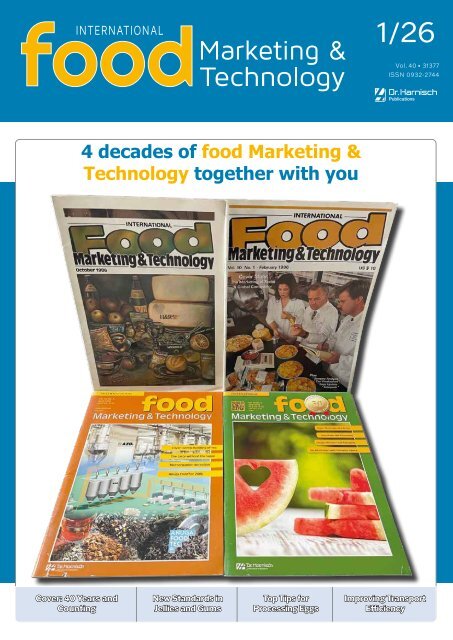
4 decades of <strong>food</strong> <strong>Marketing</strong> &<br />
<strong>Technology</strong> together with you<br />
Cover: 40 Years and<br />
New Standards in<br />
<strong>food</strong> <strong>Marketing</strong> Counting & <strong>Technology</strong> • February Jellies 2025<br />
and Gums<br />
Top Tips for<br />
Processing Eggs<br />
Improving Transport<br />
Efficiency
FOOD HYDROCOLLOID CONFERENCE <strong>2026</strong><br />
FEATURED SPEAKERS:<br />
• Ashland Nutrition<br />
Margie Best<br />
• Azelis<br />
Dr. Markus Matuscheck<br />
• Bright Moon Seaweed<br />
Dr. Demeng Zhang<br />
• Calidad Pascual<br />
Alejandro Gonzalez Navech<br />
• Cargill<br />
Xavier Martin<br />
• Danone<br />
Pauline Marcelli<br />
Vincent Nguyen<br />
• Haribo Group<br />
Conrad Fessler<br />
• ICL<br />
Svjetlana Jerkovic<br />
• IFF<br />
Maria Luiza Teixeira<br />
• IMR International<br />
Nesha Zalesny<br />
Dennis Seisun<br />
• Ingredion<br />
Jim Zallie<br />
• Keller and Heckman<br />
Dr. Luca Galizia<br />
• Nestlé<br />
Dr. Paulo Fernandes<br />
• The Food Truth Project<br />
Veronica Jaramillo<br />
❖Panel Discussions<br />
❖ Banquet Dinner<br />
TESTIMONIALS:<br />
“The variety and breadth of the topics and attendees at this<br />
conference are very valuable for those in the hydrocolloid<br />
industry.” • “The annual IMR Conference is a congregation<br />
of the top minds in the hydrocolloid space and is a mustattend<br />
event.” • “Well planned and executed conference, and<br />
the thought put into it clearly shows!” • “Key hydrocolloid<br />
suppliers and customers, locked in one room. Extraordinary<br />
level of knowledge, excellent content.”<br />
The #1 Networking Event<br />
AVAILABLE SPONSORSHIPS:<br />
&<br />
IMR International is the Publisher of :<br />
“The Quarterly Review of Food Hydrocolloids”<br />
www.hydrocolloid.com<br />
+1 619 871 1415 & +1 858 776 2930<br />
info@hydrocolloid.com<br />
PROUD SPONSORS:<br />
Join us!<br />
Conference Location<br />
The Westin Hotel<br />
Valencia, Spain<br />
www.marriott.com<br />
+34 963 62 5900, Mention:<br />
‘IMR Food Hydrocolloid Conference’
Editorial<br />
40 Years of Food Industry Expectations<br />
When you visit a lot of <strong>food</strong> and<br />
beverage events, it is inevitable that<br />
you pick up some of the trends and hot<br />
topics, almost by osmosis, as it were.<br />
Now Food <strong>Marketing</strong> & <strong>Technology</strong> is<br />
40 years old and we have travelled and<br />
visited a lot of events. Here are some of<br />
the things we have picked up.<br />
One of the main changes in the global<br />
<strong>food</strong> industry over the past forty years,<br />
is that consumers have become much<br />
more informed. Where they get their<br />
information and what they do with it is<br />
one side of the coin, and this is where<br />
the <strong>food</strong> industry can do better. Popular<br />
mis-information is always easier to<br />
digest than <strong>food</strong> science. However<br />
<strong>food</strong> science is the background to<br />
what the <strong>food</strong> industry has to offer.<br />
Specialists like the Instutute of Food<br />
<strong>Technology</strong> are starting to be more proactive<br />
in explaining the science behind<br />
<strong>food</strong> and why it is much more positive<br />
than negative. There doesn’t need to<br />
be any secrecy.<br />
Over forty years a lot of good has come<br />
through improvements in hygiene and<br />
safety, through better preservation<br />
and good recipes, as well as the<br />
environmental benefits of saving<br />
packaging and using more sustainable<br />
materials. The hot topics which we<br />
featured in the very first issues in<br />
1986 are still relevant today – reducing<br />
calories, using natural additives, sugar<br />
substitution, increasing automation<br />
and reducing packaging. Even meat<br />
alternatives, superfruits, better<br />
hygiene and a global marketplace<br />
were all as relevant then as they are<br />
now.<br />
Whilst many of these topics are<br />
cyclical, some buzzwords are new,<br />
such as personalised nutrition or ultra<br />
processed <strong>food</strong>s (or UPFs). This phrase<br />
is currently more emotional than<br />
scientific and is seen by consumers<br />
as a catch-all for everything which is<br />
wrong about the <strong>food</strong> industry. In truth<br />
it is the definition which is poor and<br />
imprecise. Consumers often get lost<br />
in buzzwords and popular opinion has<br />
little to do with science or veracity.<br />
The industry needs to take a stance<br />
and give an alternative viewpoint about<br />
that. This year we will follow up with<br />
Ian Healey<br />
Editor-in-Chief<br />
science and industry experts in an<br />
attempt to redress this balance and<br />
iron out some of the misconceptions.<br />
At the end of the day, we are all<br />
responsible for our personal nutrition<br />
and for what and how much we<br />
consume. But of course, we depend<br />
on correct information to help us make<br />
these choices.<br />
Sincerely<br />
If you like it – subscribe!<br />
<strong>food</strong> <strong>Marketing</strong> & <strong>Technology</strong> • February <strong>2026</strong><br />
3
Contents<br />
<strong>food</strong> <strong>Marketing</strong> & <strong>Technology</strong> February <strong>2026</strong><br />
3 Editorial<br />
42 Impressum<br />
Ingredients<br />
➔ 2021<br />
Nigeria 24-26 11th edition<br />
Lagos March www.agro<strong>food</strong>-nigeria.com<br />
6 Hydrocolloids and Consumers – A Pantry Friendly<br />
Strategy<br />
10 Why Postbiotics are Emerging as Safe, Stable, and<br />
Science-backed Nutrition Innovation<br />
13 New Standard for Vegan & Vegetarian Jellies & Gums<br />
14 Flavor of the Year <strong>2026</strong> Captures a Global Desire for<br />
Warmth and Freshness<br />
16 Calling all Nutraceutical Innovators Vita<strong>food</strong>s Europe<br />
Innovation Awards return in <strong>2026</strong><br />
Iran 18-21 33rd edition<br />
Tehran May www.iran-agro<strong>food</strong>.com<br />
Ethiopia 04-06 8th edition<br />
Addis Ababa June www.agro<strong>food</strong>-ethiopia.com<br />
West Africa 08-10 3rd edition<br />
Abidjan October www.agro<strong>food</strong>-westafrica.com<br />
➔ 2027<br />
Iraq 23-26 9th edition<br />
Erbil November www.iraq-agro<strong>food</strong>.com<br />
Ghana October 8th edition<br />
Accra<br />
www.agro<strong>food</strong>-ghana.com<br />
Processing<br />
18 From Shell to Shelf: Top Tips for Processing Egg<br />
Products<br />
20 Air Jet Cleaning System wins Innovation Award at<br />
Fi Europe<br />
21 Dicing and Slicing featured at Food Processing<br />
Expo <strong>2026</strong><br />
22 The Largest X8 Metal Detector in Company History<br />
24 Beyond Reheating: How Microwaves Are Transforming<br />
Modern Food Processing<br />
Packaging<br />
26 interpack <strong>2026</strong>: Focus of exhibitors at this edition<br />
28 Improving Transport Efficiency and Reducing<br />
Emissions with Reusable Active Lock Crates<br />
32 Flexibility in Manufacturing:<br />
35 Agro<strong>food</strong> Nigeria <strong>2026</strong> Ready to Roll<br />
www.fairtrade-messe.de ml<br />
All shows & contact information<br />
WhatsApp fairtrade +49157 509 755 36<br />
I faitrade<br />
Departments<br />
36 Djazagro <strong>2026</strong>:<br />
38 IFT First <strong>2026</strong><br />
39 ProSweets Cologne <strong>2026</strong><br />
40 Calendar of Events<br />
42 Index<br />
4
<strong>food</strong> <strong>Marketing</strong> & <strong>Technology</strong> • February 2025<br />
Vol. 40 • 31377<br />
ISSN 0932-2744<br />
4 decades of <strong>food</strong> <strong>Marketing</strong> &<br />
<strong>Technology</strong> together with you<br />
1/26<br />
Cover:<br />
Forty years is a long time however you<br />
count it. In 1986 this magazine was launched,<br />
as the first horizontal publication<br />
in the global <strong>food</strong> industry. Covering<br />
ingredients and technology over a multisector<br />
industry, and featuring the mutual<br />
benefits of each, has seen Dr. Harnisch<br />
Publications fill a market need.<br />
Our Cover Story starts on page 3.<br />
5-7 May <strong>2026</strong>, Fira Barcelona<br />
Cover: 40 Years and<br />
Counting<br />
New Standards in<br />
Jellies and Gums<br />
Top Tips for<br />
Processing Eggs<br />
Improving Transport<br />
Efficiency<br />
Cover: Dr. Harnisch Publications<br />
More to<br />
Jellies & Gums<br />
A new innovation delivers the processing advantages of gelatin<br />
combined with the benefits of a starch-based, plant-derived<br />
ingredient. The result: modern, gelatin-free confectionery that<br />
meets today’s technical, economic, and consumer demands<br />
— while offering superior stability in real-world conditions. Find<br />
more on page 13.<br />
Processing Eggs<br />
Processing eggs involves a number of key cooling and heating<br />
processes to maintain product quality and safety, as well as maximize<br />
shelf life, so choosing the right heat exchangers and processing<br />
systems is essential. Eggs are highly perishable and also<br />
contain a complex mixture of heat-sensitive proteins, fats, vitamins<br />
and minerals. See page 18.<br />
Efficient Logistics<br />
A leading Italian vegetable specialist, has strengthened the<br />
efficiency and sustainability of its logistics operations by<br />
partnering with a global leader in reusable plastic packaging and<br />
pooling solutions. By introducing reusable Active Lock Crates,<br />
storage capacity, product per truck and reduced emissions have<br />
been optimized. Read more on page 28 .<br />
<strong>food</strong> <strong>Marketing</strong> & <strong>Technology</strong> • February 2016<br />
The world’s<br />
nutraceutical<br />
event is bigger<br />
than ever<br />
Vita<strong>food</strong>s Europe returns for its biggest<br />
event to date. With an expanded show<br />
floor, there are more opportunities<br />
than ever to discover what’s next in<br />
nutraceuticals.<br />
30,000+ expected attendees<br />
Connect with thousands of<br />
global nutraceutical buyers,<br />
suppliers and experts<br />
Discover new products, innovations<br />
and insights<br />
More networking opportunities<br />
across the entire nutraceutical<br />
supply chain<br />
Book your<br />
tickets now
Ingredients<br />
Hydrocolloids and Consumers<br />
– A Pantry Friendly Strategy<br />
By Dennis Seisun<br />
Ask a consumer (non-<strong>food</strong> scientist),<br />
“Do you like hydrocolloids?” and<br />
the answer is likely to be “Do I like<br />
what???”. Then ask, “What about<br />
starch, gelatin, and pectin?”, and the<br />
answer is likely to be, “Oh, those….,<br />
Yeah, sure, they’re fine, no problem”.<br />
Unless, of course, the consumer is<br />
vegetarian, in which case the answer<br />
would be, “Starch and pectin OK, but<br />
gelatin is not for me.” Gelatin, pectin,<br />
and starch are typically what we would<br />
call “Pantry Friendly Hydrocolloids”.<br />
Consumers are likely to have them<br />
in their pantry and use them in home<br />
cooking. So, where does that leave<br />
the likes of xanthan, gellan, CMC,<br />
MC/HPMC, and so many other less<br />
well-known hydrocolloids? In the dark<br />
and subject to suspicion.<br />
Making them pantry-friendly is a<br />
strategy that suppliers and users of<br />
these hydrocolloids should adopt. For<br />
the longest time, the <strong>food</strong> industry<br />
has paid little attention to consumer<br />
opinions and concerns and is now<br />
suffering the consequences. The<br />
attitude of the <strong>food</strong> industry has<br />
generally been, “Supply it and they<br />
will eat it”. The scenario has changed<br />
dramatically. Consumers are far<br />
more aware and more informed,<br />
often misinformed, about their <strong>food</strong>,<br />
Agar<br />
Alginates (incl. PGA)<br />
Acacia (aka Gum Arabic)<br />
Carrageenan<br />
Cellulosics (CMC, MC/HPMC and<br />
MCC)<br />
Gelatin<br />
Gellan<br />
Guar<br />
Locust Bean Gum (aka carob bean<br />
gum)<br />
Pectin<br />
Starch<br />
Tara<br />
Xanthan<br />
particularly processed <strong>food</strong>. First, let’s<br />
explore what hydrocolloids are, where<br />
they come from, and why they are used.<br />
Then we’ll consider how and where<br />
consumers get their information and<br />
make decisions. Lastly, what can the<br />
industry do, if anything, to correct or<br />
better inform consumers about this<br />
unique and essential set of additives<br />
in the <strong>food</strong> industry.<br />
Hydrocolloids are essentially<br />
texturizing agents and stabilizers in<br />
<strong>food</strong> formulations. For the most part,<br />
they help to viscosify, suspend, or gel,<br />
but also have other useful properties.<br />
The list of hydrocolloids that IMR has<br />
been surveying over the last 45 years<br />
includes the following:<br />
This list is by no means exhaustive,<br />
and there are several other, less<br />
widely used hydrocolloids such<br />
as tragacanth, karaya, curdlan,<br />
and konjac, to name a few. For<br />
each hydrocolloid listed above,<br />
there are dozens, if not hundreds,<br />
of differentiated sub-categories.<br />
Starches, for example, can be derived<br />
from corn, wheat, potato, rice, or<br />
tapioca. They can be native, chemically<br />
modified, or physically modified with<br />
dozens of subcategories of each.<br />
Pectin can be produced from the<br />
peel of lemon, lime, oranges, or apple<br />
pomace. Most hydrocolloids can be<br />
further differentiated by organic,<br />
GMO-free, fair trade, kosher, halal,<br />
etc. Consumers trying to understand<br />
the origins of the ingredients they eat<br />
have every right to be confused.<br />
Geographically, the source of these<br />
hydrocolloid raw materials covers<br />
the globe. Seaweeds from Norway,<br />
Chile, Morocco, the Philippines,<br />
Indonesia, Tanzania, South Africa,<br />
New Zealand, and several other<br />
countries are used to produce agar,<br />
alginates, or carrageenan. Sudan is<br />
the major source of gum acacia, but<br />
the entire sub-Saharan belt of Africa,<br />
from East to West, is also a source.<br />
Food cellulosics are produced from<br />
specialty-grade processed cellulose<br />
derived from trees or cotton, which<br />
are grown worldwide. Food-grade<br />
gelatin, the only hydrocolloid of<br />
animal origin, is primarily produced<br />
from beef hide or pork skin, though<br />
other sources are also used. Gellan<br />
gum, curdlan, and xanthan gum are<br />
produced through fermentation in<br />
large tanks. Guar, tara, and locust<br />
bean gum are seed extracts from<br />
crops grown in India, Peru, and<br />
Morocco, respectively. Pectin is<br />
produced from the peels of lemon<br />
and lime, mostly grown in Argentina<br />
and Mexico. Orange pectin from<br />
6 <strong>food</strong> <strong>Marketing</strong> & <strong>Technology</strong> • February <strong>2026</strong>
Ingredients<br />
Brazilian crops is gaining traction.<br />
Apple pomace is also a source.<br />
Finally, starch, the most widely<br />
used hydrocolloid by volume and<br />
value, is produced from crops grown<br />
worldwide. Consumers with “buy<br />
local” in mind would be hard-pressed<br />
to apply it to hydrocolloids.<br />
Next, consider the “why hydrocolloids<br />
are used”. Water is an intrinsic part<br />
of virtually any <strong>food</strong> formulation.<br />
Controlling the behavior of this<br />
water with other components in<br />
the formulation is the key to why<br />
hydrocolloids are ubiquitous. At the<br />
same time, <strong>food</strong> texture is an intangible<br />
property, especially when compared to<br />
color, flavor, or odor, which are more<br />
easily identifiable. Aside from “water<br />
control,” hydrocolloids help to reduce<br />
cost, extend shelf life, and often<br />
prevent unsightly syneresis.<br />
hydrocolloids in consumer minds?<br />
One strategy would be to address<br />
the source of misleading or biased<br />
information. Consumers are<br />
increasingly relying on phone apps<br />
that scan <strong>food</strong> barcodes and present<br />
highly simplified ratings, purportedly<br />
guiding them to better <strong>food</strong> choices.<br />
Unfortunately, many of these phone<br />
apps rely on fearmongering to drive up<br />
subscription levels. IMR has tried to<br />
communicate directly with one of the<br />
largest of these, but unfortunately,<br />
has essentially hit a brick wall. In<br />
any case, many of these phone apps<br />
give widely varying opinions of the<br />
same <strong>food</strong> and/or additives. More<br />
confusion for the consumer.<br />
Traditionally, hydrocolloids have<br />
remained beneath the consumer<br />
radar screen. A “don’t rock the boat<br />
approach” by hydrocolloid producers<br />
and users does not seem to have<br />
worked. The growing consumer<br />
visibility of hydrocolloids is more<br />
negative than positive. It’s not too<br />
late to fight back with some positive<br />
messaging. A grassroots effort by<br />
hydrocolloid producers would be well<br />
advised. Social media influencers<br />
could be engaged. Advertising in<br />
non-industry media is a better way to<br />
reach consumers. Trade journals are<br />
read by <strong>food</strong> formulators who do not<br />
need convincing that hydrocolloids<br />
are fine. Recruiting an advertising<br />
agency that could develop a strategy<br />
is recommended. Funding for such<br />
efforts would best be handled by<br />
trade associations, which could<br />
spread the cost among beneficiaries.<br />
In search of a clean label, there are<br />
ongoing efforts to remove as many<br />
additives as possible, including<br />
hydrocolloids. Consumers’ demands<br />
and concerns, however, are often<br />
ill-founded and counterproductive.<br />
Nevertheless, “The Perception of<br />
the consumer is the reality of the<br />
producer,” and producers have to deal<br />
with it. Removing hydrocolloids from<br />
a formulation is, of course, possible,<br />
but at a cost. The downside of no<br />
hydrocolloids would be multifaceted.<br />
Removing hydrocolloids would make<br />
a <strong>food</strong> less palatable. It would also<br />
make <strong>food</strong>s less shelf-stable,<br />
leading to higher transportation costs<br />
and more waste. On the social level,<br />
there are millions of impoverished<br />
farmers, harvesters, and middlemen<br />
who survive through land or aquatic<br />
farming and other raw-material<br />
supply functions. Eliminating or<br />
reducing the use of hydrocolloids<br />
would have dire social consequences.<br />
Lastly, the visual appearance of many<br />
<strong>food</strong>s would suffer; think separation,<br />
settling, and syneresis, which many<br />
consumers might view as spoilage.<br />
Hydrocolloids eliminate or at least<br />
mitigate all of these defects.<br />
What can the hydrocolloid industry<br />
do to improve the image of<br />
<strong>food</strong> <strong>Marketing</strong> & <strong>Technology</strong> • February 2025 <strong>2026</strong><br />
7
Ingredients<br />
Each hydrocolloid sector, seaweed<br />
extracts, seed gums, exudates, etc.,<br />
has some strong positive messaging<br />
attributes that can be used to<br />
promote a good image.<br />
All things from the “blue economy”<br />
generally have a positive connotation<br />
with consumers. Agar, alginates, and<br />
carrageenan are all seaweed-derived<br />
and employ hundreds of thousands<br />
in seaweed farming, harvesting, and<br />
packaging.<br />
Gum acacia harvesting is one of<br />
the few remaining commercial<br />
activities in war-torn Sudan and<br />
neighboring countries. A large swath<br />
of the population relies on acacia for<br />
survival, not to mention that acacia<br />
trees are a critical element in stopping<br />
or slowing down desertification.<br />
Each seed gum, guar, tara, and locust<br />
bean gum has a unique messaging<br />
element that could increase positive<br />
consumer perception. The tara<br />
tree is endemic to Peru, and tens of<br />
thousands of Peruvians survive from<br />
it. Similarly with the annual guar crop<br />
in India, except that literally hundreds<br />
of thousands are involved. The carob<br />
tree (source of locust bean gum) is so<br />
important<br />
that it is considered part of Morocco‘s<br />
heritage (patrimoine), the world’s<br />
largest home to carob trees. Other<br />
sources include Spain and other<br />
Mediterranean countries. The pod of<br />
the carob was prized already in the<br />
early days of Christianity and known<br />
as “St. John’s Bread.”<br />
Cellulosics have a bad rap because of<br />
their chemical-sounding name. But<br />
consumers should know that cellulose<br />
is one of the most abundant materials<br />
in the plant kingdom, and virtually ALL<br />
fruit and vegetables contain cellulose.<br />
Consumers consume cellulosics daily at<br />
rates much higher than when used as a<br />
hydrocolloid.<br />
Xanthan, gellan, and other<br />
biopolymers are produced through<br />
a process similar to that used to<br />
produce beer and wine: fermentation.<br />
It is one of the more sustainable and<br />
scalable processes.<br />
Pectin hardly needs any introduction.<br />
Grandma had it in her pantry and<br />
made the jam enjoyed for generations.<br />
Consumers need little introduction,<br />
but reinforcing the citrus or apple<br />
origins could not hurt.<br />
Last but not least, starch is probably<br />
the most pantry-friendly hydrocolloid.<br />
No household is likely to be without<br />
some in the pantry.<br />
Familiarity is the first step to<br />
acceptance. For the hydrocolloids,<br />
which are less well known to consumers,<br />
efforts should be made to make<br />
them more familiar. Demonstration<br />
programs at <strong>food</strong> markets could be<br />
established. Taste tests and consumerfriendly<br />
explanations could be provided<br />
by college interns in <strong>food</strong> science.<br />
Academic credits could be obtained<br />
for such activities, which could be<br />
volunteer-based.<br />
Of course, we realize that “Ideas are<br />
a dime a dozen.” Putting them into<br />
practice is the real challenge. It needs<br />
the hydrocolloid industry to break out<br />
of its stabilized mentality and become<br />
more proactive in defending the image<br />
of its products.<br />
IMR is doing what we can to defend and<br />
promote the image of hydrocolloids<br />
through our Hydrocolleague Tidbits,<br />
which reach thousands each week.<br />
Strategies will be discussed at the<br />
forthcoming global conference on<br />
hydrocolloids in Valencia, Spain April<br />
26-28, <strong>2026</strong>. Perhaps we will see<br />
you there. Registration is at www.<br />
hydrocolloid.com/conference.<br />
Note: This article has been written<br />
and edited entirely by human effort. It<br />
is certified (by IMR) 100% AI free. Any<br />
errors or omissions are purely human.<br />
Your comments (human please) are<br />
very welcome<br />
fmt<br />
Dennis Seisun is Founder and President of IMR<br />
International, the Hydrocolloid consultancy<br />
and organizer of the annual International Hydrocolloid<br />
Conference, which is this year in Valencia<br />
Spain in April.<br />
For more information:<br />
www.hydrocolloid.com/conference<br />
FOOD HYDROCOLLOID CONFERENCE <strong>2026</strong><br />
FEATURED SPEAKERS:<br />
8 • Ashland Nutrition<br />
<strong>food</strong> <strong>Marketing</strong> & <strong>Technology</strong> • February <strong>2026</strong><br />
Margie Best<br />
• Azelis<br />
TESTIMONIALS:<br />
“The variety and breadth of the topics and attendees at this<br />
conference are very valuable for those in the hydrocolloid<br />
industry.” • “The annual IMR Conference is a congregation
Ingredients<br />
<strong>food</strong> <strong>Marketing</strong> & <strong>Technology</strong> • February 2025 <strong>2026</strong><br />
9
Ingredients<br />
Why Postbiotics are Emerging<br />
as Safe, Stable, and Science-backed<br />
Nutrition Innovation<br />
Sandra Einerhand is the founder and head of Einerhand Science<br />
& Innovation, an award-winning nutrition consultancy providing<br />
evidence-based solutions to the <strong>food</strong> and dietary supplements industry.<br />
With over 25 years of experience in nutrition science, Sandra has<br />
dedicated her career to substantiating the health benefits of <strong>food</strong><br />
ingredients and translating scientific insights into credible innovations.<br />
Her expertise covers nutrition across the lifespan, with a strong<br />
focus on emerging areas such as microbiome science, biotics, and<br />
postbiotic innovation. Before founding her consultancy, Sandra held<br />
senior R&D and scientific leadership roles at Danone Nutricia, Tate<br />
& Lyle Ingredients, and Lipid Nutrition, and previously served as an<br />
associate professor at Erasmus MC in Rotterdam. Sandra holds a PhD in<br />
Medicine and a degree in Chemistry from the University of Amsterdam.<br />
Sandra’s contributions to the field have been widely recognized: her<br />
company won the Luxlife Food and Drink Award for Best European By Sandra Einerhand<br />
Early Life Nutrition Consultancy (2020), and she received both the<br />
NutraChampion Award and Go Global Award in 2021 for her scientific<br />
and business excellence. She also chairs the Nutrition Consultants Cooperative (NCC), and serves as a longstanding<br />
jury member for international innovation awards, including those hosted by Food Ingredients<br />
Europe and NutraIngredients.<br />
Over the past decade, postbiotics<br />
have transformed from a relatively<br />
unknown scientific concept into one<br />
of the most dynamic frontiers of<br />
health and nutrition. The momentum<br />
is unmistakable: scientific publications<br />
mentioning postbiotics have surged<br />
from less than 30 before 2010 to 887 in<br />
2024, with projections to exceed 1000<br />
by 2025. This rapid growth reflects<br />
not only academic curiosity but also<br />
rising confidence across the <strong>food</strong> and<br />
beverage industry that postbiotics are<br />
here to stay. The real inflection point<br />
came in 2021, when the International<br />
Scientific Association for Probiotics and<br />
Prebiotics (ISAPP) published the first<br />
consensus definition: “a preparation<br />
of inanimate microorganisms and/or<br />
their components that confers a health<br />
benefit on the host.” (1)<br />
Before this, the lack of clarity hampered<br />
industrial application, companies<br />
hesitated to invest without a clear<br />
regulatory or scientific framework.<br />
With a definition in place, research<br />
and product development accelerated<br />
rapidly, leading to increased clinical<br />
validation and an expanding pipeline<br />
of postbiotic-enriched products across<br />
multiple categories. For companies<br />
navigating this fast-moving field, the<br />
combination of solid science and<br />
regulatory expertise has become<br />
crucial to de-risk innovation and<br />
accelerate time to market.<br />
Several factors may explain why<br />
postbiotics are gaining traction<br />
among researchers, regulators, and<br />
industry leaders alike. Firstly, human<br />
intervention trials, particularly with<br />
heat-treated strains and/or their<br />
components, have reported benefits<br />
not only in gut health but also in<br />
areas far beyond, such as endurance,<br />
reduced fatigue, and stress (2). In fact,<br />
clinical trials have often shown that<br />
postbiotics are similarly effective as<br />
their live counterparts, probiotics, in<br />
supporting gut, immune, metabolic,<br />
and even mental health (1,3). This<br />
broadens the narrative from “gut<br />
10 <strong>food</strong> <strong>Marketing</strong> & <strong>Technology</strong> • February <strong>2026</strong>
Ingredients<br />
health only” to a more holistic story<br />
spanning immune, metabolic, muscle<br />
and even mental health. Some<br />
postbiotics even link into the growing<br />
interest in GLP-1 agonists, appetite<br />
regulation and metabolic outcomes (4),<br />
further increasing relevance. Secondly,<br />
unlike probiotics, postbiotics cannot<br />
replicate in the body. This eliminates<br />
risks such as sepsis, fungaemia, or the<br />
transfer of antibiotic resistance (5).<br />
Regulatory experience also suggests<br />
that achieving safety approval for<br />
inanimate bacteria may be more<br />
straightforward than for live organisms.<br />
Indeed, the European Food Safety<br />
Authority (EFSA) has already issued<br />
positive safety assessments for<br />
inactivated Bacteroides xylanisolvens<br />
and Akkermansia muciniphila preparations,<br />
both now authorized for use<br />
in the EU. Thirdly, heat stability and pH<br />
tolerance mean postbiotics withstand<br />
processing conditions that would<br />
otherwise destroy live microbes.<br />
This opens opportunities in baked<br />
goods, bars, and shelf-stable<br />
beverages, while reducing cold chain<br />
costs. Their ease of standardization,<br />
storage, and transport further<br />
enhances their commercial appeal.<br />
Despite this promise, postbiotic<br />
innovation is not without hurdles.<br />
Transitioning from the well-established<br />
“CFU” count used for probiotics to<br />
meaningful units for inactivated biomass<br />
(such as mg of standardized biomass or<br />
total cell equivalents) requires validated<br />
enumeration methods and strict batch<br />
consistency. The solution lies in setting<br />
clear inactivation parameters, release<br />
specifications tied to biomarkers, and<br />
claim language aligned with clinical<br />
evidence.<br />
Formulators must also address sensory<br />
challenges: even heat-killed cells can<br />
impact mouthfeel or beverage clarity.<br />
Advances in strain selection, particle<br />
size optimization, microencapsulation,<br />
and light filtration are already providing<br />
solutions, with several beverage-ready<br />
postbiotics now commercially available.<br />
Finally, companies should resist the<br />
temptation to extrapolate probiotic<br />
data to postbiotic formats. Instead,<br />
successful innovation will be anchored in<br />
human evidence specifically generated<br />
with postbiotics. From a regulatory<br />
standpoint, this distinction is crucial: in<br />
the EU, use of the term “postbiotic” in<br />
<strong>food</strong>s or supplements will likely require<br />
EFSA-approved health claims and<br />
systematic novel <strong>food</strong> applications.<br />
Strategic guidance on claim<br />
substantiation and dossier preparation<br />
is therefore becoming a key enabler for<br />
companies aiming to enter this space.<br />
Postbiotics are already making<br />
their mark across diverse product<br />
categories globally. Fermented infant<br />
formulas containing the postbiotic<br />
human milk oligosaccharide 3-GL,<br />
children’s drinks with heat-killed<br />
Lacticaseibacillus paracasei, and<br />
nutritional supplements with<br />
Akkermansia muciniphila are just a<br />
few examples. Multinationals such<br />
as Nestlé and Danone, alongside<br />
small and medium-sized enterprises<br />
and agile start-ups, are actively<br />
commercializing postbiotic-containing<br />
formulas, yoghurts, sports beverages,<br />
ready-to-drink formats. Even nutritional<br />
drinks for the health ageing<br />
population are nowadays present<br />
on the market. These examples<br />
illustrate how scientific findings can<br />
be translated into real-world products<br />
when supported by the right evidence<br />
base and innovation strategy.<br />
What is particularly striking is the<br />
move toward combination products.<br />
Some launches now include blends of<br />
postbiotics with or without other biotics<br />
or bioactives, reflecting both scientific<br />
insights and consumer demand for multibenefit<br />
solutions. This is consistent with<br />
ongoing clinical trials exploring mixes for<br />
synergistic effects across gut, immune,<br />
brain, and muscle health.<br />
Looking ahead, several promising<br />
frontiers are emerging for postbiotics.<br />
<strong>food</strong> <strong>Marketing</strong> & <strong>Technology</strong> • February 2025 <strong>2026</strong><br />
11
Ingredients<br />
Early evidence points to benefits<br />
in brain health, particularly in areas<br />
such as mood, stress, and anxiety—<br />
highly relevant in today’s fast-paced<br />
lifestyle. Muscle health is another area<br />
attracting growing interest, with studies<br />
focusing on endurance, strength, and<br />
muscle mass outcomes not only for<br />
athletes but also for the healthy ageing<br />
population. In addition, combinatorial<br />
approaches are gaining momentum,<br />
where postbiotics are paired with<br />
other biotics or functional bioactives to<br />
achieve product differentiation, broader<br />
health coverage, and stronger market<br />
positioning.<br />
These directions align seamlessly with<br />
consumer expectations for holistic<br />
wellness solutions that go beyond<br />
gut health alone addressing immune,<br />
metabolic, brain, muscle, or skin health.<br />
Postbiotics have evolved from a niche<br />
curiosity into a more robust, evidencebased<br />
platform for innovation. They<br />
are backed by rapidly expanding<br />
human evidence, with manufacturing<br />
advantages and suitable for diverse<br />
product formats, from infant formula<br />
to sports nutrition and active ageing<br />
solutions.<br />
For <strong>food</strong> and beverage leaders, the<br />
opportunity is twofold: respond to<br />
the science-driven demand for safe,<br />
effective biotics and leverage the<br />
versatility of postbiotics to expand<br />
into new health territories and<br />
formats. As research accelerates<br />
and consumer awareness grows,<br />
the coming years will likely see<br />
postbiotics move from “emerging” to<br />
“essential” in the functional nutrition<br />
toolbox. For innovators aiming to<br />
capture this momentum, partnering<br />
with experienced nutrition science<br />
consultancies can help bridge the<br />
gap between cutting-edge research,<br />
regulatory compliance, and successful<br />
product launches.<br />
fmt<br />
For more information:<br />
https://esi4u.nl<br />
References and notes<br />
1. Salminen, S.; Collado, M.C.; Endo, A.; Hill, C.;<br />
Lebeer, S.; Quigley, E.M.M.; Sanders, M.E.; Shamir,<br />
R.; Swann, J.R.; Szajewska, H.; et al.<br />
The International Scientific Association of<br />
Probiotics and Prebiotics (ISAPP) Consensus<br />
Statement on the Definition and Scope of Postbiotics.<br />
Nat Rev Gastroenterol Hepatol 2021,<br />
18, 649–667<br />
2. Kerksick, C.M.; Moon, J.M.; Jäger, R. It’s<br />
Dead! Can Postbiotics Really Help Performance<br />
and Recovery? A Systematic Review.<br />
Nutrients 2024, 16, 720<br />
3. Amobonye, A.; Brynita Pillay, ·; Hlope, F.;<br />
Stella, ·; Asong, T.; Santhosh Pillai, Postbiotics:<br />
An Insightful Review of the Latest Category in<br />
Functional<br />
Biotics. World Journal of Microbiology and Biotechnology<br />
2025 41:8 2025, 41, 1–30.<br />
4. Wu, W.; Chen, Z.; Han, J.; Qian, L.; Wang, W.;<br />
Lei, J.; Wang, H. Endocrine, Genetic, and Microbiome<br />
Nexus of Obesity and Potential Role<br />
of Postbiotics: A Narrative Review. Eating and<br />
Weight Disorders 2023, 28, 84<br />
5. Calvanese, C.M.; Villani, F.; Ercolini, D.; De Filippis,<br />
F. Postbiotics versus Probiotics: Possible<br />
New Allies for Human Health. Food Research<br />
International 2025, 217, 116869<br />
12 <strong>food</strong> <strong>Marketing</strong> & <strong>Technology</strong> • February <strong>2026</strong>
Ingredients<br />
New Standard for Vegan & Vegetarian<br />
Jellies & Gums<br />
A starch-based innovation that brings gelatin-like performance to confectionery applications<br />
The Emsland Group introduces Emjel®<br />
LC 15, a new-generation functional<br />
starch that transforms the way<br />
manufacturers produce vegan and<br />
vegetarian confectionery. Designed to<br />
bridge the long-standing gap between<br />
starch and gelatin systems, Emjel® LC<br />
15 enables atmospheric cooking —<br />
delivering the same processing ease<br />
traditionally associated with gelatin,<br />
now in a fully plant-based solution.<br />
Conventional starch-based jellies<br />
require high cooking temperatures<br />
and complex processing conditions<br />
to achieve full gelatinization and<br />
the desired texture. Gelatin, on the<br />
other hand, works efficiently under<br />
atmospheric conditions, making<br />
production simpler and gentler on<br />
sensitive ingredients. Until now, this<br />
difference has limited the use of<br />
starches in premium jelly and gum<br />
applications. Emjel® LC 15 changes<br />
that.<br />
With this innovation, manufacturers can<br />
produce gelatin-free products without<br />
switching to pressure or vacuum cooking<br />
systems — while achieving the smooth,<br />
elastic texture and clear appearance<br />
consumers expect from high-quality<br />
confectionery such as gums and jellies.<br />
At the same time, these products enjoy<br />
improved thermostability, maintaining<br />
their structure even at elevated<br />
temperatures where gelatin-based<br />
products may soften or melt.<br />
With Emjel® LC 15, confectionery<br />
producers can:<br />
• Produce gelatin-free jellies under<br />
atmospheric conditions — no need<br />
for pressure or vacuum cooking<br />
systems, also suitable for starchless<br />
moulding<br />
• Achieve gelatin-like quality with a<br />
smooth, elastic texture and clear<br />
appearance<br />
• Improve product thermostability,<br />
ensuring better resistance to heat<br />
compared to gelatin-based recipes<br />
• Expand into vegan, halal, and kosher<br />
markets with a fully plant-based<br />
solution<br />
• Protect sensitive ingredients such as<br />
natural flavors, colors, and vitamins<br />
thanks to gentler processing<br />
• Reduce energy consumption<br />
and costs through lower cooking<br />
temperatures<br />
Redefining what’s possible in jelly<br />
and gum production, Emjel® LC 15<br />
delivers the processing advantages<br />
of gelatin combined with the benefits<br />
of a starch-based, plant-derived<br />
ingredient. The result: modern, gelatinfree<br />
confectionery that meets today’s<br />
technical, economic, and consumer<br />
demands — while offering superior<br />
stability in real-world conditions. fmt<br />
For more information:<br />
www.emsland-group.de/en/<br />
<strong>food</strong> <strong>Marketing</strong> & <strong>Technology</strong> • February 2025 <strong>2026</strong><br />
13
Ingredients<br />
Flavor of the Year <strong>2026</strong> Captures a<br />
Global Desire for Warmth and Freshness<br />
The international company dsmfirmenich,<br />
innovators in nutrition,<br />
health, and beauty, has announced<br />
‘Frosted Star Anise’ as its Flavor of the<br />
Year for <strong>2026</strong>. This forward-thinking<br />
flavor draws from the Pantone Color<br />
of the Year <strong>2026</strong>: ‘PANTONE 11-4201<br />
Cloud Dancer’, a lofty white hue which<br />
inspired dsm-firmenich to elevate both<br />
an ingredient and a feeling as the <strong>2026</strong><br />
Flavor of the Year. Together, these two<br />
emotional indicators reflect a growing<br />
global desire for calm in an increasingly<br />
fast-paced world.<br />
‘Frosted Star Anise’ combines the<br />
comforting warmth of star anise with<br />
a cool, frosted twist. This distinctive<br />
pairing is more than flavorful—it<br />
represents a dual aspiration: peace<br />
and tranquility, embodied by star anise,<br />
and revitalization, captured in the<br />
refreshing frosted element.<br />
“Innovation and cultural insight are<br />
at the heart of what we do at dsmfirmenich,”<br />
said Maurizio Clementi,<br />
EVP for Taste. “Building on star anise’s<br />
quiet rise and the growing fascination<br />
with cooling and other trigeminal<br />
sensations, ‘Frosted Star Anise’ fulfills<br />
today’s craving for balance and a<br />
breath of fresh air.”<br />
A flavor with many dimensions<br />
Star anise is a striking, star-shaped<br />
spice with a sweet-spicy profile and<br />
notes of licorice, clove, and cinnamon.<br />
It features in global cuisines—from<br />
Vietnamese pho to Moroccan tagine<br />
to Mexican café de olla to Chinese<br />
five-spice-inspired blends—and in<br />
comforting classics like chai, mulled<br />
wine, and jams. It also shines in<br />
adventurous applications such as<br />
root beer floats, BBQ sauce, and<br />
confectionery and savory dishes<br />
where it adds complexity and aromatic<br />
depth.<br />
The “frosted” element introduces<br />
cooling sensations through ingredients<br />
like mint or advanced technologies<br />
such as dsm-firmenich’s freezestorm.<br />
“Cooling isn’t a taste—it’s a complex<br />
sensation triggered by temperaturesensitive<br />
receptors,” explained Jeffrey<br />
Schmoyer, VP Human Insights,<br />
Taste, Texture & Health. “These<br />
trigeminal sensations—which also<br />
include spiciness, warming, and<br />
numbing—enhance flavor in exciting,<br />
multidimensional ways.”<br />
Flavor innovation rooted in<br />
consumer and cultural insights<br />
To select its Flavor of the Year,<br />
dsm-firmenich analyzes emerging<br />
ingredients—including those hiding in<br />
plain sight. According to the company’s<br />
analysis of product launch data, nearly<br />
10,000 products have featured star<br />
anise as an ingredient over the past<br />
decade, yet only 10% highlighted<br />
this fact front-of-pack—a trend now<br />
shifting as the profile of star anise<br />
rises in awareness. Additionally, dsmfirmenich’s<br />
global survey of ingredient<br />
perception reveals that while twothirds<br />
of consumers recognize star<br />
anise, only 34% have reportedly<br />
tasted it—an opportunity for brands<br />
to introduce and shape how the flavor<br />
is experienced. Notably, star anise is<br />
gaining traction in hot and alcoholic<br />
drinks—categories that often signal<br />
future flavor trends.<br />
“Star anise is a ‘secret weapon’—<br />
ubiquitous yet underappreciated,”<br />
said Schmoyer. “It’s time this versatile<br />
ingredient gets the attention it<br />
deserves.”<br />
Cooling and frosted elements are also<br />
trending, especially in beverages, but<br />
increasingly in other categories—like<br />
refreshing jellies, shaved ice, and<br />
chilled soups—and even in beauty and<br />
home care, where “frosted” conveys<br />
elegance and uplifting freshness.<br />
Leading the way: flavor as an<br />
emotional experience<br />
Whether introducing trigeminal<br />
sensations that bring exciting<br />
new tastes, offering ingredient<br />
solutions for enhanced nutritional<br />
functionality, or identifying flavor<br />
opportunities that many overlook,<br />
dsm-firmenich is uniquely positioned<br />
to understand—and deliver—what<br />
consumers demand from their <strong>food</strong><br />
and beverages today.<br />
“Flavor of the Year is more than a taste—<br />
it embodies cultural sentiment and<br />
emerging trends,” added Clementi. “It’s<br />
an astute sense of ‘what’s next,’ distilled<br />
into an experience that resonates<br />
emotionally with consumers. That’s at<br />
the heart of what we do every day.” fmt<br />
www.dsm-firmenich.com/<br />
<strong>2026</strong>-frosted-star-anise<br />
14 <strong>food</strong> <strong>Marketing</strong> & <strong>Technology</strong> • February <strong>2026</strong>
Ingredients<br />
<strong>Technology</strong> & <strong>Marketing</strong><br />
International Magazine May <strong>2026</strong> ISSN 2628-5851<br />
International Magazine September 2025 ISSN 2628-5851<br />
<strong>Technology</strong> & <strong>Marketing</strong> 3/25<br />
<strong>Technology</strong> & <strong>Marketing</strong> 2/26<br />
International Magazine March <strong>2026</strong> ISSN 2628-5851<br />
<strong>Technology</strong> & <strong>Marketing</strong><br />
1/26<br />
Ingredients: Palatability in Wet Pet Food, Organic Antioxidants, Plant based Diets, Protein<br />
Processing: Performance & Flexibility Growth, Trends in Cutting Applications<br />
Packaging: Sustainable Snacks, Recyclable Pouches, Driving Innovations<br />
<strong>Marketing</strong>: Love to Pets from Ukraine, Fi Europe 2025, Zoomark 2025, Interzoo <strong>2026</strong><br />
Ingredients: Proteins, Vitamins, Stabalization, Plant Extracts<br />
Processing: Drying, Mixing & Weighing, Cooking, Testing<br />
Packaging: Can, Pouches, Bags, Sacks, Labelling, PET Update<br />
<strong>Marketing</strong>: Global Pet Expo, Orlando, USA; Interzoo, Nuremberg, Germany<br />
Ingredients: Proteins, Vitamins, Stabalization, Plant Extracts<br />
Processing: Drying, Mixing & Weighing, Cooking, Testing<br />
Packaging: Can, Pouches, Bags, Sacks, Labelling, PET Update<br />
<strong>Marketing</strong>: Global Pet Expo, Orlando, USA; Interzoo, Nuremberg, Germany<br />
Free trial issue at <strong>food</strong>@harnisch.com<br />
The magazine PetFood PRO has grown out of a conviction<br />
and wish to underline the high level of quality and care in the<br />
manufacture of pet <strong>food</strong>, through the choice of ingredients,<br />
choice of technology and choice of packaging materials. We<br />
will endeavour to present this in an informative way, through<br />
a reader-friendly style and with a marketing perspective.<br />
www.pet<strong>food</strong>pro-mag.com<br />
<strong>food</strong> <strong>Marketing</strong> & <strong>Technology</strong> • February 2025 <strong>2026</strong><br />
15
Ingredients<br />
Calling all Nutraceutical Innovators<br />
Vita<strong>food</strong>s Europe Innovation Awards<br />
return in <strong>2026</strong><br />
Following a successful first edition<br />
in 2025, Informa Markets has<br />
announced the return of the Vita<strong>food</strong>s<br />
Europe Innovation Awards to<br />
celebrate the nutraceutical industry’s<br />
most exciting and groundbreaking<br />
advancements. Serving as a key<br />
platform for recognizing nutraceutical<br />
excellence, the awards will take place<br />
during Vita<strong>food</strong>s Europe <strong>2026</strong> on<br />
5 May, once again spotlighting the<br />
outstanding ingredients, finished<br />
products, and sustainable initiatives<br />
transforming the global nutraceutical<br />
landscape.<br />
Applications are now open until<br />
27 February, after which a panel of<br />
industry-leading judges will review<br />
submissions and select a shortlist of<br />
finalists in March. Finalists will then be<br />
invited to pitch their innovations live<br />
in Barcelona the day before Vita<strong>food</strong>s<br />
Europe opens its doors, with winners<br />
revealed at an exclusive awards<br />
ceremony during the event.<br />
A platform for innovation and<br />
industry leadership<br />
“The outstanding standard of<br />
last years’ award entries were a<br />
true testament to the creativity<br />
and innovative thinking shaping<br />
nutraceuticals,” says Gareth Baguley,<br />
Brand Director at Informa Markets.<br />
“Not only did the 2025 awards<br />
highlight breakthrough solutions<br />
and meaningful initiatives, they also<br />
showcased the collaborative spirit<br />
that’s central to the community.As<br />
the nutraceutical industry continues<br />
to grow and pioneer new ideas, we’re<br />
proud to be bringing the awards back<br />
and building on the success of the<br />
inaugural edition. We’d like to welcome<br />
all those eligible to enter, and we’re<br />
already looking forward to celebrating<br />
the innovations moving nutraceuticals<br />
forward together!”<br />
From vision to victory<br />
Entries are open to all Vita<strong>food</strong>s<br />
Europe <strong>2026</strong> exhibitors, with entrants<br />
encouraged to spotlight innovations<br />
16 <strong>food</strong> <strong>Marketing</strong> & <strong>Technology</strong> • February <strong>2026</strong>
Ingredients<br />
launched within the past two years.<br />
The awards will cover a wide range of<br />
categories, from finished products to<br />
specific health areas such as sports<br />
nutrition, immune and gut health,<br />
as well as healthy ageing. Plus, for<br />
<strong>2026</strong>, two brand new categories will<br />
reflect major market shifts, including<br />
weight management – driven by the<br />
rise of GLP-1s – and nutricosmetic<br />
ingredients, highlighting innovations<br />
shaping these fast-growing sectors.<br />
In addition, the Diversity & Inclusion<br />
award is open to all companies,<br />
including non-exhibitors, which are<br />
leading the way in creating inclusive<br />
workplaces within the industry. The<br />
full list of <strong>2026</strong> award categories<br />
include:<br />
Sports Nutrition and Active Lifestyle<br />
Ingredient; Immune and Gut Health<br />
Ingredient; Cognitive and Emotional<br />
Health Ingredient; Healthy Ageing<br />
Ingredient; Weight Management<br />
Ingredient; Nutricosmetic Ingredient;<br />
Most Innovative Consumer-ready<br />
Nutraceutical Finished Product;<br />
Diversity & Inclusion; Sustainability<br />
Entries will be evaluated by an<br />
independent panel of industry experts<br />
– once again chaired by Prof. Colin<br />
Dennis, Chair of the Board of Trustees<br />
at IFIS Publishing – alongside leading<br />
specialists in scientific research,<br />
regulation, market insights and<br />
product development.<br />
Winners of the Vita<strong>food</strong>s Europe<br />
Innovation Awards will be presented<br />
with trophies during the awards<br />
ceremony, plus will benefit from<br />
enhanced visibility online and onsite<br />
at the <strong>2026</strong> event. They will<br />
also receive a webinar sponsorship<br />
package, courtesy of one of the award<br />
sponsors, Smartcore.<br />
fmt<br />
For more information:<br />
www.vita<strong>food</strong>s.eu.com<br />
<strong>food</strong> <strong>Marketing</strong> & <strong>Technology</strong> • February 2025 <strong>2026</strong><br />
17
Processing<br />
From Shell to Shelf: Top Tips for<br />
Processing Egg Products<br />
Eggs are one of nature’s most nutrient-dense <strong>food</strong>s, containing<br />
high quality protein as well as being naturally rich in vitamin D, B2<br />
(riboflavin), vitamin B12, iodine, selenium, and several other essential<br />
dietary vitamins and minerals. It’s therefore unsurprising that they are<br />
one of the world’s most popular <strong>food</strong>s.<br />
By Matt Hale<br />
The Netherlands tops the global egg<br />
consumption stakes (per person) by<br />
some margin, followed by Hong Kong,<br />
China, Mexico and the Maldives1. As<br />
you would eggs-pect (sorry!), thanks<br />
to their great natural packaging, the<br />
majority of eggs are supplied in their<br />
shells, but depending on country and<br />
market, the demand for liquid egg<br />
products remains strong, accounting<br />
for 17% of the UK market2, and 29%<br />
in the US3 last year. For safety and<br />
product longevity, most liquid egg<br />
products are pasteurized (sometimes<br />
known as Extended Shelf Life, or ESL,<br />
egg products).<br />
Challenging characteristics<br />
Processing eggs involves a number of<br />
key cooling and heating processes to<br />
maintain product quality and safety,<br />
as well as maximize shelf life, so<br />
choosing the right heat exchangers<br />
and processing systems is essential.<br />
Eggs are not only highly perishable,<br />
but also contain a complex mixture of<br />
heat-sensitive proteins, fats, vitamins<br />
and minerals. Furthermore, they are<br />
comprised of both white and yolk, each<br />
of which have different textural and<br />
nutritional characteristics.<br />
Fresh eggs have a thick white and a<br />
raised yolk. Over time, the white thins<br />
and the yolk spreads and enlarges as<br />
water passes through the membrane<br />
from the white into the yolk. Because<br />
of this, eggs need to be refrigerated<br />
and processed quickly, and one of<br />
the key stages in the production of<br />
liquid egg is to cool the product to<br />
around 5 °C or less immediately after<br />
breaking and filtering to prevent<br />
further bacterial growth. The contents<br />
of an egg are essentially sterile<br />
until broken, so one of the aims of<br />
processing is to reduce or eliminate<br />
any bacteria or contamination which<br />
may be introduced once the egg is<br />
cracked. Liquid whole egg and yolk<br />
should be held at or below 4 °C, and<br />
egg whites below 7 °C, meaning that<br />
heat exchangers (such as the HRS MI<br />
Series) are crucial in egg processing.<br />
Matt Hale, Global Key Account Director, HRS<br />
Heat Exchangers<br />
Key pasteurization considerations<br />
The other crucial thermal process<br />
for producing liquid egg products<br />
is UHT pasteurization. However,<br />
while the white and yolk are distinct<br />
components, when mixed, they<br />
interact mutually – for example, egg<br />
white is denatured at 58 °C while<br />
yolk is denatured at 65 °C. These<br />
low temperatures can make it hard<br />
to aseptically process natural liquid<br />
egg products, so in many cases eggs<br />
are cooked before the minimum<br />
time and temperature required for<br />
pasteurization has been achieved.<br />
Egg whites and yolks each have different textural<br />
and nutritional characteristics, and are<br />
denatured at different temperatures<br />
Photos: HRS Heat Exchangers<br />
18 <strong>food</strong> <strong>Marketing</strong> & <strong>Technology</strong> • February <strong>2026</strong>
Processing<br />
Corrugated tube heat exchangers such as the HRS MI Series, are ideal for pasteurising liquid egg and other egg products<br />
Pasteurization can induce a number of<br />
unwanted effects, however, including<br />
gel formation and softening of the<br />
yolk, or irreversible denaturation<br />
of the proteins and changes to<br />
appearance. If not handled correctly,<br />
thermal pasteurization can decrease<br />
protein content, change physical<br />
characteristics such as texture and<br />
color, and increase product viscosity.<br />
Choosing the right pasteurization<br />
regime and equipment is therefore<br />
vital to minimize and prevent such<br />
unwanted effects.<br />
Various time and temperature regimes<br />
are used to pasteurize eggs depending<br />
on the product, which could be whole<br />
egg; separated egg (whites or yolks);<br />
or a treated product, like salted yolk.<br />
Each product type presents a different<br />
challenge in terms of viscosity, and<br />
products with added salt also introduce<br />
a higher likelihood of equipment<br />
degradation or corrosion.<br />
Despite these difficulties, there are<br />
several benefits of pasteurization,<br />
including <strong>food</strong> safety, product<br />
uniformity and improved shelf life.<br />
Depending on the exact combination of<br />
treatment time and temperature used,<br />
it may be possible to produce a shelf<br />
life of up to 16 weeks for refrigerated<br />
liquid egg products.<br />
The benefits of corrugated tubes<br />
Historically, plate heat exchangers have<br />
been typically used to pasteurize egg<br />
products, but these can allow product<br />
to coagulate on the plate surface. This<br />
can in turn foul the heat exchanger so<br />
that frequent cleaning is required to<br />
maintain operational efficiency, adding<br />
time, energy and cost to the process<br />
while reducing production capacity.<br />
In comparison, corrugated tube heat<br />
exchangers such as the HRS MI Series,<br />
are ideal for pasteurizing liquid egg and<br />
other egg products. The corrugated<br />
design creates turbulent product flow,<br />
which reduces fouling and improves<br />
heat transfer. This means that a smaller<br />
corrugated tube heat exchanger<br />
will provide an equivalent (or even<br />
superior) performance to a similarsized<br />
smooth tube heat exchanger.<br />
Where there is greater risk of fouling, or<br />
where the product needs particularly<br />
careful handing (for example, with<br />
some cooked egg products), then the<br />
gentle action of the HRS Unicus Series<br />
of reciprocating scraped surface heat<br />
exchangers (SSHEs) is ideal.<br />
A final consideration when choosing<br />
equipment for egg processing is the<br />
ability to clean-in-place (CIP), which<br />
is particularly important given the<br />
physical nature of the product and the<br />
potential for the formation of harmful<br />
bacteria. All HRS heat exchangers<br />
and pasteurization systems are<br />
designed for efficient, thorough and<br />
traceable CIP, giving users peace of<br />
mind in addition to industry-leading<br />
performance.<br />
fmt<br />
For more information:<br />
www.hrs-heatexchangers.com<br />
References:<br />
1https://worldpopulationreview.com/countryrankings/egg-consumption-by-country<br />
2https://www.egginfo.co.uk/egg-facts-andfigures/industry-information/data<br />
3 https://unitedegg.com/facts-stats/<br />
<strong>food</strong> <strong>Marketing</strong> & <strong>Technology</strong> • February 2025 <strong>2026</strong><br />
19
Processing<br />
Air Jet Cleaning System wins Innovation<br />
Award at Fi Europe<br />
Tetra Pak has received the Food<br />
Manufacturing Innovation Award from Fi<br />
Europe for its Tetra Pak® Air Jet Cleaning<br />
System for Powder. The award-winning<br />
innovation replaces costly and timeconsuming<br />
manual cleaning-in-place<br />
(CIP) methods for powder handling<br />
equipment, with an innovative dry<br />
approach which can deliver cost savings<br />
and facilitates quick changeovers<br />
between recipes.<br />
Judged by independent industry experts,<br />
Fi Europe’s Innovation Awards recognize<br />
innovative <strong>food</strong> manufacturing or<br />
packaging equipment that improves<br />
manufacturing efficiency, reduces waste<br />
or enhances product safety. Three Tetra<br />
Pak innovations were named as finalists,<br />
out of 177 entrants. Also nominated in<br />
the Food Manufacturing Innovation<br />
category was the Tetra Pak® Industrial<br />
Protein Mixer, which addresses the<br />
costly problem in high-protein beverage<br />
production: foaming during powder<br />
mixing, leading to product loss, extended<br />
downtime, and reliance on defoaming<br />
agents.<br />
Tetra Pak was also named a finalist in the<br />
Future Foodtech Innovation category for<br />
its Whole oat beverage line, which use<br />
the whole grain, making it possible to<br />
produce up to 25% more from the same<br />
amount of raw material with zero fiber<br />
waste, and a beverage with 60% more<br />
protein and around 200% more fiber.<br />
without water or chemicals, eliminating<br />
wastewater treatment and reducing<br />
environmental impact.<br />
The Tetra Pak® Air Jet Cleaning also<br />
delivers significant savings by reducing<br />
cleaning time from 90 minutes to just<br />
30 minutes per cycle, in turn increasing<br />
uptime and resulting in net annual<br />
savings of up to €50,000[1]. Trials<br />
have shown that the flushing function<br />
recovers up to 50 liters of product<br />
per batch, reducing annual product<br />
losses by up to 52,500 liters 1. By<br />
reducing product loss and avoiding CIP<br />
liquids, the system can support both<br />
resource conservation and clean-label<br />
production goals.<br />
It handles a wide range of powders, from<br />
dairy and nutritional products to plantbased<br />
and specialty mixes, and works<br />
for both small batches and large-scale<br />
production, making it ideal for operations<br />
with frequent recipe changes as well as<br />
simplifying allergen management.<br />
Food producers can analyse and validate<br />
their powder-formulated products and<br />
processes at industrial scale at Tetra<br />
Pak’s Product Development Centre<br />
for Powder Process and <strong>Technology</strong> in<br />
Cholet, France, where the Tetra Pak®<br />
Air Jet Cleaning System for Powder is<br />
among the technologies available at the<br />
pilot plant for testing.<br />
Francois-Xavier Barbey, Business<br />
Stream Director, Powder Process and<br />
<strong>Technology</strong> PSE Food Solutions at Tetra<br />
Pak, comments: “We are proud to see<br />
the Tetra Pak® Air Jet Cleaning System<br />
recognized as setting a benchmark for<br />
efficiency and innovation in powder<br />
handling. Applicable to a range of powders<br />
and powder-handling equipment, the<br />
award-winning Tetra Pak® Air Jet Cleaning<br />
system is a compelling investment for<br />
producers seeking higher efficiency and<br />
profitability.”<br />
TETRA PAK’s central motivation is to<br />
make <strong>food</strong> safe and available. It’s why<br />
they provide advanced <strong>food</strong> production<br />
systems. In collaboration with customers<br />
and suppliers, and driven by more than<br />
24,000 dedicated employees worldwide,<br />
the company protects <strong>food</strong> sustainably<br />
every day for hundreds of millions of<br />
people in more than 160 countries. Tetra<br />
Pak is commited to making <strong>food</strong> safe<br />
and available, everywhere and promise<br />
to protect what’s good: <strong>food</strong>, people and<br />
the planet.<br />
fmt<br />
For more information:<br />
www.tetrapak.com<br />
The winning Tetra Pak® Air Jet Cleaning<br />
System for Powder addresses the<br />
challenges of manually cleaning powder<br />
handling equipment, which can lead to<br />
downtime, hygiene risks and increased<br />
costs. Using high-speed compressed air<br />
jets combined with vacuum extraction,<br />
the Tetra Pak ® Air Jet Cleaning System for<br />
Powder removes powder residues from<br />
all internal surfaces without requiring the<br />
machine to be opened. This maintains<br />
a sealed environment and eliminates<br />
moisture-related microbial growth risks<br />
associated with liquid cleaning. Unlike<br />
traditional CIP using liquids, the Tetra<br />
Pak ® Air Jet Cleaning System operates<br />
Photo: Tetra Pak team collecting the award, from left to right: Dr. V. Krishnakumar President, GIRACT<br />
and Awards Judge; Jean-Christophe Margotteau; Hayfa Boussoffara; Christel Casasnova; Professor<br />
Colin Dennis, Chairman of the Judging Committee.<br />
20 <strong>food</strong> <strong>Marketing</strong> & <strong>Technology</strong> • February <strong>2026</strong>
Processing<br />
Dicing and Slicing featured at Food<br />
Processing Expo <strong>2026</strong><br />
Urschel, the global leader in <strong>food</strong><br />
processing technology, is headed<br />
to The California League of Food<br />
Producers (CLFP) Food Processing<br />
Expo from February 4-5, <strong>2026</strong>. Urschel<br />
will be featuring two machines this year<br />
on the Sacramento, Calif. showroom<br />
floor: the DiversaCut 2110A® Dicer<br />
with conveyor and the KRONEN GS<br />
10-2 Slicer to showcase endless <strong>food</strong><br />
processing solutions.<br />
The ruggedly designed, high<br />
capacity DiversaCut 2110A® Dicer<br />
with built-in discharge conveyor<br />
features an all-encompassing<br />
system that streamlines usability.<br />
Built for continuous operation<br />
and uninterrupted production, the<br />
DiversaCut 2110A® Dicer delivers<br />
slices, dices, strips, and shreds at largescale<br />
capacities for <strong>food</strong> processors.<br />
A maximum infeed product of 10″<br />
(254 mm) in any dimension allows<br />
for labor-cost savings and waste<br />
reduction by eliminating the need to<br />
precut products. Production-proven<br />
targeted precision cutting at high<br />
capabilities is made possible with<br />
the compact cutting zone. The builtin<br />
conveyor additionally facilitates<br />
batch processing into totes or onto<br />
conveying systems or platforms.<br />
a sanitary, stainless-steel design<br />
with the <strong>food</strong> product zone separate<br />
from the mechanical zone, sloped<br />
surfaces and hinged panels to aid in<br />
washdowns, and a more compact size<br />
that allows the machine to take up<br />
limited floor space.<br />
Visit Urschel at booth #509 during the<br />
show’s two-day run to learn more on<br />
how both machines can benefit <strong>food</strong><br />
processors globally. Urschel additionally<br />
looks forward to another year of<br />
supporting the Food Processing Expo<br />
in its mission to grow the international<br />
<strong>food</strong> processing sector.<br />
fmt<br />
For more information:<br />
www.urschel.com<br />
Like this<br />
shape?<br />
The multifunctional, belt-fed KRONEN<br />
GS 10-2 Slicer, which Urschel began<br />
offering in 2025 alongside other select<br />
KRONEN commercial/industrial<br />
processing systems, will also be on<br />
display at the Food Processing Expo.<br />
The KRONEN GS 10-2 Slicer boasts<br />
effective and gentle slicing, dicing,<br />
shredding, grating, and segmenting<br />
solutions across many product groups,<br />
making it an ideal high-capacity cutting<br />
option for <strong>food</strong> processors. Product<br />
enters the machine on a 5″ (125 mm)<br />
wide built-in flat conveyor that moves<br />
it toward the rotating cutting knife at<br />
speeds preset on the keypad, which<br />
allows for the adjustment of cut<br />
thickness without having to change<br />
the knife. Additional features include<br />
easily interchangeable cutting discs,<br />
USE OUR TECHNOLOGIES<br />
TO BOOST YOUR BUSINESS!<br />
SCHAAF TECHNOLOGIE GMBH<br />
www.<strong>food</strong>extrusion.de<br />
<strong>food</strong> <strong>Marketing</strong> & <strong>Technology</strong> • February 2025 <strong>2026</strong><br />
21
Processing<br />
The Largest X8 Metal Detector in<br />
Company History<br />
Eriez® has manufactured the largest<br />
X8 Metal Detector in the company’s<br />
history, marking a major milestone<br />
for the X8 platform worldwide. The<br />
detector, produced at the Eriez facility<br />
in Caerphilly, Wales, UK is one of a pair<br />
and features a 1,200 x 1,200 mm (47<br />
x 47 inches) aperture. This landmark<br />
build expands the capabilities of the<br />
X8 line while maintaining the precision,<br />
sensitivity, and reliability that define<br />
Eriez inspection technology.<br />
Tom Pickwick, Product Specialist at<br />
Eriez-Europe, explains, “Whether a<br />
customer needs a standard compact<br />
unit or a large custom build, the X8<br />
delivers the same uncompromising<br />
accuracy across the product range.”<br />
He adds, “Our global team is fully<br />
equipped to support every system<br />
in our comprehensive inspection<br />
portfolio.”<br />
Engineered for leading-edge<br />
sensitivity, intuitive operation, and<br />
broad application versatility, the X8<br />
Metal Detector series is designed to<br />
perform in <strong>food</strong>, packaging, plastics,<br />
recycling, and other processing<br />
environments. All X8 systems are built<br />
to the same rigorous performance<br />
standards, ensuring superb detection<br />
capability regardless of product size or<br />
industry application.<br />
Established in 1942, Eriez is a global<br />
leader in separation technologies. The<br />
company’s commitment to innovation<br />
has positioned them as a driving<br />
market force in several key technology<br />
areas, including magnetic separation,<br />
flotation, metal detection, and material<br />
handling equipment. The company’s<br />
1,000+ employees are dedicated to<br />
providing trusted technical solutions<br />
to the mining, <strong>food</strong>, recycling,<br />
packaging, aggregate, and other<br />
processing industries. Headquartered<br />
in Erie, Pennsylvania, USA, Eriez<br />
designs, manufactures, and markets<br />
on six continents through 12 wholly<br />
owned international subsidiaries and<br />
an extensive sales representative<br />
network.<br />
fmt<br />
For more information:<br />
www.eriez.com<br />
22 <strong>food</strong> <strong>Marketing</strong> & <strong>Technology</strong> • February <strong>2026</strong>
Processing<br />
XXI International Trade Fair<br />
for Savoury Snacks & Nuts<br />
FIL EXPO<br />
Lisbon<br />
Portugal<br />
17–18 June<br />
<strong>2026</strong><br />
Move your<br />
business<br />
forward<br />
at the worldwide fair<br />
for savoury snacks<br />
➝ Trends<br />
➝ Tastes<br />
➝ Technologies<br />
➝ Suppliers<br />
➝ Decision-makers<br />
➝ Distributors<br />
Enquiries<br />
➝ Trade Partners<br />
veronica@esasnacks.eu<br />
<strong>food</strong> <strong>Marketing</strong> & <strong>Technology</strong> • February 2025 <strong>2026</strong><br />
23<br />
➝ Customers<br />
snackex.com
Processing<br />
Beyond Reheating: How Microwaves Are<br />
Transforming Modern Food Processing<br />
Microwave energy has emerged as a powerful tool in modern <strong>food</strong> processing, changing the way we<br />
cook, preserve, and package <strong>food</strong>. What began as an innovation for home kitchens is now driving largescale<br />
industrial applications—from drying fruits to sterilizing ready-to-eat meals. With rising demand for<br />
nutritious, minimally processed <strong>food</strong>s, microwave processing offers a perfect balance of speed, safety, and<br />
sustainability.<br />
By Yash Nawale, Priyanka & P. Barnwal<br />
The Science of Microwaves<br />
Microwaves are electromagnetic<br />
waves, typically operating between 300<br />
MHz and 300 GHz. In <strong>food</strong> processing,<br />
the most common frequencies are<br />
2.45 GHz (for domestic and pilotscale<br />
use) and 915 MHz (for industrial<br />
operations). When microwaves<br />
interact with polar molecules such<br />
as water or fat, they cause them<br />
to oscillate rapidly, producing heat<br />
through molecular friction. This<br />
volumetric heating ensures that <strong>food</strong><br />
warms evenly throughout—unlike<br />
conventional methods that heat from<br />
the surface inward.<br />
Industrial Applications of<br />
Microwave <strong>Technology</strong><br />
1. Drying and Dehydration<br />
Microwave drying drastically shortens<br />
drying time and reduces energy<br />
consumption. It helps preserve natural<br />
color, aroma, and nutrients in <strong>food</strong>s<br />
such as fruits, vegetables, herbs, and<br />
spices. Advanced systems combine<br />
microwaves with vacuum or infrared<br />
heating to achieve high-quality dried<br />
products. For example, microwave–<br />
vacuum drying is used for heatsensitive<br />
<strong>food</strong>s like strawberries and<br />
mint leaves.<br />
2. Heating and Cooking<br />
In industrial kitchens, microwaves<br />
allow rapid cooking of convenience<br />
<strong>food</strong>s while retaining moisture and<br />
flavor. Compared to boiling or frying,<br />
microwave cooking minimizes nutrient<br />
loss and oxidation. Modern <strong>food</strong><br />
plants use conveyor-based microwave<br />
tunnels for baking cakes, reheating<br />
ready-to-eat meals, and preparing<br />
snack <strong>food</strong>s.<br />
3. Pasteurization and Sterilization<br />
Microwave-assisted pasteurization<br />
and sterilization have become vital for<br />
ensuring <strong>food</strong> safety. These systems<br />
can heat <strong>food</strong>s in sealed containers,<br />
maintaining sterility without affecting<br />
texture or color. Continuous-flow<br />
microwave sterilizers are now used for<br />
soups, sauces, milk, and baby <strong>food</strong>s.<br />
The technology reduces processing<br />
time by up to 80% while saving<br />
significant amounts of water and<br />
energy.<br />
4. Thawing and Tempering<br />
Microwave thawing provides fast,<br />
uniform defrosting of frozen meat,<br />
poultry, and sea<strong>food</strong>. It minimizes drip<br />
loss and prevents microbial growth.<br />
Large meat processing units employ<br />
this technology before grinding or<br />
cutting operations, ensuring consistent<br />
product quality.<br />
5. Blanching and Puffing<br />
Microwave blanching quickly<br />
inactivates enzymes in vegetables<br />
like peas and spinach, preserving<br />
their green color and crunch. In<br />
snack production, microwave puffing<br />
generates light, crispy textures in<br />
cereals and extruded snacks.<br />
Sustainability and Energy Efficiency<br />
Microwave systems are far more<br />
efficient than traditional steam-based<br />
methods, which often operate below<br />
20% efficiency. Since microwaves<br />
generate heat only within the <strong>food</strong>,<br />
there is minimal energy loss. Moreover,<br />
microwave plants can operate on<br />
renewable electricity, eliminating the<br />
need for fossil-fuel boilers. These<br />
systems also require less water,<br />
making them ideal for sustainable and<br />
eco-conscious <strong>food</strong> production.<br />
Modern Microwave Equipment<br />
and Indian Developments<br />
India has been quick to adopt microwave<br />
technology for <strong>food</strong> processing. Several<br />
national and international players are<br />
contributing to this shift:<br />
• SAIREM (France) and Ferrite (USA)<br />
supply advanced microwave dryers<br />
and sterilizers for spice and readymeal<br />
industries in India.<br />
• Püschner (Germany) and Ampleon<br />
(Netherlands) have collaborated with<br />
Indian firms to install continuous-<br />
24 <strong>food</strong> <strong>Marketing</strong> & <strong>Technology</strong> • February <strong>2026</strong>
Processing<br />
flow microwave heating systems for<br />
dairy and beverage processing.<br />
• Indian manufacturers such as Asha<br />
Microwave Technologies and Sairem<br />
India Pvt. Ltd. provide microwave<br />
dryers for spices, dairy powders, and<br />
herbal products.<br />
• Research institutions like ICAR–<br />
NDRI and CFTRI Mysuru are<br />
developing hybrid microwave–<br />
infrared and microwave–vacuum<br />
systems for milk pasteurization, curd<br />
drying, and ghee clarification.<br />
• Startups and automation firms are<br />
introducing AI-based microwave<br />
dryers and sensors that adjust<br />
energy levels dynamically for<br />
optimized drying.<br />
Expanding Applications Across<br />
Food Categories<br />
• Fruits and Vegetables: Used for<br />
drying, blanching, and pasteurization<br />
while preserving nutrients and color.<br />
• Meat and Sea<strong>food</strong>: Rapid, uniform<br />
cooking and thawing minimize<br />
bacterial growth.<br />
• Dairy and Beverages: Continuousflow<br />
microwave systems for milk,<br />
soups, and juices ensure microbial<br />
safety with minimal thermal damage.<br />
• Bakery and Snacks: Microwave<br />
baking and puffing provide faster<br />
production cycles and improved<br />
crispness.<br />
Challenges and the Road Ahead<br />
Although microwave processing<br />
offers many benefits, challenges<br />
remain—particularly in achieving<br />
perfect uniformity in large-scale<br />
systems and developing microwavecompatible<br />
packaging. However, with<br />
ongoing research and AI-driven power<br />
control, these limitations are being<br />
rapidly overcome. The integration<br />
of hybrid systems (microwave with<br />
radio-frequency or infrared) holds<br />
promise for even greater efficiency and<br />
precision.<br />
Conclusion<br />
From speeding up drying and cooking<br />
to ensuring safer, more sustainable<br />
<strong>food</strong> production, microwaves have<br />
revolutionized the <strong>food</strong> industry. In<br />
India, their adoption across dairy,<br />
meat, and fruit sectors is a testament<br />
to how science can power innovation.<br />
As equipment advances and costs<br />
drop, microwave technology is poised<br />
to become a cornerstone of modern,<br />
eco-friendly <strong>food</strong> processing. fmt<br />
References<br />
For more information:<br />
www.fmtmagazine.in<br />
Guo, Q., Sun, D.-W., Cheng, J.-H., & Han, Z. (2017).<br />
Microwave processing techniques and their recent<br />
applications in the <strong>food</strong> industry. Trends in<br />
Food Science & <strong>Technology</strong>, 67, 236–247.<br />
Bhunia, K., Tang, J., & Sablani, S. S. (2024). Microwave-based<br />
sustainable in-container thermal<br />
pasteurization and sterilization technologies for<br />
<strong>food</strong>s. Sustainable Food <strong>Technology</strong>, 2, 926–944.<br />
Guzik, P., Kulawik, P., Zając, M., & Migdał, W.<br />
(2022). Microwave applications in the <strong>food</strong> industry:<br />
An overview of recent developments. Critical<br />
Reviews in Food Science and Nutrition, 62(29),<br />
7989–8008.<br />
Salazar-González, C., San Martín-González, M.<br />
F., López-Malo, A., & Sosa-Morales, M. E. (2012).<br />
Recent studies related to microwave processing<br />
of fluid <strong>food</strong>s. Food and Bioprocess <strong>Technology</strong>,<br />
5(1), 31–46.<br />
Your newsletter registration at:<br />
www.harnisch.com<br />
Digital as usual.<br />
The newsletter of Dr. Harnisch Publications<br />
Always know the latest news? In addition to our<br />
print magazines, we will keep you up to date with<br />
our newsletter free of charge. Receive current<br />
information and exclusive content from various<br />
industries. You can register for the newsletter at:<br />
www.harnisch.com<br />
<strong>food</strong> <strong>Marketing</strong> & <strong>Technology</strong> • February 2025 <strong>2026</strong><br />
25
Packaging<br />
interpack <strong>2026</strong>:<br />
Focus of exhibitors at this edition<br />
The interpack year has started and the processing and packaging industry looks to its global industry<br />
meeting in <strong>2026</strong> with palpable expectations. In a phase of fundamental decisions – caught between<br />
regulation, automation and cost pressure – interpack provides the framework for jointly classifying trends,<br />
technologies and solutions.<br />
What moves the sector in the<br />
interpack year <strong>2026</strong>? The packaging<br />
industry continues to undergo<br />
fundamental change. Artificial<br />
intelligence, automation and databased<br />
production models are quickly<br />
gaining in importance while stricter<br />
regulations, cost pressure and skilled<br />
labour shortages as well as geopolitical<br />
insecurities change boundary<br />
conditions. But technology advances<br />
and the rising demand especially for<br />
pre-packaged <strong>food</strong> and pharmaceutical<br />
products also open up new scope for<br />
companies that selectively invest in<br />
future-ready solutions.<br />
In this environment, interpack is of<br />
particular significance. Some 2,800<br />
exhibitors will be presenting processing<br />
and packaging technologies and<br />
concepts in Düsseldorf from 7 to 13<br />
May <strong>2026</strong>. In terms of content, three<br />
Hot Topics will set the trade fair scene:<br />
Smart Manufacturing, Innovative<br />
Materials and Future Skills.<br />
Answers across the value chain<br />
To Monica Cervellati, Corporate<br />
Communication Manager<br />
at IMA Group, technical<br />
advances, materials<br />
and skills are<br />
equally in focus: “At<br />
interpack <strong>2026</strong>, IMA<br />
aims to showcase<br />
key technological<br />
innovations shaping the<br />
processing and packaging industry in<br />
pharma, medical and <strong>food</strong> industries.<br />
Smart manufacturing, new materials<br />
and futureready skills guide our vision<br />
of the future. The trade fair is essential<br />
to showcase technology news, meet<br />
industry partners and share our vision<br />
of tomorrow.” IMA is the biggest<br />
exhibitor at interpack when it comes to<br />
size with an extensive participation in<br />
Hall 17.<br />
Companies are tasked with making<br />
manufacturing processes more<br />
stable, flexible and efficient. How<br />
they can succeed is demonstrated<br />
by Theegarten-Pactec in Hall 1,<br />
for instance. “At interpack, we will<br />
showcase our latest developments in<br />
automation, digitalisation, and process<br />
optimisation for packaging technology,<br />
as usual. All approaches pursue one<br />
clear goal: enabling<br />
even greater<br />
efficiency in<br />
our customers’<br />
processes,”<br />
explains President<br />
& CEO Markus<br />
Rustler.<br />
The more complex manufacturing<br />
and packaging processes get, the<br />
more important holistic line solutions<br />
become. “Coesia will participate at<br />
interpack <strong>2026</strong> as the leading partner<br />
for integrated lines in Food, Personal<br />
Care and Cosmetics, delivering<br />
smart and sustainable automation<br />
that reduces TCO,<br />
increases efficiency<br />
and supports longterm<br />
customer<br />
relationships,”<br />
says Alessandro<br />
Parimbelli, CEO at<br />
Coesia, which will be<br />
found in Hall 6.<br />
Multivac also links efficiency,<br />
automation and sustainability in its<br />
trade fair appearance.<br />
CEO Christian<br />
Traumann says:<br />
“As an innovative<br />
and strong partner<br />
for processing<br />
and packaging<br />
<strong>food</strong> we will showcase<br />
added-value solutions that perfectly<br />
reconcile the current requirements<br />
made on efficiency, automation,<br />
digitalization and sustainability – from<br />
skilled crafts to industry. The focal<br />
themes here are Smart Packaging and<br />
Smart Production. Under the motto<br />
‘Protecting what protects health’ we<br />
will additionally present solutions for<br />
industry-specific and individual needs<br />
of the medical and pharmaceutical<br />
industries.”<br />
Caught between regulatory<br />
requirements, sustainability targets<br />
and efficiency pressures, companies<br />
have to re-orient their<br />
processes. How<br />
to do this is also<br />
exemplified by the<br />
Marchesini Group<br />
in Hall 15. CEO<br />
Valerio Soli explains:<br />
“Sustainability and<br />
robotics will take centerstage to<br />
support our customers in implementing<br />
the PPWR, balancing product safety,<br />
traceability and material recyclability.<br />
interpack <strong>2026</strong> will be an important<br />
opportunity for the Marchesini Group<br />
to showcase cutting-edge aseptic<br />
packaging solutions together with AST.”<br />
Hygiene and efficiency in <strong>food</strong><br />
processing<br />
Product safety and hygiene is a<br />
recurring theme offering many new<br />
approaches. “Cleanability and resource<br />
efficiency are becoming decisive<br />
factors for manufacturers facing<br />
stricter requirements on <strong>food</strong> safety,<br />
sustainability and operational efficiency.<br />
Interpack is an important<br />
platform for discussing<br />
how technology<br />
can support these<br />
demands in practice,”<br />
says Gitte Svenstrup,<br />
Head of Strategy at<br />
Aasted. The company can<br />
be found in Hall 1.<br />
26<br />
<strong>food</strong> <strong>Marketing</strong> & <strong>Technology</strong> • February <strong>2026</strong>
Packaging<br />
Sollich and Chocotech will showcase<br />
innovations at interpack <strong>2026</strong> that<br />
make confectionary production more<br />
efficient, hygienic and connected. “Our<br />
aim: to show customers how we shape<br />
the future with smart technologies<br />
and optimised processes. interpack<br />
offers precisely the right platform to<br />
do so. The Sollich and Chocotec team<br />
looks forward to an in-depth<br />
exchange at our exhibits<br />
at our exhibition<br />
stand in Hall 3,” says<br />
Klaus-Dietrich<br />
Franzmeier, Board<br />
Member at Sollich KG.<br />
Innovations in<br />
packages and packaging media<br />
However, the trade fair is not only<br />
determined by machinery. Boasting<br />
well over 1,000 exhibitors the packaging<br />
media segment of interpack <strong>2026</strong> is<br />
the world’s biggest of its kind. One<br />
exhibitor in this segment is Metsä Board<br />
in Hall 8a: “Regulation and changing<br />
consumer preferences are driving<br />
demand for fossil-free and recyclable<br />
packaging materials. A key focus for<br />
us at interpack is the development of<br />
lightweight cartonboard solutions with<br />
a reduced carbon footprint, particularly<br />
for <strong>food</strong> and pharma packaging. Through<br />
our daily 360 Services workshops, we<br />
demonstrate practical, easy-to-recycle<br />
packaging design solutions and how<br />
brand owners can work to<br />
reduce their Scope<br />
3 emissions,” says<br />
Erja Hyrsky, SVP,<br />
Commercial<br />
Operations at<br />
Metsä Board, announcing<br />
the trade<br />
fair appearance.<br />
“Packaging solutions are increasingly<br />
driven by sustainability requirements,<br />
regulatory readiness and operational<br />
efficiency,” says<br />
Francesco Giannolo,<br />
Vice President,<br />
Commercial<br />
Consumer Packaging,<br />
EMEA/<br />
APAC at Sonoco,<br />
describing current developments.<br />
“Regulatory readiness has become a<br />
decisive factor in packaging decisions,<br />
pushing brands to prioritise solutions<br />
with clear recycling pathways<br />
and long-term compliance across<br />
markets. This shift calls for partners<br />
who can combine sustainability<br />
with real industrial expertise. With<br />
a long-standing leadership position<br />
in sustainable packaging and strong<br />
capabilities in both rigid paper and<br />
metal packaging, Sonoco Consumer<br />
Packaging empowers brands to make<br />
confident, future-ready choices.”<br />
The interpack Exhibitor and Product<br />
Database will be constantly added to with<br />
product news and further information<br />
until the trade fair.<br />
fmt<br />
For more information:<br />
www.interpack.com<br />
<strong>food</strong> <strong>Marketing</strong> & <strong>Technology</strong> • February <strong>2026</strong> 27
Packaging<br />
Improving Transport Efficiency and<br />
Reducing Emissions with Reusable<br />
Active Lock Crates<br />
Fiordelisi, a leading Italian specialist in<br />
sun-dried and semi-dried vegetables,<br />
has strengthened the efficiency and<br />
sustainability of its logistics operations<br />
by partnering with Tosca, a global<br />
leader in reusable plastic packaging and<br />
pooling solutions. By introducing Tosca’s<br />
reusable Active Lock Crates across<br />
its multi-site operation, Fiordelisi has<br />
increased storage capacity, transported<br />
more product per truck, and reduced<br />
transport-related emissions.<br />
Based in Puglia in southern Italy,<br />
Fiordelisi manages its entire<br />
value chain – from cultivation<br />
to processing – supplying major<br />
retailers and manufacturers across<br />
Italy and Europe. With sustainability<br />
embedded in its long-term strategy,<br />
the company continually reviews<br />
its operations to identify ways to<br />
reduce environmental impact while<br />
maintaining high quality and cost<br />
efficiency.<br />
Improving storage and transport<br />
efficiency across sites<br />
Historically, Fiordelisi relied on<br />
traditional stackable plastic crates to<br />
move products between production<br />
sites and for outbound transport.<br />
These crates took up significant space<br />
when empty and limited the amount<br />
of finished product that could be<br />
loaded onto each truck. For a business<br />
handling large seasonal volumes of<br />
sun-dried tomatoes, these constraints<br />
directly affected operational efficiency,<br />
transport costs, and emissions.<br />
Seeking a more efficient and<br />
sustainable alternative, Fiordelisi<br />
began evaluating reusable solutions<br />
that could improve both empty-crate<br />
logistics and finished-goods transport.<br />
Tosca’s reusable plastic offered a<br />
clear opportunity to optimise space,<br />
reduce waste, and support Fiordelisi’s<br />
sustainability ambitions.<br />
Reusable Active Lock Crates<br />
designed for real operations<br />
To address these challenges, Tosca<br />
introduced its reusable plastic Active<br />
Lock folding crates. Built for durability<br />
and repeated use, the crates are<br />
designed to withstand demanding<br />
<strong>food</strong> processing environments while<br />
folding flat when empty. This feature<br />
dramatically reduces the space<br />
required for storage and transport of<br />
empty crates, making them ideally<br />
suited to Fiordelisi’s multi-site logistics<br />
flows, while the rigid structure and<br />
secure locking system help keep<br />
products stable in transit, reducing<br />
product damage and shrinkage.<br />
Beyond operational performance,<br />
Tosca’s pooling and reuse model<br />
supports a circular approach to<br />
packaging. The plastic crates are reused<br />
multiple times, reducing reliance<br />
on single-use packaging, lowering<br />
waste volumes, and helping Fiordelisi<br />
prepare for evolving regulatory and<br />
28<br />
<strong>food</strong> <strong>Marketing</strong> & <strong>Technology</strong> • February <strong>2026</strong>
Packaging<br />
PROCESS TECHNOLOGY&COMPONENTS<br />
© Aerzen<br />
The cross-sectoral media platform<br />
for suppliers and users in two languages:<br />
German and English<br />
GREEN EFFICIENT TECHNOLOGIES<br />
DE 1/25<br />
Exclusive information around the pump<br />
and compressor industry as well as<br />
systems and components<br />
Wasserstoff und Prozesstechnik<br />
Energie- und Wärmenetzwerke Speichertechnik<br />
Kreislaufwirtschaft Ressourcen Logistik<br />
Developments and trends<br />
First-hand future technology<br />
Targeted at international trade<br />
shows for <strong>2026</strong><br />
EFFICIENCY EFFICIENCY<br />
EFFICIENCY EFFICIENCY<br />
EFFICIENCY EFFICIENCY EFFICIENCY EFFICIENCY<br />
EFFICIENCY EFFICIENCY EFFICIENCY EFFICIENCY EFFICIENCY<br />
EFFICIENCY EFFICIENCY EFFICIENCY EFFICIENCY EFFICIENCY<br />
EFFICIENCY EFFICIENCY EFFICIENCY EFFICIENCY EFFICIENCY<br />
EFFICIENCY EFFICIENCY EFFICIENCY EFFICIENCY EFFICIENCY EFFICIENCY<br />
EFFICIENCY EFFICIENCY EFFICIENCY EFFICIENCY EFFICIENCY<br />
EFFICIENCY EFFICIENCY EFFICIENCY EFFICIENCY EFFICIENCY<br />
EFFICIENCY EFFICIENCY EFFICIENCY EFFICIENCY EFFICIENCY EFFICIENCY<br />
EFFICIENCY EFFICIENCY EFFICIENCY EFFICIENCY<br />
EFFICIENCY EFFICIENCY EFFICIENCY<br />
EFFICIENCY EFFICIENCY<br />
Unabhängiges Fachmagazin für richtungsweisende Technologien<br />
New since 2022:<br />
„Green Effi cient Technologies“<br />
is published 4 times a year<br />
<strong>food</strong> <strong>Marketing</strong> & <strong>Technology</strong> • February <strong>2026</strong> 29<br />
Dr. Harnisch Verlags GmbH · Eschenstr. 25 · 90441 Nuremberg · Tel.: +49 (0) 911 - 2018 0 · info@harnisch.com · www.harnisch.com
Packaging<br />
sustainability requirements, such as<br />
PPWR.<br />
“Our reusable packaging and pooling<br />
model is designed to reduce waste, cut<br />
emissions, and improve performance<br />
in real-world operations,” said Marco<br />
Mangano, Sales Manager – Retail,<br />
Tosca. “Fiordelisi is a strong example<br />
of how these benefits come together in<br />
practice.”<br />
Measurable gains in efficiency,<br />
cost, and sustainability<br />
Since switching to Tosca’s Active<br />
Lock Crates, Fiordelisi has recorded<br />
clear operational improvements. The<br />
foldable design allows the company<br />
to store five times more empty crates<br />
in the same space, significantly<br />
optimising warehouse capacity and<br />
reducing internal handling.<br />
Transport efficiency has also increased<br />
substantially. Fiordelisi can now load<br />
560 additional filled crates per truck<br />
compared with its previous packaging<br />
solution. This equates to more than<br />
one extra tonne of sun-dried tomatoes<br />
per shipment, improving cost efficiency<br />
while reducing the number of journeys<br />
required.<br />
“Being able to send over a tonne more<br />
product on the same truck makes<br />
our transport both more efficient and<br />
more sustainable,” Antonio Fiordelisi,<br />
General Manager at Fiordelisi<br />
explained. “We reduce the number of<br />
trips and the emissions linked to them.”<br />
“When you can transport more product<br />
in the same space, you spend less,<br />
generate less waste, and emit less CO₂.<br />
These are tangible, measurable benefits<br />
that reusable packaging delivers,”<br />
said Gianpaolo Mezzanotte, Managing<br />
Director Southern Europe at Tosca.<br />
A partnership focused on<br />
continuous improvement<br />
Looking ahead, Fiordelisi expects<br />
efficiency and sustainability to remain<br />
top priorities and views Tosca as a<br />
Marco Mangano_Tosca<br />
long-term partner in that journey.<br />
“Tosca brings us efficient, consistent,<br />
and reliable packaging solutions,”<br />
the company noted. “The quality is<br />
excellent, the solutions are efficient,<br />
and the cost-to-quality ratio is very<br />
good.”<br />
“Fiordelisi is proactive in improving<br />
both supply chain performance and<br />
sustainability. Tosca are proud to<br />
support them with reusable solutions<br />
that help deliver operational,<br />
30<br />
<strong>food</strong> <strong>Marketing</strong> & <strong>Technology</strong> • February <strong>2026</strong>
Packaging<br />
economic, and environmental value,”<br />
said Gianpaolo Mezzanotte.<br />
Together, Fiordelisi and Tosca are<br />
demonstrating how well-designed<br />
reusable packaging can deliver<br />
measurable improvements in efficiency,<br />
cost control, and sustainability across<br />
<strong>food</strong> supply chains.<br />
About Tosca<br />
Tosca is a global leader in reusable<br />
plastic packaging and performance<br />
pooling solutions. Committed to driving<br />
sustainability and innovation across<br />
industries, Tosca focuses on supplying<br />
innovative packaging solutions for a<br />
wide variety of industries<br />
Tosca’s end-to-end pooling capabilities<br />
offer a smart and sustainable solution<br />
for growers, suppliers, and retailers.<br />
By utilising reusable containers and<br />
pallets, Tosca not only reduces costs<br />
but also enhances supply chain<br />
performance.<br />
fmt<br />
For more information:<br />
www.toscaltd.com.<br />
<strong>food</strong> <strong>Marketing</strong> & <strong>Technology</strong> • February <strong>2026</strong> 31
Packaging<br />
Flexibility in Manufacturing:<br />
How Modular Conveyor Systems Support Agile Production in Food and Beverage Applications<br />
By Marcie Palmer, <strong>Marketing</strong> Manager at Dynamic Conveyor<br />
In a manufacturing environment<br />
defined by frequent change,<br />
operational flexibility is now a<br />
competitive necessity. Product lines<br />
shift frequently, facility layouts change,<br />
and customer demands can pivot<br />
overnight. For operations leaders, one<br />
of the most essential components of<br />
flexibility is the conveyor system. Once<br />
viewed as a static component of plant<br />
infrastructure, conveyors have evolved<br />
into highly configurable tools that<br />
can support rapid change, streamline<br />
processes, and drive long-term cost<br />
savings.<br />
This shift is being driven by the rise<br />
of modular conveyor systems—<br />
customizable,<br />
reconfigurable<br />
platforms that adapt alongside<br />
production needs. Unlike traditional<br />
fixed systems that require substantial<br />
effort to modify, modular conveyors<br />
are designed to change with minimal<br />
downtime, labor, or capital expense.<br />
The Flexibility Imperative<br />
Traditional conveyor systems, while<br />
robust, often lack the adaptability<br />
necessary for modern manufacturing<br />
in <strong>food</strong> and beverage applications. In<br />
DynaClean Modular Conveyor<br />
the past, introducing new product lines<br />
or adjusting production cells typically<br />
meant costly and disruptive overhauls.<br />
Modular conveyor systems solve<br />
these problems by enabling users<br />
to easily add, remove, or rearrange<br />
components.<br />
Labor challenges underscore the need<br />
for flexibility. With labor costs rising<br />
and high turnover, manufacturers<br />
need systems that reduce manual<br />
labor and simplify training. Modular<br />
conveyors minimize downtime through<br />
quick reconfigurations and automate<br />
product handling.<br />
Additionally, modular conveyors<br />
can be precisely tailored to product<br />
specifications. For example, a<br />
production line initially designed<br />
with flat conveyors can integrate<br />
incline modules to maximize space<br />
utilization or adapt to new equipment<br />
configurations. It is helpful to think of<br />
these modular systems as “building<br />
blocks,” allowing manufacturers to<br />
incrementally adapt their infrastructure<br />
without a major overhaul, improving<br />
manufacturing efficiency and reducing<br />
waste.<br />
Maintenance, Cost, and Safety<br />
Benefits<br />
A key advantage of modular systems<br />
is their ease of maintenance.<br />
Components are typically off-theshelf,<br />
enabling rapid replacement<br />
and minimal downtime. Parts<br />
standardization significantly reduces<br />
maintenance and inventory costs, and<br />
manufacturers benefit from volume<br />
pricing and straightforward spare parts<br />
management, enhancing the overall<br />
cost-effectiveness of these systems.<br />
Equally important, modular systems<br />
deliver significant safety benefits.<br />
Modular conveyor systems inherently<br />
reduce ergonomic risks by automating<br />
tasks traditionally performed manually.<br />
Modular systems mitigate pinch points<br />
while protective covers, hoppers, and<br />
modular safety accessories minimize<br />
injury risks. Conveyor systems can be<br />
made to comply with the specifications<br />
of OSHA, UL, NFPA ensuring the<br />
equipment meets local regulatory<br />
requirements and your company’s<br />
production needs.<br />
Supporting Smarter Automation<br />
As automation expands across<br />
industries, modular conveyors have<br />
become essential for flexible, futureready<br />
production lines in <strong>food</strong> and<br />
beverage industries. Their value lies<br />
in both their ability to adapt quickly<br />
to new processes and the range of<br />
accessories that enable seamless<br />
integration with automated systems.<br />
Modular conveyors with plug-andplay<br />
controls and accessories, such<br />
as metal detectors, hoppers, chutes,<br />
ionizers, and reject arms, can be<br />
easily configured for new products or<br />
regulatory needs. For example, hoppers<br />
and chutes help <strong>food</strong> processors<br />
contain and guide product, reducing<br />
spillage and cross-contamination,<br />
while metal detectors in plastic lines<br />
prevent contaminants from damaging<br />
downstream equipment. Belt options<br />
32<br />
<strong>food</strong> <strong>Marketing</strong> & <strong>Technology</strong> • February <strong>2026</strong>
Packaging<br />
like anti-static or easy-release<br />
surfaces, allow facilities to handle<br />
diverse products and fit conveyors into<br />
tight areas with changing production<br />
layouts.<br />
These accessories address real<br />
operational challenges. Additional<br />
automation accessories such as<br />
integrating sensors and vision systems<br />
enables automated quality checks,<br />
such as counting, leak detection, or<br />
short-shot detection, supporting onepiece<br />
flow and reducing defects.<br />
By enabling quick adaptation, whether<br />
adding a cooling fan, swapping a belt,<br />
or installing a diverting arm, modular<br />
conveyors help operators maintain<br />
productivity and meet KPIs. Seamless<br />
integration with automation also<br />
supports real-time data flow, predictive<br />
maintenance, and Corporate &<br />
regulatory compliance needs.<br />
With the right accessories, a conveyor<br />
becomes more than a transport toolit’s<br />
a dynamic platform that helps<br />
manufacturers optimize efficiency,<br />
quality, and safety as their operations<br />
evolve.<br />
ROI Considerations<br />
Though modular conveyors may cost<br />
more upfront than fixed systems, their<br />
long-term value is greater, especially<br />
for companies with uncertain or<br />
seasonal demand. Manufacturers<br />
DynaClean Z Conveyor<br />
can build in phases, scaling systems<br />
as needs grow, which spreads out<br />
capital costs through fiscal cycles and<br />
allows for more accurate planning, risk<br />
mitigation, and adaptability.<br />
From an engineering perspective,<br />
modular systems, like those designed<br />
by Dynamic Conveyor, an industry<br />
leader in conveyor technology, are<br />
built on standardized, interchangeable<br />
modules. This allows engineers to<br />
quickly reconfigure layouts, add incline<br />
or decline sections, or adapt to new<br />
equipment heights by simply inserting<br />
or removing specific modules-without<br />
the need for custom fabrication or<br />
extended downtime. For example, if<br />
a production process changes from<br />
handling flat items to taller products,<br />
engineers can swap in taller flights<br />
or switch to a different belt surface<br />
to maintain throughput and product<br />
integrity.<br />
Scalability is particularly valuable for<br />
operations navigating fluctuating<br />
order volumes or evolving workflows.<br />
A facility can quickly add modules to<br />
accommodate peak season demand, or<br />
reconfigure existing lines to support new<br />
products-without the disruption and<br />
expense of a complete system overhaul<br />
or replacement. This flexibility ensures<br />
that conveyor investments remain<br />
aligned with actual business needs,<br />
reducing the risk of over- or underspending<br />
on automation infrastructure.<br />
Maintenance costs also tend to<br />
be lower with modular systems.<br />
Standardized,<br />
off-the-shelf<br />
components can be quickly replaced,<br />
minimizing downtime and simplifying<br />
spare parts management. Many<br />
modular designs are engineered for<br />
tool-less maintenance, allowing plant<br />
staff to perform repairs or adjustments<br />
without specialized training or lengthy<br />
shutdowns. For engineers and<br />
maintenance teams, this means less<br />
time troubleshooting and more time<br />
focused on optimizing production.<br />
Energy efficiency further enhances<br />
long-term ROI. Modern modular<br />
conveyors often feature variablespeed<br />
drives and high-efficiency<br />
motors, which help reduce energy<br />
consumption and operating costs over<br />
the system’s lifecycle. And because<br />
modular systems can be reconfigured<br />
or expanded without replacing the<br />
entire line, the total cost of ownership<br />
remains lower, even as production<br />
requirements change.<br />
For manufacturers evaluating these<br />
investments, seeking companies<br />
with decades of experience offers a<br />
useful benchmark. For more than 30<br />
years, Dynamic Conveyor has helped<br />
companies in sectors from plastics<br />
to <strong>food</strong> processing realize rapid ROI<br />
by scaling systems as their needs<br />
evolve. In one case, a global packaging<br />
company saved approximately $50,000<br />
by reconfiguring existing Dynamic<br />
Conveyor modules to accommodate<br />
new product sizes, eliminating the<br />
need for a new system purchase. Other<br />
clients have reported payback periods<br />
as short as 12 months, citing labor<br />
savings, reduced downtime, and the<br />
ability to adapt quickly to market shifts<br />
as key drivers of value.<br />
For businesses looking to optimize<br />
capital allocation and future-proof<br />
their operations, modular conveyor<br />
systems offer a compelling blend<br />
of cost-effectiveness, operational<br />
agility, and sustainable value. When<br />
exploring how to justify ROI for a new or<br />
expanded conveyor system, engaging<br />
with an experienced provider early in<br />
the process can help identify the most<br />
strategic path forward.<br />
<strong>food</strong> <strong>Marketing</strong> & <strong>Technology</strong> • February <strong>2026</strong> 33
Packaging<br />
Food & Beverage: Meeting<br />
Sanitation and Compliance with<br />
Modular Flexibility<br />
In <strong>food</strong> production, flexibility must be<br />
matched by uncompromising standards<br />
for sanitation and compliance. Modular<br />
conveyors designed for this sector, such<br />
as Dynamic Conveyor’s DynaClean®<br />
line, are engineered with <strong>food</strong> safety<br />
and rapid changeovers in mind. These<br />
systems feature tool-less disassembly,<br />
quick-change belts, and washdownsafe,<br />
non-absorbent materials that allow<br />
for thorough cleaning and sanitation<br />
in minutes-helping processors meet<br />
strict FDA, USDA, NSF, and BISCC<br />
requirements.<br />
A key advantage is the ability to adapt<br />
layouts as seasonal product lines or<br />
regulatory requirements change, without<br />
major capital investment or extended<br />
downtime. Processors can swap belt<br />
types for different products or add<br />
hoppers and chutes to prevent crosscontamination.<br />
Features like corrosionresistant<br />
sidewalls and stainless steel<br />
legs minimize bacterial harborage and<br />
streamline sanitation.<br />
A modular approach also supports<br />
rapid response to recalls or allergencontrol<br />
events, as conveyors can<br />
be disassembled, sanitized, and<br />
reconfigured by plant staff-maximizing<br />
uptime and minimizing risk.<br />
Accessories such as metal detectors<br />
and vision systems can be integrated<br />
to automate quality checks, while<br />
adjustable legs and multiple conveyor<br />
configurations (flat, Z, vertical, radius)<br />
optimize floor space and adapt to<br />
evolving plant layouts.<br />
The Road Ahead: Enabling the Next<br />
Generation of Manufacturing Agility<br />
As manufacturing continues its rapid<br />
evolution, the demand for greater<br />
flexibility, efficiency, and resilience is<br />
only accelerating. The convergence of<br />
automation, digitalization, and datadriven<br />
decision-making is reshaping how<br />
factories operate and compete. Modular<br />
conveyor systems are poised to play a<br />
pivotal role in this transformation, serving<br />
as the backbone of agile production<br />
environments that can adapt to shifting<br />
markets, emerging technologies, and<br />
evolving regulatory landscapes.<br />
The next wave of innovation will see<br />
conveyors move beyond their traditional<br />
role as material movers. IoT-enabled<br />
controls, real-time performance<br />
monitoring, and seamless integration<br />
with robotics and smart factory systems<br />
will empower manufacturers to optimize<br />
processes, anticipate maintenance<br />
needs, and respond instantly to new<br />
opportunities or disruptions. As artificial<br />
intelligence and advanced analytics<br />
become more accessible, conveyors will<br />
increasingly provide actionable insightshelping<br />
teams improve quality, reduce<br />
waste, and maximize throughput.<br />
For operations leaders, the priority<br />
is clear: invest in infrastructure that<br />
is not only robust and reliable, but<br />
also inherently adaptable. Modular<br />
systems, especially those designed for<br />
easy reconfiguration, integration, and<br />
compliance, offer a strategic advantage<br />
that extends far beyond initial cost<br />
savings. They enable companies to<br />
scale, pivot, and innovate without the<br />
friction and downtime of traditional fixed<br />
systems.<br />
Providers with a proven track record in<br />
modular technology and engineering<br />
support, such as Dynamic Conveyor,<br />
are helping manufacturers across<br />
industries realize these benefits in<br />
real-world applications. By leveraging<br />
modularity, automation, and data<br />
integration, organizations can build<br />
production environments that are<br />
ready for whatever comes nextwhether<br />
it’s a new product launch, a<br />
regulatory shift, or the next leap in<br />
smart manufacturing.<br />
In this new era, the manufacturers<br />
who thrive will be those who<br />
prioritize adaptability and continuous<br />
improvement. Modular conveyor<br />
systems are more than a response to<br />
today’s challenges - they are a foundation<br />
for tomorrow’s opportunities.<br />
fmt<br />
For more information:<br />
www.dynamicconveyor.com<br />
Processors have reported measurable<br />
improvements in both efficiency and<br />
ROI. For example, <strong>food</strong> packaging lines<br />
using modular systems have reduced<br />
cleaning and changeover times<br />
from hours to minutes, supporting<br />
high-throughput operations while<br />
maintaining strict compliance.<br />
Dynamic Conveyor’s engineering team<br />
works closely with <strong>food</strong> manufacturers<br />
to tailor solutions for each application,<br />
from initial concept through installation<br />
and ongoing support-ensuring<br />
that every system is optimized for<br />
both today’s needs and tomorrow’s<br />
challenges.<br />
34
Events<br />
Agro<strong>food</strong> Nigeria <strong>2026</strong> Ready to Roll<br />
Policymakers, local manufacturers,<br />
international technology providers,<br />
development partners and investors<br />
are set to drive the next<br />
phase of Nigeria’s agro-industrial<br />
transformation, with renewed focus on<br />
reducing <strong>food</strong> imports, stabilizing <strong>food</strong><br />
inflation and converting agricultural<br />
output into scalable, export-ready<br />
value chains.<br />
second-largest agricultural exporter<br />
globally—will serve as the headline<br />
country. The Dutch participation will<br />
showcase globally tested solutions in<br />
<strong>food</strong> processing, cold-chain logistics,<br />
horticulture, seed technology,<br />
packaging and sustainable production<br />
systems, offering practical pathways<br />
for scaling Nigeria’s agro-industrial<br />
capacity.<br />
Conference and Exhibitor Partner for<br />
Agro<strong>food</strong> Nigeria, Odion Aleobua, said<br />
the 11th edition marks a decisive shift<br />
from potential to execution. “Nigeria’s<br />
agro-industrial future will be shaped by<br />
policy clarity, private capital, technology<br />
adoption and trade readiness. Agro<strong>food</strong><br />
Nigeria is designed as a serious business<br />
platform where those decisions are<br />
advanced,” he said.<br />
The stakeholders will converge at<br />
the Agro<strong>food</strong> Nigeria Tradeshow and<br />
Conference, where discussions will also<br />
center on addressing limited processing<br />
capacity and persistent post-harvest<br />
losses—challenges that continue to<br />
constrain value creation, job generation<br />
and foreign-exchange earnings in a<br />
sector that contributes over 22 per cent<br />
to Nigeria’s Gross Domestic Product<br />
(GDP).<br />
Now in its 11th edition, the con-ference is<br />
scheduled to hold from March 24 to 26<br />
at the Landmark Centre, Victoria Island<br />
Annex, Lagos. Organized by Fairtrade<br />
Messe, the event will host exhibitors<br />
from more than 15 countries, reinforcing<br />
Agro<strong>food</strong> Nigeria’s status as the region’s<br />
most international, decision-driven<br />
agro-industrial marketplace.<br />
The organizers announced that the<br />
Netherlands—one of the world’s most<br />
advanced agri-<strong>food</strong> economies and the<br />
Key speakers at the conference include<br />
Bismarck Rewane, Managing<br />
Director of Financial Derivatives<br />
Company Limited, and Dr. Yemi Kale,<br />
Group Chief Economist at Afreximbank.<br />
They will address issues ranging from<br />
production efficiency and industrial<br />
competitiveness to macroeconomic<br />
trends, <strong>food</strong> infla-tion, trade, investment<br />
signals, the African Continental Free<br />
Trade Area (AfCFTA) and export-led<br />
industrial growth.<br />
Speaking on the strategic direction of<br />
the <strong>2026</strong> edition, Managing Director<br />
of Fairtrade Messe, Paul Maerz, said<br />
Nigeria’s <strong>food</strong> challenge has moved<br />
beyond production to the urgent need<br />
for rapid <strong>food</strong>-system industrialization.<br />
“Nigeria’s <strong>food</strong> challenge is no longer<br />
about production alone, but about how<br />
quickly the country can industrialize its<br />
<strong>food</strong> system, reduce losses, deepen<br />
processing and meet international<br />
quality standards.”<br />
Director-General of NACCIMA the<br />
Nigerian Association of Chambers<br />
of Commerce, Industry, Mines and<br />
Agriculture, Olushola Obadimu,<br />
described the exhibition as timely,<br />
especially as the country grapples with<br />
climate change, rising production costs,<br />
post-harvest losses and limited market<br />
access. He stressed the urgent need<br />
for practical solutions, modern technologies<br />
and strategic partnerships.<br />
“Events like Agro<strong>food</strong> Nigeria create<br />
the right environment for meaningful<br />
conversations to translate into actionable<br />
outcomes.”<br />
Similarly, Director-General of the<br />
Manufacturers Association of Nigeria<br />
(MAN), Segun Ajayi-Kadir, said the<br />
exhibition provides a direct and practical<br />
bridge between Nigerian manufacturers<br />
and international technology providers.<br />
The platform supports technology<br />
acquisition, adoption of global<br />
standards in <strong>food</strong> processing and<br />
packaging, and the strengthening of<br />
the Made-in-Nigeria brand through<br />
increased value addition—outcomes<br />
that directly contribute to economic<br />
growth, job creation and national <strong>food</strong><br />
security.<br />
On Lagos Chamber of Commerce<br />
and Industry’s (LCCI) partnership with<br />
Fairtrade Messe, LCCI Director-General,<br />
Dr. Chinyere Almona, said the event<br />
offers a vital opportunity to unite key<br />
stakeholders whose collaboration will<br />
advance <strong>food</strong> security and significantly<br />
improve production quality across<br />
Nigeria’s agricultural value chain. fmt<br />
For more information:<br />
www.fairtrade-messe.de<br />
<strong>food</strong> <strong>Marketing</strong> & <strong>Technology</strong> • February 2025 <strong>2026</strong><br />
35
Events<br />
Djazagro <strong>2026</strong>: Must-attend Event for<br />
Agri-<strong>food</strong> Exhibitors in Algeria<br />
Registration for Djazagro <strong>2026</strong> is now<br />
open. From April 12 to 15, <strong>2026</strong>, at the<br />
Palais des Expositions d’Alger – Safex,<br />
Algeria, Djazagro will host a new edition<br />
of this flagship event for the North<br />
African agri-<strong>food</strong> industry.<br />
Over the years, this event has become a<br />
key reference for industry professionals,<br />
reflecting the vitality of a market in which<br />
<strong>food</strong> production and processing play a<br />
strategic role. In Algeria, the agri-<strong>food</strong><br />
industries alone account for nearly 50%<br />
of industrial GDP, a figure that highlights<br />
both the economic importance of the<br />
sector and the relevance of Djazagro as<br />
a driver of growth.<br />
In 2025, the exhibition brought together<br />
650 companies and brands from 39<br />
countries, making it a unique platform for<br />
commercial, technological and industrial<br />
exchanges. Each edition attracts<br />
experts, decision-makers and producers<br />
seeking new partners and discovering<br />
innovations to shake the future of the<br />
regional agri-<strong>food</strong> value chain.<br />
A comprehensive offering covering<br />
the entire agri-<strong>food</strong> cycle<br />
One of Djazagro’s key strengths lies in<br />
the diversity of its offering. The exhibition<br />
covers the entire <strong>food</strong> production cycle,<br />
from processing and transformation to<br />
packaging, handling, <strong>food</strong> service and<br />
ingredients. Exhibitors come to Djazagro<br />
with three main objectives: meeting new<br />
customers, strengthening relationships<br />
with existing partners, and enhancing<br />
their brand image in the market.<br />
In 2025, the exhibitor satisfaction survey<br />
revealed that 89% of exhibitors were<br />
satisfied with their participation in the<br />
show. It was also reported that 75% of<br />
exhibitors were international, confirming<br />
the global reach of the event and its ability<br />
to attract industry leaders from around<br />
the world. This international openness<br />
encourages the dissemination of<br />
innovation, the sharing of expertise and<br />
the creation of long-term partnerships—<br />
key drivers of growth for the sector.<br />
Qualified visitors representative of<br />
the entire industry<br />
In 2025, Djazagro welcomed 25,000<br />
professionals, 95% of whom were from<br />
Algeria. This diverse audience included<br />
<strong>food</strong> processing manufacturers,<br />
distributors, artisan bakers and pastry<br />
chefs, farmers, as well as players<br />
from the <strong>food</strong> service, logistics and<br />
technical services sectors. Laboratories,<br />
engineering firms and equipment<br />
suppliers were also present, highlighting<br />
the event’s cross-sector nature.<br />
All visitors share the same objective:<br />
anticipating sector developments and<br />
strengthening their competitiveness.<br />
Most attend Djazagro to discover<br />
new products and equipment, meet<br />
suppliers or stay informed about market<br />
trends. Visitor loyalty is remarkable:<br />
96% of visitors from the previous edition<br />
stated their intention to return in <strong>2026</strong>,<br />
demonstrating the quality of exchanges<br />
and the climate of trust fostered by the<br />
exhibition.<br />
Major agri-<strong>food</strong> players in<br />
attendance<br />
Each year, Djazagro attracts leading<br />
figures from the agri-<strong>food</strong> landscape.<br />
Companies present in 2025 included<br />
ABC Pepsi, a major soft drinks player;<br />
Biscorima, a biscuit specialist; and<br />
Boissons ITHRI, a local producer of<br />
juices and soft drinks. Also present<br />
were Cebon and Cedelice, renowned<br />
for their quality <strong>food</strong> products, as well as<br />
Cevital and Chocodada, leading Algerian<br />
references in agri-<strong>food</strong> processing and<br />
confectionery respectively. International<br />
groups such as Coca-Cola and Danone<br />
stood alongside local companies like<br />
Conserverie du Maghreb, active in the<br />
production of canned and processed<br />
<strong>food</strong>s.<br />
The diversity of the exhibition was<br />
further reflected by the presence<br />
of emblematic players in vinegar<br />
production, dairy and biscuit<br />
manufacturing, including Grande<br />
Vinaigrerie Constantinoise, Laiterie<br />
Soummam, Nouvelle Biscuiterie de<br />
Cherchell, and Magimix de Lezzar.<br />
The pasta and cereals sector was<br />
represented by Groupe SIM and Pâtes<br />
Warda, while the vegetable oils and fats<br />
segment featured Palmary Sarl Sobco.<br />
Together, these companies—from dairy<br />
products to condiments, beverages to<br />
pasta —illustrate the variety and vitality<br />
of the industrial fabric represented at<br />
Djazagro.<br />
Djaz’Innov Awards : celebrating<br />
innovation<br />
A symbol of the exhibition’s commitment<br />
to industrial creativity, the Djaz’Innov<br />
competition once again highlights the<br />
most innovative products, processes<br />
and technologies. This program offers<br />
exhibitors a unique opportunity to<br />
showcase their expertise and gain official<br />
market recognition.<br />
The innovations presented cover a<br />
wide range of fields, including energy<br />
efficiency, <strong>food</strong> safety, waste reduction<br />
and sustainable packaging. Being<br />
awarded a Djaz’Innov prize provides<br />
winners with significant visibility<br />
among decision-makers and buyers,<br />
while also recognizing the dynamism<br />
of the Algerian and regional agri-<strong>food</strong><br />
industry.<br />
36 <strong>food</strong> <strong>Marketing</strong> & <strong>Technology</strong> • February <strong>2026</strong>
Events<br />
A catalyst for industrial and economic development<br />
Djazagro goes beyond the scope of a traditional<br />
trade show—it acts as a catalyst for industrial and<br />
economic development. By facilitating networking<br />
among stakeholders, it promotes knowledge transfer,<br />
improves the quality of local production and helps<br />
structure a more competitive industrial ecosystem.<br />
Each edition contributes to strengthening <strong>food</strong><br />
sovereignty, stimulating investment and supporting<br />
job creation within the sector.<br />
Join the exhibitors at Djazagro <strong>2026</strong><br />
In the agri-<strong>food</strong> processing sector, Donaldson<br />
Ultrafilter will present its industrial filtration<br />
systems, while Clauger will showcase its refrigeration<br />
and air treatment solutions for process control.<br />
Armaturenwerk will highlight its stainless-steel<br />
components for <strong>food</strong>-grade fluid transfer, and Ateliers<br />
François will exhibit compressors designed for<br />
production lines.<br />
Packaging and conditioning will also take center stage<br />
with the participation of Krones, KHS, Sipa, Multivac<br />
and Sidel, five renowned companies known for their<br />
automated filling, blow-molding and thermoforming<br />
lines. These technologies, at the heart of industrial<br />
performance, support increasingly sustainable,<br />
recyclable and eco-designed packaging solutions.<br />
In the <strong>food</strong> and beverage category, ICC Oils will<br />
showcase its expertise in vegetable oils, ABC Fruits<br />
will present its range of fruit juices and purées, while<br />
Cevital, a flagship of Algerian industry, will highlight<br />
its large-scale processing activities. Chocodada,<br />
an iconic local brand, will illustrate the vitality of the<br />
confectionery sector.<br />
Raw materials, ingredients and additives will be<br />
featured through V. Mane & Fils, a specialist in flavors<br />
and natural extracts; Barry Callebaut, a global expert<br />
in chocolate and cocoa; Vandelis, a manufacturer of<br />
functional ingredients; and Fontarome, known for its<br />
aromatic formulations for the <strong>food</strong> industry.<br />
Finally, the bakery and pastry sectors will be<br />
represented by AIT Ingredients, a supplier of<br />
improvers and enzymes; JAC, a designer of baking<br />
machinery; and Robot Coupe, a global reference in<br />
professional <strong>food</strong> preparation equipment. Together,<br />
these companies cover every stage of the value chain,<br />
from raw materials to final processing.<br />
Are you an agri-<strong>food</strong> professional? Please follow up for<br />
further information on the Djazagro <strong>2026</strong> Exhibition. fmt<br />
For more information:<br />
www.djazagro.com<br />
<strong>food</strong> <strong>Marketing</strong> & <strong>Technology</strong> • February 2025 <strong>2026</strong>
Events<br />
Future of AI in New Product<br />
Development and Food Safety<br />
IFT President Peggy Poole discusses the Future of AI in New Product Development and Food Safety at<br />
Binsted Lecture<br />
The Institute of Food Technologists<br />
(IFT), a non-profit scientific<br />
organization committed to advancing<br />
the science of <strong>food</strong> and its application<br />
across the global <strong>food</strong> system, is proud<br />
to announce that IFT President Peggy<br />
Poole, PhD, will present the Binsted<br />
Lecture on “Leveraging AI in New<br />
Product Development and Food Safety”<br />
at the Food and Drink Federation’s<br />
London, UK office on February 12,<br />
<strong>2026</strong>. The event is a collaboration<br />
between IFT’s British Section, the Food<br />
and Drink Federation, the Institute of<br />
Food Science and <strong>Technology</strong>, and<br />
Campden BRI, a global leader in <strong>food</strong><br />
and drink science and research.<br />
In 2024, Poole retired as vice<br />
president of the Tea Division for<br />
Bigelow Tea Company, based in<br />
Fairfield, Connecticut, where she was<br />
responsible for R&D, quality, and tea/<br />
ingredient procurement. She has more<br />
than 40 years of experience in the <strong>food</strong><br />
industry and assumed the position of<br />
IFT President on September 1, 2025.<br />
“I’m honored and excited to deliver the<br />
Binsted Lecture and to engage with<br />
colleagues who share a commitment to<br />
<strong>food</strong> science,” said Poole. “With more<br />
than 40 years in the <strong>food</strong> industry,<br />
I’ve watched our field evolve through<br />
waves of new tools and technologies.<br />
I look forward to reflecting on those<br />
experiences and discussing how AI<br />
can help us continue advancing <strong>food</strong><br />
science, product development, and<br />
<strong>food</strong> safety in meaningful ways.”<br />
The lecture is named in honor of<br />
one of the founders of IFT, Raymond<br />
Binsted. IFT presidents have delivered<br />
the Binsted Lecture dating back to<br />
1998, three years before Binsted’s<br />
passing. Binsted also helped found<br />
the IFT British Section. Through IFT<br />
Sections, <strong>food</strong> science professionals<br />
network and collaborate with their<br />
local peers through a variety of events<br />
and opportunities. IFT has 46 Sections<br />
spread across the U.S., as well as<br />
Mexico, Japan, England, and Canada.<br />
“The Binsted Lecture provides an<br />
important opportunity to exchange<br />
perspectives across the global <strong>food</strong><br />
science community, and IFT is proud<br />
to participate in this long-standing<br />
tradition of international collaboration,”<br />
said IFT CEO Christie Tarantino-Dean.<br />
“Dr. Poole’s impressive career spanning<br />
<strong>food</strong> safety, product development, and<br />
the integration of new technologies<br />
makes her perspective on AI especially<br />
valuable at this moment of change.”<br />
About Institute of Food<br />
Technologists<br />
Since 1939, the Institute of Food<br />
Technologists (IFT) has served as<br />
the voice of the global <strong>food</strong> science<br />
community. IFT advocates for science,<br />
Peggy Poole is the President of the Instutue<br />
of Food Technologists<br />
technology, and research to address<br />
the world’s greatest <strong>food</strong> challenges,<br />
guiding our community of more than<br />
200,000. IFT convenes professionals<br />
from around the world – from<br />
producers and product developers<br />
to innovators and researchers across<br />
<strong>food</strong>, nutrition, and public health –<br />
with a shared mission to help create a<br />
global <strong>food</strong> supply that is sustainable,<br />
safe, nutritious, and accessible to all.<br />
IFT provides its growing community<br />
spanning academia, industry, and<br />
government with the resources,<br />
connections, and opportunities<br />
necessary to stay ahead of a rapidly<br />
evolving <strong>food</strong> system as IFT helps feed<br />
the minds that feed the world. fmt<br />
For more information:<br />
ift.org.<br />
July 12-15 <strong>2026</strong><br />
Please visit Dr. Harnisch Publications at<br />
IFT FIRST, McCormick Place Chicago, IL<br />
Booth S 2981<br />
38 <strong>food</strong> <strong>Marketing</strong> & <strong>Technology</strong> • February <strong>2026</strong>
Events<br />
ProSweets Cologne <strong>2026</strong>: Global<br />
Supplier Expertise for a Strong Sweets<br />
and Snacks Industry<br />
- High international reach and strong focus on the future<br />
- Topical themes like AI, digitalization and sustainable packaging solutions<br />
Before sweets and snacks are ready<br />
for the market, key decisions are<br />
taken – regarding recipes, production<br />
processes, packaging solutions and<br />
efficiency. This was precisely what<br />
ProSweets Cologne concentrated on. As<br />
the only trade fair worldwide with a clear<br />
focus on the supply industry for sweets<br />
and snacks, together with ISM and the<br />
newly-established ISM Ingredients, the<br />
three events covered the entire value<br />
chain of the sweets and snacks industry<br />
– from raw materials and ingredients, to<br />
packaging and production through to<br />
the marketable product.<br />
„The strength of this year‘s ProSweets<br />
lay primarily in its clear focus and the<br />
excellent quality of the visitors. The<br />
compact structure, high level of internationality<br />
and the immediate proximity<br />
to ISM and ISM Ingredients enabled<br />
efficient discussions, short routes and<br />
concrete business deals along the entire<br />
value chain. At the same time, diverse<br />
networking and event formats created<br />
a tangible experience and turned the<br />
trade fair into a vibrant meeting point for<br />
the industry,“ emphasised Oliver Frese,<br />
Chief Operating Officer of Koelnmesse<br />
GmbH.<br />
„ProSweets<br />
demonstrated<br />
impressively what innovation potential<br />
arises when trade fairs are intelligently<br />
interlinked. The close collaboration<br />
with ISM and ISM Ingredients creates<br />
a unique platform that promotes the<br />
professional exchange and provides<br />
the industry with a further innovation<br />
boost,“ stated Carola K. Herbst, Deputy<br />
Managing Director, DLG Competence<br />
Centre for Agriculture & Food.<br />
Complete spectrum of offers of<br />
the supplier industry<br />
In its regular cycle, ProSweets<br />
presented itself as a compact and<br />
focused trade fair format. The entire<br />
spectrum of offers of the international<br />
supplier industry was showcased in<br />
four clearly defined theme worlds –<br />
World of Packaging Materials, World<br />
of Packaging <strong>Technology</strong>, World<br />
of Production <strong>Technology</strong> as well<br />
as World of Operating Equipment<br />
& Auxiliary Devices. The clear<br />
structure ensured an efficient visitor<br />
guidance, facilitated the orientation<br />
and supported targeted business<br />
development along the entire value<br />
chain.<br />
International orientation and<br />
global supply chains under focus<br />
1,790 exhibiting companies from 75<br />
countries participated in ISM, ISM<br />
Ingredients and ProSweets. Foreign<br />
exhibitors accounted for 85 percent<br />
of the total. In total, around 32,500<br />
trade visitors from 140 countries<br />
attended the trade fairs, the foreign<br />
share was 71 percent. The countries<br />
with the highest participations<br />
included Germany, Turkey, Italy and<br />
the Netherlands. The high level of<br />
internationality reflected both the<br />
global orientation of the sweets<br />
and snacks industry as well as the<br />
growing significance of international<br />
supply chains and technological<br />
partnerships.<br />
Future themes characterized the<br />
offerings and content<br />
In terms of contents, ProSweets<br />
clearly placed the focus on the<br />
key challenges facing the industry.<br />
Artificial intelligence, digitalization,<br />
sustainable packaging solutions,<br />
increasing production effi-ciency as<br />
well as regulatory requirements –<br />
including the EU Packaging Regulation<br />
PPWR – were the center of attention<br />
of the offerings and the accompanying<br />
events.<br />
With a clearly focused event<br />
programme, the three fairs set<br />
content-related highlights. The Expert<br />
Stage once again served as the central<br />
knowledge hub for examples of best<br />
practice in everyday industrial life.<br />
The programme was enhanced by the<br />
Talks & Tasting Stage. This interactive<br />
stage combined lectures with product<br />
tastings, live podcasts and creator<br />
formats, fostering a lively exchange<br />
between the industry, start-ups and<br />
industry experts.<br />
New name in<br />
From 2027 onwards, ISM will unite all<br />
sections of the international sweets and<br />
snacks industry under a joint umbrella<br />
brand. With ISM, ISM Ingredients<br />
and ISM Manufacturing, a seamless,<br />
clearly structured and inspiring trade<br />
fair experience will be created - from<br />
the ingredients and the production<br />
through to the finished product. In this<br />
way, the industry‘s entire value chain<br />
will be united under one strong brand.<br />
The first edition of ISM Manufacturing<br />
is scheduled to take place from 31<br />
January to 3 February 2027.<br />
fmt<br />
For more information:<br />
www.prosweets.com<br />
<strong>food</strong> <strong>Marketing</strong> & <strong>Technology</strong> • February 2025 <strong>2026</strong><br />
39
Events<br />
<strong>2026</strong> MARCH <strong>2026</strong> APRIL<br />
<strong>2026</strong> MAY<br />
March 3-5<br />
Manchester, UK<br />
International Brewing Awards<br />
BFBI, 11 Pendeford Business Park<br />
Side Strand,<br />
Wolverhampton, WV95HD<br />
Tel: +44-1902 422303<br />
marketing@bfbi.org.uk<br />
24-26 March<br />
Lagos, Nigeria<br />
Agro<strong>food</strong> Nigeria<br />
fairtrade Messe GmbH & Co. KG<br />
Vossstr. 3,<br />
69115 Heidelberg, Germany<br />
Tel.: +49-6221/4565-0 • Fax: +49-6221/4565-25<br />
info@fairtrade-messe.de<br />
www.fairtrade-messe.de<br />
April 12-15<br />
Algiers, Algeria<br />
Djazagro <strong>2026</strong><br />
Comexposium<br />
17 Quai du Président Paul Doumer,<br />
92400 Courbevoie, France<br />
Tel: (+33) 1 76 77 13 56<br />
djazagro@comexposium.com<br />
www.djazagro.com<br />
April 26-28<br />
Valencia, Spain<br />
Hydrocolloids Conference<br />
IMR International<br />
PO Box 7744<br />
San Diego, CA 92167 USA<br />
+1 858 776 2930<br />
www.hydrocolloid.com/conference<br />
May 5-7<br />
Barcelona, Spain<br />
Vita<strong>food</strong>s Europe<br />
Informa Markets,<br />
WTC Tower Ten, 7th Floor,<br />
Strawinkskylaan 763,<br />
1077 XX Amsterdam,<br />
The Netherlands<br />
Tel.: +31-20-409 9544<br />
Fax: + 31-20-363 2616<br />
www.figlobal.com<br />
<strong>2026</strong> MAY<br />
<strong>2026</strong> JUNE<br />
<strong>2026</strong> JULY<br />
<strong>2026</strong> OCTOBER<br />
May 7-13<br />
Düsseldorf, Germany<br />
interpack<br />
Messe Düsseldorf GmbH<br />
Postfach 10 10 06,<br />
40001 Düsseldorf,<br />
Germany<br />
Tel.: +49 211 45 60 01<br />
Fax: +49 211 45 60 6 68<br />
www.interpack.com<br />
May 18-21<br />
Teheran, Iran<br />
Agro<strong>food</strong> + Bevtec<br />
fairtrade Messe GmbH & Co. KG<br />
Vossstr. 3,<br />
69115 Heidelberg, Germany<br />
Tel.: +49-6221/4565-0<br />
Fax: +49-6221/4565-25<br />
info@fairtrade-messe.de<br />
www.fairtrade-messe.de<br />
June 4-6<br />
Addis Ababa, Ethiopia<br />
Agro<strong>food</strong> + Bevtec<br />
fairtrade Messe GmbH & Co. KG<br />
Vossstr. 3,<br />
69115 Heidelberg, Germany<br />
Tel.: +49-6221/4565-0<br />
Fax: +49-6221/4565-25<br />
info@fairtrade-messe.de<br />
www.fairtrade-messe.de<br />
July 12-15<br />
Chicago, IL, USA<br />
IFT FIRST<br />
Institute of Food Technologists<br />
252 W. Van Buren,<br />
Suite 1000,<br />
Chicago, IL 60607<br />
Tel.: +1-312-782-8424<br />
Fax: +1-312-782-8348<br />
www.ift.org<br />
Oct 18-21<br />
Chicago, IL, USA<br />
Pack Expo International<br />
PMMI<br />
12930 Worldgate Drive,<br />
Suite 200<br />
Herndon, VA 20170<br />
Phone: 571.612.3200<br />
Email: expo@pmmi.org<br />
This list of events is accurate, to the best of our knowledge. However potential visitors are recommended to check with the<br />
organizer since some details are subject to change. We make no claims to be complete and are grateful for any corrections<br />
or completions. Please contact: <strong>food</strong>@harnisch.com<br />
40 <strong>food</strong> <strong>Marketing</strong> & <strong>Technology</strong> • February <strong>2026</strong>
Events<br />
<strong>2026</strong> NOVEMBER<br />
November<br />
Dubai, UAE<br />
Gul<strong>food</strong> Manufacturing<br />
Dubai World Trade Centre,<br />
PO Box 9292, Dubai,<br />
United Arab Emirates<br />
Tel: +971-4 308 6124<br />
www.gul<strong>food</strong>manufacturing.com<br />
Nov 10-12<br />
Nuremberg, Germany<br />
BRAU Beviale<br />
YONTEX GmbH & Co. KG<br />
Kürschnershof 2-4<br />
90403 Nuremberg, Germany,<br />
Email: info@yontex.com,<br />
www.brau-beviale.de<br />
Nov 17-19<br />
Frankfurt, Germany<br />
Food Ingredients Europe<br />
Informa Markets,<br />
WTC Tower Ten, 7th Floor,<br />
Strawinkskylaan 763, 1077 XX Amsterdam,<br />
The Netherlands<br />
Tel.: +31-20-409 9544 • Fax: + 31-20-363 2616<br />
www.figlobal.com<br />
<strong>2026</strong> NOVEMBER<br />
Nov 17-20<br />
Milan, Italy<br />
SIMEI<br />
Unione Italiana Vini soc. coop.<br />
Via S. Vittore al Teatro 3, 20123 Milano<br />
Tel: +39-02 7222 2825<br />
Fax: +39-02 866 575<br />
info@simei.it<br />
www.simei.it<br />
Nov 22-24<br />
Nuremberg, Germany<br />
SPS - Smart Production Solutions<br />
Mesago Messe Frankfurt GmbH<br />
Rotebühlstr. 83-85<br />
70178 Stuttgart, Deutschland<br />
Tel. +49 711 61946-0 • Fax +49 711 61946-91<br />
info@mesago.com<br />
mesago.com<br />
interpack<br />
PROCESSING & PACKAGING<br />
7 – 13 MAY <strong>2026</strong><br />
INTERPACK.DE<br />
PROCESSING & PACKAGING FOR FOOD<br />
<strong>food</strong> <strong>Marketing</strong> & <strong>Technology</strong> • February 2025 <strong>2026</strong><br />
41
Last Page<br />
Advertiser’s Index • February <strong>2026</strong><br />
Page Company Location<br />
37 Djazagro Trade Fair, Paris, France<br />
25 Dr. Harnisch Publications Nuremberg, Germany<br />
23 European Snacks Association Brussels, Belgium<br />
4 fairtrade GmbH & Co. KG Heidelberg, Germany<br />
Digital: Gerhard Shubert GmbH Crailsheim, Germany<br />
9 IFT First Chicago IL, USA<br />
Cover 2 IMR International San Diego CA, USA<br />
41 Interpack - Messe Düsseldorf Düsseldorf, Germany<br />
15 PetFood PRO Nuremberg, Germany<br />
21 Schaaf Technologie Bad Camberg, Germany<br />
Cover 4 Urschel Laboratories Inc. Chesterton IN, USA<br />
5 Vita<strong>food</strong>s Europe, Barcelona Amsterdam, the Netherlands<br />
Whilst every effort is made to ensure the accuracy of this information, we appreciate your comments and corrections<br />
if something should be not quite right.<br />
IMPRESSUM FMT<br />
ISSN 0932-2744<br />
Publishing Company:<br />
Dr. Harnisch Publications<br />
Eschenstr. 25<br />
90441 Nuremberg, Germany<br />
Tel: +49-911-2018-0<br />
Fax: +49-911-2018-100<br />
E-mail: <strong>food</strong>@harnisch.com<br />
Internet: www.harnisch.com<br />
Editor-in-Chief: Ian D. Healey<br />
Tel: +49-911-2018-215<br />
E-mail: ihealey@harnisch.com<br />
Publisher: Benno Keller<br />
Editorial Team: Sebastian Martinek,<br />
Steve Max, Silke Watkins,<br />
Vera Lengenfelder<br />
Communications: Britta Steinberg<br />
Copy Editing: Sabine Straka<br />
Technical Manager: Armin König<br />
Advertising: Sabrina Maasberg<br />
Subscriptions: Marta Bletek-Gonzalez<br />
Art Director: Bruno Bozic<br />
Reader Service: Sabrina Maasberg<br />
Subscription Information:<br />
Qualified Readers, executives in<br />
the <strong>food</strong> industry, are put on the<br />
mailing list free of charge. Regular<br />
delivery by subscription only.<br />
€ 102 per year, 6 issues (surface mail)<br />
€ 118 per year (air mail)<br />
printed by:<br />
AKONTEXT s.r.o<br />
Zárydničná 2048 / 7<br />
141 00 Praha 4<br />
CZ47286954<br />
Copyright © <strong>2026</strong> by Dr. Harnisch<br />
Verlag, Nuremberg, Germany<br />
PREVIEW • APRIL <strong>2026</strong><br />
Using Confectionery<br />
Science<br />
Color Color Sorting Sorting<br />
Logistics<br />
Interpack<br />
Conveying<br />
<strong>2026</strong><br />
Fi Europe Review<br />
… and lots more<br />
… and lots more<br />
42<br />
<strong>food</strong> <strong>Marketing</strong> & <strong>Technology</strong> • February <strong>2026</strong>
<strong>food</strong> <strong>Marketing</strong> & <strong>Technology</strong> • February 2025<br />
Vol. 40 • 31377<br />
ISSN 0932-2744<br />
1/26<br />
4 decades of <strong>food</strong> <strong>Marketing</strong> &<br />
<strong>Technology</strong> together with you<br />
+49 (0)911 2018-100<br />
or mail us to: <strong>food</strong>@harnisch.com<br />
Cover: 40 Years and<br />
Counting<br />
New Standards in<br />
Jellies and Gums<br />
Issue 1/<strong>2026</strong><br />
Top Tips for<br />
Processing Eggs<br />
Improving Transport<br />
Efficiency<br />
Our service: If you would like to have more information on articles and/or<br />
adverts please fax this form and quote the headline and page number.<br />
All questions must be answered to process your inquiry!<br />
1. Business Classification:<br />
Type Product Function<br />
Manufacturer Milling Dairy Products Administration/Management<br />
Supplier Bakery Fruit + Vegetable Prod. Product Development<br />
Distributor Confectionery Beverages, alcoholic Production<br />
Import/Export Meat & Fish Beverages, non-alcoholic Packaging<br />
Flavors & Spices other (please specify) Research & Development<br />
<br />
2. Business Interests<br />
We plan purchase Probable future purchase We need general information<br />
3. How do you rate this publication?<br />
excellent good fair poor<br />
4. I wish to receive future issues of FM & T<br />
Yes No<br />
5. Number of employees at this location<br />
6. How many people in your company read your copy of FM & T?<br />
7. Headline and page no.<br />
8. Please enter my subscription to FM & T for one year<br />
The subscription shall start immediately beginning of<br />
Domestic Mail ( 84,– incl. p+h+VAT)<br />
Surface Mail ( 102,– / US $ 132 ,– incl. p+h)<br />
Air Mail ( 118,– / US $ 153,– incl. p+h)<br />
Check enclosed<br />
Bill me<br />
Charge my credit card: Euro-Card Visa Amex<br />
9. I would like to advertise – please call me:<br />
Company:<br />
Name:<br />
Position:<br />
Address:<br />
valid until:<br />
Country:<br />
Phone:<br />
Fax:<br />
E-mail:<br />
Date:<br />
Signature:<br />
The subscription is prolonged automatically for one year unless it is cancelled 6 weeks before expiry.
Slice | Dice | Strip | Shred | Granulate | Puree<br />
www.urschel.com<br />
Boundless<br />
Food Cutting<br />
Solutions<br />
Urschel designs and manufactures<br />
high capacity, precision <strong>food</strong> cutting<br />
machinery designed for rugged<br />
production environments. Sanitary and<br />
dependable in design. Rely on Urschel<br />
cutting solutions to effectively process<br />
all types of products.<br />
Contact Urschel to learn more.<br />
#1 Best selling provider<br />
of industrial cutting machinery<br />
throughout the world<br />
® Urschel, Urschel logo symbol, and The Global Leader in Food Cutting <strong>Technology</strong> are registered trademarks of Urschel Laboratories, Inc. U.S.A.















 Change language