


Cummins Asia Pacific Magazine - Issue #4 2025
Cummins Asia Pacific Magazine – Issue #3 2024
Cummins Asia Pacific Magazine – Issue #3 2024

Transform your PDFs into Flipbooks and boost your revenue!
Leverage SEO-optimized Flipbooks, powerful backlinks, and multimedia content to professionally showcase your products and significantly increase your reach.
Issue 4, 2025
ASIA PACIFIC MAGAZINE
A new era for Cummins
SADLEIRS HITS TOP GEAR
Euro 6 Cummins X15 in the spotlight
LIVING THE DREAM
Cummins welcomes 69 new apprentices
FULL THROTTLE AT PNG MINE
Cummins’ key role at OK Tedi mine
Cummins’ display will be a highlight
of the Brisbane Truck Show in May.
Cummins Asia Pacific Magazine
ISSUE 4 2025
A powerful start to 2025
04
08
10
11
12
13
‘Not just another
transport company…’
Passion is driving productivity
at Dynes Transport, an iconic
New Zealand fleet.
X FACTOR
Cummins’ new generation 15-litre
engine rated at 660 hp will be a
top talking point at the Brisbane
Truck Show.
At the HELM of innovation
Cummins’ fuel agnostic capability
with its X15 engine platform will
be on display at the Brisbane
Truck Show.
Powertrain integration:
A win for truck operators
The remarkable transformation of
Cummins in recent years to become a
genuine powertrain supplier will be in
evidence for the first time in Australia
at the Brisbane Truck Show in May.
Leading the pack with a 10
Cummins’ new fuel agnostic X10
engine will be showcased at the
Brisbane Truck Show.
Cummins unveils hydrogen ICE
Cummins has developed a hydrogen
internal combustion engine for trucks
and buses in partnership with key
technology partners.
Contents OVER
14
16
22
24
26
28
Sadleirs hits top gear
Sadleirs has rejuvenated its
Perth-based roadtrain business with
the addition of seven new Cummins
X15 Euro 6-powered Kenworths.
Living the dream
A comprehensive report on the
importance of apprentices to
Cummins’ operations in Australia,
New Zealand and PNG.
Low profile, high standards
Despite a highly visible and
impeccably presented fleet,
McNaughts Transport of Finley, NSW,
is the quintessential quiet achiever.
Powerful medicine
Cummins’ proven expertise in
critical power installations at major
hospital projects is a key reason for
its involvement in the new $1.5b
Footscray hospital in Melbourne.
Full throttle for PNG mining lynchpin
Cummins has long played a key
role at the OK Tedi copper and gold
mine in Papua New Guinea which is
commissioning a new haul truck fleet
in 2025.
Proactive – not reactive –
maintenance
Cummins’ PrevenTech for Mining
is a proven maintenance solution
that offers an array of benefits for
the industry.
04
30
32
33
35
36
38
‘We’ve got the advantage…’
Mining services firm National Group
makes major investment in fleet to
support clients.
In carbon reduction mode
Cummins has acquired the assets
of First Mode, a leader in retrofit
hybrid solutions for mining and
rail operations.
Rio Tinto’s renewable diesel move
Rio Tinto has acknowledged Cummins
for its transition from conventional to
renewable diesel for all heavy mining
equipment at its Kennecott Bingham
Canyon copper mine in Utah.
Cummins extends legendary
B-series platform
Cummins has unveiled an update to its
legendary B-series platform, the new
B7.2, the largest B-series engine ever
with its 7.2-litre displacement.
Kobelco
In recent years, Kobelco has added
new Cummins-powered hydraulic
excavators to its offerings.
At the cutting edge
Campbell Gilmour has had
time-honoured involvement in New
Zealand’s trucking industry as a
driver, fleet manager and fleet owner.
40
42
43
44
46
10
Pumped up
Cummins has recognised
National Pump & Energy (NPE)
for commissioning the 500th
Cummins-powered water pump in
its national fleet.
Holograms drive Cummins’
parts authentication
Cummins steps up the fight against
counterfeiters with a new parts
labelling system.
FAILED! Non-genuine QSK
engine parts tested
A Cummins engineering team has
carried out extensive testing of 106
non-genuine QSK engine parts from a
recognised supplier.
400th Cummins engine for VLocity
Cummins has delivered its 400th QSK19
engine for Victoria’s world-recognised
VLocity trains.
Cummins’ impact on communities
Stories highlighting community work
carried out by Cummins employees.
As we power into 2025, we can look back on the previous year
with a great deal of satisfaction. My sincere thanks to our many
loyal customers who rely on us for their success, and also to
our employees, the strength behind our brand in driving our
aspirational goals.
Looking forward, we are certainly facing uncertain times. However, in the face of
this uncertainty you can be assured that our 106-year-old company has endured
many business cycles and we are well equipped to navigate these cycles now and
into the future.
The culture and values of our company are the foundation of our success, and
they will forever remain strong. We will continue to build relationships with our
customers and improve customer satisfaction. In the meantime, we will be driving
cultural shifts that are critical to position us for the future success, including: decide
and execute swiftly, clarify and prioritise, and drive accountability for outcomes.
The transformation of our company in recent years to become a genuine
powertrain supplier – from engine to transmission to axles and brakes – is a
remarkable achievement. As you’ll read in our special five-page Brisbane Truck
Show preview, centerpiece of the Cummins stand will be a world-first display
showing the integration of Cummins X15 engine, Eaton Cummins 18-speed Endurant
transmission and Meritor drive axes and brakes. If you’re attending the show, make
sure you head to the Cummins stand to catch up with our truck engine business
team. Our new generation X15D rated at 660 hp – the highest ever output for a
Cummins truck engine – is sure to be a popular discussion point!
Speaking of investment in our talents, I am delighted to share that we have
welcomed 69 new apprentices to the Cummins South Pacific family in 2025. This
marks significant progress in building a diverse and skilled workforce. We are proud
to be exceeding industry benchmarks and continuing to support the development
of talented individuals who are ready to make an impact in their careers.
So, there’s a lot to read in this issue – about our customers, our products and
projects, and our people – as Cummins continues to evolve at incredible pace to
meet the ever-changing needs of the future.
As we look ahead, I am confident that the coming year will bring even greater
success, driven by our technology transformation, cultural shifts and strong
partnership with our customers. With the unwavering
commitment from our employees, we are ready to
embrace new opportunities, overcome challenges and
achieve new heights together!
Annie Chu
Executive Managing Director
Cummins Asia Pacific
Cummins Asia Pacific magazine
is published by
Cummins Asia Pacific
2 Caribbean Drive, Scoresby VIC 3179 Australia.
16 24 30
Editor: Murray Clifford
Business Manager: Jacque May
Publisher: Monika Gietz
Writer: Olivia Co
Passion is driving productivity at Dynes Transport,
an iconic New Zealand fleet.
‘Not just another
transport company…’
Dynes Transport celebrated its 50th anniversary in 2021, a proud family company that powers
onwards as an industry leader, being much more than a standard logistics company.
Founded in the small town of Tapanui in
West Otago in the South Island but now
based in Dunedin, Dynes became a 50/50
joint partner with the HW Richardson
Group in 2016.
While HWR is New Zealand’s largest
privately owned transport business with
around 1300 trucks, Dynes itself operates
a large fleet, with the Paccar brands –
Kenworth and DAF – dominating.
Dynes’ core haulage activities include dairy
products, bulk woodchips, logging, bulk
wine and grapes, and an array of other
bulk products related to New Zealand’s
primary sectors.
The history of Dynes Transport is worth
sharing because it features two men –
both named Jim – who went on to become
iconic figures in the trucking industry.
The first steps
In 1969, aged just 20, twin brothers Jim
and John Dynes took their first major step
into the business world when they bought
Cooper Transport, owned by Jim Cooper,
in Tapanui.
The Dynes boys were too young to qualify
for a bank loan, however Cooper offered to
sell them his business while guaranteeing
their loan until they turned 21.
Jim Cooper moved to Darwin in Australia
to eventually become the country’s
largest roadtrain operator with his
Gulf Transport, Bulkhaul, Roadtrains of
Australia and Powertrans businesses.
Both Dynes and Cooper forged formidable
reputations in the industry, leaving
wonderful legacies of innovation, great
business accomplishments and invaluable
industry advocacies.
Peter Dynes – Jim’s son – owns the
business today (in partnership with HWR),
while Matt Horan is the CEO and the first
person outside the Dynes family to hold
the operational reins.
Prior to joining Dynes seven years ago,
Horan was general manager of New
Zealand’s Pacific Fuel Haul, a member of
the TIL Group.
‘Solution architects’
The values espoused by Dynes reflect the
straight-talking approach of the company.
“Our value statement is not what we
want to be but what we actually are,”
says Matt Horan. “We want our people
to think for themselves, make decisions,
and we provide the environment for them
to do that.”
The company talks about having
“solution architects”, people who act
like entrepreneurs and think outside the
square because “we’re not just another
transport company”.
Continued →
We focus on logistics
environments that are challenging…
we go after the tough stuff.
Dynes CEO Matt Horan: “If our partners go the
extra mile for us we go the extra mile for them.”
Dynes has a long-standing partnership
with Kenworth and Cummins.
4 | CUMMINS ASIA PACIFIC MAGAZINE | ISSUE 4 2025
5
Transporting bulk milk is
a core Dynes activity.
Kenworth and Cummins have guided us
through 50 years of business, through all the
recessions and helped grow our business.
Forestry has been a cornerstone of the Dynes
business since it was founded in 1969.
Cutting carbon
“Decarbonisation is becoming a reality for
success in the long term,” says Horan.
“It is very important to us because a lot of
our clients are in the dairy industry, selling
product to the world, which becomes more
challenging without a zero carbon stamp.”
HWR is planning to install two electrolysers
so that hydrogen can be accessed locally.
“The great news is that Cummins is well
advanced with development of a hydrogen
internal combustion version of the X15,”
says Horan. We need to stay ahead of the
curve and the fact Cummins is innovating
in this area gives us confidence that this is
the right technology to pursue.”
Meanwhile, low-emission Euro 6 DAFs are
running in the Dynes fleet and the first
Kenworths with Euro 6 X15 engines are
entering service.
Academy success
With a serious shortage of truck drivers in
New Zealand, the Dynes Academy is aiming
to overcome the problem by providing
industry-based learning to young people.
“We’re tackling the fact we’re losing
drivers to retirement and we need to
replace them,” says Horan. “The academy
is about developing and bringing new talent
through our system, young guys and girls
who are practically minded and want a
hands-on role.
“It’s teaching young people as much about
life skills as it is about getting in a truck. It’s
about getting the basics right and setting
them up for success.
“The recruits are exposed to different jobs
where they have to make decisions, and
they get experience in class 2 trucks doing
various local deliveries including picking up
waste tyres.
→ Continued
“We have a waiting list there’s that much
interest in the academy.”
Another value is being “nimble”, not
over-complicating the business as “we
understand the value of agility”. The
importance of its people, who must be
accountable, is also emphasised: “We look
after our people and their families, and our
people look after our company.”
“We focus on logistics environments
that are challenging,” states Horan with
emphasis. “We go after the tough stuff…
it’s about being productive and utilising
our logistics expertise to provide custom
packages that deliver high value for our
customers.
“The reliability and performance of the
gear we have at our fingertips means we
can scale and do things other can’t, that’s
why we’ve been able to grow our business
and that’s why customers rely on us. It’s a
combination of our people and our gear.”
Long-standing partnership
The start of Dynes’ partnership with
Kenworth and Cummins dates back to the
mid-70s when a W924 Kenworth powered
by a small cam Cummins NTC350 was put
into service.
“The Kenworth brand is important to us
because of what it offers in terms of total
life costs. The back half of an asset’s life
matters most and that’s where Kenworth
is strongest,” Horan states.
“The brand also plays a big part in
attracting quality drivers, drivers who are
looking for a premium product to drive
because it’s their workplace.
“Our long-standing partnership with
Kenworth and Cummins is a package deal
that gives our drivers confidence. I’ve talked
to numerous drivers who say they are at
Dynes because we have the best of the
best gear here and we don’t compromise
on it.”
Horan hastens to add: “DAF is a very useful
platform in certain parts of our business
that need good visibility, and it also caters
for our older drivers with its European
comfort.”
Trust is everything
“The mantra at Dynes is that if our partners
go the extra mile for us we go the extra
mile for them. Loyalty to our partners is
important especially when the going gets
tough,” declares Horan.
“Kenworth and Cummins have guided us
through 50 years of business, through
all the recessions and helped grow our
business.
“Trust in partnership is everything, and
we’ve got an awesome partnership with
Jade Whiteman and the Cummins team in
New Zealand.”
He points out that Dynes’ focus is on
maximising its assets, so the fleet has to be
diversified because New Zealand is limited
in scale.
“Most of our trucks are useful in more than
one sector. The twist lock design we have
developed enables our trucks to switch
between milk tanker, log and curtainside
haulage so we’re keeping our assets as
busy as possible.”
The company also has a keen eye on
utilising hydrogen to power some of its
fleet. In conjunction with HW Richardson
Group, a DAF has been fitted with a dual
fuel diesel-hydrogen system which, says
Horan, is performing well.
Company founder Jim Dynes in the early
1970s with one of his first Kenworths.
Scan or click
for more info.
Dynes’ restored 1970s Kenworth (left) alongside one
6 | CUMMINS ASIA PACIFIC MAGAZINE | ISSUE 4 2025
of its newest, a K220, displayed at a 2024 Southpac
event celebrating Kenworth’s 100th anniversary.
7
Brisbane Truck Show 2025 preview
Brisbane Truck Show 2025 preview
Cummins’ new generation 15-litre engine rated at 660 hp
will be a top talking point at the Brisbane Truck Show.
Field testing
The X15D – or PX-15 as it is known in Paccar’s newly-released
DAF XG cabover – is an entirely new 15-litre Cummins platform,
available only with Euro 6 emissions compliance.
“Cummins has taken internal combustion to
the next level with the X15D,” says Sean
McLean, Director and General Manager of
On-Highway Business for Cummins Asia Pacific.
“It delivers the highest-ever outputs for a
Cummins truck engine while setting new
standards for fuel efficiency at ultra-low
emissions levels.”
The top rating is 660 hp at 1800 rpm backed
up by massive peak torque of 2360 lb ft which
extends from 1400 rpm all the way back to
900 rpm.
This rating eclipses the existing X15 peak
outputs of 625 hp/2050 lb ft and enhances
Cummins’ engine downspeeding strategy for
improved fuel economy.
This strategy is aimed at lowering cruise rpm
for fuel efficiency gains while at the same time
providing the performance to meet both driver
and trip time expectations.
225 kg weight reduction
Another key feature is the X15D’s dry weight
reduction of 225 kg compared with the
current X15.
A sculpted iron block and composite oil pan are
among the weight saving features that result in
the X15D having the highest power-to-weight
density in the industry.
Euro 6 emissions compliance
is achieved with single module
aftertreatment technology that
integrates both the diesel particulate
filter (DPF) and AdBlue SCR system.
Australian release
The first example of the new 15-litre
platform is already underway with the
PX-15 branded engine in Paccar’s new
DAF XG cabover.
ZF’s automated 16-speed TraXon transmission
harnesses the high torque of the PX-15 and
drives through to Cummins-Meritor
MT21-165 rears.
Gross combination mass (GCM) rating of the
DAF XG is 97 tonnes.
The X15D will be available for other truck
brands to meet Euro 6 requirements into
the future, with higher GCM applications
in Australia following further field
testing and validation.
Eagerly awaited will be an Eaton
Cummins automated 18-speed
Endurant transmission to handle the
2360 lb ft torque rating.
X15D is an entirely new
15-litre Cummins platform.
“Initial field testing of the engine has focused on
B-double type applications.” says Sean McLean.
“Eighteen units rated at 660 hp have been
involved in the validation program with
customers, accumulating around six million
kilometres.
“The program has met our objectives and
that was to gain feedback on fuel economy,
performance and durability,” he says. “We’ve
had great feedback, especially on driveability
and torque.”
He points out that Cummins will continue to
field test in higher gross weight combinations
to ensure durability and performance of the
X15D prior to release in these applications.
X15D has a dry weight reduction of
225 kg compared with existing X15.
The X15D is part of Cummins ‘fuel agnostic’
platform known as HELM – Higher Efficiency,
Lower emissions, Multiple fuels – which
comprises diesel, natural gas and hydrogen
internal combustion engines derived from a
common base with high
parts commonality.
PX-15 was subject to
extensive testing in Australia.
The lighter engine is also a big advantage in
cabover applications, providing significantly
reduced front axle tare weight.
The latest evolution of Cummins’ XPI (Extreme
Pressure Injection) fuel system is used on the
X15D as is a standard wastegate turbocharger.
The program has met our objectives
and that was to gain feedback on fuel
economy, performance and durability.
Scan or click
for more info.
8 | CUMMINS ASIA PACIFIC MAGAZINE | ISSUE 4 2025
X15D features highest ever outputs
for a Cummins truck engine.
DAF XG features 660 hp Cummins
(designated PX-15 in DAF).
9
Brisbane Truck Show 2025 preview
Brisbane Truck Show 2025 preview
Cummins’ fuel agnostic capability with its X15 engine
platform will be on display at the Brisbane Truck Show.
At the
HELM
innovation
With its fuel agnostic HELM platform, Cummins is advancing internal
combustion engine technology with further improvements in efficiency
as well as compatibility with cleaner fuels like hydrogen and natural gas.
“HELM – higher efficiency, lower emissions,
multiple fuels – captures the innovation
that is powering us forward,” says Sean
McLean, Director and General Manager
of On-Highway Business for Cummins
Asia Pacific.
The HELM engines are an important
element of Cummins’ Destination Zero
strategy to go further, faster to reduce
the greenhouse gas (GHG) and air quality
impacts of its products.
The industry-first fuel agnostic platform
basically comprises one block and three
cylinder head options – a compression
ignition head for diesel, and spark ignition
heads for natural gas and hydrogen (a zero
carbon fuel at the tailpipe).
So, the different engine versions have a
high degree of parts commonality.
Lower upfront cost
of
Internal combustion engines have a
significantly lower upfront cost than fuel
cell or battery electric installations, require
little modification to today’s trucks, and
provide familiarity for truck operators and
technicians.
The advanced diesel version of the HELM
X15 is currently being introduced in Australia
in Paccar’s DAF XG rated at 660 hp and
branded the PX-15.
The natural gas version of the X15 – the
X15N – is now also in full production, at
Cummins’ Jamestown engine plant in the
US, while the hydrogen version – the X15H
– is expected to become available later in
the decade.
The X15N, the first natural gas engine to
be designed specifically for heavy-duty
truck applications, is offered with maximum
outputs of 500 hp and 1850 lb ft of torque.
The X15H will have higher peak outputs of
530 hp and 1900 lb ft of torque.
Key features of the HELM engines include
high cylinder pressure
capability, doubleoverhead
camshafts,
variable valve timing, high
pressure fuel injection,
reduced parasitic loads
and all-new software.
X15 fuel agnostic platform basically comprises
one block and three cylinder head options – a
compression ignition head for diesel, and spark
ignition heads for natural gas and hydrogen.
Natural gas X15N is now in full
production in the US and winning
plaudits for its performance.
Scan or click
for more info.
Powertrain integration:
a win for truck operators
The remarkable transformation of Cummins in recent years to become a genuine powertrain supplier –
from engine to transmission to axles and brakes – will be in evidence for the first time in Australia at the
Brisbane Truck Show in May.
A world-first display showing the integration
of Cummins X15 engine, Eaton Cummins
18-speed Endurant speed transmission, and
Meritor driveline, axles and brakes – will be in
the spotlight at Brisbane.
Cummins’ acquisition of Meritor in 2022 was
the critical piece for Cummins in being able to
rollout a completely integrated powertrain.
Several years earlier, the creation of the
Eaton Cummins joint venture for advanced
transmissions started the ball rolling for
Cummins to expand its capabilities to offer
fully integrated powertrain solutions.
First for a truck show
Significantly, the Brisbane show will be the
first time the combined forces of Cummins
and Meritor are displayed together at a truck
show in Australia.
While the Meritor business now operates
under the banner of Cummins Drivetrain and
Braking Systems (CDBS), the Meritor name
is retained for drivelines, axles and brakes.
Industry-dominant drive axles spearhead
the Meritor presence in Australia and
New Zealand but the actual Meritor
product portfolio is vast, catering for
various commercial vehicle, military and
industrial applications.
There’s an amazing array of drive axles for
single, tandem and tri-drive applications,
along with front axles (drive and non-drive),
drum and disc brakes, independent front
suspensions, trailer air suspensions, power
take-off units and even tyre
inflation systems.
Of course, the eAxle is where the future
lies in terms of full electric integration…
but that’s another story!
Lower cost of ownership
“The Brisbane show will be a great
opportunity to see the result of the
Cummins-Meritor integration and the
benefits it offers customers as we bring
together complementary technologies to
seamlessly enhance efficiency, performance
and lower emissions across the powertrain
system,” says David Cole, Managing Director
of CDBS Australia.
“For customers this means lower total
cost of ownership and having confidence
in system dependability, backed by
comprehensive Cummins support across the
powertrain.”
The Meritor 160-series tandem drive axle
has been proven in Australia over many
years of use.
The MT21-165GP, the most widely used
tandem, is rated at a nominal 110 tonnes
Gross Combination Mass (GCM) and has
recently been updated with two different
specs for Australian linehaul and vocational
applications.
In the linehaul version, the oil pump has been
engineered out of the tandem axle which
provides linehaul customers with a fuel
economy improvement of up to 1.5%.
The vocational version retains an integrated
pump enabling greater longevity when a
broader and more demanding application
is required.
Interestingly, the MT21-165GP is used in
the new DAF XG, powered by Cummins’
entirely new 15-litre powerhouse, the X15D,
which delivers the highest ever outputs for
a Cummins truck engine – 660 hp and a
massive 2360 lb ft of torque.
Local modifications
The Meritor 160-series drive axles are
assembled in Australia with significant local
modifications to both the axles and brakes
to ensure durability.
The Meritor drive axle portfolio in Australia
extends right up to heavy haul applications
where the RZ78-388G is used for tri-drive
applications and the P610 hub reduction
tandem offers a GCM rating up to 250
tonnes subject to application approval.
Meritor Permalube RPL drivelines and
universal joints are another critical link in the
Cummins integrated powertrain, with many
customers in B-double linehaul applications
regularly seeing over one million kilometres
of trouble-free performance.
These RPL drivelines are permanently
lubricated and sealed for life to reduce
maintenance costs.
Scan or click
for more info.
Parts availability through the Cummins and
Meritor dealer network, best-in-class field
support and proven product efficiency and
durability are the key elements that ensure
Cummins’ powertrain integration is a win for
truck operators.
10 | CUMMINS ASIA PACIFIC MAGAZINE | ISSUE 4 2025
11
Brisbane Truck Show 2025 preview
Cummins’ new fuel agnostic X10 engine will be
showcased at the Brisbane Truck Show.
Leading
the pack
with a
The X10 is a brand new
10-litre engine platform to
be launched in North America
and Europe in 2026 and other
global markets at a later stage.
10
While the X10 will have fuel agnostic capability and be able to run on hydrogen and natural
gas, the diesel version will be available first, compliant with the ultra-low U.S. EPA 2027
and Euro 7 emission regulations.
Diesel will remain a critical technology for the on-highway market for years to come, and
Cummins will continue to support it.
“We are committed to advancing diesel technology while our
markets and our customers need it to run their businesses,” says
Sean McLean, Director and General Manager of On-Highway
Business for Cummins Asia Pacific.
The diesel X10 will be available with ratings up to
450 hp and peak torque of 1650 lb ft, outputs
that will suit short haul and regional trucking
operations as well as bus and coach applications.
The 10-litre engine features the latest evolution of
Cummins’ XPI fuel system, with extra-high pressure
injection and an electronic wastegate turbocharger,
enabling fuel savings of up to 7% compared to equivalent
Euro 6 engines, dependent on duty cycle.
For further reductions in carbon emissions, customers can use
B20 or renewable diesel.
A key design feature of the X-series platform is a double
overhead camshaft (DOHC) realising advances in combustion
and thermal efficiency. Friction losses across the engine design
have also been reduced and a sculpted block contributes to
weight saving.
The engine can be paired with a variety of transmissions depending
on the application including the Eaton Cummins Endurant automated
gearbox to enable additional driveability benefits and efficiency gains.
The X10 is also equipped with Acumen, which provides digital connectivity
and direct, immediate access to a range of applications and capabilities.
These capabilities provide value throughout the lifecycle of the engine and include
over-the-air calibration, predictive service recommendations and additional features that
enhance uptime.
X10 is a brand new 10-litre platform
with maximum outputs of 450 hp
and 1650 lb ft of torque.
Scan or click
for more info.
This project has successfully
delivered a viable, familiar power
option that meets the operating
requirements of today’s
commercial vehicles.
Cummins
unveils hydrogen ICE
for trucks and buses
Cummins has developed a hydrogen internal combustion engine (H2-ICE) for
commercial vehicles in partnership with key technology partners.
The 6.7-litre engine, using zero-carbon
hydrogen fuel and equipped with an
aftertreatment system, delivers a more
than 99% reduction in tailpipe carbon
emissions and ultra-low NOx, compared to
the current diesel engine standard (Euro VI).
Named ‘Project Brunel’, the project was
match-funded by the UK Government and
facilitated by the Advanced Propulsion
Centre UK (APC). Johnson Matthey, PHINIA
and Zircotec were the project partners.
At an event held at the Cummins Darlington
UK facility, Cummins and its partners
discussed how H2-ICE technology can
meet the efficiency, performance and
carbon emissions reductions required
to accelerate the decarbonisation of
commercial vehicles.
Viable power option
Jonathan Atkinson, Executive Director -
Product Strategy at Cummins, said: “Project
Brunel highlights the power of collaboration
between industry leaders and underscores
our ongoing commitment to industry
decarbonisation.
“This project has successfully delivered a
viable, familiar power option that meets
the operating requirements of today’s
commercial vehicles - with zero-carbon
fuel and without the need for a complete
vehicle redesign.
“This is a major achievement for Cummins
Darlington and for the UK’s hydrogen
technology leadership.
“We hope the Government recognises
this technology’s potential for commercial
vehicles beyond 2035 and 2040, to align
regulation with other major global markets.”
The 6.7-litre engine is based on Cummins’
well-established B6.7 diesel platform
but reworked to run on hydrogen. It is
underpinned by new hydrogen fuel injection
technology from PHINIA, aftertreatment
catalyst and advanced metals chemistry
development from Johnson Matthey, and
hydrogen barrier coatings from Zircotec.
While the engine is for medium-duty
trucks and buses, the design is scalable to
heavy-duty applications, including non-road
mobile machinery such as construction and
agricultural equipment.
Cummins is already developing a 15-litre
hydrogen internal combustion engine for
heavy-duty vehicles.
12 | CUMMINS ASIA PACIFIC MAGAZINE | ISSUE 4 2025
13
There’s a strong sense of history at Sadleirs, one of Australia’s most established logistics providers.
Sadleirs’ Thomas McAulay…impressed with
performance and fuel efficiency of X15 Euro 6 engine.
A fleet of new Kenworths powered by Euro 6 Cummins X15 engines is the
key to Sadleirs’ efficient triple roadtrain operations in Western Australia.
New Kenworths are operating
on triple roadtrain work.
Sadleirs hits
top GEAR
Family-owned, the company has an
incredibly long history dating back to
1829. In fact, it is the oldest family-owned
logistics company in Australia.
Sadleirs traces its origins to Lionel
Samson & Son, founded by two brothers
who established a merchant business
in Fremantle on their arrival in Western
Australia in 1829. In 1936, the company
acquired RC Sadleir, which had opened
in 1895.
Today, Sadleirs delivers services across
Australia and internationally through
multiple divisions, each focused on
delivering tailored logistics backed by
the kind of timeless customer services
that has defined the business since
its inception.
While the Sadleirs Resources division is
known for its impressive fleet of threetrailer
roadtrains powering north through
Western Australia’s Pilbara and Gascoyne
regions to service the mining, energy and
oil and gas sites, the company’s reach
goes well beyond road transport.
The prominent Sadleirs brand also
transverses rail, air and sea routes
through its specialist divisions in
domestic rail linehaul and global freight
forwarding and customs brokerage
- demonstrating strong intermodal
capability and the scale to support local
and international supply chains.
Fleet investment
Sadleirs has invested significantly in its
fleet in recent years, with a focus on
reliability, efficiency and sustainability. A key
part of this strategy was the introduction
of seven Kenworth T610 SAR prime
movers in 2024, powered by Cummins X15
Euro 6 engines rated at 565 hp.
Projected whole-of-life costs were the
key reason the Kenworths were given
the nod, says Thomas McAulay, National
Assets and Facilities Manager for Sadleirs.
Resale value, durability, fuel burn, service
support and driver acceptance were
among the factors that figured strongly in
the analysis of which trucks to purchase.
Significantly, Sadleirs is looking at a
lifespan of 10 to 15 years for the T610s.
All seven Kenworths are operating on
triple roadtrain work between Perth and
Karratha, a one-way distance of 1,500
km, hauling freight for the Barrow Island
oil fields.
“We’re running at gross weights of
around 100 tonnes from Perth to
Karratha and around 80 tonnes on the
return trip,” Thomas points out.
“Our oldest Kenworth has done over
130,000 km and we’ve had no issues,”
he adds.
X15 performance
“The Euro 6 Cummins is impressive.
Reliability has been very good to date, the
drivers love the performance and we’ve
had very good support from Cummins.”
Sadleirs is operating the ‘Performance’
version of the Euro 6 Cummins which is
evident in the power and torque curves.
The X15 delivers its rated 565 hp over a
wide band, from 1600 to 2000 rpm, while
this is backed up by peak torque of 1850
lb ft which extends from 1600 rpm all the
way back to 1000 rpm.
Sadleirs’ Kenworths are equipped with
Eaton UltraShift 18-speed automated
transmissions, driving through to
4.3:1 rears.
2000
Thomas points out that the ECM
download from one of the Kenworths
shows fuel consumption of 1.58 km/litre,
a running time of 90% in top gear, and
average engine speed of 1322 rpm.
“Fuel consumption is very good, in line
with our expectations for the X15, and it
will only improve when we fine-tune the
aerodynamics,” he adds, pointing out that
rooftop wind deflectors are to be fitted.
The Euro 6 engines also fit with Sadleirs’
commitment to decarbonisation and
supports its aspirational aim of achieving
net-zero emissions by 2035.
The X15 is EGR-free and utilises a
standard wastegate turbocharger for
Euro 6. Single module aftertreatment
technology integrates both the diesel
particulate filter (DPF) and AdBlue
selective catalytic reduction (SCR) system.
Lower cost maintenance
While Sadleirs relies on OEM servicing of
its European trucks, Thomas McAulay is
utilising Sadleirs’ own workshop to service
the Kenworths which he believes will
result in lower cost maintenance over the
life of the trucks.
“We have a workshop team of 10
and Cummins has been involved in
a familiarisation program with our
technicians,” he points out.
Cummins’ support, led by Geoff
Ironmonger, is rated highly by Thomas.
“When we’ve wanted something from
Cummins, the response has been quick,”
he states.
565 / 1850
565 / 1850
600
1800
1600
500
1400
400
Torque (lb-ft)
1200
1000
800
300
Power (hp)
600
200
The Euro 6 Cummins is impressive.
Reliability has been very good to date, the
drivers love the performance and we’ve
had very good support from Cummins.
SCAN or click
for more info.
400
200
0
600
700
800
900
1000
1200
1300
1400
1500
1600
RPM
Impressive power and torque curves
of 565 hp X15 Euro 6 rating.
Torque (lb-ft)
Power (hp)
1700
1800
1900
2000
100
0
Photo courtesy of Gavin McManus.
Cummins on-highway account manager Geoff
14 | CUMMINS ASIA PACIFIC MAGAZINE | ISSUE 4 2025
Ironmonger familiarises Sadleirs technicians with X15
Euro 6 engine. Inset: Ironmonger with Thomas McAulay.
15
CUMMINS APPRENTICE PROGRAM 2025
Living the Dream
Sixty-nine
apprentices are set to power Cummins’ future after
gathering in Melbourne for the annual onboarding program.
“The onboarding program provides the
perfect opportunity for our apprentices
to dive deep into life at Cummins,”
said Kate Evans, Training Manager for
Cummins Asia Pacific.
“Through this week together, they
will be able to develop long-lasting
connections among themselves and
gain valuable training experience ahead
of their apprenticeships.”
This year’s cohort includes 69 recruits,
showcasing a range of skills and
backgrounds. The 2025 group spans
ages 16 to 39, bringing a wealth of
perspectives and energy to the program.
Taking place between the Cummins
Scoresby branch, Kangan Institute and
Alfred Hospital, the week-long program
aims to provide the new starters with
the necessary basic hand skills and
safety knowledge to thrive throughout
their apprenticeships.
The program took a step further in
focusing on safety by engaging the
apprentices in the P.A.R.T.Y. (Prevention
of Alcohol and Risk Related Trauma
in Youth) Program at The Alfred. The
program is a dynamic and interactive
injury awareness and prevention
program which utilises true stories and
experiences to show the impact of injury.
Compared to previous years, the
apprentices had the opportunity to hear
from customers and industry partners
that work closely with Cummins.
Evans noted that it is crucial to
understand the importance of
maintaining a positive relationship with
customers to ensure positive workflow
and lasting relationships.
“The onboarding program has been
consistent over the years. However,
we introduced the session with a
customer to emphasise how critical
the relationship with our customers
is, particularly when getting the repair
done right first time, communication
and limiting the customer downtime,”
she said.
“This year we also introduced the guest
speaker session, inviting Transport
Women Australia, Trades Women
Australia, Apprentice Ambassador
and Heavy Vehicle Industry Australia
representatives to speak to the group.”
Looking to the future of Cummins’
apprentice program, Evans states the
team will not just continue in hiring
a more diverse pool of talent but
also evolve the program to be able to
support the career goals and interests
of the apprentices.
“By adopting personalised learning
pathways and allowing fourth-year
apprentices to tailor training to match
their career goals and interests, we can
help them not only succeed currently
but build a strong foundation for their
future career with Cummins.”
Scan or click
for more info.
16 | CUMMINS ASIA PACIFIC MAGAZINE | ISSUE 4 2025
17
CUMMINS APPRENTICE PROGRAM 2025
Erin Simpson
Based at the Newcastle (NSW) branch,
Erin Simpson is giving her second shot
in trade with a vision to stay for the
long-term. Only recently beginning her
30s and giving birth to her child only
months ago, she is ready to take on new
challenges in this next chapter of her life.
On what drew her to apply for the
apprentice program, Erin said she
Meet our apprentices
Based in Pooraka (Adelaide), Ashlee was
inspired to pursue the trade pathway
by her father who was in the trucking
industry. On what she enjoys about the
job, Ashlee cites the hands-on approach
to the work and the different tasks she
can work on daily.
Ashlee first learned of Cummins through
her family, having been encouraged
by her father to apply for the
apprenticeship when it was available.
“When I saw the opportunity to apply on
the website, I talked to my dad about it
and he said it should be a company I go
for because they’re very reliable,”
she said.
Ashlee stated that the onboarding
program had been a good opportunity
learned from friends that Cummins was
an ideal place to work.
“I’ve got a lot of friends that work within
the transport industry, and they all talk
about how Cummins is a pretty good
place to work,” she said.
“When I did the interview for this
opportunity it left a really good
impression with me. I wanted
somewhere where I would feel included,
and Cummins seemed to be just the
place where I would find that.”
When asked how she found the
onboarding program and meeting her
team for the first time, Erin responded
positively, noting the inclusive nature and
opportunity from industry partners as a
highlight.
“From day one everyone had taken
us under their wing, showed where
everything was and took time to get
to know us and our stories. Having a
5-month-old baby at home, everyone
was understanding,” she said.
“We met some people from
Tradeswomen Australia and other
to bond with her fellow apprentices and
understand the inner workings of the
company.
“It’s been good to connect with people
from other branches around the country
and learn about safety, health and the
different procedures of how things are
done in the company,” she said.
“At my branch, we have buddies to work
with to make sure we are supported at
all times.”
Only 20-years-old, Ashlee took a brief
break after high school and completed a
Certificate II in Automotive Servicing to
increase her chance in job hunting. Now
at the start of her career at Cummins,
she’s hoping to further expand her skills
portfolio over the next four years.
organisations. Cummins is really trying
to help us with our networking and
connecting us to people that can help us
succeed.”
Having enrolled in trade school years
ago, Erin did not complete her original
course, opting to explore different roles
and gain many experiences along the
way. Now in a position where she is
looking to settle and build a future with
her family, Erin has returned to her
passion for trade through the apprentice
program.
“Compared to the other apprentices,
I’ve already done most of what I
have wanted. I’ve completed half an
apprenticeship, moved around Australia,
worked in cattle stations and mines!”
she said.
“After my apprenticeship, I’d like to
do a stint in field service and as I get
older, I would use my Cert III in business
administration to transfer to an office
role. I’m now at a place where I can see
myself finishing with Cummins.”
“I’m hoping that after I finish my
apprenticeship, I’ll be able to get qualified
for field service or move up to a higher
position like a supervisor or manager,”
she said.
Ashlee Heffernan
Based at the Carole Park (Brisbane) branch,
Hazeem Deen is no stranger to Cummins
products. Hailing from the family behind
Deen Bros Demolition Contractors, Hazeem
knew since a young age his calling lied
within the trade and working with engines.
“Ever since I was seven years old, I was in
the workshop sweeping the floor, washing
trucks, holding spanners for dad. Doing
repairs, it’s in my blood,” he said.
Prior to starting his current apprenticeship,
Hazeem undertook a heavy diesel
mechanic course through WECTEC
in Springfield, followed by Cert II in
Engineering. After submitting his resume
to join the apprentice program, the rest
was history.
Shelby Thompson
Based in Darwin (NT), Seth’s passion and
experience with engines stretch back to
his childhood, helping out his father who
worked as a light vehicle mechanic.
Seth discovered the apprentice program
while submitting his resume to the local
branch, where the workshop manager
encouraged him to apply. Flash forward
months later, he was officially welcomed
as one of the team’s newest apprentices.
On what his goals are for the next four
years, Hazeem simply stated he wants to
try his best and make his family proud. He
hopes that with Cummins, he will learn the
ropes in field service, how to be a manager
and eventually have a hand in running the
workshop while helping out with the family
business.
“Cummins has the leading engines. When
you start up a truck with a Cummins
engine you know you’re going to get a
good day’s work out of it. You’re not going
to break down,” he said.
“It’s the best start in the market,
you gotta be proud of that!”
Based in Perth (WA), Shelby has been
around cars her entire life, fostering a
natural interest in engines. This led her
to completing a pre-apprenticeship
which sparked her passion to pursue a
career working with engines.
Shelby’s family directed her towards
Cummins as a potential employer.
“It’s been really eye-opening, especially
seeing the apprentices from other
branches since we are all so different
but have the same passion for what
we would like to do.
“Everyone was very welcoming when I got
there,” he said.
After his apprenticeship, Seth has his
eyes set on exploring the marine industry.
“If the opportunity arises, I will definitely
stay on with Cummins after my
apprenticeship. But a goal of mine in the
long-term is to join the marine industry
and see what it’s like!”
Hazeem Deen
“Learning about the environment and
safety side of things here has also
been really good.”
On what she’s hoping to achieve from
her apprenticeship, Shelby states that
getting her qualification would be her
first step to her future plans.
“After getting qualified, I’m hoping I will
be able to go on a mine site and work
there for a while. Eventually, I would
love to start my own business!”
she said.
Seth Withnall
18 | CUMMINS ASIA PACIFIC MAGAZINE | ISSUE 4 2025
19
CUMMINS APPRENTICE PROGRAM 2025
Bronze is only the beginning
At the 30th Australian Training Awards, Cummins’ Apprentice Program team took home bronze place
for the Australian Apprenticeships Employer Award category.
The award recognises the efforts in
addressing the skill shortages impacting
Australia’s automotive industry.
“This award is in recognition of the work
all apprentice program stakeholders
do to support the development of our
apprentices at Cummins,” said Kate
Evans, Training Manager for Cummins
Asia Pacific.
Kate Evans (centre) and Philip Wright (right)
receiving the Bronze Award for Australian
Apprenticeships Employer Award.
“This is for the technicians, apprentice
supervisors, service team members,
apprentice program managers and
capability trainers and the functional
team members who assist us with the
delivery of apprentice onboarding and at
various times throughout the year.”
Held annually for the last 30 years, the
Australian Training Awards celebrates the
achievements of individuals, businesses
and organisations in the vocational
educations and training sector.
With 16 awards up for presentation,
the night was filled with a supportive
atmosphere along with performances by
First Nation artists.
Three finalists in the running
Cummins was a strong
contender for HVIA’s new Heavy
Vehicle Apprentice of the Year
Award, with three apprentices
making the finalist list.
The new major award acknowledges
the individual who has demonstrated
exceptional ability as they undergo their
apprenticeship in any discipline related to
the heavy vehicle industry.
Kate Evans, Training Manager for Cummins
Asia Pacific, believes these results are only
the beginning for Cummins nominees in
the future.
“The fact that three of our apprentices
have made it this far only shows Cummins
is on the right track when it comes to
nurturing our talent,” said Kate.
“By providing the right resources, support
and environment, we can set them up for
success early into their careers.”
Meet our finalists
Adam Pearsall - Cummins Mildura
Adam was recognised for his proactive attitude towards customers. Always trying to
reduce downtime during repairs without compromising high-quality results, his work
ethic shines through as an inspiration to his team.
Samantha Santi - Cummins Newcastle
During her apprenticeship, Samantha established herself as a role model for other
apprentices. She regularly participates in community events to promote the heavy
mechanical trade and encourage females to explore the same pathway.
Toby Newcombe
- Cummins Tamworth
Hailing from a family that owns
and operates a fleet of coaches,
Toby had proven his technical
aptitude for the trade. Since the
second year of his apprenticeship,
Toby has been able to run
complete engine overhaul repairs,
guiding and directing the qualified
tech on the repair.
HVIA finalists from left, Toby Newcombe,
Adam Pearsall, Samantha Santi.
Tui’s advice
to apprentices…
‘DREAM BIG!’
Tui Toby is a resilient – and very successful – woman. She started
working for Cummins as an apprentice in Melbourne 19 years ago.
Along the way, the debilitating effects of
breast cancer, as well as having to deal
with health issues that beset her three
children, have truly tested her resolve.
“I’ve had awesome support from
Cummins leaders both personally and at
work,” she confides.
We’re chatting with Tui while 69 new
apprentices, including 30 women, are
going through Cummins’ extensive
2025 onboarding program in Melbourne
in February.
Her advice to apprentices? “Have a
goal and dream big. Your dreams can
change constantly. Don’t be afraid to
ask questions. The silliest question is the
question you don’t ask.”
The big move
A New Zealander who came to Australia
in 2005 to “have a look around” with her
partner and three young children, Tui
didn’t know what the future held.
She left school when she was 16 and tried
a number of career paths in Auckland
– merchandising, office administration,
computers – without really getting
what she wanted most, “hands on” job
satisfaction.
Tui learned about Cummins at a careers
expo in Melbourne. “I didn’t think I’d get a
go as an apprentice because I’m a female,
but to my amazement Cummins decided
to give me a chance,” she recalls.
Being a successful apprentice was very
important to Tui and she was prepared to
give anything a go. “I wanted to develop
new skills, I wanted to learn about
everything,” she recalls.
“Retaining all the info was the biggest
challenge initially but the technical
aspects got a lot easier as time went on.”
After serving her apprenticeship at the
Campbellfield and Laverton branches
in Melbourne, Tui progressed to the role
of workshop manager at Laverton, a
position she held for three years and at
one stage had a team of three workshop
supervisors, 15 technicians and several
apprentices.
Not daunted
For some women, doing an
apprenticeship as a diesel technician and
then becoming a workshop manager
would be a bit daunting, but not so for Tui.
“There were new challenges every day
and I enjoyed that,” she says. “I had
people to manage and I dealt with
customers too.”
She recalls she had a lot of coaching
and mentoring sessions, with a focus
on managing a team. “The HR people at
Cummins were really helpful,” she says.
Tui Toby (far right) with, from left, Mark Luciani, workshop manager
Cummins Laverton; Eva Kladas, parts interpreter Laverton;
Nic Strong, workshop maintenance coordinator Laverton.
During her time as workshop manager,
she earned a reputation for her
commitment and willingness to assist
others in order to achieve a high standard
of customer satisfaction.
Then she took on the role of operations
manager for the world-recognised
VLocity rail project in Victoria, with
responsibility for servicing and
maintenance of the Cummins QSK19
engines powering the railcars. One of the
most reliable passenger railcars in the
world, the VLocity project will take on its
400th QSK19 engine early in 2025.
More recently, Tui has been field service
supervisor at Cummins Laverton, another
role she has enjoyed.
“I have a great team, they make me
look good,” she says with a smile. “I
organise their schedules and repairs and
communicate with the customers.”
20 | CUMMINS ASIA PACIFIC MAGAZINE | ISSUE 4 2025
21
McNaughts applies its haulage expertise to general
freight and a wide range of bulk products.
Cummins regional branch manager Jackson Meredith
(left) with McNaughts maintenance boss Brian Layton
and operations manager Darryn ‘Scoota’ McDonald.
Looking for better solutions
is a company focus.
Cummins-powered Kenworths are a
staple of the McNaughts operation.
Today’s trucks are running at higher
gross weights while utilisation is higher
to counter tighter margins, so engine load
factors are consistently higher.
Low profile, high standards
Despite a highly visible and
impeccably presented fleet,
McNaughts Transport of Finley,
NSW, is the quintessential
quiet achiever.
Operating from a head office in a small
town with a population of just 2000, the
McNaught team has obviously worked hard
building relationships with customers and
keeping them for the long term.
Importantly, the company has also grown
on the back of a culture of looking after the
people that do the work.
Obviously a proud family-owned business,
the McNaughts are totally content to
walk-the-walk rather than talk-the-talk.
Achieving cost-effective life from
equipment and maintaining this equipment
to the highest standards in high gross
weight applications is another strong focus.
The McNaught fleet today comprises
around 50 prime movers – Cumminspowered
Kenworths are a staple of the
operation – and they couple to range of
trailing equipment to form A-doubles,
AB-triples, B-triples and B-doubles, with
gross weights spanning 68 to 114 tonnes.
With bases in Finley, Dubbo and Berrigan
in NSW, McNaughts applies its haulage
expertise to general freight, a wide range of
bulk products including grain and fertiliser,
and has high capacity storage facilities for
these products.
The company also has a long established
relationship with one of Australia’s largest
rice product producers.
Knowing costs
Daniel McNaught leads the family business
today as CEO.
He points out their focus is on business
resilience, running the business on their
terms and knowing their costs. If there’s a
problem it’s self-inflicted.
Nothing they do is special, it’s all about
optimisation, looking for better solutions
and working the trends better.
As a family company McNaughts
works hard at attracting and retaining
good people and is proud of its team
of employees.
Operations manager Darryn ‘Scoota’
McDonald has been with the company
close to 30 years and has seen it evolve
from modest beginnings.
He remembers when he started that
McNaughts had four trucks – two
T600 Anteater Kenworths with 435 hp
Cummins N14 Red Head engines, one
Western Star with a 525 hp Red Head,
and one cabover Kenworth with a Big
Cam 400 Cummins.
Today’s Cummins-powered Kenworths
are in the hands of a man well-known
and respected for his approach to
maintenance – Brian Layton.
Brian worked for Ian Cootes for 24 years
as workshop manager when the IR
Cootes operation had a reputation as one
of the country’s most immaculate fleets.
‘Exceptional’ support’
He rates Cummins’ support as
“exceptional”, citing Cummins’ Newcastle,
Wodonga, Laverton and Brisbane
branches for special mention.
Discussing engine life, he considers
operators are probably “expecting too
much” in view of today’s much higher
demands on equipment.
“Today’s trucks are running at higher gross
weights while utilisation is higher to counter
tighter margins, so engine load factors are
consistently higher,” he says, pointing to
the range of multi-trailer combinations
McNaughts operates with gross weights up
to 114 tonnes.
The company has settled on a standard
X15 rating for its Kenworths – 600 hp
with peak torque of 1850 lb ft – to achieve
the best balance of performance and
driveline durability.
“Engine oil changes are every 40,000 km
and we also do oil sampling at this point,”
Brian point out. “This gives us a very
good picture of trends and when engine
changeout is likely to occur.”
Recruiting mechanics
Drivetrain rebuilds are carried out at the
McNaught workshop in Finley where four Filipino
mechanics are based. “They’re doing a brilliant
job,” says Brian, pointing out their recruitment
has provided skill sets that are often hard to
come by in a small town like Finley.
Brian notes that the Kenworths are far from
basic-spec units. In recent times, the favoured
models are the T909 and K200/220 and all have
a fridge, microwave oven, TV, Icepak sleeper cab
air conditioning and other options to ensure the
drivers are well looked after.
“We’re looking and two lives with our T909s,
refurbishing them at around 1.2 million kilometres
and fitting Cummins X15e5 crate engines,” he
points out, adding the trucks are still in excellent
conditions after 2.4 million kilometres.
22 | CUMMINS ASIA PACIFIC MAGAZINE | ISSUE 4 2025
23
New Footscray hospital,
a $1.5 billion project.
Two of the four 2250 kVA generator sets designed
around Cummins’ 60-litre QSK60 diesel engine.
Cummins team (from left) Jason Griffin – commissioning
technician, Madonna Tawfik – application engineer, Kevin
Baxter – application engineer, Nikhil Kathe – senior project
manager, Prashant Patel – commissioning technician.
POWERFUL MEDICINE
The new Footscray Hospital is one of the most complex
emergency power system projects Cummins has been involved in.
At more than $1.5 billion, the new Footscray
hospital is one of Victoria’s largest ever health
infrastructure projects.
Cummins’ proven expertise in critical power installations at
major hospital projects around the country is a key reason for its
involvement in the new Footscray hospital.
In fact, the Footscray project is one of five hospital developments
and several medical-related facilities that the Cummins Power
Generation team in Melbourne is currently involved in.
Due for completion at the end of 2025, the new Footscray hospital
spans five buildings and will employ around 5000 people.
With more than 500 beds – an increase of 200 beds over the
old hospital – the new hospital will treat around 15,000 additional
patients each year and enable around 20,000 additional people to
be seen by the emergency department.
The hospital is being delivered as a Public Private Partnership with
Cummins having proven experience in hospital-related PPP projects.
Complexity
Four 2500 kVA Cummins Power Generation generator sets and six
Cummins DMC8000 digital master control systems are at the heart
of the emergency power system.
“The new Footscray hospital is one of the most complex
emergency power system projects Cummins has been involved in,”
says Cummins project manager Nikhil Kathe.
“I want to give a huge shoutout to the Cummins team involved in
the project. They are the heroes who have kept it on track.
“The project has been going for five years and has been through
several design changes in the last few years. Commissioning of
the emergency power system began in mid-November 2024 and is
expected to be completed by the start of April 2025.”
Team effort
Cummins has had a large on-site team at one stage or another,
with up to eight engineers and technicians from Cummins Laverton
involved during the construction and commissioning phases.
The team has included project manager Nikhil Kathe, previous
project manager Adam Ferrara (2020-2024), sales executive
Russell Slocomb, application engineers Kevin Baxter, Nick Rousch
and Madonna Tawfik, and technicians Jason Griffin, Prashant Patel,
Matt Brown and Sarah Bold.
Long-serving Cummins regional application engineer Kevin Baxter
confirms the complexity of the project which involves the six
Cummins DMC8000 units networking the third party controls.
These include nine transformers, six HV ring main units, 19 closed
transition ATS (automatic transfer switches), 10 load feeder circuit
breakers, and two HV incomers from the national grid.
The first of the four Cummins Power Generation generators will be
on line within 15 seconds in the event of an outage.
The four 2250 kVA generator sets are designed around Cummins’
60-litre QSK60 diesel engine which are fed with fuel from three
1000 litre tanks in the plant room. Additional bulk fuel supply
includes one 50,000-litre tank and three 35,000-litre tanks.
This capacity provides enough fuel for the four generators to run at
full load for 2.5 days.
Located on the corner of Geelong and Ballarat Roads, the new
hospital will support the increasing demand from Melbourne’s
booming western suburbs, ensuring families get the care they need
close to home.
It replaces the ageing Footscray Hospital on nearby Gordon Street,
which was built in the 1950s through community fundraising.
Bulk fuel supply includes one 50,000-litre
tank and three 35,000-litre tanks.
Scan or click
for more info.
Application engineer Kevin Baxter
24 | CUMMINS ASIA PACIFIC MAGAZINE | ISSUE 4 2025
checks one of the six Cummins
digital master controllers.
25
Cummins has long played a key role at the OK Tedi copper and gold mine in
Papua New Guinea which is commissioning a new haul truck fleet in 2025.
Full throttle for
Cummins has a long-established Over these 40 years, the company has mined A new contractor-owned Hitachi EX1200
5.4 million tonnes of copper, 16.4 million excavator with a Cummins QSK23 rated at
relationship with OK Tedi Mining
ounces of gold and 38.1 million ounces of 760 hp is also joining the fleet.
Ltd (OTML) based on trust,
silver from the open-cut operation.
service support and product
Mine life to 2050
reliability.
In fact, high horsepower Cummins engines
have had a presence at the mine for over 30
years, providing high productivity in critical
mining equipment.
The first of 15 new haul trucks from XCMG,
commissioned early in 2025, are Cumminspowered
and will set new standards of
efficiency for the mine.
Up to 240,000 tonnes of overburden are
mined each day from a pit covering about 2.6
square kilometres. In addition, around 60,000
tonnes of ore are mined each day and
delivered to the mill for processing.
Milestones
The history behind OK Tedi and its
importance to PNG’s development is a story
of trials and triumphs.
OTML was established in 1981 to mine the
Mt Fubilan copper-gold ore body discovered
in the Star Mountains – near the headwaters
of the OK Tedi River – in the Western
Province of PNG.
This followed the signing of an agreement
between the PNG Government and a
consortium headed by BHP.
Mt Fubilan was described as a copper
mountain with a gold cap after exploratory
drilling began in the area in the 1970s. At the
time it was believed to be the largest copper
deposit in the world.
OTML has come a long way since first
production in 1984, with some impressive
milestones achieved.
OTML became a 100 percent Papua New
Guinea entity in 2012 and now has in-principle
agreement to extend mine life to 2050.
The company has been a vital driver of PNG’s
development.
By 2010, OTML was the largest single
contributor to PNG’s tax revenue. Over
the next 26 years to 2050, the company
is projected to generate US$8.5 billion in
social benefits including taxes, royalties and
dividend payments.
The company has had its fair share
of challenges over time, addressing
environmental and social impacts.
Massive steps have been taken over the
years to improve rehabilitation operations
as well as environmental monitoring
and mitigation.
The next five years are considered to
be a transformational period as OTML
reinvigorates the business to ensure longevity
and sustainability.
To achieve this goal, the Growth 2050
strategy has been developed with significant
investment to extend mine life to 2050
and beyond.
New haul truck fleet
Today, six Cat 6050 excavators, each with
dual 38-litre V12 Cummins KTTA38 engines,
are the backbone of the operation and are
supported with parts and service from
Cummins Lae.
The first five of 15 new XDE260, 230-tonne
haul trucks from XCMG, powered by Tier 2
Cummins QSK60 MCRS engines rated at
2,500 hp, will also enter service at OK Tedi
early in 2025.
Cummins is the only global company involved
in the mining industry in PNG that owns and
runs its branches.
“One of the key reasons customers prefer
using our product is because they’re
dealing directly with Cummins, not through
a dealership,” said David Leach, general
manager of Cummins PNG.
Cummins employs 45 nationals in PNG who
work out of two branch locations, Port
Moresby and Lae, and most are involved in
workshop and field service technical roles.
When rebuilt engines are required for the
OK Tedi operation, they are supplied by the
Cummins Master Rebuild Centre in Brisbane
which has a world-class reputation for
quality through best practice manufacturing
and planning.
A parts supply and pricing agreement is also
in place with Cummins.
Developing apprentices is a key to building
a sustainable business, and Cummins PNG
currently has six apprentices. “We have a
lot of applications for our apprenticeships
because Cummins is recognised in the
community as being a good employer and
good trainer,” said Leach.
“Safety training is also crucial to the success
of our business. Our ‘safety first’ culture is
reflected in our record of zero incidents over
the last two years.”
PNG
One of the key reasons customers prefer
using our product is because they’re dealing
directly with Cummins, not through a dealership.
directly with Cummins, not through a dealership.
mining lynchpin
Scan or click
for more info.
Commissioning of Cummins-powered
XCMG haul trucks at OK Tedi.
Cummins PNG general manager
David Leach (centre) with Cummins
technicians alongside an engine rebuild.
New XCMG haul trucks at OK Tedi are diesel-AC
electric drive units powered by Tier 2 Cummins
QSK60 engines rated at 2,500 hp.
26 | CUMMINS ASIA PACIFIC MAGAZINE | ISSUE 4 2025
27
Cummins’ PrevenTech for Mining is a proven maintenance
solution that offers an array of benefits for the industry.
PrevenTech features include real-time engine
data logging and graphing, equipment mapping,
and customised fault code management.
Cummins uses a digital twin to simulate
performance and improve design and quality.
Proactive
– not reactive –
maintenance
We’ve gone from looking in the rear-view mirror to looking forward and
making informed decisions with the real-time data we get from PrevenTech.
We’re now being more
proactive, and less reactive, with
our maintenance practices and
that means reduced operational
and maintenance costs.
Sensor-based solutions are becoming an important part of modern-day maintenance systems.
The trend, which sees mining equipment of
all shapes and sizes attached with devices
to measure critical metrics, is only going
one way, with a growing number of reports
from around the world acknowledging the
rapid onset and importance of digitalisation
in mining.
By predicting potential equipment ‘health’
issues before they occur, the bottom line
for digital monitoring is obvious – reduced
downtime and production costs.
Cummins’ PrevenTech for Mining is a proven
real-time, data-driven digital solution to
improve equipment reliability and reduce life
cycle costs.
Miners around the world testify to its
effectiveness.
Real-time data
PrevenTech works by applying telematics, big
data, advanced analytics and IOT (Internet
of Things) technology to a machine’s engine
hardware, helping a mine identify and
diagnose issues faster and more accurately.
Features include real-time engine data
logging and graphing, equipment mapping,
and customised fault code management.
PrevenTech can track every connected
engine, securely transmitting alerts
for urgent and potential problems and
recommendations for actions and servicing.
Miners can optimise maintenance intervals
for each site individually, see the status of
equipment in real time, and plan downtime
and repair work to minimise disruption.
Alerts and recommendations are sent to
the customer by the Cummins Care team
via email, phone and a web-based customer
dashboard.
The system also increases technician safety
and efficiency by viewing live engine data
remotely without the need for technician/
engine interaction.
In Australia, PrevenTech is connected to
around 100 Cummins-powered trucks
and excavators at Whitehaven Coal mines
in NSW.
Logical step for Whitehaven
Mark Irwin, Whitehaven’s maintenance
manager at Maules Creek, saw PrevenTech
as a “logical step” for integration in the fleet
while the system was being trialled at
the mine.
“During the trial period we only had 10
engines connected but still prevented a
couple of potentially significant downtime
events. The machines were diagnosed and
Scan or click
for more info.
then repaired in a short period so as not to
disrupt production,” he reveals.
“Anything that helps us trend data and
get ahead of issues is important,” he says.
“We’ve gone from looking in the rear-view
mirror to learn from the past, to looking
forward and making informed decisions
with the real-time data we’re getting from
PrevenTech.
“In other words, we’re now being more
proactive, and less reactive, with our
maintenance practices and that means
reduced operational and maintenance costs.”
Another important element of PrevenTech is
the ability to integrate it with FleetguardFIT,
or filtration intelligence technology, which
monitors oil, air and fuel filters as well as oil
conditions.
This allows Cummins to report on the
condition of oil and engine filters on mining
equipment, thus reducing reliance on
standardised maintenance schedules and
minimising unnecessary costs.
Customers have reported extended filter
servicing intervals – for example, from
500 hours to 2000 hours – by combining
PrevenTech with FleetguardFIT.
28 | CUMMINS ASIA PACIFIC MAGAZINE | ISSUE 4 2025
Whitehaven Coal has around 100
Cummins-powered trucks and
excavators connected to PrevenTech.
29
National Group, Cummins and Komatsu
executives in front of QSK60.
Upgraded Cummins QSK60 ‘Advantage’ engine arrives
on site for installation in Komatsu 830 haul truck.
Mining services firm makes major investment in fleet to support clients.
‘We’ve got the
advantage …’
A successful collaboration between National Group, Cummins South Pacific and Komatsu Australia is delivering
efficiency gains and environmental benefits through advanced engine technology.
QSK60 module that slides in
and out of the Komatsu 830E.
In 2023, National Group, a leading privately
owned mining services firm, embarked on the
largest engine upgrade in its history.
The goal: upgrading each engine in 16
Komatsu 830E haul trucks used at the Lake
Lindsay and Curragh coal mines in the Bowen
Basin in Central Queensland.
National Group’s multi-million-dollar
project involved converting the Cummins
Tier 1 QSK60 engines in the haul trucks to
the Cummins ‘Advantage’ solution.
This solution enables the QSK60 to be
upgraded to the latest diesel technology
at overhaul time with no major changes to
the base 60-litre V16 design. The result is
lower fuel consumption and greenhouse gas
emissions, and a substantial extension to
engine life in the haul trucks.
National Group founder and managing
director, Mark Ackroyd, says the engine
project is part of his firm’s ongoing
commitment to provide one of the largest
and most advanced equipment fleets in
Australia’s mining sector.
“National Group continues to invest
heavily in its fleet,” says Ackroyd. “We are
providing more equipment that utilises latest
technology to help our mining clients reduce
their fuel consumption and carbon footprint.”
The engine upgrade is an important part
of National Group’s broader Environmental,
Social and Governance (ESG) strategy.
In 2023, National Group launched its
Sustainability Strategy to build on its previous
sustainability achievements and provide a
roadmap to expand its ESG focus this decade.
“The engine upgrade is the largest initiative
so far resulting from National Group’s new
sustainability strategy,” says Ackroyd. “We
plan to further expand our ESG focus and
are encouraged by the early success of the
engine upgrade project. The feedback from
project stakeholders is very positive.”
The QSK60 engines were upgraded on time
and on budget, with no safety incidents or
project setbacks.
Technical excellence
The project’s complexity is reflected in the
amount of planning required, the number
of people involved across three firms, and
the scale of National Group’s investment to
upgrade 16 engines.
Each engine, about 2.5m high and 3m wide,
was removed on-site and then upgraded
at the Cummins Master Rebuild Centre in
Brisbane, then resupplied as certified as
an MCRS (modular common rail fuel
system) engine.
The key technology upgrade was to the
engine’s fuel injection system. The early
high-pressure unit injection system (HPI)
was replaced with the high-pressure modular
common rail system (MCRS) that now
features on all of Cummins’ latest-generation
high-horsepower engines.
Cummins’ Advantage solution also
includes innovative combustion technology
engineered for Tier 4 Final and Stage V
emissions compliance – the most stringent
off-highways emissions standards in the
world delivering a proven 63% reduction in
diesel particulate matter.
In addition, the reduction in fuel consumption
supports a reduction of scope 1 emissions
(CO2) aligned to the National Greenhouse
and Energy Reporting Act 2007 (NGER).
Glen Evans, branch manager at Cummins in
Emerald, says the engine upgrade required
extensive collaboration. “A lot of credit should
go to the teams at National Group, Komatsu
and Cummins on this project.
“Everyone worked together really well to
understand each other’s needs, what was
required and how to ensure the project
achieved its goals. The project has been a
good opportunity for Cummins to expand its
relationship with National Group.”
At the ground level, Evans’ colleague, Fredy
Cerdan, product support representative
at Cummins, liaised with National Group
maintenance superintendent Damien Melville.
A larger group of stakeholders from National
Group, Cummins and Komatsu was then
formed and the group met before the project
officially began.
Delivering results
Gary Clarke, regional service manager
Queensland at Komatsu Australia, says a
unique feature of the Komatsu truck is its
modularisation.
“All the engine components are in one
module that slides in and out of the 830E.
It’s a really great design and means we
were able to complete all of the upgrades
and modifications off the truck which
reduced downtime when we completed the
installations on site.”
Clarke says the engine installations went
smoothly. “There were no quality issues
with the build or installation, everything
was delivered on time and there were
no safety incidents. From Komatsu’s
perspective, the results have been
as expected.”
Clarke says Komatsu welcomed the
opportunity to work closer with National
Group. “It’s one of the biggest projects
Komatsu has ever undertaken for National
Group, so it’s great that the relationship
between our organisations continues to
grow. The National Group and Cummins
team have been great to work with.”
National Group, says Clarke, deserves
credit for its investment in the project.
“Costly upgrades of equipment to deliver
environmental and efficiency benefits
are not something mining contractors in
Queensland are required to do.
“The direct benefits of reduced fuel
consumption and lower greenhouse gas
emissions go to the client rather than
the contractor.
“National Group had the foresight to
make a major long-term investment in
this project for its clients, even though
it receives indirect benefits from the
engine upgrade.”
For National Group’s Mark Ackroyd, the
main benefit is helping clients achieve their
goals. “Our firm’s DNA has always been
built on being very customer-focused.
Our clients want to use mining equipment
that reduces their carbon footprint
through lower fuel consumption. We are
responding to our clients’ needs through
this investment in engine upgrades.”
Ackroyd says the project delivers other
long-term benefits for National Group.
“We’ve further strengthened our
relationship with Komatsu and Cummins
and our people have learnt more about
collaboration on large projects.
“As we continue to expand and upgrade
National Group’s fleet, in response
to rising demand for our services,
collaboration skills with other firms are
increasingly valuable.”
Another benefit of the project is
its alignment with National Group’s
sustainability strategy. “The risk with
developing a sustainability strategy is that
it looks great on paper, but ultimately sits
on the shelf,” says Ackroyd.
“This project shows how serious we are
about implementing our new sustainability
strategy and expanding our ESG focus
through major investments that will
benefit our clients, mining workers,
communities and the environment for
years to come.”
Ackroyd expects National Group to further
upgrade its fleet in the next few years.
“It’s something we are looking at. Our
business has a lot of momentum and
capacity to invest. We see the quality
of our fleet, and the maintenance skills
behind it, as key competitive advantages
that we continue to build on to support
our clients as they grow.”
We are providing more equipment
that utilises latest technology to help
our mining clients reduce their fuel
consumption and carbon footprint.
Scan or click
for more info.
30 | CUMMINS ASIA PACIFIC MAGAZINE | ISSUE 4 2025
31
IN THE NEWS
IN THE NEWS
First Mode’s technology represents the
first commercially available retrofit hybrid
system for mining equipment.
Retail giant
Walmart is one of the first companies to
use Cummins’ new fuel agnostic X15N.
won’t meet
2040 GHG goals
Walmart, the world’s largest retailer, has been piloting
all-electric trucks and other zero-emissions technologies
but says it doesn’t expect cost-effective zero-emissions
transport to be a reality in the near future.
In carbon reduction mode
In a report in HDT (Heavy Duty Trucking) magazine, Walmart
said it would not be able to meet its ambitious emissions goals,
in part because it does not expect cost-effective low-carbon
transportation to become a reality as soon as earlier projected.
In 2020, Walmart announced a plan to achieve zero-carbon
operations by 2040. Part of that plan was electrifying all of
its vehicles, including long-haul trucks, by 2040. But Class 8
electric trucks are still too expensive.
The company pointed out that ZEVs (zero emission vehicles)
are up to two-and-a-half times the cost of diesel units.
Walmart is one of the first companies to use Cummins’ new
fuel agnostic X15N, a step along the retail giant’s road to lower
carbon emissions. Walmart’s first X15N went into service as a
trial unit in early 2023 and is fuelled with renewable natural gas
which significantly reduces lifecycle greenhouse gas emissions.
In its 2024 ESG report, Walmart said, “While we continue
to work toward our aspirational target of zero operational
emissions by 2040, progress will not be linear… and depends
not only on our own initiatives but also on factors beyond
our control.”
Among those factors, it said, was “timely emergence of
cost-effective technologies for low-carbon heavy tractor
transportation (which does not appear likely until the 2030s).”
The X15N recently went into full production at Cummins’
Jamestown Engine Plant and is offered with peak outputs
of 500 hp and 1850 lb ft of torque. It is being offered by
Kenworth, Peterbilt and Freightliner.
Cummins Inc. has acquired the assets of First Mode,
a leader in retrofit hybrid solutions for mining and rail
operations. The acquisition includes hybrid mining and
rail product lines, and the full IP portfolio which includes
hydrogen and battery powertrain solutions.
In addition, Cummins is acquiring First Mode’s commercial
portfolio, manufacturing and technical teams in Australia, the
United States and Chile.
The First Mode technology represents the first commercially
available retrofit hybrid system for mining equipment,
significantly reducing total cost of ownership (TCO) while
advancing decarbonisation in operations.
First Mode will continue to serve customers through the
transition and is dedicated to meeting customers’ needs by
shipping product in Q1 2025.
“This acquisition is an important step forward in our goal
to lead our Power Systems customers through the energy
transition,” said Jenny Bush, President of Power Systems at
Cummins. “With First Mode’s hybrid retrofit technology, we are
accelerating our ability to provide decarbonisation solutions
that meet miners’ need to drive down operating costs today.”
Cummins is at the forefront of developing multiple technology
pathways to help the mining industry transition to a
sustainable future.
Through product hybridisation and clean fuels such as ethanol
and methanol, Cummins is developing bridge technologies
that enable miners to maximise the life of existing fleets while
reducing carbon emissions.
“Cummins’ dedication to partnering with original equipment
manufacturers (OEMs) and miners ensures that these
technologies are developed and tested in real-world
environments,” Bush added.
“With hybrid retrofit kits, modular component upgrades
and scalable solutions, we are bringing miners the flexibility
and confidence they need to decarbonise operations while
adapting to evolving technologies and infrastructure.”
With its vast global service network, Cummins says it is
prepared to support newly developed bridge technologies,
ensuring seamless integration and ongoing support for mining
and rail applications.
The news follows the 2024 decision of First Mode’s majority
shareholder, Anglo American, to conclude its funding of First
Mode as part of its capital prioritisation program.
Cummins is already field testing a mining diesel-battery
hybrid truck solution in China with North Hauler Joint Stock
Co., Ltd. (NHL).
In the hybrid NTH260, a 220 t payload mining truck, the
hybrid system allows the truck engine to be downsized from
the previous 2500 hp QSK60 to the current 2000 hp
two-stage QSK50.
Early field test results show 15 – 20% average fuel savings
compared to a non-hybrid system.
Rio Tinto’s renewable diesel move
Rio Tinto has transitioned from conventional to renewable
diesel for all heavy mining equipment at its Kennecott
Bingham Canyon copper mine in Utah – the
world’s deepest open pit mine.
Cummins QSK78 engines
fuelled with renewable diesel
were part of the Rio Tinto trial.
This follows a trial conducted
in collaboration with Cummins
in which Komatsu 930E haul
trucks with QSK78 HPI and
MCRS engines were fuelled
with renewable diesel.
Rio Tinto’s Kennecott transition
to renewable diesel includes its
entire fleet of haul trucks and
heavy machinery equipment,
including 84 Komatsu 930
SE haul trucks powered with
Cummins QSK78 engines.
Nate Foster, Managing Director of Rio Tinto
Kennecott, cited partnership with Cummins had
been critical to the success of this transition.
“I want to recognise our partners Cummins, who spearheaded
the trial alongside us, and now HF Sinclair, who has helped
implement the full use of renewable diesel today,” he said.
All high horsepower Cummins industrial engines are approved
for use with unblended renewable diesel.
Compared to conventional diesel, renewable diesel can serve
as a drop-in replacement, as well as:
• Reduce well-to-work greenhouse gas (GHG) emissions
up to 90%
• Reduce tailpipe emissions of particulate matter and
smoke up to 50%
• Experience only 1-2% power loss
• Provide no impact to service/maintenance intervals
• Be stored for longer duration
Cummins’ Destination Zero strategy for mining includes
further development of two bridge pathways: hybrid and clean
fuel capabilities.
“While customers like Rio Tinto with access to renewable
diesel can already make significant strides in reducing
emissions, we intend to expand opportunities for miners with
access to clean ethanol or methanol,” said John Essegbey,
Cummins Mining Market Sensing & Innovation Manager.
“Specifically, dual-fuel systems provide flexibility for engines
to run at varying diesel substitution rates based on fuel
availability and performance needs.”
32 | CUMMINS ASIA PACIFIC MAGAZINE | ISSUE 4 2025
33
IN THE NEWS
IN THE NEWS
Cummins launches first
hydrogen ICE turbocharger
Cummins has unveiled a new
turbocharger designed specifically for
hydrogen internal combustion engines
(H2 ICE) for heavy-duty on-highway
applications.
This advancement in turbocharging
technology follows Cummins securing a
contract to supply H2 ICE turbochargers
to a major European OEM (original
equipment manufacturer).
The turbocharger is specifically designed
to power the first hydrogen internal
combustion engine for heavy-duty
on-highway applications in the
European market.
H2 ICE engine technology has been
classified as zero-emission by the
European Union (EU) and represents a
promising bridge solution for reducing
emissions.
H2 ICE engine platforms also comply
with the upcoming Euro VII emission
standards, demonstrating the potential
of hydrogen as a viable alternative in the
journey toward global decarbonisation.
Showcasing its leadership in hydrogen
innovation, Cummins overcame
significant design challenges posed by
the use of hydrogen as a fuel.
These included adapting aerodynamics
to address varying lambda requirements,
managing the increased water
production resulting from hydrogen
combustion, and mitigating the
metallurgical
impacts of
hydrogen use.
Despite these hurdles, Cummins
has successfully delivered a reliable
and high-performance turbocharger for
hydrogen powered heavy-duty
on-highway truck engines.
Hydrogen ICE
turbocharger
Cummins extends
legendary
B-series platform
Cummins has unveiled an update to its legendary B-series
platform, the new six cylinder B7.2, the largest B-series engine
ever with its 7.2-litre displacement.
This latest evolution throws the spotlight on one of the most successful
diesels ever developed by Cummins, with millions now in service around
the world.
The first B-series engine came off the production line on July 1, 1983,
and was the result of a joint development project with JI Case.
The original displacements were a 3.9-litre four cylinder and a
5.9-litre six cylinder.
Featuring a slightly higher displacement than the current
B6.7-litre engine, the new B7.2 improves unrestricted top-end
performance ratings, providing 240 to 340 hp and 650 to
1000 lb ft of torque.
New 6.7-litre Turbo Diesel for the Ram pickup truck.
Ramping up the Ram
Cummins has unveiled its most
advanced diesel pickup engine yet in the
form of the 2025 6.7-litre Turbo Diesel
rated at 430 hp for the Ram truck.
The Cummins Turbo Diesel was first
used in the 1989 Chrysler Dodge Ram,
with projected sales of less than 5,000
engines. Actual sales exceeded 20,000
engines in the first year, signalling to the
market that a powerful new combination
had been created.
The engine has evolved from the first
generation 5.9-litre with 160 hp and 400
lb ft of torque to today’s 6.7-litre with
430 hp and 1075 lb ft of torque.
Built in Columbus, Indiana, at Cummins’
legendary Columbus Mid-Range Engine
Plant (CMEP), production of the Ram
engine has reached more than 150,000
units in a single year.
Cummins today partners with
Stellantis in the supply of engines
for the Ram.
The two companies have
extended their partnership
through to 2030, paving the way for
continued innovation among the most
iconic pickup brands in the business.
Stellantis formed in 2021 from the
merger of the Italian-American
conglomerate Fiat Chrysler Automobiles
and the French PSA Group.
The latest 6.7-litre Cummins engine is
being offered in 2025 Ram 2500 and
3500 heavy-duty pickups, and Ram
3500, 4500 and 5500 chassis-cab
models. The chassis-cab units are rated
at 360 hp with 800 lb ft of torque.
The engine is optimised with a brand new
Ram model lineup featuring latest
Cummins 6.7-litre Turbo Diesel.
8-speed transmission which contributes
to noticeable gains in acceleration and
power, driving home stronger overall
truck performance and towing capability.
Noise, vibration and harshness are
also improved using helical valve train
synchronizing gears which enable a
quieter ride.
Emissions air handling also introduces
a new airflow management design with
new high-pressure fuel delivery system
and fuel pump. A new variable geometry
turbocharger delivers intelligent
condition-based power output that is
now faster and more efficient.
The higher displacement allows for a wider range
of torque offerings, creating flexibility for different
applications and duty cycles.
Global platform
The B7.2 is a global platform with roll-out to vary by
region, market and emissions standards. The engine will
go into full production in North America in 2027 to meet the
ultra-low U.S. EPA 2027 and Euro 7 emission regulations.
The B7.2 is part of Cummins’ HELM platform, HELM standing for higher
efficiency, lower emissions, multiple fuels.
The HELM engines are an important element of Cummins’ Destination Zero
strategy to go further, faster to reduce the greenhouse gas (GHG) and air
quality impacts of its products.
The new engine will bring state-of-the-art technology and
continue to serve a variety of medium-duty and vocational
applications, including bus, pickup and delivery, and utility trucks.
It will have automatic engine shutdown and stop-start capability
for improved greenhouse gas emissions and will offer a
compression engine brake and extended oil drain interval
pan option.
It will also be equipped with Cummins’ full suite of digital
technologies, which help enhance performance, maximise
uptime and reduce total cost of ownership.
The B7.2 will provide digital connectivity and immediate
access to a range of applications and capabilities through
Acumen, Cummins’ smart computing hardware.
34 | CUMMINS ASIA PACIFIC MAGAZINE | ISSUE 4 2025
35
Steeled
for success
Kobelco is a prominent name globally in the hydraulic excavator market.
In 1999, three companies came together to form the
Kobelco that we know today globally: Kobelco Construction
Machinery Co., Ltd.
The three companies were, Construction Machinery Division of
Kobe Steel, Ltd., Yutani Heavy Industries Ltd. and Kobe Steel
Kobelco Construction Machinery Co., Ltd.
Kobelco Construction Machinery Co., Ltd. is wholly owned by the
Kobe Steel Group which is also known as just Kobelco in Japan.
Today’s range of Kobelco Construction Machinery excavators
span operating weights from one-tonne to 85 tonnes and in
recent years new models have been added with Cummins power
for both the Japanese and export markets.
In 2018, Cummins Japan collaborated with Kobelco Construction
Machinery Co. on the installation of the F4.5 engine in the
20-tonne excavator and also the B7 engine in the 30 and
35-tonne models, all for the Chinese market.
The latest project has involved the installation of the Cummins
X12 engine – Stage V emissions compliant – in Kobelco 50-tonne
class excavators for the Japanese market.
These are the SK470/500LC-11 with the Cummins X12 rated at
280 kW and the demolition model, the SK550DLC-11, also rated
at 280 kW.
Cummins Japan Off-Highway Account
Manager Takatoshi Murase (left) with
Toru Nagai, Commercial Leader, Engine
Business Unit Cummins Japan.
Meet Toshinori Sengoku
In this exclusive interview, we sat down with Toshinori Sengoku, a seasoned engineer who has been
with Kobelco Construction Machinery Co., Ltd. since 2013. Over the years, he has transitioned from
working on engines and components to managing overall product development.
In 2023, he began collaborating with Cummins. Through this
partnership, he shares insights on the journey, experiences
with Cummins, and the collaborative efforts that have led to
successful product development.
Join us as we delve into the details of this fascinating career and
the impactful collaboration with Cummins.
Q: Cummins started working with you in 2023. How much did
you know about Cummins before that?
A: I knew that Cummins provided engines for other construction
machine manufacturers but I didn’t know much about the size
of the company or other details. It was before this new product
development, so I didn’t know what to expect at first.
Upon meeting, we discussed going to Columbus (Cummins Inc.
world HQ in Indiana, US). Interestingly, I was researching Conexpo
(construction trade show)internally and learned that Cummins
was participating, so a trip to Columbus made sense.
Q: At that time, you visited Cummins facilities, including the
Cummins Technical Centre. What was your impression?
A: After the trip, I started to learn more about Cummins. I
discovered that Cummins was a major player with factories in
many locations and a focus on areas like fuel cells, not just engines.
Q: Now we have the 50-tonne product manufactured. You and
Takaaki Matsumoto (lead Cummins Japan engineer for the
project) talk on a weekly basis. What is your impression of
Cummins now?
A: I’ve been working with other engine manufacturers for about
a decade but they were all domestic. I found that a multinational
company like Cummins wasn’t much different. There were
differences in areas like technical documents, which were very
detailed and took time to understand. The requirements were
specific, which was positive, and the checklist was extensive.
Manager - Hydraulic Excavator Engineering Group, Hydraulic Excavator
Engineering Department and Product Development Engineering Division.
Q: So you were able to communicate and discuss across other
teams within Cummins and Kobelco. What did you find useful?
A: Just by reading the application manual, there were things that
were hard to understand, but with active relationships across
teams, I could ask questions directly, which was very helpful.
I think there could be more projects on the way, and I look
forward to continued support like this project. Active discussion
is really needed because the documents and materials are in a
different format. Some felt culturally different, hard to read, and
difficult to find critical points.
Weekly catch-ups helped. This project was possible in a short
time period by working together.
Q: What was your impression of Cummins employees?
A: I always thought multinational companies would have a topdown
approach from headquarters, but Cummins employees
worked hard to communicate with their headquarters to ensure
our requirements were met. That left a positive impression.
I also think a lot of
work is being done
by a small number of
employees in Japan.
Toshinori Sengoku.
Kobelco SK500LC hydraulic excavator
now with Cummins X12 power.
Domestic companies usually have fewer checklists and more
tests. The actual machine testing areas had already been
discussed thoroughly, so after the prototype, things went
smoothly. This process involved less work compared to
domestic engine manufacturers.
Q: Can you elaborate on which areas had less time invested
compared to domestic engine manufacturers?
A: Heat balance measuring is a good example. Domestic
companies typically use around 200 heat sensors while
Cummins used less than half. This was a major
difference. Japanese manufacturers tend
to check rigorously, even with the same
components, area by area, while
Cummins focused more on the bigger
outcome. It felt rational. I was also
thankful that the aftermarket parts
cost and discussions were done
thoroughly at a reasonable cost.
Kobelco engineer Toshinori Sengoku (right) with
Takaaki Matsumoto, Technical Specialist, Application
& Customer Engineering – Cummins Japan.
Cummins X12 also powers
36 | CUMMINS ASIA PACIFIC MAGAZINE | ISSUE 4 2025
37
SK550DLC demolition excavator.
It’s a credit to all logging
operators who work together
to make our industry safer.
Campbell Gilmour has had time-honoured
involvement in New Zealand’s trucking industry
as a driver, fleet manager and fleet owner.
Born in the deep south in Invercargill, Campbell spent most of his
formative years in Alexandra in central Otago and started working
for Alexandra Transport when he left school at 17.
“I’ve been in transport all my working life and in the logging game
for around 32 years,” he says. “I started in the industry as a driver
when I left school and worked my way up to fleet management
and then ownership of Gilmour Transport with Warwick (Wilshier),”
he recalls.
Gilmour Transport was established in 2021 when Campbell and
Warwick Wilshier – another man immersed in New Zealand’s
timber industry – bought log transporter Alan Forbes Transport in
Tokoroa in the North Island’s Waikato region.
Forbes had been a highly respected contractor at NZ Forest
Products’ Kinleith mill since 1979.
Gilmour HQ in Tokoroa in the
North Island’s Waikato region.
Twenty-five Kenworths with Cummins X15
power are the foundation of the business.
AT THECUTTING EDGE
The Forbes business was rebranded Gilmour Transport, and the
operation today is moving around 450,000 tonnes of logs annually.
“Fuel consumption is a huge consideration,” he says. “Long gone are
the days when we didn’t worry about fuel.”
Campbell Gilmour… has been in
transport all his working life.
It’s the back-up that counts
and we can only sing the praises
of Cummins and Southpac…
Twenty-five Kenworths with Cummins X15 power are the
foundation of the business. Most of the red engines are in K200s
while some T610s and T659s have also come into the fleet with the
15-litre Cummins.
Support that counts
Service support is the key to doing business with Gilmour
Transport. Loyalty received is deserving of loyalty in return, an
adage that obviously carries weight within Campbell’s business.
“We have a very good relationship with Cummins and Southpac
(the Kenworth dealer),” Campbell states with conviction.
“As much as you want a foolproof product, it’s just not realistic.
It’s the back-up that counts and we can only sing the praises of
Cummins and Southpac and the people we deal with in those
organisations.
“We never have a cross word, we work with each other. It’s a
partnership which is important because we’ll be working alongside
each other for a long while yet.”
Damian Nicholls, operations manager for Cummins Bay of Plenty,
keeps a firm finger on the pulse of the Gilmour operation.
Campbell recounts: “We had an engine component failure a few
days out from Christmas last year and Damian pulled out all stops
and had the truck back in our yard for our Christmas line-up.
“That’s typical of the support we get from Cummins.”
The standard X15 rating is 550 hp – peak output is actually 578
hp at 1800 rpm – while the preferred Gilmour configuration is an
8x4 prime mover coupled to a five-axle trailer which operates at 54
tonnes over a 23-metre length.
Fuel consumption for each truck is calculated monthly, and
Campbell cites a fleet average of 1.59 km/litre which he says is in
line with expectations.
Gilmour Transport has two mechanics on site who carry out all
repair and maintenance work, apart from warranty jobs.
Safety a core value
Running an efficient company isn’t Campbell Gilmour’s only
business focus.
He has been on the Log Transport Safety Council since 2005 and
on the executive since 2016 and is immensely proud of the work
the council has done in lifting the standard and maintaining the
professionalism of the industry.
Safety has become a core value, not just a priority, he says.
Log trucks are the public face of one of New Zealand’s biggest
export industries and since the council was formed in 1996 – a
time of chronic log truck roll-over accidents – the safety record of
the sector has gone from being one of the worst in the transport
industry to the best.
“It’s a credit to all logging operators who work together to make
our industry safer,” says Campbell. “A lot has been done with
the introduction of longer-lower trucks for greater stability and
other initiatives such as improved driver training and safety
awareness campaigns.”
Campbell Gilmour looks back on his career in road transport with
a great deal of pride – the years he spent with the Dynes family,
for example, as a shareholder in Dunedin Carrying Company, and
when he started working in the logging industry as a driver for
Warwick Wilshier.
He even had a stint driving roadtrain triples in Western Australia.
As far as the future goes, Campbell has a positive outlook. One
thing is certain, his pride in the industry will never diminish.
38 | CUMMINS ASIA PACIFIC MAGAZINE | ISSUE 4 2025
39
NPE pontoon-mounted pumps powered
by Cummins QST30 engines at Woodie
Woodie manganese mine in WA.
Pumped up
with 500th Cummins
Cummins has recognised National Pump & Energy (NPE)
for commissioning the 500th Cummins-powered water
pump in its national fleet.
Annie Chu, Executive Managing Director -
Cummins Asia Pacific, presented a plaque
to Jeremy Collins, General Manager of NPE,
in recognition of its achievement.
Collins points out that the partnership
between NPE and Cummins has proven
highly successful across a range of
industries and water management projects.
NPE’s fleet of Cummins-powered water
pump and power generation units is
used in remote mining sites, large-scale
construction projects, and oil and
gas operations.
The reliability and efficiency of the
equipment has played a significant role in
the successful completion of these projects.
“NPE and Cummins have a shared
commitment to delivering best-in-class
products and services,” says Collins.
NPE had its origins in 2001 when Campbell
Mining Services (CMS) was formed in
Mackay, Qld, with a vision to one day be
the largest dewatering pump company in
the country.
In 2014, CMS – trading as National Pump
Services – merged with Perth-based
Resource Equipment Ltd (REL) to become
National Pump & Energy.
Toughest projects
It’s worth recounting a memorable event
in REL’s history which occurred in 2011
when frantic efforts were being made to
prevent a meltdown at Japan’s Fukushima
nuclear plant following the 9.0-magnitude
earthquake and subsequent tsunami.
Television news was dominated by the
headline: GIANT WATER CANNON ARRIVES
TO HELP BATTLE JAPAN NUKE CRISIS.
The ‘REL’ brand was prominent on the
cannon and associated equipment,
including a Cummins generator set,
Cummins Custom Pak and Cummins V12
engine, as the gear was offloaded at an air
base in Japan and readied for deployment
at the nuclear plant.
REL was contacted by foreign government
representatives asking if they could
urgently help with the emergency relief
effort in Japan. There was an overheating
problem with the nuclear reactors at
Fukushima, and the plan was to pump
seawater into the plant to cool the
reactor cores.
REL’s remote-controlled hydromining
cannon became a critical factor in the
emergency effort to help stem radiation
bleeding into the environment.
Annie Chu, Executive Managing Director –
Cummins Asia Pacific, presents plaque to
NPE General Manager Jeremy Collins.
Today, NPE’s expertise in water management
projects, from the supply of a single pump
to the design, construction and installation
of turn-key custom-built equipment and
systems, is no less impressive.
NPE’s ability to work closely with Cummins’
engineering team ensures that the power
generation systems and pumps are
optimised for the toughest conditions
and projects.
This collaboration continues to
evolve, with both companies
leveraging their strengths to
tackle new challenges and
meet the growing demands
of the global energy and
industrial markets.
Scan or click
for more info.
40 | CUMMINS ASIA PACIFIC MAGAZINE | ISSUE 4 2025
41
You get what you pay for with
quality products. If you want to take risks
to save a few dollars, you are likely to
incur greater losses in business impact
through downtime.
Holograms
drive Cummins’
parts authentication
Hologram technology now features
on Cummins’ new parts labelling.
Scan or click
for more info.
FAILED!
Cummins has introduced a new leading-edge parts label system, featuring hologram technology,
to help customers confirm they are buying the genuine product.
“Counterfeit parts are increasingly being sold as ‘Genuine
Cummins Parts’ across the globe,” says Kyle Miller, Cummins’
aftermarket business development manager for mining in the
Asia Pacific region.
Due to the magnitude of the problem in Australia, Cummins
has recently engaged Australian Border Force to help
identify and stop shipments of counterfeit parts entering
the country.
Sophisticated reproductions of original parts have made it
incredibly hard for even the trained eye to distinguish real
from fake. These illegal imitations of engine components, oils
and lubricants manufactured from inferior materials can lead
to serious safety and product issues.
To put the cost into perspective, counterfeit goods are
estimated to be a US$500 billion-per-year industry globally.
“Counterfeiters have become so sophisticated that even
their labelling, packaging, barcodes and QR codes appear
authentic, so many consumers are misled into thinking they
are buying the genuine article,” says Miller, explaining the
importance of protecting customers with advanced labelling.
Hologram development
The development of holograms, whose effects cannot be
completely replicated or simulated by normal reprographics
methods, has introduced a new level of brand protection.
To differentiate from counterfeit products, Cummins’ new
labels feature a Cummins-specific hologram as well as a
verification website. Customers can scan a QR code on the
label to reach the site (see link to site below).
42 | CUMMINS ASIA PACIFIC MAGAZINE | ISSUE 4 2025
The new labels were expected to be fully implemented by the
end of 2024, although parts that were labelled prior to the
implementation will not be relabelled.
To verify the authenticity of Cummins products
using the new label, visit www.cummins.com/
genuinepartsauthentication. Customers can also visit
a Cummins branch or authorised Cummins dealer for
confirmation.
“Cummins Genuine parts sourced from the extensive
network of Cummins branches and authorised Cummins
dealers across Australia and New Zealand are the only parts
approved and warranted by Cummins,” says Miller.
Non-genuine QSK
engine parts tested
The high risk of using counterfeit or non-genuine parts in a high horsepower diesel engine hit home at a
mining operation in Western Australia.
Detailed in Cummins Asia Pacific magazine
in 2023, a Cummins K50 – a 50-litre V16
renowned for its reliability and durability
– failed at only 6,000 hours powering
an excavator when it would have been
expected to clock up to 16,000 hours after
midlife maintenance at 8,000 hours.
Teardown of the 1,800 hp engine showed
total destruction inside one cylinder. The
reason was glaring: Counterfeit parts,
including the cylinder liners, had been used
by a third party repairer to rebuild the K50.
The downfall of using an unauthorised
Cummins repairer to cut costs was clearly
evident to the customer.
“At the end of the day you get what you
pay for with quality products. If you want
to take risks to save a few dollars, you are
likely to incur greater losses in business
impact through downtime or performance
issues,” says Kyle Miller, Cummins
aftermarket business development
manager for mining in the Asia
Pacific region.
Latest testing
A Cummins engineering team has carried
out extensive testing of 106 non-genuine
QSK engine parts from a recognised
supplier.
These parts were put through the same
rigorous test procedures Cummins uses to
manufacture Genuine Cummins parts.
Many failed on visual inspection. Some failed
because the metal was too soft or brittle.
Other parts failed for different reasons.
Part categories tested were piston, piston
pin, piston rings, cylinder liner, valves,
bearings, thrust bearing and exhaust
manifold gasket.
Testing included multiple parts per
component category. Test results
confirmed every part category failed
in measurement or material inspection
compared to Cummins standards.
One example of the difference is
connecting rod bushings. For QSK45
and QSK60 engines, Cummins only sells
these bushings with the connecting
rod to ensure quality, durability and
precise fit. Competitors sell the parts
separately, ignoring Cummins engineering
requirements.
“Cummins High Horsepower Genuine parts
sourced from the extensive network of
Cummins branches in Australia and New
Zealand are the only parts approved and
warranted by Cummins,” says Kyle Miller.
43
MILESTONES
Rob Sweeney’s retirement comes after an
extraordinary 50 years of service.
His journey began in 1975 as an apprentice diesel
mechanic at the Lansvale (Sydney) branch, working on
iconic Cummins engines like the C160, NH250, and VT903.
Rob honed his skills across a diverse range of
applications, including automotive, agriculture,
construction, marine and power generation.
Rob has held pivotal roles throughout his tenure, including
service manager, northern territory account manager,
branch manager, manager – Cummins Used and most
recently, on-highway account manager based in Sydney.
400th
Cummins engine
Another major milestone has been achieved in Victoria’s VLocity rail project with Cummins
delivering the 400th QSK19 engine for the world-recognised trains which operate on the
state’s regional network.
When the project is completed 2025, a
total of 426 QSK19 engines will have been
delivered for the current generation VLocity.
Cummins has worked closely with
the railcar manufacturers – originally
Bombardier and now Alstom – to ensure
high availability and on-time performance
of the VLocity fleet. In fact, VLocity is one
of the most reliable passenger railcars in
the world today.
When the 200th QSK19 was delivered
in 2017, it was pointed out that the key
measurement of the reliability of a rail fleet
was the MDBF, or mean distance between
failures. The MDBF is based on any delay in
station arrival time of five minutes or greater.
‘Unheard of’ reliability
“The original expectation for VLocity was
an MDBF of 100,000 kilometres, but the
actual long-term MDBF average exceeded
150,000 kilometres which was unheard
of in the diesel railcar industry,” says Mark
Pellington, who heads up the VLocity
business for Cummins.
for
VLocity
The first VLocity trains went into service
in Victoria in late 2005. Operating at
speeds of up to 160 km/h, they are
powered by 750 hp horizontal Cummins
QSK19 diesel engines.
Each car in the latest three-car VLocity
trains has 19-litre Cummins power as
well as a 182 kWe load-sharing Cummins
generator set powered by the
QSB6.7 engine.
When the VLocity project was mooted
in 2002, Cummins was considered the
only diesel engine manufacturer capable
of providing the engineering expertise to
ensure its success.
The VLocity railcars are manufactured
by Alstom at its Dandenong facility, while
production and assembly of
the propulsion, cooling and
electrical power generation
modules is carried out at
Cummins’ South Pacific
headquarters in Scoresby
(Melbourne).
The innovative module concept was
developed by an engineering team
at Cummins to significantly reduce
maintenance downtime. Each module is
designed for quick replacement with a
standby unit, meaning fast turnaround
during scheduled servicing and
maintenance.
When the modules are removed they are
taken to the Cummins Laverton branch
for refurbishment in readiness for the next
train scheduled for a major service.
“VLocity is a great success story with
the trains providing outstanding service
reliability and passenger comfort,”
says Pellington.
VLocity is a great success story with
the trains providing outstanding service
reliability and passenger comfort.
His strategic vision and ability to foster strong business
partnerships have significantly contributed to Cummins’
growth. His leadership, technical acumen and unwavering
commitment to customer support have not only shaped
Cummins’ success but also inspired colleagues and
customers alike.
Rob’s last day at Cummins will be Friday, July 11, 2025.
Sweeney, Paddison
call it a day
Two time-honoured Cummins employees, Rob Sweeney and David Paddison,
both notable in the on-highway truck engine business and other key roles
over the years, have announced their retirement.
David Paddison retired in January 2025 after an
exceptional 46 years of service.
His journey started in Tamworth (NSW) where he worked for Blackwood
Hodge, the Cummins distributor at the time. After finishing his apprenticeship
at the local Ford dealership, he began working on a wide variety of engines,
including V903s and NTC855s.
Early in his career, David took on a field service role at a tin mine in Emmaville
(NSW), providing hands-on support for six months. After that, he continued
field service work until 1983, when Cummins took over the Tamworth branch.
From there, David quickly moved up, becoming workshop manager in 1985 and
service manager in 1989. In 2002, he became branch manager in Tamworth
and, in 2010, he joined the on-highway team as a business manager, looking
after Tamworth, Newcastle and Grafton.
David built strong relationships with customers and colleagues over the years,
and his hard work was recognised with three On-Highway Business Manager
of the Year awards in 2012, 2016 and 2020.
44 | CUMMINS ASIA PACIFIC MAGAZINE | ISSUE 4 2025
45
Cummins supports
Cre8tive
Dreamtime
Cummins and Cre8tive Nations proudly celebrate
Aboriginal and Torres Strait Islander heritage
through the Creative Dreamtime Engineers Project.
The partnership first came to life in 2021 and 2022, when
Cummins proudly sponsored Cre8tive Nations’ one-day Meet the
Cre8tive Dreamtime Makers workshop for 10 teachers and 600
students in two locations through Queensland Manufacturing
Institute (QMI).
The program aims to showcase culture through science,
technology and the history of Australia’s First Nations People
and their innovative engineering and manufacturing methods.
Already successfully implemented in Mackay and Townsville
in Queensland, with Cummins’ ongoing sponsorship and
collaboration, Cre8tive Dreamtime has now become a successful
initiative that is set to expand across Australia.
Through supporting this program, Cummins empowers four to
six First Nations educators to lead and facilitate the workshops,
enhancing their ability to deliver this cultural education to all
students. This support not only respects and raises the profile
of Traditional Owners but ensures the program’s sustainable and
enduring impact through embedding cultural education within
the community long after the program delivery.
The Cre8tive Dreamtime program has created this significant and
lasting impact in many ways. Through the engagement of 1,200
to 1,500 students and 10 teachers in each location, the program
provides a deeply immersive cultural education experience.
Students gain first-hand insights into the technologies and
cultural practices of Aboriginal and Torres Strait Islander Peoples,
enhancing their understanding of STEM subjects with real-world
historical and cultural context.
This learning experience connects students with the innovative
spirit of First Nations cultures, fostering further appreciation
and respect, and creating a more inclusive and understanding
environment extending beyond the classroom and into
broader communities.
Aboriginal and Torres Strait Islander-owned and operated,
Cre8tive Nations specialises in cultural knowledge, creative
industries, special events, and educational programs. Founded
with a mission to support and foster productive and sustainable
communities, the organisation wishes to promote and preserve
culture, diversity and equity.
Cre8tive Nations’ lasting influence through their Cre8tive
Dreamtime program not only supports ongoing efforts toward
reconciliation but proudly celebrates Aboriginal and Torres Strait
Islander heritage.
46 | CUMMINS ASIA PACIFIC MAGAZINE | ISSUE 4 2025
47
cummins.com
Follow us on:
Cummins Asia Pacific
Cummins South Pacific
Cummins Southeast Asia
Cummins Philippines
@cumminsasiapacific
@cumminskorea
Scan here to
contact our
Sales team.
Scan here
for Cummins
locations.
@CumminsAPAC
@CumminsJapan


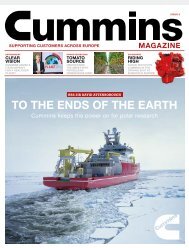

 Change language