


Transform your PDFs into Flipbooks and boost your revenue!
Leverage SEO-optimized Flipbooks, powerful backlinks, and multimedia content to professionally showcase your products and significantly increase your reach.
GOING<br />
AGAINST<br />
THE GRAIN<br />
By Gemma Gardner<br />
Confession: A salad bar made me<br />
cry on my first day of college.<br />
With a backpack full of<br />
textbooks, a U Card hanging<br />
from the lanyard around my neck and<br />
a newfound phobia of the Gopher Way<br />
tunnels, I had proudly conquered day<br />
one at the University of Minnesota. The<br />
adrenaline increasingly gave way to fatigue<br />
and hunger with each step I took toward<br />
Superblock. Knowing that I had little time<br />
before “hangry-ness” took over, it was<br />
time to face the most nerve-wracking part<br />
of my day:<br />
The dining hall.<br />
I have Celiac disease, which means that<br />
my body hates gluten, and very, very bad<br />
things happen if I eat even trace amounts<br />
of it. So, when I found myself standing in<br />
the eye of the hurricane that is the Pioneer<br />
dining hall at 5:30 p.m., anxiety consumed<br />
me. With each glance around the dining<br />
hall, the anxiety grew.<br />
Pastas, burgers, pizza — nope.<br />
French fries — fried in the same fryer<br />
as things with gluten — nope.<br />
Breaded chicken tenders — nope.<br />
Soup… with noodles. So close…<br />
Again, nope.<br />
Seeing that the options in the main areas<br />
were slim, I headed to the “allergy” station,<br />
which I had heard offered a gluten-free<br />
option for each meal. However, the option<br />
turned out to be a burger, and as I don’t eat<br />
red meat, I felt panic begin to rise in my<br />
chest. What was I going to eat?<br />
I spotted the salad bar close by and<br />
instinctively dashed its way. This was my<br />
last hope.<br />
However, that hope shattered — and<br />
so did I — when I saw that there were<br />
crouton crumbs all around the salad bar,<br />
making it too risky. Panic and frustration<br />
overwhelmed me as I crafted a game plan<br />
for finding dinner elsewhere, eventually<br />
deciding to pick up a frozen meal from<br />
the Walgreens by my dorm. The reality of<br />
my situation quickly sank: if I was already<br />
struggling to find options on the first day,<br />
what would the rest of the year be like?<br />
What is Celiac Disease?<br />
Celiac disease is far from the food<br />
intolerance many assume it to be. Rather,<br />
it’s an autoimmune condition that<br />
causes the lining of the small intestine<br />
to deteriorate after exposure to gluten,<br />
which is found in wheat, rye, barley and<br />
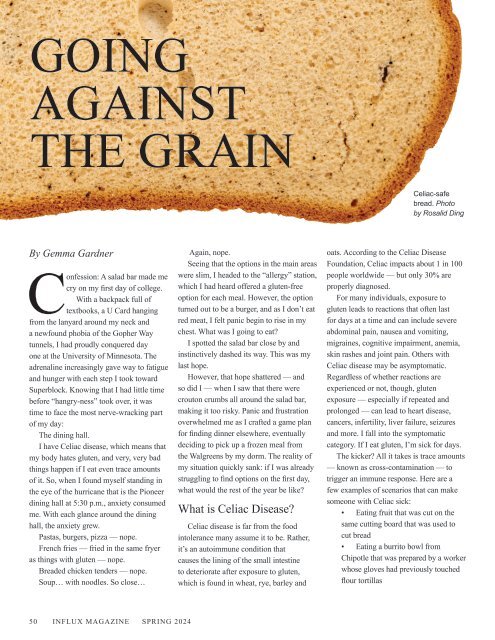
Celiac-safe<br />
bread. Photo<br />
by Rosalid Ding<br />
oats. According to the Celiac Disease<br />
Foundation, Celiac impacts about 1 in 100<br />
people worldwide — but only 30% are<br />
properly diagnosed.<br />
For many individuals, exposure to<br />
gluten leads to reactions that often last<br />
for days at a time and can include severe<br />
abdominal pain, nausea and vomiting,<br />
migraines, cognitive impairment, anemia,<br />
skin rashes and joint pain. Others with<br />
Celiac disease may be asymptomatic.<br />
Regardless of whether reactions are<br />
experienced or not, though, gluten<br />
exposure — especially if repeated and<br />
prolonged — can lead to heart disease,<br />
cancers, infertility, liver failure, seizures<br />
and more. I fall into the symptomatic<br />
category. If I eat gluten, I’m sick for days.<br />
The kicker? All it takes is trace amounts<br />
— known as cross-contamination — to<br />
trigger an immune response. Here are a<br />
few examples of scenarios that can make<br />
someone with Celiac sick:<br />
• Eating fruit that was cut on the<br />
same cutting board that was used to<br />
cut bread<br />
• Eating a burrito bowl from<br />
Chipotle that was prepared by a worker<br />
whose gloves had previously touched<br />
flour tortillas<br />
• Eating peanut butter from a<br />
jar that someone had previously dipped<br />
pretzels into<br />
Options are limited and expensive.<br />
Many people don’t understand how easy<br />
it is to cross-contaminate. Considering<br />
how little it takes to become sick, entering<br />
college as a student with Celiac and having<br />
to trust others to prepare your meals is<br />
terrifying.<br />
Eating at the Dining Halls<br />
Having had Celiac since I was 10 years<br />
old, and thus being very well-acquainted<br />
with the challenges of finding safe options<br />
outside of my own home, I knew that<br />
eating in a college dining hall would not be<br />
a walk in the park. However, I also knew<br />
that I wanted to have the experience of<br />
living in a dorm, and to do that, a meal plan<br />
was required. I decided to do everything I<br />
could to ensure that I’d be able to access<br />
gluten-free food while living in the dorms.<br />
So, before I came to college, I<br />
incessantly researched the dining system,<br />
sent copious emails to dining hall staff<br />
and read through all of the Reddit forums<br />
that I could find about the dining halls.<br />
I was reassured by the dining hall staff<br />
that their allergen-free station could<br />
guarantee gluten-free food without crosscontamination<br />
and that there could also<br />
be additional options without gluten in the<br />
general area of the dining hall, such as the<br />
Navigating life<br />
at UMN with<br />
Celiac Disease.<br />
salad bar. I felt confident that I’d be just<br />
fine — but I also brought a mini fridge and<br />
a microwave so I’d be able to store some<br />
emergency food, just in case.<br />
Unfortunately, my experience on the<br />
first day was not a fluke. In one instance,<br />
I was given regular bread in my meal,<br />
even though the station was supposed<br />
to be entirely separate from all glutencontaining<br />
ingredients. Another time, I was<br />
told that the allergen station “ran out of<br />
meals,” and I was handed a box of frozen<br />
gluten-free waffles for dinner. Despite<br />
my constant communication with the<br />
staff and management about the issues I<br />
was experiencing, I continued to be given<br />
incorrect meals and often left without food<br />
that I could eat.<br />
Thankfully, the dining system has<br />
changed management since my freshman<br />
year, and the new system appears to be much<br />
better at accommodating students’ allergies.<br />
Amy Hommes, a registered dietician at the<br />
University of Minnesota, explained that<br />
all of the University of Minnesota’s dining<br />
halls, with the exceptions of Comstock Hall<br />
and Bailey Hall, now provide stations with<br />
meals that are made to accommodate those<br />
with allergies to gluten, dairy, eggs, soy,<br />
peanuts, tree nuts, sesame and fish. In these<br />
stations, “everything is prepared separately<br />
with separate cutting boards, separate pans<br />
and separate utensils… and [they] train all of<br />
our staff on how to prevent cross-contact,”<br />
Hommes detailed.<br />
However, it’s important to note that,<br />
while the dining halls do provide a safe<br />
option for students with Celiac, there still<br />
isn’t much flexibility. Lyla Prass, a student<br />
with Celiac who had a meal plan in the<br />
dining halls last year, said she often felt<br />
frustrated by the lack of options offered.<br />
She explained how she doesn’t eat pork,<br />
so “when the meal was pork, [she] just<br />
couldn’t eat.”<br />
On-Campus Options<br />
Despite their limits, the dining halls still<br />
provide more options for us gluten-free<br />
folk than any other space on campus. “If<br />
there were any problems with the dining<br />
hall, there was nowhere else to go,” Prass<br />
said. While there are a few on-campus<br />
restaurants such as SweetGreen, JJ’s Poke<br />
and Nautical Bowls where Prass feels<br />
comfortable, she rarely eats elsewhere,<br />
given the risk of getting sick. On-campus<br />
food courts, such as the one in Coffman<br />
Memorial Union, also offer close to no safe<br />
options. Having experienced several<br />
Standard, wheat-grain bread. Photos by Rosalind Ding<br />
50 <strong>INFLUX</strong> MAGAZINE SPRING <strong>2024</strong> SPRING <strong>2024</strong> <strong>INFLUX</strong> MAGAZINE 51











 Change language