


Transform your PDFs into Flipbooks and boost your revenue!
Leverage SEO-optimized Flipbooks, powerful backlinks, and multimedia content to professionally showcase your products and significantly increase your reach.
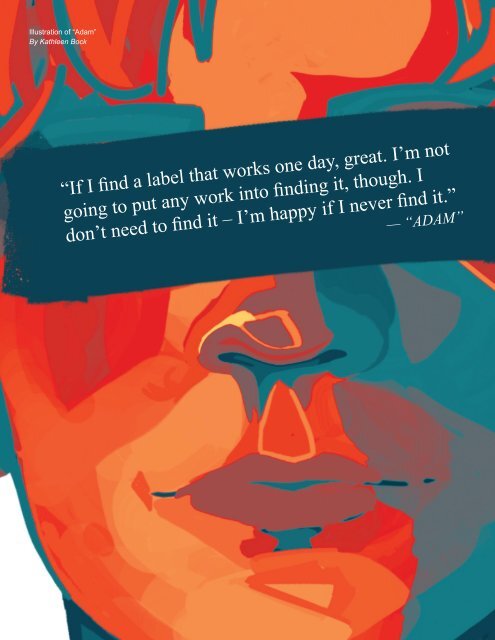
Illustration of “Adam”<br />
By Kathleen Bock<br />
“If I find a label that works one day, great. I’m not<br />
going to put any work into finding it, though. I<br />
don’t need to find it – I’m happy if I never find it.”<br />
— “ADAM”<br />
define ‘queer,’ you would probably get 100<br />
different definitions,” Adam said. “At a certain<br />
point, it stops being productive.”<br />
Experiences are blurrier than categorization<br />
Kat Rohn knew they were not cisgender<br />
around the age of 10 when the transgender<br />
movement of the ‘80s and ‘90s was filled with<br />
stories of people either living their lives in the<br />
closet or having to tear their lives apart in order<br />
to live as their authentic selves.<br />
Rohn wanted more out of their life.<br />
While they did not yet know exactly who<br />
they were, categories were a way for Rohn to<br />
reconcile with ideas they previously could not<br />
put into words — or at least better words than,<br />
“I just don’t feel right.”<br />
Categories can often go from a launching<br />
point for further exploration to a constraint for<br />
people figuring out who they are, Rohn said.<br />
Finding community meant finding freedom to<br />
explore your identity by seeing which pronouns,<br />
hairstyles or clothes felt the most affirming.<br />
However, even older generations of queer<br />
people tried to protect people from pushing the<br />
boundaries of acceptance too far.<br />
“When people initially grab on to a particular<br />
identity, it may not always stick,” Rohn said.<br />
“As we create more expansive categories, it<br />
allows people to ease into identities and make<br />
their own decisions about their lives in a way<br />
that reflects how people actually see themselves<br />
rather than trying to do XYZ because if I don’t,<br />
I won’t be validated, accepted or supported.”<br />
Rohn is now the executive director of<br />
OutFront Minnesota, the state’s largest<br />
LGBTQ+ advocacy group. As someone who<br />
came out three times — once to themselves,<br />
once to their partner and once publicly — Rohn<br />
said finding validation can help queer people<br />
overcome points of friction that many cisgender,<br />
straight people never have to think about.<br />
“It’s not about fitting into a particular box,”<br />
Rohn said. “But when you find your community<br />
and you find that sense of self, you’re able to<br />
move through the world with more confidence<br />
and support in who you are.”<br />
Rick Nelson found that support early in<br />
life. The first time Nelson showed any public<br />
affection with a man, he was sitting in the back<br />
row of a balcony inside the Uptown Theater<br />
with a jacket to cover him holding hands with<br />
his first boyfriend, Joe.<br />
As a student at the University of Minnesota<br />
in 1980, Nelson knew if anyone found out<br />
his sexuality, he would be shunned by all his<br />
brothers in his fraternity. But Nelson was a good<br />
liar. He had long since perfected presenting<br />
himself as straight, adjusting his walk and<br />
voice, and expending all his energy into being<br />
immersed in school activities to avoid bringing<br />
attention to his sexuality.<br />
On his first day working in a Dinkytown<br />
clothing store, Joe appeared in the empty store,<br />
where the two flirted until another customer<br />
came in. Joe slid his number to Nelson once the<br />
coast was clear.<br />
By the time Nelson completed graduate<br />
school, he had begun the process of coming out<br />
to friends and family. Unlike Joe, whose family<br />
cut him off after he came out, Nelson’s family<br />
was relieved he finally made public what they<br />
already suspected.<br />
“It was kind of weird, but it was telling<br />
people who I was and then walking through the<br />
world just assuming that everyone knew I was<br />
gay,” Nelson said. “I never really thought about<br />
it anymore. I was much more relaxed. I didn’t<br />
really give a shit what people thought of me<br />
after that… it was incredibly freeing. Highly<br />
recommend.”<br />
Nelson still faced discrimination: A co-worker<br />
asked if he was playing the Sugar Plum Fairy in<br />
a local Nutcracker production during a meeting;<br />
people doing double takes after Nelson said he<br />
had to drop something off to his partner. The<br />
final weight was lifted when he married his longtime<br />
partner, Robert.<br />
Now, 24 years into their relationship and<br />
11 years into their marriage, Nelson said<br />
nothing has curbed his anxiety like having the<br />
confirmation of sharing a life with the man he<br />
loves.<br />
“Put your true self out there to the world,”<br />
Nelson said. “Don’t put the idea of what you<br />
think the world wants you to be. Be yourself.<br />
It’s so much better than you can possibly<br />
imagine.”<br />
14 <strong>INFLUX</strong> MAGAZINE SPRING <strong>2024</strong> SPRING <strong>2024</strong> <strong>INFLUX</strong> MAGAZINE 15










 Change language